Schizophrenic Indian ‘Nazi’ Who Drove U-Haul into White House Sentenced to 8 Years in Prison

(Ken Silva, Headline USA) Sai Varshith Kandula, a schizophrenic non-citizen from India, was sentenced to 96 months imprisonment on Thursday for crashing a U-Haul truck into a security barrier across from the White House in 2023—a half-baked plan that the Justice Department and liberal media used to inflate the right-wing terror threat.

Judge Dabney L. Friedrich’s sentence for Kandula was the same punishment sought by the Justice Department’s prosecutors, who claimed that he was a serious neo-Nazi who threatened democracy. The harsh sentence also came despite the fact that Kandula was diagnosed with schizophrenia, and that his so-called terrorist plot was motivated by severe mental illness.

“Formally, his offense meets the requirements for application of the terrorism guideline,” the defense attorneys admitted last September, before arguing: “But in substance, he’s no terrorist.

“He’s a 20-year-old with a serious but treatable mental illness, and a sentence of 10-16 months time-served with GPS monitoring, mandated treatment and therapy, and a requirement to reside with his parents will satisfy that which the law requires: a sentence sufficient but not greater than necessary to comply with the purposes of sentencing,” the attorneys argued—unsuccessfully.

Kandula acted on his delusions in May 2023, driving a U-Haul into the protective posts that separate the White House grounds from the sidewalk. After that, he stepped outside with the Nazi flag that would be plastered across mainstream news outlets for the next several days. It appears as though someone besides Kandula unfurled the flag for the world to see, as pictures of his arrest still show the Nazi flag folded in half to obscure the swastika.

“He has no time to unfurl it. He lays it on the ground, along with the black bag, raises his hands over his head, and lies prostrate on the sidewalk. Two officers approach and grab his wrists. They pull his arms behind his back. Sai yelps. He says, ‘please, please don’t hurt me.’ An officer asks if he has any weapons. He says, ‘no,’” his defense attorneys recounted.

Despite the obvious half-baked nature of Kandula’s plans, the DOJ and mainstream media used his actions to generate anti-Trump and anti-right-wing propaganda.  Even after Kandula was formally diagnosed with schizophrenia earlier last year—as first reported by Headline USA—the DOJ repeated the claims that he was a serious Nazi who threatened democracy.

“Based on Defendant Sai Varshith Kandula’s stated aim to overthrow the democratically elected government of the United States, the aim to replace it with a dictatorship fueled by Nazi ideology, and his brazen attempt to gain access to the White House by crashing a large vehicle into the barriers protecting the White House, the government requests this Court sentence him to 96 months (eight years) of imprisonment,” prosecutors said in their Sept. 6 sentencing memorandum.

Kandula was also sentenced to 36 months of supervised release, restitution $56,727.00 and $100 special assessment. He’s expected to be deported upon his release.

Ken Silva is a staff writer at Headline USA. Follow him at x.com/jd_cashless.

Some Immigrants Are Already Leaving the U.S. in ‘Self-Deportations’

(Headline USA) Michel Bérrios left the United States a few days before the new year, giving President-elect Donald Trump’s campaign for mass deportations a small victory before they even started.

A former leader of a Nicaraguan student riot, Bérrios had been in the U.S. under President Joe Biden’s unprecedented open-border amnesty policies. But Trump’s harsh talk during the 2024 election about reasserting America’s sovereign right to enforce federal immigration laws filled her with anxious memories of hiding from authorities back home.

“I spent five years hiding. I had to change my routine. I had to completely change my life. I stopped visiting my parents, my friends,” Bérrios said of President Daniel Ortega’s crackdown on dissent.

With Trump returning to power, “that uncertainty has returned,” she added.

Open-border activists who have helped to facilitate the flood of state-sanctioned illegal immigration under Biden say a growing number of people to leave the U.S. before Trump takes office on Monday.

There isn’t data on these departures, but history has seen other eras of public backlash that drove out illegal immigrants.

Trump and his allies are counting on this “self-deportation,” the idea that by removing the incentives put in place under Democrat policies, many of those taking advantage of America’s hospitality will find it easier to leave on their own terms.

“Because [the U.S.] is not a Third World country like the ones many of us come from, I thought there would be a different culture here, and it was a rude awakening to realize that you and your family are not welcome,” Bérrios, 31, complained after realizing that the flood of millions of illegals from countries like her own who were unwilling to assimilate or contribute to the culture had effectively made it just like home.

Self-deportation helps Trump to achieve his goals without the government having to spend or do anything in such cases. Trump has long said he wanted to deport millions of illegals but never deported more than 350,000 a year in his first term. Only 41,500 detention beds are funded this year, so carrying out massive deportations has significant logistical hurdles.

“If you wanna self-deport, you should self-deport because, again, we know who you are, and we’re gonna come and find you,” Trump’s incoming border czar, Tom Homan, has said.

Bérrios had been living with her cousin in California, east of San Francisco, working at the front desk of an auto repair shop with Trump supporters, but she knew it was temporary—especially once Trump was elected.

About 1.5 million people who had temporary permission to live and work in the U.S. during Biden’s administration may see that status end soon said Melanie Nezer, vice president for advocacy and external relations at the Women’s Refugee Commission.

“Many, many people are in this situation,” she said. 

That includes those who have temporary protected status and others, like Bérrios, who received humanitarian asylum from four countries: Cuba, Haiti, Nicaragua and Venezuela.

Under Biden’s strategy to create legal pathways to those who cross the border illegally, asylum seekers from those countries can avoid the long lines at the southern border and apply online with a financial sponsor. They must fly to a U.S. airport at their expense.

About 100,000 Nicaraguans have come on two-year permits with eligibility to work since late 2022.

Bérrios arrived in 2023 as the U.S. election campaigns gained momentum. But talk of mass deportations eventually unnerved her. Returning to Nicaragua was not an option, so in December she settled on Ireland, where she had a couple of friends from the student movement.

“I felt like Ireland was a country of opportunity,” she said.

At Dublin’s airport, Bérrios handed her passport to an immigration official and said she was requesting humanitarian protection. She was quizzed on the name of Ireland’s president, answering correctly, and had her photo and fingerprints taken.

She got a government-issued identification card the next morning, valid for a year, and now shares a room with women from Somalia, Egypt and Pakistan in a hotel in a nearby town.

They are free to come and go as they please, and the government pays for her lodging.

Bérrios looks forward to enrolling in school while she waits for her work permit. An in-depth interview about her case should come in eight or nine months and a decision on her asylum request would follow.

If all goes well, she could receive permanent residency in as soon as a year, she said.

Bérrios was buoyant as she marveled at her journey with the self-deportation twist: “You make sacrifices and always hope that things will turn out like you think, maybe not exactly, but pretty close.”

Adapted from reporting by the Associated Press

Report: Head of Trump’s Security Detail Tapped as Next Secret Service Boss

(Ken Silva, Headline USA) Journalist Susan Crabtree reported Thursday that Secret Service special agent-in-charge Sean Curran, who was the head of Donald Trump’s security detail, has been appointed to lead his agency.

Curran was with Trump at Butler on July 13, and is pictured in the iconic photo of the President raising his fist in the air after he was shot. He will replace Secret Service Acting Director Ronald Rowe, who took over the ailing agency when Kimberly Cheatle disgraced herself by refusing to answer the most basic questions from Congress in the wake of the Trump shooting.

Rowe had been angling to stay on as director under Trump.  At the Sept. 11 ceremony in New York last year, Rowe stood near President Joe Biden, Trump and others at the ceremony—allegedly so that he could be seen on camera. Rep. Pat Fallon, R-Texas, accused Rowe of compromising security at the event as a result.

At a hearing last December, Fallon suggested that Rowe was standing where the special agent in-charge of the event’s security detail should have been standing.

“You wanted to be visible because you’re auditioning for this job!” Fallon yelled.

Rowe pushed back, yelling at him not to politicize the 9/11 attacks.

“I actually responded to Ground Zero,” Rowe said. “I was there going through the ashes at the World Trade Center … Show respect for our Secret Service members who died on 9/11!”

Rowe further claimed that his presence didn’t compromise Trump or Biden’s security.

Ken Silva is a staff writer at Headline USA. Follow him at x.com/jd_cashless.

New Fla. Senator Revealed as 2 Other GOP Lawmakers Weigh Gubernatorial Runs

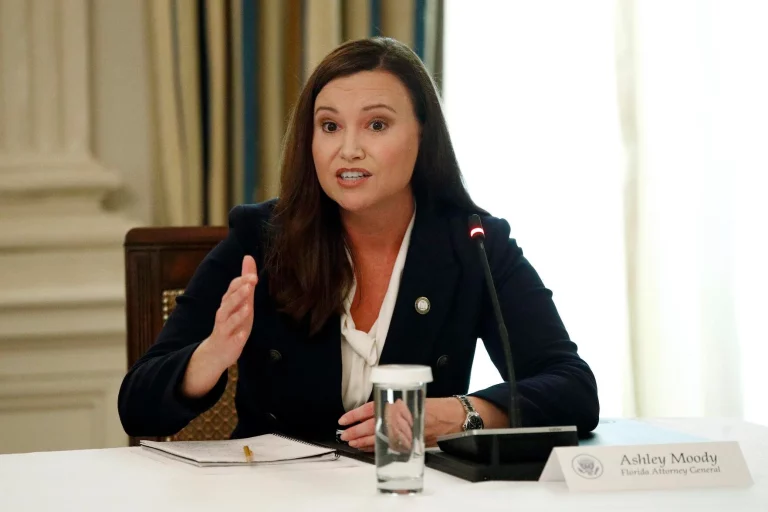
(Julianna Frieman, Headline USA) Gov. Ron DeSantis, R-Fla., announced Thursday that state Attorney General Ashley Moody would replace incoming Secretary of State-nominee Marco Rubio as Florida’s U.S. senator.

Rubio faced off with his Senate colleagues Wednesday in his confirmation hearing. He is set to resign as soon as he gets confirmed, which prompted DeSantis’s announcement at a news conference in Orlando just days before Trump’s inauguration on Monday.

As the next senator from Florida, Moody will “cut spending” and get behind Trump’s crackdown on illegal immigration, the governor said.

“Talk is cheap. We need people that have demonstrated fidelity to these principles with their actions,” DeSantis said of Moody, who led the investigation into the second Trump assassination attempt.

Moody served as the state’s attorney general since 2019.

She “has acted time and time again to support the values that we all share,” DeSantis said.

“Whether that’s illegal immigration, [the] opioid and fentanyl crisis, human trafficking,” he added. “She has stood strong time and time again, most recently in this past year, filing lawsuits and joining lawsuits to take on the weaponization of law enforcement that targeted then-candidate Donald Trump.”

Moody expressed gratitude to the governor by writing on social media.

“On DAY ONE, I stand ready to fight for Florida, support the President’s agenda, and vote for @realDonaldTrump’s Cabinet appointees,” she wrote.


DeSantis is set to leave his role as Florida governor in 2026 due to term limits. Rep. Byron Donalds, R-Fla., has reportedly told potential donors and political players in the state that he intends to run for governor to succeed DeSantis, according to NBC News.

Donalds “was in town [Tallahassee] meeting with all the folks you need to meet with,” a source who met with the conservative lawmaker told the outlet. “He told them he is in. It’s the steps any candidate takes as they prepare to run for governor.”

Donalds responded to NBC News with the following comment: “I’m fully focused on helping President Trump pass his America First Agenda. Florida will proudly lead the way.”

Another GOP lawmaker reportedly planning a gubernatorial run is Sen. Marsha Blackburn, R-Tenn., according to Axios. Blackburn reportedly intends to be Tennessee’s first female governor come 2026, and sources told the outlet she has already made calls and told people about the matter.

Julianna Frieman is a freelance writer published by the Daily Caller, Headline USA, The Federalist, and the American Spectator. Follow her on Twitter at @JuliannaFrieman.

Coyote Strike on Runway Forces United Airlines Flight Back to Chicago’s O’Hare

0

(Headline USA) A United Airlines passenger jet struck a coyote on the runway during takeoff in Chicago, forcing the flight to return to O’Hare International Airport to have the landing gear examined.

None of the 167 passengers or six crew members aboard the Boeing 737 MAX 9 were injured in the incident on Sunday, which forced the Phoenix-bound United Flight 1727 to make a swift return, the airline said Thursday in an email.

“We arranged for another plane to take our customers to their destination later that afternoon,” the airline said.

The Federal Aviation Administration is investigating, saying Thursday that the crew initially reported that the plane had struck a bird.

Collisions between aircraft and wildlife are a growing concern for aviation safety, according to the FAA.

The FAA said that between 1988 and 2023 wildlife strikes with civilian and military aircraft killed more than 491 people and destroyed more than 350 aircraft across the globe. In the United States, wildlife strikes with civilian and military aircraft killed 76 people and destroyed 126 aircraft between 1988-2023.

Most collisions involve birds, but between 1990-2023 there were 882 reported civilian aircraft strikes with coyotes and 1,301 with white-tailed deer in the U.S., according to the FAA.

Coyotes are finding a niche in many urban and suburban communities across the U.S. On Monday, a coyote was found inside a Chicago grocery store before it was captured and removed by authorities.

In 2020, two people—included a 6-year-old boy—were reportedly attacked by a coyote or coyotes in the city’s downtown area. A coyote sighting also prompted the lockdown of two schools in the city’s Lincoln Park neighborhood.

Coyotes are particularly active January through March, the animals’ mating season, officials have said.

Adapted from reporting by the Associated Press

Dozens of Armed LA Fire Survivors are Defending Homes in Face of Gov’t Tyranny

(Ken Silva, Headline USA) The Wall Street Journal published a story this week about the extraordinary courage displayed by dozens of Los Angeles residents who’ve banded together to protect their homes in the face of tyrannical government restrictions.

Describing a dismal scene of ashen streets, downed power lines and no clean drinking water, the Journal reported Tuesday that 80 residents in Altadena have defied orders to evacuate

“Residents patrol streets and interrogate strangers … They are hemmed in by yellow caution tape at neighborhood entrances flanked by National Guard troops, Los Angeles County Sheriff deputies and California Highway Patrol officers,” the Journal wrote.

“We do feel like we’re in the Wild West,” said Aaron Lubeley, a 53-year-old lawyer who is one of the holdouts and “serves as an unofficial emissary with police and fire representatives,” according to the Journal.

The newspaper reported that Lubeley has stayed over the past eight days to stop fires springing from buried embers.

According to the Journal, the holdouts might not be able to return if they leave. Unfortunately for them, it’s becoming increasingly difficult to stay due to government restrictions.

“In the first few days after the fire, Altadena neighbors said, sympathetic law-enforcement officers looked the other way as Lubeley and other holdouts slipped through checkpoints to buy supplies at Costco and Home Depot. After restrictions were tightened, Lubeley turned to family, friends and acquaintances,” the Journal wrote.

“Monday was the third time that volunteers came to checkpoints, like smugglers, to deliver supplies. It might be the last trip. Officers told Lubeley the supply drop-off would no longer be allowed,” the newspaper said.

“That night, Lubeley and others gathered before the mandatory 6 p.m. curfew to figure out ways around the new rules. Some law-enforcement personnel brought them sandwiches.”

The Journal also reported that police initially blocked a private water truck that Gerber and his neighbors tried bringing in. “So we called somebody who was very important who called Gavin Newsom and told him to let our water truck into our neighborhood,” Gerber reportedly said.

Newsom’s office reportedly didn’t respond to a request for comment. The Journal concluded its article by reporting that the neighborhood plans on having its own “fire-like militia” once it recovers.

Ken Silva is a staff writer at Headline USA. Follow him at x.com/jd_cashless.
Portland May Cut ‘Equity’ Jobs Due to Budget Problems

(Matt Lamb, Headline USA) A top official in Portland said the Oregon city may need to cut “equity” roles due to a pending budget deficit.

The city is forecasting a $27 million budget shortfall starting in the new fiscal year, according to its official website.

This has led city administrator Michael Jordan to warn of cuts to “equity” jobs. That spells trouble for three new officer positions focused on “equity, communications, and engagement,” according to the Willamette Week.

“As we proceed through the assessment process, it is possible that there will be cuts,” Jordan told the local news outlet. Other cuts include communications and engagement budgets.

The city has regularly hired for DEI roles with nice salaries. For example, the Parks and Recreation Department advertised an “equity and inclusion coordinator” job that topped out at a $104,000-per-year salary. The job would research “racial equity and inclusion best practices” and provide advice to the bureau on “racial equity assessment tools.”

This job should not be confused with a 2023 posting for an “equity and engagement planner” job in the bureau of planning and sustainability.

That analyst position, with pay reaching nearly $150,000 annually, required a “subject matter expert on equity, diversity, and inclusion” who could implement “equity frameworks.”

The hire would also conduct “racial equity” studies on “land use, climate justice, waste systems and community technology.”

The Office of Equity and Human Rights is overseen by the city administrator.

The city leans heavily into LGBT issues as well. The equity office publishes an “LGBTQIA2S+ Policy,” noting that 11% of city workers identified as being on the sexually divergent spectrum, and 15% did not select male or female when asked for their sex.

The policy program “approaches LGBTQIA2S+ equity work with an intersectional lens, centering the most marginalized demographics within the community.”

Portland is now led by Mayor Keith Wilson. For years, Ted Wheeler ran the city, largely letting homelessness run rampant and overseeing violent crime from domestic terror group Antifa.

He also used pepper spray on his own citizen, whom he accused of harassing him in 2021 for not wearing a mask while inside.

“I clearly informed him that he needed to back off,” Wheeler told police.

“He did not do so … I pulled out my pepper spray and I sprayed him in the eyes,” Wheeler continued. “He seemed surprised, and backed off. He made a comment like, ‘I can’t believe you just pepper-sprayed me.’”

However, Wheeler previously prohibited police from using tear gas during the city’s riots in 2020.

Treasury Pick Scott Bessent at Senate Hearing: Trump Can Unleash ‘Economic Golden Age’

(Headline USA) Treasury Secretary-nominee Scott Bessent told his confirmation hearing Thursday that President-elect Donald Trump has an opportunity to unleash “a new economic golden age.”

In testimony, Bessent said the U.S. must secure vulnerable supply chains, levy sanctions to address national security concerns “and critically, we must ensure that the U.S. dollar remains the world’s reserve currency.”

Lawmakers on Capitol Hill are questioning Bessent’s stance on taxes, tariffs, trade and other issues during his confirmation hearing before the Senate Finance Committee.

Trump’s choice for Treasury secretary is a South Carolina billionaire who, before becoming a Trump donor and adviser, donated to various Democratic causes in the early 2000s, notably Al Gore’s presidential run.

He also worked as a top investment assistent of globalist oligarch George Soros.

Trump took his time before settling on Bessent as his nominee. He also mulled over billionaire investor John Paulson and Howard Lutnick, whom Trump tapped as his nominee for commerce secretary.

The Treasury secretary is responsible for serving as the president’s fiscal policy adviser and managing the public debt. He would also be a member of the president’s National Economic Council.

If confirmed, Bessent will oversee massive agencies within the Treasury Department, including the Internal Revenue Service. The IRS received a massive boost in funding from Democrats’ Inflation Reduction Act, though that money has been in constant threat of being cut.

Trump expects Bessent to help reset the global trade order, enable trillions of dollars in tax cuts, ensure inflation stays in check, manage a ballooning national debt and still keep the financial markets confident.

“Productive investment that grows the economy must be prioritized over wasteful spending that drives inflation,” Bessent testified.

Senators were expected to question the money manager for hours on his views on cryptocurrency, the Trump-era tax cuts and potential conflicts of interest.

Sen. Elizabeth Warren, D-Mass., a member of the finance committee, sent Bessent more than 100 written questions in advance, interrogating him on such topics as agency independence, housing, treasury workforce issues and financial stability oversight.

In addition, Democrats on the Senate Finance Committee are circulating a document that alleges Bessent has avoided paying roughly $1 million in taxes related to his hedge fund. He will be asked about this during his hearing.

Bessent has backed extending provisions of the 2017 Tax Cuts and Jobs Act, which Trump signed into law in his first year in office. Estimates from various economic analyses of the costs of the various tax cuts range from nearly $6 trillion to $10 trillion over 10 years.

He calls for spending cuts and shifts in existing taxes to offset the costs that extending the tax cuts would add to the federal deficit.

Adapted from reporting by the Associated Press

Trumps Taps Ex-Democrat to Draft Executive Order Ending Offshore Wind Farms

(Headline USA) President-elect Donald Trump tasked a New Jersey congressman and vocal critic of offshore wind with writing an executive order he could issue to halt wind energy projects.

Offshore wind is a major part of transitioning to an electric grid powered entirely by sources that don’t emit carbon dioxide when generating electricity. The power sector is responsible for nearly a third of the nation’s planet-warming greenhouse gas emissions.

On the campaign trail, Trump vowed to end the offshore wind industry as soon as he returned to the White House. He wants to boost production of fossil fuels such as oil, natural gas and coal in order to restore U.S. energy independence and economic prosperity.

The draconian energy restrictions imposed by the Biden administration are presumed to have played a key role in the inflationary economy that began shortly after the Democrat president took office and has been difficult to rein in ever since.

Rep. Jeff Van Drew, R-N.J., said he spoke with Trump by phone about a month ago and urged him to act on his campaign promise.

“I said ‘Mr. President, we need to move on this,’” Van Drew said.

Trump agreed, instructing the lawmaker—who switched from Democrat to Republican in protest of House Democrats’ dubious 2019 impeachment oft the GOP leader—to “Write an executive order, get it to my people.”

Van Drew told the Associated Press Wednesday night that he quickly emailed a draft order to former North Dakota Gov. Doug Burgum, Trump’s pick to be interior secretary.

Van Drew said the draft is written to halt offshore wind development from Rhode Island to Virginia for six months so the incoming interior secretary could review how leases and permits were issued.

Van Drew said he believes the approvals did not fully take into account the impact on the fishing industry, tourism, whales or Americans’ utility bills, and it’s problematic to rely on foreign renewable energy companies building the wind farms.

The Interior Department includes the agency responsible for offshore renewable energy development in federal waters, the Bureau of Ocean Energy Management. Burgum appeared before a Senate committee Thursday for a confirmation hearing.

Sen. Angus King, I-Maine, said at the hearing Burgum knows the benefits of wind power since he’s from North Dakota, which gets more than one-third of its electricity from onshore wind turbines.

He asked Burgum to convince Trump wind power “isn’t all bad.”

Burgum said the electric grid needs more resources that provide power continuously, as opposed to “intermittent” sources such as solar and wind that fluctuate.

King then asked if Burgum would commit to continuing with offshore wind leases that have been issued.

“I’m not familiar with every project that the interior has underway, but I’ll certainly be taking a look at all of those,” Burgum said.

“If makes it makes sense and they’re already in law, then they’ll continue,” he added. “I think the key is—and I think President Trump’s been very clear in his statements—that he’s concerned about the significant amount of tax incentives that have gone toward some forms of energy.”

Van Drew declined to show the AP the order, saying he doesn’t expect Trump to use his draft verbatim, it’s a template. He expects Trump to issue an offshore wind executive order within the first quarter of the year, possibly as early as his first day on the job. Van Drew said he views that as a first step toward an eventual moratorium on offshore wind development.

Trump says wind turbines are horrible and expensive, citing recent reports that have linked them to an uptick in beached whales on the New England coastline.

Trump’s team responded to a request for comment Thursday by sharing the transcript from Trump’s Mar-a-Lago press conference this month. He said he would seek to have a “policy where no windmills are being built.”

The Biden administration worked to propel the nascent U.S. offshore wind industry forward to address climate change as an existential threat. It set targets to deploy 30 gigawatts of offshore wind energy by 2030, generating enough electricity to power more than 10 million homes, and up to 15 gigawatts of electricity through floating sites by 2035, enough to power 5 million homes.

The nation’s first commercial-scale offshore wind farm opened in March, a 12-turbine wind farm called South Fork Wind 35 miles east of Montauk Point, New York.

The Bureau of Ocean Energy Management held first-ever lease sales off the West Coast and the Gulf of Mexico, and the first commercial sale for floating offshore wind on the Atlantic coast. It approved the nation’s 11th commercial-scale offshore wind energy project in December. Combined, the 11 projects total over 19 gigawatts of clean energy, enough to power more than 6 million homes.

Adapted from reporting by the Associated Press

Federal Budget Deficit up Nearly 40 Percent Through First Quarter of Fiscal 2025

(Mike Maharrey, Money Metals News Service) The budget deficit continues to balloon, with the Q1 2025 budget shortfall running 39.4 percent higher than the same period in fiscal 2024.

The Biden administration ran an $86.7 billion budget deficit in December, according to the latest Monthy Treasury Report. That pushed the first-quarter budget shortfall to $710.94 billion.

Federal tax receipts were down around 2.2 percent through the first three months of fiscal 2025. (The fiscal year begins Oct. 1.) This was primarily due to weak revenues in October. November and December receipts were higher than last year.

Overall, federal receipts have been rising over the last 18 months. The real problem is on the spending side of the ledger.

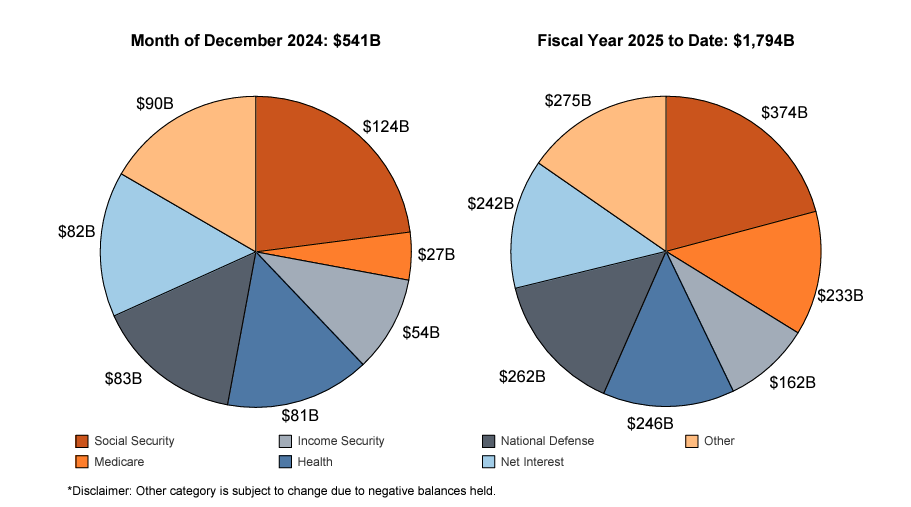
The Biden administration blew through $541.15 billion in December, pushing first-quarter spending to $1.79 trillion. Federal outlays were 10.9 percent higher in the first quarter of the fiscal year compared to the same period in 2024.

You might recall that President Biden promised that the [pretend] spending cuts would save “hundreds of billions” with the debt ceiling deal (aka the [misnamed] Fiscal Responsibility Act).

That never happened.

The federal government continues to find new reasons to spend money, whether for natural disasters at home or wars overseas. The Biden administration spent a staggering $6.75 trillion in fiscal 2024, a 10 percent increase over 2023 outlays.

The government spent $308.4 billion for interest on the national debt through the first three months of fiscal 2025, a 7 percent increase over the same period last year.

The federal government spent more on interest on the debt than it did on national defense ($262 billion) or Medicare ($233 billion) in Q1. The only higher spending category was Social Security.

Uncle Sam paid $1.13 trillion in interest expense in fiscal 2023. It was the first time interest expense has ever eclipsed $1 trillion. Projections are for interest expense to break that record in fiscal 2025.

Much of the debt currently on the books was financed at very low rates before the Federal Reserve started its hiking cycle. Every month, some of that super-low-yielding paper matures and has to be replaced by bonds yielding much higher rates. And even with the recent Federal Reserve rate cuts, Treasury yields are pushing upward as demand for U.S. debt sags.

So What?

These big deficits pile onto a national debt that officially topped $36 trillion last month.

Some people claim borrowing, spending, and big national debts don’t matter.

They do.

According to the national debt clock, the current debt level represents 122.84 percent of GDP. Studies have shown a debt-to-GDP ratio of over 90 percent retards economic growth by about 30 percent.

And as the Bipartisan Policy Center points out, the growing national debt and the mounting fiscal irresponsibility undermine the dollar.

“Confidence in U.S. creditworthiness may be undermined by a rapidly deteriorating fiscal situation, an increasing concern with federal debt set to grow substantially in the coming years.”

This could lead to lower economic growth, higher unemployment, and less investment wealth.

Lack of confidence in the U.S. fiscal situation could also lower demand for U.S. debt. This would force interest rates on U.S. Treasuries even higher to attract investors, exacerbating the interest payment problem. As already mentioned, we’ve seen a big spike in Treasury yields despite Fed rate cuts.

Biden has run the debt higher at a dizzying pace, but to be fair, this isn’t just a Biden problem. Every president since Calvin Coolidge has left the U.S. with a bigger national debt than when he took office.

The debt will likely be one of the biggest problems facing President Trump as he takes the reins of power. With Republicans controlling both chambers of Congress and the White House, there is an opportunity to tackle the spending problem, but whether the GOP has the political will to make substantial cuts remains to be seen.

Trump has at least talked about slashing the size of government, but he’s going to need to do better than he did during his first term.

The Trump administration almost hit the $1 trillion mark in 2019 and was on pace to run a trillion-dollar deficit in fiscal 2020 before the pandemic, even as the U.S. supposedly enjoyed the “best economy” ever. The economic catastrophe caused by the government’s response to COVID-19 gave policymakers an excuse to spend with no questions asked, and we saw record deficits in fiscal 2020 and 2021.

Even if the Trump administration manages to slash discretionary spending as promised, that only accounts for 27 percent of total spending. The vast majority is for entitlements, and there is little political will to take the scissors to Social Security or Medicare.

And the sad fact is most people in positions of power are content to kick the debt can down the road. They reason, ‘Nothing has happened yet, so why worry?’ But the problem with playing kick the can down the road is you eventually run out of road.