Americans Admit Skipping ‘Terms of Service,’ Raising Privacy Concerns

(Shirleen Guerra, The Center Square) One-third of Americans have admitted to skipping reading “terms of service agreements” when using apps and other online services, leading to broader concerns over data privacy and user awareness.

This trend is seen in a survey by NordVPN showing that American respondents scored 63% on the national privacy test, which measures digital habits, digital privacy awareness, and digital risk tolerance.

“While online debates about what holds greater value–data, oil, or land–continue, the answer is clear in the cybersecurity field: data,” Adrianus Warmenhoven, a cybersecurity expert at NordVPN, said.

“Unlike physical assets, personal data can be copied, stolen, damaged, or sold without leaving any visible traces, posing serious financial and reputational risks. And apps are often the main channel through which this sensitive personal information is lost, due to unnoticed permissions, missed updates, malicious software, and unauthorized data sharing,” continued Warmenhoven.

The terms and service agreements generally appear before users gain access to various apps and are designed to inform users about how their data will be collected, used and shared.

The survey stated that while Americans have the best “digital risk tolerance,” they may need to be “more mindful of sharing their data with apps via permissions.” According to the results, Americans share more information than necessary.

According to data from the National Privacy Test, 27% of Americans paid no attention to apps’ privacy policies in 2024, which is the very agreement that outlines how apps like TikTok can collect and use data.

The lack of awareness only feeds into the larger discussion over the risks associated with sharing personal data, especially with apps that are tied to foreign governments.

The issue continues to gain attention nationwide in light of the recent TikTok ban in the United States.

The U.S. government argues that the platform’s Chinese parent company, ByteDance, could be forced to share user data with the Chinese government, posing national security risks.

These concerns led to the U.S. Supreme Court upholding a federal law banning the platform unless sold. Although the app was granted a 75-day reprieve from the president’s executive order, the highlighted risks remain.

The Federal Trade Commission is tasked with consumer privacy and data security across several industries and allocates a portion of its annual budget to enforcement and education over data privacy.

According to documents, the FTC requested a 20% increase for its 2025 budget, bringing the requested total to $535 million and 1,443 full-time equivalent positions.

Ten of those positions are in the Bureau of Consumer Protection, which supports the “increasingly complex consumer protection investigations, including privacy and data security issues.”

‘Top Doctor’ Sister of Biden Press Sec Tickles Fears of Trump-Induced Pandemic

(Julianna Frieman, Headline USA) Stephanie Psaki, the so-called “doctor” sister of Biden-era White House Press Secretary Jen Psaki, tickled fears that President Donald Trump could allow a deadly disease to enter the U.S.

After Trump acted immediately to ensure global bodies like the World Health Organization could never let another COVID-19 disaster infringe on American freedoms again, “circle back” Psaki’s sister warned in an article for STAT News that the U.S. could be more vulnerable to “unknown pathogens” like the Marburg virus disease.

“As I’ve watched the Trump administration announce a series of actions that undermine our ability to detect and respond to biological threats, including stopping CDC staff from communicating or traveling and sending National Security Council staff home indefinitely, I wonder: Who is protecting the American people from Marburg right now?” Stephanie Psaki, who has a PhD in demography and an M.S. in global health, wrote.

Marburg virus disease symptoms include fever, headache and malaise, according to the WHO.

The Ebola-like illness spreads from human-to-human contact and later symptoms include watery diarrhea, abdominal pain, nausea and vomiting.

There is currently an outbreak of Marburg in Tanzania, according to the Centers for Disease Control and Prevention.

Stephanie Psaki, who worked for Biden as his senior advisor on Human Rights and Gender Equity in the Office of Global Affairs, said “now is not the time to demolish our well-oiled and efficient machine” and called for the U.S. government maintain its involvement with the WHO and other global health agencies. She called Trump’s post-COVID executive orders “irresponsible and dangerous.”

“These outbreak responses are hard enough to get right when you have the support of political leadership to act quickly,” she wrote. “There are plenty of experienced civil servants who know how to contain this outbreak, but if their ability to take quick decisive action is hampered even for a few days the window for quick action might close.”

Julianna Frieman is a freelance writer published by Headline USA, the Daily Caller, The Federalist, and the American Spectator. Follow her on Twitter at @JuliannaFrieman.

Ex-Daily Wire Host Makes Comeback after CEO Throws Shade

(Julianna Frieman, Headline USA) Former Daily Wire host Brett Cooper marked the beginning of her online comeback Monday after CEO Jeremy Boreing threw shade at his ex-employee.

Cooper announced her departure as host of The Comments Section on Dec. 10, 2024, only to be abruptly replaced by her former producer, friend and bridesmaid, Reagan Conrad.

Rumors of Cooper’s exit started before she released her video revealing what she claimed was her own decision, and many fans suggested she was forced out.

Boreing addressed Cooper’s exit during a live question-and-answer session for all-access subscribers on the Daily Wire app. He pushed back against rumors that Conrad received acting lessons to mimic Cooper’s behavior, calling the claim “absolutely absurd and deeply offensive.”

“I’ve never asked her to do anything to be more like Brett,” the Daily Wire CEO said before descending into a passive aggressive comment about dancing and singing lessons given to Cooper. “It’s actually ironic because I did send Brett to various kinds of lessons as a performer.”

After abandoning The Comments Section, which she built since March 2022 to strong base of 4 million subscribers, Cooper launched her own YouTube channel.

It has since accumulated more than 660,000 subscribers.

She posted her first independent video on Monday, a trailer for The Brett Cooper Show.

The video started with a montage of Internet personalities speculating about Cooper’s whereabouts before cinematic footage shows the popular 23-year-old host prepare to step back behind the microphone.

“I’m ready,” Cooper said. These were her only words spoken in the trailer of her new show, which is set to release its first episode on Thursday.

“We’re so back,” Cooper wrote on X with a link to the video. Her fans expressed their excitement in the comments and congratulated the Gen Z commentator.

Cooper appears to be following in the footsteps of friend and fellow ex-Daily Wire host Candace Owens, who launched her own YouTube channel podcast after parting ways with the company March 2024.

Owens promoted Cooper’s new series on her own X account and called the trailer’s cinematography “really beautiful.” She said she was “excited for Thursday.”

Julianna Frieman is a freelance writer published by the Daily Caller, Headline USA, The Federalist, and the American Spectator. Follow her on Twitter at @JuliannaFrieman.

Selena Gomez Sobs Hysterically, Says ‘All My People Are Getting Attacked’ as Trump Takes On Illegal Migrants

(Julianna Frieman, Headline USA) Selena Gomez, who recently starred in a film about a transgender cartel boss, led the charge of leftist meltdowns Monday as she cried to her millions of social media followers about President Donald Trump’s mass deportations.

Since-deleted video showed Gomez, 32, sobbing hysterically as she tells the viewer “all my people are getting attacked” as a result of the Trump administration’s removal of illegal migrants from the U.S.

The former Disney Channel star did not stop to acknowledge the illegal alien status of those deported. She opted instead to peddle an emotionally-charged leftist talking point in the form of a celebrity meltdown.

“I’m so sorry. All my people are getting attacked, the children. I don’t understand. I wish I could do something but I can’t,” Gomez moaned through tears. “I don’t know what to do. I’ll try everything, I promise.”

Despite Gomez’s promise, she did not elaborate on her plans to take on the Republican president’s policy.

Gomez could start by adopting the “mi casa es su casa” mindset and housing illegal migrants in her California mansion, but she stopped short of offering to take any illegal migrants in the building.

Trump’s border czar, Tom Homan, reacted to Gomez’s tear-filled freakout Monday afternoon on Fox News. He told her to lobby Congress to change the law, but until then, the Trump administration must act “without apology” to “make our community safer.”

“It’s all for the good of the nation. And we’re going to keep going. No apologies. We’re moving forward,” Homan said.

Sen. Ted Cruz, R-Texas, asked on social media why the Only Murders in the Building star did not shed a tear for Laken Riley or Rachel Morin, both victims of migrant crime.

“Why does Hollywood only cry for murderers & rapists & gang-bangers?” Cruz wrote on X.

Social media users panned the Wizards of Waverley Place alum’s waterworks as “pathetic” and “stupid.”

Various commentators including Dinesh D’Souza, Riley Gaines and Charlie Kirk asked why Gomez did not shed a tear when thousands of children were trafficked across the border under the Biden administration.

Candace Owens called Gomez’s border-bound breakdown “objectively hilarious,” to which Brett Cooper asked the following: “is she going to take an IG break after this?”

Gomez quickly became aware of the backlash and deleted her Instagram Story video. She wrote in a new post, “Apparently it’s not ok to show empathy for people.”

Julianna Frieman is a freelance writer published by the Daily Caller, Headline USA, The Federalist, and the American Spectator. Follow her on Twitter at @JuliannaFrieman.

Markets Get Deep Sixed By DeepSeek

(Brien Lundin, Money Metals News Service) Market mayhem just ensued as China unveils a cheaper, better AI. As much as market experts and pundits plan and predict, it seems that the big developments come out of left field.

And you can’t get more out of left field than the big shocker that emerged over the weekend:

Researchers at Chinese AI company DeepSeek launched its AI program, dubbed R1, which it claimed performs as well as the West’s most advanced — and expensive — AI agents.

Those other AI efforts, notably OpenAI’s models, are famous for needing the most advanced chips from Nvidia, which has driven the rocket-shot performance of that stock along with other AI-oriented plays.

Naturally, DeepSeek’s claims that their model could perform just as well for a small fraction of the cost, and do so with off-the-shelf gaming chips, were met with some skepticism.

But as experts ran through the system over the weekend, those claims were more than vindicated. Some interactions with the AI that I’ve seen are actually frightening.

So as this new reality emerged over the weekend, it was widely expected that today’s trading sessions in stocks and other risk assets would be a bloodbath. And that’s just what emerged, with all the major stock indices falling at the open.

Of course, most of the damage was within the tech-heavy Nasdaq, and as I write the Dow is actually trading back in the green. The Nasdaq is off about 3.5% while Nvidia has shed about 17% of its market value.

Gold has had an interesting session so far. After beginning the day only off about $8, it began selling off more and more, apparently on margin-call-related selling. It now stands down about $36, while silver has shed 55¢.

The Big Picture For Gold Is Better Than Ever

Again, today’s selling in gold and silver seems to reflect a rush for liquidity to meet margin calls in other investments.

This sort of market action typically passes quickly, and in fact, gold’s longer-term technical picture just got much better.

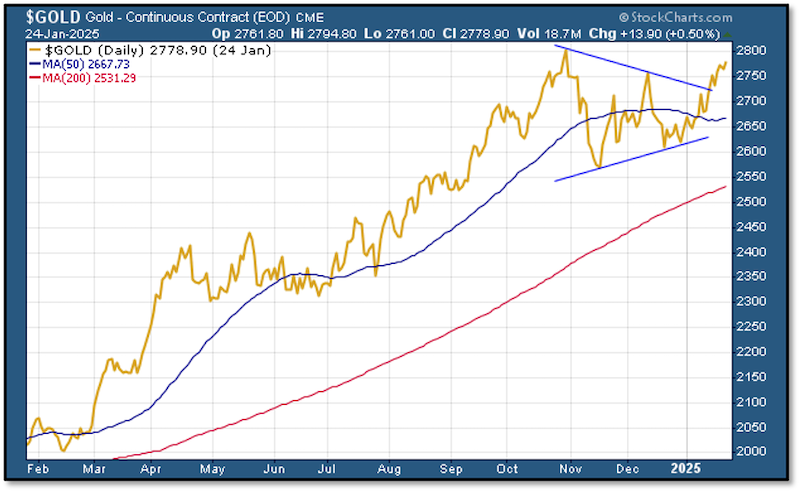
Consider this chart:

Note how gold has been struggling to recover from its big election correction, trading in a range and tracing out a classic flag or pennant formation.

And now see how the price trend has dramatically broken out of that flag pattern as the price was once again challenging $2,800 and a record high…before today’s setback.

For my part, I’m betting on the big picture. This year will bring more surprising developments in the markets and the economy, and gold is the only asset that stands to benefit from virtually anything that happens.

If you’re a serious investor, you need to be positioned in the metals as wealth insurance, and high-powered junior mining stocks as investments.


Brien Lundin is the publisher and editor of Gold Newsletter, the publication that has been the cornerstone of precious metals advisories since 1971.  Mr. Lundin covers not only resource stocks but also the entire world of investing. He also hosts the annual New Orleans Investment Conference. To get Brien Lundin’s ongoing commentary on the markets at no charge, click here to subscribe to his free Golden Opportunities newsletter.

SCOOP: China Continues Making Covert Gold Purchases in London

(Jan Nieuwenhuijs, Money Metals News Service) While the gold space has been obsessed over the gold streaming from London to New York in reaction to President Donald J. Trump’s tariff threats, even as it had little effect on price, the bigger story is that the People’s Bank of China (PBoC) is quietly stockpiling gold at a frenetic rate.

Direct gold exports from the U.K. to China—a proxy for PBoC purchases—remained impressively strong in November at 50 tonnes. As the Chinese central bank (PBoC) in 2024 has secretly bought approximately 600 tonnes with $50 billion U.S. dollars, it’s confident about where the dollar price of gold is going: UP.

An Exceptional Bull Case for Gold

Since February 2023, I have been publishing evidence of the PBoC buying significantly more gold than what it reports to the IMF. These purchases have broken the West’s dominance in the market by driving the price higher (see here and here).

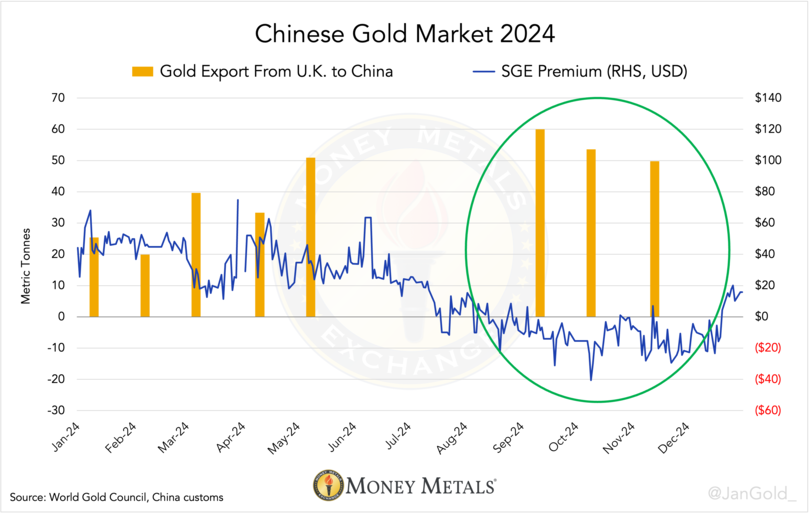
I found the smoking gun of the PBoC’s secret gold operations in November 2024. As private demand in China declined and premiums on the Shanghai Gold Exchange (SGE) turned negative in September, Chinese imports remained robust.

For those with knowledge of the Chinese market, there can only be one explanation for stout inflows when SGE gold is trading at a discount: the central bank is bringing in gold. It also fits hand in glove with the other evidence.

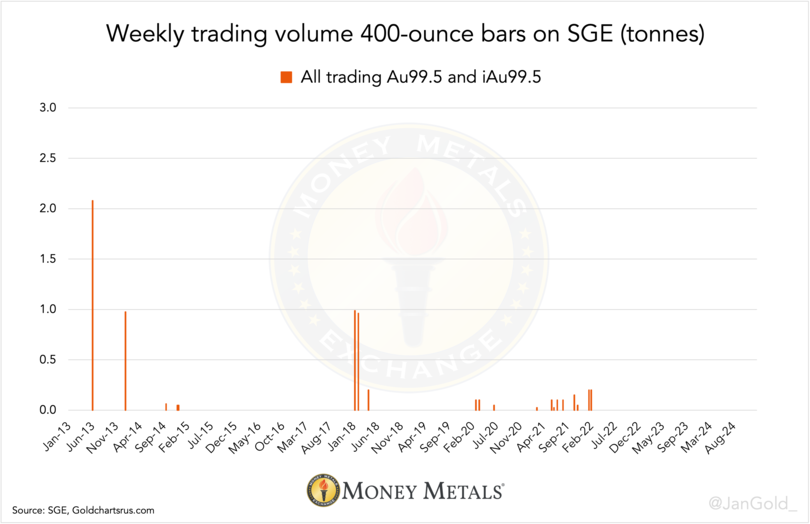
There can be no reasonable doubt that export of large 400-ounce gold bars from the London OTC market to China reflect PBoC purchases. 400-ounce bars aren’t even traded over the Chinese central bourse (SGE).

Chart 1. Virtually zero large bars have ever traded over the SGE.

Chart 1. Virtually zero large bars have ever traded over the SGE.

After I published these revelations, Goldman Sachs replicated my work for themselves, which in time will help bring this story to a wider audience. Western institutional investors have already spotted this trend in 2024 and joined the bull market.

Before long, this will go mainstream and gold could more than double in price this decade.

How Much Gold Did the PBoC Buy in November?

In my last article, I wrote:

The PBoC’s “unreported” purchases in London accounted for a stunning 60 tonnes in September and another 55 tonnes in October.

…while cross-border trade statistics from the U.K. for November have yet to be released, I foresee another purchase of a similar magnitude.

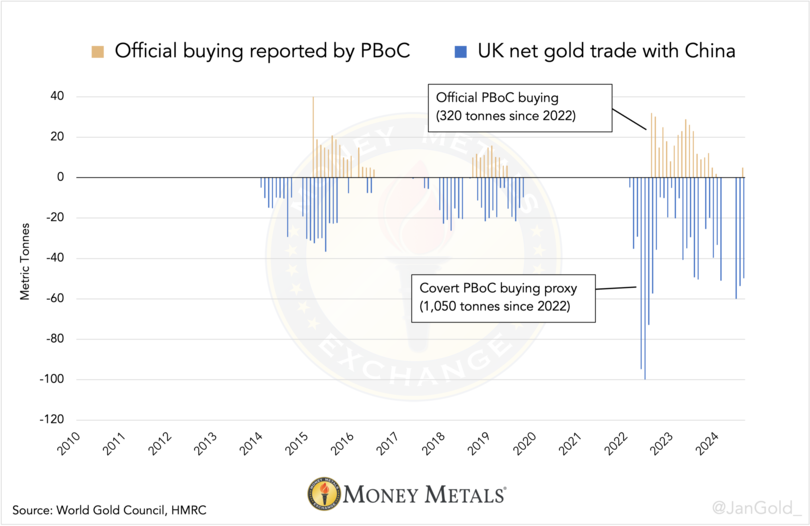
By now we know from U.K. customs (HMRC) that it was 50 tonnes, bringing total exports to China since 2022 to 1,050 tonnes. Over this period, China’s monetary authority has bought at least three times as much gold than formally reported.

Chart 2. Note that London is not the only place where the PBoC snaps up gold.

Chart 2. Note that London is not the only place where the PBoC snaps up gold.

I was able to foresee strong buying because Chinese customs (GACPRC) is quicker to release its statistics than HMRC. For November—when the SGE was still trading at a discount—China’s gross import accounted for 124 tonnes.

Nations don’t import 124 tonnes when demand is subdued. And again, the majority of this gold was imported into the Beijing region where the central bank vaults are located.

All signals flash PBoC buying.

Chart 3. In November China also imported gold from Hong Kong, Switzerland, and Canada.

Chart 3. In November China also imported gold from Hong Kong, Switzerland, and Canada.

China, as well as Saudi Arabia, are obviously preparing for a multipolar world in which the dollar’s role as a reserve asset will be gently reduced.

Gold’s hedging benefits against geopolitical shocks, and fears of a debt spiral and yield curve control will keep central bank gold demand in the East structurally higher. (Eastern central banks own a lot less monetary gold relative to their Western counterparts.)

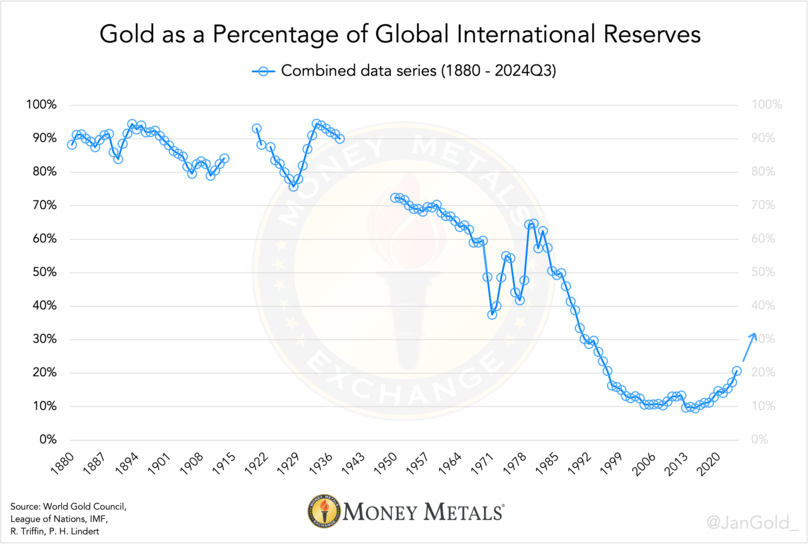
Chart 4. Gold’s share of international reserves is rising fast, from 10% in 2015 to 20% in 2024.

Chart 4. Gold’s share of international reserves is rising fast, from 10% in 2015 to 20% in 2024.

There is no indication the PBoC has bought any Bitcoin.


Originally a sound engineer in the Dutch movie industry, Jan Nieuwenhuijs has devoted the last decade to in-depth gold market research. His commentary and analysis has earned him international recognition as a top expert on the Chinese gold market, the COMEX futures market, the London Bullion Market, and the Turkish gold market. At Money Metals, he writes about the international monetary system, central bank gold policies, the mechanics of the global gold market, the gold price, and economics in general.

Warrantless FISA Searches are Unconstitutional, Judge Says in Landmark Ruling

(Ken Silva, Headline USA) Lost in the excitement of President Donald Trump’s first days in office was a major ruling last week that implicates Americans’ privacy rights.

Indeed, a U.S. judge ruled last Tuesday that the U.S. government violates the Fourth Amendment when it conducts warrantless searches of information collected under Section 702 of the Foreign Intelligence Surveillance Act.

U.S. Judge LaShann DeArcy Hall’s judgment last week was in the case of Agron Hasbajrami, who was arrested in September 2011 at John F. Kennedy International Airport after buying a one-way airline ticket to travel to Turkey. He pleaded guilty in 2012 and was sentenced to 15 years in prison for trying to travel to Pakistan the previous year to join a radical jihadist insurgent group.

While in prison, he was notified by the federal government that some evidence against him had been gathered via FISA 702, which allows the FBI and other agencies to collect without a warrant the communications of foreigners located in other countries—including when those subjects are in contact with Americans or other people inside the U.S.

For about the last decade, Hasbajrami has challenged the constitutionality of the FISA surveillance that he was subjected to. Judge Hall’s ruling last Tuesday was a major step in that legal battle.

In her ruling, Judge Hall noted that the warrantless collection of U.S. communications under Section 702 can be constitutional. For instance, the “incidental collection” of a U.S. person’s communications is allowed if it occurred while the FBI was targeting a foreign national outside the country.

But while the U.S. government might be able to collect the communications without a warrant, it’s does require one if it wants to read the content of those comms, Judge Hall ruled last week.

“Simply acquiring the defendant’s communications under Section 702, albeit lawfully, did not, in and of itself, permit the government to later query the retained information. To hold otherwise would effectively allow law enforcement to amass a repository of communications under Section 702—including those of U.S. persons—that can later be searched on demand without limitation,” the judge said.

“While communications of U.S. persons may nonetheless be intercepted, incidentally or inadvertently, it would be paradoxical to permit warrantless searches of the same information that Section 702 is specifically designed to avoid collecting.”

While ruling the warrantless FISA queries unconstitutional, the judge declined to suppress the information that was collected from those searches—ruling that agents acted in “good faith” when they searched through Hasbajrami’s comms without a warrant.

Reacting to last week’s judgment, the non-profit Project for Privacy & Surveillance Accountability said it shows that implementing warrant requirements for FISA searches is “moderate and practical.”

“The court recognized that there is room for exigent, or emergency, circumstances. But it reasonably creates an expectation that in most cases involving an American a warrant will be required,” said PPSA general counsel Gene Schaerr.

Hasbajrami’s lawyers have signaled that they plan to appeal the parts of Judge Hall’s judgment. They also want to be able to read the parts of the judgment that were redacted.

It’s not clear whether the Justice Department will also appeal the ruling. Trump’s pick for attorney general, Pam Bondi, said during her confirmation hearing that she opposes “backdoor searches” under Section 702—which is what Hasbajrami was subjected to.

However, Bondi signalled her overall support for FISA 702. Trump’s pick to run the Office of Director of National Intelligence, Tulsi Gabbard, also said she supports warrantless spying on Americans via Section 702 , while national security advisor Mike Waltz has always been a vocal proponent of 702.

The Associated Press contributed to this report.

Ken Silva is a staff writer at Headline USA. Follow him at x.com/jd_cashless.

Buy the Dip or Invest in Gold? China’s AI Rollout Sparks Panic-Selling

(Headline USA) Wall Street’s superstars were tumbling Monday as a competitor from China threatened to upend the artificial-intelligence frenzy they’ve been feasting on.

But the question for investors was whether the panic would have any real staying power, particularly with the Trump administration already tightening up on tougher trading policies with the Asian rival and discussions that even TikTok may go dark instead of relying on Chinese technology, which poses serious threats to national security.

Investors, thus, were left questioning whether to double down on boom stocks like Nvidia, which has now become one of the world’s most valuable companies, and its growing list of domestic competitors, such as Broadcom, or to pull out of the suddenly unreliable stock market and back into safer assets, such as precious metals.

The S&P 500 was down 1.8% in afternoon trading and heading for its worst day in more than a month. Big Tech stocks took some of the heaviest losses, with Nvidia down 17.4%, and they dragged the Nasdaq composite down 3.5%.

Stocks outside of AI-related industries held up much better, though, and the Dow Jones Industrial Average was up 160 points, or 0.4%, as of 2:02 p.m. Eastern time. The Dow has much less of an emphasis on tech than the S&P 500 and Nasdaq.

The shock to financial markets came from China, where a company called DeepSeek said it had developed a large language model that can compete with U.S. giants but at a fraction of the cost.

DeepSeek had already hit the top of the chart for free apps on Apple’s App Store by Monday morning, and analysts said such a feat would be particularly impressive given how the U.S. government has restricted Chinese access to top AI chips.

Skepticism, though, remains about how much DeepSeek’s announcement will ultimately shake the AI supply chain, from the chip makers making semiconductors to the utilities hoping to electrify vast data centers gobbling up computing power.

“It remains to be seen if DeepSeek found a way to work around these chip restrictions rules and what chips they ultimately used as there will be many skeptics around this issue given the information is coming from China,” according to Dan Ives, an analyst with Wedbush Securities.

DeepSeek’s disruption nevertheless rocked AI-related stocks worldwide.

In Amsterdam, Dutch chipmaking equipment company ASML slid 7%. In Tokyo, Japan’s Softbank Group Corp. lost 8.3% to pull closer to where it was before leaping on an announcement trumpeted by the White House that it was joining a partnership to invest up to $500 billion in AI infrastructure.

And on Wall Street, shares of Constellation Energy lost nearly a fifth of its value, 19.9%. The company has said it would restart the shuttered Three Mile Island nuclear power plant to supply power for data centers for Microsoft.

All the worries sent investors toward bonds, which can be safer investments than any stock. The rush pushed the yield of the 10-year Treasury down to 4.54% from 4.62% late Friday.

It’s a sharp turnaround for the AI winners, which had soared in recent years on hopes that all the investment pouring in would remake the global economy and deliver gargantuan profits along the way. Such stellar performances also raised criticism that their stock prices had gone too far, too fast.

Before Monday’s drop, Nvidia’s stock had soared from less than $20 to more than $140 in less than two years, for example.

Other Big Tech companies had also joined in the frenzy, and their stock prices had benefited too. It was just on Friday that Meta Platforms CEO Mark Zuckerberg was saying he expects his company to invest up to $65 billion this year and grow its AI teams significantly, while talking up a datacenter in Louisiana that will be so large it would cover a significant part of Manhattan.

A small group of such companies has become so dominant that they’ve come to be known as the “Magnificent Seven.” These companies—Alphabet, Amazon, Apple, Meta Platforms, Microsoft, Nvidia and Tesla—alone accounted for more than half the S&P 500’s total return last year, according to S&P Dow Jones Indices.

Their immense sizes in turn have also given them huge sway over the S&P 500 and other indexes that give more weight to bigger companies. It shows the risk of betting too much on just a few winning stocks, something that market experts call “concentration risk.”

That “can feel good when those few names or ideas are on the ascent, but it is even more dangerous when disruptions take place,” said Brian Jacobsen, chief economist at Annex Wealth Management.

Still, he suggested not overreacting to Monday’s sharp swings. “It is possible that the news out of China could be overstated and then we could see a reversal of the recent market moves,” Jacobsen said. “It is also possible that the news is true, but then that would present new investment opportunities.”

More big swings may be ahead. Apple, Meta Platforms, Microsoft and Tesla are all on the schedule this upcoming week to report how much profit they made at the end of 2024.

The pressure is on companies to keep delivering strong profits, particularly after a recent jump in Treasury yields, even with Monday’s decline. When bonds are paying more in interest, they put downward pressure on stock prices.

So far, big U.S. companies have been reporting better results than analysts expected. AT&T became the latest on Monday, and its stock rose 6%.

In stock markets abroad, movements for broad indexes across Europe and Asia weren’t as forceful as for the big U.S. tech stocks. France’s CAC 40 fell 0.3%, and Germany’s DAX lost 0.5%.

In Asia, stocks edged 0.1% lower in Shanghai after a survey of manufacturers showed export orders in China dropping to a five-month low.

The Federal Reserve holds its latest policy meeting later this week. Traders don’t expect recent weak data to push the Fed to cut its main interest rate. They’re virtually certain the central bank will hold steady, according to data from CME Group.

Adapted from reporting by the Associated Press

‘Chiefs Are Like Democrats’: TayTay’s NFL Powerhouse Accused of Rigging Playoffs

(Julianna Frieman, Headline USA) The Kansas City Chiefs faced accusations of rigging the NFL playoffs Sunday night after the team of pop star Taylor Swift’s boyfriend, tight end Travis Kelce, secured their spot in Super Bowl LIX.

The Philadelphia Eagles soared their way to the Super Bowl Sunday afternoon with a score of 55-23 against the Washington Commanders, previously known as the Redskins.

The Chiefs’s narrow 32-29 victory against the Buffalo Bills was more questionable as sports fans and political commentators raised an eyebrow at constant interference from referees, which they suggested was part of a bigger scheme.

“Chiefs are like Democrats. All they do is rig results,” X influencer @BehizyTweets wrote, bemoaning “another year of Taylor Swift’s goons thinking they know ball.”

Barstool Sports founder David Portnoy said he was “quitting watching football” after the playoff game, in which he claimed referees let the Chiefs win through “blatant cheating.”

Other football fans piled on by saying the referees made their Chiefs favoritism “so obvious.” X influencer Matt Wallace called the NFL “unwatchable” for making “5 incorrect calls” in favor of the Chiefs, while making zero that helped the Bills.

Outkick personality Charly Arnolt characterized Super Bowl LIX as the “Eagles versus the NFL” in a Monday appearance on Fox News.

“I don’t think any make-up calls are going to be happening. I think that the same direction the refs have been taking this entire season, ‘I’m in favor of Taylor Swift’s boyfriend’s team,’ are probably going to be the same calls they make during the Super Bowl,” Arnolt told Fox and Friends First co-hosts, who laughed.

Super Bowl LIX will be the Chiefs’s third consecutive Super Bowl and the second featuring Swift as a sideshow.

In 2023, the Chiefs beat the Eagles 38-35 in what was branded the sibling rivalry Super Bowl, as the Chiefs’s Travis Kelce faced off against the Eagles’s Jason Kelce.

Travis Kelce’s profile was elevated further in 2024 when Swift, a Pennsylvania native, watched her new NFL boyfriend from the bleachers as the Chiefs won 25-22 against the San Francisco 49ers.

“I don’t watch NFL but knew the Chiefs would win. The NFL is about promoting Taylor Swift and her boy toy because he promotes the poison vax,” one X user wrote, evoking Kelce’s ties to pharmaceutical giant Pfizer.

Stephen L. Miller, editor of the The Spectator, said he was “not mad” about the Chiefs being in the Super Bowl because “the entire country and culture is going to hate both the Kansas City Chiefs and Taylor Swift.” He added, “That’s worth any 3 hours on a Sunday.”

Outkick host Clay Travis questioned whether interested in another Chiefs-Eagles Super Bowl would wane come Feb. 9. His colleague, Outkick host Tomi Lahren, predicted that the game would be “one of the lowest rated Super Bowls of the last decade.”

The NFL celebrated the Chiefs’s playoff win by sharing a video of Swift and Kelce smiling and waving at the crowd.

“What a moment for Travis Kelce and Taylor Swift,” the NFL wrote with a heart emoji Sunday night.

Julianna Frieman is a freelance writer published by the Daily Caller, Headline USA, The Federalist, and the American Spectator. Follow her on Twitter at @JuliannaFrieman.

‘Numbers Are the Numbers’: CNN Host Loses Cool as Data Guru Shows a Different Story on Trump

(Julianna Frieman, Headline USA) CNN host Kate Bolduan lost her cool Friday as the network’s senior political data reporter shared numbers that contradicted her negative spin on President Donald Trump.

Harry Enten stood before CNN’s big board and revealed that Trump’s approval rating skyrocketed by six points in January compared to his previous high when he was up three in March 2017.

“This is a very different Donald Trump. He’s leading a very different administration, the way he’s attacking things. And the American public is very much more in line with him than they were at any point in his entire first term,” Enten said as he stood before graphics on the wall displaying the Reuters/IPSOS adult polling results.

Bolduan stuttered as she interjected with a “correction.” She said, “This is not a very different Donald Trump. This is a very different Donald Trump as being viewed by voters.”

Enten pushed back at the bitter CNN anchor, telling her that Trump’s White House chief of staff, Susie Wiles, is leading the charge in a “much less disorganized fashion.”

“Take me back in history,” Bolduan demanded.

The data analyst found it “interesting” that Trump’s first net approval rating of his second term was much higher than his entire first term.

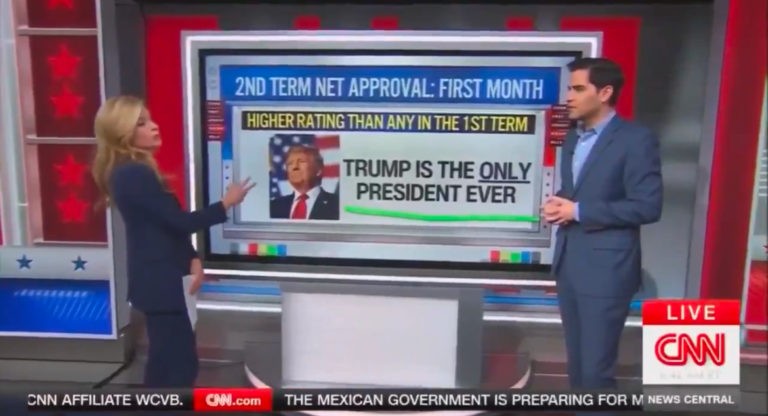
He changed CNN’s board to show a graphic that said “Trump is the only president ever” to have a higher rating in his second term than his first term.

Bolduan shrieked, her voice raising in pitch, “I have a really hard time believing this!”

As Enten underlined the graphic in green, he told his CNN colleague that data showing Trump’s appeal is “100% true.”

“I went back—I love spreadsheets,” Enter continued. “Donald Trump’s is the first guy ever with a net approval rating in the first month of his second term is higher than any rating that he’s ever had in his entire first term.”

Bolduan stood by seething as the data reporter continued, “This is true. I don’t make stuff up! The numbers are the numbers.”

She sarcastically told Enten she “believes in nothing” until he puts it on CNN’s data wall.

Julianna Frieman is a freelance writer published by the Daily Caller, Headline USA, The Federalist, and the American Spectator. Follow her on Twitter at @JuliannaFrieman.