Buy the Dip or Invest in Gold? China’s AI Rollout Sparks Panic-Selling

(Headline USA) Wall Street’s superstars were tumbling Monday as a competitor from China threatened to upend the artificial-intelligence frenzy they’ve been feasting on.

But the question for investors was whether the panic would have any real staying power, particularly with the Trump administration already tightening up on tougher trading policies with the Asian rival and discussions that even TikTok may go dark instead of relying on Chinese technology, which poses serious threats to national security.

Investors, thus, were left questioning whether to double down on boom stocks like Nvidia, which has now become one of the world’s most valuable companies, and its growing list of domestic competitors, such as Broadcom, or to pull out of the suddenly unreliable stock market and back into safer assets, such as precious metals.

The S&P 500 was down 1.8% in afternoon trading and heading for its worst day in more than a month. Big Tech stocks took some of the heaviest losses, with Nvidia down 17.4%, and they dragged the Nasdaq composite down 3.5%.

Stocks outside of AI-related industries held up much better, though, and the Dow Jones Industrial Average was up 160 points, or 0.4%, as of 2:02 p.m. Eastern time. The Dow has much less of an emphasis on tech than the S&P 500 and Nasdaq.

The shock to financial markets came from China, where a company called DeepSeek said it had developed a large language model that can compete with U.S. giants but at a fraction of the cost.

DeepSeek had already hit the top of the chart for free apps on Apple’s App Store by Monday morning, and analysts said such a feat would be particularly impressive given how the U.S. government has restricted Chinese access to top AI chips.

Skepticism, though, remains about how much DeepSeek’s announcement will ultimately shake the AI supply chain, from the chip makers making semiconductors to the utilities hoping to electrify vast data centers gobbling up computing power.

“It remains to be seen if DeepSeek found a way to work around these chip restrictions rules and what chips they ultimately used as there will be many skeptics around this issue given the information is coming from China,” according to Dan Ives, an analyst with Wedbush Securities.

DeepSeek’s disruption nevertheless rocked AI-related stocks worldwide.

In Amsterdam, Dutch chipmaking equipment company ASML slid 7%. In Tokyo, Japan’s Softbank Group Corp. lost 8.3% to pull closer to where it was before leaping on an announcement trumpeted by the White House that it was joining a partnership to invest up to $500 billion in AI infrastructure.

And on Wall Street, shares of Constellation Energy lost nearly a fifth of its value, 19.9%. The company has said it would restart the shuttered Three Mile Island nuclear power plant to supply power for data centers for Microsoft.

All the worries sent investors toward bonds, which can be safer investments than any stock. The rush pushed the yield of the 10-year Treasury down to 4.54% from 4.62% late Friday.

It’s a sharp turnaround for the AI winners, which had soared in recent years on hopes that all the investment pouring in would remake the global economy and deliver gargantuan profits along the way. Such stellar performances also raised criticism that their stock prices had gone too far, too fast.

Before Monday’s drop, Nvidia’s stock had soared from less than $20 to more than $140 in less than two years, for example.

Other Big Tech companies had also joined in the frenzy, and their stock prices had benefited too. It was just on Friday that Meta Platforms CEO Mark Zuckerberg was saying he expects his company to invest up to $65 billion this year and grow its AI teams significantly, while talking up a datacenter in Louisiana that will be so large it would cover a significant part of Manhattan.

A small group of such companies has become so dominant that they’ve come to be known as the “Magnificent Seven.” These companies—Alphabet, Amazon, Apple, Meta Platforms, Microsoft, Nvidia and Tesla—alone accounted for more than half the S&P 500’s total return last year, according to S&P Dow Jones Indices.

Their immense sizes in turn have also given them huge sway over the S&P 500 and other indexes that give more weight to bigger companies. It shows the risk of betting too much on just a few winning stocks, something that market experts call “concentration risk.”

That “can feel good when those few names or ideas are on the ascent, but it is even more dangerous when disruptions take place,” said Brian Jacobsen, chief economist at Annex Wealth Management.

Still, he suggested not overreacting to Monday’s sharp swings. “It is possible that the news out of China could be overstated and then we could see a reversal of the recent market moves,” Jacobsen said. “It is also possible that the news is true, but then that would present new investment opportunities.”

More big swings may be ahead. Apple, Meta Platforms, Microsoft and Tesla are all on the schedule this upcoming week to report how much profit they made at the end of 2024.

The pressure is on companies to keep delivering strong profits, particularly after a recent jump in Treasury yields, even with Monday’s decline. When bonds are paying more in interest, they put downward pressure on stock prices.

So far, big U.S. companies have been reporting better results than analysts expected. AT&T became the latest on Monday, and its stock rose 6%.

In stock markets abroad, movements for broad indexes across Europe and Asia weren’t as forceful as for the big U.S. tech stocks. France’s CAC 40 fell 0.3%, and Germany’s DAX lost 0.5%.

In Asia, stocks edged 0.1% lower in Shanghai after a survey of manufacturers showed export orders in China dropping to a five-month low.

The Federal Reserve holds its latest policy meeting later this week. Traders don’t expect recent weak data to push the Fed to cut its main interest rate. They’re virtually certain the central bank will hold steady, according to data from CME Group.

Adapted from reporting by the Associated Press

‘Chiefs Are Like Democrats’: TayTay’s NFL Powerhouse Accused of Rigging Playoffs

(Julianna Frieman, Headline USA) The Kansas City Chiefs faced accusations of rigging the NFL playoffs Sunday night after the team of pop star Taylor Swift’s boyfriend, tight end Travis Kelce, secured their spot in Super Bowl LIX.

The Philadelphia Eagles soared their way to the Super Bowl Sunday afternoon with a score of 55-23 against the Washington Commanders, previously known as the Redskins.

The Chiefs’s narrow 32-29 victory against the Buffalo Bills was more questionable as sports fans and political commentators raised an eyebrow at constant interference from referees, which they suggested was part of a bigger scheme.

“Chiefs are like Democrats. All they do is rig results,” X influencer @BehizyTweets wrote, bemoaning “another year of Taylor Swift’s goons thinking they know ball.”

Barstool Sports founder David Portnoy said he was “quitting watching football” after the playoff game, in which he claimed referees let the Chiefs win through “blatant cheating.”

Other football fans piled on by saying the referees made their Chiefs favoritism “so obvious.” X influencer Matt Wallace called the NFL “unwatchable” for making “5 incorrect calls” in favor of the Chiefs, while making zero that helped the Bills.

Outkick personality Charly Arnolt characterized Super Bowl LIX as the “Eagles versus the NFL” in a Monday appearance on Fox News.

“I don’t think any make-up calls are going to be happening. I think that the same direction the refs have been taking this entire season, ‘I’m in favor of Taylor Swift’s boyfriend’s team,’ are probably going to be the same calls they make during the Super Bowl,” Arnolt told Fox and Friends First co-hosts, who laughed.

Super Bowl LIX will be the Chiefs’s third consecutive Super Bowl and the second featuring Swift as a sideshow.

In 2023, the Chiefs beat the Eagles 38-35 in what was branded the sibling rivalry Super Bowl, as the Chiefs’s Travis Kelce faced off against the Eagles’s Jason Kelce.

Travis Kelce’s profile was elevated further in 2024 when Swift, a Pennsylvania native, watched her new NFL boyfriend from the bleachers as the Chiefs won 25-22 against the San Francisco 49ers.

“I don’t watch NFL but knew the Chiefs would win. The NFL is about promoting Taylor Swift and her boy toy because he promotes the poison vax,” one X user wrote, evoking Kelce’s ties to pharmaceutical giant Pfizer.

Stephen L. Miller, editor of the The Spectator, said he was “not mad” about the Chiefs being in the Super Bowl because “the entire country and culture is going to hate both the Kansas City Chiefs and Taylor Swift.” He added, “That’s worth any 3 hours on a Sunday.”

Outkick host Clay Travis questioned whether interested in another Chiefs-Eagles Super Bowl would wane come Feb. 9. His colleague, Outkick host Tomi Lahren, predicted that the game would be “one of the lowest rated Super Bowls of the last decade.”

The NFL celebrated the Chiefs’s playoff win by sharing a video of Swift and Kelce smiling and waving at the crowd.

“What a moment for Travis Kelce and Taylor Swift,” the NFL wrote with a heart emoji Sunday night.

Julianna Frieman is a freelance writer published by the Daily Caller, Headline USA, The Federalist, and the American Spectator. Follow her on Twitter at @JuliannaFrieman.

‘Numbers Are the Numbers’: CNN Host Loses Cool as Data Guru Shows a Different Story on Trump

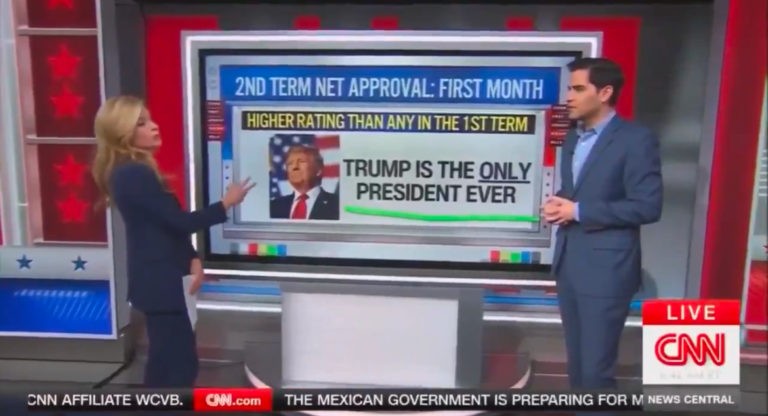
(Julianna Frieman, Headline USA) CNN host Kate Bolduan lost her cool Friday as the network’s senior political data reporter shared numbers that contradicted her negative spin on President Donald Trump.

Harry Enten stood before CNN’s big board and revealed that Trump’s approval rating skyrocketed by six points in January compared to his previous high when he was up three in March 2017.

“This is a very different Donald Trump. He’s leading a very different administration, the way he’s attacking things. And the American public is very much more in line with him than they were at any point in his entire first term,” Enten said as he stood before graphics on the wall displaying the Reuters/IPSOS adult polling results.

Bolduan stuttered as she interjected with a “correction.” She said, “This is not a very different Donald Trump. This is a very different Donald Trump as being viewed by voters.”

Enten pushed back at the bitter CNN anchor, telling her that Trump’s White House chief of staff, Susie Wiles, is leading the charge in a “much less disorganized fashion.”

“Take me back in history,” Bolduan demanded.

The data analyst found it “interesting” that Trump’s first net approval rating of his second term was much higher than his entire first term.

He changed CNN’s board to show a graphic that said “Trump is the only president ever” to have a higher rating in his second term than his first term.

Bolduan shrieked, her voice raising in pitch, “I have a really hard time believing this!”

As Enten underlined the graphic in green, he told his CNN colleague that data showing Trump’s appeal is “100% true.”

“I went back—I love spreadsheets,” Enter continued. “Donald Trump’s is the first guy ever with a net approval rating in the first month of his second term is higher than any rating that he’s ever had in his entire first term.”

Bolduan stood by seething as the data reporter continued, “This is true. I don’t make stuff up! The numbers are the numbers.”

She sarcastically told Enten she “believes in nothing” until he puts it on CNN’s data wall.

Julianna Frieman is a freelance writer published by the Daily Caller, Headline USA, The Federalist, and the American Spectator. Follow her on Twitter at @JuliannaFrieman.

These 3 Catalysts Could Fuel Precious Metals Markets

(Clint Siegner, Money Metals News Service) Longtime bullion investors have been evaluating whether to buy, sell, or hold in recent months. The change in leadership in Washington DC has prompted some searching as to the direction of the markets.

Demand for precious metals tends to come in three broad categories; inflation hedging, safe-haven buying, and speculation.

Inflation Hedging

Gold and silver will generally get a look from investors when investors are looking for ways to protect their savings from the ravages of inflation.

Given the imperative for ongoing inflation in our debt-based currency system, and the history of all fiat currencies, more inflation in the long run is all but guaranteed.

Inflation remains above the Fed target rate, but the central bank has already begun a new cycle of rate cuts. The consensus among Fed watchers is that the central bank will cut rates twice more this year.

Lower interest rates are inflationary as reducing the cost of funds stimulates borrowing, which adds to the money supply.

President Trump spoke publicly last week about interest rates being too high. He signaled that he will be pushing Jerome Powell and other Fed bankers for even more rate cuts.

The Federal Reserve Bank has always been marketed to the public as an independent institution, simply pursuing its dual mandate for protecting the value of the dollar and fostering full employment. In truth, the Fed never was independent and never will be.

The Fed Chairman is appointed by the president and serves at his pleasure. Trump may very well succeed in getting what he wants from Jerome Powell.

Meanwhile, Congress has an absolutely abysmal record when it comes to controlling spending.

It is possible this time will be different, but Trump himself has never been a budget hawk.

Last month, he advocated for Congress to finally dispense with the debt ceiling altogether.

To the extent Trump imposes new tariffs, some price inflation is likely. A 25 percent tariff on imports from Canada and Mexico, for example, is almost certain to drive prices higher on goods imported from those nations.

Higher-than-normal inflation in the year ahead looks like a good bet.

Safe-Haven Buying

Forecasting safe-haven demand from investors who worry about crises ranging from wars to troubles in the financial markets is trickier.

War tensions are falling in the two main international conflict zones – Ukraine and the Middle East.

Here at home, the COVID pandemic, which stimulated a wave of gold and silver buying that began in March of 2020, is now in the rearview mirror.

Many feel health officials exaggerated the risks of COVID and are in no mood to entertain another pandemic scare.

As a sign of the times, Trump withdrew the U.S. entirely from the WHO last week.

While Americans seem well inoculated against another health panic, other troubles are possible.

The mass deportations promised by the Trump administration are an example of a reform which could come with the cost of at least some social chaos. The round-up of millions of illegal immigrants could generate some violence.

The equity markets remain significantly overvalued when looking at the average Price-to-Earnings (PE) ratio. A significant correction in stocks is inevitable, though it is impossible to predict the timing.

Speculative Demand

Gold and silver prices have performed well in recent years, but the price action of late hasn’t been enough to entice a wave of speculative longs into the markets.

For the moment prices are range-bound. There is currently nothing in the metals markets to compare with the energy in cryptocurrency markets where buying seems to beget more buying.

Gold and silver bugs have long anticipated a short covering squeeze. Whether or not they will get it in the next year or two is completely uncertain – like predicting the next major correction in the stock market.

That said, inventories are dwindling and the shortage is showing up in premiums for COMEX deliverable bars. The premiums for these bars have generally been stable, despite periodic shortages of retail gold and silver products in the bullion markets.

This provides some basis for wondering if the long-awaited reckoning for shorts is nigh. If speculators find some reason to go heavily long gold and silver, leverage in the future markets could make for some explosive price action.


Clint Siegner is a Director at Money Metals Exchange, a precious metals dealer recently named “Best in the USA” by an independent global ratings group. A graduate of Linfield College in Oregon, Siegner puts his experience in business management along with his passion for personal liberty, limited government, and honest money into the development of Money Metals’ brand and reach. This includes writing extensively on the bullion markets and their intersection with policy and world affairs.

Trump’s Tariff Threat Makes Colombia Dance to the Tune of Mass Deportations

(Julianna Frieman, Headline USA) President Donald Trump’s threat of emergency tariffs made Colombia dance Sunday to the tune of the one-week-old U.S. leader’s demand for compliance with his mass deportation plan.

Upon learning that Colombia’s “socialist” president prevented two U.S. flights filled with illegal migrants to land in the country, Trump ordered his administration to impose 25% tariffs, a travel ban, visa revocation, and various sanctions on Colombia.

“These measures are just the beginning,” Trump wrote in his announcement on Truth Social. “We will not allow the Colombian Government to violate its legal obligations with regard to the acceptance and return of the Criminals they forced into the United States!”

The White House revealed that within hours after America’s trade war warning, the Colombian government “agreed to all of President Trump’s terms” including deportation flights. Colombian President Gustavo Petro reposted a statement by White House Press Secretary Karoline Leavitt, signifying his compliance with Trump’s demands.

“The Government of Colombia has agreed to all of President Trump’s terms, including the unrestricted acceptance of illegal aliens from Columbia returned from the United States, including on U.S. military aircraft, without limitation or delay. Based on this agreement, the fully drafted IEEPA tariffs and sanctions will be held in reverse, and not signed, unless Colombia fails to honor this agreement,” the statement read in part.

But Colombia is not off the hook just yet as sanctions issued by the State Department and enhanced inspections from Customs and Border Protection will “remain in effect until the first planeload of Colombian deportees is successfully returned,” according to the White House.

The statement revoked Trump’s tariffs, which would have increased from 25% to 50% after one week. However, it affirmed they would be put in place if Colombia fails to comply with the U.S.

Although Gustavo initially agreed to go as far as send his presidential plane to help deport illegal migrants from the U.S., the Colombian leader did not refrain from puffing out his chest on the world stage.

After calling travel to the U.S. “a bit boring,” Gustavo told Trump in a multi-paragraph rant on social media, “You will never rule us.”

He compared Americans under Trump to slaveholders and made the bizarre claim that Trump sees him as an “inferior race.”

“Your blockade does not scare me, because Colombia, besides being the country of beauty, is the heat of the world,” Gustavo wrote before adding, “I do the same,” in response to Trump’s threat of tariffs.

Julianna Frieman is a freelance writer published by the Daily Caller, Headline USA, The Federalist, and the American Spectator. Follow her on Twitter at @JuliannaFrieman.

WATCH: Bill Gates Speaks about His Time w/ Jeffrey Epstein

(Ken Silva, Headline USA) In a wide-ranging interview with the Wall Street Journal, billionaire Bill Gates said he was “foolish” and “quite stupid” to have associated himself with deceased sex trafficker and alleged Israeli intelligence asset Jeffrey Epstein.

“In retrospect, I was foolish to spend any time with him, and he sort of got time with various people by spending time with other people,” Gates told Journal editor-in-chief Emma Tucker. “I think I was quite stupid. I thought it would help me with global health, philanthropy. In fact, it failed to do that, and it was just a huge mistake.”

When asked whether the fallout from Epstein has made him more “wary,” Gates said it “definitely” has.

“I mean, are you kidding?” he added.

The Journal revealed in May 2023 that Epstein discovered that Gates had an affair with Russian bridge player Mila Antonova. Epstein may have attempted to use that knowledge to blackmail Gates.

According to the Journal, Epstein told Gates that he knew about the affair after Gates refused to donate $100 million to his charity.

Epstein also made Boris Nikolic, a Gates confidant and top science adviser at the time, as  a backup executor in his will just days before Epstein died in 2019.

Nikolic told the Journal that Epstein didn’t discuss the idea with him beforehand, that he subsequently declined to serve, and that he believes he was listed by Epstein as a way to strike at Gates.

“He couldn’t have listed Bill because that would have been too obvious, so he chose me,” he reportedly said. “I have come to believe it was likely a retaliatory move against Bill Gates.”

Gates has repeatedly denied any criminal wrongdoing with respect to his links to Epstein—but it may have cost him his marriage to Melinda French Gates.

In 2022, French Gates allegedly had serious doubts about her husband’s friend the entire time.

“I did not like that [Bill] had meetings with Jeffrey Epstein,” Melinda said in an interview last year.

“I made that clear to him. I also met Jeffrey Epstein exactly one time. I wanted to see who this man was, and I regretted it from the second I stepped in the door.”

She later called him “evil personified.”

Meanwhile, Gates might be trying to rekindle his relationship with his ex-wife. He recently told The Times of London that his divorce is “the mistake I regret the most.”

Ken Silva is a staff writer at Headline USA. Follow him at x.com/jd_cashless.

Three Things Investors Should Consider Outside the President’s Control

(Mike Maharrey, Money Metals News Service) As we enter the Trump era, there seems to be considerable optimism about the economy’s trajectory.

If you’re a free market person, it’s reasonable to feel optimistic. We will likely see deregulation. We saw that impulse during Trump’s first term, and we’ve already seen it in some of his executive orders. For instance, Trump has already made moves to open oil drilling. We’ve also seen some early signs of fiscal reform with a federal hiring freeze.

But no matter what you think of President Trump, as an objective investor, some things should give you pause. That’s because, under the U.S. system of government, there is only so much a president can do.

Here are three things to consider that could significantly impact the economy that Trump will have little to no control over.

The National Debt

The national debt is climbing at a dizzying pace. As I put it in a recent article, the federal government is hurtling toward a fiscal cliff with its foot on the accelerator.

Trump has talked about cutting government spending, a refreshing change. But he has a long row to hoe.

In the first place, he needs the cooperation of Congress. Given party politics in the U.S., that can be a daunting challenge.

Political incentives work against spending cuts. Talking about spending cuts in the abstract is easy. Cutting specific programs is hard.

That’s due to the nature of politics. Politicians’ primary concern is getting re-elected. That means their focus tends to be on making constituents happy in the short term. Inflicting pain in the here and now is not a recipe for electoral success, and fiscal reform always causes some pain.

Think about it: if you’re a member of Congress, do you want to go back to your district and tell your constituents you slashed a popular program?

As a result, many of the things that need to be cut to make a dent in spending aren’t likely to be touched.

For instance, defense spending makes up a big chunk of the discretionary budget. Do you think they are going to slash the Pentagon with all of the geopolitical tension out there?

I don’t either.

It’s also important to remember that discretionary spending  – the stuff in the budget that can be cut – only makes up about 27 percent of overall outlays. To really get to the heart of the matter, you must deal with Social Security and Medicare. These programs are known as “the third rail of politics.” In other words, touching that rail will get you electrocuted. They may tinker around the edges, but it’s more likely Congress will kick the can down the road than produce true reforms.

The other problem is the government always finds some new reason to spend money, whether in a crisis overseas or at home.

We’ve heard budget cut talk before, but remember, every president since Calvin Coolidge has left the U.S. with a bigger national debt than when he took office.

Even with his best efforts, Trump will struggle to change the borrowing and spending trajectory.

Monetary Policy

Trump recently said he will “demand” interest rates drop immediately.

He can demand all he wants, but he doesn’t have the authority to make the Federal Reserve do anything.

I’m not so naive as to think that the Fed is above the political fray, but Powell and Company are concerned first and foremost with the economic stuff, not political rhetoric. And given human nature, Trump’s demands may cause Jerome Powell to dig his feet in deeper.

Trump isn’t wrong. This debt-riddled bubble economy needs a lower interest rate environment to run.

But Trump isn’t right either. The Fed needs to keep interest rates higher for longer to tackle sticky price inflation.

I’ve written about how the Fed is in a Catch-22 – stuck between a rock and a hard place. It needs to simultaneously raise and lower interest rates.

Good luck with that, right?

Trump has no control here. It is what it is. And it is a recipe for more inflation.

Nearly Two Decades of Monetary Malfeasance

Finally, there isn’t much Trump can do about the consequences of more than a decade of monetary malfeasance. He can’t unwind nearly $9 trillion in printed money injected into the economy since the 2008 financial crisis through multiple rounds of quantitative easing (QE). He can’t undo the malinvestments in the economy and the debt bubble created by more than a decade of artificially low interest rates. This monetary malfeasance distorted the economy beyond its breaking point.

Those consequences – an economic crash and perhaps a financial crisis – are going to play out no matter who is in the Oval Office.

It is possible the powers that be can kick the can down the road for a while, but if we look at the trajectory of the economy after the monetary malfeasance of the dot-com era, the bust probably isn’t too far down the road.

Conclusion

While White House policies matter, and they can improve or hinder progress, the economy doesn’t live or die on the back of the president.

It’s important to keep these things in mind as you make investment decisions in the months ahead. A lot of people are selling gold and silver right now, imagining that Trump will turn the economy around and get price inflation under control. But given the things that are out of the president’s control, it might be wise to consider some of these three factors. Be careful not to let your political inclinations cloud your economic judgments.


Mike Maharrey is a journalist and market analyst for MoneyMetals.com with over a decade of experience in precious metals. He holds a BS in accounting from the University of Kentucky and a BA in journalism from the University of South Florida.

David Morgan: Gold, Silver, and Surviving the Trump Economy

(Money Metals News Service) On a recent episode of the Money Metals podcast, host Mike Maharrey sat down with David Morgan, founder of The Morgan Report and author of The Silver Manifesto.

David Morgan’s book, The Silver Manifesto, was recently listed among the top 5 books on sound money for 2025.

The conversation spanned a variety of topics, including the impact of the current political climate on precious metals markets, tariffs, economic challenges, and strategies for investing in metals.

(Interview Starts Around 4:10 Mark)

The discussion began with an analysis of how the “Trump 2.0” administration might influence the gold and silver markets. Morgan explained that recent signals from the administration, including the possibility of tariffs on imported metals, have already caused disruptions in the market. Metals previously flowing freely from the London Bullion Management Association to the U.S. are now being expedited to avoid potential tariffs, leading to a squeeze in supply.

While premiums on retail metals like Silver Eagles have decreased—falling from $14 to around $2.75—Morgan described a bifurcated market where the wholesale physical market remains tight. This divergence, he suggested, underscores the complexity of current market conditions.

Tariffs: Inflationary or Beneficial?

Morgan and Maharrey debated the broader implications of tariffs, with Morgan noting that while tariffs may initially seem like a fair way to level the playing field, they often disrupt the economy.

Drawing parallels to the Great Depression, Morgan warned that policies like the Smoot-Hawley Tariff Act exacerbated economic downturns by increasing costs globally.

Morgan noted that tariffs on precious metals could directly lead to higher gold prices. For example, a 10% tariff on gold priced at $2,700 per ounce would add $270, a cost ultimately borne by consumers.

The Debt Problem: A “Math Problem”

Turning to broader economic issues, Morgan emphasized that the U.S. debt crisis transcends politics. Whether under Trump or Biden, he argued, the fundamental issue remains: Medicare, Medicaid, Social Security, and military spending constitute the lion’s share of government expenditures. Even with policy tweaks like raising the retirement age or freezing pensions, Morgan suggested these measures merely delay the inevitable.

Maharrey agreed, adding that geopolitical tensions make it unlikely that military spending will see significant cuts anytime soon. Both commentators stressed the need for systemic reforms rather than superficial adjustments.

The podcast delved into the pros and cons of various investment vehicles for precious metals. Morgan emphasized the importance of starting with physical metals, such as gold and silver coins or bars, which provide tangible wealth and anonymity. While premiums on physical metals vary, Morgan noted that they often average out over time.

He also discussed exchange-traded funds (ETFs), which provide a convenient way to gain exposure to metals without the need for physical storage. However, Morgan expressed concerns about the lack of transparency in some ETFs, questioning whether their physical holdings are used as collateral or double-counted.

For those interested in leveraged exposure, Morgan highlighted mining stocks. While mining companies often offer higher returns during bullish markets, he cautioned that this sector requires careful research due to risks like operational inefficiencies and inflationary pressures.

Lessons from History: Gold Confiscation and Honest Money

The conversation also touched on historical events, including the 1930s gold confiscation in the U.S.

Morgan noted that while such a scenario is unlikely to recur, mining stocks could provide an alternative form of gold exposure in such a case. He argued that an honest money system—backed by precious metals—would restore economic freedom and integrity, values he sees as eroding in the current system.

Key Takeaways for Investors

Morgan concluded with practical advice for precious metals investors:

  • Start Small: Build a physical metals position gradually, using dollar-cost averaging.
  • Diversify: Consider mining stocks and ETFs, but only after establishing a core physical position.
  • Be Informed: Understand the dynamics of the metals market and avoid overexposure to any single asset class.

Closing Thoughts

As Maharrey wrapped up the discussion, he praised Morgan’s expertise and commitment to educating the public about honest money. Morgan, in turn, shared his larger mission: promoting truth, integrity, and economic freedom through his work in the precious metals sector.

Listeners were encouraged to explore resources like The Morgan Report and Morgan’s upcoming documentary, Silver Sunrise, for deeper insights into the world of precious metals investing.

The conversation underscored the importance of staying informed and proactive in uncertain economic times, particularly for those seeking to preserve wealth through tangible assets like gold and silver.

Key Questions & Answers

Money Metals Podcast David Morgan Mike Maharrey

The following are the key questions and answers from the Money Metals podcast with host Mike Maharrey, and precious metals analyst and macroeconomist David Morgan:

How is the Trump 2.0 era expected to impact the gold and silver markets?

David Morgan noted that the Trump administration’s indication of potential tariffs on imported metals has already caused market disruptions. Metals are being shipped from London to the U.S. to avoid tariffs, creating a supply squeeze in the wholesale market. At the same time, retail premiums on products like Silver Eagles have dropped significantly, illustrating a bifurcated market.

Are tariffs inflationary, and how do they affect precious metals?

Morgan explained that tariffs generally lead to higher prices, as the costs are passed on to consumers. For example, a 10% tariff on gold priced at $2,700 per ounce would increase the consumer price by $270. While tariffs may seem like a way to protect domestic industries, they often disrupt economies, as seen during the Great Depression with the Smoot-Hawley Tariff Act.

How does public confidence in the economy influence precious metals demand?

Morgan suggested that during Republican administrations like Trump’s, investors may feel more optimistic about the economy and less inclined to buy precious metals as a hedge. However, he emphasized that underlying issues, such as national debt, persist regardless of political leadership, making metals a long-term safe haven.

What are the key issues with U.S. debt, and can they be resolved?

Morgan described the U.S. debt problem as a “math problem” rather than a political issue. Programs like Medicare, Medicaid, Social Security, and military spending dominate the budget, leaving little room for meaningful cuts. Political adjustments, like raising the retirement age, may delay the issue but fail to address its root causes.

What are the benefits and risks of physical precious metals?

Physical metals provide tangible wealth, anonymity, and a hedge against inflation. While premiums vary, they average out over time. Morgan emphasized starting with physical bullion as the foundation of any metals investment strategy.

How do ETFs compare to physical metals?

ETFs offer an easy way to gain exposure to metals without the need for physical storage. However, Morgan expressed concerns about transparency in some ETFs, questioning whether their physical holdings are double-counted or used as collateral. He recommended using ETFs only after building a core position in physical metals.

What are the advantages and risks of mining stocks?

Mining stocks can provide leverage to rising gold and silver prices, offering higher returns during bullish markets. However, they also carry risks, such as inflationary pressures and operational inefficiencies. Morgan highlighted the importance of careful research and diversification when investing in this sector.

Could gold confiscation happen again?

Morgan considered gold confiscation highly unlikely but noted that mining stocks could offer indirect exposure to gold in such a scenario. He argued that silver is too undervalued for confiscation to be worthwhile, as it represents a negligible portion of the financial system.

What practical advice did David Morgan offer for precious metals investors?

Morgan advised starting small, using dollar-cost averaging to build a physical metals position gradually. He recommended diversifying into ETFs or mining stocks only after establishing a foundation in physical bullion. He also emphasized the importance of staying informed and tailoring investments to individual goals and circumstances.

Homan Shuts Down Deportation Costs Critics: ‘What Price Do You Put on Laken Riley’s Life?’

(Luis Cornelio, Headline USA) The legacy media has fabricated yet another excuse to oppose President Donald Trump’s deportation orders: claiming that removing illegal aliens convicted of violent crimes is too costly. 

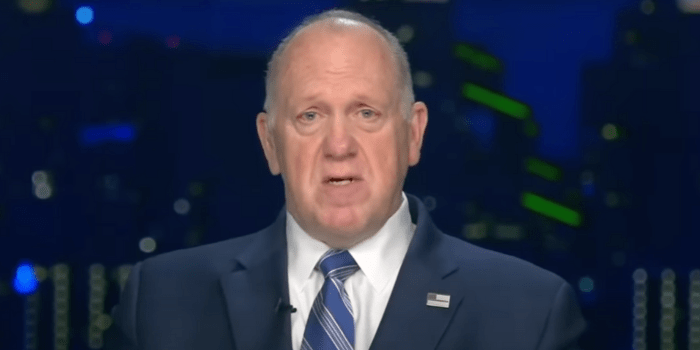
Tom Homan, the White House border czar, quickly countered this narrative during an interview with ABC News host Martha Raddatz on the Sunday episode of This Week. 

“Estimates are that there are 11 million undocumented immigrants in this country right now. How can you possibly afford to deport all of these people?” Raddatz asked. 

Homan replied by saying Congress would address budget concerns and emphasized the overwhelming support for the removal of violent illegal aliens. 

“What price do you put on national security?” Homan shot back. “What price do you put on these young ladies that have been raped and murdered and burned alive? What price do you put on that? What price do you put on Laken Riley’s life?” 

Homan’s remarks referenced Laken Riley, a beloved 22-year-old nursing student who was brutally killed and attacked by Jose Antonio Ibarra, an illegal alien from Venezuela. Ibarra destroyed Riley’s skull as she tried to call 911. 

In another tragic case, 12-year-old Jocelyn Nungary was sexually assaulted, bound and killed by Franklin Pena and Johan Martinez-Rangel, two illegal aliens from Venezuela admitted under President Joe Biden’s border policies. 

Rachel Morin, a 37-year-old mother of five, was raped and killed by a man whom authorities alleged is Victor Martinez Hernandez. This alleged perpetrator is an El Salvadoran national who entered the U.S. in February 2023. 

Martinez Hernandez, who was wanted for the murder of a woman in El Salvador, was arrested 10 months after Morin’s body was found. He was apprehended in an unrelated home invasion and assault of a 9-year-old in Los Angeles. 

Homan highlighted these horrific cases to emphasize the urgency of securing the southern border.

“When you have stories like these and you don’t secure that border, that’s when national security threats enter the country, that’s when sex trafficking goes up [and] that’s when the fentanyl comes in and kills a quarter of a million Americans and I don’t put a price on that,” he said.

Watch the full interview below.

Ratcliffe Breaks Down Biden-era Report Confirming COVID Leaked from Wuhan

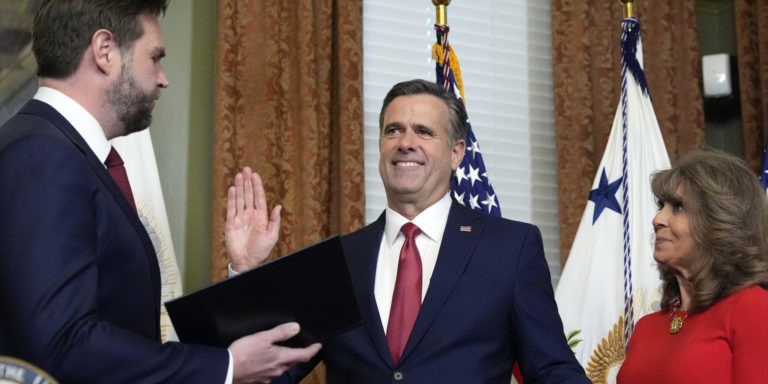
(Luis Cornelio, Headline USA) CIA Director John Ratcliffe explained the reasoning behind the release of a Biden-era study concluding that the COVID-19 pandemic likely originated from a lab leak in Wuhan, China. 

Speaking on Fox News’s Sunday Morning Futures with Maria Bartiromo, Ratcliffe said the CIA’s decision to release its confidential report was aimed at restoring transparency in the obscure spy agency. 

“Part of what we have to do is we have to restore Americans’ trust in our own institutions like the intelligence community and law enforcement—and that includes the CIA,” Ratcliffe said. 

“I had the opportunity on my first day to make public an assessment that actually took place in the Biden administration, so it can’t be accused of being political,” he continued. “The CIA has assessed that the most likely cause of this pandemic that has brought so much devastation around the world was because of a lab-related incident in Wuhan.” 

While Ratcliffe promised to continue its investigation, he emphasized that it was “important for the American people to see an institution like the CIA get off the sidelines and be truthful about what our intelligence shows.” 

Once dismissed as “fringe” and conspiratorial, this theory led to rampant censorship of Americans who dared to discuss it on social media platforms, as documented by the Media Research Center’s censorship database, CensorTrack. 

Former COVID-19 czar “Mr.” Anthony Fauci led the attack against those who proposed the idea the pandemic originated in Wuhan, appearing in a series of media interviews and hearings before Congress.

In contrast to Fauci, one of the earliest proponents of the lab leak theory was Sen. Tom Cotton, R-Ark., who faced widespread backlash from the legacy media and the Democrats. 

He was smeared by headlines like “Senator Tom Cotton Repeats Fringe Theory of Coronavirus Origins” by The New York Times and “Tom Cotton keeps repeating a coronavirus fringe theory that scientists have disputed” by The Washington Post. 

On Sunday, Cotton shot back on X and in an interview on the latest episode of Fox News Sunday: “I said from the very beginning that COVID probably came from the Wuhan labs. The important thing now is that we have to make China pay for unleashing this plague on the world.”