There Are Some Bullish Indicators in the Silver Market

(Mike Maharrey, Money Metals News Service) Silver has quietly had a strong start to 2025, with the price up 12.6 percent. However, it remains significantly underpriced compared to gold from a historical perspective with the gold-silver ratio still above 90-1.

The gold-silver ratio tells you how many ounces of silver it takes to buy one ounce of gold given the current spot price of both metals.

While industrial demand has a much bigger impact on the price of silver than gold, silver is still fundamentally a monetary metal and its price tends to track with gold over time. The gold-silver ratio reflects this relationship.

In the modern era, the gold-silver ratio has averaged between 40-1 and 60-1. The current ratio running so much wider than that historical spread indicates that silver is underpriced and is a bargain compared to gold.

As with most averages, the gold-silver ratio tends to eventually return to the mean when it gets significantly out of whack. Over the last few decades, this snap-back has tended to happen very quickly.

For instance, in 2020, the gold-silver ratio set a record of 123-1 as the pandemic gripped and then plunged to around 60-1 as central banks around the world cranked up the money creation machine to cope with governments shutting down economies.

The 2008 financial crisis and the Great Recession provide another example. The spread rose to over 80-1 in the early days of the crisis and then fell to 30-1 as the Federal Reserve cranked up the money printing machine.

These two examples indicate that there appears to be some correlation between the gold-silver ratio and central bank money creation. The spread tends to drop when the Fed cranks up money creation and opens back up when the central bank attempts to tighten monetary policy.

The ratio did narrow as the Fed began discussing monetary easing last summer, but it now appears that the central bank is trying to slow rate cuts due to sticky price inflation. Even so, the slowdown in balance sheet reduction the Fed initiated last summer and the three rate cuts late last year have already created a more inflationary environment with the money supply rising. This is, by definition, inflation. This has supported both gold and silver prices, along with market volatility caused by the flow of metal from London to New York due to tariff threats and other factors.

Given the level of debt and malinvestments in the economy due to decades of easy money, it’s only a matter of time before the Fed is forced to lean back into monetary easing. This could be the catalyst to drive silver higher and close the gold-silver ratio.

The supply and demand dynamics also indicate that silver is underpriced.

There is also a technical indicator that is bullish for silver.

Last fall, I reported on a “secular cup and handle” pattern in silver. Since November, we have seen a short-term cup and handle patent develop within the handle of the larger secular trend.
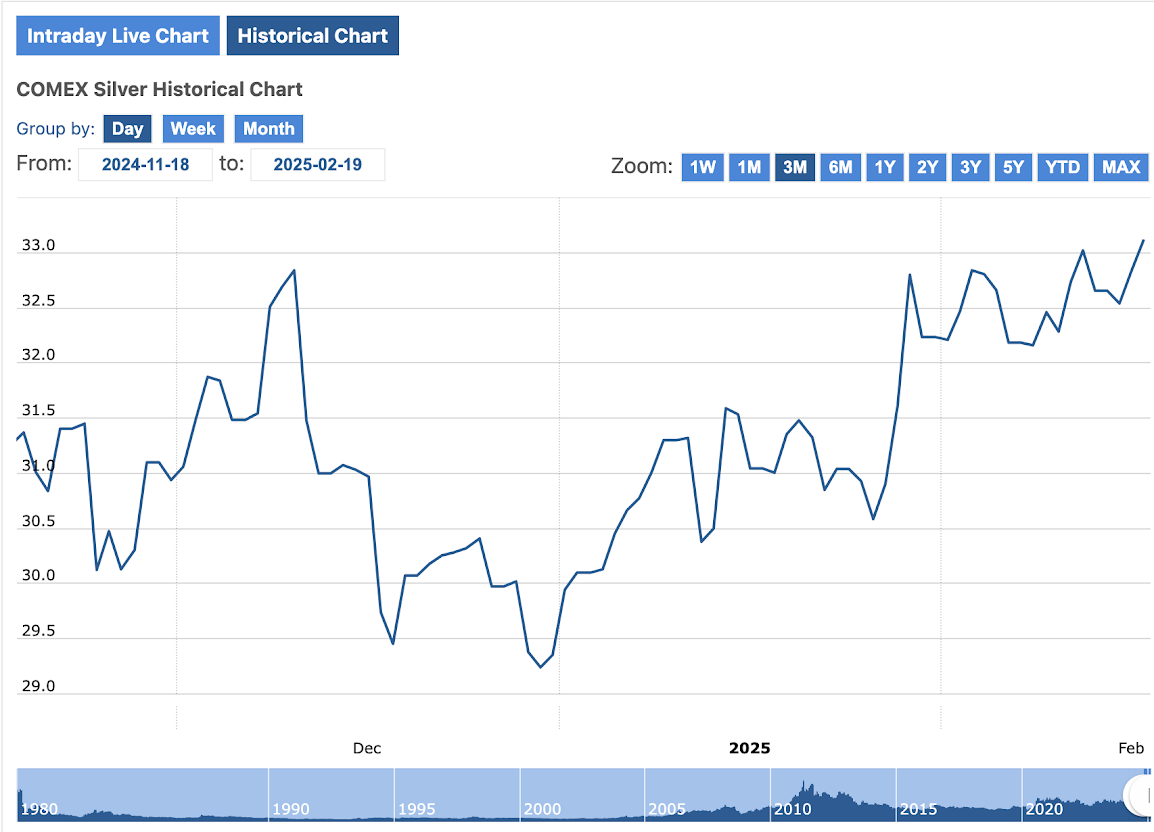
You can see the “cup” with the twin highs of just below $33 per ounce. Following the last peak, we see a dip in the price followed by what appears to be a consolidation “handle.”

A handle pattern on the chart of a stock or commodity often precedes a breakout.

This potential breakout will be something to watch for in the coming weeks.

Regardless, given the gold-silver ratio spread, silver appears to be set up for a significant leg up in the near to midterm. If this plays out as it has historically, this is a good time for investors to take advantage of silver’s relatively lower price before the breakout begins.


Mike Maharrey is a journalist and market analyst for MoneyMetals.com with over a decade of experience in precious metals. He holds a BS in accounting from the University of Kentucky and a BA in journalism from the University of South Florida.

Audit the Fed, Audit Fort Knox, Audit Everything

(Clint Siegner, Money Metals News Service) Americans have to wonder, based on revelations coming out of Washington DC, whether government waste, fraud, and abuse is happening on an industrial scale.

The need to perform audits and implement controls is obvious, despite wailing from people who somehow aren’t happy with the questions being asked. If we are going to have a republic, taxpayers need some confidence their hard-earned money is well spent.

The word “audit” has some negative connotations – mostly associated with taxes and the Internal Revenue Service.

But well-run private sector companies do audits as a matter of routine and for a number of good reasons.

Metals stored in the Money Metals facility are perpetually audited. And we reconcile bank statements against client payment records, conduct physical counts of our entire inventory daily, audit staff adherence to internal controls and procedures, audit the auditors, and so on.

Money Metals has never had an internal loss in its 15 years of operation. Everyone working in our business understands and respects the need to run a tight ship and that details matter. Audit and accountability is part of the company’s culture.

There is generally a lot more “give a damn” found in the private sector, something which appears to be mostly missing in Washington DC.

Fort Knox

Fort Knox has not been credibly audited for decades.

Here are some other points to ponder as the debate heats up over federal audits.

As for Fort Knox, it’s been decades since there was a credible audit of its contents.

As Money Metals researcher Jan Nieuwenhuijs detailed last week, one of several problems is that vault compartments have been opened without proper re-auditing.

Without robust auditing and accountability, the problems only get worse with time. Defense Secretary Donald Rumsfeld announced in a press conference on Sept. 10, 2001 that the Pentagon couldn’t account for $2 Trillion in spending. Unfortunately that story was buried by the events that ensued the following day – September 11th.

More than two decades have passed and the Pentagon still cannot pass an audit. How much more has been wasted or stolen? Corruption and apathy are problems that continually grow unless they are rooted out.

Government employees are suddenly facing accountability. Private citizens have a right to privacy. But government agencies, the Federal Reserve, and NGOs gorging themselves on taxpayer money do not.

No taxpayer funded organization is entitled to unquestioning trust. In the best of circumstances, Americans should “trust but verify.” Under current circumstances, the proper stance is closer to “trust absolutely nothing.”

Intensive auditing and housecleaning will be the only road back to some level of trust.

It’s an important part of a much needed cultural shift.

For those of us who care about honest money, audits represent step one in getting rid of the Federal Reserve. Americans weren’t quite ready to “End the Fed” when Ron Paul made that a cornerstone of his presidential campaigns. There was far too much trust in the benevolence and wisdom of people like Alan Greenspan and Ben Bernanke.

Audit the Fed

Now the tide may be turning. Americans are less trusting and ready to demand some answers. A look inside the Fed can only help.

There has never been a public audit and full accounting for the Fed’s activities. That is remarkable, given the power of that institution and the amount of money running through it.

The lack of oversight is intentional. Politicians and bankers have been selling Americans on the notion of “independence.” Somehow it is better if the central bank answers to no one and never has to explain exactly what it does with trillions of dollars.

The Fed has been a black box since its inception. Given the disdain for transparency is hardwired there, it’s a good bet citizens would be outraged to know how much waste, fraud, and abuse has developed over time.


Clint Siegner is a Director at Money Metals Exchange, a precious metals dealer recently named “Best in the USA” by an independent global ratings group. A graduate of Linfield College in Oregon, Siegner puts his experience in business management along with his passion for personal liberty, limited government, and honest money into the development of Money Metals’ brand and reach. This includes writing extensively on the bullion markets and their intersection with policy and world affairs.

India Gold Price Sets Records; Impacts Jewelry and Investment Demand

(Mike Maharrey, Money Metals News Service) After moderating in November and December, the price of gold has surged to new all-time highs in India to kick off 2025. Higher prices have weighed on gold jewelry demand but continue to support investment demand.

India ranks as the world’s second-largest gold market.

Despite falling around 6 percent in rupee terms through the last two months of 2024, gold still emerged as India’s top-performing asset class, posting a 21 percent annual gain. This compares to a 26 percent return in dollars.

Beginning in January, gold rallied in rupee terms and is up 10 percent ($286 in dollar terms) so far in 2025. The gold price has set several new records along the way, peaking at ₹86,831/10g.

According to World Gold Council analysts, a combination of geopolitical risks, growing concerns about inflation, and increased investment flows have driven gold prices in India higher.

Gold Jewelry Demand Slumps; Investment Demand Remains Robust

According to the World Gold Council, the rising gold price has “taken the shine” off gold jewelry demand in India. Anecdotal reports indicate retail sales slumped in January, and slow demand persisted through the first few weeks of February.

Gold jewelry is viewed differently in India than in the West. It is seen as not only an adornment but also an investment. Much Indian jewelry is made from pure 24-carat gold, as opposed to the 14- and 18-karat pieces more common in the U.S. and Europe. Many Indian families use gold jewelry as savings.

Indian demand is also heavily influenced by cultural and religious traditions that inform the best times for purchases and gift-giving. Some individuals may avoid making major purchases during certain phases of the lunar calendar, believing that these times bring bad luck.

January 15 marked the end of an inauspicious buying period on the Hindu calendar, but demand weakness appears to have persisted into the current month.

World Gold Council analysts said wedding purchases have also slowed “suggesting that many consumers had front-loaded their purchases when prices dipped in November.”

Sagging demand has resulted in a price spread between domestic and international prices as sellers offer discounts to spur sales.

In addition to slowing sales, many Indian jewelers also report increased jewelry selling as people rush to lock in profits at higher prices.

According to the World Gold Council, many retailers are not restocking due to the high prices because they face challenges in making payments to wholesalers, creating a liquidity crunch in the industry.

Even as jewelry sales dipped, demand for gold coins and bars has remained strong with many investors anticipating further price increases.

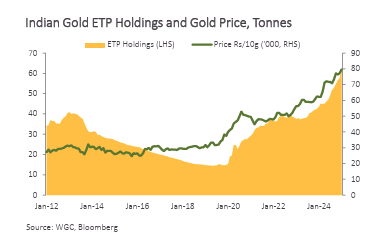
We also see investor interest reflected in India gold ETFs. Gold-backed funds reported “unprecedented” inflows of gold in January of $435 million. Over the previous 12 months, inflows had averaged around $112 million.

In tonnage terms, Indian ETFs increased their gold stocks by 4.6 tonnes, bringing total holdings to 62.4 tonnes.

According to the World Gold Council, investors are directing free cash flows into gold for “diversification amid ongoing global and domestic economic and policy uncertainty.”

Weakness in Indian equities is also pushing investors toward safe havens such as gold.

Gold Imports Dip

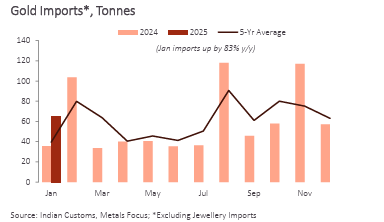
Gold imports in India slowed in January due to the high prices and pullback in demand. Imports are estimated to have run between 30 and 35 tonnes. That was the lowest level since July, but still about 40 percent higher than a year earlier.

Good Government Policy News for Gold Investors

In a bit of good news for Indian gold and silver investors, the new Union Budget maintained the import duty on gold at 6 percent, while reducing the customs tariff on gold jewelry imports from 25 percent to 20 percent.

There had been some speculation that the government might raise the import duty after slashing it significantly last July. The move initially pushed prices down by about 6 percent and drove record gold imports in August.

According to the World Gold Council, the reduction in the jewelry tariff won’t likely have a significant impact on domestic jewelry production because imports aren’t significant and are limited to high-end pieces.

Gold Plays an Important Role in the Indian Economy

India ranks as the world’s second-largest gold-consuming country.

Indians historically have an affinity for gold. While it’s hard to know for sure exactly how much gold Indians hold because of the amount of metal circulating in the underground economy, the best estimate is that Indian households own more than 25,000 tons of gold.

Gold is deeply interwoven into the country’s marriage ceremonies, along with its religious and cultural rituals. Festival seasons typically boost gold demand.

Indians have long valued the yellow metal as a store of wealth, especially in poorer rural regions. Around two-thirds of India’s gold demand comes from beyond the urban centers, where large numbers of people operate outside the tax system. Many Indians use gold jewelry not only as adornment but as a way to preserve wealth.

In the West, gold is generally viewed as a luxury item. Not in India. Even poor Indians buy gold. According to a 2018 ICE 360 survey, one in every two households in India had purchased gold within the last five years. Overall, 87 percent of Indian households own some gold. Even households at the lowest income levels in India hold some of the yellow metal. According to the survey, more than 75 percent of families in the bottom 10 percent of income managed to buy some gold.

The yellow metal was a lifeline for Indians buffeted by the economic storm caused by the government’s response to COVID-19. After the Indian government locked down the country, banks tightened credit to mitigate the default risk. Unable to secure traditional loans, Indians used gold to secure financing. As Indians endured a second wave of lockdowns, many Indians resorted to selling gold outright to make ends meet.


Mike Maharrey is a journalist and market analyst for MoneyMetals.com with over a decade of experience in precious metals. He holds a BS in accounting from the University of Kentucky and a BA in journalism from the University of South Florida.
Gold Market Insights: Revaluation, Audits, and Arbitrage

(Money Metals News Service) In a recent Money Metals podcast, host Mike Maharrey interviewed gold market analyst Jan Nieuwenhuijs about critical topics impacting the gold market, including central bank gold revaluation, concerns about America’s gold reserves, and significant arbitrage activities involving gold transfers from London to New York.

(Interview Starts Around 6:30 Mark)

Who is Jan Nieuwenhuijs?

Jan Nieuwenhuijs
Jan Nieuwenhuijs

Jan Nieuwenhuijs is a respected gold market analyst and investigative journalist known for his in-depth research on gold markets, particularly in relation to central banks, monetary policy, and international gold flows.

Jan Nieuwenhuijs writes articles and analyses for Money Metals Exchange and is known for uncovering critical insights into gold auditing practices and financial policies affecting the precious metals sector. You can follow him on X (formerly Twitter) @JanGold_.

Central Bank Gold Revaluation and Inflation Concerns

Nieuwenhuijs clarified that gold revaluation refers to an accounting method by which central banks adjust the book value of their gold reserves to match current market values, creating an unrealized gain on their balance sheets.

This adjustment allows central banks to convert these gains into spendable funds without physically printing money, potentially leading to inflationary pressures.

Specifically, he noted that the U.S. Federal Reserve currently values its gold certificates, representing the Treasury’s gold holdings, at just $42 per ounce.

If revalued to present market prices, it could yield approximately $700 billion, significantly expanding the monetary base and possibly fueling inflation similar to the 1970s.

Nieuwenhuijs stated that such revaluation practices are indeed under consideration, citing discussions about funding a sovereign wealth fund through these unrealized gains, which raises concerns about substantial inflationary effects.

Auditing America’s Gold Reserves: Transparency and Trust Issues

The conversation also addressed America’s unclear gold reserve status at Fort Knox. Despite claims of holding 8,133 tons of gold, the U.S. hasn’t had a credible audit since the 1950s. Nieuwenhuijs highlighted legislative efforts like former Congressman Alex Mooney’s Gold Reserve Transparency Act, calling for regular audits and thorough checks for encumbrances like leases or swaps.

Nieuwenhuijs’s investigations revealed significant auditing flaws, missing documentation, and repeated breaches of seals on gold compartments, reinforcing the urgency for a comprehensive audit to maintain trust in the U.S. dollar.

Gold Arbitrage: London to New York Transfers

On current gold market dynamics, Nieuwenhuijs explained recent massive gold flows from London to New York driven by arbitrage opportunities due to expected U.S. tariffs on gold imports. Traders have been purchasing gold in London and simultaneously selling futures contracts in New York, exploiting the price discrepancies.

He debunked misconceptions about the U.S. government using this gold for its reserves, highlighting the impracticality of central banks trading 100-ounce COMEX contracts when they primarily deal with 400-ounce bars.

Potential Tariffs and Market Unpredictability

Regarding potential tariffs on precious metals, Nieuwenhuijs considered them unlikely since gold primarily serves as a monetary metal, not a commodity. However, he acknowledged the unpredictability of policy under former President Trump, emphasizing the importance of vigilance among investors. Nieuwenhuijs urged holding gold and silver as tangible assets to safeguard against currency instability and inflation.

Conclusion: Gold as a Secure Investment

In summary, Nieuwenhuijs emphasized gold’s critical role as a secure investment during uncertain economic conditions, advising investors to maintain tangible holdings amid ongoing geopolitical and economic volatility.

Key Questions and Answers

Money Metals Podcast Mike Maharrey Jan Nieuwenhuijs

The following are the key questions and answers in the Money Metals podcast interview with host Mike Maharrey and gold analyst Jan Nieuwenhuijs:

What is gold revaluation, and why is it significant?

Gold revaluation is an accounting practice where central banks adjust their gold reserves’ book value to current market prices, creating unrealized gains. These gains can be converted into spendable funds without physical money printing, potentially causing inflationary pressures.

Why is an audit of America’s gold reserves necessary?

An audit is essential due to longstanding uncertainty about whether America actually holds the claimed 8,133 tons of gold. Credible audits have not occurred since the 1950s, and prior efforts revealed significant flaws and irregularities. A thorough audit is crucial to maintain trust in the U.S. dollar.

What is causing significant gold flows from London to New York?

Gold is moving from London to New York primarily due to arbitrage opportunities created by expected U.S. tariffs on gold imports. Traders buy gold in London and simultaneously sell futures contracts in New York, exploiting the resulting price discrepancies.

Are tariffs on precious metals likely, and what impact might they have?

Tariffs on precious metals like gold are considered unlikely because gold primarily serves as a monetary metal rather than a commodity. However, unpredictable policy changes under former President Trump keep investors cautious, emphasizing the importance of holding gold and silver to protect against currency instability and inflation.

21 Feds Resign Rather than Help DOGE Streamline Government

(Headline USA) More than 20 civil service employees resigned Tuesday from billionaire Trump adviser Elon Musk’s Department of Government Efficiency, saying they were refusing to use their technical expertise to help cut costs.

“We swore to serve the American people and uphold our oath to the Constitution across presidential administrations,” the 21 staffers wrote in a joint resignation letter, a copy of which was obtained by The Associated Press. “However, it has become clear that we can no longer honor those commitments.”

The staffers who resigned worked for what was once known as the United States Digital Service, an office established during President Barack Obama’s administration after the botched rollout of Healthcare.gov, the web portal that millions of Americans use to sign up for insurance plans through the Democrat’s signature health care law.

The day after Trump’s inauguration, the staffers wrote, they were called into a series of interviews that foreshadowed the disruptive work of Musk’s’ Department of Government Efficiency, or DOGE.

According to the staffers, people wearing White House visitors’ badges, some of whom would not give their names, grilled the nonpartisan employees about their qualifications and politics.

Those who remained, about 65 staffers, were integrated into DOGE’s government-slashing effort. About a third of them quit Tuesday in masse.

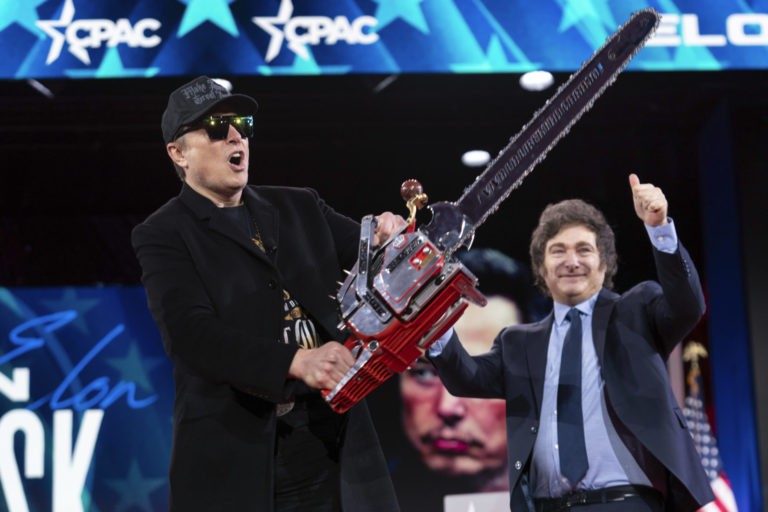
Last week, Musk stood on stage at the Conservative Political Action Conference gathering outside Washington, where he boasted of his exploits and hoisted a blinged-out, Chinese-made chainsaw above his head that was gifted by Argentinian President Javier Milei.

“This is the chainsaw for bureaucracy,” Musk bellowed from the stage.

Adapted from reporting by the Associated Press


Bitcoin Slides to Pre-Trump Prices

(Headline USA) The price of bitcoin fell below $90,000 and other cryptocurrencies saw large drops Tuesday morning, erasing some of the gains digital assets have made since President Donald Trump took office on a pro-crypto agenda.

Bitcoin, the world’s most popular cryptocurrency, was trading at about $89,000 as the U.S. stock market opened. That’s down from about $106,000, which was the price around Trump’s inauguration. The decline in bitcoin and other crypto assets accelerated after a report showed a bigger-than-expected drop in consumer confidence for this month.

Cryptocurrency is highly volatile, and prices can change rapidly. Even with Tuesday’s drop, bitcoin is still up significantly since Trump won last year’s election. Supporters said the price drops represent a good investment opportunity.

“Buy the dips!!!” Eric Trump, the president’s son, said on the social media platform X. He replaced the letter B with the symbol for bitcoin.

It’s been a mixed bag for the cryptocurrency industry in recent weeks. The president and pro-crypto members of Congress have promised to usher in a golden age for the industry and pledged quick action to craft friendly regulations. And in recent weeks, regulators at the Securities and Exchange Commission have signaled plans to drop enforcement actions against key industry players, like Coinbase and Robinhood.

But a large hack of a major cryptocurrency exchange — one of the biggest thefts of all time — and a major scandal involving the president of Argentina and a meme coin have highlighted some of the vulnerabilities in a relatively still nascent industry.

Last week the Dubai-based cryptocurrency exchange Bybit announced it was a victim of a sophisticated hack that stole about $1.5 billion worth of digital currency. A number of security researchers believe North Korea, which authorities have blamed for several other major crypto hacks, was behind the theft.

Argentine President Javier Milei is facing a corruption probe into his promotion of a meme coin, called LIBRA, whose price soared then quickly crashed after Milei posted about it on X. Milei has distanced himself from the meme coin and denied any wrongdoing.

Meme coins are a highly speculative form of cryptocurrency that are mostly minted as jokes and have no intrinsic value but can sometimes soar in price.

One of the crypto developers involved in the LIBRA coin said meme coins are essentially a rigged game that benefits a small group of people at the expense of retail investors in a recent interview with an independent journalist.

That developer, Hayden Davis, also revealed he was involved in the launch of First Lady Melania Trump’s meme coin just before her husband took office. The Melania meme coin was trading at about 90 cents on Tuesday, down from more than $13 when it first launched. The president also helped launch a meme coin just before he took office that’s seen a similar price trajectory.

Solana, a major cryptocurrency that’s a key player in the meme coin ecosystem, has seen its price roughly cut in half since Trump’s inauguration.

Adapted from reporting by the Associated Press

CNN: Anti-Trump CIA Officers Thinking about Selling State Secrets to Foreign Powers

(Ken Silva, Headline USA) CNN has reported a bizarre and troubling admission by the CIA—that the Trump administration’s efforts to rein in the agency may lead to disgruntled employees selling state secrets to foreign intelligence services.

The admission from the CIA came in a Monday CNN report about how an unclassified email sent to the White House earlier this month may have identified some undercover officers.

“The CIA is conducting a formal review to assess any potential damage from an unclassified email sent to the White House in early February that identified for possible layoffs some officers by first name and last initial and could’ve exposed the roles of people working undercover,” CNN reported, before revealing the seemingly far bigger national security risk.

“And on the CIA’s 7th floor — home to top leadership — some officers are also quietly discussing how mass firings and the buyouts already offered to staff risk creating a group of disgruntled former employees who might be motivated to take what they know to a foreign intelligence service.”

CNN quoted an anonymous source, who explained why CIA agents may turn traitor.

“You take whatever number of employees who are gonna get cut loose and they have knowledge of sensitive programs — that by definition is an insider risk,” CNN’s source said. “You’re just rolling the dice that these folks are gonna honor their secrecy agreement and not volunteer to a hostile intelligence service.”

CNN’s report sparked outrage among Republicans, with Rep. Anna Paulina Luna among those calling the threat for what it is: treason.

“CNN now says that “top leadership” at the CIA are worried anti-Trump personnel may by motivated to sell out America to a foreign power,” added conservative commentator Charlie Kirk. “In other words, the people who created the Russia Hoax might now sell America’s secrets to Russia — and then CNN will be there to blame Trump.”

Ken Silva is the editor of Headline USA. Follow him at x.com/jd_cashless.

GOP Rep. Denies Threatening to ‘Kill’ Tucker Carlson Despite Viral Video

(Luis Cornelio, Headline USA) Rep. Dan Crenshaw, R-Texas, denied threatening to kill journalist Tucker Carlson in a Thursday interview with GB News, despite a hot mic capturing his disturbing remark. 

Crenshaw made the apparent threat at the end of his interview with British journalist Steven Edginton at a conference by the Alliance for Responsible Citizenship.

“Have you ever met Tucker?” Edginton asked. 

“We’ve talked a lot on Twitter. If I ever meet him, I’ll fucking kill him. He’s the worst person in the world,” Crenshaw was caught saying. 

Earlier in the interview, Crenshaw dismissed Carlson’s reporting on the federal government exploiting taxpayer dollars to fund Ukraine’s war with Russia. 

Carlson “doesn’t know what he’s talking about,” Crenshaw claimed. 

After the hot-mic clip went viral on social media on Monday, Rep. Marjorie Taylor Greene, R-Ga., pressed Crenshaw on whether he had threatened her friend Carlson. 

“Lol, no,” Crenshaw replied—quickly earning a community note that fact-checked his post: “Dan Crenshaw did in fact say that if he ever met Tucker Carlson he would kill him.” 

Carlson—formerly the host of one of Fox News’s most-watched shows but now an independent journalist—reacted to the apparent threat. 

“Why don’t you come sit for an interview and we’ll see how you do? I’ll send you my address,” Carlson wrote on X, garnering more than 1.2 million views. 

Several conservative and Republican commentators slammed Crenshaw, with X owner Elon Musk asking, “Why is Crenshaw homicidal regarding Tucker?” 

Carlson and Crenshaw have traded jabs on social media, particularly regarding foreign and domestic policy issues. 

“Tucker is a political court jester, desperate for controversy to remain relevant,” Crenshaw tweeted in 2024. 

In another tweet, Crenshaw accused Carlson of being a “click-chaser,” who will “eventually fade into nothingness, because his veneer of faux intellectualism is quickly falling apart and revealing who he truly is: a cowardly, know-nothing elitist who is full of shit.” 

Carlson humorously fired back, calling Crenshaw one of the “dumbest, most liberal Republicans” in Congress. 

Disturbing Emails Expose NSA’s Secret ‘Transgender Sex Chatroom’

Note: This report contains lewd language reportedly used by Biden-era federal employees at the National Security Agency. Reader discretion is advised.

(Luis Cornelio, Headline USA) A group of transgender federal employees at the National Security Agency allegedly used a taxpayer-funded messaging system to blatantly discuss gender surgeries, sexual fetishes and even penetration, according to disturbing emails unearthed by City Journal on Monday. 

Uncovered by journalists Christopher Rufo and Hannah Grossman, the messages—dating back to the Biden administration—expose lewd conversations on a chat system originally meant solely for mission-related topics. This stands in stark contrast to President Joe Biden’s pompous pledge to restore decency in 2021.

According to screenshots of the messages, one transgender-identifying intelligence worker boasted about feeling pleasure from getting “my butthole zapped by a laser,” calling the sensation “shocking.” 

Another worker promoted estrogen treatment, which some biological men take to grow breasts in an attempt to mimic the female puberty. “Look, I just enjoy helping other people experience boobs,” this worker allegedly said.

A third Defense Intelligence Agency worker appeared to reference gender castration, saying: “[O]ne of the weirdest things that gives me euphoria is when i pee, i don’t have to push anything down to make sure it aims right.” 

In another chat thread, an employee positively described their reassignment surgery as “everything,” adding: “I’ve found that i like being penetrated (never liked it before GRS), but all the rest is just as important as well.” 

The same worker claimed the surgery was “100000000% worth it” but lamented that the taxpayers did not foot the bill.  

Another worker indicated they would have traveled to Thailand for facial feminization surgery if insurance hadn’t covered it. However, it’s unclear whether taxpayer-funded insurance paid for it. 

“I’m on tricare retired, and at least as of now, it doesn’t cover any gender affirming surgeries. Paid for everything out of pocket,” the worker replied. 

The messages did not stop there. In another instance, an intelligence worker claimed that their preferred pronouns were “it/its” rather than the traditional “she/her” or “he/him.” 

These shocking messages reflect Biden’s promotion of transgenderism at the expense of taxpayers. This all came crashing down on Jan. 20, when Donald Trump was sworn in as the 47th president. 

“Efforts to eradicate the biological reality of sex fundamentally attack women by depriving them of their dignity, safety, and well-being,” Trump wrote in an executive order minutes after being inaugurated. “The erasure of sex in language and policy has a corrosive impact not just on women but on the validity of the entire American system. Basing Federal policy on truth is critical to scientific inquiry, public safety, morale, and trust in government itself.” 

He added, “Accordingly, my Administration will defend women’s rights and protect freedom of conscience by using clear and accurate language and policies that recognize women are biologically female, and men are biologically male.” 

Read Ruffo’s findings below:


Ex-Democrat Founds Brand to Oppose Trans Athletes in Women’s Sports

(Casey Harper, The Center Square) A growing coalition of female athletes are standing up to keep women’s sports solely for biological women.

The United Nations released a recent report saying trans athletes have won about 900 medals that would have gone to roughly 600 female athletes.

The issue came to a head most recently when President Donald Trump signed an executive order banning biological men from competing in women’s sports and another saying there are only two sexes.

Jennifer Sey, CEO and founder of the sports apparel brand, xx-xy Athletics, told The Center Square that while Trump’s order is significant, there are many more battles to be fought on this issue.

“I think what Trump has done is the right thing,” Sey said. “He’s put this in the cultural consciousness. And now I think we, the people, have to fight for legislation to get this done and final and permanent.”