Note to readers: The following special report about the July 4, 2022 Highland Park mass shooting was reprinted with the permission of online researcher Becca Spinks, who has contributed to Headline USA investigations in the past (see here). Before you begin, make sure to read Part 1 and Part 2!
(Becca Spinks—BX WRITES) The trial of Robert Eugene Crimo III was just four days away. How could it already be February of 2025? While it felt like only a few moments had passed, it had, in fact, been 2 years, 6 months, and 16 days since the fateful day of the mass shooting in Highland Park.
It had simultaneously been the longest and the shortest 2 and a half years of my entire life. I had been so busy with my investigation into the 764 network that I hadn’t thought about the Highland Park investigation in months, and I needed to reorient myself to the case.
My reorientation got a kick start when Headline USA editor Ken Silva sent me a link to Trevor Aaronson’s new podcast. I was shocked. Just a few months prior, Trevor blew me off by saying it was a long-term project, and I had assumed it would be released sometime after Bobby’s trial. I immediately dropped what I was doing and began to listen to the Audible Original podcast, which was comprised of 7 chapters and totaled over 4 and a half hours in length.
I glanced at the clock and noticed it was already 2pm. It was going to be a long afternoon.
Part 3 of my investigation into the Highland Park shooting and alleged gunman Robert Crimo is out now! pic.twitter.com/1JfphkcJAN
— Bx (@bx_on_x) February 24, 2025
It would take me over six hours to finish the podcast due to the number of times I had to stop to drive my palm into my face and send messages about it to my team.
By the time I finished the podcast, I was in disbelief. It wasn’t a “human interest” piece about Bobby and Jamie, like Bob had told me a few months prior. Instead, it was exactly what I had feared.
The podcast was titled, “Into the Madness: A Killer’s Game, A Woman’s Obsession, A Dark Conspiracy.” In it, Trevor used Jamie as a singular source of information, my information to be exact, in order to debunk her obsessive narrative that a vast FBI conspiracy was at play in the case against Bobby Crimo. But Jamie wasn’t the only biased source in this debacle. Trevor’s agenda was likewise abundantly clear. He had set out to prove that conspiracy theories are destroying our country.
Trevor’s overall conclusion was that everything about the case—the music videos, Arcturus, Bobby’s jumbled confession, his interactions with Jamie, and his unusual behavior in court—all boiled down to a simple game. Bobby, as Game Master of his own ARG, carefully deliberated and planned out every step as an elaborate troll and exploited an emotionally unstable Jamie Borchardt into becoming just another pawn in his game. By extension, all of those involved in the independent investigation of the Highland Park shooting were also pawns being duped by a nihilistic madman into falsely believing there could be more to the story.
But that wasn’t the real purpose of the podcast for Trevor. He made this abundantly clear by interjecting his own political commentary, admonishing President Donald J. Trump and conservative media personality Tucker Carlson for spreading conspiracy theories about matters completely unrelated to Bobby’s case. These rants, which seemed out of place in the broader context of the series, revealed a more personal motive.
Trevor Aaronson’s most commonly cited work is his book titled, The Terror Factory: Inside the FBI’s Manufactured War on Terrorism and a related TED Talk, “How this FBI strategy is actually creating U.S.-based terrorists.” It’s not hard to grasp why people view him as a go-to expert on FBI malfeasance, specifically with regard to manufactured terrorism plots.
But in this series, Trevor expressed annoyance at right wing pundit Tucker Carlson, who he claimed cited his work out of context and used it to support a “conspiracy theory” about FBI involvement in the January 6th Capitol Riot. It seems Trevor was peeved at this claim, which apparently didn’t align with his own political views. Jamie approached Trevor because she thought he would humor her theory that the FBI was involved in a cover-up in Highland Park. Seeing an opportunity to prove a personal point, Trevor set out to exploit her, attacking a strawman in the process.
He was at least partly right; the evidence did NOT support an FBI cover-up. But there was plenty of evidence that contradicted the official narrative and raised pertinent questions about the possible involvement of other individuals. My team unearthed plenty of evidence that users of the website Documenting Reality did, in fact, interact with and influence Bobby in the year leading up to the shooting. Documenting Reality members congregated in a paywalled area of the site called The Water Cooler, where we discovered an oddly parasocial group of violence-obsessed miscreants who had forged some very unusual relationships.
Fletcher Stiles, a Documenting Reality user who was close to Bobby, worked as a mental health professional. Stiles lived in Oregon and drove the same model of truck seen in the shooting trip photos. He’d also encouraged other users to commit suicide, including one who met a violent death just a few days later. In addition to the strange cast of characters Bobby was connected to online, there was also an extraordinary amount of physical evidence that Bobby didn’t act alone.
All of these details were omitted by Trevor because his only source was Jamie. My decision to withhold certain information from her turned out to be a wise one.
Parallel Reconstruction
Trevor’s series made it abundantly clear that the information didn’t come from its original source – me. I had shown strategic discretion in my conversations with Jamie, intentionally omitting how I came to find the information. As a result, her statements on the podcast were riddled with lies and inaccuracies. What’s more, these errors were easy for me to prove since I still had records of my conversations with Jamie.
A great example of Jamie’s failure to reconstruct my research was when she claimed to have found all of her clues from Bobby’s online footprint.
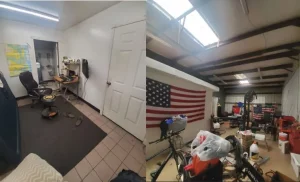
For example, Jamie claimed she identified Todd Rhodes herself based on pictures that Bobby had posted online. But what Jamie didn’t know was that we were only able to identify Todd Rhodes based on the address of his shop in Jacksonville, which was sent to me by Bob. There was nothing in Bobby’s online footprint that would have enabled her to find this.
In another instance, Trevor also claimed that Jamie discovered Bobby’s trip to Oregon based on photos he posted online. He goes on to describe the pictures with the red truck full of guns and Bobby shooting a shotgun. Those photos were given to me directly by Bob and were never posted online by Bobby or anyone else. Jamie only learned about those photos when I posted a short Rumble video discussing my continued research into the shooting in November of 2023.
Jamie also claimed that she used clues from Documenting Reality to locate several individuals—another easily disproven lie.
Not only did I utilize exclusive information to make many of those connections, but Jamie didn’t even have an account on Documenting Reality. She once lamented to me in a personal message that she would have an account of her own if it weren’t for the bitcoin payment required to access the Water Cooler. I suppose it’s possible she figured out a way to get her own account later down the road, but when it came to identifying the key members of the site discussed on the podcast, Jamie was forced to rely on my access to Documenting Reality. These facts were easy for me to prove by referencing my long and detailed conversation history with Jamie.
There were many other examples of this type of misattribution scattered throughout Trevor’s series. In some cases, Trevor was able to reconstruct the information on his own during his interview with Bob. However, none of that changed the fact that Jamie had learned all of that information from me. This might seem like an inconsequential observation if it weren’t for the fact that Jamie, who was an unreliable narrator according to Trevor himself, had presented the evidence I helped her obtain in an unbiased manner.
But as Trevor also noted repeatedly, Jamie was biased towards a vast FBI conspiracy against Bobby to the point of obsession. The evidence that my team and I had painstakingly accumulated over the course of two years was distorted by Jamie to conform to this bias. This was the very thing I was concerned about that led me to try to contact Trevor in the first place.
Trevor undoubtedly knew that I was the source of Jamie’s information. Not only had I told him explicitly in my many unanswered messages to him, but he had used elements of my previously published research to build his own understanding of certain events, and he must have known I would listen to his podcast. Maybe Trevor underestimated my ability to fight back, or my ability to offer a reconstruction of how we obtained, through meticulous OSINT research, all of the information that Jamie stole.
Or perhaps, he simply didn’t care because that’s not what he was getting paid to do.
Deny, Deny, Deny
Admittedly, Trevor did a fair amount of investigative work of his own during the creation of the series. He used Jamie’s stolen information about the identities of key Documenting Reality users to track them down and ask them to comment on their involvement.
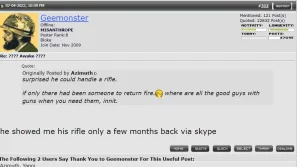
First, he tracked down a Documenting Reality user named Geemonster, who was involved in the Motley Crue Skype call. Geemonster, a man from the UK whose real name was Gareth Wilkins, was on our radar not only because he led the Motley Crue Skype group, but because he was reported to be a Nazi.
However, I dismissed Wilkins as being a co-conspirator early on in our research. He had responded to the news of the shooting with immense sorrow, and frequently chastised other users who tried to turn it into a joke. I got the impression that Wilkins, who was much older and an ex-heroin addict, saw himself as a father figure to Bobby and was genuinely distraught by his alleged actions. Wilkins conversation with Trevor seemed to support this conclusion.
Trevor then turned his attention to Chris Wilson, the owner of Documenting Reality, who agreed to speak with Trevor over a brief email exchange. Wilson previously ran the controversial website nowthatsfuckedup.com between 2004 to 2006, which was initially a site for user-contributed pornography.
During the US-Iraqi War, Wilson began to allow U.S. military personnel to gain access to the site in exchange for “trophy photos”, or graphic depictions of corpses and other disturbing imagery submitted from the kill zones in Iraq and Afghanistan.
The site became known for its disturbing model of “bodies-for-porn,” and as a result, Wilson soon found himself in the middle of the Abu-Ghraib scandal. Wilson was later arrested on 301 charges, 300 misdemeanors and one felony, under Florida obscenity laws. Working with a legal team which specialized in First-Amendment cases, Wilson worked out a plea deal and was ordered to close his business and not work on any adult websites for five years. Wilson founded Documenting Reality exactly 5 years later, in 2011.
The presence of “feds” on Wilson’s site wasn’t just a rumor. Bob Sr. told me the FBI had outright admitted to him that they had agents on the forum. This same information was parroted by Chris Wilson in the days and weeks following the shooting as he lamented attempts by the feds to persuade him to shut down the site.
Wilson also acted suspiciously in the aftermath of the shooting, removing several posts made by Bobby in the early morning hours of July 4, 2022. Trevor didn’t ask Wilson about any of these things. He did, however, ask Wilson whether or not he had ever met Bobby in person. Wilson also lived near Jacksonville, and Bobby had once told Jamie in a phone call that the two had met. Wilson denied this, and Trevor moved on.
The next user to be questioned by Trevor was Todd Rhodes. Trevor didn’t record the conversation, he only narrated what he claims Rhodes told him. And of course, what Rhodes told him is that he didn’t know a thing about Bobby’s personal life, nor did he have any suspicions that Bobby may commit a violent act in the near future. He had already told the FBI everything he knew and was completely without fault in the matter.
Again, Trevor moved on.
Trevor was able to successfully track down the user Aphid Lip, a man named Brian who Jamie believed was responsible for grooming Bobby, and he was also able to track down Fletcher Stiles. Both men claimed they never met Bobby in Oregon.
Fletcher told Trevor, “I never attended anything with Bobby. Your information is false.” Brian backed this up, telling Trevor he knew who the two people in the Oregon photo were, and that they were actually two different people from the site. He then offered to ask those two people, who were unnamed, to contact Trevor. They never did. Trevor moved on.
Most of the Documenting Reality users that Trevor interviewed were also interviewed by the FBI, an important fact that we wouldn’t learn until later, well after we had identified them as people of interest in our own, independent investigation.
But Trevor seemed determined to use his interviews as irrefutable evidence of the point he’d been attempting to make all along—that we were all crazy conspiracy theorists, our minds warped by conservative media into seeing things that weren’t really there. Realistically, the fact that the gore and violence obsessed miscreants on that website denied their involvement in a mass killing that the FBI had already questioned them about isn’t really surprising or revealing.
Trevor used his conversations with Jamie to form an erroneous conclusion:
“During one of those livestreams, Brian mentioned the Highland Park shooting, the Skype group, and the FBI’s interest in it. Reed clipped the video and took to Twitter with a wild claim – Brian had groomed Bobby to commit the Highland Park shooting. Jamie stalled upon that tweet, and it became a key piece of her theory that Bobby had been manipulated or coerced, possibly by an undercover law enforcement agent. If all of this sounds absurd, well, it is. But the real absurdity is how common this kind of story is becoming. Tweets from internet randos like Reed are feeding conspiracy theories and spreading misinformation through American society. Every single day. Take for instance, this claim from President Donald Trump during a 2024 Presidential debate…”
Trevor claimed that Jamie’s entire “conspiracy theory” was based on a single tweet from another Documenting Reality member, Reed, who had claimed on Twitter that Brian (Aphid Lip) groomed Bobby. In reality, we were already following in the footsteps of the FBI’s own investigation into the matter based on a combination of non-public information provided by Bobby’s family and posts made by members of Documenting Reality. The tweet he was referring to, where Reed accused Brian of grooming Bobby, wasn’t posted until July of 2023, one full year into our investigation. Trevor was attacking a strawman in his attempt to debunk all of our hard work, and he was revealing his political bias in the process.
There was another Documenting Reality user that Trevor curiously neglected to mention in his series. A prolific user of the site named Yanni ranked as one of the highest people of interest in our investigation due to his close relationship and proximity to Bobby.
In my conversations with Bob Sr., he mentioned that Bobby had called a number immediately after the shooting before heading to a home in Northbrook, according to phone records that Bob pulled for investigators that same day. The call was made at 11:06am local time. It took Bob a while to dig through his records and find it, but he eventually sent me the phone number. I was able to trace that number to a person named Joshua Rangel in Northbrook, Illinois.
According to an FBI affidavit released in support of a search warrant of Bob’s home, Bobby fled the scene of the shooting and traveled on foot to his mother’s house to pick up her vehicle. Bobby then stopped by his father’s house prior to driving to the residence of a person in Northbrook, who the FBI identified as “Individual A”, which confirmed that Bobby visited Rangel after the shooting. When asked about this visit, Bobby allegedly stated that he stopped for a drink of water.
The evidence that Yanni is Joshua Rangel is strong. Yanni and Bobby both confirmed in Documenting Reality posts that they knew each other in real life and that Yanni lived near Bobby, close to O’Hare airport. On Joshua Rangel’s Facebook page was a recent Marketplace listing that placed him at a location only a few miles away from O’Hare. Yanni also claimed that he was interviewed by the police right after the shooting, and we know for certain that Joshua Rangel was interviewed due to Bobby calling his number and stopping by his house after the shooting.
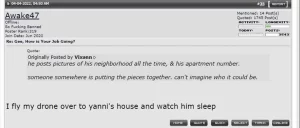
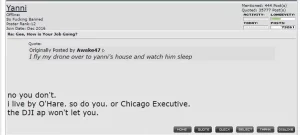
The activity of Yanni on Documenting Reality was by far the most suspicious with regard to the shooting. Yanni and Bobby had been posting on the forum on July 3rd and 4th, in the late night and early morning hours before the shooting, but Chris Wilson scrubbed the majority of these messages. When the news broke, a Documenting Reality user posted a thread in the Water Cooler titled, “??? Awake ???” referencing Bobby’s username on the site, Awake47.
The original poster wrote, “Did Awake just kill a lot of people in Chicago? Super nice guy.. I wonder what made him do it..” In response, Yanni wrote, “what. I was just joking,” to which the original poster replied, “I thought you were too. what. the. fuck.”
My research partner Paul said that Jamie got cagey whenever Rangel was brought up. She once told him that she knew him and that he was just a college kid who was harmless and had nothing to do with anything. This raises the possibility that Jamie didn’t even mention it to Trevor, perhaps due to some sort of personal bias, or perhaps for another reason.
Also missing from Trevor’s analysis are several other users of interest, including one woman who sent Bobby money via CashApp prior to the shooting. Despite all of the suspicious characters involved in the mystery, Trevor limited his research to the individuals on the Motley Crue Skype call who all plainly denied involvement, leading him to conclude that there was absolutely no evidence that anyone from Documenting Reality had anything to do with the shooting. I strongly disagree with this conclusion.
Interestingly enough, the Facebook activity of Joshua Rangel had become increasingly bizarre, even threatening, in the build up to Bobby’s trial. On February 16, 2025, Rangel posted:
The man that I loved… Robert Eugene Crimo III is innocent. Falsely accused in some federal plot to control the populace so that the rich get richer. The poor get poorer. And the dumb blind idiots? Get feasted on by the wolves among them like the sheep they truly are.
Jamie’s dodgy attempts to distract investigators away from Rangel suddenly made a lot more sense.
The Honeypot
Trevor had succeeded in painting Jamie as a crazed conspiracy theorist. On Audible, the description for his podcast read:
Into the Madness is a deep dive into the events leading up to the mass shooting and the story of a woman who became a confidant to Crimo and the final player in his game. Drawing from dozens of interviews and more than 48 hours of recorded calls with Bobby, investigative journalist Trevor Aaronson tells a story that will challenge everything you think you know about mass shootings, conspiracy theories, and the fragile boundary between reality and illusion.
48 hours of recorded calls with Bobby—calls which were recorded non-consensually by a woman named Jamie Borchardt. Trevor was quick to respond to criticisms over his use of the recorded calls by asserting that Jamie lived in a one-party consent state.
But the black and white legality of the matter didn’t answer for the extremely gray-area ethical dilemma posed by publishing such content. I have to admit, the recordings that Trevor included in his podcast were eye-opening. They exposed Jamie as far more than just a “fan girl”, she was a highly deceptive and manipulative woman who contacted Bobby with a purpose.
Sometime in 2023, Jamie uploaded some pictures of her and Bobby in an intimate bedroom setting, where Bobby appeared to be naked. She used these photos to bolster the claim that she had been romantically involved with Bobby in the past.
But, as mentioned previously, Jamie also claimed to have met Bobby in 2016, when he was only 16 years old, and she was much older. Then, she clamed that she and Bobby had an online-only relationship up until the shooting. Bob looked at the photos and immediately dismissed them.
“These can’t be real”, he said. “They look photoshopped.” He was right. The pictures showed Jamie with her typical Snapchat filter, while Bobby was relatively filter-free. Bob continued to insist that Jamie never met Bobby prior to the shooting. Maybe she had been a fan of his music, but Bobby never mentioned her, and Bob had never seen her before.
Jamie pounced on the opportunity to become a prison girlfriend to Bobby, and Bobby seemed happy to oblige. That said, recording 48 hours of phone conversations with her boyfriend without his knowledge seemed like a strange thing to do. I don’t recall Trevor asking Jamie why she chose to record all of those calls. He selectively played clips of the recordings, probably less than 5 minutes total in the entire 4-1/2 hour podcast. The tiny portion of clips that were selected allowed Trevor to paint a neatly curated picture of a killer. That is, if you aren’t listening closely.
The recordings were bizarre and unnatural. Jamie wasn’t really talking to Bobby; she was talking to the voice recorder. I have heard Bobby talk before, both online and in phone calls with his dad, and I can attest that his demeanor while on the phone with Jamie seemed completely different. He sounded softer, more vulnerable, but also guarded.
Trevor concluded that Bobby was manipulating Jamie into playing his game, but the version that I heard was the complete opposite. Jamie’s soft, playful tones were juxtaposed by jarring, interrogational questions. She sometimes seemed to be trying to fabricate things for the recording, for example, by asking Bobby to recall something and then massaging his memory.
Other times her demeanor was controlling, manipulative and interrogational.
Towards the end of the podcast series, Trevor acknowledged that Jamie was an unreliable narrator, and he also attempted to claim she wasn’t actually a hybristophile, but he stopped short of considering an ulterior motive.
In reality, Jamie Borchardt, the woman who claimed to be a nursing student in her 20s or early 30s, was actually a 44-year-old mother of two, information that she desperately wanted to hide. Who was this mysterious woman who fabricated a fake identity in order to record phone calls with a high-profile defendant in jail, only to hand them over to a podcaster for release a mere 4 days before the trial date?
This is just one of many unsolved mysteries in Highland Park.
The Tape
Although I’d already mentally tossed the entire podcast series in the garbage, I was determined to patiently listen to the entire four and a half hours before saying anything publicly. When I got to Chapter 6, titled, “The Confession,” my general annoyance quickly changed into disbelief when Trevor admitted the following:
In the course of investigating all this, I met someone close to the case who had access to some of the evidence, including the video of Bobby’s FBI interrogation. This person allowed Jamie and me to watch the video under one condition – we couldn’t make any recordings. I want to see the interrogation video myself out of professional curiosity. But I want Jamie to see it for a different reason. Bobby confessed during this interrogation. We know that much. I hope that by watching that herself, Jamie might come to the same conclusion that I have. That Bobby is guilty, and that whatever relationship she has with him, to Bobby, is just part of a game.
It was already public knowledge that Bobby Crimo had confessed not long after his arrest during an interrogation with Lake County police, but the specific details of the confession were still under a strict gag order.
In March of 2023, an FBI affidavit was made public detailing the search of the house that Bobby shared with his dad. The search uncovered bomb making materials in Bobby’s bedroom. This news was sensational enough to grab a few headlines, but the most interesting parts were buried within the 31-page affidavit, where the FBI Special Agent included mentions of Bobby’s confession in support of the search warrant.
It’s clear that Trevor borrowed heavily from this FBI affidavit in his section on the confession, but he also included specific, word-for-word quotes from both Bobby and the police interrogators which were not found in the affidavit, or anywhere else, meaning he had to have seen the full tape.
Who was the person responsible for violating the gag order by granting access to both a journalist and a mentally unwell stalker, a woman who was deemed so untrustworthy by Lake County that she had eventually been banned from contacting Bobby in jail? I was reeling.
Trevor quoted the interrogation tape alongside his own scathing commentary about Bobby’s certain guilt. According to Trevor, the tape was proof that Bobby was a soulless, evil murderer who had exploited the media, the investigators, and his “fan girls” in furtherance of his own twisted game. Not only that, but Trevor also made it a point, went out of his way, even, to assert that Bobby acted alone and that no one else could have possibly helped him.
I’m not a legal expert by any means, so I reached out to a lawyer friend and explained the situation. His response was as follows:
That would be illegal and should be directed to the judge. The judge could sanction the prosecution and criminally punish someone if they actually did that. Could subpoena the podcaster. It’s a clear violation of the gag order. It’s also [a] violation of due process for Bobby. If the judge thinks its bad enough, could be grounds for mistrial.
How was it possible that a professional journalist like Trevor could make such a severe misstep?
Spinning Out
In my search for explanations, I asked myself a simple question: Who, aside from Trevor, would benefit from the strategically timed release of this podcast, which painted Bobby as a nihilistic, soulless murderer beyond a reasonable doubt, and painted anyone who questioned the official narrative as a conspiracy theorist?
The obvious answer was the prosecution. So-called “Perception Management” techniques are always a key part of any solid legal strategy, and it’s not unprecedented to learn of scandalous or even illegal measures taken by corrupt state prosecutors in the build-up to a high-profile trial.
In a recent landmark case, Jennifer Crumbley was found guilty of involuntary manslaughter after her son, Ethan Crumbley, killed four students at a high school in Michigan.
The trial and eventual conviction of Crumbley’s parents was compared by the media to the criminal case against Bob Crimo Sr. After her conviction and sentencing, Jennifer Crumbley’s defense attorney filed a motion alleging that state prosecutors paid upwards of $100k to PR firms in order to orchestrate a smear campaign against her. The motion elaborated that as part of the smear campaign, the prosecution violated a gag order by opening up access to media outlets prior to the trial.
One thing that had become increasingly obvious throughout my Highland Park investigation was that Eric Rinehart, the Lake County State Attorney in charge of the case against Bobby, was as dishonest and corrupt as they come. Not only had Rinehart repeatedly made misleading statements to the press, but he also railroaded Bob Crimo Sr. into a last-minute plea deal, forcing Bob to abandon his not-guilty plea and submit to 60 days in jail (The details of the unconstitutional legal case against Bob is outlined in two Rumble videos here and here.)
Rinehart had been committed from Day 1 to exploit the tragedy for political reasons, namely, to enact stricter gun control laws. Was it possible that Trevor’s podcast was part of a PR campaign engineered by Rinehart? Of course, at least in the present moment, this was only a conspiracy theory.
After completing the entire podcast, I made a post on X to Trevor, accusing him of relying on an unreliable narrator, Jamie, to debunk my own research, and potentially breaking laws in the process.
I am simply reeling over this. I really don't want to have to make this post.
Trevor, I tried REPEATEDLY to contact you with information regarding this podcast project. I tried contacting you for over 2 years!! When I finally got in touch with you a few months ago with the help… https://t.co/RvU6ftkpNm pic.twitter.com/7vap7d4CHa
— Bx (@bx_on_x) February 21, 2025
Trevor responded:
3/ — The series — again, had you finished it, you would know this — makes it clear that Jamie is an unreliable source.
There are other distortions in your claims, but these are the most egregious. I won’t be responding further.
— Trevor Aaronson (@trevoraaronson) February 21, 2025
It was bad enough that Trevor called my detailed criticism “attention-seeking behavior,” but even more appalling was his accusation that I was trying to take credit for Jamie’s research.
He wasn’t just accusing me of lying, he was sending me a veiled warning not to proceed with my investigation. Trevor’s seemingly bad intentions began to glow.
***
My next call was to Bob, who had already heard the news and was at a loss for what to do. His main concern had to do with his own recorded interview, which he claimed he asked Trevor to only narrate rather than to include in Bob’s own voice.
To this, Trevor simply responded, “You consented to being recorded.” Bob also took particular offense to Trevor’s portrayal of Bobby’s mother, Denise, as a conspiracy theorist. Denise had suffered greatly in the years following the events of the shooting, causing her mental health to deteriorate. This deterioration was so severe that it was readily apparent to even the most casual observer. Bob felt Trevor had exploited her weakened state to support his overarching narrative about mass shooting conspiracies.
I had never intended to release any of my investigative work prior to the conclusion of Bobby’s trial. I wanted to analyze all of the evidence before making up my mind as to Bobby’s guilt, and I worried that by putting my information out before I had all of the facts, I may be swayed by public opinion myself.
However, I now had to consider the possibility of a deliberate effort by Trevor to debunk my research and harm my reputation. As the unexpected complexity of the current situation started to sink in, I came to a realization. If Trevor is releasing information to sway the public opinion in the direction of Bobby’s guilt, then that leaves me in a unique position to balance the scale.
I woke up after a night of restless sleep to another call from Bob. He called to inform me that the trial wouldn’t have any remote viewing sessions available.
“Good,” I said. “Hopefully that means they will be livestreaming it.”
I quickly pivoted the conversation to the more pressing topic: Trevor’s podcast. I had gone back to the confession part and screen-recorded it. I sent it to Bob via email and urged him to get it to the court. It took some time, but I was able to convince Bob that it did matter. The prosecution had been putting the Crimo family through the wringer for months, and now Bobby’s constitutional rights hung in the balance. The interrogation tape was the prosecution’s key piece of evidence. A piece of evidence so important that the defense had been fighting to get it thrown out on constitutional grounds.
Now, four days before the trial, the information in that tape had been strategically leaked to the media and released to the public. I told Bob that it was possible the confession could be thrown out as a result. This seemed to light a fire under him, and he agreed to talk with the investigators on the following Monday, the day that jury selection was scheduled to begin.
“Hey by the way,” Bob continued, “I talked to Bobby earlier today, and I mentioned the girl in Texas. That’s what he knows you as: the girl in Texas. And he said he knows how your YouTube got banned.”
“Yeah”, I laughed. “Shit happens, I guess”.
“Well Bobby said, ‘tell her I appreciate her.’” I sat quietly for a couple of brief moments to let that sink in. It was a confusing feeling. “Well,” I managed to sputter out, “you can just tell him I said, ‘hang in there.’”
Up Next: Part 4…