Saturday, April 18, 2026

Trump Says US Military Has Started Blockade on Iranian Ports as Iran Calls It ‘Piracy’

(Dave DeCamp, Antiwar.com) ​​President Donald Trump said on Monday that the US military has begun enforcing a blockade on the Strait of Hormuz as Iran has denounced the move as “piracy.”

US Central Command said the blockade will aim to impede the passage of all ships entering or leaving Iranian ports, including those in the Arabian Sea and the Gulf of Oman. US Navy ships will be enforcing the blockade from the Gulf of Oman and the Arabian Sea, east of the Strait of Hormuz.

CENTCOM also said it wouldn’t block ships passing through the Strait of Hormuz that aren’t linked to Iran, but such vessels would likely be blocked by Iran anyway, meaning the US move will have the effect of shutting down all transits through the strait.

Iran’s military released a statement calling the US blockade illegal and warning that if the security of ports in Iran is “threatened,” no port in the region would be safe.

“The restrictions imposed by criminal America on maritime navigation and transit in international waters are illegal and constitute an example of piracy,” said the spokesman for Iran’s Khatam al-Anbia Central Headquarters.

In a post on Truth Social, President Trump warned that any Iranian naval vessels that come near the US Navy ships enforcing the blockade would be “eliminated” and referenced the US bombing campaign against small, alleged drug boats in the waters of Latin America.

“Iran’s Navy is laying at the bottom of the sea, completely obliterated – 158 ships. What we have not hit are their small number of, what they call, “fast attack ships,” because we did not consider them much of a threat,” Trump said.

“Warning: If any of these ships come anywhere close to our BLOCKADE, they will be immediately ELIMINATED, using the same system of kill that we use against the drug dealers on boats at Sea. It is quick and brutal. P.S. 98.2% of Drugs coming into the U.S. by Ocean or Sea have STOPPED!” the president added.

In another post, Trump claimed that 34 ships passed through the Strait of Hormuz on Sunday, but according to ship trackers, only four ships made the transit that day.

Trump ordered the blockade after the US and Iran failed to reach a deal during talks in Pakistan. The blockade is seen as a pressure campaign to get Iran to capitulate to US demands, including a commitment to zero nuclear enrichment, but there’s no sign yet that Tehran is backing down. While Israel has continued its attacks on Lebanon, a ceasefire between the US and Iran has held for several days.

This article originally appeared at Antiwar.com.  


Netanyahu Says the Trump Administration Gives Him Reports on Iran Talks Every Day

(Dave DeCamp, Antiwar.com) ​​Israeli Prime Minister Benjamin Netanyahu said on Monday that he spoke with Vice President JD Vance after the US-Iran talks in Pakistan and described the call as part of a daily report the Trump administration provides him.

“I spoke yesterday with Vice President J.D. Vance. He called me from his plane on his way back from Islamabad. He reported to me in detail, as this administration does every day, about the development of the negotiations,” Netanyahu said at a cabinet meeting, according to Axios reporter Barak Ravid.

The comments from Netanyahu highlight the close coordination between the US and Israel on Iran. Ravid reported in early March that US envoy Steve Witkoff and President Donald Trump’s son-in-law, Jared Kushner, who has known Netanyahu since he was a child, were speaking to Netanyahu and other Israeli officials nearly every day. Witkoff and Kushner led the negotiations with Iran in the lead-up to the war and both attended the Pakistan talks.

A March 4 report from Ravid for Axios reads: “A US official said special envoy Steve Witkoff and Trump’s adviser and son-in-law Jared Kushner talk almost every day to Netanyahu, to the director of Mossad David Barnea, and to other Israeli officials — and that regardless of ups and downs in the past, the coordination over the last month was very close.”

Netanyahu said in his comments on Monday that he and Vance discussed an “explosion” in the US-Iran talks, which he blamed on Iran. The Israeli leader claimed that Tehran had violated its ceasefire agreement with the US by not fully opening the Strait of Hormuz, but Iran didn’t take the step to open the waterway in response to Israel’s escalation of its bombing campaign in Lebanon.

The original ceasefire announcement issued by Pakistan’s prime minister, which the US had approved, said that the deal includes a truce in Lebanon, but the US backtracked on that commitment after Israel kept bombing the country.

“The explosion came from the American side, which could not tolerate Iran’s blatant violation of the agreement to enter the negotiations. The agreement was that they would cease fire, and the Iranians would immediately open the gates. They did not do that. The Americans could not accept that,” Netanyahu said.

Netanyahu also said that Vance told him the US priority was related to Iran’s nuclear program. “He also made it clear to me that the main issue on the agenda for President Trump and the United States is the removal of all enriched material, and ensuring that there is no more enrichment in the coming years, and that could be in decades, no enrichment within Iran. That is their focus, and of course it is also important to us,” he said.

Joe Kent, the former head of the National Counterterrorism Center, who resigned in opposition to the war with Iran, has described the US demand for Iran to commit to never enriching uranium as a “poison pill” in the negotiations that serves Israel’s interest.

“Upcoming negotiations will fail if we don’t restrain the Israelis & stop giving them access to our decision-making. The Israelis push for zero uranium enrichment because they know it’s a poison pill for Iran & will result in the war continuing,” Kent said on X in response to Netanyahu’s comments. “Iran has committed to not developing or obtaining a nuclear weapon since 2003. A deal can be reached about uranium enrichment levels & monitoring – ending the war & opening the [Strait of Hormuz]. This can only happen if we treat the Israelis like the junior partner & put our interests 1st.”

This article originally appeared at Antiwar.com.  


Disgraced Swalwell to Resign from Office as Gonzales Fallout Follows

(Luis CornelioHeadline USAEric Swalwell announced Monday that he will resign from Congress, just days after he was slapped with mounting accusations of sexual misconduct, including two instances of alleged sexual assault.

Swalwell’s post on X stopped short of conceding the allegations, but instead framed the decision to resign as necessary amid growing bipartisan threats of expulsion.

The move came as reports emerged of additional accusations, with critics also threatening to release potentially damaging material.

“I am deeply sorry to my family, staff, and constituents for mistakes in judgment I’ve made in my past,” Swalwell said. “I will fight the serious, false allegation made against me. However, I must take responsibility and ownership for the mistakes I did make.”

Swalwell did not specify his final day in office but said he would work with staff to “ensure they are able, in my absence, to serve the needs of the good people of the 14th congressional district.”

Addressing the expulsion push, he added: “Expelling anyone in Congress without due process, within days of an allegation being made, is wrong. But it’s also wrong for my constituents to have me distracted from my duties. Therefore, I plan to resign my seat in Congress.”

The allegations against Swalwell include claims that he engaged in sexual activity with a female staffer who was too intoxicated to consent.

A second accuser alleged that he used Snapchat, a children’s social media app, to send an unsolicited photo of his penis and demanded one in return.

Two other women described facing unwanted sexual advances from Swalwell and physical touch while they were intoxicated.

His resignation coincided with the launch of a House Ethics Committee probe, as well as two state-level criminal investigations in New York and California. One alleged incident reportedly occurred in Manhattan.

The scandal erupted as Swalwell was campaigning in California’s open gubernatorial primary, where he had been considered a leading contender.

Swalwell’s announcement was soon followed by controversy surrounding Rep. Tony Gonzales, R-Texas, who recently admitted to an affair with a former staffer after initially denying it.

The staffer, Regina Santos-Aviles, later burned herself to death after the affair became known to her husband.

Like Gonzales, Swalwell has denied key aspects of the allegations, particularly claims involving non-consensual conduct.

His rapid political collapse has been described by critics as one of the most dramatic downfalls in modern political history.

Some Republican commentators argue that the speed and intensity of Democrats’ condemnation of Swalwell suggest more damaging revelations could still emerge, or that party leaders may have been aware of his conduct beforehand.

Reports Say the US and Israel May Restart Bombing Campaign in Iran

(Dave DeCamp, Antiwar.com) The US and Israel may restart the bombing campaign against Iran just days into a two-week ceasefire, according to US and Israeli media reports.

The Wall Street Journal reported that President Donald Trump is considering launching “limited” strikes against Iran as part of a pressure campaign that includes a blockade on Iranian ports, though any “limited” attacks will likely lead to a full-blown resumption of the conflict since Iran would almost certainly retaliate.

According to The Times of Israel, all three major Hebrew-language TV networks in Israel reported that the IDF is gearing up for a renewed bombing campaign, meaning it was a coordinated leak from Israeli military officials.

Israel appears eager to restart the war with Iran, as it has impeded progress toward a diplomatic solution between the US and Iran by escalating its attack on Lebanon with a major bombing campaign. Tehran has insisted that the ceasefire must also include Lebanon, and the US initially agreed on that point, but later backtracked after Israel’s escalation.

The Israeli broadcaster Kan cited a senior Israeli military official who said that “Israel is interested in renewing the war against Iran,” after the war ended “too early, without sufficient pressure being applied on Iran regarding the nuclear issue and ballistic missiles.”

Talks between the US and Iran in Pakistan failed to make any progress as the US continued to demand that Iran commit to never again enriching uranium on its territory as part of its civilian nuclear program, a condition Iranian officials have made clear is a non-starter.

This article originally appeared at Antiwar.com.  

Millions in Medical Bills Lead to Demand for Price Transparency Policies

(Emily Rodriguez, The Center Square)  A new report shows hospitals in Virginia filed 1.15 million lawsuits against patients over unpaid medical bills between 2010 and 2024, collecting $1.4 billion.

PatientRightsAdvocate.org collaborated with George Washington University Law School and Stanford University’s Clinical Excellence Research Center to research Virginia court records, revealing what PatientRightsAdvocate.org described as a “coordinated medical debt ecosystem in which hospitals, law firms, and courts collectively extract billions from patients.”

The records revealed the medical bill lawsuits inflicted patients with $45.9 million in court costs while generating $87.1 million in attorneys’ fees.

“In their most vulnerable hour, patients faced undue challenges, such as unclear pricing, difficulty understanding their medical bills, and unexpected legal action for debts they could not afford,” said Cynthia Fisher, founder and chairman of PatientRightsAdvocate.org. “Without consistent price transparency, patients often had limited ability to anticipate or verify costs, leaving many families under significant financial strain.”

Interviewing patients for the report revealed how patients were routinely subjected to hidden and varying prices for hospital services, and that patients experienced significant financial and mental distress from not having access to prices or understanding their bill prices.

Nonprofit hospitals were responsible for more than half, 52.7%, of medical debt lawsuits, despite receiving tax exemptions tied to providing community benefits that only cost 5.9% of hospital operating expenses.

“The report illustrates just how widespread medical debt collection is: how much it accounts for all debt collections; how many hospitals, doctors, and lawyers they involve; and how they follow patients for years after requiring medical care,” said Barak Richman, George Washington University Law School professor. “We aptly describe it as an economic vortex and as an ecosystem of coercive collection.”

Just 20 law firms filed more than half of all cases, often obtaining default judgments that triggered garnishments. Courts issued 812,948 judgments, and patients faced interest rates as high as 18% annually.

“American workers’ paychecks and bank accounts too often fall prey to unethical medical bill collection practices,” said Arnold Milstein, Stanford physician and professor. “We hope our findings trigger much stronger protection by lawmakers, state bar associations and or employers ASAP.”

PatientRightsAdvocate.org wants Congress to pass the bipartisan Patient Deserve Price Tags Act, which they believe would “bring much-needed transparency and accountability to healthcare pricing and help protect patients from these harmful practices.”

“The widespread practice of suing patients underscores the importance of strengthening price transparency policies to ensure that patients are informed and hospitals are held accountable for unfair pricing tactics,” Fisher said.

Somali National Faces Homicide Charges for Deadly Vehicle Collision

(José Niño, Headline USA)  Authorities recently arrested a local truck driver following a devastating nine vehicle collision that claimed three lives. This tragic event occurred on Interstate 71 near Delaware County on a Saturday evening.

According to a detailed report from ABC 6, 50-year-old Modou F. Ngom now faces vehicular homicide charges after his semi truck failed to halt in a construction zone. The massive Freightliner slammed into a line of stationary traffic which caused a catastrophic chain reaction.

The impact proved fatal for three residents of Ashley, Ohio who were traveling together in a Chevrolet Silverado. The deceased include a 37-year-old man and a 36-year-old woman as well as an innocent 1 year old child. Rescue teams also rushed three other victims to local hospitals to treat serious injuries. This horrific scene forced officials to close both sides of the interstate for many hours while reconstruction experts examined the wreckage.

Public figures are now calling for immediate changes to national transportation policies. National security analyst Mehek Cooke shared her outrage on Twitter/X regarding the background of the driver.

Cooke noted that the suspect is a Somali national who gained naturalization during the Obama administration. She argued that the incident represents a systemic failure rather than just an accident. Cooke stated that “Congress is still letting untrained, unqualified truck drivers kill Americans on our roads.” She urged the public to “Give DOT the power now” to prevent further senseless loss of life.

The Ohio State Highway Patrol continues to lead this investigation with support from the Delaware County Prosecutor. Citizens across the state are mourning the loss of a young family while questioning why such dangerous drivers remain behind the wheel. Modou F. Ngom is currently being held at the Delaware County Jail as the legal process moves forward.

José Niño is the deputy editor of Headline USA. Follow him at x.com/JoseAlNino

Judge Dismisses Trump’s $10B Lawsuit Against WSJ, Murdoch Over Reporting on Ties to Epstein

(Headline USA) A federal judge dismissed President Donald Trump’s $10 billion defamation lawsuit against the Wall Street Journal and Rupert Murdoch on Monday over a story on his ties to Jeffrey Epstein.

U.S. District Judge Darrin P. Gayles in Florida wrote in the order that Trump had failed to make the argument that the article was published with the intent to be malicious, but gave the president a chance to file an amended complaint.

Trump filed the lawsuit in July, following up on a promise to sue the paper almost immediately after it put a new spotlight on his well-documented relationship with Epstein by publishing an article that described a sexually suggestive letter that the newspaper said bore Trump’s signature and was included in a 2003 album compiled for Epstein’s 50th birthday.

The letter was subsequently released publicly by Congress, which subpoenaed the records from Epstein’s estate.

The ruling marks yet another blow in the Trump administration’s efforts to manage fallout over its release of the Epstein files and the president’s attempts to use the legal system to chill reporting he find critical of him.

The White House didn’t immediately respond to a request for comment.

Adapted from reporting by the Associated Press

Swalwell Exits California Governor’s Race After Assault Allegations as Rivals Seek His Supporters

(Headline USA) Democratic Rep. Eric Swalwell’s abrupt exit from the race for California governor left his rivals scrambling to lock down his former supporters in a crowded contest with no clear leader, injecting more turmoil into the campaign to lead the nation’s most populous state.

Swalwell’s decision to suspend his campaign Sunday followed allegations that he sexually assaulted a woman twice, including when she worked for him, that were published Friday in the San Francisco Chronicle and later by CNN. While pulling out of the race he remained defiant in a post on the social platform X, saying, “I will fight the serious, false allegations that have been made — but that’s my fight, not a campaign’s.”

For rival candidates in a wide-open race, the key issue is where Swalwell’s supporters will go. He was among the most prominent Democrats in the contest, with mail ballots scheduled to go to voters in early May in advance of the June 2 primary election.

Katie Porter, one of the leading Democrats, posted a line from a San Francisco Chronicle column on X, “Democrats can pull victory from the jaws of defeat by coalescing around Porter.” Billionaire hedge fund manager-turned-liberal activist Tom Steyer said he secured the support of Rep. Jared Huffman, a Democrat whose coastal district runs north of San Francisco, not far from Swalwell’s home turf. Antonio Villaraigosa, the former Los Angeles mayor, pitched a new ad promising to lower gas and grocery costs in a state known for its punishing cost of living.

“As governor, I’ll do everything I can to bring costs down,” he said.

With seven established Democrats and two leading Republicans on a primary ballot with more than 50 candidates, the race remains fluid. While Swalwell has suspended his campaign, his name cannot be removed from the ballot.

“Nobody has really caught fire,” said Democratic consultant Andrew Acosta, who is not involved in the campaign. Swalwell’s supporters “will scatter out to other candidates.”

Swalwell is perhaps best known nationally as a House manager in President Donald Trump’s second impeachment trial during his first term in early 2021. But in a media environment dominated by Trump, the race remains distant from many California voters.

After the publicity about sexual misconduct allegations, “I think there are probably more people who know who Eric Swalwell is than can articulate a Tom Steyer position paper,” Acosta added.

Swalwell was considered a leading contender along with fellow Democrats Steyer and Porter and two Republicans, Riverside County Sheriff Chad Bianco and conservative commentator Steve Hilton, who landed Trump’s endorsement.

The 48-hour period marked a rapid reversal for a candidate who appeared to be gaining momentum in the packed field to replace outgoing Democratic Gov. Gavin Newsom, who is barred by law from seeking a third term.

Though Swalwell has denied the allegations, he has appeared to reference infidelity in multiple statements.

“To my family, staff, friends, and supporters, I am deeply sorry for mistakes in judgment I’ve made in my past,” he wrote. That followed a video post on Friday where he apologized to his wife.

The accusations reordered a wide-open gubernatorial race that had Democrats fretting the party’s large number of candidates could lead to them getting shut out of the general election in November. That’s because California has a top-two primary system in which two candidates advance to the general election, regardless of party.

Swalwell had become a clear target for his Democratic rivals as he began to lock up institutional support. Some had seized on rumors of sexual misconduct that circulated on social media for weeks before the Chronicle’s report.

The San Francisco Chronicle spoke to a woman who alleged Swalwell sexually assaulted her in 2019, when she worked for him, and again in 2024. The woman said she did not go to police at the time of the assaults because she was afraid she would not be believed. In both cases the woman said she was too intoxicated to consent to sex. 

CNN reported on allegations that appeared to come from the same woman, and spoke to several other women who accused Swalwell of other sexual misconduct.

Neither outlet named the woman, and The Associated Press has not been able to independently verify her account and identity. Her lawyer declined to comment.

The alleged 2024 incident occurred in New York, and the Manhattan District Attorney’s Office said it’s investigating. That office urged anyone with knowledge to contact its special victims division.

As Swalwell’s campaign flailed over the weekend, fellow California Reps. Jared Huffman, Ro Khanna and Sam Liccardo said Swalwell should resign, as did Reps. Teresa Leger Fernández of New Mexico and Pramila Jayapal of Washington state.

“This is not a partisan issue,” Jayapal said Sunday. “This cuts across party lines. And it is depravity of the way that women have been treated.”

Some representatives said they would support the rare step of expelling him from the U.S. House should he refuse to step aside.

It all added to the mounting political pressure on Swalwell, which began with allies like Sen. Adam Schiff and Rep. Jimmy Gomez cutting their support. Gomez had helped run Swalwell’s campaign and said he was immediately ending his role.

With the House returning to session Tuesday, the question of whether to expel Swalwell could come to a head quickly. Rep. Anna Paulina Luna, R-Fla., said Saturday that she would be filing a motion to start the process.

Expulsion votes in the House are rare and require a two-thirds majority, but there is recent precedent for taking the step. Republican George Santos of New York in 2023 became just the sixth member in House history to be ousted by colleagues for his conduct.

Huffman, Jayapal and Leger Fernández said they would vote to expel Swalwell from the House, though they said they also support expelling Rep. Tony Gonzales, R-Texas, who admitted to an affair with a former staff member who later died by suicide.

Swalwell, who is originally from Iowa, was elected in 2012 and represents a House district east of San Francisco. He launched a presidential run in April 2019 but shuttered it a few months later after failing to catch on with voters.

Adapted from reporting by the Associated Press

Pope Leo Says He Does Not Fear Trump

(Headline USA) U.S.-born Pope Leo XIV pushed back Monday on President Donald Trump’s broadside against him over the U.S.-Israel war in Iran, telling reporters that the Vatican’s appeals for peace and reconciliation are rooted in the Gospel, and that he doesn’t fear the Trump administration.

“To put my message on the same plane as what the president has attempted to do here, I think is not understanding what the message of the Gospel is,” Leo told The Associated Press aboard the papal plane en route to Algeria. 

“And I’m sorry to hear that but I will continue on what I believe is the mission of the church in the world today.”

History’s first U.S.-born pope stressed that he was not making a direct attack against Trump or anyone else with his general appeal for peace and criticisms of the “delusion of omnipotence” that is fueling the Iran war and other conflicts around the world.

“I will not enter into debate. The things that I say are certainly not meant as attacks on anyone. The message of the Gospel is very clear: ‘Blessed are the peacemakers,’” Leo said.

“I will not shy away from announcing the message of the Gospel and inviting all people to look for ways of building bridges of peace and reconciliation, and looking for ways to avoid war any time that’s possible.”

Speaking to other reporters, he added: “I’m not afraid of the Trump administration or of speaking out loudly about the message of the Gospel, which is what the Church works for.”

“We are not politicians. We do not look at foreign policy from the same perspective that he may have,” the pope said, adding, ”I will continue to speak out strongly against war, seeking to promote peace, promoting dialogue and multilateralism among states to find solutions to problems.

“Too many people are suffering today, too many innocent people have been killed, and I believe someone must stand up and say that there is a better way,” he said.

Trump delivered an extraordinary broadside against Leo on Sunday night, saying he didn’t think the U.S.-born global leader of the Catholic Church is “doing a very good job” and that “he’s a very liberal person,” while also suggesting the pontiff should “stop catering to the Radical Left.”

Flying back to Washington from Florida, Trump used a lengthy social media post to sharply criticize Leo, then kept it up after deplaning, in comments on the tarmac to reporters.

“I’m not a fan of Pope Leo,” he said.

Trump’s comments came after Leo suggested over the weekend that a “delusion of omnipotence” is fueling the U.S.-Israel war in Iran. While it’s not unusual for popes and presidents to be at cross purposes, it’s exceedingly rare for the pope to directly criticize a U.S. leader — and Trump’s stinging response is equally uncommon, if not more so.

“Pope Leo is WEAK on Crime, and terrible for Foreign Policy,” the president wrote in his post, adding, “I don’t want a Pope who thinks it’s OK for Iran to have a Nuclear Weapon.”

Italian politicians across the spectrum showed their solidarity with Leo. Premier Giorgia Meloni sent a message of support for his peace mission while the leader of the main opposition party, Elly Schlein, was more direct, calling Trump’s attacks “extremely serious.”

Trump repeated that sentiment in comments to reporters, saying, “We don’t like a pope who says it’s OK to have a nuclear weapon.”

Later, Trump posted a picture suggesting he had saint-like powers akin to those of Jesus Christ. Wearing a biblical-style robe, Trump is seen laying hands on a bedridden man as light emanates from his fingers, while a soldier, a nurse, a praying woman and a bearded man in a baseball cap all look on admiringly. The sky above is filled with eagles, an American flag and vaporous images.

All of that came after Leo presided over an evening prayer service in St. Peter’s Basilica on Saturday, the same day the United States and Iran began face-to-face negotiations in Pakistan during a fragile ceasefire, with Vice President JD Vance leading the U.S. delegation. Vance is Catholic and recently released a book about his faith.

During his evening prayer service, the pope didn’t mention the United States or Trump by name, but his tone and message appeared directed at Trump and U.S. officials, who have boasted of U.S. military superiority and justified the war in religious terms.

Leo, who is on an 11-day trip to Africa starting Monday — has previously said that God “does not listen to the prayers of those who wage war, but rejects them.” He’s also referenced an Old Testament passage from Isaiah, saying that “even though you make many prayers, I will not listen — your hands are full of blood.”

Before the ceasefire, when Trump warned of mass strikes against Iranian power plants and other infrastructure and that “an entire civilization will die tonight,” Leo described such sentiments as “truly unacceptable.”

In his social media post on Sunday night, however, Trump went far beyond the war in Iran in criticizing Leo.

The president wrote, “I don’t want a Pope who thinks it’s terrible that America attacked Venezuela, a Country that was sending massive amounts of Drugs into the United States.” That was a reference to the Trump administration having ousted Venezuelan President Nicolás Maduro in January.

“I don’t want a Pope who criticizes the President of the United States because I’m doing exactly what I was elected, IN A LANDSLIDE, to do,” Trump added, referencing his 2024 election victory.

He also suggested in the post that Leo only got his position “because he was an American, and they thought that would be the best way to deal with President Donald J. Trump.”

“If I wasn’t in the White House, Leo wouldn’t be in the Vatican,” Trump wrote, adding, “Leo should get his act together as Pope, use Common Sense, stop catering to the Radical Left, and focus on being a Great Pope, not a Politician. It’s hurting him very badly and, more importantly, it’s hurting the Catholic Church!”

In his subsequent comments to reporters, Trump remained highly critical, saying of Leo, “I don’t think he’s doing a very good job. He likes crime I guess” and adding, “He’s a very liberal person.”

Archbishop Paul S. Coakley, president of the U.S. Conference of Catholic Bishops, issued a statement saying he was “disheartened” by Trump’s comments.

“Pope Leo is not his rival; nor is the Pope a politician. He is the Vicar of Christ who speaks from the truth of the Gospel and for the care of souls,” Coakley said.

The Italian Bishops’ Conference expressed regret over Trump’s words, and underlined that the pope “is not a political counterpart, but the successor of Peter, called to serve the Gospel, truth and peace.”

In the 2024 election, Trump won 55% of Catholic voters, according to AP VoteCast, an extensive survey of the electorate. But Trump’s administration also has close ties to conservative evangelical Protestant leaders and has claimed heavenly endorsement for the war on Iran.

Defense Secretary Pete Hegseth urged Americans to pray for victory “in the name of Jesus Christ.” And, when Trump was asked whether he thought God approved of the war, he said, “I do, because God is good — because God is good and God wants to see people taken care of.”

Adapted from reporting by the Associated Press

Oil Prices Climb Back Above $100 and Stocks Slip as Hopes Recede a Bit About the US-Iran War

(Headline USA) Oil prices are back above $100 per barrel, and stock markets are falling worldwide Monday after 21 hours of ceasefire talks between the United States and Iran failed to end their war.

But the moves are more modest than many of the extreme swings that have rocked financial markets since the start of the war in late February. Analysts said that suggests Wall Street still hopes both sides will ultimately avoid a worst-case scenario for the global economy.

The S&P 500 slipped 0.3% and gave back only a bit of its gains from the prior week, which had built on hopes about the weekend’s U.S.-Iran talks. The Dow Jones Industrial Average was down 361 points, or 0.8%, as of 9:35 a.m. Eastern time, and the Nasdaq composite was 0.3% lower.

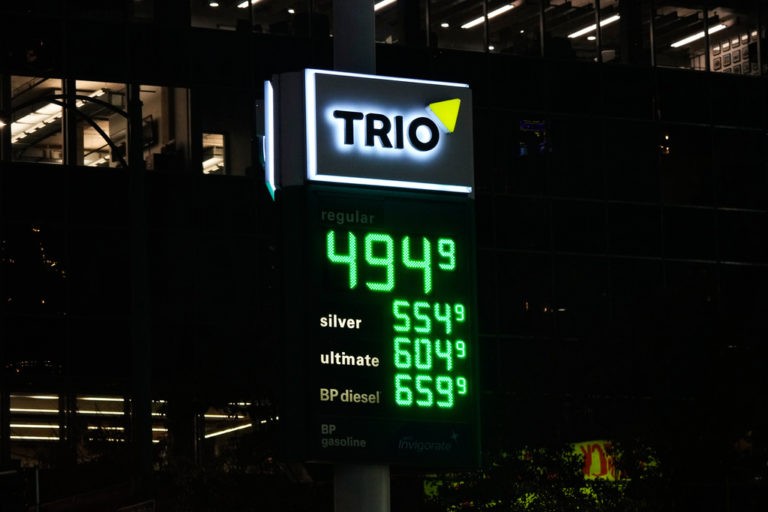
The moves were sharper in the oil market, where prices jumped roughly 7%. After the weekend’s talks failed, President Donald Trump threatened a blockade of the Strait of Hormuz, a move that raises the pressure on Iran by trying to prevent it from making money by selling oil.

A blockade would keep even more oil off the global market, after prices already jumped for everyone because of shortfalls due to Iran’s restrictions on traffic in the important strait. That narrow waterway is how much of the oil produced in the Persian Gulf area reaches customers worldwide.

Iran responded by threatening all ports in the Persian Gulf and the Gulf of Oman.

“Security in the Persian Gulf and the Sea of Oman is either for everyone or for NO ONE,” the Islamic Republic of Iran Broadcasting reported Monday. “NO PORT in the region will be safe,” according to a statement from the Iranian military and the Revolutionary Guards.

The price of Brent crude, the international standard, rose back toward $102 per barrel and is well above its roughly $70 price from before the war. But it remains below the $119 peak it’s touched at times when worries about the U.S.-Iran war have been at their heights.

“Markets are taking some encouragement from the fact that the two sides are talking and that the broader ceasefire seems to be holding, for now,” according to Sameer Samana, head of global equities and real assets at Wells Fargo Investment Institute.

And, as with so many pronouncements made so far in the U.S.-Iran war, much will depend on the details of the blockade and exactly what gets restricted.

“Not all blockades are created the same,” said Brian Jacobsen, chief economic strategist at Annex Wealth Management.

“The developments over the weekend might not be as negative for the markets as many fear.”

In the meantime, big U.S. companies are beginning to tell investors how much money they made during the first three months of the year.

Goldman Sachs, the investment bank, said it made $5.63 billion in profit during the quarter, more than investors expected. But financial analysts pointed to some potentially concerning signals underneath the surface, including lower revenue from the trading of fixed income, commodities and currencies. Its stock fell 3.8%.

JPMorgan Chase, Wells Fargo, Citigroup and Bank of America all report later this week, as do Johnson & Johnson, Netflix and PepsiCo.

In the bond market, Treasury yields held relatively steady. The yield on the 10-year Treasury edged up to 4.32% from 4.31% late Friday.

In stock markets abroad, indexes fell across much of Europe and Asia. Germany’s DAX lost 1%, and Hong Kong’s Hang Seng fell 0.9% for two of the world’s larger losses.

“The outcome of the talks was not really what people were hoping for, that’s for certain,” Neil Newman, Managing Director, Head of Strategy at Astris Advisory Japan, said in Hong Kong about the U.S.-Iran negotiations.

“As we stand here at the moment, it doesn’t look very nice. Certainly, the oil prices are a big concern.”

Adapted from reporting by the Associated Press