Bolivia Uses Gold to Prop Up Its Finances

(Mike Maharrey, Money Metals News Service) The Bolivian government is using gold to maintain the country’s solvency.

Large amounts of dollar-denominated debt burden Bolivia, and the country owns the lowest credit rating of any Latin American country, according to S&P Global. The country’s debt is rated Ca, defined as “likely in, or very near, default.” It is the second-lowest rating on the scale.

According to the agency, the country’s abysmal credit rating is based on its “reduced reserve levels” and its “weak capacity to fully meet its debt commitments over the next six to 12 months.

And yet somehow, the country has managed to keep up with its debt payments, even as its natural gas boom petered out, leading to a dollar shortage.

How?

By leveraging the country’s gold reserves.

The Bolivian central bank has been buying gold from local miners, having it refined abroad (in Turkey), and then liquidating the bullion for dollars to service its debt.

In effect, Bolivian miners are digging real money out of the ground, and the government is turning it into fiat currency to pay its debt obligations.

According to the most recent data reported by Bloomberg, the Bolivian central bank has bought almost 24 metric tons of locally produced metal and monetized 44 tons since May 2023. The operations have generated around $3 billion.

The central bank isn’t just turning gold into dollars to service its debt. It is also bolstering its reserves, reportedly holding 19 tonnes in overseas banks.

According to Fitch Ratings, the central bank effectively financed the entirety of the 2024 budget deficit. It had to step in because the government lacked the ability to tap international markets and raise necessary dollar-denominated funds.

Bolivia is one of a growing number of central banks buying gold from domestic sources. Most countries that source local gold use it to bolster and diversify their reserves. This strategy allows countries to grow their reserves using local currency.

Bolivia has significant gold reserves. Last year, the country produced 26.5 tonnes of gold, according to World Gold Council data.

The strategy isn’t without its problems.

In a statement, the central bank says it buys the gold exclusively using local currency. There is some speculation that the government is printing additional bolivianos to buy gold, exacerbating the already extreme inflationary pressure in the country.

There are also concerns that the government is buying gold from unscrupulous outfits that have little regard for environmental concerns or the welfare of their miners.

The head of a Bolivian organization trying to foster sustainable mining practices told Bloomberg, “The central bank is interested in buying gold and it doesn’t care where it comes from.

However, the central bank insists it “only acquires gold in the domestic market from legally established participants, registered and authorized by the competent entities.

In 2023, the Bolivian government passed a law requiring domestic gold producers to sell to the central bank first. In 2024, gold exports tumbled by 72 percent.

While this program has allowed Bolivia to keep up with its debts, it may not be sustainable. Inflation continues to rapidly devalue the boliviano. The growing spread in the official exchange rate and the black-market exchange rate between the U.S. dollar and the boliviano is incentivizing miners to look for buyers who will pay for the gold in dollars, even with the government offering a 12.5 percent premium.

This underscores the problem with fiat currency. Governments can create as much fiat money as they want. This leads to persistent price inflation and a steady erosion of purchasing power. Gold is real money. Its value is recognized around the world. And it serves as a lifeline when fiat systems fail.


Mike Maharrey is a journalist and market analyst for Money Metals with over a decade of experience in precious metals. He holds a BS in accounting from the University of Kentucky and a BA in journalism from the University of South Florida.


2 Officers Killed and a 3rd is Wounded in a Utah Shooting, Authorities Say

(Headline USA) Two police officers responding to a domestic disturbance call were shot and killed in Utah and a man was taken into custody after bystanders persuaded him to drop the gun, authorities said Monday.

A sheriff’s deputy and a police dog were shot and wounded in their car as they arrived to help at a neighborhood in Tremonton on Sunday night. The deputy from Box Elder County was released from the hospital Monday and the dog was hospitalized in fair condition, police said.

“These officers are definitely heroes,” Police Chief Chad Reyes in neighboring Brigham City said at a news conference Monday morning.

“We really don’t know what we’re walking into,” he said of domestic disturbance calls. “And they are one of the most dangerous events that we can be dispatched on.”

Police received multiple 911 hang-up calls from a home in the city. A single officer from the Tremonton-Garland Police Department arrived first and was speaking to someone at the home when the man came out with a gun, police said in a news release. Reyes said he believed the man lived at the house.

“The male opened fire on the officer, striking and killing the officer,” the news release said. A second officer from the department who responded “was immediately fired upon by the same male suspect” and was killed, it said.

After the officers were shot, bystanders persuaded the man to put down his weapon, police said. Up to 50 officers from multiple agencies responded. SWAT teams arrived to clear the home and verify that there was no further threat, police said.

Utah Gov. Spencer Cox called what happened “a terrible and tragic night.” He posted online that he joined the state in mourning the loss “of these courageous law enforcement officers.”

The man was arrested on charges of aggravated murder, police said in the news release.

The names of the officers and the suspect have not been released.

Tremonton, which has about 10,000 people, is in northern Utah about 75 miles (121 kilometers) north of Salt Lake City.

Adapted from reporting by the Associated Press.

Money Metals Secures $70 Million to Expand Its Gold-Backed Loan Service

(Money Metals News Service) Money Metals today announced the acquisition of $70 million in total equity and debt capital to expand its program, giving businesses and investors access to low-interest financing secured by their physical gold and silver.

“Accessing cash liquidity without selling precious metals and getting stuck with a capital gains tax bill makes a ton of sense in certain situations, but silver and gold loan options are almost non-existent,” said Stefan Gleason, CEO of Money Metals Exchange, Money Metals Depository, and Money Metals Capital Group.

“Such loans are totally unavailable from traditional bankers who amazingly still view gold and silver with skepticism and/or who are outright unqualified to verify, store, or value them,” continued Gleason.

“But thanks to Money Metals, individuals and businesses can now borrow against their gold and silver without paying exorbitant pawn-shop-type interest rates,” Gleason noted. “Our precious-metals-backed credit lines are quick to set up, user-friendly, and cost-effective.”

Money Metals loan applicants can borrow up to 75 percent against the market value of their metals after depositing their coins, bars, or rounds minted of gold, silver, platinum, and/or palladium as collateral into their own Money Metals Depository storage account.

Underwriting is nearly instantaneous, and terms on Money Metals’ revolving lines of credit include interest-only payments, auto-renewal options, and low interest rates.

“Because of Money Metals’ low cost of capital and because our borrowers provide quality collateral, we can offer rates that are competitive with home equity lines of credit and commercial bank loans,” said Gleason.

“Given the advantages for certain types of borrowers, such as real estate investors and small-business entrepreneurs, we envision demand for our loan program doubling over the next 12 months.”

Borrower collateral is stored in a physically segregated manner and fully insured at Money Metals Depository, the privately operated Class 3 vaulting facility in Eagle, Idaho, that has recently received national attention for being larger than the U.S. Bullion Depository at Fort Knox, Kentucky. The world-class Idaho depository secures precious metals holdings for trustees, IRA custodians, banks, individuals, and businesses.

Borrowers submit a simple loan application, ship their collateral to Money Metals Depository for inspection and storage, and receive funds immediately upon execution of loan documents.

Loan proceeds should be used for business or investment purposes (rather than personal, family, or household purposes) and cannot be immediately used to purchase additional precious metals. Minimum loan size is $15,000 and the maximum is $7.5 million — with the program available to borrowers in nearly all U.S. states and several countries.

Money Metals Capital Group can also provide letters of credit, i.e., financial documents that guarantee payment from a buyer to a seller. Such instruments are used in domestic and international trade to reduce risk and ensure payment.

For more information (or to apply for a loan), call (800) 800-1865 or visit https://www.moneymetals.com/gold-loan.

You Can’t Blame the Big Surge in Producer Prices Entirely On Tariffs

(Mike Maharrey, Money Metals News Service) Producer prices rose significantly more than expected in July, throwing markets into turmoil and calling into question what seemed like an almost certain Federal Reserve interest rate cut in September.

The big jump in wholesale price inflation seemed to confirm worries that aggressive tariffs would eventually manifest in higher price inflation. However, a deeper look at the numbers reveals that import taxes can’t be the sole source of this price spike.

July PPI By the Numbers

The producer price index for final demand surged 0.9 percent month-on-month in July, according to Bureau of Labor Statistics data. It was the biggest monthly increase in producer prices since June 2022.

Wall Street forecast a 0.2 percent increase in PPI.

On an annual basis, producer prices are up 3.3 percent. It was the biggest 12-month increase since February.

Stripping out food and energy prices, core PPI also charted a 0.9 percent gain. That was against a 0.3 percent forecast.

Producer prices reflect costs incurred by businesses at various stages in the production process. The PPI is considered a leading inflation indicator as companies will ultimately pass at least some of those increased costs to consumers.

The Consumer Price Index (CPI) has also shown some heating up of price inflation, but nothing on the scale of the July PPI.

Was This the Manifestation of Tariffs in the Economy?

Mainstream media immediately blamed tariffs for the big jump in producer prices. High Frequency Economics chief economist Carl Weinberg told Reuters the report was “a kick in the teeth for anyone who thought that tariffs would not impact domestic prices in the United States economy,” adding that it was “strong validation” of the Fed’s wait-and-see approach to monetary policy.

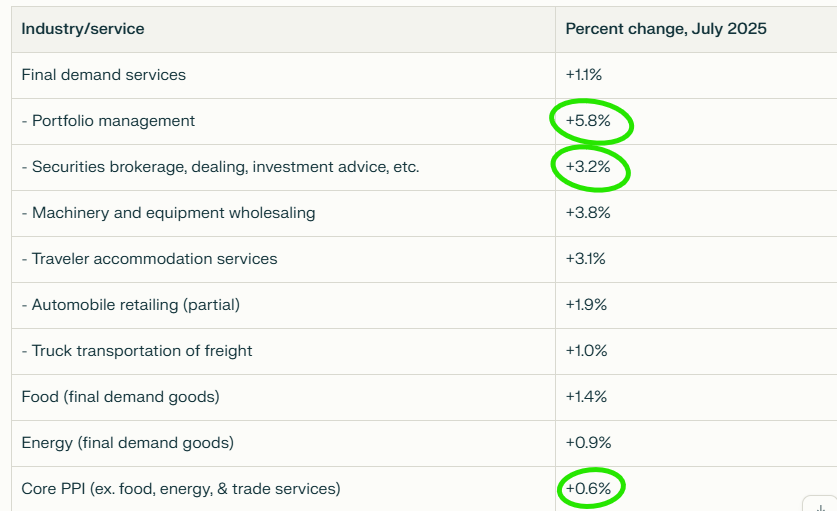
While there was some sign of price inflation in goods, Final Demand for Services exploded by 1.1 percent month-on-month in July. Annualized, core service prices jumped by 4 percent.

Rising service prices are not a product of import tariffs.

A big rise in the cost of financial services drove the services PMI higher. Portfolio management fees soared 5.8 percent, reflecting the surging stock market.

Hotel and motel room prices, airline fares, and freight costs also surged higher.

The price of goods wasn’t immune from this inflationary pressure, gaining 0.7 percent in June. This may well reflect the costs of tariffs. For instance, food prices were pushed upward by a jump in the price of fruits and vegetables.

Excluding food and energy, goods prices rose a more modest 0.4 percent, with notable increases in the cost of steel, aluminum, and primary nonferrous metals.

While the mainstream has taken the July PPI data as a confirmation of accelerating tariff-related price inflation, the fact that services are leading the way undercuts this narrative because services are not subject to import taxes.

WolfStreet noted, “It’s services inflation at the consumer level that is so hard for the Fed to contain, which is why the Fed fears services inflation so much.

Two-thirds of U.S. consumer spending is on services.

Core service consumer prices are also heating up. They came in at 4.4 percent annualized, the worst reading in six months. This accounts for 60 percent of the total CPI.

So Why Is Price Inflation Heating Up?

But if tariffs aren’t causing the surge in service prices, what is?

Good old-fashioned monetary inflation is the most likely culprit.

I have argued for months that the Federal Reserve never did enough to slay inflation. Given the amount of money pumped into the economy between the Great Recession and the pandemic (nearly $9 trillion), coupled with more than a decade of artificially low interest rates, raising rates to 5.5 percent and shedding a relatively small amount from the bloated central bank balance sheet was enough to paper over some of the symptoms, but not strike the root of the problem.

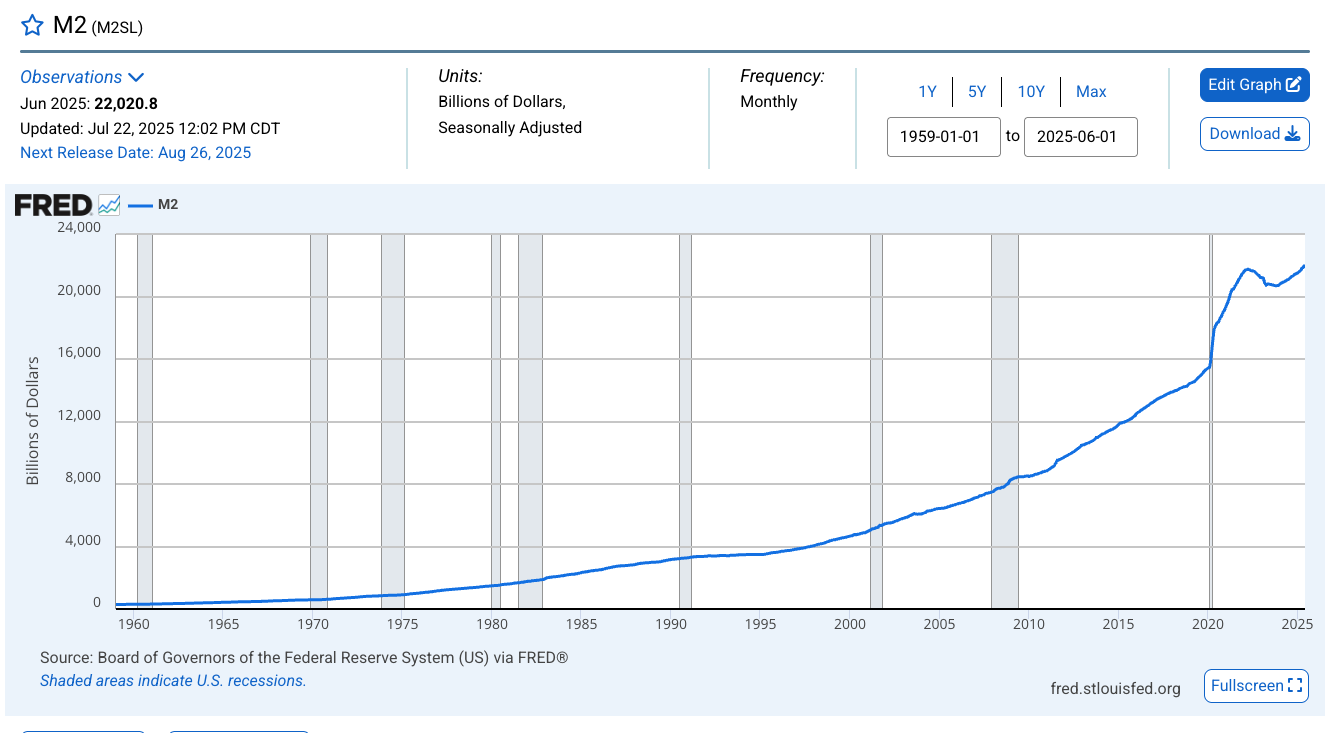
Since then, the Fed has cut rates by a full percentage and it has slowed down its balance sheet reduction scheme. Meanwhile, the money supply has been expanding for well over a year. As of the end of June, the money supply had grown by more than $600 billion since its low point in mid-2023. As of the end of that month, the M2 money supply stood at $22 trillion, above the peak reached during the pandemic.

This, by definitionis inflation. It shouldn’t come as a shock that this monetary inflation is starting to bleed into producer and consumer prices.

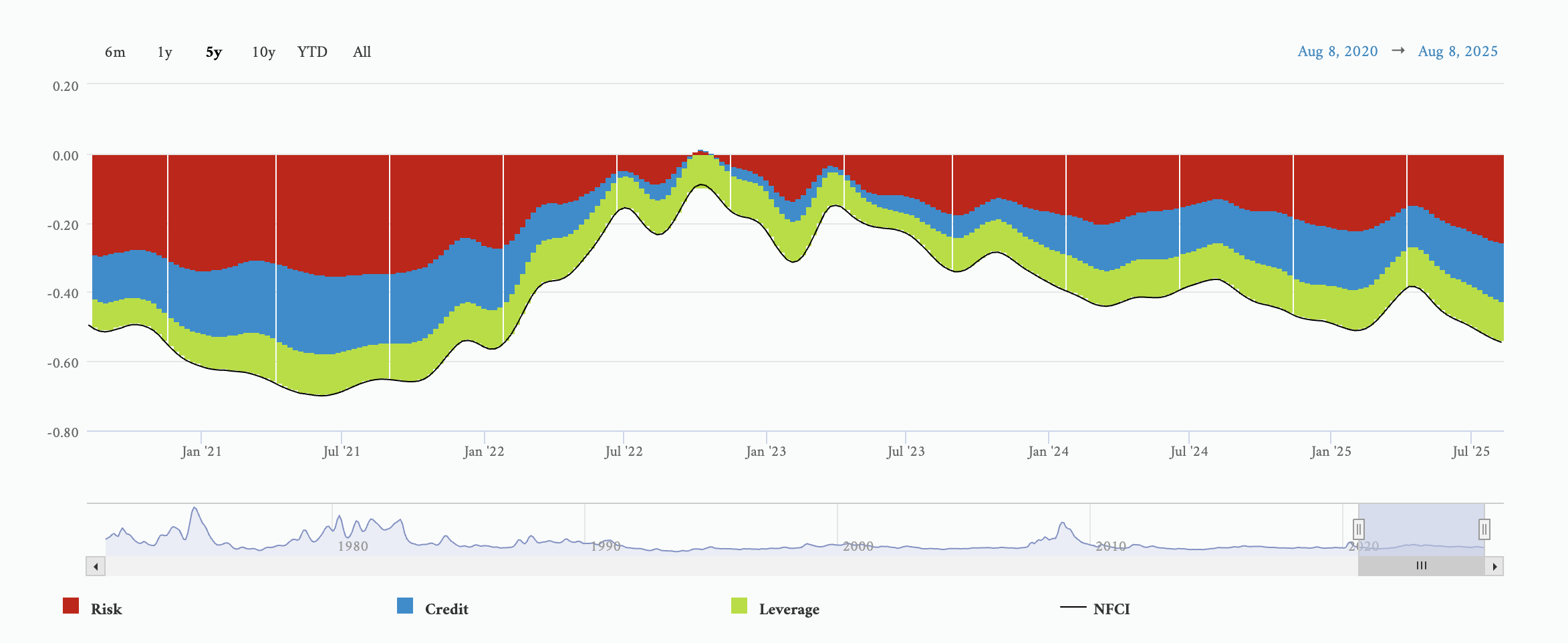
The Chicago Federal Reserve’s own National Financial Conditions Index also indicates that monetary policy is loose from a historical perspective. In fact, conditions weren’t even tight at the peak of the tightening cycle.

Understanding Inflation

It’s important to understand that tariffs don’t cause generalized price inflation. They can cause certain prices to rise, but import taxes don’t drive up the general price level throughout the entire economy. All things being equal, other prices will drop as some prices rise on tariffed products and consumers adjust their behavior.

There is only one thing that causes price levels to generally rise throughout the economy, and that is an increase in the supply of money and credit. As economist Milton Friedman put it, “Inflation is always and everywhere a monetary phenomenon.”

The fact that we now define rising prices as inflation creates a great deal of confusion. It wasn’t always that way. Inflation used to be precisely defined as an increase in the supply of money and credit. One of the impacts of monetary inflation is price inflation.

Henry Hazlitt is best known for his brilliant book Economics in One Lesson. In another essay titled “Inflation in One Page,” he explained why using a more precise definition of inflation is crucial.

“Inflation is an increase in the quantity of money and credit. Its chief consequence is soaring prices.

“Therefore inflation—if we misuse the term to mean the rising prices themselves—is caused solely by printing more money. For this, the government’s monetary policies are entirely responsible.” (Emphasis added)

Tariffs make a good inflation scapegoat, but never forget what Hazlitt said. “The government’s monetary policies are entirely responsible.”

The political class would prefer you not grasp this reality because money creation is the lifeblood of big government. That means they’ll blame everything in the world for inflation, so you don’t point your fingers at the real culprits – all of them!


Mike Maharrey is a journalist and market analyst for Money Metals with over a decade of experience in precious metals. He holds a BS in accounting from the University of Kentucky and a BA in journalism from the University of South Florida.
FBI Director Patel Celebrates the Agents Who Helped Kill Cattle Rancher and Foster Parent LaVoy Finicum

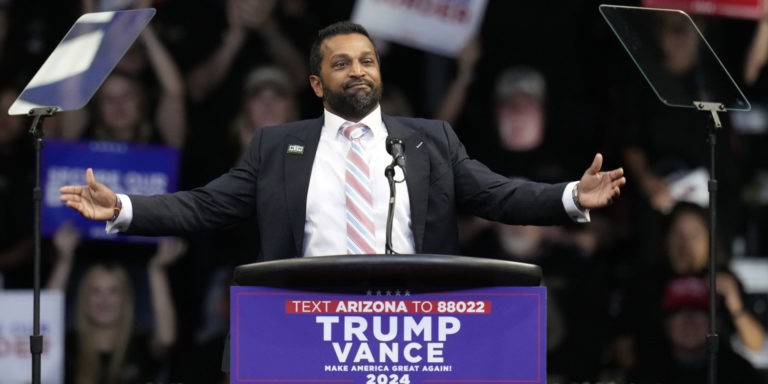
(Ken Silva, Headline USA) In his latest betrayal to the MAGA movement, FBI Director Kashyap Patel has reportedly honored the agents who helped kill cattle rancher, foster parent and constitutional activist Robert “LaVoy” Finicum under highly suspicious circumstances.

“Patel in July presented the team members, including agent W. Joseph Astarita who was acquitted on charges related to the showdown, with the FBI’s Shield of Bravery at a ceremony at the agency’s headquarters in Washington, D.C.,” OregonLive.com reported Saturday.

LaVoy Finicum PHOTO: Wikipedia

The OregonLive article included an apparent photo from an internal FBI newsletter. The photo of Patel and the FBI agents who helped kill Finicum included the caption: “Recipients are recognized for courageous acts in the line of duty or within the scope of their FBI employment. The Hostage Resuce Team responded to a violent extremist militia group’s armed takeover of the Malheur Wildlife Refuge in Oregon in 2016.

“When the militia’s leader and key members planned to meet clandestinely outside the refuge, the FBI and the Oregon State Police staged a traffic stop to arrest them,” the caption continued. “The leader rammed his vehicle into the lead HRT vehicle, trapping SA John Neidert under the leader’s vehicle.”

The FBI’s description of the events that led to Finicum’s death is pure propaganda.

What Really Happened

As has been widely documented, Finicum was killed under suspicious circumstances during the occupation of the wildlife refuge. The FBI and local law enforcement had set up a roadblock to stop Finicum and several other activists, and shot at his vehicle as he approached. Finicum got out of his truck with his hands in the air, but was gunned down by Oregon State Police anyway.

The FBI’s Hostage Rescue Team initially denied firing at Finicum, but agents were later caught engaging in a coverup—removing bullet casings from the crime scene at the dead of night. The FBI was later determined to have fired at least two shots. One FBI HRT operator was indicted over the matter, but a jury acquitted him in 2018.

The Bill Barr Coverup

Last year, Headline USA broke the story that former Attorney General Bill Barr blocked then-DOJ Inspector General Michael Horowitz from conducting his own investigation into the FBI’s conduct in the Finicum shooting.

“The OIG encountered a significant issue regarding its access to information in this matter,” he said in a July 2024 report.

Horowitz said he was allowed to polygraph two FBI HRT operators who were present at the scene of the shooting. However, Barr wouldn’t allow him to interview a third HRT operator, he said.

“The FBI routinely uses polygraph examinations in its administrative misconduct investigations, and the OIG’s request was identical to the polygraph requests that the FBI had previously approved for the first two FBI HRT operators,” Horowitz said.

“Nonetheless, the FBI denied that request following its receipt of a memorandum from then Attorney General William Barr stating that the FBI should deny the OIG’s request because of his belief that compelling the polygraph would not be consistent with FBI policy or appropriate under the circumstances,” he added.

Most of Horowitz’s report focused on the FBI’s “mishandling” of evidence. He recounted how local law enforcement assumed control of the crime scene because only two shell casings were initially found.

However, investigators later determined that at least eight shots were fired, only six by the Oregon staties. FBI aerial surveillance footage later showed FBI HRT personnel moving around the scene in the dark after the shooting—using flashlights to look under and around vehicles, examining the area near the roadblock, and appearing to pick up objects from the roadway in an apparent attempt to engage in a cover-up.

The FBI’s story about the cover-up is that its agents were looking for flash bang canister during its evening search—even though none were collected that night.

The DOJ-IG report debunked the FBI’s cover story, but nevertheless didn’t recommend any penalties for the agents involved. Instead, the DOJ-IG recommended new guidelines for how the FBI HRT handles “sensitive” evidence such as flash bangs.

Last year, Headline USA also contacted Ammon Bundy, the leader of the Malheur National Wildlife Refuge standoff, for his reaction to the report. Bundy, who was arrested over the matter but later acquitted, reiterated his longstanding belief that his friend, Finicum, is dead because of the FBI.

“The FBI HRT caused the entire incident. They shot at the vehicle when the sheriff pulled us over causing Lavoy to flee. Then the FBI shot at the vehicle when Lavoy was driving. Then FBI agents continued to shoot into the vehicle after it was stopped—shooting my brother in the arm, (the bullet is still in his arm today),” Bundy told this publication.

“Then after it was all over the FBI secretly picked up the ammunition casings and lied in the reports and interviews about how many time the shot.”

Kashyap’s Treachery 

Since taking the healm at the bureau, Patel flip-flopped on domestic surveillance and now supports warrantless spying, he’s backtracked on releasing the Jeffrey Epstein files, and he hasn’t exposed the U.S. government’s involvement in the Jan. 6, 2021, protests-turned-riots.

Patel’s also pushed for a bigger budget for the FBI, insisted that Epstein killed himself, and said that there’s nothing more for the public to know about the July 13 Trump assassination attempt. Despite saying that the investigation into July 13 is closed, Patel’s FBI has refused to release records on that incident.

According to former FBI agent Kyle Seraphin, Patel is a closed homosexual who parties all night and shows up for work late.

Patel was recently revealed to be living with GOP donor Michael Muldoon in the billionaire’s Las Vegas home—an arrangement that’s raising some eyebrows within the bureau, according to Seraphin.

“The other question I’ve had people bring up … including people who are pro-Trump … They don’t know a lot of 50- or 40-something-year-old Indian men that are unmarried and living with other men that don’t have something going on,” Seraphin recently said on the show Redacted, hosted by Clay Morris.

“There’s rumors passing around the FBI that have kind of intimidated that this may be more than just two men living together, which by the way, for two men in their 40s and 50s is a pretty strange circumstance.”

The FBI reportedly declined to comment on Patel honoring the agents who helped kill Finicum.

Correction: The original version of this article stated that the FBI agents killed Finicum. It was the Oregon State Police who shot and killed Finicum, and so this article has been updated to say that the agents “helped” kill him.

Ken Silva is the editor of Headline USA. Follow him at x.com/jd_cashless.

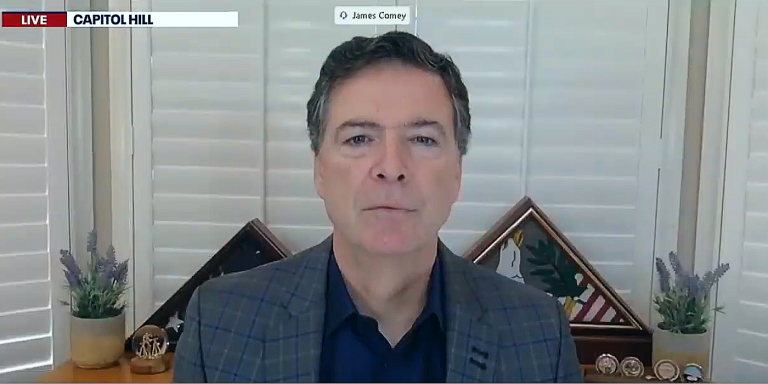
Ex-FBI Director Comey Reveals Himself as Taylor Swift Superfan

(Ken Silva, Headline USA) Former FBI Director James Comey is reportedly under investigation by the Justice Department. Apparently, he’s been listening to pop star Taylor Swift to cope.

In a bizarre five-minute speech on Substack, Comey disclosed his longtime fandom of Swift. He said he went to his first Swift concert 15 years ago, has bought tickets for numerous family members, and is part of a “family Swifty group chat.”

“I know all her music and I listen to it in my headphones when I mow the grass,” he said.

His favorite songs? All Too Well and Exile, he said.

Comey said he draws on Swift for inspiration. When President Donald Trump recently took a swipe at Swift, Comey said she displayed class.

“She’s living her best life—producing great music and not letting the jerks get power over her mind,” he said.

“I don’t want us to become like Trump and his followers. There’s a stunning coarseness and ugliness in the Republican Party today,” he said, adding, “Thank you, Taylor Swift. Keep the faith.”

Comey could be under DOJ investigation for several reasons, including the fact that he led the FBI when it launched the politicized and fruitless Russiagate investigation. He also made last month what appeared to be a veiled death threat against Trump when he posted a photo of seashells arranged to spell out “86 47.”

The number “86” is colloquially known as slang for getting rid of something or someone, while “47” refers to Trump’s position in the presidential lineup.

FBI Director Kashyap Patel is reportedly running a an investigation into whether there was a “grand conspiracy” between intelligence officials and Democratic politicians.

Patel’s FBI’s broader conspiracy case would allow a special prosecutor more time to connect recent alleged crimes to older events, treating them as part of a continuing conspiracy or racketeering operation. The probe could also enable the empaneling of a grand jury outside Washington, D.C., where Trump has historically faced unfavorable juries. Florida, where overt acts of the alleged conspiracy occurred, is being considered as an alternative venue.

Ken Silva is the editor of Headline USA. Follow him at x.com/jd_cashless.

Free Speech or Antisemitic Threats? Jew-Hating Rapper Charged by the Feds

(José Niño, Headline USA) ​“F*** the Jews, f*** you if you Jewish, f*** the Jews, f*** you if you Jewish. One shot, two shots, leave you in the sewage,” were among the lyrics that led to federal charges against an Atlanta-based rapper, despite never engaging in any form of violent or threatening behavior.

Earlier this month, federal authorities arrested Christopher Robertson, 42, after he allegedly posted politically incorrect comments about minorities online and peacefully talked to staff at multiple Jewish facilities across the Atlanta metropolitan area. Court records show that federal authorities charged Robertson of Fairburn, Georgia, with “knowingly send[ing] a communication in interstate or foreign commerce containing a true threat to injure the person of another.”

Robertson operated under the alias James Lomak on social media and performed as a rapper named NoxBond. Under his rapper persona, he refers to himself as the “Root Operator Infinite Tier NoxBond Ba’el” and the “Emperor Of Earth and Be’al of Druids.” His digital presence is marked by anti-religious commentary, exemplified by statements that say “God isn’t real, Jesus isn’t real.” 

According to the Justice Department (DOJ), the events leading to Robertson’s arrest took place at the end of July, when Robertson was discovered inside the secured parking lot of the Jewish Federation of Greater Atlanta. When he encountered the facility staff, he casually introduced himself the “official spokesperson for the white race” and requested to speak with a senior Jewish official “to avoid further antisemitism, and to end the conflict between Israel and Hamas.” Staff members escorted him off the property.

Later the same day, Robertson appeared at The Temple, a synagogue in Atlanta, where he again sought to speak with a rabbi. Security escorted him from the premises.

Around this time, law enforcement began reviewing Robertson’s social media accounts, which were filled with videos that law enforcement described as “increasingly antisemitic.” In one video posted late last month, Robertson declared, “I will not tolerate cultural genocide get that understood I will fight for it, I will die for it…” according to court records.

The following day, he allegedly wrote online, “I’m going to pull up in a synagogue and start some arguments with the goddam Jew overlords in person.”


At the end of last month, Robertson appeared at the Chabad of Peachtree City in Tyrone, Georgia, requesting to meet a rabbi. Staff, having been alerted to his activities, locked down the building and called 911. Police responded and escorted Robertson from the premises.

Robertson later posted a video of this incident online. That same evening, he called several Jewish organizations in an effort to set up meetings with rabbis.

Earlier this month, Robertson’s continued posting videos. In one video, he proclaimed, “Jewish people, you need to gather up whoever the f*** you need to gather up and get them to Atlanta now.”

The culmination of these events led to federal charges. In the sworn affidavit, FBI Special Agent Kelly Gray wrote, “On or about August 1, 2025 in Fulton County, in the Northern District of Georgia, defendant(s) did knowingly send a communication in interstate or foreign commerce containing a true threat to injure the person of another.”

United States Magistrate Judge Christopher C. Bly found probable cause and issued a warrant for Robertson’s arrest. Assistant U.S. Attorneys Brent Alan Gray and Bret R. Hobson are prosecuting the case.

When agents approached his residence, Robertson barricaded himself inside for several hours, but ultimately surrendered peacefully. A firearm was recovered at the scene, and a federal magistrate ordered Robertson detained pending further hearings, even though the rapper had previously interacted with staff and security in a peaceful and lawful manner.

U.S. Attorney Theodore S. Hertzberg, noted in a statement, “The allegations against Robertson, which include menacing visits to Jewish facilities and vile online threats against Jews and Blacks, are of great concern. Protecting the community from hate-fueled violence is a foundational part of the Department of Justice’s mission, and we will aggressively prosecute criminals who abuse the internet to terrorize and intimidate others.” 

Special Agent in Charge Paul Brown of the FBI added, “Mr. Robertson’s alleged actions serve as a disturbing reminder of the terrifying hatred our Jewish communities encounter simply because of their beliefs. The FBI will continue to work diligently with our law enforcement and community partners to investigate any individual who threatens the safety of our residents.”

The court document can be viewed here.

José Niño is the deputy editor of Headline USA. Follow him at x.com/JoseAlNino

Businesses Brace for New Tax Challenges Amid Global Tariff Focus

(The Center Square) U.S. businesses and their partners across the globe are looking to make sure they comply with the highest import duties in decades amid a worldwide focus on President Donald Trump’s slate of tariffs.

Since retaking office, Trump has hit nearly every nation with new tariffs and is working to reshape global trade to give U.S. companies a home-field advantage.

Mike Sanders, CEO and co-founder of the sales tax automation company CereTax, told The Center Square that companies big and small want the lowest possible taxes while complying with federal laws. That can get complex quickly.

For example, minor changes to materials, dimensions, or compositions can justify placing products in lower-tariff categories. The practice is called tariff engineering. One example: Converse puts fuzzy fabric on the soles of its signature All Stars so they can be categorized as slippers rather than athletic shoes. The change comes at a significant tax discount.

Sanders said any justifiable reclassification that can save money is a top business priority.

Such changes are legal, but there are some gray and illegal areas, such as intentional misclassification, undervaluation and fraud.

Sanders said businesses are evaluating their options to reduce tariffs by rewiring supply chains, diversifying sourcing and re-shoring. Another option for lower trade duties: Foreign-Trade Zones, which are free-trade zones often located near Customs and Border Protection ports.

Sanders said many companies are rethinking their tax strategies and revisiting classification and supplier options. And they also want to avoid evasion penalties.

“We also have to make sure that there’s no like misclassification or any kind of disguises or false statements or even omissions, because right now, those are driving some significant penalties just for the additional scrutiny,” he told The Center Square.

Sanders said that as companies review classifications, they may also consider how those changes affect overall sales tax compliance.

On Friday, U.S. Customs and Border Protection announced two trade enforcement wins under the Enforce and Protect Act, which authorizes CBP to investigate and stop evasion schemes. CBP said it uncovered more than $400 million in unpaid trade duties through EAPA investigations from the start of Trump’s second term through Aug. 8, 2025. In that same period, CBP identified 89 cases with “reasonable suspicion of duty evasion.”

“We’re working tirelessly to prevent evasion and ensure a level playing field for U.S. companies,” CBP Commissioner Rodney Scott said.

CBP also investigated 23 U.S. importers and a network of Chinese shell companies funneling goods through Indonesia, South Korea, and Vietnam. Discovered in May, the scheme identified more than $250 million in revenue owed – a figure expected to rise as the probe expands.

CBP enforcement teams carried out port inspections, analyzed trade data, and conducted on-the-ground verifications in Indonesia and Taiwan as part of the investigations. Every importer investigated was found in violation, more companies were exposed, and new evasion tactics uncovered, CBP officials said.

Last week, Trump’s tariffs on products from 66 nations, the 27-nation European Union, and others took effect.

New tariffs raised $58.5 billion in revenue between January and June of this year before accounting for income and payroll tax offsets, according to an analysis of federal data from the Penn Wharton Budget Model. The study found that the average effective tariff rate increased to 9.14% in June from 2.2% in January, when Trump returned to office.

Trump has said he wants to use tariffs to restore manufacturing jobs lost to lower-wage countries in decades past, shift the tax burden away from U.S. families, and pay down the national debt.

A tariff is a tax on imported goods paid by the person or company that imports the goods. The importer can absorb the cost of the tariffs or try to pass the cost on to consumers through higher prices.

Bud Light Considers Tapping Sydney Sweeney to Rehab Tarnished Image

(Ben Sellers, Headline USA) What started as a joke may soon become a multimillion-dollar reality as Anheuser–Busch marketing executives were reported last week to be in serious consideration for a deal with actress and American Eagle model Sydney Sweeney.

The Daily Mail reported that the blonde bombshell could net $10 million dollars in a Bud Light deal currently under consideration.

“Sydney Sweeney’s American Eagle campaign delivered undeniable commercial impact— denim sales surged and the brand’s stock climbed,” said entertainment lawyer Christopher Chatham, an expert in negotiating celebrity endorsements.

“That kind of performance makes her a compelling candidate for Bud Light, especially as the brand considers options in responding to past criticism,” Chatham added. “Beer brands pay for reach, resilience, and relevance—and Sweeney delivers all three, so it would not be surprising if a Bud Light endorsement deal were to approach or potentially reach the seven-figure range.”

The two have been flip sides of a cautionary tale on the power conservatives have in the marketplace amid pressures from the ESG movement to use branding as political virtue-signaling.

Bud Light, once a staple for the St. Louis-based beer manufacturer, lost nearly a quarter of its sales—roughly $1.4 billion in annual revenue—after outrage conservatives boycotted the brand for its promotion of transgender personality Dylan Mulvaney in 2023.

According to some estimates, its overall market value plunged more than $15 billion due to the woke misstep.

It has since tried and failed to rehab its tarnished image, including a partnership with the Ultimate Fighting Championship, but negative perceptions have taken root, making it the butt of many jokes on conservative-friendly outlets and programs.

That included Fox News comedian Jimmy Failla, who floated the idea of a Bud Light–Sweeney collab in an Aug. 5 op-ed, noting that Sweeney’s “good jeans” campaign had sent American Eagle’s stock soaring by 23%.

“Teaming up with Sweeney would mark a return to the Golden Age of beer sales, where catering to the customer’s preferences was far more important than trying to align them with the woke White chicks screaming into their iPHONES on TIK TOK,” Failla wrote.

It is unclear whether the youth-oriented clothing manufacturer intentionally set off a firestorm when it began the campaign, which leftists have denounced as Nazi-esque for suggesting that Sweeney’s Aryan features should be given a positive value judgment.

The attacks ultimately resulted in a sort of Streisand-effect backlash turning Sweeney—who, it turns out, is a registered Republican and expert marksman—into the posterchild for anti-woke resistance.

Even President Donald Trump weighed in, further lifting the public profile of the 27-year-old “Euphoria” actress with a lengthy post on Truth Social.

Many have noted that American Eagle itself has also used non-white pitch-models, such as left-wing singer Beyoncé Knowles.

But when faced with cancel-culture pressure, it doubled down on the decision, thereby plunging headfirst into the culture war on the winning side.

That may give beer execs optimism that Sweeney could be the Great White Hope destined to rescue their brand—once celebrated for its clever commercials—and wipe away any lingering negativity among consumers.

“[I]f Bud Light teams up with Sydney Sweeney, all the ill will from the Dylan Mulvaney fiasco will disappear faster than a CEO on a Coldplay Kiss Cam,” Failla wrote.

“I say that because as a gorgeous and fun loving girl who is not ashamed of her femininity, she’s everything that made Bud Light Commercials successful before the Mad Men in the advertising department were replaced with Mad THEM,” he added.

Ben Sellers is a freelance writer and former editor of Headline USA. Follow him at x.com/realbensellers.

3 Killed, 8 Injured in Shooting in Crowded New York Club

(Headline USAThree people are dead and eight others wounded after a shooting in a crowded New York City club early Sunday morning.

Investigators believe a shooter or shooters opened fire with multiple weapons at Taste of the City Lounge in the Brooklyn neighborhood of Crown Heights after “a dispute” just before 3:30 a.m., killing three men, New York Police Department Commissioner Jessica Tisch told reporters.

“It’s a terrible shooting that occurred in the city of New York,” Tisch said at a news briefing. She said officers are investigating at least 36 shell casings from the lounge, as well as a firearm that was discovered in a nearby street.

Those wounded in the shooting — eight men and three women — are being treated at hospitals for non-life-threatening injuries, she said. The ages the victims range from 27 to 61.

The shooting comes amid a record low year for gun violence in New York City

“I mean, we have the lowest numbers of shooting incidents and shooting victims seven months into the year that we’ve seen on record in the city of New York,” she said. “Something like this is, of course, thank God an anomaly and it’s a terrible thing that happened this morning, but we’re going to investigate and get to the bottom of what went down.”

Adapted from reporting by the Associated Press