Trump Officials Deny Working with ADL on Anti-Semitism Policy

(José Niño, Headline USA) A public disagreement between the Trump administration and the Anti-Defamation League has intensified, as both sides issue contradictory statements about their working relationship on crafting anti-Semitism policy.

The situation kicked off after ADL CEO Jonathan Greenblatt stated in a widely circulated video that the organization was “working with the Trump administration” to combat antisemitism.

Responding to the video, a senior Trump administration official told activist Laura Loomer last Wednesday that while Secretary of Education Linda McMahon had agreed to meet with Greenblatt at his request, there was no ongoing partnership or coordination between the administration and the ADL. 

The official emphasized that Greenblatt had not met President Trump, nor had he met with the administration’s anti-Semitism envoy Yehuda Kaploun or other key advisers. 


They also rejected Greenblatt’s suggestion that the Trump White House was following the same anti-Semitism protocols as the Biden administration, asserting that the current approach represents a fundamentally different set of policies.

This denial arose as some right-wing media figures and activists pointed to instances they claimed showed substantive cooperation between the ADL and administration officials. Among the examples cited were the administration’s calls for prohibiting face masks following Greenblatt’s advocacy on the issue, public praise from Greenblatt for the arrest of a pro-Palestinian activist, and the Trump administration’s support for ADL-driven Title VI complaints dealing with campus anti-Semitism. 

In a similar vein, Headline USA previously covered Greenblatt’s praise of the Trump administration for fighting antisemitism and . 

Representatives for the ADL have not provided further comment, and Trump officials have reiterated that meetings with advocacy groups are common and do not necessarily indicate policy alignment.

José Niño is the deputy editor of Headline USA. Follow him at x.com/JoseAlNino 


Headline Rewind: Our Biggest Scoops from the Week August 11-17

(Ken Silva, Headline USA) Watch our video breakdown of our best stories from last week, and find the time stamps and links below:

0:15: Federal Bureaucrat Teleworked from 10 Different Countries, Including Mexico and Lebanon

Federal Bureaucrat Teleworked from 10 Different Countries, Including Mexico and Lebanon

1:30: SCOOP: Secret Service Shot ‘Suicidal’ Man 18 Times Outside of the White House

SCOOP: Secret Service Shot ‘Suicidal’ Man 18 Times Outside of the White House

2:30: Conservative Plagiarist Benny Johnson’s Show Sued for Stealing Content

Conservative Plagiarist Benny Johnson’s Show Sued for Stealing Content


3:30: EXCLUSIVE: Michigan AG Still Hasn’t Expunged Record for Man Acquitted in Whitmer Kidnap Case

EXCLUSIVE: Michigan AG Still Hasn’t Expunged Record for Man Acquitted in Whitmer Kidnap Case

Ken Silva is the editor of Headline USA. Follow him at x.com/jd_cashless.

Republicans Respond to Data Showing 10M Will Soon Lose Medicaid Coverage

(The Center Square) Democrats are sounding the alarm over a new analysis showing that the One Big Beautiful Bill Act will cause millions of Medicaid recipients to lose their current coverage.

According to the Congressional Budget Office’s newest estimate, Medicaid reforms in the One Big Beautiful Bill Act will result in roughly 10 million people losing eligibility for their current health care plan by 2034.

“This latest analysis by the nonpartisan Congressional Budget Office confirms that the deeply unpopular One Big Ugly Law is also deeply unfair,” House Minority Leader Hakeem Jeffries, D-N.Y., said in a response statement. “The American people deserve better than this cruel Republican budget scam.”

Republicans, however, have pointed out that the breakdown of the numbers offers a different perspective. Out of the 10 million affected, 5.3 million are able-bodied adults without dependents. Under the OBBBA, they could still remain on Medicaid, so long as they participate in work-related activities at least 80 hours per month.

The work requirements would not apply to pregnant women; minors and seniors; foster youth under 26; Tribal members; the medically frail; those already meeting TANF or SNAP work requirements; caregivers with young dependents; or the currently and recently incarcerated.

Another 3.7 million current Medicaid recipients set to lose coverage will still have access to some other form of government-sponsored health insurance. These individuals are primarily dual enrollees in Medicare and Medicaid, or those who are erroneously enrolled in Medicaid in more than one state. The former group would lose Medicaid but could retain Medicare, while the latter would be eligible to claim their Medicaid coverage only in their actual state of residence.

The remaining 1 million impacted individuals are noncitizens who do not meet immigration status requirements for Medicaid enrollment. Those noncitizens have nonetheless received coverage under taxpayer-funded, state-sponsored Medicaid programs.

“The prolonged lie exacerbated by Democrats that 17 million individuals will lose health care coveragefrom the One Big Beautiful Bill Act has finally been dispelled,” House Committee on Energy and Commerce Chair Brett Guthrie, R-Ky., said Monday.

“It’s easy to scare people with coverage loss estimates, but the facts are clear – the vast majority of these individuals are either choosing to lose coverage or aren’t actually eligible for Medicaid, and nearly all are eligible for other forms [of] coverage.”

Overall federal spending on Medicaid will still grow by 30% over the next decade, provided that Republicans refrain from further enrollee-reducing changes in another ‘big, beautiful bill,” which GOP  leaders are considering.

Trump: Zelenskyy Could End Russia-Ukraine War ‘If He Wants To’

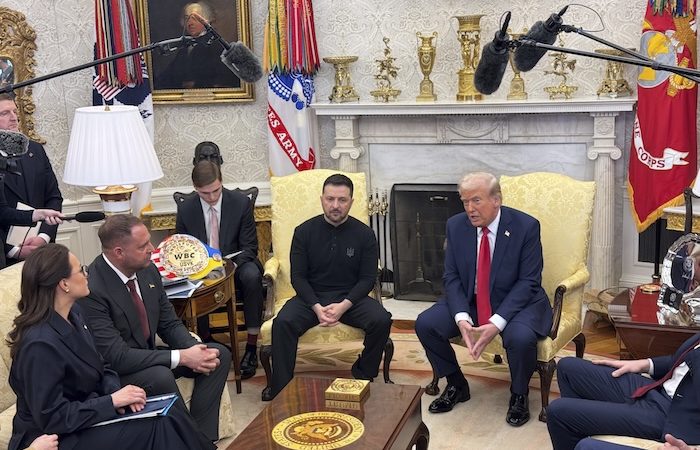
(The Center Square) Ahead of the summit with Ukrainian President Volodymyr Zelenskyy and other European leaders in Washington on Monday, President Donald Trump said Ukraine should give up efforts for NATO membership and Russian-annexed Crimea.

Zelenskyy jetted off to Washington over the weekend after Trump’s meeting with Russian President Vladimir Putin in Alaska failed to produce an immediate ceasefire. British Prime Minister Keir Starmer, French President Emmanuel Macron and German Chancellor Friedrich Merz will join Zelenskyy at the White House on Monday afternoon for discussions with Trump.

Ironing out potential land swaps will be central to the meeting’s agenda. Putin and Trump have suggested that Ukraine cede land to Russia as part of a peace deal, but Zelenskyy has maintained his opposition to this.

Trump reiterated his position ahead of Monday’s meeting, saying Kyiv should relinquish efforts to regain control of its southern Crimean Peninsula, which Russian forces invaded in 2014. The peninsula has been a valuable asset to Moscow during the war.

After walking back his demand to Putin for an immediate ceasefire, Trump appeared to continue a shift in Putin’s direction by suggesting that Zelenskyy carries the burden of ending Russia’s aggression toward Ukraine.

“President Zelenskyy of Ukraine can end the war with Russia almost immediately, if he wants to, or he can continue to fight,” Trump said.

The U.S. has previously maintained that the responsibility of ending the conflict lies with Russia because of its 2014 and 2022 invasions of Ukrainian territory. Zelenskyy responded to Trump’s shift in position on Sunday.

“Russia must end this war, which it itself started,” Zelenskyy said.

Trump also indicated that Ukraine should give up hope of joining NATO. Putin has long opposed Ukraine’s membership in the pact and has held this demand as part of a potential peace agreement.

Still, Special Envoy Steve Witkoff said Sunday that Ukraine would still be allowed security measures from NATO members, a key reason Ukraine sought membership. Witkoff reported that Putin agreed to this measure during Friday’s meeting in Alaska.

Planned Restart of California Oil Production Faces Legal Challenges

(The Center Square) Oil and gas production resumed on May 15 that had been out of service for 10 years after an oil spill off the California coast, with the restart of the Santa Ynez Unit in the Santa Barbara Channel expected to boost U.S. energy supplies by up to 50,000 barrels per day by year-end 2025, according to the U.S. Bureau of Safety and Environmental Enforcement.

Legal challenges remain, however.

Litigations involve the environment, oversight approval involving Santa Barbara County, and accusations from the lieutenant governor and State Lands Commission she leads.

The three platforms that comprise the Santa Ynez Unit – Harmony, Heritage and Hondo – tap into an offshore reservoir containing approximately 190 million barrels of recoverable oil reserves, representing nearly 80% of reserves in Pacific Northwest states and about 3% of total U.S. reserves, the bureau says in a release. Platform Harmony began production on May 15 at a rate of 6,000 barrels a day.

The Santa Ynez unit includes 112 wells located 5 to 9 miles offshore in federal waters, three offshore platforms, a pipeline system, and an onshore oil and gas processing facility at Las Flores Canyon. In the year before the 2015 shutdown, the three Santa Ynez Unit platforms produced an average of about 45,000 barrels of oil equivalent each day.

Restarting production at the Santa Ynez Unit is “a significant achievement” that aligns with the Trump administration’s energy dominance initiative, said bureau Principal Deputy Director Kenneth Stevens.

“President Trump made it clear that American energy should come from American resources,” he said.

The Bureau of Safety and Environmental Enforcement had expected production would resume on Platform Heritage in July and Platform Hondo in August.

Stevens said second-term Republican President Donald Trump’s leadership and Interior Secretary Doug Burgum’s commitment turned a decade-long shutdown into a comeback story for Pacific oil production.

“In just months, BSEE helped bring oil back online safely and efficiently – right in our own backyard,” said Stevens. “That’s what energy dominance looks like: results, not delays.”

The 2015 spill occurred when a 24-inch buried pipeline owned by Plains All American Pipeline ruptured near Refugio State Beach in Santa Barbara County, releasing 140,000 gallons of oil, some of which flowed into the Pacific Ocean and soiled miles of beach. After a cleanup and then years of litigation and class action lawsuits, Plains All American agreed in 2024 to pay $230 million to the fishing industry and shoreline residents and to settlements totaling $72.5 million with California State Lands Commission and Aspen American Insurance.

In February 2024, Houston-based Sable Offshore Corp. bought the dormant Santa Ynez Unit from ExxonMobil, which never repaired the assets. In late May this year, Sable said it had hydrotested seven of the eight sections of the unit’s onshore pipeline and only one final test would be required. The company said it had obtained all permits from state and county governments necessary to resume production. Sable says it has added new safety measures that include a total of 27 emergency shutoff devices and round-the-clock leak detection.

Sable Chairman and Chief Executive Jim Flores said the resumption of Santa Ynez oil production is a “milestone achievement” that will help bring “energy security to the state of California.”

Hurdles are numerous.

Several environmental organizations, including the Center for Biological Diversity and the Environmental Defense Center, have filed lawsuits against the California state fire marshal arguing that waivers were issued to Sable without sufficient environmental review or public input. Another lawsuit challenges the legality of transferring permits from Exxon to Sable without a majority vote by Santa Barbara County’s Board of Supervisors. A court in Santa Barbara County in June granted a restraining order that bars Sable from opening the onshore Las Flores pipeline until litigation concludes.

In a May 23 letter to Sable Vice President of Environmental and Governmental Affairs Steve Rusch, Lt. Gov. Eleni Kounalakis, chairwoman of the California State Lands Commission, accuses the company of falsely portraying Santa Ynez oil production. Kounalakis wrote that Sable’s May 19 release “appears to mischaracterize the nature of recent activities” and that the so-called “restart” was nothing more than “well-testing procedures required by the Bureau of Safety and Environmental Enforcement prior to restart.”

Kounalakis wrote that a failure by Sable to comply with applicable regulatory requirements or to resolve any outstanding permitting issues could constitute a breach of the commission’s leases.

Investors who recently put money in Sable Offshore securities say in a class action lawsuit that the company on May 19 deceptively triggered a stock frenzy when it announced the resumption of oil production at the Santa Ynez Unit, which they contend was not accurate.

Sable share prices rose by 12.5% on the day. Two days later, on May 21, Sable said it raised $256.5 million in a secondary stock offering.

Trump Says Israeli Captives Will Be Released Only If ‘Hamas Is Confronted and Destroyed’

(Dave DeCamp, Antiwar.com) President Trump said on Monday that the only way the remaining Israeli captives would be freed from Gaza is if Hamas is “confronted and destroyed,” a statement that provides backing for the Israeli government’s plans to escalate its genocidal war on the Palestinian territory.

“We will only see the return of the remaining hostages when Hamas is confronted and destroyed!!! The sooner this takes place, the better the chances of success will be,” the president wrote on Truth Social.

The next phase of Israel’s offensive will focus on taking over Gaza City and involves forcibly displacing 1.2 million Palestinian civilians to the south as part of an ethnic cleansing campaign. The plans to escalate come as Palestinians are starving to death in Gaza every day due to the Israeli blockade, and a new mass displacement will make the humanitarian situation significantly worse.

While Trump claims escalation is the only way to free the captives, relatives of the Israelis who remain in Gaza and former hostages are urging for a diplomatic solution. The Israeli military has also been warning that plans to escalate with the goal of the full occupation of Gaza would risk harming or killing the remaining captives, but Israeli Prime Minister Benjamin Netanyahu isn’t concerned.

Trump also claimed in his post that he was responsible for freeing “hundreds” of Israeli hostages, a reference to the ceasefire deal that was signed in January, under which Hamas released 30 living Israeli captives. Hamas also later released Edan Alexander, an Israeli-American IDF soldier, as a goodwill gesture to the Trump administration. More than 100 civilian Israeli hostages were released as part of a short truce deal in November 2023, and just eight Israelis have been recovered alive by the Israeli military.

“Remember, I was the one who negotiated and got hundreds of hostages freed and released into Israel (and America!),” Trump said. “I was the one who ended 6 wars, in just 6 months. I was the one who OBLITERATED Iran’s Nuclear facilities. Play to WIN, or don’t play at all! Thank you for your attention to this matter!”

US and Israeli officials have claimed that Hamas is not interested in a diplomatic deal, but the group’s long-standing position is that it’s willing to release the remaining 50 Israelis, which include only about 20 who are alive, in exchange for a permanent truce. Hamas is also working with mediators Qatar and Egypt to restart ceasefire talks and has accepted their latest proposal.

This article originally appeared at Antiwar.com.

Report: Human Rights Campaign Pressures Transgender Procedures on Minors

(Tate Miller, The Center Square) The Human Rights Campaign pressures children’s hospitals into performing transgender procedures on minors, according to a Do No Harm report.

Do No Harm is a medical organization dedicated to keeping identity politics out of all areas of the medical field, while the Human Rights Campaign (HRC) is an LGBTQ rights group.

Do No Harm medical director Dr. Kurt Miceli and co-author of the group’s report said in a statement obtained by The Center Square: “It is time to expose and root out the Human Rights Campaign’s vast influence over healthcare systems.”

“Our report sheds light on how the HRC weaponized its so-called ‘Healthcare Equality Index’ to pressure pediatric hospitals into chemically and surgically castrating children,” Miceli said.

“By capitulating to the HRC’s political scheme, hospitals have utterly betrayed patients, especially children struggling with gender dysphoria,” Miceli said. “If health systems care about providing high-quality pediatric care, then they should distance themselves from the HRC and its Index.”

Miceli said that “medical professionals must learn the truth about pediatric gender medicine and dare to speak out against the harmful model imposed by the HRC and other ideologues.”

The HRC has not yet responded to The Center Square’s multiple requests for comment.

According to Do No Harm’s report, some of the HRC’s transgender initiatives include “writing the manual on pediatric sex trait modifications, enticing school children to consider where they fit on the gender spectrum, standing against legislation that restrains the medical transition of minors, and fighting for insurance companies to cover sex trait modifying medications and procedures for children.”

The HRC ensures “that healthcare providers are on board” with these initiatives via its Healthcare Equality Index (HEI).

“The HEI itself measures hospitals’ adherence to the tenets of gender ideology, by evaluating healthcare facilities’ policies and practices within five major categories,” the report said.

The five categories are “Non-Discrimination and Staff Training,” “Patient Services and Support,” “Employee Benefits and Policies,” “Patient and Community Engagement,” and “Responsible Citizenship.”

Encapsulated in these categories are “requirements such as LGBTQ+ medicine training for executives, offering transgender-specific clinical services, providing coverage for puberty blockers to children, and promoting LGBTQ+ community programs,” according to a Do No Harm news release.

The 2024 HEI lists 41 pediatric hospitals, the report showed; 30 of these institutions received a 90 or above HEI score from the HRC while 20 received 100.

According to the report, “all children’s hospitals that participate in the Healthcare Equality Index with a score of 100 communicate publicly and proudly that they will perform all manner of interventions for the purpose of pediatric medical transition, and they will not tolerate dissenting voices.”

The report stated that the end of the HRC’s influence can occur with a few steps. Increased public awareness of HRC’s influence on hospitals and accountability for participation in the HEI are necessary steps, according to the report.

Additionally, employees speaking out against HRC policies and trainings that promote gender ideology, consumers pushing businesses to stop contributing to the HRC, and legislation to ban all forms of gender transition intervention for minors are listed in the report as ways to help end the HRC’s influence.

The report said that “most parents would be horrified to find out that many HEI hospitals train their staff to ask children if they feel like a boy or a girl when they are not present.”

“Hospitals that care for children should neither promote a political ideology nor take cues from the HRC on the care of children with gender dysphoria,” the report said. It’s time for hospitals to sever ties with the HRC and the harmful ideology it evangelizes.”

FUNNY MONEY: Gold Revaluation, Bitcoin Reserve, and Other Shell Games

(Clint Siegner, Money Metals News Service) Rumors of gold revaluation have been in the news lately. One thing is clear. Politicians have no interest in using the nation’s gold reserves for anything like the original purpose.

Americans get smoke and mirrors instead. Officials may like to point to the large reserves and talk about the confidence all that gold inspires.

They just don’t want to impose any restraint on their ability to borrow and spend.

Nobody in Washington is talking about making the Federal Reserve Note back into genuine dollars, which are redeemable for gold or silver. The likely result of any revaluation will be a weaker money, not stronger.

Bitcoins vs Gold

One proposal is to use freshly minted dollars to create a “Strategic Bitcoin Reserve.”

Fans and speculators were hoping the federal government would wade into the Bitcoin market with nearly three-quarters of a trillion dollars to spend – driving up prices and bestowing the cryptocurrency with legitimacy as a “reserve” asset.

Treasury Secretary Scott Bessent threw cold water on that idea last week. Some in the Bitcoin community felt betrayed. Candidate Trump had announced his intention to create a reserve at the Nashville Bitcoin Conference in July 2024.

Bessent floated a different idea in February. He suggested the government could “monetize the asset side of the U.S. balance sheet.”

Some speculated that meant the U.S. might create a windfall of dollars by formally revaluing the gold reserves, which are currently held on the books at $42.22 per ounce.

Nations like Norway and Saudi Arabia are creating sovereign wealth funds. Public money is invested in stocks of publicly traded companies, oil fields, real estate, and other assets.

Last week, Trump administration officials suggested the U.S. government may take a direct stake in chipmaker Intel, where share prices have floundered for years.

There is no question that such a move would be wonderful for prices in whichever assets officials decide to buy. There are, however, plenty of questions as to whether bureaucrats and politicians should be picking winners and losers.

Meanwhile, the Treasury has the ability to assign any value they want to the nation’s gold reserves. The value is currently set at $42.22/oz – about 1/80th of gold’s current value.

They could just as easily set the value of the gold at $275,000/oz – roughly 80 times the current value – although this would mean little unless the Treasury transacted using this number or forced the Fed to issue more Federal Reserve Notes in connection with the U.S. gold certificates it holds.

The total Federal Reserve Note value of the gold would suddenly be north of $40 trillion, more than what is needed to retire the entire national debt.

That won’t happen. Why? Because it puts a spotlight on the real problem.

Shell Game

The value of the gold doesn’t go up…

Rather, the value of the money collapses.

A few years back, far-left politicians proposed minting platinum coins, each with a face value of $1 trillion, which the Treasury would exchange at the Fed to help pay off debt or finance the deficit.

It’s only a matter of time before the public recognizes the sham that is our current monetary system.


Clint Siegner is a Director at Money Metals Exchange, a precious metals dealer recently named “Best in the USA” by an independent global ratings group. A graduate of Linfield College in Oregon, Siegner puts his experience in business management along with his passion for personal liberty, limited government, and honest money into the development of Money Metals’ brand and reach. This includes writing extensively on the bullion markets and their intersection with policy and world affairs.

Republican Stacy Garrity Seeks to Challenge Pennsylvania Gov. Josh Shapiro’s Reelection Bid

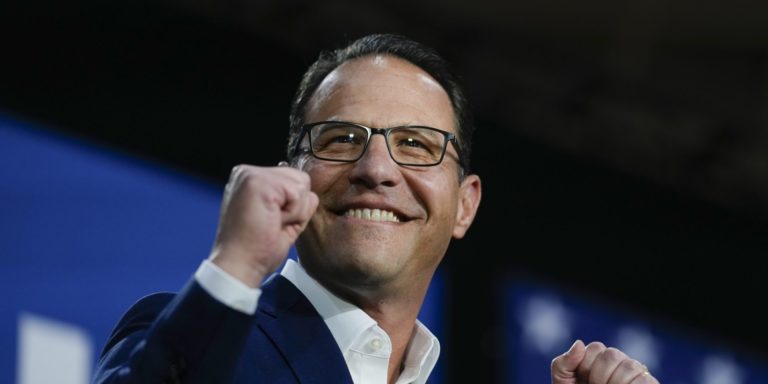
(Headline USA) Stacy Garrity, Pennsylvania’s two-term elected state treasurer, said Monday that she will seek the Republican nomination to challenge Democratic Gov. Josh Shapiro ’s reelection bid, setting up what could be a contest between a low-profile officeholder and a potential White House contender in 2028.

Garrity said in a statement that she “will bring jobs back, strengthen our economy and make Pennsylvania more affordable for families in every corner of the state.”

Some top Pennsylvania Republicans support Garrity in the 2026 race for governor and hope she’ll see a clear primary field, although those hopes have been buffeted in recent weeks by 2022’s losing gubernatorial candidate, Doug Mastriano, suggesting that he’ll run again.

Garrity has hinted at a run for months and stepped up her criticism of Shapiro. In campaign fundraising appeals, she accused Shapiro of being soft on law and order and hostile to her “pro-worker, pro-energy, pro-America agenda.”

In a video released Monday, she called herself a “strong ally” of President Donald Trump, highlighted her military service and vowed to “fix the problems Josh Shapiro has created.” That, she said, includes Pennsylvania’s relatively high tax burden and rising grocery prices.

Shapiro has returned fire, blasting her for supporting Trump’s big tax break and spending cut package. He has suggested that she supported it because she is “desperate” to get Trump’s approval and said it would hurt rural hospitals and people who rely on Medicaid, drive up the cost of energy and blow up the federal deficit.

In her video, Garrity defended the bill as “requiring able-bodied recipients to work for their benefits and ending benefits for those here illegally.” Trump has not made an endorsement in the race.

Asked about Garrity on Friday, Shapiro said he’s going to keep creating jobs, funding schools, keeping police officers on the beat and bringing Republicans and Democrats together, while Republicans “can focus on their political games all they want.”

Garrity’s task of challenging Shapiro is, by any measure, a tall one. Garrity is relatively untested and spent less than $3 million in her two campaigns for treasurer in 2020 and 2024.

Shapiro, 52, has won three statewide races, carries a reputation as a disciplined messenger and powerhouse fundraiser who spent more than $70 million alone in his sole campaign for governor, smashing Pennsylvania’s campaign finance record.

He’s grown into a national figure after he made Democratic presidential nominee Kamala Harris’ shortlist for vice presidential running mates last year and is viewed as a potential White House contender for the party in 2028.

For Republicans, there is more on the line than knocking off Shapiro. They also want a credible candidate at the top of their ticket as they try to bring out enough voters to defend their congressional seats and their majority in the U.S. House.

Shapiro is a former state House member, county commissioner and attorney general who has a base of support in his home in Philadelphia’s heavily populated suburbs.

Garrity, 61, is from rural northern Pennsylvania and came to politics late in life.

A trained accountant, Garrity was a longtime executive for a powdered metals supplier in northern Pennsylvania. She was also an Army reservist who retired as a colonel and served in Iraq, where she ran the detention center at Camp Bucca as part of the 800th Military Police Brigade.

Since her 2020 upset victory of the incumbent Democratic treasurer, Garrity has been an avid campaigner, speaking at numerous Trump rallies. In 2022, she was perhaps the GOP’s most visible surrogate for Mastriano.

Shapiro won his 2022 contest by almost 15 percentage points, an election cycle Republicans would rather forget.

By all accounts, Shapiro and Garrity have had a professional working relationship and avoided partisan squabbling over official matters. Shapiro even gave Garrity a warm and personal introduction in January before she was sworn in to her second term as treasurer.

During her time as treasurer, Pennsylvania has run up big surpluses, buoyed by federal COVID-19 aid and inflation-juiced tax collections.

That temporarily took pressure off state finances. However, Pennsylvania is reverting to its status as a perennial deficit state, and Garrity has warned that Shapiro’s continued stewardship will force tax increases onto residents.

As treasurer, Garrity kept several top Democratic staffers on board, expanded the ways in which the department can return unclaimed property and increased the department’s investments in Israel bonds.

Adapted from reporting by the Associated Press.

Hijacked Satellites and Orbiting Space Weapons: In the 21st Century, Space is the New Battlefield

(Headline USA) As Russia held its Victory Day parade this year, hackers backing the Kremlin hijacked an orbiting satellite that provides television service to Ukraine.

Instead of normal programing, Ukrainian viewers saw parade footage beamed in from Moscow: waves of tanks, soldiers and weaponry. The message was meant to intimidate and was an illustration that 21st-century war is waged not just on land, sea and air but also in cyberspace and the reaches of outer space.

Disabling a satellite could deal a devastating blow without one bullet, and it can be done by targeting the satellite’s security software or disrupting its ability to send or receive signals from Earth.

“If you can impede a satellite’s ability to communicate, you can cause a significant disruption,” said Tom Pace, CEO of NetRise, a cybersecurity firm focused on protecting supply chains.

“Think about GPS,” said Pace, who served in the Marines before working on cyber issues at the Department of Energy. “Imagine if a population lost that and the confusion it would cause.”

Satellites are the short-term challenge

More than 12,000 operating satellites now orbit the planet, playing a critical role not just in broadcast communications but also in military operations, navigation systems like GPS, intelligence gathering and economic supply chains. They are also key to early launch-detection efforts, which can warn of approaching missiles.

That makes them a significant national security vulnerability, and a prime target for anyone looking to undermine an adversary’s economy or military readiness — or deliver a psychological blow like the hackers supporting 

Russia did when they hijacked television signals to Ukraine.

Hackers typically look for the weakest link in the software or hardware that supports a satellite or controls its communications with Earth. The actual orbiting device may be secure, but if it’s running on outdated software, it can be easily exploited.

As Russian forces invaded Ukraine in 2022, someone targeted Viasat, the U.S.-based satellite company used by Ukraine’s government and military. 

The hack, which Kyiv blamed on Moscow, used malware to infect tens of thousands of modems, creating an outage affecting wide swaths of Europe.

National security officials say Russia is developing a nuclear, space-based weapon designed to take out virtually every satellite in low-Earth orbit at once. The weapon would combine a physical attack that would ripple outward, destroying more satellites, while the nuclear component is used to fry their electronics.

U.S. officials declassified information about the weapon after Rep. Mike Turner, R-Ohio, issued a public warning about the technology. Turner has pushed for the Department of Defense to provide a classified briefing to lawmakers on the weapon, which, if deployed, would violate an international treaty prohibiting weapons of mass destruction in space.

Turner said such a weapon could render low-Earth orbit unusable for satellites for as long as a year. If it were used, the effects would be devastating: potentially leaving the U.S. and its allies vulnerable to economic upheaval and even a nuclear attack.

Russia and China also would lose satellites, though they are believed to be less reliant on the same kinds of satellites as the U.S.

Turner compared the weapon, which is not yet ready for deployment, to Sputnik, the Russian satellite that launched the space age in 1957.

“If this anti-satellite nuclear weapon would be put in space, it would be the end of the space age,” Turner said. “It should never be permitted to go into outer space. This is the Cuban Missile Crisis in space.”

Mining the moon and beyond

Valuable minerals and other materials found on the moon and in asteroids could lead to future conflicts as nations look to exploit new technologies and energy sources.

Acting NASA Administrator Sean Duffy announced plans this month to send a small nuclear reactor to the moon, saying it’s important the U.S. does so before China or Russia.

“We’re in a race to the moon, in a race with China to the moon,” Duffy said. 

“To have a base on the moon, we need energy and some of the key locations on the moon. … We want to get there first and claim that for America.”

The moon is rich in a material known as helium 3, which scientists believe could be used in nuclear fusion to generate huge amounts of energy. While that technology is decades away, control over the moon in the intervening years could determine which countries emerge as superpowers, according to Joseph Rooke, a London-based cybersecurity expert who has worked in the U.K. defense industry and is now director of risk insights at the firm Recorded Future.

The end of the Cold War temporarily halted a lot of investments in space, but competition is likely to increase as the promise of mining the moon becomes a reality.

“This isn’t sci-fi. It’s quickly becoming a reality,” Rooke said. “If you dominate Earth’s energy needs, that’s game over.”

China and Russia have announced plans for their own nuclear plants on the moon in the coming years, while the U.S. is planning missions to the moon and Mars. Artificial intelligence is likely to speed up the competition, as is the demand for the energy that AI requires.

Messages left with Russia’s Embassy in Washington were not returned.

Despite its steps into outer space, China opposes any extraterrestrial arms race, according to Liu Pengyu, a spokesperson for China’s Embassy in Washington. He said it is the U.S. that is threatening to militarize the final frontier.

“It has kept expanding military strength in space, created space military alliances, and attempted to turn space into a war zone,” Liu said. “China urges the U.S. to stop spreading irresponsible rhetoric, stop expanding military build-up in space, and make due contribution to upholding the lasting peace and security in space.”

What the US is doing about security in space

Nations are scrambling to create their own rocket and space programs to exploit commercial prospects and ensure they aren’t dependent on foreign satellites. It’s an expensive and difficult proposition, as demonstrated last week when the first Australian-made rocket crashed after 14 seconds of flight.

The U.S. Space Force was created in 2019 to protect American interests in space and to defend U.S. satellites from attacks from adversaries.

The space service is far smaller than the more well-established services like the Army, Navy or Air Force, but it’s growing, and the White House is expected to announce a location for its headquarters soon. Colorado and Alabama are both candidates.

The U.S. military operates an unmanned space shuttle used to conduct classified military missions and research. The craft, known as the X-37B, recently returned to Earth after more than a year in orbit.

The Space Force called access to space a vital national security interest.

“Space is a warfighting domain, and it is the Space Force’s job to contest and control its environment to achieve national security objectives,” it said in the statement.

American dominance in space has been largely unquestioned for decades following the end of the Cold War and the fall of the Soviet Union. But the new threats and competition posed by Russia and China show the need for an aggressive response, U.S. officials say.

The hope, Turner said, is that the U.S. can take steps to ensure Russia and China can’t get the upper hand, and the frightening potential of space weapons is not realized.

“You have to pay attention to these things so they don’t happen,” Turner said.

Adapted from reporting by the Associated Press.