(Luis Cornelio, Headline USA) The man allegedly caught on tape stealing a rifle from an FBI vehicle during an anti-ICE protest in Minnesota has been identified as a convicted felon and accused Latin King gang member, the DOJ said Friday.
The suspect, Raul Gutierrez, has been charged with being a felon in possession of a firearm and theft of government property after the FBI identified him as the man in the video.
According to a DOJ press release, Gutierrez is known at DEA as a “violent criminal with a history involving fentanyl and methamphetamine drug trafficking and distribution.” He is tied to the Latin King gang, the DOJ added.
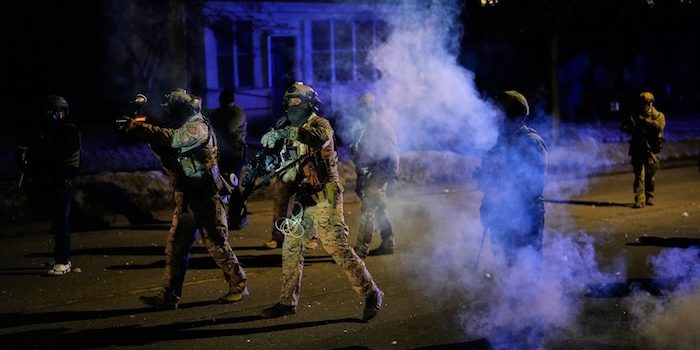
Gutierrez’s identification and arrest followed a viral social media video showing anti-ICE rioters breaking into an FBI vehicle and opening a weapons locker on Wednesdays.
The video, captured by independent journalist Nick Sortor, apparently helped federal agents identify Gutierrez. In the clip, a man prosecutors said is Gutierrez waits as another person breaks into the locker. As soon as the locker is opened, the crowd erupts.
🚨 BREAKING: Minneapolis rioters successfully BROKE OPEN a weapons locker in a federal vehicle and STOLE A RIFLE and ammunition before fleeing
I captured the thief’s face and license plate on the getaway vehicle.
The suspect is then seen grabbing what appears to be a rifle before fleeing the scene. Sortor is heard saying, “Oh my God,” before pursuing the suspect, while police sirens blare in the background.
Gutierrez’s alleged license plate was also captured in the video.
Responding to the arrest, U.S. Attorney Daniel N. Rosen said, “This alleged gang member, who is a previously convicted felon, is a danger to the community and this case is an indictment of the weak-on-crime policies promoted by the Mayor and Governor.”
If convicted of all charges, Gutierrez faces a maximum combined sentence of 20 years in prison. He made his first court appearance on Friday.
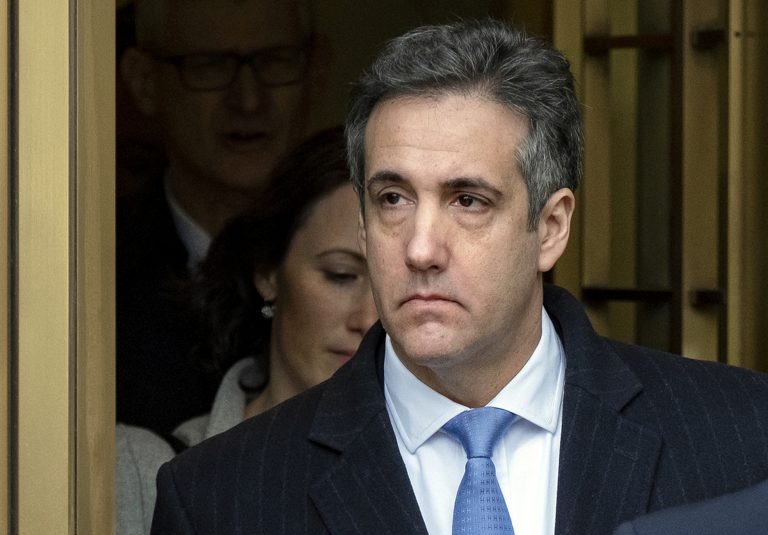
(Luis Cornelio, Headline USA) Disgraced former Trump attorney Michael Cohen admitted Friday that he felt “pressured” and “coerced” by New York Attorney General Letitia James and Manhattan District Attorney Alvin Bragg to provide testimony designed solely to help their cases against President Donald Trump.
Cohen, who once served as Trump’s longtime personal lawyer, made the startling admission in a Substack post responding to recent appeals developments tied to the Manhattan prosecution.
“From the time I first began meeting with lawyers from the Manhattan DA’s Office and the New York Attorney General’s Office in connection with their investigations of President Trump, and through the trials themselves, I felt pressured and coerced to only provide information and testimony that would satisfy the government’s desire to build the cases against and secure a judgment and convictions against President Trump,” Cohen wrote.
Cohen’s relationship with Trump imploded after Bragg launched an investigation into payments Trump allegedly made out of his own personal funds to Stormy Daniels. Bragg claimed the payments constituted falsified business records and violated campaign finance laws, despite the money not coming from campaign funds.
The case ultimately resulted in a conviction, though its practical impact was minimal after Trump was elected president, rendering the prosecution unenforceable.
James, meanwhile, spearheaded a separate civil case accusing Trump of inflating property valuations to secure favorable loans and insurance terms. That case proceeded even though the financial institutions involved testified they were repaid in full and with interest.
An appellate court later rejected the majority of the fines imposed in James’s case, significantly undercutting her claims.
Bragg and James built their high-profile prosecutions around Cohen. In the Substack, Cohen stated that during his meetings with prosecutors, “It was clear they were interested only in testimony from me that would enable them to convict President Trump.”
He said that Manhattan prosecutors “frequently asked inappropriate leading questions to elicit answers that supported their narrative.”
Cohen said the same dynamic existed with James’s office.
“Her office made clear that the testimony they wanted from me was testimony that would help them do just that. Again, I felt compelled and coerced to deliver what they were seeking,” he stated.
Cohen also accused both officials of exploiting the cases for personal and political gain. “In doing so, they blurred the line between justice and politics; and in that blur, the credibility of both suffered.”
Cohen previously served a federal prison sentence and has spent years publicly attacking Trump, making his recent comments all the more shocking.
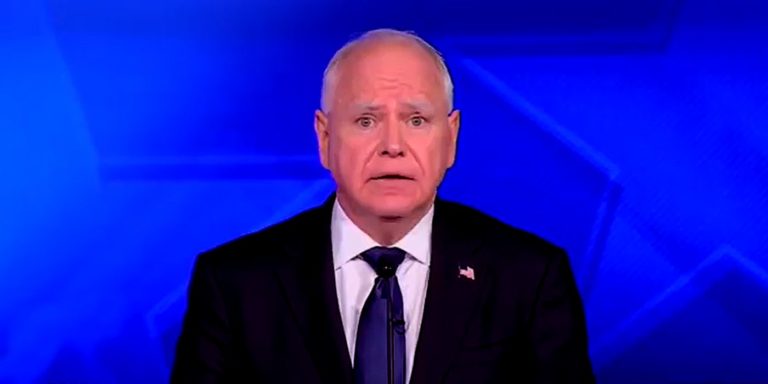
(Headline USA) The Justice Department is investigating whether Minnesota Gov. Tim Walz and Minneapolis Mayor Jacob Frey have impeded federal immigration enforcement through public statements they have made, according to The Associated Press.
The investigation, which both Walz and Frey said was a bullying tactic meant to threaten political opposition, focused on potential violation of a conspiracy statute.
CBS News first reported the investigation.
The investigation comes during a weekslong immigration crackdown in Minneapolis and St. Paul that the Department of Homeland Security has called its largest recent illegal immigration enforcement operation, resulting in more than 2,500 arrests.
The operation has become more confrontational since the fatal shooting of Renee Good on Jan. 7, with agents pulling people from cars and homes and frequently being confronted by angry bystanders demanding they leave.
In response to reports of the investigation, Walz said in a statement: “Two days ago it was Elissa Slotkin. Last week it was Jerome Powell. Before that, Mark Kelly. Weaponizing the justice system and threatening political opponents is a dangerous, authoritarian tactic.”
U.S. senators Kelly, from Arizona, and Slotkin, from Michigan, are under investigation from the President Donald Trump administration after appearing with other Democratic lawmakers in a video urging members of the military to resist “illegal orders.” The administration has also launched a criminal investigation of Powell for lying to Congress about the Fed’s multi-billion-dollar renovation project, a first for a sitting federal reserve chair.
Walz’s office said it has not received any notice of an investigation.
Frey described the investigation as an attempt to intimidate him for “standing up for Minneapolis, our local law enforcement, and our residents against the chaos and danger this Administration has brought to our streets.”
The U.S. attorney’s office in Minneapolis did not immediately comment.
In a post on the social media platform X following reports of the investigation, Attorney General Pam Bondi said: “A reminder to all those in Minnesota: No one is above the law.” She did not specifically mention the investigation.
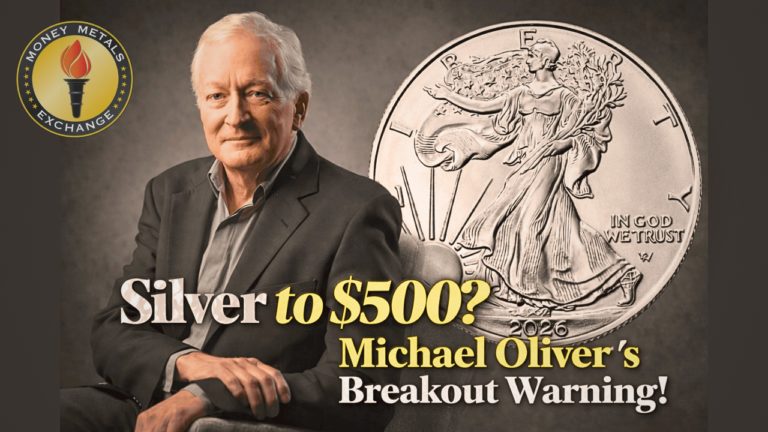
(Money Metals News Service) On a recent episode of the Money Metals podcast, host Mike Maharrey sat down with veteran market technician J. Michael Oliver, commonly referred to as simply Michael Oliver, to unpack why he believes silver is breaking out of a half-century “box” and entering a radically new price regime.
Oliver, who entered the futures business in April 1975 and later developed his proprietary Momentum Structural Analysis (MSA), argued that the current move in monetary metals isn’t a normal bull market. In his view, familiar “overbought” rules and tidy profit-taking instincts are exactly how investors get shaken out before the real acceleration begins.
(Interview Starts Around 6:51 Mark)
Who Is Michael Oliver, and What Is Momentum Structural Analysis?
Oliver said he began as a futures broker at EF Hutton in New York in the mid-1970s and learned old-school bar-chart technical analysis early in his career. In the early 1980s, he started building his own approach, which he later formalized as Momentum Structural Analysis.
He launched MSA in 1992, initially serving institutional clients. In 2015, he opened the service to retail subscribers.
His key claim is simple – momentum tends to break first.
Instead of watching price alone, Oliver converts price into a momentum-style oscillator that measures how far price is above or below an average. He says those momentum structures form their own floors, ceilings, and trendlines—and major turns often show up there before they become obvious on price charts.
Why Oliver Thinks Gold’s Bull Market Still Has Much Higher Targets
Oliver used gold as a framing device for the bigger thesis. Most people underestimate how large percentage moves can be in monetary metals.
He referenced gold’s 1976 corrective low near 100 and the 1980 peak near 850, which he described as a roughly eightfold gain. He then pointed to the 2001–2011 bull market, which also produced an approximately eightfold rise, culminating in gold’s 2011 peak around $1,920.
Against those historical comparisons, Oliver argued the current cycle—starting from the $1,050 bear-market low—has only delivered roughly a fourfold increase so far.
If gold merely matched prior eightfold gains, he suggested a reference point around $8,500. He implied the current macro backdrop could justify even more than that, but used the $8,000–$8,500 range to challenge the idea that gold is “overdone.”
The Silver Breakout: Why $90+ Doesn’t Mean “Bubble”
Maharrey noted that silver had pushed above $90 and that many listeners were asking if the move was too fast, too vertical, and therefore a bubble. He said he regularly hears from people asking whether they should take profits.
Oliver’s answer was blunt… this is exactly how people miss the move.
He said his team began arguing about six months earlier that silver was poised to accelerate after approaching $35 for the third time, including attempts around October 2024 and March 2025, both of which failed before the market finally broke higher.
In Oliver’s view, silver wasn’t just moving up. It was breaking out of an entire historical regime.
The Silver-to-Gold Ratio Signal Oliver Says People Missed
The centerpiece of Oliver’s case was silver’s relationship to gold.
He described measuring the silver-gold spread by dividing gold by silver and expressing the relationship as a percentage. He said silver was around 1% of the price of gold early in the year and then surged—especially in April and May—effectively doubling its relative value from that depressed level.
He pointed to prior historical spread peaks for context.
He cited about 6.5% during the 1979–1980 silver run and about 3.1% during the 2011 peak, describing those as monthly peak closes.
Then came the crucial technical event. Oliver said a ceiling in that spread that extended back roughly 10 years was broken in October and November. After that, he argued, silver’s price didn’t just rise—it went vertical.
He compared the setup to summer 1979, when he said silver nearly quintupled over the next five months, and to September 2010, when he said silver rose roughly “two and a half” times over the next six months.
Silver Price Prediction: “A Couple Hundreds,” and Possibly $300 to $500
Oliver argued that silver is no longer bound by the old $40–$50 range that contained the market for about half a century.
In the next handful of months, he said he expects silver to reach “the couple hundreds,” with a realistic possibility of $300 to $500.
He also said the historic silver-gold ratio ranges—3.1% and 6.5%—could be challenged or exceeded. His point was that even if gold only moved to something like $8,000, those percentage relationships imply silver prices that would shock investors who sell simply because the chart “looks overbought.”
Copper and Lead: Why Silver Could Repeat a “New Reality” Breakout
To make the idea of a “new reality” breakout more believable, Oliver pointed to other commodities that spent decades trapped in ranges and then abruptly repriced higher.
He said copper was capped for decades at around $0.50 to $1.50 before breaking out in late 2005 and running to about $4.50 within several quarters.
He also said lead stayed range-bound for decades and then in 2007 “quadrupled plus” in several quarters after breaking out.
His point wasn’t that silver is copper or lead. His point was that once a long-held ceiling breaks, markets can destroy conventional ideas about overbought levels and measured moves.
Why the “$95 Target” Mindset Is the Wrong Lens
Oliver argued that most people do the math in a way that automatically caps their expectations.
On an arithmetic chart, silver’s historical range from roughly $4 to $50 looks like a $45 box. So investors project $45 higher and see $95–$100 as the natural stopping point.
Oliver said that’s not the real dimension.
On a logarithmic scale, going from $4 to $50 is more than a tenfold move. And he noted that silver achieved a comparable tenfold-type move twice over the past 50 years.
By that logic, he argued that a similar move above $50 implies something like $500—numbers that sound impossible only until the market reprices and forces everyone to adjust.
CPI vs M2: Why Oliver Thinks Money Supply Tells the Real Story
Maharrey mentioned that some skeptics were using CPI comparisons to argue silver had overshot fundamentals. Oliver rejected CPI as an inflation yardstick.
He said M2 is the better metric and described M2 as parabolic.
Maharrey agreed and noted he’s been hammering that point for months, even as some people refuse to accept it.
Oliver suggested that when people finally understand the degradation of the currency unit, they’ll realize that a doubled stock price over a decade might not represent real gains—just a reflection of a declining measuring stick.
The Real Catalyst: A Government Bond Crisis, Not a Normal Cycle
Oliver widened the lens beyond metals and into systemic risk.
He argued the West is facing a government debt crisis, not another mortgage-style shock like 2007–2009. In his view, U.S., Japanese, and European/UK debt markets are all vulnerable, and any major break could ripple across the entire financial system.
He cited a comment he attributed to the head of the New York Fed in November, saying they would start “buying bonds,” ostensibly to provide liquidity. Oliver interpreted that as support.
He also warned about the U.S. 30-year bond, saying 30-year T-bond futures were around 116, with a crash low around 117 in October 2022. He argued the market has been stuck near the floor for years, and said a drop toward 111 would be “flush city” by his technical measures—potentially triggering an emergency in the government bond market.
Oil Could Shock Everyone Next, Oliver Warns
Near the end of the conversation, Oliver flagged oil as an underappreciated risk.
He said if oil moves above $63 during the quarter—especially on a monthly close—his momentum structures suggest the potential for a sharp upside run. He floated a 50% surge in oil and said it may not even need a news catalyst.
In his view, it would be a technical “ambush” that hits consumers directly at the gas pump.
Manipulation, Reversion, and Silver’s Coming “Tantrum”
Maharrey asked why silver stayed trapped in an old pricing regime for so long. Oliver said he couldn’t fully explain it, but noted the long-standing argument that silver has been manipulated.
He suggested that if suppression has been real, the unwind could be violent. When markets are forced away from reality, he argued, they often overcorrect when the restraint breaks.
That’s why he expects silver not only to reprice, but to overshoot—because the market is correcting decades of distortion in a short, explosive window.
Where to Follow Michael Oliver’s Work
Maharrey closed by encouraging listeners to look into Oliver’s approach as a complement to macro analysis.
Oliver said people can learn more at OliverMSA.com, where he explains Momentum Structural Analysis and offers sample copies. Maharrey also noted that longer interviews with Oliver are available online for those who want a deeper dive.
The episode ended with Maharrey thanking Oliver and inviting him to return for a future conversation.
(Hayley Feland, The Center Square) A Washington, D.C.–based oversight organization has formally asked the Minnesota Department of Children, Youth, and Families to provide internal records that relate to the state’s Child Care Assistance Program, citing concerns about fraud.
On Jan. 13, Empower Oversight filed a request under the Minnesota Data Practices Act for their records regarding CCAP oversight and enforcement activities. The group said the program, which distributes millions of taxpayer dollars annually to child care providers, has been the subject of “numerous reports of waste, fraud and abuse of taxpayer dollars.”
In a news release, Empower Oversight noted Minnesota receives about $185 million in federal funds for CCAP each year, totaling more than $1 billion since 2019. It also said recent reporting and public scrutiny have “raised serious questions about widespread fraud and misuse of CCAP funds, as well as the adequacy of state oversight.”
“Given the scale of public funding involved and the importance of protecting both taxpayer dollars and vulnerable families, it is critical to understand what the agency knew about these issues and how it responded,” said Empower Oversight President Tristan Leavitt in the organization’s announcement. “Ensuring appropriate protections for anyone who helps bring transparency to the program is essential to restoring public trust.”
The records request letter submitted to DCYF Commissioner Tikki Brown asks for documents, including investigative reports that found providers with no children present, since Jan. 7, 2019, and all communications regarding providers connected to the Feeding Our Future scandal.
Empower Oversight described itself in the letter as “a nonpartisan, nonprofit educational organization … dedicated to enhancing independent oversight of government and corporate wrongdoing” that helps insiders safely report waste and misconduct.
In a statement to TCS, Empower Oversight said that the state has acknowledged receipt of the data request, but they are unsure when they will receive results. Laws in the state of Minnesota only require that they return the data in a “reasonable time.”
“Unless there are concerted efforts to proactively detect and redress fraud, programs like this are ripe for abuse. Turning your head and ignoring the problem only allows those willing to commit fraud to be even bolder with their transgressions,” Leavitt told TCS. “Transparency through records requests like ours, and whistleblowers coming forward, is the first step to ensuring officials can get to the root cause.”
DCYF said they would look into the situation with the records request but did not share any further comment at the time of publication.
(Mark E. Johnson, Contributor) Singer-songwriter Jason DeFord, aka Jelly Roll, is showing off his major health transition, fulfilling a promise made to himself one year ago on ESPN’s daily sports talk program, “The Pat McAfee Show,”
“I was killing myself. Literally,” DeFord, 41, told Mens’ Health. “I was eating myself to absolute death.”
Men’s Health editor Richard Dorment set out to find out why formerly 500-plus-pound singer was so determined to make a radical change in his life.
“We really wanted to get to the root of what was driving this desire for transformation,” Dorment said. “Once we started to have that conversation, we really began to understand his why, which was his relationship with food and what he came to think of as a food addiction.”
Jelly reveals steps on his weight loss journey after dropping the first 120 pounds
Known for his open and honest lyrics in such hits as “Save Me,” “Need a Favor,” and “Son of a Sinner,” DeFord doesn’t hold back about his struggles in the short film, which follows him for a year as he works toward his transition.
“When I first met him, in February 2025, he was 380 pounds, down 160 pounds from his heaviest, in 2020. He hadn’t seen or felt the definition of his hip bones in years. Now it’s November. He’s 265—and hopping around the ring looking spry.” – Ryan D’Agostino, MEN’S HEALTH
“Here I was going into my 40s at 500 and some pounds,” he said in the film.
“I think I was just trying to find my way into whatever I could, and I think what I was doing was, I felt so misunderstood that I was closet-eating the whole time,” he added.
The film also shows Jelly Roll hitting the gym, doing push-ups, even running up sets of stairs at arenas.
Men’s Health spoke to trainers, nutritionists, medical advisers and family members who helped Jelly Roll along the way, because any personal makeover goal is more likely to be successful when you have the support of those around you.
MEN’S HEALTH said Jelly’s motivation is one many overweight people can relate to.
“Jelly Roll continues to make an impact on fans with his powerful messages and amazing music, something he’s sure to continue in the upcoming year.” – Rachelle Lewis, Parade
“He opens up the doors to us to follow him on this path through the setbacks, through the challenges, through the days when it’s really, really hard, and you don’t want to do this. But he perseveres,” Dorment said. “And I think ultimately, that’s what we learn from the film, is that everybody’s journey is different, but by understanding that it’s maybe not a straight line, that there is no one right way to do it, ultimately, you can get to where you want to go.”
Mark E. Johnson: In his fiftieth year as a writer for national publishers, Mark E. Johnson has written for Men’s Health, Mayo Clinic, Prevention, and many more.
(Headline USA) The 22-year-old Utah man charged with killing conservative activist Charlie Kirk is due back in court Friday as his attorneys seek to disqualify prosecutors in the case over an alleged conflict of interest.
Tyler Robinson is charged with aggravated murder in Kirk’s Sept. 10 shooting on the Utah Valley University campus in Orem, just a few miles north of the Provo courthouse. Prosecutors with the Utah County Attorney’s Office plan to seek the death penalty if Robinson is convicted. Robinson has not yet entered a plea.
An 18-year-old child of a deputy county attorney attended the campus event where Kirk was shot. The child, whose name was redacted from court filings, later texted with their father in the Utah County Attorney’s Office to describe the chaotic events around the shooting, the filings from prosecutors and defense lawyers state.
Defense attorneys say that personal relationship is a conflict of interest that “raises serious concerns about past and future prosecutorial decision-making in this case,” according to court documents. They also argue that the “rush” to seek the death penalty against Robinson is evidence of “strong emotional reactions” by the prosecution and merits the disqualification of the entire team.
Several thousand people attended the outdoor rally where Kirk, a co-founder of Turning Point USA who helped mobilize young people to vote for President Donald Trump, was shot as he took questions from the audience. The adult child of the deputy county attorney did not see the shooting, according to an affidavit submitted by prosecutors.
“While the second person in line was speaking with Charlie, I was looking around the crowd when I heard a loud sound, like a pop. Someone yelled, ‘he’s been shot,’ ” the child stated in the affidavit.
The child later texted a family group chat to say “CHARLIE GOT SHOT.” In the aftermath of the shooting, the child did not miss classes or other activities, and reported no lasting trauma “aside from being scared at the time,” the affidavit said.
Prosecutors have asked District Judge Tony Graf to deny the disqualification request.
“Under these circumstances, there is virtually no risk, let alone a significant risk, that it would arouse such emotions in any father-prosecutor as to render him unable to fairly prosecute the case,” Utah County Attorney Jeffrey Gray said in a filing.
Gray also said the child was “neither a material witness nor a victim in the case” and that “nearly everything” the person knows about the actual homicide is mere hearsay.
The Associated Press left email and telephone messages for Robinson’s defense attorney, Kathryn Nester.
Prosecutors have said text messages and DNA evidence connect Robinson to the killing. Robinson reportedly texted his romantic partner that he targeted Kirk because he “had enough of his hatred.”
At recent hearings, Robinson’s legal team has pushed to limit media access in the high-profile case. Graf has prohibited media from publishing photos, videos and live broadcasts that show Robinson’s restraints to help protect his presumption of innocence before a trial.
The judge has not ruled on a suggestion by the defense to ban cameras in the courtroom.
Prosecutors are expected to lay out their case against Robinson at a preliminary hearing scheduled to begin May 18.
(Ken Silva, Headline USA) The man convicted of attempting to assassinate Donald Trump at his Palm Beach golf course in September 2024 has asked for a lenient sentence. While the government seeks life imprisonment, Ryan Routh’s attorney has asked for 20 years.
In a Thursday motion for a downward departure from sentencing guidelines, Routh’s attorney, Martin Roth, said his client denies he acted with the intent to kill a presidential candidate. Nor did Routh’s actions necessarily constitute terrorism, Roth argued.
Even so, Roth admitted that sentencing guidelines call for his client to spend life in prison. Nevertheless, Roth asked for a downward variance for Routh, who is 60 years old.
“A term of 20 years, followed by the required 7-year mandatory sentence required by Count two would be sufficient to meet the need for punishment, provide the defendant with correctional treatment and provide for mental health treatment in a custodial setting,” Roth said. “Defendant would be in custody into his eighties and would not pose any threat to cause harm to the public.”
🚨NEW: Ryan Routh's attorney has asked Judge Cannon to sentence the would-be Trump assassin to just 20 years. Routh would be 80 and no threat when he's released, the lawyer argued. Routh's sister also asked Cannon to send him to a low-security facility instead of a supermax. pic.twitter.com/WBEPWHcl0n
Attached to Roth’s motion were three letters in support of Routh: one from his sister, Nancy Meyers; another from his son, Adam Routh; and a third from his childhood mentor, retired US Army Colonel Michael Kelly.
Kelly, a Trump supporter, said he first met Routh when he joined his Boy Scouts troop in the 70s. Ryan was a bright boy at the time, and Kelly said he didn’t know when and how Routh went astray.
Adam, meanwhile, said Routh was a good father to him, while the sister, Myers, said Routh was a protective brother.
Myers, who said she was a litigation attorney with 30 years of experience, asked Judge Aileen Cannon to send Routh to the low-security facility at Federal Correctional Institute Butner—as opposed to a supermax facility, which is where he could be headed if his crimes are deemed federal terrorism. FCI Butner would be near his family in North Carolina, and “would be the most appropriate for Ryan’s needs given the intensive care, counseling, and rehabilitation of mental health needs offered there.”
Routh is set to be sentenced on Feb. 4.
On Sept. 15, 2024, a Secret Service agent spotted Routh hiding in the bushes with an SKS-style rifle at Trump’s Palm Beach golf course. The agent shot at Routh five times—missing but causing him to flee the scene. Routh was caught some 45 minutes later on the I-95. During the traffic stop, a woman named Norka Pardo was driving with her 6-year-old girl, Mia Rosalie Monreal, and she crashed into the backed-up traffic.
Monreal suffered debilitating brain injuries as a result. Months later, doctors were still trying to restart her brain, according to the mother.
“She was not responding, she’s not waking up at all, so they have to kind of help her out and give her medication to help her brain restart,” the mother told local media last January. “She’s kind of opening her eyes, closing to fall asleep, opening her eyes but there was no response.”
Ken Silva is the editor of Headline USA. Follow him at x.com/jd_cashless.
(Dave DeCamp, Antiwar.com) US forces have seized another oil tanker in the Caribbean, according to statements from the US military and US officials, as the Trump administration continues its blockade on Venezuela with the goal of controlling the country’s oil industry and exports.
US Southern Command said that US Marines and sailors deployed from the aircraft carrier USS Gerald R. Ford seized the tanker named Veronica early Thursday morning. The command posted a video showing US forces descending onto the tanker.
The ship marks the sixth Venezuela-linked tanker the US has seized in recent months and the fourth since the US attack on Caracas to kidnap President Nicolas Maduro, which killed more than 80 people.
Last week, after the US seized the fifth tanker, President Trump claimed the action was done in coordination with Venezuela’s government, which is currently led by Acting President Delcy Rodriguez, Maduro’s vice president.
“Today, the United States of America, in coordination with the Interim Authorities of Venezuela, seized an oil tanker which departed Venezuela without our approval,” Trump wrote on Truth Social last Friday. “This tanker is now on its way back to Venezuela, and the oil will be sold through the GREAT Energy Deal, which we have created for such sales.”
A US official told Reuters on Wednesday that the US completed its first sale of Venezuelan oil under a deal with the Venezuelan government. The official said that revenue from the initial sale, about $500 million, is being held in US-controlled bank accounts.
“The Veronica is the latest tanker operating in defiance of President Trump’s established quarantine of sanctioned vessels in the Caribbean, proving the effectiveness of Operation Southern Spear yet again,” SOUTHCOM said.
(Joshua D Glawson, Money Metals News Service) A rumor has been circulating on social media that the U.S. Mint is PLUM OUT of silver… implying silver will soon become “unobtanium” across the board. The evidence loosely backing the claims is a notice on the U.S. Mint website, which is, indeed, not selling certain collectible silver items for now.
Here’s the U.S. Mint’s statement,
“Notice: Due to rapidly rising metal costs, silver numismatic (collectible) products have been temporarily removed from sale as we evaluate pricing across our entire numismatic portfolio. Products will be placed back on sale as soon as prices are adjusted. American Eagle Silver bullion coins remain available for purchase through our network of authorized purchasers.”
Since the price of silver has increased by nearly 200% in the past year, in these extremely bullish days, this has put a lot of pressure on the whole industry, and that includes government “enterprises” in the space.
When spot prices continue to rise, those respective websites must update their pricing constantly so they do not sell at a loss… particularly bullion-focused sellers like Money Metals.
And with the sharp rise in the price of silver — nearly doubling in 4 months, the fixed prices of the U.S. Mint’s high-premium “burnished” and “proof” coins were suddenly no longer twice the silver spot price, but priced at or below current spot!
The U.S. Mint does not sell the bullion American Eagle coins directly to the public… what the public CAN purchase on the U.S. Mint’s website is all the kind of stuff that is not really a silver “investment” at all — but spiffy, supposedly “collectible” items.
The simple fact is that flat-footed government officials and bureaucrats in this Washington, D.C., pseudo-enterprise are incapable of gracefully adjusting to market fluctuations. It is not that I am anti-government, per se,in making this statement, but rather that it is a practical outcome of intentional policies in government.
Government generally involves bureaucratic meetings with senior officials, and possibly internal votes and rule changes, to react to pretty much anything.
In order for the Mint to adjust to the growing demand in silver and silver coin buying, and to continue profiteering off of the public with their high-margin “collectibles,” government managers needed to put a pause on silver sales until they can determine new product pricing that may last for a while, such as through fiscal 2026.
Therefore, the key takeaway about the Mint’s decision to stop selling its marketable items is really this – governments are downright terrible at business and probably ought to get out of it. In this case, an actual business would simply adjust its pricing on the fly.
Conspiracy theories, hearsay, and precious metal dealer hype may have contributed to a misunderstanding that there is little to no silver available in the market.
Make no mistake, what’s happening with silver lately is certainly momentous — and the outlook remains quite bullish.
But it’s wise to try to tune out the over-sensationalized hype the best you can. There is simply no need to buy silver coins from a government source that, more often than not, overcharges for its products anyway.
Instead, embrace the free market approach — one that has dynamic pricing, transparent premiums, and can swiftly adjust to the ebbs and flows of market demand.
A similarly juicy rumor is currently making the rounds regarding China’s limitations on silver exports, but this, too, has turned out to be overstated, as our analyst Mike Maharrey explained.
Money Metals has PLENTY of silver in stock right now – the only issues we have are delays in order processing due to the overwhelming volume of retail purchasers and sellers that are choosing to do business with Money Metals.
We’ve already hired 45 new employees (and counting!) since Christmas Day to help address the high order flow and phone call volume.
If an item at the Money Metals site actually goes out of stock, customers can sign up for an email alert when it’s back.
Money Metals does not have any shortage of American Silver Eagles right now— or any other major categories of precious metals. Rather than picking up Silver Eagles, your better value deal would be silver bars and rounds. Please take a look at MoneyMetals.com!
Joshua D. Glawson is Content Manager for Money Metals and is a writer on such topics as politics, economics, philosophy, finance, and personal development. He has a Bachelor’s in Political Science from the University of California, Irvine.