12 Penn. School Districts Hid $400M to Pass Tax Increases

(Anthony Hennen, The Center Square) A dozen school districts in Pennsylvania exploited a legal loophole to raise millions of dollars in new taxes on the public without putting it to a referendum.

In the process, they’ve hidden hundreds of millions of dollars in reserve funds that could cover school costs without raising taxes.

The state auditor has warned that there are potentially more school districts who have done the same.

The announcement, made during a press conference by Auditor General Timothy DeFoor, was based on an audit of a dozen schools across the state.

“For years, there’s been concerns raised to us from the General Assembly and from residents about school districts who are raising taxes while seemingly having enough money in the reserves to cover any type of budget gaps,” DeFoor said. “For nearly a year, our audit team looked in (to) this practice to see whether school districts appropriately used referendum exceptions to raise property taxes without voter input.”

The audit found that the school districts did this repeatedly — collectively, they raised taxes 37 times from 2018-2021.

As a result, though they increased taxes, the districts have $390 million in their general funds accounts “that is sitting unspent,” DeFoor said.

The law was meant to be used as an extreme measure for financial hardship. Instead, the school districts have used it as a “regular budgeting tool,” DeFoor said.

“These districts found a way to use the law to their advantage so they could always raise taxes,” DeFoor said. “Basically, it’s a shell game.”

The following schools were audited, all of which have increased taxes without a public referendum:

Abington School District, Montgomery County;

Bethlehem Area School District, Northampton and Lehigh counties;

Cannon-McMillian School District, Washington County;

Hempfield School District, Lancaster County;

Lower Merion School District, Montgomery County;

Neshaminy School District, Bucks County;

North Allegheny School District, Allegheny County;

Northampton Area School District, Northampton County;

North Penn School District, Montgomery County;

Penn Manor School District, Lancaster County; and

School District of Lancaster, Lancaster County;

West Chester Area School District, Chester and Delaware counties.

It’s not yet clear how many more school boards have done the same.

“These are just 12 districts; there are 500 in Pennsylvania,” DeFoor said. “It’s not a stretch to say that it’s happening throughout the commonwealth.”

The auditor recommended that the General Assembly modify existing law to require districts to use their general funds and surplus funds before asking the Department of Education to issue an exception to a tax referendum.

School boards defended the practice to the auditor as pragmatic. They needed to submit a budget by June 30, but would not yet know how much they would receive from the state government by that time.

DeFoor suggested that school districts’ fiscal year should be shifted from June 30 to Sept. 30 to avoid such a problem.

“We simply cannot allow school boards to use legal maneuvers that take away the voice of our taxpaying citizens,” DeFoor said.

Critics noted that schools have built up significant reserve funds for years while increasing taxes.

“School districts are flush with cash even as they promulgate a narrative of underfunding,” Nathan Benefield, senior vice president of the Commonwealth Foundation, said in a press release. “Many districts have been stockpiling taxpayer funds for years—increasing their reserve funds far above what’s necessary for a rainy day.”

Since 2012, the 500 school districts across Pennsylvania have seen their reserve funds increase by almost 33% to $5.3 billion, Benefield noted, along with $3.6 billion in federal pandemic aid.

“The audit confirms that many school districts are not only adequately, but excessively funded,” Benefield said. “The state should move to protect Pennsylvania taxpayers from unnecessary tax increases and direct funding towards students—including those seeking alternatives to their neighborhood school. Families, not school buildings, need more resources.”


Predictions of China’s Decline Born of Low Birthrates Are Baseless

(John Tamny, RealClear Wire) New York Times columnist Bret Stephens is 49. It’s good news that he’s relatively young simply because it means readers will get to enjoy his unique insights and remarkable way with words for a long time to come.

It’s also good news in a global sense because his age signals that he’ll be around to retreat on his long-held stance that “China’s decline” born of demographics is “undeniable.” No doubt China could decline, but readers can rest assured that demographics (Stephens cites 9.56 million Chinese births in 2022 versus 10.41 million deaths) will not be the cause. Stephens contends that “China is increasingly likely to grow old before it gets rich” with the previous numbers informing his viewpoint, but the viewpoint ignores bigger truths about how we work that reject his pessimism.

To see why, it’s most useful to start with anecdote. Jack Ma is one of China’s richest citizens, and a name Stephens is surely familiar with. As of 2020, Ma’s MYbank had met the needs of over 35 million businesses through the origination of over $300 billion worth of loans. The previous number becomes more interesting when loan approval rates and non-performing loans are considered. According to Cornell professor Eswar Prasad, MYbank’s loan approval rate is “four times higher than that of traditional lenders” while its non-performing ratio at the end of 2020 “was only 1.5 percent.” Where it gets most interesting is the source of the remarkably accurate vetting of borrowers. Per Prasad, “MYbank pioneered the 3-1-0 model of providing collateral-free business loans to SMEs [small and medium-sized enterprises]. The model intimates that borrowers can complete their online application in three minutes and obtain approval in one second, with the entire process requiring zero human intervention.”

Ma’s amazing financial innovations are a reminder that thanks to ever more sophisticated automation of effort formerly required of humans, the focus on birthrates as the source of decline in countries like China brings new meaning to non sequitur. Though fewer Chinese are being born today, their productivity thanks to the aforementioned automation of so much will render them capable of doing the work of hundreds and realistically thousands of individuals. Stephens’s pessimistic analysis presumes a static quality to humans that is anything but. As machines that can be produced in unlimited fashion evolve in terms of their ability to produce and think for us, so surges the productive capacity of every human lucky enough to be born today in China, and anywhere else.

Stephens adds that a “declining population generally correlates with economic decline,” but if true then it would certainly be true that South Korea would be a troubled nation facing a bleak present and future. Figure that it has the lowest birthrate of all the world’s developed countries, and it combines the latter with one of the highest suicide rates. Yet South Korea continues to grow for the same reasons that China will. See above. Except that there’s more.

Stephens writes that the “replacement rate necessary to maintain a stable population is 2.1,” but countries are not numbers. Stephens surely knows this too, but his argument about China’s difficult future ignores a simple truth that he’s also likely well aware of: the very few invariably drive progress. Not too many decades ago Seattle was essentially the Detroit, Flint, or Aliquippa of today, but in modern times its growth is staggering. Was it a procreation boom that transformed Seattle? No, it was merely the return of Emerald City natives Bill Gates and Paul Allen from Albuquerque, NM, the city where they initially founded Microsoft.

What transformed Seattle is also what made Silicon Valley the world’s most dynamic region of economic activity, and also what sets up Austin, TX for stupendous growth now and in the future. Talent. Austin soars not because its people are rabbit like, but arguably because a Stanford dropout by the name of Joe Liemandt chose it to start Trilogy Software back in the 1990s. Thousands of Stanford types subsequently followed Liemandt to Texas, only for the once-shabby college town to turn into a shimmering city.

Though Stephens is certainly correct in his implied assertion that people are wealth, it’s the very few who create the wealth in ways that lift cities, states, and countries. And they create that wealth through cooperation with other “hands” (human and machine) around the world.

What Stephens predicts is rooted in the notion that countries are essentially closed economic shops, but they’re not. Consider the U.S. Depending on the day Apple is the world’s most valuable company, and the iPhones that have been most instrumental in lifting it to the top of the corporate heap are a productive consequence of the rest of the world. While this could change in the future with the total automation of factories, for now iPhones don’t touch American hands until they’re in the hands of American buyers. It’s all a reminder that the only closed economy is the world economy, at which point it really doesn’t matter how many babies are being born in China so long as the babies born in China are free to work alongside babies born around the world.

In other words, China’s birthrate will be of little consequence to its future. In reality, the only risk to China’s future growth is what imperiled it and crushed it in the past: a lack of economic freedom. Every other “problem,” whether real or imagined, will be overcome by innovation born of individual genius China is clearly rich with.

Big Tech Is Sacrificing Its Fragile Employees to Meddle in 2024 Election

(Ben Sellers, Headline USA) A funny thing happened at Headline USA in mid-January: Google took the unprecedented step of trying to demonetize us.

As it has with a who’s who of conservative websites—from The Federalist to ZeroHedge—Google has attempted in the past to regulate our content through ultimatums. But this time, rather than complain about an isolated article, the monopolistic online publishing company sent a list of more than 25 stories that it deemed unacceptable.

In Google’s subjective opinion, the articles all promoted “Unreliable and harmful claims,” “Dangerous or derogatory content” or “Shocking content”—the latter offense for an article about Nancy Pelosi confusing “Kwanzaa” with the German word for “penis.”

In one case, Google banned an article about the obscene performance at an all-ages drag show, claiming it was “Adult: Sexual content,” which was sort of the point of exposing it in the first place. The article itself contained no obscenities or graphic content other than a written account of what occurred at the show.

The longstanding debate over whether Google, as a key utility in the public square, has an obligation—legal, moral and otherwise—to allow rather than attempt to suppress an open dialogue is one that must play out in the courthouses and statehouses, which may never happen as long as the company has powerful lawyers and lobbyists advocating for it.

But from a strictly financial standpoint, the matter may be a no-brainer.

MANIC RECESSION

Less than a week after Google determined that it would no longer extend its ad services to a mid-size, mostly reputable conservative website as a matter of higher principle, it announced its intention to cut 12,000 jobs—or 6% of its own workforce.

That, in turn, created a panic among the “surviving” employees. According to a recent article in the Post Millennial, they now fear for their “psychological safety” with the prospect of a guillotine dangling over their heads.

“How are we supposed to ever feel safe again?” one employee asked during an all-hands meeting on Monday.

What incentive do employees have to “keep working super hard,” asked another. “Does it matter?”

Another said the process was like a “really bad game of Russian roulette.”

As much as I’d like to think Google’s decision to cut Headline USA’s ads and its decision to cut its staff were causally related, our livelihood was but a gnat in the eyes of the $1.24-trillion-dollar juggernaut.

Nonetheless, a company that is in the process of belt-tightening to brace for recessionary impacts in the year ahead is hardly one that wants to begin taking new measures to alienate its own revenue streams on the basis of arbitrary political values.

So, the question, then, is what may be driving Google toward this apparent cognitive dissonance in its policies?

Perhaps the explanation lies in the timing.

THE DAVOS DIRECTIVE
Klaus Schwab
Klaus Schwab, president and founder of the World Economic Forum, delivers a speech. / PHOTO: AP

Google’s announcement—and those echoed by other woke Big Tech companies like Facebook, Amazon, Microsoft and Salesforce—coincided with the declaration by “chief economists” at the World Economic Forum in Davos that a global recession was on the horizon.

“With two-thirds of chief economists expecting a world-wide recession in 2023, the global economy is in a precarious position,” said WEF Managing Director Saadia Zahidi.

“The current high inflation, low growth, high debt and high fragmentation environment reduces incentives for the investments needed to get back to growth and raise living standards for the world’s most vulnerable,” Zahidi continued.

“Leaders must look beyond today’s crises to invest in food and energy innovation, education and skills development, and in job-creating, high-potential markets of tomorrow,” Zahidi concluded. “There is no time to lose.”

Clearly, Big Tech took the message to heart, and other major companies that look to Silicon Valley as their guiding beacon on controversial policies, will follow suit.

But do the layoffs from major corporate entities help to mitigate a financial crash, or to usher it in?

With so much of the WEF’s cabalistic summit dedicated to social-engineering objectives, it seems as if key players are not attempting to avoid a recession (the U.S. arguably has been in one already with two consecutive quarters of negative growth under the Biden economy) but to exacerbate it.

OFF-YEAR ENGINEERING
James Carville
James Carville / IMAGE: MSNBC

Just as the timing was right for deep-state operatives to plant the seeds of a potential Biden exit via his snowballing classified-documents scandal, the political off-year is an opportunity to sow orchestrated chaos in the financial sector with the express purpose of effecting a miraculous economic recovery in 2024 at the hands of—well, whoever is the Democrat president then.

That person, who likely will be the party’s next nominee, will be celebrated as the second-coming of FDR for bringing the nation back from the brink of its preordained fiasco.

Everywhere you look, major leftist networks who, last year, trashed James Carville’s Clinton-era words of wisdom that “It’s the economy, stupid” will be trotting out the ex-campaign manager to ride his one-trick pony like he was Carl Bernstein.

Meanwhile, Google—which was just sued by the Justice Department for monopolizing digital advertising technologies, prompting a plunge in its stock value—may take the opportunity to sell off parts of its advertising business and invest in “high-potential markets of tomorrow” like cricket farms and invisible flutes.

Fortunately, Headline USA will be just fine, with or without Google—because, in times of crisis, we offer a high-demand service that few others do: supplying the information that Google and the WEF don’t want you to see.

Ben Sellers is the editor of Headline USA. Follow him at twitter.com/realbensellers.

Sunshine Might Be Free but Solar Power is Not Cheap

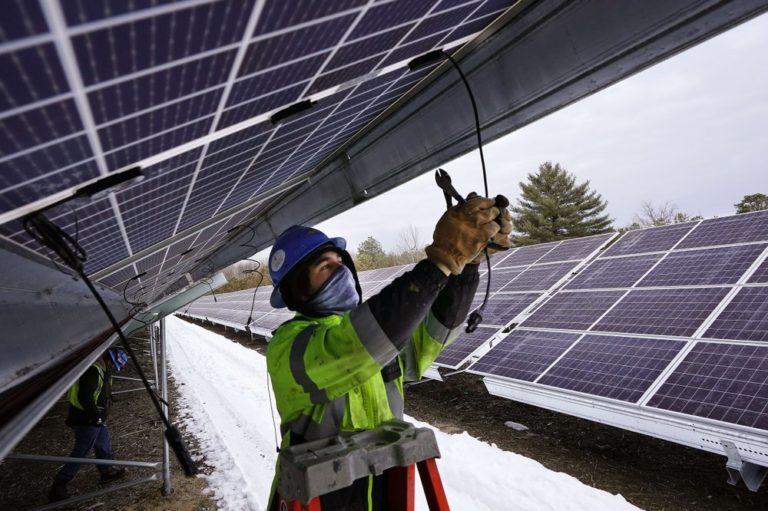
(Isaac Orr, RealClear Wire) Mississippi residents are consistently told that renewable energy sources, like solar panels, are now the lowest-cost ways to generate electricity, but these claims are based on creative accounting gimmicks that only examine a small portion of the expenses incurred to integrate solar onto the grid while excluding many others.

When these hidden expenses are accounted for, it becomes obvious that solar is much more expensive than Mississippi’s existing coal, natural gas, and nuclear power plants and that adding more solar will increase electricity prices for the families and businesses that rely upon it. One of the most common ways of estimating the cost of generating electricity from different types of power plants is a metric called the Levelized Cost of Energy, or LCOE.

The LCOE is an estimate of the long-term average cost of producing electricity from a power plant. These values are estimated by taking the costs of the plant, such as the money needed to build and operate it, fuel costs, and the cost to borrow money, and dividing them by the amount of electricity generated by the plant (generally megawatt hours) over its useful lifetime.

In other words, LCOE estimates are essentially like calculating the cost of your car on a per-mile-driven basis after accounting for expenses like initial capital investment, loan and insurance payments, fuel costs, and maintenance.

We can estimate the LCOE of new solar facilities in Mississippi by using overnight capital cost estimates from the U.S. Energy Information Administration Electricity Market Module and other state-specific factors. We can then compare the cost of solar to the real-world cost data for the coal and natural gas generators at the Victor J. Daniel Jr. Generating Plant, and the Grand Gulf nuclear power plant using the Federal Energy Regulatory Commission Form 1 database.

Electricity generated by new solar panels would cost $50.67 per megawatt hour when accounting for the fact that monopoly utilities are allowed to increase electricity prices to cover the cost of building any new solar facilities that receive approval from the Mississippi Public Service Commission, plus a ten percent rate of return, shown as “utility profits,” below.

These cost estimates are, I should point out, for the unsubsidized cost of solar – what you might call the real, or underlying cost of producing it. This matters because the Biden administration’s enormous $370 billion so-called “Inflation Reduction Act” offers massive subsidies for solar, which on the surface seem to reduce the cost of solar. In reality, what the IRA subsidies do is reduce the cost paid by some by passing on the costs to the taxpayer. Subsidy, in other words, does not change the underlying costs of solar, which remain unattractive no matter how many inducements the federal government offers us to go solar.

The most affordable electricity in the state was generated by the combined cycle natural gas units at the Victor J. Daniel Generating Plant at a cost $30.31 per MWh, based on the 2021 delivered cost of natural gas, which was $3.90 per million British thermal units (MMBtu), and electricity generation. Natural gas prices might have risen recently, but even at these increased prices, natural gas gives Mississippians better value than solar. So, too, does nuclear.

The next most affordable power plant was the Grand Gulf nuclear facility, which generated electricity for $32.10 per MWh, based on 2021 output. Lastly, the coal units at the Victor J. Daniel Generating Plant produced electricity for $43.83 per MWh, based on 2021 delivered coal prices of $2.55 per MMBtu and electricity generation.

But wait, there’s more.

Not only are solar panels more expensive than the existing natural gas, coal, and nuclear plants on Mississippi’s electric grid, but they also provide less value because they don’t provide electricity if the sun isn’t shining, which is most of the time.

Statistics from EIA show solar facilities in Mississippi only generated about 22% of their potential output in 2021, which means utility companies would need to install 450 megawatts (MW) of solar to generate 100 MW of electricity, on average, over the course of a year, requiring a huge overbuild of capacity to get the same annual energy output.

Creating an electric grid capable of incorporating all of these extra solar panels will require taking thousands more of acres of land, building more transmission lines to connect these panels to the grid, and moving the power to where it is needed. These costs, including the property taxes associated with the land, the lines, and the other equipment, will be passed along to customers through their electricity rates.

According to the Midcontinent Independent Systems Operator, these transmission lines routinely cost between $2.5 million and $3.1 million per mile. Despite their enormous price tag, solar advocates don’t usually include these transmission costs in their LCOE calculations because they are inconvenient.

Lastly, it is important to remember that no matter how many solar panels are installed in Mississippi, the electricity needs of the state will still require the use of natural gas power plants or expensive new battery storge facilities to provide electricity when the sun isn’t shining, which happens every night. As a result, Mississippi families and businesses are forced to pay for two electric systems: one that works when the sun is out, and one that works when it isn’t.

The data are clear: when all these costs are added up, we see that solar is much more expensive than using Mississippi’s existing natural gas, coal, or nuclear power plants. Therefore, the Mississippi Public Service Commissioners should protect ratepayers from the unnecessary cost increases that will inevitably result from building more solar facilities in the Magnolia state.

Freshman GOP Rep. to Skip Biden Reception Because of ‘Excessive’ COVID Restrictions

(Headline USA) Freshman Rep. Nick LaLota, R-N.Y., said this week that he will boycott all events with President Joe Biden in protest of the White House’s ongoing COVID-19 restrictions.

Referring to the White House’s requirements that all guests provide proof of a negative COVID-19 test 24 hours prior to visiting the White House and show proof of vaccination, LaLota said he would not abide by “excessive and unnecessary” expectations.

“Out of protest, I will not be attending President Biden’s gathering of Freshman House Members at the White House this week. Even though four months ago the president told 60 Minutes that the pandemic is over, the White House is today enforcing arbitrary, outdated and unscientific pandemic protocols upon members of Congress who accepted the President’s invitation to meet him at the White House,” LaLota said in a statement.

“Arbitrary and unscientific” pandemic protocols like the White House’s should be “far behind us,” LaLota added.

LaLota’s decision was cheered by his upstate colleague, Rep. Elise Stefanik, R-N.Y., the Republican Conference chair.

“For too long, the Biden Administration has worked to force their COVID-19 vaccine mandates on Americans and extend their authoritarian protocols,” Stefanik said, according to the New York Post. “It is past time for them to recognize the pandemic is over and end these requirements at the White House, instead of continuing to virtue signal to appeal to the Far Left.”

White House press secretary Karine Jean-Pierre continued the president’s continued enforcement of COVID-19 restrictions on Tuesday, claiming “we pay very close attention to the science.”

“We have protections in place to protect staff and the president of the United States. COVID isn’t over. We’ve been very clear about that,” Jean-Pierre claimed. “Hundreds of Americans are dying every day and cases are increasing right now, today. And that’s why we take common sense measures like COVID testing ahead of large indoor gatherings at the White House.”

Poll: Amnesty for Illegals a Huge Flop w/ Americans

(Dmytro “Henry” Aleksandrov, Headline USA) A poll revealed that the vast majority of Americans do not think that there should be a blanket amnesty for people who cross the border of the United States illegally.

In partnership with the Convention of States Action, The Trafalgar Group conducted a survey that found that only 14% of Americans polled agreed that illegal immigrants should be granted citizenship, according to Summit News.

The poll also showed that 59.5% of Americans said that “those in review should complete their reviews and either be removed or granted asylum, and those here illegally should be expelled.”

However, 15% said that “only those in asylum review should be granted amnesty and citizenship.”

The most interesting part of the study was that fewer than 3% of Hispanic voters said that illegals should be allowed to stay in the country permanently.

Even though the survey showed 30% of Democrats believed that blanket amnesty should be enacted, and there was also 36% of people on the Left that think the opposite.

The poll also found that most Americans still want Donald Trump’s border wall completed, with 62.6% saying that it is “essential to US National Security.”

The poll highlighted the divide between people on the Left and Right even more by showing that more than 86% of Democrats do not support building the wall, while 93% of Republicans support it.

“While Democrats continue to pander to Hispanics and pretend they want open borders and mass illegal immigration, the data overwhelmingly shows that they, as American citizens, want illegal immigrants expelled from the country,” Mark Meckler, President of the Convention of States, said.

“While it is the Biden Administration’s responsibility to secure the border and expel those trying to enter illegally–and it has utterly failed to do so for two years–the new Congress has the ability to exercise vigorous oversight and put heat on the White House. Clearly, such oversight has the strong backing of voters.”

Hunter Biden Helped Problematic Cousin Land Luxury LA Apartment for Her Parole

(Headline USA) Hunter Biden allegedly paid $50,000 in rent for a Los Angeles apartment for his estranged cousin, Caroline Biden, the daughter of Joe Biden’s brother Jim, according to the Washington Free Beacon.

In a 2018 form, Biden claimed he paid $49,910 in rent for a Washington, D.C. office space. Though it is not clear whether this amount is legitimate, the form on which it appeared has its own interesting backstory, and can be traced to an email between Hunter Biden and a luxury apartment complex in Los Angeles.

According to the email, Hunter Biden reached out about renting a space, allegedly for himself. But text messages from his abandoned laptop show the apartment was actually for his cousin, Caroline Biden, who was on parole at the time.

Caroline Biden, the president’s niece and the daughter of his brother, Jim, pleaded guilty in 2017 to stealing more than $100,000 worth of make up. She managed to skirt a grand larceny charge and its prison sentence, but was sentenced to two years of probation.

She texted Hunter Biden on July 26, 2018, telling Hunter that she wanted to spend her probation period in Los Angeles, and that she urgently needed a California address so her lawyer could transfer her probation there.

Caroline Biden told Hunter at one point that she wanted to move to California to be closer to him.

Jim Biden seems to have worked with Hunter Biden to move Caroline out to California. Hunter Biden told Jim that he was looking for rentals in Laguna for her, but he was not able to secure a place in time for Caroline’s probation meeting.

“Hunter, parole officer needs Caroline’s address in CA in order to transfer to CA,” Sara Biden, Caroline’s mother and Joe Biden’s sister-in-law, texted him. 

Shortly after Sara’s text, Hunter Biden instructed his assistant, Katie Dodge, to fill out a rental application on his behalf for the Villa Carlotta, a luxury Los Angeles building. Even though the unit was supposedly for Hunter, Dodge told the property manager that they needed the unit that very same evening and that he “only had a few bags.”

President Joe Biden was also involved in the effort to rehabilitate his niece, Caroline. He even landed her a job offer from Masimo Corporation, a California company owned by one of Biden’s largest donors. But she dismissed the $85,000 base salary, claiming that she needed at least six figures.

“That’s below minimum wage in California after taxes,” she told Jim Biden in an email. “I cannot take this job. I have never made this little money in my life.” 

Virginia Parole Board Flooded Streets w/ Violent Offenders in 2020: AG

(Ken Silva, Headline USA) Virginia Attorney General Jason Miyares released a scathing report Wednesday, alleging that the state’s former parole board chair, Adrianne Bennett, committed numerous crimes by releasing 134 violent offenders from prison in March and April 2020.

According to the report, those released under Bennett’s watch included four capital murderers, 31 first-degree murderers, 11 rapists and 33 armed robbers. Only four non-violent offenders were among the 134 released early, the report said.

Miyares attributed the improper parole decisions to the “traceable actions” of Bennett.

“Under Chair Adrianne Bennett, the Virginia Parole Board endangered public safety and abused its power by releasing dozens of violent felons against Parole Board policies, and frequently in clear violation of a court order or Virginia law,” Miyares said Wednesday. “Judge Bennett’s brazen abuse of her power put Virginians’ safety at risk so that she could promote a criminal-first, victim-last agenda without regard for victims or their safety.”

Miyares’s report alleged that Bennett’s decisions were made with disregard to victims’ legal rights, and violated numerous laws. Violations included failing to notify victims of impending parole decisions.

“For example, the case of Vincent Martin, who murdered Richmond police officer Michael Connors and whose release generated coverage from local media, had 528 instances of victim opposition to his release from 39 different VA localities and 9 different states. [Parole board] policy and procedure allowed for his parole to be rescinded based on significant victim opposition, but no action was taken,” the report said.

“Hugh Brown was sentenced to life in prison for shooting his pregnant girlfriend to death and setting her body on fire. Chair Bennett called his crime ‘sociopathic’ in 2018 and he was denied parole in March 2020, but Chair Bennett ensured he received an ‘extra review’ in April for his release. She ordered staff to stop the victim notification system from alerting the victims,” the report added.

The report further alleged that Bennett’s actions enabled offenders to re-victimize more than 10 innocent Virginians—such as when her unlawful restoration of violent sex offender David Simpkins’ parole eligibility directly enabled him to commit 15 new violent felonies.

Despite these and other illegalities, Miyares said he couldn’t charge Bennett or anyone else because the statute of limitations has passed. Bennett is now a judge for the 2nd Judicial District Juvenile & Domestic Relations District Court in Virginia Beach.

The report instead made several policy recommendations, including stronger victim notification and transparency requirements.

The attorney general’s investigation and final report were conducted pursuant to an executive order from Virginia Governor Glenn Youngkin.

Ken Silva is a staff writer at Headline USA. Follow him at twitter.com/jd_cashless.

Biden Escalates Ukraine, Russia War w/ Tank Gifting

(Headline USA) In what would be a reversal, the Biden administration is poised to approve sending M1 Abrams tanks to Ukraine, U.S. officials said Tuesday, as international reluctance to send tanks to the battlefront against the Russians begins in some quarters to erode. A decision to send a bit more than 30 tanks could be announced as soon as Wednesday, though it could take months for the tanks to be delivered.

The decision to send the high-tech tanks created concerns that it would further drag the United States into the conflict, with the responsibility of training and maintenance for the tanks.

U.S. officials said details are still being worked out. One official said the tanks would be bought under an upcoming Ukraine Security Assistance Initiative package, which provides longer-range funding for weapons and equipment to be purchased from commercial vendors.

The U.S. announcement is expected in coordination with an announcement by Germany that it will approve Poland’s request to transfer German-made Leopard 2 tanks to Ukraine, according to one official. The officials spoke on condition of anonymity because the decision has not yet been made public.

By agreeing to send the Abrams at an as-yet unspecified time under the assistance initiative, the administration is able to meet German Chancellor Olaf Scholz’s demand for an American commitment without having to send the tanks immediately.

Much of the aid sent so far in the 11-month-old war has been through a separate program drawing on Pentagon stocks to get weapons more quickly to Ukraine. But even under that program, it would take months to get tanks to Ukraine and to get Ukrainian forces trained on them. It wasn’t clear Tuesday how soon the U.S. will start training Ukrainian troops on the Abrams and roughly how soon they can get to the battlefront.

Until now, the U.S. has resisted providing its own M1 Abrams tanks to Ukraine, citing extensive and complex maintenance and logistical challenges with the high-tech vehicles. Washington believes it would be more productive to send German Leopards since many allies have them and Ukrainian troops would need less training than on the more difficult Abrams.

Just last week, Under Secretary of Defense for Policy Colin Kahl told reporters that the Abrams is a complicated, expensive, difficult to maintain and hard to train on piece of equipment. One thing Defense Secretary Lloyd Austin has been very focused on, he said, “is that we should not be providing the Ukrainians systems they can’t repair, they can’t sustain, and that they, over the long term, can’t afford, because it’s not helpful.”

A U.S. official familiar with White House thinking said the administration’s initial hesitancy was based on concerns about the requisite training and the sustainment of the tanks. The official added that the administration believes that such plans are now in place, but it could take time to implement them.

At the Pentagon, spokesman Brig. Gen. Pat Ryder said he had nothing to announce on any U.S. decision regarding Abrams tanks. But he said, “anytime that we’ve provided Ukraine with a type of system, we’ve provided the training and sustainment capabilities with that.”

The administration’s reversal comes just days after a coalition of more than 50 senior defense officials from Europe and beyond met in Germany to discuss Ukraine’s war needs, and battle tanks were a prime topic.

Ukrainian leaders have been urgently requesting tanks, but Germany had resisted mounting pressure either to supply its own tanks or clear the way for other countries, such as Poland, to send the German-made tanks from their own stocks. Kremlin spokesman Dmitry Peskov said the deployment of Western tanks would trigger “unambiguously negative” consequences.

Defense leaders from the countries that have Leopard 2 tanks met with the Germans during the Friday conference at Ramstein Air Base in an effort to hammer out an agreement.
On Sunday, Berlin indicated it wouldn’t stand in the way if other countries wanted to send the Leopard 2 tanks to Kyiv. Germany needs to agree for the tanks to be given to Ukraine, which is not a member of NATO.

U.S. and German officials have given mixed signals about whether the U.S. and German decisions are linked, and whether Berlin was hesitant to send its tanks unless the U.S. sent Abrams.

Polish Defense Minister Mariusz Błaszczak said Tuesday that Poland has officially requested permission from Germany to transfer its Leopard 2 battle tanks to Ukraine.

German officials confirmed to the dpa news agency they had received the application and said it would be assessed “with due urgency.” German Foreign Minister Annalena Baerbock said Sunday that Berlin wouldn’t seek to stop Poland from providing the high-tech armor to Kyiv.

German officials declined to comment on the reports of a tank deal. The news weekly Der Spiegel reported Tuesday, without citing a source, that Germany will provide Ukraine with at least one company of Leopard 2 tanks from its own army’s stock. A company comprises 15 tanks.

Scholz is due to deliver an address to parliament Wednesday and field questions from lawmakers, many of whom have been pressing the government to join allies in providing the tanks to Ukraine.

The likely plans to send the Abrams were first reported by The Wall Street Journal.

Adapted from reporting by the Associated Press

Top African Journalist Simon Ateba Calls Out Karine Jean-Pierre as a Bad ‘Fit’

(Molly Bruns, Headline USA) In a press briefing at the White House on Tuesday, Today News Africa reporter Simon Ateba slammed press secretary Karine Jean-Pierre for her apparent inability to answer questions concerning President Joe Biden’s recently discovered library of classified documents.

“Karine,” Ateba said. “Since you don’t have any answer on the classified documents, you don’t seem a good fit for this job”

Jean-Pierre ignored him and took a different question from another reporter, as reported by the Post Millennial.

“We do not seem to have any answer from you,” Ateba then added.

Journalists attempting to write stories about the Biden document scandal are reaching their boiling point as Jean-Pierre continues to dodge questions, redirect their questions to bureaucratic stooges and only give the vaguest of answers.

Information about the documents, some of which were found in Biden’s personal home, is slowly making its way out of the White House. Recent information suggests that the administration is working with the Department of Justice to lock up the details of the scandal.

A report from the Washington Post indicated that Biden “was hoping for a speedy inquiry that would find no intentional mishandling of the documents, planning to disclose the matter only until after Justice issued its all clear.”

Ateba has fought it out with Jean-Pierre before, refusing to allow her to brush off his questions on breaking news.

Notably, he also derailed former press secretary Jen Psaki’s final press conference by talking over two other reporters. The White House Correspondents’ Association threatened to expel him in an official letter over the incident.

Ateba said trying to get information from the White House briefings is a “nightmare” in an interview with Tucker Carlson.

“It’s been really hard covering the White House,” Ateba explained. “It’s been hell and I don’t know how I was able to sustain my strength.”

He suspects that Jean-Pierre may be discriminating against him and other African reporters.

“I’m an immigrant, and I ask tough questions,” Ateba stated as possible reasons why Jean-Pierre has ignored him.

Ateba’s abrasive interview tactics echo those used by many in the mainstream media during the Trump administration, when reporters like CNN’s Jim Acosta and Playboy‘s Brian Karem frequently disrupted officials and created an unruly atmosphere, prompting then-press secrataries Sarah Huckabee Sanders and Kayleigh McEnany to threaten expulsion.

After Acosta had his press pass revoked for his disrespectful demeanor, CNN successfully sued to have it reinstated.