(Ken Silva, Headline USA) The House passed legislation Wednesday that criminalizes Christian beliefs, and conflates criticism of the Israeli government with anti-Semitism—the latest response from lawmakers to a nationwide student protest movement over the Israel-Hamas war.
The proposal, which passed 320-91 with some bipartisan support, would codify the International Holocaust Remembrance Alliance’s definition of anti-Semitism in Title VI of the Civil Rights Act of 1964, a federal anti-discrimination law that bars discrimination based on shared ancestry, ethnic characteristics or national origin. The upshot of the legislation is that it could make it easier for students to file civil rights complaints.
Antisemitism is wrong, but I will not be voting for the Antisemitism Awareness Act of 2023 (H.R. 6090) today that could convict Christians of antisemitism for believing the Gospel that says Jesus was handed over to Herod to be crucified by the Jews.
— Rep. Marjorie Taylor Greene🇺🇸 (@RepMTG) May 1, 2024
“Antisemitism is wrong, but I will not be voting for the Antisemitism Awareness Act of 2023 (H.R. 6090) today that could convict Christians of antisemitism for believing the Gospel that says Jesus was handed over to Herod to be crucified by the Jews,” Greene said on Twitter.
“Antisemitism is wrong, but this legislation is written without regard for the Constitution, common sense, or even the common understanding of the meaning of words. The Gospel itself would meet the definition of antisemitism under the terms of this bill!” Gaetz said.
This evening, I will vote AGAINST the ridiculous hate speech bill called the “Antisemitism Awareness Act.”
Antisemitism is wrong, but this legislation is written without regard for the Constitution, common sense, or even the common understanding of the meaning of words. The… pic.twitter.com/HYg2LJDLAI
Along with criminalizing certain Christian beliefs, the legislation’s adopted definition of anti-Semitism, which deems it antisemitic to claim that the “existence of a State of Israel is a racist endeavor” or to compare “contemporary Israeli policy to that of the Nazis.”
The bill now goes to the Senate where its fate is uncertain.
In a letter sent to lawmakers Friday, the American Civil Liberties Union urged members to vote against the legislation, saying federal law already prohibits anti-Semitic discrimination and harassment.
“H.R. 6090 is therefore not needed to protect against antisemitic discrimination; instead, it would likely chill free speech of students on college campuses by incorrectly equating criticism of the Israeli government with antisemitism,” the letter stated.
Jeremy Ben-Ami, president of the centrist pro-Israel group J Street, said his organization opposes the bipartisan proposal because he sees it as an “unserious” effort led by Republicans “to continually force votes that divide the Democratic caucus on an issue that shouldn’t be turned into a political football.”
(Headline USA) With a growing belief during the Biden administration that the U.S. government has actively been engaged in gaslighting and propagandizing its own citizens with the aim of manipulating them to undermine the democratic process, the U.S. military unveiled yet another tone-deaf advertising campaign Thursday that creepily celebrated its psychological warfare campaigns.
The ambiguous ad offered no clarity as to whether the targets of these so-called psy-ops were foreign or domestic enemies—or both.
While the CIA is long suspected of having conducted color revolutions to topple hostile foreign governments, only recently has it engaged in similar activities domestically, with intelligence operatives having infiltrated groups of extremists on both the Right and Left, using them to foment social unrest such as the George Floyd riots and the Jan. 6 uprising at the U.S. Capitol, with significant political ramifications.
Released in the early morning hours Thursday, the video is the second provocative recruiting ad that, in itself, exemplifies the kind of work the psy-op soldiers do to influence public opinion and wage a behind-the-scenes war of ideas and information that can be even more powerful than active combat.
Called “Ghost in the Machine 2,” the new video comes two years after the inaugural video was posted on the unit’s YouTube site and generated a firestorm of online chatter.
“It’s a recruiting video,” said the Army major who created it, speaking with the Associated Press before the new video’s release. “Someone who watches it and thinks, wow, that was effective, how was it constructed—that’s the kind of creative mindset we’re looking for.”
The soldier, a member of the 8th Psychological Operations Group based at Fort Liberty, North Carolina, (formerly Fort Bragg) also made the first video. He asked that his name not be used to protect his identity, as is common among special forces troops.
The video is unsettling, with haunting images of faceless people, fire and soldiers. The voiceover is a cascade of recognizable historical voices as the screen pulses cryptic messages touting the power of words, ideas and “invisible hands.”
Hints of its origin are tucked into frames as they flash by: PSYWAR. The Army’s psychological warfare soldiers are using their brand of mental combat to bring in what the service needs: recruits.
With numbers in the newly woke military having plummetted to dire levels, it hopes that those who find the video intriguing may be the target audience as it works to enlist soldiers to join its Special Operations Command.
Psyop units are used for an array of missions that can range from simple leaflet drops to more sophisticated propaganda and messaging aimed at deceiving the enemy or shaping opinion on foreign soil.
It’s illegal for the U.S. military to conduct psychological operations on Americans, which is why those operations are conducted through highly classified intelligence or law-enforcement operations rather than through the Pentagon. However, the tactics are the same, and there is likely a significant amount of overlap in the personnel as military retirees who cut their teeth working on foreign operations are recruited into the secretive domestic roles.
Army Special Operations Command leaders and special forces recruiters hope that a new stream of chatter inspired by the video will help bring in recruits to an often unseen and little known job.
“From a tactical level, the psyop mission is extremely hard to show and tell,” said Lt. Col. Steve Crowe, commander of the Special Forces Recruiting Battalion. And it’s the job in Army special forces that recruiters say is the hardest to fill.
Across the military, the armed services have been struggling to meet enlistment goals, with most falling far short of their targets in recent years.
The Army, which is the largest service, has had the most trouble, missing its goal by about 15,000 soldiers for the past two years.
The Army’s Special Operations recruiters who recruit from already-serving soldiers say they are making about 75% of their overall goal, which is between 3,000 and 4,000. Of that, they have to bring in about 650 active-duty soldiers to psychological operations per year.
Recruiting struggles in Army Special Operations Command have mirrored those of the larger Army. The recruiters said they are responsible for bringing in several types of special forces—the most well-known are the Green Berets and Delta Force, but there are also Civil Affairs, Psychological Operations and the 160th Special Operations Aviation Regiment, known as the Knight Stalkers.
The Army has said it intends to trim the number of psyop soldiers, but still has struggled to fill the ranks.
Perhaps the most celebrated psy-op was in World War II, when the so-called U.S. Ghost Army outwitted the Germans using inflatable tanks, radio trickery, costumes and impersonations.
In what was dubbed Operation Viersen, the soldiers used the inflatables, sound trucks and phony headquarters to draw German units away from the point on the Rhine River where the 9th Army was actually crossing. Several of the last surviving members of the unit were recently awarded the Congressional Gold Medal at a ceremony in Washington.
These days, psyop activities are often classified. But one of the last U.S. service members to die in Afghanistan— killed by a suicide bomber at Abbey Gate during the chaotic evacuation in 2021—was a psyop soldier: Army Staff Sgt. Ryan Knauss, 23, of Corryton, Tennessee. His task that day was largely crowd control and influence, by using a bullhorn to communicate with the frantic throngs of Afghans and get them moving in the right direction.
A more recent example would be assistance to Ukraine. U.S. psychological operations soldiers have advised and assisted Ukrainian troops in their efforts to counter Russian disinformation campaigns since 2014. After the Russian invasion in February 2022, Ukrainian forces used a range of tactics—including leaflets and social media—to entice Russian troops to surrender and tell them how and where to give themselves up.
About half of the psychological operations troops are young people who join when they enlist. The rest are recruited from within the Army’s existing ranks. The command’s recruiters focus on the internal audience, which has its own challenges.
A growing hurdle, according to Crowe and Army Maj. Jim Maicke, executive officer of the Special Forces recruiting battalion, is that these days regular soldiers across the Army have less interaction with special operations forces than they did during the Iraq and Afghanistan wars.
In those conflicts, soldiers often worked side-by-side with commandos, or were deployed at the same bases and had a better view of what they did.
“Business was generally pretty good. And the reason, we believe, was all the interaction that was happening between special operations and conventional forces,” said Crowe, adding that soldiers “got to see behind the curtain, how we operate. We don’t have that anymore.”
It’s particularly difficult for psyops soldiers, whose work is often less visible than that of the more celebrated Army commandos and not always understood.
“We’re all nerds for sure,“ said the Army major who created the ad. “But we’re all nerds in different ways.” Usually, those who are drawn to the job are “planners,” he said. “They’re writers, they’re great thinkers. They’re idea people.”
Often, he said, they are creative, such as artists and illustrators, but others are tech experts who can bring those ideas to life in videos or online messaging.
The new “Ghost in the Machine” video is aimed at that audience.
“I think what he does with ‘Ghost in the Machine’ is it tells you what psychological operations is, and shows you it, without telling you in words,” said Crowe. “You watch the video and you’re like, OK, this is how I’ll influence and change behavior.”
On a recent recruiting trip to the Citadel, the Military College of South Carolina, the recruiters brought a psyop officer and a civil affairs officer along to speak with the cadets.
“We had a very limited amount of time to engage about 450 cadets,” said Maicke, a graduate of the college. “And the psyop officer chose to give a brief introduction and then immediately turn on the ‘Ghost in the Machine’ video. He ended with, ‘if anyone has any questions about this, I’m right over here,’ and business was booming.”
In fact, about six months after the first video was released, the command began surveying soldiers who applied for the psyop mission and got into the assessment and selection course. More than 51% said the video had a medium to high level of influence on their decision to try out for the job, recruiters said.
That, said the Army major, is the goal of the second video, which ends with a crescendo of music, shots of marching military troops with their arms raised in surrender, and a question streaming across the screen: “Do you believe in the power of words and ideas. Will You. We Believe.”
The final frames say PSYWAR and show the website: goarmysof.com.
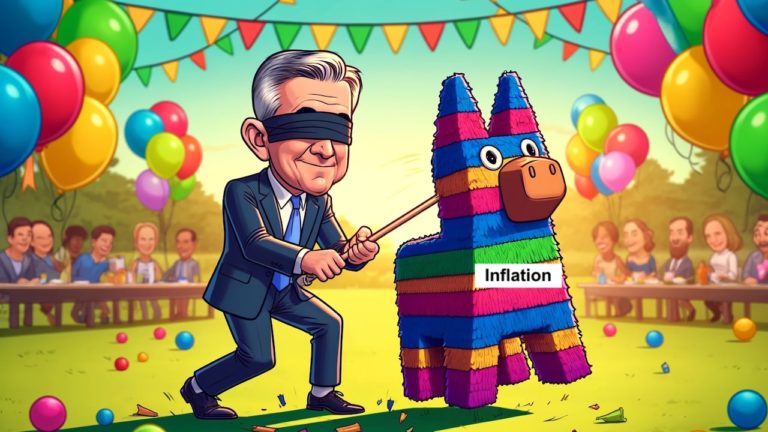
(Mike Maharrey, Money Metals News Service) Federal Reserve Chairman Jerome Powell and his fellow central bankers are swinging at inflation like a blindfolded kid trying to break a piñata.
Do you remember the March FOMC meeting? The Fed released its projections for rate cuts in the coming months. The consensus was for three cuts this year.
Fast forward six weeks. That’s all off the table.
Not a year. Not half a year. Six weeks.
Now ask yourself this question: did the underlying economic fundamentals really shift significantly in just six weeks?
Meanwhile, Powell & Company are flip-flopping all over the place, running their mouths, swinging a stick, and mostly missing the target.
Interest Rates Will Stay Put
As expected, the FOMC held rates steady between 5.25 and 5.5 percent. In its official statement, the Committee conceded that rates will remain at this level into the foreseeable future.
“The Committee does not expect it will be appropriate to reduce the target range until it has gained greater confidence that inflation is moving sustainably toward 2 percent.”
During the post-meeting press conference, Powell admitted that he and his fellow central bankers don’t have a clue when that might happen.
“I would say my personal forecast is that we will begin to see further progress on inflation this year. I don’t know that it will be enough, sufficient. I don’t know that it won’t. We’re going to have to let the data lead us on that.”
It’s ironic to contrast how emphatic Powell was when insisting that inflation was “transitory” and how wishy-washy he is now.
Powell said the decision as to when to ease monetary policy is “a judgment call.”
“There isn’t any rule. You can’t look to a rule.”
Or to put it another way, Powell & Company is running monetary policy on hunches and guesses.
When asked whether unemployment ticking above 4 percent would be enough to trigger a cut, the Fed chair also refused to provide any concrete guidance.
“An unexpected weakening is the way I characterized it. I’m not going to try to define exactly what I mean by that, but it would have to be meaningful, and get our attention, and lead us to think that the labor market was really significantly weakening for us to want to react to it.”
While Powell didn’t give any hints about the timing of rate cuts, he did indicate that further rate hikes aren’t currently on the table, but he didn’t rule them out.
“I think it’s unlikely that the next policy rate move will be a hike. I would say it’s unlikely.”
Powell insisted that monetary policy is “sufficiently restrictive.” I should note here that monetary policy remains loose from a historical perspective.
Balance Sheet Reduction to Slow
While the FOMC didn’t make any changes to interest rates, it did announce plans to slow balance sheet reduction. According to the official statement, the Fed will ratchet down the reduction of its Treasury holdings by more than half, from a maximum of $60 billion to $25 billion per month beginning in June. It will continue to reduce its holdings of mortgage-backed securities by $35 billion per month.
The plan to slow the balance sheet run-off is completely at odds with the Fed’s insistence that it is committed to pushing price inflation back to its 2 percent target.
The Federal Reserve added nearly $5 trillion to its balance sheet during the pandemic and injected the same amount of money into the economy. This is, by definition, inflation. This monetary inflation is the root of the price inflation we’re suffering from today. Since the central bank launched its inflation fight, it has only wrung $1.5 trillion of that inflation out of the economy. This is just a drop in the inflationary bucket.
The balance sheet reduction scheme was tepid, to begin with. Based on the plan announced in March 2022, it would take 7.8 years for the Fed to shrink its balance sheet back to pre-pandemic levels. That doesn’t even begin to touch the trillions added to the balance sheet in the decade after the 2008 financial crisis.
And now their winding balance sheet reduction down.
It’s no secret why.
The U.S. government has a borrowing problem. It is issuing Treasuries at breakneck speed to cover the massive monthly budget deficits. When the Fed allows bonds to roll off its balance sheet, the Treasury Department must find buyers in the open market to replace them. (The government has to borrow money to pay the bondholders who lent them money in the past.) In effect, balance sheet reduction increases the supply of Treasuries in the marketplace, causing prices to fall and yields (interest rates) to rise. With the U.S. government paying more on interest expense than every spending category except Social Security, the Fed simply can’t maintain balance sheet reduction.
In a nutshell, it is backing off balance sheet reduction to enable U.S. government borrowing and spending.
But this move is completely at odds with the inflation fight and reveals that the Fed isn’t quite as concerned about beating price inflation as the rhetoric might indicate.
When you look at what Powell & Company say and do, it becomes clear that these central bankers don’t know what they’re doing. It’s a monetary policy based on conjecture, wild guesses, and hope.
Mike Maharrey is a journalist and market analyst for MoneyMetals.com with over a decade of experience in precious metals. He holds a BS in accounting from the University of Kentucky and a BA in journalism from the University of South Florida.
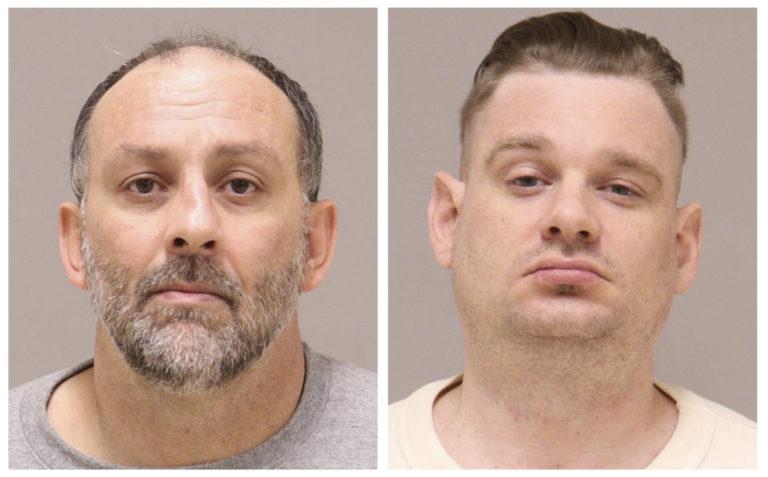
(Ken Silva, Headline USA) The much-anticipated appeal hearing was held Thursday for Barry Croft and Adam Fox, the alleged “ringleaders” of the 2020 militia conspiracy to kidnap Michigan Gov. Gretchen Whitmer.
Croft and Fox were convicted of plotting to kidnap Whitmer after their second trial in late 2022. At their first trial earlier that year, a jury acquitted two other men while failing to reach a verdict for Croft and Fox.
The two men appealed their convictions on multiple grounds. Thursday’s hearing focused largely on the conduct of FBI informants and their handling agents.
Oral arguments in appeal of conviction of Adam Fox and Barry Croft–two men entrapped by FBI in Whitmer fednapping hoax–about to begin.
Croft’s attorney, Timothy Sweeney, argued that his client should get a retrial because he wasn’t allowed to introduce numerous text messages that showed improper conduct by the FBI.
Those text messages showed how FBI informants were pressuring Fox and Croft to formulate a plan against Whitmer. A list of the texts can be found in this document.
Representing the government, Assistant U.S. Attorney Nils Kessler argued that the FBI text messages were irrelevant because Fox and Croft were already predisposed to committing an act of terrorism.
“All the [FBI] statements identified by defense go to inducement. If jury found they were predisposed [to kidnapping Whitmer], none of that matters,” Kessler said. “This court has held that entrapment can only happen if the government plants an idea in an innocent persons’ head.”
The appeals justices expressed skepticism about Kessler’s argument. One justice disagreed with the prosecutor’s reading of the law.
“They’re saying the jury didn’t see all the pressure, all the government informants pounding on them. Surely that’s relevant?” the justice asked Kessler, to which he responded: “Theoretically, yes, but they don’t identify any statements where an informant actually put that kind of pressure to go kidnap the governor.”
The justices then identified several statements where informants pressured the defendants to move forward with a plot against Whitmer. For example, FBI informant Steve Robeson said in August 2020: “If we don’t talk about actually doing what the fuck we need to be doing, I’m done with meetings.”
Kessler argued that Robeson was only pressuring the defendants to disclose their plan, but the appeals justice seemed to disagree. “I’m reading this as, ‘We need to make a plan,’” she said.
The appeals justices presiding over the case were Judge Joan Larsen, Judge Chad Readler, and Judge Stephanie Davis. Audio, but not video, of the hearing was streamed, making it difficult to identify which justices were speaking.
A recap of the hearing can be found here:
Oral Arguments on Appeal: Adam Fox & Barry Croft, Whitmer "Kidnap Plot" Case https://t.co/CcBkLJFMOb
(Ken Silva, Headline USA) In the post-9/11 terror wars, the U.S. military used classified surveillance equipment to track people through their cell phones and license plates.
Now, such equipment is being purchases by small towns throughout the U.S. According to the political outlet NOTUS, at least two Texas towns along the U.S.-Mexico border have purchased a product called “TraffiCatch,” which collects the unique wireless and Bluetooth signals emitted by nearly all modern electronics to identify devices and track their movements.
NOTUS quoted TraffiCatch’s manufacturer, which said its product can “detect in-vehicle wireless signals [and] merge such signals with the vehicle license plate.”
“Combining license plate information with data collected from wireless signals is the kind of surveillance the U.S. military and intelligence agencies have long used, with devices mounted in vehicles, on drones or carried by hand to pinpoint the location of cell phones and other electronic devices,” NOTUS noted. “Their usage was once classified and deployed in places like Afghanistan and Iraq.”
The Texas towns using TraffiCatch are Webb County, Texas—which includes the border city of Laredo—and Val Verde County. A Texas state grant program called Operation Lone Star helped fund the purchases, NOTUS reported.
Webb County Sheriff’s office Capt. Federico Calderon told NOTUS that the technology was used as a pilot to scan for radiofrequency signals in areas where no devices should be — specifically to try and protect seasonally-used rural ranches from trespassers.
He reportedly said the county did not share data with the federal government, and that the county purchased a “very restricted” version of TraffiCatch compared to what governments abroad have purchased.
Supreme Court precedent suggests that using TraffiCatch against Americans would require a warrant. But NOTUS noted that police departments around the country have worked around such requirements with equipment such as TraffiCatch and “stingrays”—technology that simulate cell towers and collect signals from devices nearby.
As Headline USA has reported, police agencies have tried to conceal their use of such equipment.
Documents obtained by the Project for Privacy & Surveillance Accountability and the ACLU show that the FBI has been forcing local police departments to sign nondisclosure agreements before providing them with stingrays. The NDAs prohibit stingray data from being used as primary evidence in any affidavits, hearings, or trials.
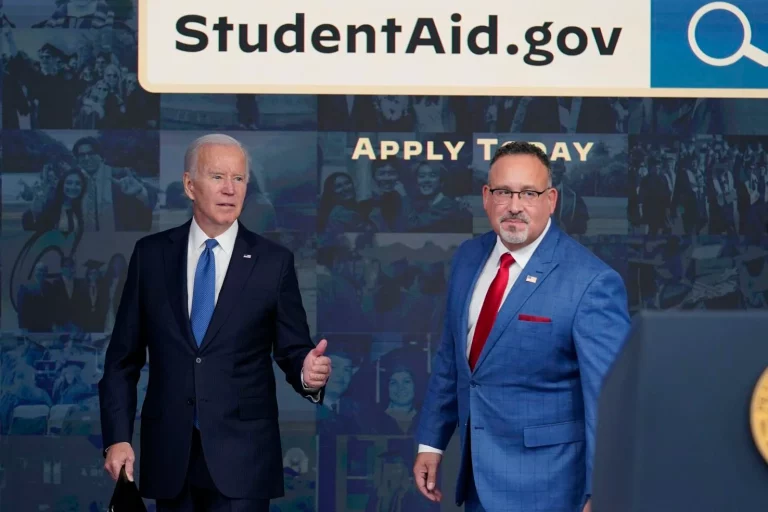
(Luis Cornelio, Headline USA) President Joe Biden’s wave of a magic wand has made billions of dollars in college debt disappear for students who attended a now-defunct university.
On Wednesday, Biden announced the “cancellation” of $6.1 billion in student loans for 317,000 students who had enrolled at the Art Institutes.
“This institution falsified data, knowingly misled students, and cheated borrowers into taking on mountains of debt without leading to promising career prospects at the end of their studies,” Biden claimed in a press release.
Our taxes are paying for useless degrees for people who chant Death To America.
The staggering $6.1 billion in loan forgiveness marks part of nearly $29 billion in debt relief transferred to American taxpayers. This $29 billion figure is allegedly connected to universities that Biden alleges “exploited” borrowers.
Biden’s widely discussed program has aided 1.6 million borrowers, comprising 4.6 million Americans.
“We will never stop fighting to deliver relief to borrowers, hold bad actors accountable, and bring the promise of college to more Americans,” Biden claimed.
The Art Institutes were a consortium of private universities offering certificates and degrees ranging from associate’s to master’s degrees. It was originally headquartered in Atlanta, Georgia.
The university also had campuses in Arizona and Pennsylvania, both crucial states in the lead-up to the 2024 presidential election, reported the New York Post on Wednesday.
Critics have long chastised Biden’s student loan forgiveness plan as part of a broader effort to bolster his flagging re-election campaign.
During the 2020 campaign, Biden pledged to cancel student debt if elected president.
Within a year of taking office, Biden attempted to assert the authority to cancel student loan debt through the Health and Economic Recovery Omnibus Emergency Solutions (HEROES) Act.
After several states sued Biden, the Supreme Court invalidated the program, admonishing the Biden administration that it lacked the authority to implement such a plan.
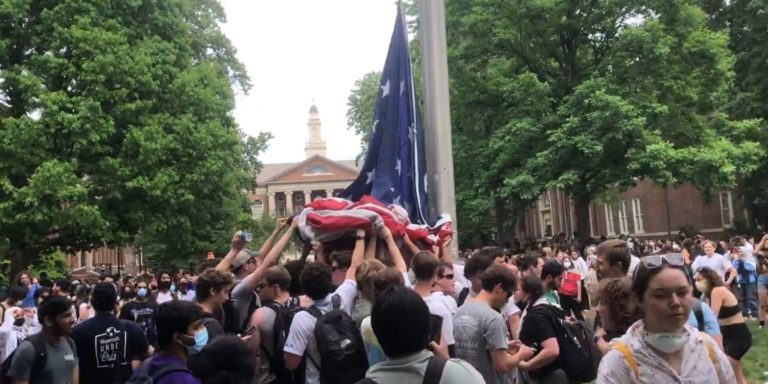
(Luis Cornelio, Headline USA) A fraternity at the University of North Carolina has garnered viral recognition for their courageous stand against anti-Israeli hecklers who defaced and lowered an American flag.
In a video that has since gone viral, members of Pi Kappa Phi were captured collectively raising the American flag in the rain, while the hecklers watched on.
The fraternity’s patriotic gesture prompted an outpouring of support on social media, with Americans rallying behind them through contributions of over $200,000 to a GoFundMe fundraiser aimed at hosting a celebratory feast.
“We are overwhelmed by you glorious, Patriotic Americans who value good beer and great times,” wrote John Noonan, the organizer behind the crowdfunding page.
He added, “Commie losers across the country have invaded college campuses to make dumb demands of weak University Administrators. But amidst the chaos, the screaming, the anti-semitism, the hatred of faith and flag, stood a platoon of American heroes.”
One of the best photos of 2024 so far:
Fraternity brothers are pelted by anti-Israel protesters at UNC Chapel Hill while protecting the United States flag as it is re-hoisted following its removal by protesters.
The overwhelming support for the fraternity members comes amid escalating violence and threats against Jewish students at several universities. These anti-Israel individuals vaguely protest U.S. support for the Jewish state as it confronts Hamas, a designated foreign terror group.
These protests have now reached UNC.
As reported by Newsweek, an anti-Israel mob unleashed their wrath on the UNC campus, brandishing the Palestinian flag at individuals who expressed discontent with their pro-Palestinian sentiments.
In response, the fraternity brothers stepped into action to protect the American flag, chanting, “USA! USA!”
Protests at UNC turning violent. Police rush quad in front of Wilson Library to replace a Palestinian flag demonstrators had put up in place of American one. Several students throw filled water bottles at law enforcement, incl. at Police Chief Brian James. pic.twitter.com/Sh5dYaEe1q
According to the fundraiser, the funds will be used to throw a party for the brothers who stood up to the hecklers.
“These boys… no, men, of the UNC Chapel Hill Pi Kappa Phi, gave the best to America and now they deserve the best,” the page added. “Help us raise funds to throw this frat the party they deserve, a party worth of the boat-shoed Broleteriat who did their country proud.”
A user named William Ackman, presumably hedge fund manager Bill Ackman, has donated $10,000.
In New York City, a similar video has since gone viral, showing NYPD officers lowering a Palestinian flag at the City College of New York’s campus in upper Manhattan.The video depicts an officer jumping to retrieve the flag while another tosses it to the floor.
In response, New York City Mayor Eric Adams thanked the NYPD for restoring the American flag.
“It’s despicable that schools would allow another country’s flag to fly in our country. So blame me for being proud to be an America,” Adams said during a press conference on Wednesday. “We’re not surrendering our way of life to anyone.”
NYC Mayor Adams: “It’s despicable that schools would allow another country’s flag to fly in our country. We’re not surrendering our way of life to anyone.” pic.twitter.com/ES0z1jqb5x
(Dmytro “Henry” Aleksandrov, Headline USA) Former far-left Google employees filed a federal labor complaint against the Big Tech company on Apr. 29, 2024, saying they were illegally fired for protesting Google’s partnership with the Israeli government and asking for better working conditions.
The complaint that was filed with the National Labor Relations Board stated Google violated the rights of the ex-employees “by terminating and/or placing them on administrative leave in response to their protected concerted activity, namely, participation (or perceived participation) in a peaceful, non-disruptive protest that was directly and explicitly connected to their terms and conditions of work,” the National Review reported.
The former Google workers staged sit-ins on Apr. 16, 2024, to protest Google and Amazon’s $1.2 billion contract with Israel, Project Nimbus, which provides cloud computing and artificial intelligence services to the Israeli government.
In the end, police arrested at least nine protesters and fired at least 28 employees a day later, with an additional 20 firings coming the following week. The news source reported that approximately 50 workers were terminated.
“This is a very clear case of employees disrupting and occupying work spaces, and making other employees feel threatened and unsafe. By any standard, their behavior was completely unacceptable — and widely seen as such,” a Google spokesperson said.
The spokesperson then doubled down on Google’s decision and said that the company “carefully confirmed and reconfirmed that every single person whose employment was terminated was directly and definitively involved in disruption inside our buildings.”
Google CEO Sundar Pichai also previously said Google employees shouldn’t use the workplace to “fight over disruptive issues or debate politics.”
However, the far-left workers argued that they were justified to be activists instead of employees.
“That’s legally protected activity. Sundar can say he doesn’t want that, but the National Labor Relations Act says otherwise. Google is probably the most powerful company in the world and the work the workers do every day has an incredible impact. To pretend it’s objective and you can’t talk about the effects of that is absurd,” an anonymous software engineer who was fired said.
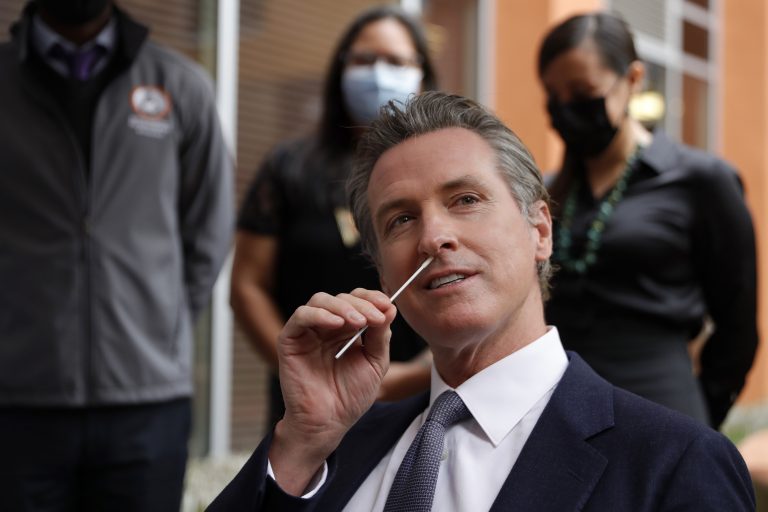
Newsom added that the effort is part of a first-in-the-nation plan to “address historical wrongs committed against California Native American tribes.”
California awarded more than $100 million for 33 tribal land projects through the program, which was set aside in the 2022-2023 and 2023-2024 state budgets, the Epoch Timesreported.
The news source additionally reported that the grants could be used for ancestral land return, restoration, workforce development, implementation of traditional ecological knowledge and tribal expertise, habitat restoration and climate and wildfire resilience projects.
“These awards are an acknowledgment of past sins, a promise of accountability, and a commitment to a better future—for the land and all its people, especially its original stewards,” Newsom said.
Most of the grants were awarded to tribal projects in Northern and Central California, the California Natural Resources Agency said.
“Today marks a pivotal moment in our journey toward healing and reconciliation,” Chairman Kevin Osuma, Iipay National of Santa Ysabel, said, adding that the award is a financial contribution and a symbol of solidarity, a recognition of rights, and a commitment to stewarding their ancestral lands.
The Kashia Band of Pomo Indians also said they are committed to preserving the natural resources and cultural heritage of their people.
“We look forward to working closely with the state and local communities to ensure that this land is protected and cared for in a sustainable manner,” Kashia Band of Pomo Indians Tribal Chairperson Dino Franklin said.
Early funding went to projects for the Hoopa Valley Tribe. The tribe acquired nearly 10,400 acres of forested property with the funds, the Times reported. The ribbon-cutting ceremony for this ancestral land return is set for May 14, 2024.
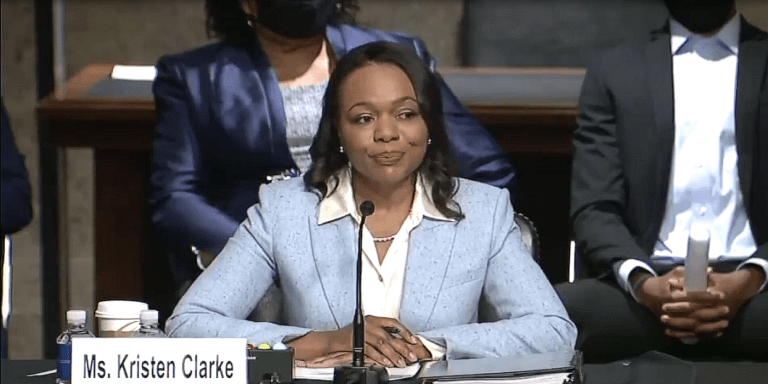
(Luis Cornelio, Headline USA) An embattled DOJ official is under scrutiny for failing to disclose her previous run-ins with the law during her confirmation hearings.
Assistant Attorney General Kristen Clarke omitted her arrest in a domestic violence incident involving her then-husband to the Senate.
Clarke, nominated by President Joe Biden in 2021 to her position, heads the powerful and pro-abortion Civil Rights division of the DOJ.
The revelation of her prior arrest came to light through a report by the Heritage Foundation’s Daily Signal, sparking concerns about Clarke’s lack of transparency during the confirmation process.
In comments to CNN, an outlet infamous for its left-leaning stance, Clarke claimed, without evidence, that she was not obligated to disclose her arrest as the charges had been expunged.
Her statement suggested that the arrest stemmed from the alleged violence she endured in her previous marriage.
“Nearly 2 decades ago, I was subjected to years-long abuse and domestic violence at the hands of my ex-husband,” Clarke stated. “This was a terrorizing and traumatizing period that I have sought to put behind me to promote my personal health, healing and well-being.”
Despite her statements to CNN, Clarke answered “no” to a specific question on the Senate confirmation documents that asked: “[S]ince becoming a legal adult, have you ever been arrested for or accused of committing a violent crime against any person?”
Clarke excused her failure to disclose the now-expunged arrest because she felt like it. “When given the option to speak about such traumatic incidents in my life, I have chosen not to,” she added.
Furthermore, despite the importance of the Senate confirmation process, she remarked, “I didn’t believe during my confirmation process and I don’t believe now that I was obligated to share a fully expunged matter from my past.”
Clarke’s deliberate omission of her arrest has provoked the ire of Sen. Mike Lee, R-Utah, demanding her immediate resignation.
“She lied under oath during her confirmation proceedings, and should resign,” Lee wrote on Twitter.
Lee also criticized Clarke, who enjoys massive prosecutorial powers at the DOJ, for jailing pro-life demonstrators while seemingly lying under oath about her own arrests.
Kristen Clarke is in charge of enforcing civil rights laws.
She enforces those laws aggressively against anyone who sneezes near an abortion clinic.
And not at all against those who vandalize churches.
She lied under oath during her confirmation proceedings, and should resign. https://t.co/5tHpaG4a2W
Clarke’s notably softer stance, as observed in her comments to CNN, sharply contrasts with her previous statements where she proudly highlighted her efforts in prosecuting pro-life activists.
In January, she celebrated the felony convictions of sex pro-life activists, claiming, “These defendants are being held accountable for unlawfully obstructing access to reproductive health services.”