“No. No, I have not [heard from either Joe or Jill],” Roberts responded to Morgan.
After learning she was pregnant with Hunter’s child, 33-year-old Roberts said that she had suicidal thoughts, calling her pregnancy “one of the loneliest times” of her life because Hunter left her as soon as he found out that Roberts was pregnant, Breitbart reported.
“I went through some pretty dark times emotionally and mentally during that time… I knew that, as long as I was pregnant, I wasn’t going to do anything to myself, because that would harm my child… But I would feel that, after the pregnancy, would it be better for my daughter and for Hunter and everyone else if I wasn’t here? Because it seemed like a scandal, and a burden what I felt at those times,” she told Morgan.
During the interview, Roberts also recalled how she felt hurt when she read a 2019 New Yorker profile, in which Hunter denied ever having sex with her.
“I can remember just reading it and just not having any words,” she said.
Hunter met Roberts when she worked as a stripper at the Washington D.C. “gentlemen’s” club Mpire with the stage name “Dallas.”
Roberts had been on Hunter’s company payroll for nine months, including while he was in a relationship with his late brother’s widow, Hallie, and struggled with a crack addiction.
“He had a demon on his back. He was obviously suffering from addiction during that time. But he had my attention. I was intrigued,” Roberts told Morgan.
She then said that her daughter, Navy, and Hunter previously had meetings on Zoom but had not met in person. Roberts said that Navy is “well aware” that her father has a lot going on.
“She’s waited five years. She can wait a couple more months,” she said, about a prospective meeting with her father who doesn’t want to be present in the child’s life.
(Luis Cornelio, Headline USA) A state judge on Thursday dismissed several charges against David DePape, the man accused of attacking former House Speaker Nancy Pelosi’s husband, Paul Pelosi, according to the San Francisco Chronicle.
The dismissed charges include attempted murder, elder abuse and assault with a deadly weapon.
These state charges were brought by the San Francisco District Attorney’s office in addition to DePape’s federal conviction, which landed him 30 years in jail.
Judge Harry Dorfman ruled in favor of DePape’s public defenders, who argued that these charges amounted to double jeopardy, thereby violating his constitutional rights.
The incident in question occurred on Oct. 28, 2022, when DePape broke into the Pelosi residence in San Francisco with the intent to kidnap Nancy Pelosi and break her knees. Instead, he encountered Paul Pelosi and brutally assaulted him with a hammer.
Despite the partial dismissal, DePape still faces significant charges, including false imprisonment, residential burglary, threatening a family member of a public official, attempting to sway a witness and aggravated kidnapping.
These charges were not covered by the federal case and DePape has pleaded not guilty to them.
Following DePape’s federal sentencing, Attorney General Merrick Garland emphasized the importance of the federal prosecution claiming that “violence against those who serve the public and their families will not be tolerated.”
He added, “The Justice Department will aggressively prosecute those who target public servants and their families with violence. In a democracy, people vote, argue, and debate to achieve the policy outcome they desire. But the promise of democracy is that people will not employ violence to affect that outcome.”
On Thursday, Clinton attempted to commemorate the 80th anniversary of D-Day but, in a pattern familiar to Democrats, she turned her post into a political statement about former President Donald Trump.
“Eighty years ago today, thousands of brave Americans fought to protect democracy on the shores of Normandy,” Clinton wrote on Twitter, adding: “This November, all we have to do is vote.”
Eighty years ago today, thousands of brave Americans fought to protect democracy on the shores of Normandy.
While Clinton did not specify who Americans should vote for, she has previously endorsed President Joe Biden for the 2024 election.
D-Day refers to the military operations carried out by Allied powers, leading to the liberation of France from Nazi occupation in World War II.
As reported by Fox News, several conservatives criticized Clinton for politicizing the 80th anniversary of D-Day.
“Just pure evil. Comparing the sacrifices of those who died to defeat Hitler and retake Europe to Democrats voting against Donald Trump. Sick and disgusting,” tweeted RedState writer Bonchie.
Conservative radio host Dana Loesch echoed Bonchie’s sentiments, writing: “In 2016 you attempted to undo everything they fought for by partnering with Fusion GPS to launder discredited oppo in the press, and merchandise it into surveillance warrants on enemies through FISA. Were my WWII vet grandparents alive today they’d slam this.”
The man behind the conservative Twitter page ComfortablySmug, who also hosts the Ruthless podcast, added, “What kind of shameless, broken, lizard person do you have to be to tweet out some nonsense like this?”
Other criticism included:
How disrespectful to our WWII heroes who faced unimaginable fear with immense courage 80 years ago today. https://t.co/JLFdsyU1A9
Holy shit I despise these people. It’s impossible to capture just how loathsome a comment this is. To cheapen what WWII heroes did to BS garbage politics makes me sick. Again, WWII veterans deserve so much better than this. https://t.co/kkZegFKaf9
What an enormously stupid and vile comment. Trump is not Hitler. And voting is not storming a beach under a hail of machine-gun fire to free millions from the tyranny of the Nazis. https://t.co/4SM5u62XKz
The communist doesn’t share any of your values. To the elite communists, America is just a bank vault to be looted. To the street communists, it’s an evil to be destroyed.
This would not mark the first time Democrats politicized a holiday or a special event.
The Biden campaign recently faced criticism for attacking Trump’s pro-life stance on Mother’s Day, an occasion meant to celebrate mothers.
“What a sad, miserable, cowardly existence Crooked Joe Biden and his campaign must have to make such a disgusting ad on such a joyous day,” the Trump team told Fox News. “Their lives are obviously filled with anger, hate, and resentment because they clearly suffer from Trump Derangement Syndrome.”
The American Enterprise Institute hosted a series of panel discussions surrounding the deployment of AI. Panelists discussed safety protocols, workforce development and regulatory initiatives.
Speakers included industry experts and policy directors such as Michael Richards, director of policy for the U.S. Chamber of Commerce Technology Engagement Center, and Bojan Tunguz, a former Nvidia software engineer, along with four others.
With the rapidly evolving AI technology, the need for industry, government and citizens to come together to promote safe but effective deployment is more crucial than ever.
“The core challenge is developing a general purpose technology that is fundamentally different from prior general purpose technologies, like electricity,” said Chris Meserole, executive director of the Frontier Model Forum.
In prior technologies, “we knew what it would do if we could build it, we just weren’t sure if we could build it or scale it out,” said Meserole.
AI has the opposite problem, he said.
While the engineering and development of AI has become better understood, its capabilities are hard to anticipate.
“We’re not entirely sure how to assess its safety,” Meserole said.
Recent developments have made the AI technology irresistible in roles of predictive maintenance, supply chain optimization and management, autonomous production lines and worker safety. Accordingly, there is a greater need for institutional and industrial convergence on standards and regulation.
Across borders, AI regulation has taken different approaches at different speeds.
In the United States, President Joe Biden recently issued an executive order, which is one of the few federal actions to date taken to address the AI revolution. The comprehensive order addresses issues related to privacy, civil rights, consumer protections, scientific research, and workers’ rights.
Last month, the U.S. Congress took its first steps to identify specific legislative needs, in the way of a bipartisan quartet of senators led by Majority Leader Chuck Schumer, D-N.Y.
Meserole said he applauds the work done by Schumer.
The European Union has already enacted legislation. In May, the union adopted the AI Act, a comprehensive set of regulations and requirements primarily for developers and employers.
The act prohibits numerous AI uses, such as social scoring or compiling facial recognition databases.
Regulation, and the advocacy for it, tends to address many of the same issues, including cybersecurity, critical infrastructure, privacy, misinformation and election security.
The current status-quo surrounding the AI revolution is uncertainty with a highly optimistic outlook on the potential benefits. Companies have begun gradually using AI for efficiency and optimization, especially in the tech sector at companies like Apple or Meta.
“A lot of what we’re seeing is a sort of crawl-walk-run approach,” said Mark Johnson, cofounder of Michigan Software Labs. “They’re starting with these simple agents and chatbots, which become these recommendation engines, which—based on their database and pricing engines—really drive to help make sure they are reaching the full potential of their business and revenue.”
The spoils of AI will not only go to Fortune 500 companies, however. AI has tremendous potential in education and helping individuals climb the socioeconomic ladder.
Lezlie Sizemore, associate vice president for workforce and economic initiatives at Kentucky’s Council on Postsecondary Education, spoke on Kentucky initiatives that use AI to help recovering addicts.
The Kentucky Community and Technical College System offers CLIMB-Health, a program aimed at establishing postsecondary pathways for individuals in recovery or reentry who are seeking entry-level employment as peer specialists.
AI has been used to train these individuals and mimic “clients” who require counseling.
“The individual could say ‘I want to practice a scenario with a veteran struggling with alcohol addiction,’” Sizemore said.
“This particular bot also guides them in their own postsecondary education journey,” she continued. “They could say, ‘I want to be a nurse or a psychologist,’ and this chat-bot would let them know what to do, step-by-step.”
(Ken Silva, Headline USA) Nashville mass shooter Audrey Hale’s “manifesto” was released this week revealing ramblings about transgenderism, violent fantasies and numerous indications of mental illness.
Hale’s writings were reported on this week by the Tennessee Star, which sued the U.S. government for the shooter’s manifesto.
“So now in America, it makes one a criminal to have a gun or, be transgender, or non-binary,” Hale reportedly wrote in one journal entry. “God I hate those s***head politicians.”
Hale also reportedly wrote about having deep regret in hitting puberty before blockers were available.
BREAKING: More information has been revealed about the transgender Nashville shooter Audrey Hale. Among four dozen pages of writings, Hale describes how she fantasized about her "imaginary p*nis" and how she hated her "conservative" parents who viewed her as their daughter.
“2007 was the birth of puberty blockers and a newfound discovery for treatment of non-conforming transgender children,” Hale wrote. “I’d kill to have those resources.”
Additionally, Hale reportedly fantasized about having sex as a man by creating scenes with stuffed animals.
‘I can pretend to be them [and] do the things boys do [and] experience my boy self as Tony,’ she wrote.
“God, I am such a pervert.”
Hale, a 28-year-old woman who was identifying as a man at the time of the mass shooting, gunned down three Christian children and three adults in March 2023 before being killed by law enforcement. In the subsequent investigation, officials discovered the manifesto in Hale’s apartment.
Public interest and concern over what drove the trans mass shooter’s rage has led to intensified calls for the release of the manifesto, which reportedly reveals in chilling details what Hale had planned.
The first three pages the purported manifesto were leaked to conservative broadcaster Steven Crowder last November. The Nashville Police Department reportedly suspended seven detectives over the leak.
The portion of the manifesto that was leaked purportedly revealed Hale had been planning the school shooting for years, and that she deliberately targeted “white privileged” “cr*****s” and “f****ts.”
The portion of the manifesto that was leaked purportedly revealed Hale had been planning the school shooting for years, and that she deliberately targeted “white privileged” “cr*****s” and “f****ts.”
“Can’t believe I’m doing this but I’m ready… I hope my victims aren’t,” Hale wrote. “My only fear is if anything goes wrong. I’ll do my best to prevent any of the sort. God let my wrath take over my anxiety. It might be 10 minutes tops. It might be 3-7. It’s gonna go quick. I hope I have a high death count. Ready to die.”
(Casey Harper, The Center Square) After two decades at war with the Taliban, the U.S. government is now sending millions of taxpayer dollars to the terrorist group.
The Taliban resumed power in Afghanistan immediately after the chaotic and deadly withdrawal of U.S. troops earlier in the Biden administration.
A new federal watchdog report shows that the U.S. government has sent at least $11 million to the Taliban since the 2021 withdrawal of U.S. troops. But experts and even the federal watchdog estimate the number is much higher.
“The U.S. government has continued to be the largest international donor supporting the Afghan people since the former Afghan government collapsed and the Taliban returned to power in August 2021,” the federal watchdog, SIGAR, wrote in its report. “Since then, the U.S. government has provided more than $2.8 billion in humanitarian and development assistance to help the people of Afghanistan.”
SIGAR said that the $11 million figure is likely only “a fraction” of taxpayer dollars actually going to the Taliban.
“SIGAR also found that the $10.9 million paid by 38 U.S. Department of State, U.S. Agency for International Development, and U.S. Agency for Global Media implementing partners is likely only a fraction of the total amount of U.S. assistance funds provided to the Taliban in taxes, fees, duties, and utilities because UN agencies receiving U.S. funds did not collect data or provide relevant information about their subawardees’ payments,” the report said.
Much of that taxpayer funding is transferred to the Taliban goes through nongovernmental organizations receiving foreign aid.
“To carry out their programs, U.S. agencies rely heavily on nongovernmental organizations and public international organizations, such as the UN, to implement humanitarian and development assistance,” the report said. “Both the former Ghani administration and the current Taliban-controlled government benefited from U.S. aid by imposing taxes, fees, duties and utilities on implementing partners as a condition of operating in Afghanistan.”
In fact, the right-leaning legal group Judicial Watch released an investigation recently showing that the Taliban has created fake NGOs to siphon away tax dollars.
Judicial Watch estimates the actual taxpayer dollars received by the Taliban is much higher than $11 million.
Although the Taliban has banned education for girls, the U.S. continues to send hundreds of millions of dollars to Afghanistan for education.
From Judicial Watch:
Since the terrorist group returned to power in August 2021, Uncle Sam has continued to fund Afghanistan’s education sector through six programs that cost $185.2 million even though the Taliban has issued decrees drastically limiting access to education for girls and women as well as restricting women’s ability to work and other basic freedoms.
Nevertheless, the American taxpayer dollars keep flowing. In fiscal year 2023, which ended in September, the U.S. sent Taliban-ruled Afghanistan over $566 million in humanitarian assistance. Most of it was for emergency food but a chunk was classified as going to general humanitarian and health. More than $15 million went to a cause that is labeled “redacted” in the government records.
Besides its terrorist past, the Taliban also severely oppresses women and girls and denies an array of human rights.
“SIGAR has reported on the importance of U.S. funds being spent on U.S. priorities and not in ways that benefit the Taliban, which represses women and girls, denies the human rights of the Afghan people and remains unrecognized as a legitimate government by the U.S. government and the international community,” the report said.
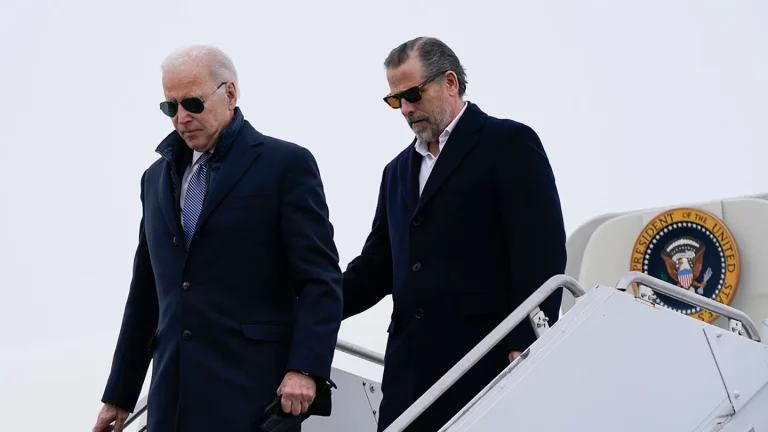
Hunter, 54, has been in court this week on gun charges related to his use of crack cocaine.
Special counsel David Weiss indicted him in September 2023 in federal court in Delaware on three counts tied to the possession of a gun while using drugs.
Two of the counts involve allegations that he allegedly lied on a form attesting that he was not using illegal drugs when he bought a .38 Special Colt Cobra revolver in October 2018. The third count alleges that he possessed a firearm while using illegal drugs.
President Biden told ABC News that he would accept the verdict in his son’s trial and would not seek to pardon Hunter Biden. The White House has repeatedly said Biden would not pardon his son if convicted of a crime.
In a statement Monday at the outset of Hunter Biden’s gun trial, the president said he wouldn’t comment on the trial.
“Hunter’s resilience in the face of adversity and the strength he has brought to his recovery are inspiring to us,” Biden said in a statement.
“A lot of families have loved ones who have overcome addiction and know what we mean,” he added. “As the president, I don’t and won’t comment on pending federal cases, but as a dad, I have boundless love for my son, confidence in him, and respect for his strength.”
Hunter’s previous plea deal on gun and tax fraud charges fell apart in July 2023 after last-minute disagreements over the degree to which he could face future charges for other alleged crimes still possibly under investigation.
That plea deal revolved around alleged tax crimes and a single gun charge.
If convicted, Hunter faces up to 10 years in prison on the first two counts and five years on the third count.
(Ken Silva, Headline USA) Covenant School shooter Audrey Elizabeth Hale reportedly used funds from a federal Pell Grant to buy the guns she used to kill three 9-year-old children and three adult staff members in a March 27, 2023, mass shooting.
The bombshell news was first reported by Tennessee radio host Brian Wilson, who said that Hale “took money from an education grant she received to purchase her weapons and to pay for training at a local gun range.”
According to the Tennessee Star, Hale purchased seven guns, three of which were recovered from the Covenant School after she died.
“The three guns alone—each currently valued at $519, $849, and $578—would cost an estimated total $1,946,” the Star reported Friday. “The total estimated cost of the weapons and accessories on the list is $2,619.68.”
News of Hale receiving federal funds is the latest major development in the 14-month-old crime. More pages from Hale’s much-anticipated manifesto were also released this week, as Headline USA covered in this story.
Wilson and the Tennessee Star have also detailed Hale’s extensive mental illness, reporting Sunday that Hale’s psychiatrist failed to report the transgender killer’s murder fantasies to law enforcement—a legal and ethical violation.
“Sources familiar with the investigation confirm that search warrants were run on the home and office of the therapist in an effort to obtain notes of the therapy sessions with the Covenant School shooter,” Wilson reportedly said last Friday.
“One source says detectives have evidence that the shooter told the therapist about fantasies that involved, among other things, killing her parents and carrying out a school shooting of some kind.”
The psychologist, who hasn’t been named, reportedly closed her practice just 86 days prior to Hale’s attack.
Hale, a 28-year-old woman who was identifying as a man at the time of the mass shooting, gunned down three Christian children and three adults in March before being killed by law enforcement. In the subsequent investigation, officials discovered the manifesto in Hale’s apartment.
(Mike Gleason, Money Metals News Service) Gold has been the headline performer in the first half of the year – breaking records and commanding attention. But in the second half of 2024, silver may be set to steal the show.
Silver has been quietly outperforming gold since February. Silver prices surged to an 11-year high last month.
The junior monetary metal still has a long way to go in order to reach a new all-time high above $49 an ounce. Even if it doesn’t achieve that feat in 2024, it could still set a new record for a year-end closing price.
After silver spiked to $49 in early 2011, it slumped the rest of the year to finish disappointingly back below the $30 level. If silver can have a decent second half of the year, or better yet build on what it did in the first half, then it will have established a new precedent and a strong base for a further bull run ahead.
Today, though, the monetary metals are seriously taking it on the chin — and what was looking like a positive week is now well into the red. As of this Friday afternoon, silver is down $2 to trade around $29.50 while gold is down $70 at $2,315.
Metals markets got a bit of a boost on Thursday from weaker-than-expected jobs numbers that sent the U.S. Dollar Index declining. The Bureau of Labor Statistics reported that the number of Americans filing for unemployment rose to exceed the consensus estimate.
However, Friday’s Nonfarm Payrolls report reversed things sharply as the May number was up 272,000, rather than the consensus forecast of only 190,000. The outperformance seemed to erase the unemployment number that was reported earlier in the week that gave a boost to metals.
Of course, bad news for Main Street isn’t necessarily bad for Wall Street. Anything that increases the odds of a Federal Reserve rate cut could carry bullish implications for stocks – at least in the short term.
But long-term investors shouldn’t be fooled into thinking that nominal stock market highs necessarily represent real underlying strength. The S&P500 has lagged behind both gold and silver year to date. In other words, stocks are losing value when priced in terms of sound money.
The U.S. dollar continues to depreciate at an elevated rate, making it difficult for the Fed to justify cutting rates. But dovish Fed officials may be encouraged by the European Central Bank, which opted this week to reduce its deposit rate by 25 basis points.
The ECB’s first rate cut in five years didn’t hurt the euro or trigger any sort of safe-haven buying of Federal Reserve notes. In fact, the U.S. dollar drifted lower versus a basket of foreign currencies. Perhaps currency traders are expecting America’s central bankers to soon follow suit with a rate cut of their own.
A pivot toward monetary easing would please Wall Street cheerleaders and Biden administration mouthpieces. Stock market bulls are looking for another excuse to push valuations even higher. And Joe Biden is desperate to get whatever polling boost he can from a stimulus injection into the economy.
The White House and its allies in the media act perplexed that voters generally aren’t happy with the way the economy is performing. They insist that Americans should be grateful for Bidenomics and the fact that inflation has come down.
The official rate of inflation may be lower now than it was a couple of years ago. But prices themselves haven’t come down. They continue to rise. And they are rising at a faster rate than they were when Biden took office, despite his repeated claims to the contrary.
A relentlessly rising stock market is a symptom of the problem. And for that matter, so are soaring precious metals prices, today’s pullback notwithstanding.
In the event that the economy rolls over, the stock market could finally do so as well. It’s already starting to weaken in real terms.
Economic stagnation plus high inflation is a terrible environment for conventional financial assets. Under stagflation, though, gold and silver can shine as alternative assets that help stabilize and boost investor portfolios.
Mike Gleason is a Director with Money Metals Exchange, a precious metals dealer recently named “Best in the USA” by an independent global ratings group. Gleason is a hard money advocate and a strong proponent of personal liberty, limited government and the Austrian School of Economics. A graduate of the University of Florida, Gleason has extensive experience in management, sales and logistics as well as precious metals investing. He also puts his longtime broadcasting background to good use, hosting a weekly precious metals podcast since 2011, a program listened to by tens of thousands each week.
(Money Metals News Service) The Sound Money Defense League (SMDL) is celebrating its 10th anniversary in 2024, marking a decade of relentless advocacy for the remonetization of gold and silver as legitimate currency.
Jp Cortez, Executive Director of SMDL, joined Mike Maharrey on the Money Metals Exchange podcast to discuss the organization’s mission, achievements, and the ongoing fight against taxes on precious metals.
According to Jp Cortez, “The Sound Money Defense League, celebrating its 10th anniversary in 2024, is a national nonpartisan group focusing on remonetizing gold and silver as money. The primary obstacle to using gold and silver as money is the taxes on their use and purchase. Our work involves eliminating these taxes and educating legislators across the United States about the importance of sound money.”
(Interview Begins Around 5:41 Mark)
A Decade of Advocacy
Established in 2014, the Sound Money Defense League is a national, nonpartisan public policy group. It focuses on eliminating the taxes that hinder the use of gold and silver as money. Cortez highlighted that the most significant barrier to using precious metals as currency is the taxes imposed on their purchase and use, including sales tax and capital gains tax. The SMDL’s primary goal is to eliminate these taxes state by state and, to some extent, at the federal level.
Jp Cortez mentioned that the Sound Money Defense League has had significant legislative successes in multiple states. Specifically, he highlighted that there are currently five states in the country that still charge taxes on precious metals, indicating that the majority of states have benefited from their advocacy by eliminating such taxes
The Tax Battle
Cortez emphasized the adverse effects of taxes on precious metals, explaining that they create practical obstacles for people wanting to use gold and silver as money. He pointed out that only five states currently charge sales tax on precious metals, and these states are losing revenue because buyers are either shopping across state borders or online to avoid taxes.
In states with taxes, events like coin shows avoid doing business, resulting in lost economic activity. Cortez argued that eliminating these taxes could potentially increase state revenue by attracting more business and economic activity.
According to Cortez, “Most states view taxes as revenue streams. Eliminating the tax on gold and silver could actually increase state revenue because it would attract more business, such as coin shows, that avoid states with such taxes. Concerning intentional barriers, it’s more likely that state politicians are unaware of the issues surrounding sound money rather than deliberately opposing it. The classification of gold and silver as collectibles by the IRS may also influence state policies.”
Jp Cortez went on to say, “The reason that gold and silver are not money is because of the taxes that surround their use and their purchase. So the first thing would be to eliminate these taxes. This is the single biggest point of friction that exists more than whether or not states have bullion depositories more than whether or not they’ve reaffirmed legal tender status or anything like that, the actual practical obstacle in the way of people using gold and silver as money are the taxes that surround its use.”
The Educational Mission
A significant part of SMDL’s work involves educating state legislators. Cortez noted that many state politicians have never considered the concept of sound money. SMDL educates these lawmakers on the importance and benefits of using gold and silver as money. The organization also works to pass legislation that supports sound money, such as bullion depositories and legal tender laws, and opposes the implementation of central bank digital currencies (CBDCs).
Jp Cortez said, “The concept of sound money has largely escaped the American cultural consciousness, unlike in Asia, where gold and silver are commonly sold and bought even by younger demographics. Much of SMDL’s effort is focused on educating both the public and legislators about the value and utility of sound money.”
Grassroots Mobilization
Cortez highlighted the importance of grassroots mobilization in their legislative efforts. By leveraging the extensive customer base of Money Metals Exchange, SMDL can quickly mobilize constituents to contact their state legislators about key bills. This direct involvement often makes a significant impact on the outcome of legislative battles.
Success at the State Level
Cortez explained why SMDL focuses on state-level legislation rather than federal initiatives. State-level advocacy is more effective and feasible due to the closer connection between constituents and their representatives. He cited examples of successful state-level campaigns, such as Tennessee, which has seen multiple pro-sound money bills pass after initial success in eliminating sales tax on precious metals.
Challenges and Future Outlook
The podcast also touched on the broader challenges of promoting sound money. Cortez acknowledged that while there is growing awareness and interest in precious metals as a savings medium, using them as transactional currency faces hurdles due to economic principles like Gresham’s Law. People prefer to spend less valuable currency and save valuable assets like gold.
However, the rise of innovative financial products and technologies, such as digital gold and physical fractional gold, shows promise. Cortez believes that the market, free from regulatory obstacles, will naturally gravitate towards sound money.
The Sound Money Index
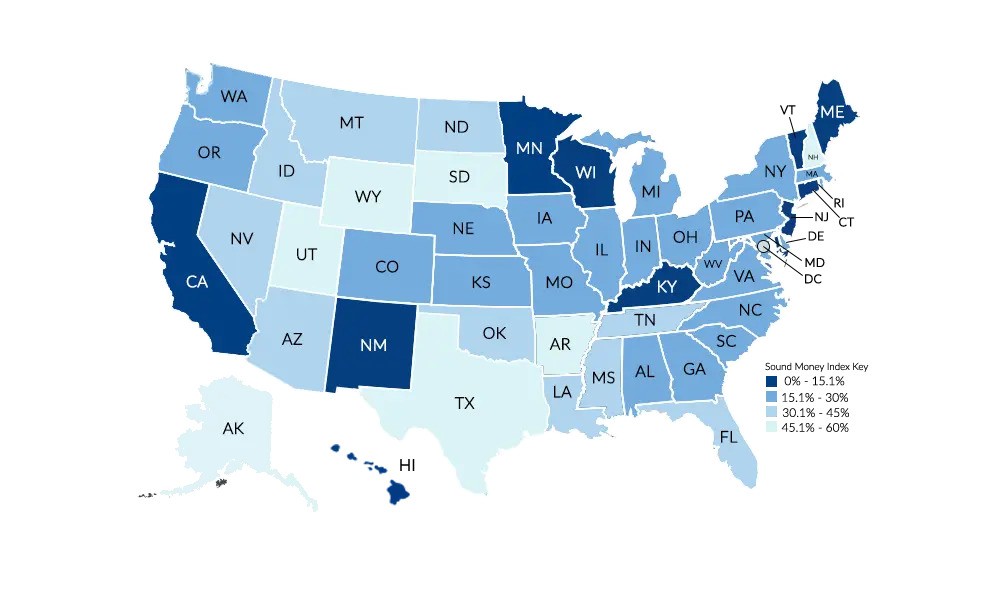
One of SMDL’s notable projects is the Sound Money Index, an annual report that ranks states based on their sound money policies. This index considers various factors, including tax policies, legal tender laws, and state reserves of gold and silver. Cortez mentioned that the upcoming 2024 index would reflect significant legislative successes, potentially shaking up the rankings as states like Utah, Tennessee, and Kentucky have made substantial strides in recent years.
Grassroots Action
Cortez urged listeners to get involved in the sound money movement by supporting SMDL, staying informed through their website, and participating in grassroots campaigns. He emphasized that state-level activism can have a profound impact on policy and encouraged individuals to voice their support for sound money legislation in their states.
The Sound Money Defense League continues to lead the charge in advocating for the remonetization of gold and silver, celebrating a decade of success and gearing up for future battles. Through education, legislation, and grassroots mobilization, SMDL aims to restore the role of precious metals in everyday commerce and safeguard economic stability.