Wisconsin Lawmakers Strike Down Three Emergency Election Rules

(Benjamin Yount, The Center Square) The fight over who writes the rules for elections in Wisconsin continues.

The Legislature’s rule-making body, the Joint Committee for Review of Administrative Rules, on Monday voted to suspend three proposed emergency rules from the Wisconsin Elections Commission that dealt with uniform rules for absentee voting, challenges to candidates and challenges to nominating paperwork.

Attorney Sklyar Croy, with the Wisconsin Institute for Law and Liberty, told lawmakers none of the solutions that WEC is looking to make permanent are true emergencies.

“The Commission issued scope statements in September 2023. It then took until late spring 2024 for Gov. Tony Evers to approve the emergency rules. The commission waited until six months before the beginning of the 2024 election cycle to begin emergency rulemaking, and then took several months thereafter to finish,” Croy said. “This committee should not allow an administrative agency to just mouth the word emergency as a means of avoiding permanent rulemaking procedures.”

Croy said allowing WEC to use the emergency rule process for these three rules would allow the Elections Commission to side-step the lengthy review that comes with permanent rulemaking.

Worse, state Rep. Janel Brandtjen, R-Menomonee Falls, said it would allow the Elections Commission to act as if the legislature doesn’t exist.

“I think that this emergency rulemaking process needs to be shut down, because other agencies are paying attention,” Brandtjen said. “This process of going around the legislature is incredibly dangerous. And if WEC has the ability to move this, I can guarantee you that we will have a lot of emergency rules.”

Democrats, however, argue it is the rulemaking process and the JCRAR who are dangerously working-around the process of making laws.

“I think it’s apt that we’re talking about separation of powers, when we’ve just had a Supreme Court ruling on this very issue. It strikes me that what this committee is taking upon itself is essentially doing the court’s job and doing the executive branch’s job,” Sen Kelda Roys, D-Madison, said. “This committee is, you know, pretty problematic from a separation of power standpoint.”

That Supreme Court ruling limited the power of the legislature’s Joint Committee on Finance when it came to spending already appropriated money.

The decision to suspend WEC’s proposed emergency rules doesn’t change much for Wisconsin’s pending elections.

The absentee ballot proposal would have been the most impactful, but without it, clerks across Wisconsin will continue to provide their voters with absentee ballot instructions. The proposed emergency rule would simply have prohibited those clerks from issuing any guidance that did not adhere to WEC’s suggested rules.

Calls Grow for Biden ‘Proof of Life’ as Impromptu Campaign Exit Falls Under Suspicion

(Ben Sellers, Headline USA) The very platform that President Joe Biden, the former presumptive Democratic nominee, used to announce his impromptu—albeit, not entirely unexpected—exit from the 2024 presidential election had become a breeding ground of suspicion following a full day in which Biden himself had yet to surface.

With his schedule having been wiped indefinitely, a growing number of social-media users  on X were beginning to demand #ProofofLife as of Monday afternoon.

While some continued to joke about it, others found the apparent cover-up of the sitting president’s condition to be alarming and a matter of the utmost public interest.

Rumors began spreading that Biden may have undergone some kind of serious medical emergency during his trip last week to Las Vegas.

“The last time the public saw Biden he feebly walked down the stairs of Air Force One and had to be physically assisted into the presidential limo,” noted conservative radio pundit Todd Starnes. “He has not been seen in public since.”

If, indeed, Biden were still alive, others questioned whether the ostensibly COVID-stricken 81-year-old may have agreed to something under severe duress or in a weakened state that he would not otherwise have consented to if he were in full health.

Then there were questions as to whether Biden was even aware of his decision to drop out at all.

Several pointed out that in addition to the lack of visual proof, the letter itself did not appear on his official White House letterhead, and the signature did not match with his normal signature.

Biden’s initial announcement claimed that something more official would be forthcoming later in the week.

Late Monday, he reportedly called into Vice President Kamala Harris’s campaign headquarters to offer his support.

However, in the era of deep-fake videos and a Democratic Party that already has expended all its credibility by attempting to mislead the public about Biden’s condition, it may take more convincing than that.

Already, Biden’s voice has been known to have been replicated by artificial intelligence as part of a hoax that occurred during the New Hampshire primary, when voters received robocalls telling them to stay home.

Attorney General Merrick Garland also cited concerns over the misuse of recordings as his pretense for refusing to make public the audio interview between Biden and special counsel Robert Hur—which ultimately resulted in Garland being charged with contempt of Congress.

Meanwhile, both Republicans expressed outrage over the duplicitous manner in which Democrats have sought to use the Biden bait-and-switch to nullify the results of their primary election while still attempting to keep the incapacitated, vegetable president in office—despite acknowledging that he is unfit to serve.

Several, including House Speaker Mike Johnson, R-La., promised that they would wage whatever legal challenges were necessary to prevent the candidate swap from going through.

Yet, Democrat lawyer Marc Elias threatened Johnson back, saying that the DNC would ultimately prevail in any legal battle over its right to deprive Democrats of a duly-elected candidate based on their dubious bylaws, which ultimately grant all the party’s power to an uber-class of elite super-delegates.

Showing little self-awareness over the fact that Democrats themselves had just committed an insurrection, Elias projected the accusation onto Johnson, accusing him, in true Saul Alinsky form, of being an “insurrectionist.”

Just days earlier, Rep. Alexandria Ocasio–Cortez, D-N.Y., had fumed in a rambling rant against Democrat party elites via Instagram that there was not consensus about Biden’s exit, sowing suspicion about the means through which her own party was attempting to oust the current president.

However, she has since fallen in line with the party talking points.

Ben Sellers is the editor of Headline USA. Follow him at twitter.com/realbensellers.

Reps. Comer and Raskin Issue Bipartisan Call for Secret Service Director’s Resignation

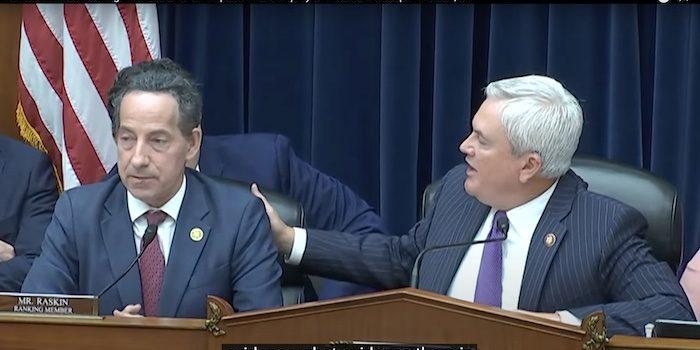
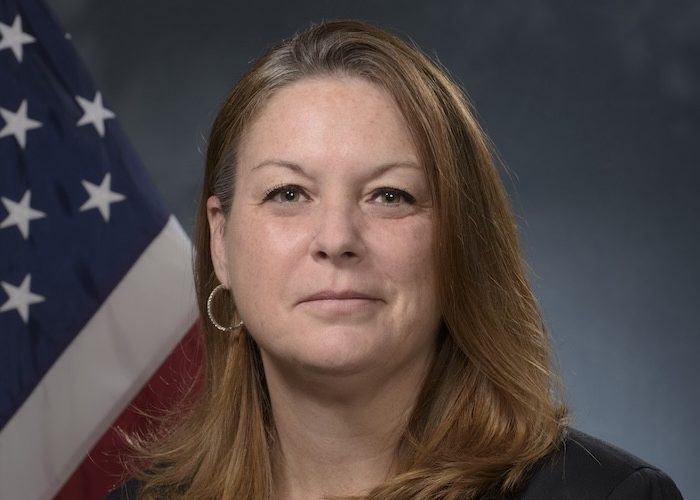
(Ken Silva, Headline USA) Following Monday’s House Oversight Committee hearing on the Trump assassination attempt, committee chair James Comer, R-Ky., and ranking member Jamie Raskin, D-Md., signed a joint letter demanding the resignation of Secret Service Director Kimberly Cheatle.

The bipartisan call for Cheatle’s resignation came after she failed to answer the simplest of questions at Monday’s hearing, including how alleged shooter Thomas Crooks was able to access the rooftop within 200 yards of Donald Trump during his July 13 rally in Butler, Pennsylvania. Cheatle also couldn’t provide a timeline of events for Congress.

“Today, you failed to provide answers to basic questions regarding that stunning operational failure and to reassure the American people that the Secret Service has learned its lessons and begun to correct its systemic blunders and failures,” Comer and Raskin said.

“In the middle of a presidential election, the Committee and the American people demand serious institutional accountability and transparency that you are not providing. We call on you to resign as Director as a first step to allowing new leadership to swiftly address this crisis and rebuild the trust of a truly concerned Congress and the American people.”

Over the weekend, there had been reports and rumors circulating that Cheatle’s resignation was impending. But on Monday, she said she intends to remain as Secret Service director, saying she wants to ensure “integrity” of the ongoing investigation into the security failures at the July 13 rally.

Throughout the hearing, numerous lawmakers from both sides of the aisle called on Cheatle to resign.

Those calls only grew louder after Cheatle admitted that she didn’t review the security plan for the Butler rally, nor did she speak to the agents on the ground on the day of the assassination attempt. Cheatle admitted that she still hasn’t even visited the scene of the crime.

Rep. Pat Fallon, R-Texas, had perhaps the most stinging call for Cheatle’s resignation, telling her she should “go back to guarding Doritos!” That was a reference to her prior job as Director in Global Security at PepsiCo.

Ken Silva is a staff writer at Headline USA. Follow him at twitter.com/jd_cashless.

Phone Data Reveals Link between Trump Shooter and Washington DC

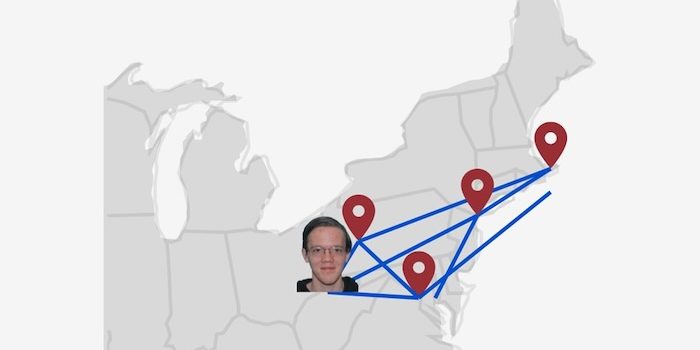
(Ken Silva, Headline USA) The Heritage Foundation’s Oversight Project has released an analysis of geolocation data linked to the devices of alleged Trump shooter Thomas Crooks and his “associates,” revealing that a frequent visitor to the Crooks household also travelled to a building in Washington DC—in the same vicinity as an FBI office there.

“Someone who regularly visited Crooks home and work also visited a building in Washington, DC located in Gallery Place,” stated the Oversight Project. “This is in the same vicinity of an @FBI office on June 26, 2023. Whose device is this?”

According to the Oversight Project, another device linked to Crooks visited Plymouth Harbor, Massachusetts in March. The non-profit government watchdog also tracked Crooks-linked devices movement around Pennsylvania in the days leading up to his July 13 assassination attempt, which left one firefighter dead and hospitalized at least two others.

The Oversight Project didn’t delve much into its methodology for how it tracked the devices. The group did say that it “identified devices that were located at Crook’s home and his work within the past year.”

“There were at least 9 devices linked to these AD-IDs We are willing to cooperate with legitimate investigations and share further information,” the Oversight Project added.

“For the protection of whistleblowers and our investigation, we will not be sharing further information with the congressional task force due to the connective tissue between that entity and FBI, USSS, and other entities.”

The Oversight Project’s analysis adds to the intrigue surrounding Crooks. It comes on the heels of reports that Crooks used at least “three encrypted platforms” located in Germany, New Zealand and Belgium.

Crooks was also reportedly spotted using a range finder, and law enforcement found a transponder on his person—which was presumably to detonate the explosives reportedly found in his car.

Despite Crooks having at least three encrypted apps, two phones, and accounts on gaming platforms, authorities he acted alone.

On Sunday, Rep. Anna Paulina Luna, R-Fla., became one of the first members of Congress to publicly express the likelihood that others were involved.

“We do know that he was a gamer. He was operating on Discord, which is a chatroom. And it’s very likely that with the equipment he came up with—the explosives and the detonator—he was obviously working with someone,” Luna said on Fox News.

Ken Silva is a staff writer at Headline USA. Follow him at twitter.com/jd_cashless.

WATCH: AOC Asks Surprisingly Trenchant Questions to Secret Service Director

(Ken Silva, Headline USA) While many Democrats took Monday’s congressional hearing into the Trump assassination attempt as an opportunity to push gun control, Rep. Alexandria Ocasio-Cortez, D-NY, to her credit, took time to ask some surprisingly trenchant questions to Secret Service Director Kimberly Cheatle.

AOC began her questioning by criticizing Cheatle for saying that a complete report on the July 13 Trump shooting won’t be finished for about another 60 days. Given the threat environment coming amidst one of the most politically chaotic times in recent U.S. history, she said a report needs to be made public as soon as feasibly possible.

“The idea that a report will be finalized in 60 days prior to any actionable decisions being made is not acceptable,” she said. “It’s been 10 days … There needs to be answers … Without your answers, we’re flying blind.”

AOC then asked about the Secret Service’s protective perimeter—or lack thereof—that was established at the July 13 Trump rally in Butler, Pennsylvania.

First, the New York representative asked whether the Secret Service has a standard perimeter, or whether such a perimeter is established on a case-by-case basis. Cheatle said the perimeter is determined separately for each event.

That’s when AOC asked one of the most trenchant questions so far from Monday’s hearing.

“An AR-15 has a range of about 400-600 yards. Why is the Secret Service protective perimeter shorter than one of the most popular semi-automatic weapons in the United States?” she asked.

Cheatle had no good answer.

“An advance was completed, and a number of factors are used to determine the permitter,” she said, giving a non-answer.

Cheatle added that “overwatch was created to help mitigate some of those buildings [within the Secret Service perimeter].”

AOC reiterated her point: “A perimeter wasn’t set at the event to put [Trump] outside of the range of an AR-15,” she said, noting that the rifle is one of the most popular weapons in America.

The congresswoman finished her time by urging Cheatle to answer questions. To that point, she had dodged nearly every substantial question posed to her by both Democrats and Republicans.

“I’d urge you to be more forthright,” AOC said.

Ken Silva is a staff writer at Headline USA. Follow him at twitter.com/jd_cashless.

We Are in a Recession in Full-Time Jobs

(Mike Maharrey, Money Metals News Service) We’ve been told the economy is strong for more than a year. The strong labor market with millions of new jobs serves as a primary data point to support this claim.

But the headline numbers don’t tell the whole story. 

The labor market isn’t telling us the economy is strong. It’s signaling recession with full-time employment dropping.

Month after month, mainstream media trumpets the “creation” of hundreds of thousands of new jobs. White House spokespeople point to the data and brag. Federal Reserve officials say it proves we are heading for a “soft landing.”

And then a month later, the Bureau of Labor Statistics (BLS) quietly revised the number of new jobs lower. In June, the BLS erased 111,000 jobs from the books.

But even with the revisions one can still argue job growth remains impressive.

This is why you should always look beyond the headlines.

In reality, we have been in a full-time job recession for several months.

More Jobs Doesn’t Mean More People Working

As Mises Institute Executive Editor Ryan McMaken pointed out, the total number of employed people has stagnated over the past year, even as the economy created hundreds of thousands of jobs every month.

How can this be? 

The only way this can happen is if more and more people are working more than one job.

As we look at the numbers, it’s important to understand that the BLS releases two different reports. The establishment survey reports the total number of jobs created. It gets all the headlines. The household survey measures the employment status of individuals in households.

There are huge discrepancies between these two metrics.

Part of this is due to the fact that the BLS establishment survey creates jobs out of thin air. The agency uses a “birth-death model” that assumes the existence of new jobs every month based on assumptions and conjecture.

But even taking this into account, the discrepancies between the establishment and household surveys tell an interesting story.

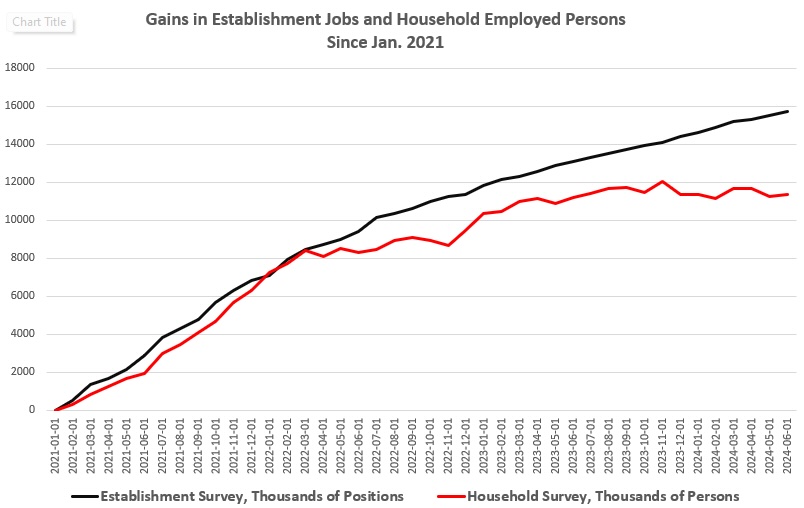
According to the official establishment survey data (We’ll accept it as valid for the sake of argument), the economy added 2.6 million jobs between June 2023 and June 2024.

However, according to the household survey, the total number of employed persons only rose by 195,000.

In a healthy economy, you would expect to find the number of employed people rapidly rising with all these new jobs. If there is new work, you would expect new workers to fill those positions.

But based on the BLS household survey, the total number of employed people has flatlined over the last year.

This has been the trend since the end of the pandemic. Since January 2021, the establishment survey shows nearly 16 million new jobs. Meanwhile, the household survey charts less than 12 million newly employed persons.

Again, the only way an economy can add jobs without additional workers is if currently employed people take on additional jobs. 

This appears to be what’s happening. People are losing full-time employment and taking on multiple part-time jobs, or they are still working full-time and taking on an extra job delivering pizzas in an effort to make ends meet.

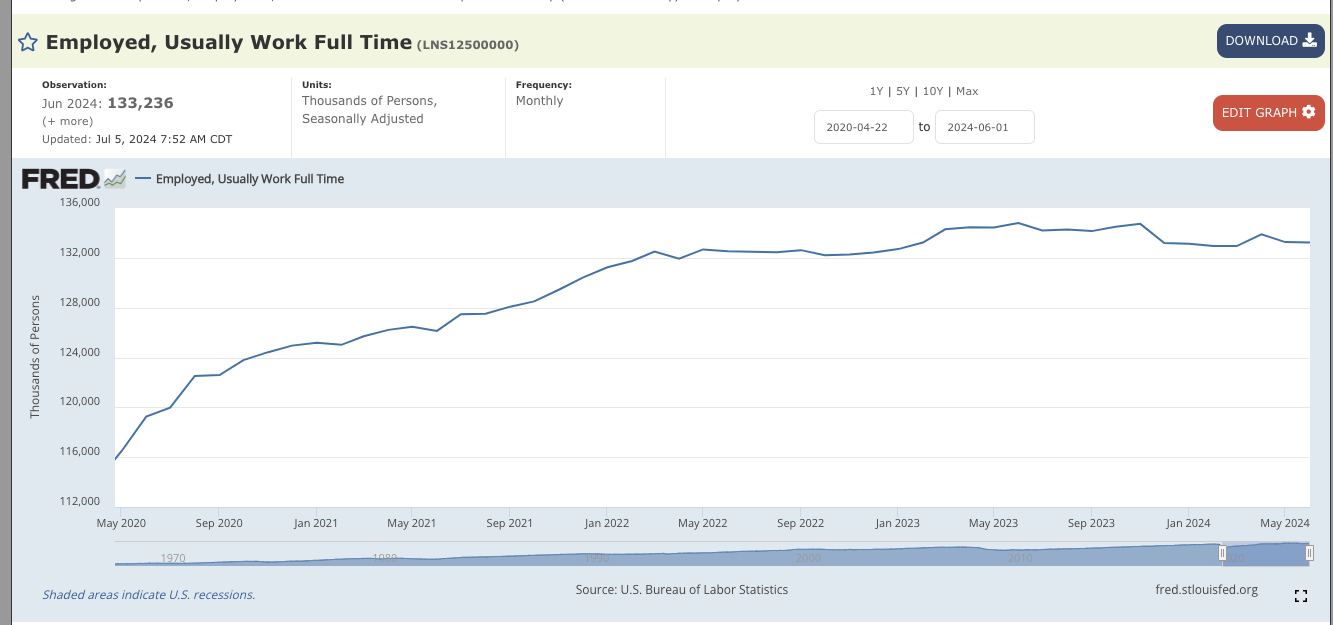
In fact, while the number of part-time jobs has grown, the number of full-time jobs has dropped. Based on household survey data, over the last three months, the number of full-time jobs fell into recession territory with the number of full-time employees dipping from 133.9 million to 133.2 million since April.

Looking at the chart, the number of full-time employees has generally dropped since late 2023.

Meanwhile, the total number of full-time jobs was down year over year in February, March, April, May, and June.

This indicates some people are taking on a second full-time job as they try to cope with rising prices.

McMaken points out, “Over the past fifty years, three months in a row of negative growth in full-time jobs has always been a recession signal and has occurred when the United States has been in recession, or about to enter a recession.”

“This is to be expected in a weakening economy. Empirical studies have shown that economies tend to shift to part-time work in times of economic downturn as a means of allowing employers more flexibility in reducing costs. This has been observed internationally, and not just in the United States.”

Whenever you see headlines citing government data, you should always dig deeper. The mainstream media tends to report what the government wants you to hear. That often diverges from reality!


Mike Maharrey is a journalist and market analyst for MoneyMetals.com with over a decade of experience in precious metals. He holds a BS in accounting from the University of Kentucky and a BA in journalism from the University of South Florida.

Biden Out: How Will Gold and Silver Markets Respond?

(Clint Siegner, Money Metals News Service) Joe Biden announced Sunday that he is ending his presidential campaign, but he intends to finish the current term. This article may be political in nature, but it will have major ramifications for investors, including gold and silver bugs.

The bullion markets have been relatively quiet in recent months. The frenetic buying which kicked off in the spring of 2020 lasted for nearly 3 years, before metals investors paused for a breather. Premiums have since come way down, and dealer inventories are fully replenished.

Bullion investors in the U.S., who tend to skew conservative or libertarian, may be feeling less anxious in recent months.

Donald Trump has been rising in the polls, while Biden has looked more unelectable.

Pessimism about where the country is headed has been a major driver in the markets for physical gold and silver. For many, Trump seems to represent the “right track.” His election in 2016 led to a couple of quiet years, and demand is subdued once again with Trump as the front-runner.

Whomever the Democrats select to replace Biden, the question will be whether they have significantly better prospects to beat Trump in November. If he or she does, expect U.S. investors to buy more gold and silver.

Vice President Kamala Harris looks to be in the pole position, though she was not immediately endorsed by all prominent Democrats. However, the Democratic National Convention won’t begin for nearly a month.

The months just ahead in the bullion markets may look a lot like the past few months, provided Trump can hold onto his current lead in the polls.

The failed assassination attempt may have only strengthened Trump’s odds, and it isn’t clear who Democrats might offer as a solid counter.

It is important to note that this commentary is about the potential demand for physical bullion products in the U.S. and how that impacts premiums – not the direction of paper prices. There often isn’t much of a connection, at least in the short term.

Any sustained surge in demand for metal in the U.S. will likely result in higher bid and ask premiums for coins, rounds, and bars.


Clint Siegner is a Director at Money Metals Exchange, the national precious metals company named 2015 “Dealer of the Year” in the United States by an independent global ratings group. A graduate of Linfield College in Oregon, Siegner puts his experience in business management along with his passion for personal liberty, limited government, and honest money into the development of Money Metals’ brand and reach. This includes writing extensively on the bullion markets and their intersection with policy and world affairs.

Secret Service Director STILL Won’t Say Why Agents Weren’t on Rooftop Used by Trump Shooter

(Ken Silva, Headline USA) Secret Service Director Kimberly Cheatle began Monday’s much-anticipated House Oversight Committee hearing by declining to say why agents weren’t guarding the rooftop that was used by alleged Trump shooter Thomas Crooks as a perch for his assassination attempt.

Oversight Chairman James Comer, R-Ky., began the hearing by asking Cheatle a series of basic questions, including ones to confirm that her agency has a $3.1 billion budget and more than 8,000 employees.

Cheatle confirmed those numbers, but then became tight-lipped when Comer began to ask about the July 13 assassination attempt against presidential frontrunner Donald Trump, which also left a firefighter dead and at least two others hospitalized with severe injuries.

“At any point Saturday, did the Secret Service have agent on top of that roof?” Comer asked.

“We’re just nine days out from the incident,” Cheatle responded, citing an “ongoing investigation” as her reason for not providing basic information.

Comer continued to press the Secret Service director.

“Why did the Secret Service didn’t place a single agent on the roof? Wasn’t that building within the Secret Service’s perimeter that should’ve been secured?” Comer asked.

To that latter question, Cheatle did respond—if only to shift blame away from her agency. She said the building from whence Crooks fired at Trump was, in fact, outside of the Secret Service’s protective perimeter on the day of the Butler, Pennsylvania Trump rally.

Cheatle then declined to answer questions about how many Secret Service agents were with Trump on July 13. Comer was asking that question in the context of reports about Trump’s security detail being composed mostly of Homeland Security agents—as opposed to actual, trained Secret Service protectors.

“Quite frequently, we use agents from HSI,” Cheatle, said referencing DHS’s Homeland Security Investigations, or HSI.

Cheatle did confirm reports that Crooks flew a drone over the Trump rally site on the day of the event. She said she received that information from the FBI, which is investigating the shooting.

Cheatle also insisted that the Secret Service provided all the security that Trump asked for. That response comes on the heels of the Secret Service admitting Saturday that it had turned down requests for additional federal resources sought by Trump’s security detail in the two years leading up to his attempted assassination last week.

Ken Silva is a staff writer at Headline USA. Follow him at twitter.com/jd_cashless.

Gen Z and Millennial Investors Want Gold!

(Mike Maharrey, Money Metals News Service) You might think of gold as old-fashioned – an investment that mostly appeals to Boomers. But in the real world, it’s Millennials and Gen-Zers who are clamoring for gold.

According to a recent study by Bank of America Private Bank, 45 percent of wealthy investors under the age of 43 own gold, and another 45 percent expressed interest in holding the yellow metal. In other words, 90 percent of millennials and Gen Z investors are positive about gold. 

These are far higher percentages than we find among Gen X and Boomer investors.

A separate study by State Street found millennials on average have about 17 percent of their portfolios allocated to gold, the highest percentage of any age demographic. Boomers and Xers average about 10 percent.

SoFi head of investment strategy Liz Young Thomas told Reuters that young people have historically considered traditional assets such as gold “boring,” but strong returns over the last several years have turned their heads and changed their attitudes.

In fact, gold was among the best-performing assets in 2023 and through the first half of 2024.

“We are seeing returns we normally don’t see in such a short period of time. Naturally, when assets have strong returns, younger audiences start to perk up,” Thomas said.

According to Reuters, it’s not just the “healthy spot price” in recent months that has renewed the buzz around gold.

“It is also increasingly on the shelves in popular retail environments [such as Costco], which boosts visibility.”

A financial planner told Reuters that as his millennial clients get wealthier, they become increasingly interested in investing in “directly-held self-custodied” gold.

This is because gold comes with very little counterparty risk. If you own physical metal and store it in a safe at home, there isn’t another party involved. Nobody can default on gold (or silver). Its value will never go to zero. And gold is liquid under virtually any market conditions.

Young people are also becoming increasingly aware of the increasing risk in today’s economy with rapidly increasing government debt and rampant price inflation. 

As Reuters noted, “If the world’s financial system happens to go haywire, or currencies collapse, at least you would have something real to hold onto.”


Mike Maharrey is a journalist and market analyst for MoneyMetals.com with over a decade of experience in precious metals. He holds a BS in accounting from the University of Kentucky and a BA in journalism from the University of South Florida.

BlackRock Tied to Biden Coup as Links to Trump Assassination, IT Meltdown Emerge

(Ben Sellers, Headline USA) BlackRock, the multi-trillion-dollar company that has seen its stench touch on all of the suspicious events in the past week, played a direct role, of sorts, in finalizing the long-drawn-out Biden coup on Sunday.

As the 81-year-old president lay stricken with COVID-19 and any number of other unknown ailments, his bedside advisers were Steve Ricchetti and Mike Donilon, according to Politico.

When people ask who is really running the country, it is a safe bet that staffers like these had outsize influence in calling the shots.

Both had longstanding ties going back at least to the Obama administration, where they served similar roles serving as Biden confidantes, and likely had roles of influence behind the scenes in the Clinton administration, as well. During the Trump years, they assumed cushy interim jobs drawing salaries from the China-backed Biden Institute through the University of Delaware.

Donilon, who had been a humble campaign adviser of late, appears to have stepped into the role of senior adviser when Anita Dunn was conveniently jettisoned last month.

Dunn, a longtime adviser, fell on her sword after Biden’s disastrous debate. As recently as April, she had been one of the top staffers quietly trying to get Biden to remove Karine Jean-Pierre as press secretary. In other words, Dunn sincerely tried to prop-up the failing president where others were simply standing back and waiting for Biden’s implosion to occur.

Donilon, by contrast, had a key role in pressing Biden not to focus on issues or policies, but rather to attack former President Donald Trump as a threat to democracy—the sort of divisiveness that ultimately resulted in the Jan. 13 assassination attempt on the GOP candidate.

He is the brother of Tom Donilon, who was chief of staff in the Clinton State Department and national security adviser under Obama and now serves as chairman of the BlackRock Investment Institute.

Tom Donilon has visited the White House multiple times during the Biden administration, although the odds are good those meetings were not simply to do lunch with his brother or to say ‘hi’ to his former National Security Council colleagues.

Indeed, questions have arisen as to the extent to which BlackRock was running the White House given the widespread influence of the Donilon family—which also includes Tom’s daughter Sarah working at the NSC.

The globalist investment company, which gave birth to the toxic ESG strategy of forcing other companies to comply with a specific political agenda, is believed to have played a major role in forming the Biden administration’s China policy—in other words, allowing a spy balloon to fly over key security sites and doing little else to push back on the nation’s growing aggression.

More recently, BlackRock has played a major role in Ukraine operations, including major farmland acquisitions and securing the contract to rebuild it whenever the war there finishes, which raises considerable questions about how the bidding process played out.

Because of Tom Donilon’s roles in the State Department and the National Security Council, he undoubtedly had a strong part in crafting the Ukraine policy, which began in earnest with the 2014 color revolution that ousted the country’s Russia-friendly president.

Whether that involves CIA black sites, biolabs testing newly weaponized COVID or anthrax strains, or a massive server database capable of tapping into unsecured voting systems, Democrats’ peculiar interest in Ukraine remains something of a mystery.

Some now wonder if BlackRock and its co-conspirators might be willing to do anything necessary to keep it that way—including the attempt on Trump’s life.

Would-be assassin Thomas Crooks’s ties to the company are now on the radar of Sen. Josh Hawley, R-Mo., and others who are investigating the assassination attempt.

Crooks was featured in a BlackRock commercial during high school. The company also was reported to have investments in Austin Private Wealth, which was the only one to issue a short-sale order for Trump’s media company (DJT) the day before the assassination attempt.

In between the attempt to kill one presidential candidate one weekend and the successful effort to nullify a democratic primary the next weekend by forcing out its winning candidate, another anomaly also caught the attention of many.

CrowdStrike—the company best known for its ties to Dominion Voting Systems and for its role in maintaining and forensically examining the hacked Democratic National Committee servers in 2016—claimed that a routine update resulted in a Windows glitch that resulted in a global IT meltdown.

Among the systems reportedly impacted by it were the Dominion-run voting machines in Maricopa County, Arizona, which were not supposed to be online.

Not surprisingly, CrowdStrike has considerable ties to the Deep State, the DNC and to BlackRock.

Shawn Henry, CrowdStrike’s current chief security officer and a member of the company’s executive team, served as executive assistant director of the FBI during the Obama administration, working, undoubtedly, with other members of the Seventh Floor rogue’s gallery such as James Comey and Andrew McCabe.

BlackRock also is the top investor in CrowdStrike, meaning it essentially owns the company.

But don’t expect any of this information to be validated by the trusted sources at Fox News—since BlackRock also now owns a substantial stake in that company, and likely was behind its massive settlement deal for more than $700 billion with Dominion Voting Systems in a dubious defamation lawsuit.

Its “acquisition” of Fox last year also likely led to the termination of popular host Tucker Carlson and other Ukraine skeptics.

But while Fox founder Rupert Murdoch reportedly lobbied Trump hard to select Doug Burgum as his running mate, Trump listened instead to Carlson by selecting Ukraine war skeptic J.D. Vance.

Expect to see the network subtly begin to incorporate more of the leftist/mainstream media talking points into its reporting while ignoring the big stories right in front of their eyes that have its top investors’ fingerprints all over them.

Ben Sellers is the editor of Headline USA. Follow him at twitter.com/realbensellers.