WATCH: Local Cop Confronts Trump Shooter Seconds before Assassination Attempt

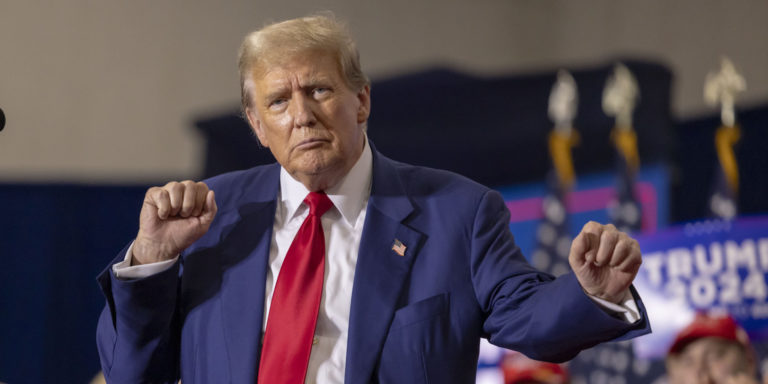
(Ken Silva, Headline USA) The Butler Township Police Department has released body cam footage from the officer who confronted Thomas Crooks seconds before he opened fire on Donald Trump and his supporters at the July 13 campaign event in Pennsylvania.

The footage corroborates testimony from Pennsylvania State Police Commissioner Christopher L. Paris that a local cop climbed onto the rooftop and attempted to stop Crooks, but jumped back down when Crooks pointed his AR-15 rifle at him.

Paris initially said this happened “minutes” before the assassination attempt, but later changed his testimony to say “seconds.” The footage, which shows the officer climbing about 20 seconds before Crooks opened fire at 6:11 p.m., appears to support the latter account.

“Fu– this close, bro. Dude, he turned around on me,” the officer later told his colleagues after the shooting stopped.

“Before you motherf—–s came up here, I popped my head up there like an idiot by myself dude,” the officer who was boosted onto the roof, was heard saying.

“Then he turned around and I f—— dropped and I started f—— I was calling out bro, f—— on top of the roof. F—— we’re not on the same frequency?”

The audio from the body cam footage doesn’t have audio during the shooting. The audio only starts nearly 2 minutes in, when the officer is getting his own rifle out of his police vehicle. The officer later climbed the roof again to examine Crooks’s corpse.

The unnamed officer’s body cam footage was the culmination of a search for Crooks that began by at least 5:38 p.m.—more than 30 minutes before the shooting.

“Kid [lurking] around building we are in. AGR I believe it is. I did see him with a range finder looking towards stage. FYI. If you wanna notify SS snipers to look out. I lost sight of him,” a counter sniper texted at 5:38 p.m., attaching two photos of Crooks.

“Call it in to command and have a uniform check it out.”

According to the Washington Post, after initially seeing him at 5:38 p.m., officers “lost track” of him for about 20 minutes. Then, the same counter sniper again spotted Crooks at 6:02 p.m.—this time on the side of the building facing away from the Trump rally.

Crooks was walking northeast, and the sniper apparently thought he was headed to a Sheetz gas station about a quarter-mile outside the rally site.

“He just went towards the Sheetz,” the sniper reportedly said, sending his colleagues on a wild goose chace while Crooks was presumably already on the roof.

Ken Silva is a staff writer at Headline USA. Follow him at twitter.com/jd_cashless.

Biden Hints that Dems Will Interfere w/ Peaceful Transition If Trump Wins

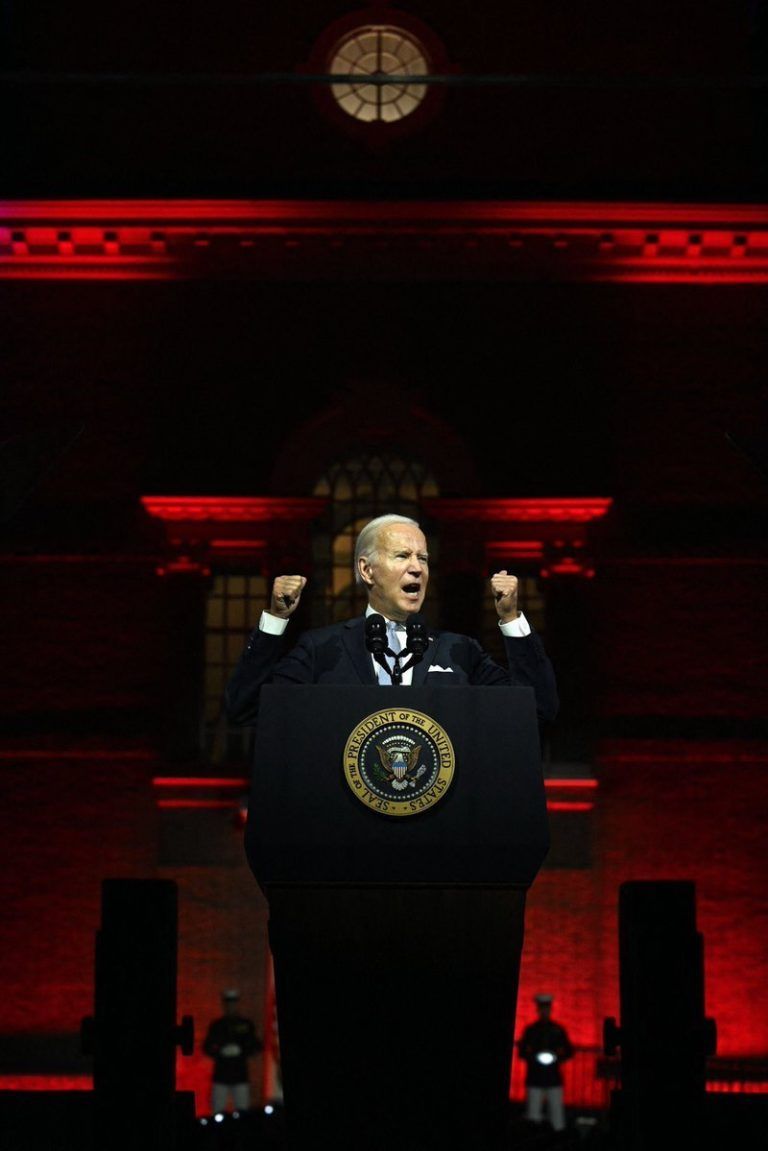
(Jacob Bruns, Headline USA) President Joe Biden hinted in a recent interview with CBS News that Democrats plan to interfere with the transfer of power if Republican candidate Donald Trump wins the 2024 election, Fox News reported.

In the interview, which is set to air in full on Sunday, Biden told CBS correspondent Robert Costa that in the case of a Trump victory, things might get ugly as the left desperately tries to hold on to power.

“Are you confident that there will be a peaceful transfer of power Jan. 20, 2025?” Costa asked.

“If Trump wins, no I’m not confident at all,” Biden answered ominously, before altering his answer to get out of his mishap.

“If Trump loses, I’m not confident at all,” Biden emphasized as he tried to correct himself.

Following up his telling blunder, Biden proceeded to falsely suggest that Trump has been threatening Americans if they do not vote for him.

“He means what he says,” Biden added.

“We don’t take him seriously,” Biden continued. “He means it—all this stuff about if we lose, there’ll be a bloodbath.”

Biden was mischaracterizing a prior statement Trump made specifically about the U.S. auto industry that a Democratic victory will result in an economic “bloodbath” because China is attempting to flood the market with cheap electric vehichles produced in Mexico.

Biden went on to cite an unspecified instance of alleged Republican shakedown of local elections officials, and accusing Trump of not caring about America.

“Look what they’re trying to do now, in the local election districts where people count the votes,” he said. “You can’t love your country only when you win.”

Biden’s comments about the Democrats’ opposition to Trump echo comments made by Rep. Jamie Raskin, D-Md., who revealed earlier this year just how far Democrats plan to go to keep Trump out of the White House.

“It’s going to be up to us on Jan. 6, 2025, to tell the rampaging Trump mobs that he’s disqualified,” Raskin said.

The interview will be the first major public appearance for the embattled president since his withdrawal from the 2024 campaign.

Biden made the reckless comment despite Trump’s reassurance in last month’s debate that he would gladly and “absolutely” accept the results of a “fair and legal and good election.”

Pro-Censorship Cartel Disbands after Being Sued by Elon Musk

(Ken Silva, Headline USA) The Global Alliance for Responsible Media is being disbanded roughly two days after Elon Musk sued the group for colluding to throttle advertising after Musk bought Twitter company for $44 billion in late 2022.

The World Federation of Advertisers, which created GARM and which represents about 90% of global ad spending, announced the decision in a Thursday email, according to Business Insider. WFA CEO Stephan Loerke reportedly wrote that the decision was “not made lightly,” but that GARM has limited resources. Those resources will apparently be concentrated on fighting Musk’s lawsuit.

It looks like House Republicans also had a large hand in GARM’s disbandment. Twitter/X CEO Linda Yaccarino said in a video announcement this week that the lawsuit stemmed in part from evidence uncovered by the U.S. House Judiciary Committee which she said showed a “group of companies organized a systematic illegal boycott” against X.

The Republican-led committee had a hearing last month looking at whether current laws are “sufficient to deter anticompetitive collusion in online advertising.”

In a report released last month, the House Judiciary Committee found—among other things—that GARM targeted popular podcaster Joe Rogan over his views on the COVID-19 vaccine. According to the House Judiciary report, GARM tried to drive advertisers away from Rogan due to his pro-choice vaccine views.

“GARM pressured Spotify to punish Mr. Rogan by applying GARM’s standards on Mr. Rogan’s content,” the report stated.

“In late-January 2022, Spotify met with Joe Barone, Managing Partner Brand Safety Americas, of GroupM, a Steer Team member, to discuss so-called misinformation on Spotify,” the report said, noting that GroupM is the world’s largest media buying agency.

Even though GroupM didn’t buy ads on the Joe Rogan Experience, the organization still pressured to punish the podcaster, according to the Judiciary report.

Rogan, of course, survived the coordinated onslaught and today still has one of the world’s most popular shows.

Ken Silva is a staff writer at Headline USA. Follow him at twitter.com/jd_cashless.

Three Months from Election Day, Georgia Election Board Alters Rules

(T.A. DeFeo, The Center Square) Georgia’s election board has approved a measure that allows county election boards to make a “reasonable inquiry” before certifying election results.

However, critics of the move are sounding the alarm, saying it will open the door to overreach.

“The majority on the State Election Board has created the opportunity for county board members to either delay or fail to certify based solely on speculation, rumor, or their own political preferences,” ACLU of Georgia Executive Director Andrea Young said in a statement.

“We want to remind county boards that certifying election results is an administrative task,” Young added. “Doing anything more than this is an overreach by county boards and beyond the scope of their authority. By passing this petition, the State Election Board is setting a precedent that it is acceptable to make substantial changes to our election rules just 90 days before an election.”

The executive director of Georgia’s Board of Elections did not respond to a request for comment on the board’s move.

According to the ACLU, state law mandates that county elections boards – or the probate judge in some counties without an elections board – certify the county’s election results by 5 p.m. the Monday after an election. State officials told The Center Square that since the Monday after the election this year is Veterans Day, a state holiday, the deadline is the next day.

When asked about the state board’s 3-2 vote to pass the measure, Secretary of State Brad Raffensperger’s office said it expects local elections boards to certify their results on time.

“Georgia’s Election Integrity Act requires counties to certify the election results by November 12 and we fully anticipate that counties will follow the law,” Georgia’s Secretary of State’s Office said in a statement to The Center Square.

Elections have been a hot topic in the Peach State since the 2020 presidential election, with state lawmakers passing multiple election measures, including the high-profile Senate Bill 202, also known as the Election Integrity Act of 2021.

“Another big win from the Georgia State Election Board,” Greater Georgia, which former Republican U.S. Sen. Kelly Loeffler launched, said in a social media post. “Yesterday, they passed a new rule allowing counties to conduct ‘reasonable inquiry’ before certifying elections, meaning discrepancies will be investigated BEFORE election … results are final – not after!”

Psych Patients for Kamala: Leftist Group Registering Voters at Mental Hospitals

(Ken Silva, Headline USA) Republicans are worried about illegal immigrants voting, but at least migrants presumably know where they are. The same can’t be said for another dubious voting block sought after by the Democrats: insane people.

The non-profit group “Vot-ER” has been hitting up the hospitals to scrape every voter possible for the 2024 election—including psych patients.

In a recent press release, the Pennsylvania Psychiatric Institute bragged about its partnership with Vot-ER, which was founded by Alister Martin, a former adviser to Vice President Kamala Harris.

“Depression and mental illness decrease the probability of voting, especially as it relates to a marginalized population. However, voting is an important part of the recovery process. It has been found to increase life satisfaction, decrease risky behaviors and increase mental wellbeing,” Dr. Julie Graziane, an inpatient psychiatrist at Pennsylvania Psychiatric Institute, said in a recent press release.

Graziane’s quote puts a positive spin on the program. But an analysis from the conservative-leaning Free Beacon is blunt: “The hospital asks psychiatric inpatients, regardless of diagnosis, if they would be interested in ‘voter registration tools.'”

As noted by the Free Beacon, Vot-ER claims to be nonpartisan. But it’s staffed by progressive operatives, funded by progressive foundations, and its parent group, “A Healthier Democracy,” has referred to DEI as “the bedrock of fair healthcare.”

Free Beacon reported that Vot-ER even has scripts doctors can use to encourage “undocumented patients” to register their “friends and family members who are citizens” to vote.

“Critics say that Vot-ER, which hosts trainings on ‘medical racism’ and partners with the Climate Psychiatry Alliance, is turning doctors into political activists and patients into political capital,” the Free Beacon reported.

Along with concerns aobut whether Vot-ER’s efforts are healthy democracy, there are also questions about whether patients could be harmed.

“The transformation has raised ethical questions about the power dynamic between patient and provider, the capacity of institutionalized people to give consent, and the potential for partisan pushiness in the exam room, where political chit-chat was long seen as off-limits,” the Free Beacon noted.

Vot-ER has reportedly decline to respond to requests for comment.

Ken Silva is a staff writer at Headline USA. Follow him at twitter.com/jd_cashless.

FBI Raids Home of Longtime Biden Critic

(Ken Silva, Headline USA) Former United Nations weapons inspector Scott Ritter—a longtime critic of Joe Biden, NATO and the Israel—had his home raided by the FBI on Wednesday.

According to Ritter, the raid was related to a suspected violation of the Foreign Agents Registration Act, which requires lobbyists for foreign countries to register with the Justice Department.

“I will tell you right now I am not in violation of the Foreign Agents Registration Act … and hopefully, by executing the search warrant and taking the information that they did, they will rapidly reach that conclusion,” Ritter told reporters outside his home.

“There’s no doubt I’m being targeted because of statements I’ve made about U.S. policy in Ukraine, I’m being targeted because of an effort to improve relations,” he added. “This has a chilling effect on freedom of speech.”

In June, Ritter had his passport seized by U.S. authorities as he traveled to attend an international conference in Russia. Ritter was en route to the St. Petersburg International Economic Forum in Russia when feds stripped him of his passport as he tried to board a flight in New York.

Ritter has long been an outspoken critic of Biden’s foreign policy. In 2022, he called Biden “a war criminal” due to his actions in Ukraine.

According to a since-deleted social-media post Ritter, Biden helped Ukraine promote anti-Russian propaganda in order to cover up for Ukrainian war crimes.

“Congratulations America,” he wrote, “we’ve created yet another Presidential war criminal!”

But the bad blood between the two goes back even farther. In 1998, while Biden was in the Senate, Ritter testified before the Senate in his capacity as UN weapons inspector.

At that hearing, Biden chastised him for allegedly failing to do his job well. Biden would later reportedly refuse to have Ritter as a witness during hearings into whether Iraq had weapons of mass destruction. Ritter maintained that Iraq didn’t have WMDs, and he was proven correct.

Ritter does have previous convictions for unlawful contact with a minor and criminal solicitation.

Ken Silva is a staff writer at Headline USA. Follow him at twitter.com/jd_cashless.

Another Recession Signal: Credit Card Spending Is Slowing Significantly

(Mike Maharrey, Money Metals News Service) America runs on debt. And American consumers may be getting close to their credit card limits, yet another signal the U.S. economy could be teetering on the brink of a recession. (If it’s not there already.)

According to the latest data released by the Federal Reserve, revolving credit cratered in June for the second time in the last three months. Meanwhile, non-revolving credit continued to grow at a tepid rate, a trend we’ve seen for well over a year.

Overall, the growth of consumer debt slowed considerably. Consumer credit grew by a modest $8.9 billion, a 2.1 percent increase. Americans now owe $5.08 trillion in consumer debt.

The Federal Reserve consumer debt figures include credit card debt, student loans, and auto loans, but do not factor in mortgage debt. When you include mortgages, U.S. households are buried under a record level of debt. As of the end of the second quarter, total household debt stood at $17.8 trillion.

Pundits and politicians talked up the “robust economy” and the “resilient” American consumer for months, but this economic growth was courtesy of Visa and Mastercard. It wasn’t exactly a sustainable economic trajectory, and things may be starting to unwind. A bad jobs report sent markets into a tailspin as investors started to come to grips with the fact the soft landing could turn into a crash landing.

The high levels of consumer debt coupled with a slowdown in borrowing is yet another bad sign. It looks like the American consumer might have maxed out the credit card, or they’re at least feeling the strain of sky-high interest rates.

Revolving debt – primarily made up of credit card balances – contracted in June, falling by -1.5 percent. That means people not only kept their credit cards in their wallets, some even paid down balances. 

Credit card borrowing also contracted in April. It rebounded in May, but with another contraction in June, we could be seeing the beginning of a trend.

Interestingly, consumers are increasingly tapping into their home equity despite high mortgage rates. They are likely using the money to pay off even higher interest rate credit cards.

But even with credit card use tanking, American consumers are still buried under $1.34 trillion in revolving debt.

The double whammy of rising debt and interest rates exacerbates the debt problem. Average credit card interest rates eclipsed the previous record high of 17.87 percent over a year ago. The average annual percentage rate (APR) currently stands at 20.73 percent, with some companies charging rates as high as 28 percent.

Americans are starting to struggle to pay those big balances. Roughly 9.1 percent of credit card balances have transitioned into delinquency in the last year and the pace is increasing.

The growth in non-revolving debt also reveals problems in America’s borrow-and-spend paradise. 

Non-revolving debt, primarily reflecting outstanding auto loans, student loans, and loans for other big-ticket durable goods, increased by 3.4 percent to $3.72 trillion. This continues a trend of sagging spending on big-ticket items that we’ve seen in recent months. Before the pandemic, revolving credit growth averaged 5 percent. 

Joe Biden, Jerome Powell, and the talking heads on Fox Business talk about a “resilient economy” and a “soft landing” until they’re blue in the face, but Americans have been borrowing to buy it. They may have reached their limit and that’s bad news for an economy that lives on debt.


Mike Maharrey is a journalist and market analyst for MoneyMetals.com with over a decade of experience in precious metals. He holds a BS in accounting from the University of Kentucky and a BA in journalism from the University of South Florida.


Trillion-Dollar Coins: A Dumb Idea That Some Gov’t People Take Seriously

(Mike Maharrey, Money Metals News Service) When I was about 7 years old, my friend Tommy and I decided we were going to dig a cave. We envisioned a massive cavern we could stand up in. It would be our secret fort. We went as far as digging a pretty deep hole in Tommy’s backyard. 

It was a dumb idea.

But our cave-building scheme wasn’t nearly as dumb as the notion that simply minting a trillion-dollar coin can solve America’s debt problem.

The idea is pretty simple. The U.S. Treasury could mint a $1 trillion platinum coin, deposit it at the Federal Reserve, and then the federal government could write checks against that asset.

Voila! Budget problem solved.

Now, it may sound a little bit like creating money out of thin air.

That’s because it is. But hey, if it’s legal, why not? 

I’ll be honest; when people were discussing the trillion-dollar coin during the 2023 debt ceiling fight, I thought it was just an attention-grabbing political gimmick. Even Janet Yellen eventually nixed the idea. Surely nobody seriously considered such a scheme, right? 

Wrong.

Documents obtained by Bloomberg investigative journalist Jason Leopold reveal that government officials discussed the feasibility of minting a trillion-dollar coin on at least two occasions in 2013 and 2015. 

According to a heavily redacted November 2013 memo, Treasury Department officials and Department of Justice lawyers discussed the legality of issuing a “large denomination coin in order to obtain funds for making debt payments and other expenditures if Congress fails to raise the debt ceiling.” 

A second memo dated Oct. 27, 2015, reveals another round of discussions about the legality of such a scheme.

It seems to me they should probably consider the economic ramifications before fretting over legal minutia, but that’s just me. 

Yale professor Jack Balkin promoted the $1 trillion coin scheme back in 2011. Here’s how it would work:  

“Sovereign governments such as the United States can print new money. However, there’s a statutory limit to the amount of paper currency that can be in circulation at any one time.

“Ironically, there’s no similar limit on the amount of coinage. A little-known statute gives the secretary of the Treasury the authority to issue platinum coins in any denomination. So some commentators have suggested that the Treasury create two $1 trillion coins, deposit them in its account in the Federal Reserve and write checks on the proceeds…

“The ‘jumbo coin’ [strategy works] because modern central banks don’t have to print bills or float debt to create new money; they just add money to their customers’ checking accounts.”

In effect, it would be no different than the quantitative easing operations (QE) the Federal Reserve currently runs to expand the money supply.

In a QE operation, the Federal Reserve buys securities (primarily U.S. Treasuries and mortgage-backed securities). The catch is the money to buy these assets doesn’t exist until the Fed “writes a check” for the purchase. Imagine your bank honoring a check you wrote even though your balance was zero. That’s QE in a nutshell. The central bank creates the money out of thin air and injects it into the economy.

The trillion-dollar coin scheme would have the same practical effect as QE, but the government would be off the hook from having to pay off bonds on the Fed balance sheet. Instead of having to borrow money by issuing bonds for the Fed to later monetize, the government would just create the money itself bypassing the Fed middleman.

So, what’s the problem?

Well, we just saw what happens when the Fed creates money out of thin air. During the pandemic, the central bank created nearly $5 trillion through quantitative easing. After that, prices went through the roof. This was inevitable because money creation is, by definition, inflation. One of the consequences of monetary inflation is price inflation. 

Minting a trillion-dollar coin would have a similar effect. 

The coin is just a prop for monetary kabuki theatre to make it all seem legal and above board. They wouldn’t even use 1 trillion dollars in platinum. If they did, it would weigh over 60 million pounds.

In fact, they don’t even need the coin. As economist Robert Murphy explained, the Treasury could sell a paperclip to the central bank. Just imagine a QE operation using a paperclip instead of Treasury bonds.

“The Federal Reserve has the power to buy whatever assets it wants at whatever price it wants. In principle, [the Treasury Secretary] could sell a paperclip to the Fed for $2 trillion. The Fed would simply write a check made out to the Treasury, drawn on the Fed itself.

“When the Treasury deposited this check with its own bank — which just so happens to be the Fed — then its own ‘checking account’ balance would go up by $2 trillion. This money wouldn’t come from anywhere in the sense that some other account would need to be debited $2 trillion. On the contrary, the system’s total reserves (and what is called the ‘monetary base’) would have swelled by $2 trillion. The Treasury would be free to start paying bills by writing checks on the $2 trillion in its account.”

Nevertheless, some people think this is a great idea. In their minds, it would be “free money.”

But as the saying goes, there ain’t no such thing as a free lunch. You would pay for the $1 trillion coin through the inflation tax – just like you’re still paying for the pandemic-era stimulus every time you go to the grocery.

Minting a coin or selling a paper clip and pretending it is worth $1 trillion doesn’t change the economic dynamics. When you boil it all down, it’s just a weird scheme to increase the money supply.

And I can’t emphasize this enough – increasing the money supply is inflation.

In theory, the government could keep price inflation under control by using the newly created funds judiciously and with restraint. In theory, they could just dribble the new money out slowly as they need it to minimize the inflationary effect. In theory, it could work!

And in theory, Tommy and I could have dug a cave fort.

Let’s be honest – judicious and restrained aren’t qualities you find in politicians. They’d blow through that $1 trillion like a spring tornado through Kansas. And when they spent it all, they’d mint another coin. And another. And another.

There would be no dribble. It would unleash a cascade of spending on top of the tidal wave we already have.

But this is what you get when you have an entire school of economics that disconnects money from stuff. 

Sure, the federal government could mint a $1 trillion coin. But it can’t mint stuff. It can’t create stuff out of thin air. It can’t mint cars, food, clothing, houses, and cell phones. It can’t wave a wand a create vital services.

But don’t you worry! We’re dealing with “smart” people here. They’ll tell you, “Don’t worry! This is different.” And then they’ll start spinning. They’ll offer up seemingly plausible reasons a $1 trillion coin will work. They’ll couch it in academic speak and technical jargon to make it sound even more plausible. They’ll yammer about how the dollar is the global reserve currency and everybody wants more of them. They show you some convincing-looking accounting tautologies. They’ll babble and gesticulate. And suddenly, you’ll be thinking, “Heck yeah! Mint that $1 trillion coin! That’s the ticket!”

No.

It’s dumb. 

Tommy and I quickly realized our cave fort was a dumb idea. But unfortunately, dumb ideas spun out in the hallowed halls of government rarely die so easily.

Photo by Donkey Hotey used under Creative Commons license.


Mike Maharrey is a journalist and market analyst for MoneyMetals.com with over a decade of experience in precious metals. He holds a BS in accounting from the University of Kentucky and a BA in journalism from the University of South Florida.

Nevada Agrees to Clean Up 90K Voters from Election Rolls

(Luis Cornelio, Headline USA) Nevada has agreed to purge over 90,000 ineligible voters from its rolls following a legal battle with the Republican National Committee and the Trump campaign, according to a press statement from the Nevada GOP. 

The purge will focus on Clark County, which includes Las Vegas, and will remove individuals no longer active under state law, the Wednesday statement alleged,

RNC Chair Michael Whatley praised the decision as a significant step for voter security. “Election integrity starts with clean voter rolls, and that’s why we’ve brought litigation in key states to compel outcomes just like this,” he tweeted.

The Nevada GOP’s Executive Board also expressed satisfaction with the voter roll cleanup in a press statement. 

“We are incredibly pleased with the recent voter roll clean-up in Clark County. Our team has worked tirelessly to ensure a fair and free election this November,” the board stated.

The party vowed to achieve similar victories across the state’s 16 counties ahead of the 2024 presidential election, where President Donald Trump is expected to face Kamala Harris, the embattled and unpopular vice president.

The push for clean voter rolls began in April 2024, shortly after former RNC Chair Ronna McDaniel’s resignation. In June, U.S. District Court Judge Cristina Silva dismissed the lawsuit, claiming the state had insufficient time to address the issues raised. 

According to Nevada-based News 4, Secretary of State Cisco Aguilar, a Democrat, began the cleanup after sending postcards to over 150,000 voters whose mail was returned as “undeliverable” during the 2023 primaries.

The voters who did not respond by Aug. 6 were moved to inactive status and will not receive automatic ballots until they update their registration, the outlet reported. 

It isn’t immediately clear whether Aguilar’s actions came after the GOP’s requests. Headline USA has reached out to the RNC for clarification.

Nevada is considered a pivotal state for both Trump and Harris in 2024. Trump narrowly lost the state in 2016 and 2020 to Democrats Hillary Clinton and Joe Biden, respectively. Redfield & Wilton Strategies poll shows both candidates tied at 40%.

Shocker: CNN Calls Out Dem. Senator Questioning Vance’s Military Service

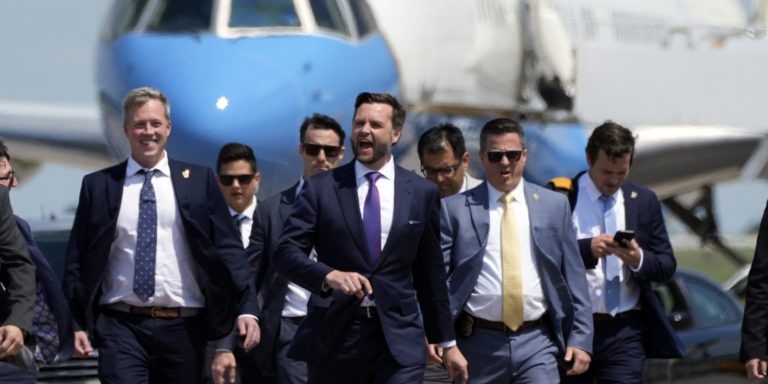
(Luis Cornelio, Headline USA) Minnesota Gov. Tim Walz and Sen. JD Vance, both 2024 contenders for vice president, are facing scrutiny over their military service, with Walz’s scandal receiving more attention—and rightfully so.

Walz served 20 years in the National Guard and re-enlisted for seven years after Sept. 11. He quit four years earlier and was demoted for not completing his service. Despite this, Walz used his former higher rank, sparking “stolen valor” accusations. 

In a CNN interview on Wednesday, Sen. Tina Smith, D-Minn., attempted to criticize Vance’s military record as compared to that of Walz. “I’m not aware of any military service that J.D. Vance has ever served, so let’s just make the comparison there,” Smith said, ignoring Vance’s four-year enlistment in the Marine Corps.

CNN anchor Alex Acosta, infamous for his bias against Republicans, corrected Smith by noting Vance’s Marine service. Smith, acknowledging her falsehood, replied, “Okay. Pardon me for that.”

The controversy embroiling Walz gained traction after a 2018 letter from National Guard members resurfaced on Tuesday.

The letter criticized Walz for referring to himself as a “sergeant major,” a rank he held provisionally before his demotion as he left the Guard three years earlier than planned, leading to the demotion. 

Walz is also under fire after he suggested that the weapons he “carried in war” must not be in American streets. But he never served in combat, the Washington Post reported on Wednesday. 

Some media outlets falsely reported that Walz had served in Iraq. He left the guard shortly before their deployment to the Middle East.

Bloomberg reporter Joshua Green came under fire for stealth-editing a piece to state Walz had served in Italy instead of Iraq. 

In response to the error and subsequent edit, Daily Caller editor-in-chief Geoffrey Ingersoll questioned Green about the details behind his false reporting. 

“Which deployment specifically that his unit did to Italy counted as ‘in support of enduring freedom’? Or are we just accepting this as true because the campaign is saying it?” Ingersoll tweeted. 

According to the Media Research Center, MSNBC host Chris Hayes and CNN anchor Brianna Keilar defended Walz, accusing Republicans of “swift boating” the Minnesota governor.