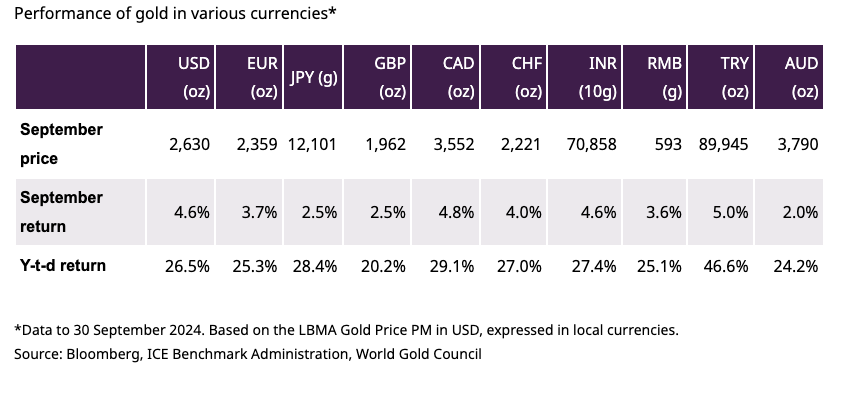
(Mike Maharrey, Money Metals News Service) The gold bulls kept running in September as gold set new record highs eight times and the price gained another 4.6 percent.
And it appears this bull market has plenty of momentum left in it.
As of Sept. 30, gold was up 26.5 percent in dollar terms on the year.
According to World Gold Council analysis, dollar weakness was the primary factor driving the price of gold higher, as the supersized rate cut by the Federal Reserve put a significant drag on the greenback.
An uptick in geopolitical risk with deteriorating conditions in the Middle East also spurred safe-haven buying.
The biggest headwind for gold last month was the “momentum factor.” Strong returns in a prior month tend to pressure the following month’s returns lower and vice versa.
Gold charted solid gains in every other major currency as well.
Looking ahead, the World Gold Council projects a gold-friendly environment of lower yields, wavering spreads, and a continued elevated correlation between equities and bonds.
Two years ago, bonds and equities both lost value. It was the first time both charted declines in 53 years. Since that time, bonds and equities have continued to be highly correlated. As the World Gold Council noted, this correlation undermines diversification benefits and raises total portfolio risk.
Since gold tends to be uncorrelated, this raises its importance as a portfolio diversifier.
According to the World Gold Council, “A recent report, based on a simple macro framework combining yields and corporate spreads, suggests that correlation is set to stay on this track. If this pans out, it will present many investors with a fundamental challenge around how to approach diversification; risk managers will continue to be nervous and interest in a diversifier and hedge like gold will likely remain high.”
We also appear to be moving into a “risk off” investment environment. Historically, this has driven the strongest returns for gold.
The World Gold Council paints a bullish picture for gold in the near term.
“Against a backdrop of high equity-bond correlation and shifting macro phases, the outlook for gold offers investors diversification and a hedge against broader portfolio risk. Add to this support from central bank buying, rising demand from key markets like India, and the return of Western ETF investors, and the recent escalation in Middle East tensions, gold is well positioned to benefit from these evolving market conditions.”
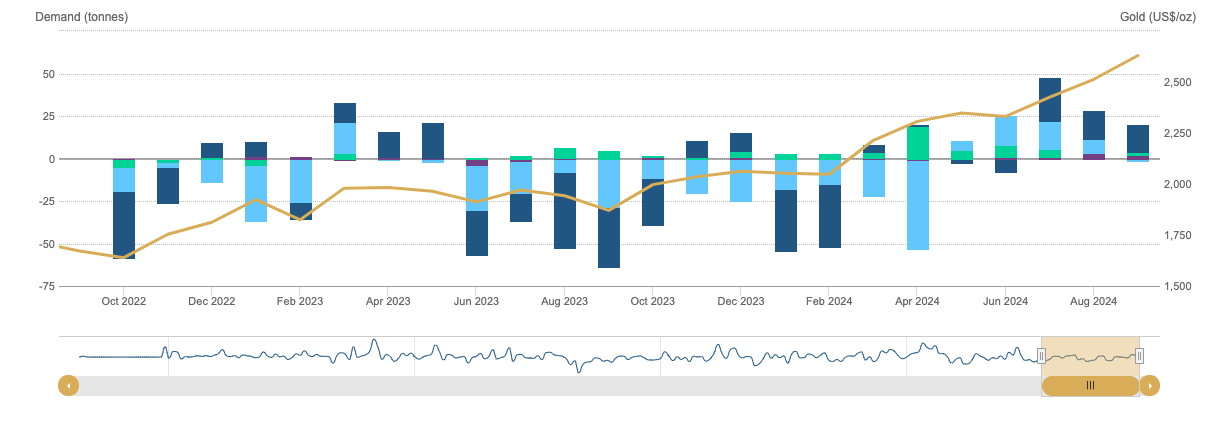
(Mike Maharrey, Money Metals News Service) Led by North American funds, gold-backed ETFs reported net inflows of metal for the fifth straight month in September.
Globally, ETFs reported a net 18.4-ton increase in gold holdings last month.
Collectively, gold ETFs held 3,200 tons of gold as of September 30.
A combination of gold inflows and rising gold prices raised the total assets under management (AUM) of gold-backed funds by 5 percent to $271 billion. Year to date, AUM by gold-backed funds have grown by 26 percent.
North American funds led the way in September, adding 16.2 tons of gold to their holdings.
According to the World Gold Council, “Similar to prior months, the surging gold price not only attracted investor attention but also led to exercises of in-the-money call options of major gold ETFs, creating sizable inflows at the expiry date.”
Geopolitical tensions, particularly the ongoing conflict in the Middle East, also attracted gold ETF inflows as investors looked for safe havens.
Europe was the only region to report ETF gold outflows in September, with holdings declining modestly by -1.7 tons.
Outflows primarily came from funds based in the UK. The Bank of England elected to leave interest rates unchanged at its September meeting. According to the World Gold Council, “The BoE’s cautious move cooled investor expectation of future rate cuts and fuelled a sizable rebound in UK gilt yields which coincided with major local gold ETFs’ outflows.”
German and Swiss funds both reported gold inflows last month. This was primarily due to a deteriorating economic outlook and safe haven demand.
Asian funds added gold to their holdings for the 19th straight month. The region’s ETFs reported the addition of 2 tons of gold. Strong price momentum and elevated geopolitical risks contributed to the continued inflows. More fundamentally, the demand for gold in Asia reflects a continued migration of the yellow metal from the West to the East.
Funds in other regions, including Australia, reported gold inflows of 1.9 tons. Australian and South African funds led the way. Australian gold ETFs have now registered inflows for four consecutive months.
Global gold trading volumes also rebounded in September, averaging 7 percent higher month-on-month. Over-the-counter trading activity was up 10 percent in dollar terms and 6 percent in tonnage terms.
COMEX total net longs continued to rise, reaching 976 tons by the end of September. That represents a 6 percent month-on-month rise and the highest month-end level since February 2020.
Inflows of gold into ETFs can have a significant impact on the global gold market by pushing overall demand higher.
A gold ETF is backed by a trust company that holds metal owned and stored by the trust. In most cases, investing in an ETF does not entitle you to any amount of physical gold. You own a share of the ETF, not gold itself.
ETFs are relatively liquid. You can buy or sell an ETF with a couple of mouse clicks. You don’t have to worry about transporting or storing metal. In a nutshell, it allows investors to play the gold market without buying full ounces of metal at the spot price.
Since you are just buying a number in a computer, you can easily trade your ETF shares for another stock or cash whenever you want, even multiple times on the same day. Many speculative investors take advantage of this liquidity.
But while a gold ETF is a convenient way to play the price of gold on the market, you don’t actually possess any gold. You have paper. And you don’t know for sure that the fund has all the gold either, especially when the fund sees inflows. In such a scenario, there have been difficulties or delays in obtaining physical metal.
(Mike Maharrey, Money Metals News Service) Russia plans to introduce central bank digital currency for public use next year. This is another step forward toward a completely cashless society and a step backward for financial privacy.
According to a press release from the Bank of Russia, digital rubles will be available to the public by July 1, 2025, and the system will roll out over three years. According to the press release, consumers will make payments with digital rubles using a universal QR code based on the National Payment Card System.
“Major banks will have to give their clients an opportunity to conduct transactions with digital rubles, namely to open digital ruble accounts and deposit cash thereto, make funds transfers, as well as receive digital rubles via the relevant infrastructure. The regulator plans to launch a large-scale use of the digital national currency from that moment on. It is important that the digital ruble is available to both individuals and businesses and that they are able to use it freely, just like other ruble forms (physical money or bank deposits).”
Smaller banks will have additional time to prepare their systems for the shift to CBDC. They have until July 1, 2026, to begin digital ruble services. “Other credit institutions must comply with the requirement by July 1, 2027,” the Bank of Russia statement said.
Trade and service companies (TSCs) with earnings over 30 million rubles must begin accepting digital rubles by July 1, 2025, while businesses earning between 20 and 30 million rubles will have an additional year. All companies will be required to accept digital rubles by 2027.
“Following the large-scale launch of digital rubles, both banks and TSCs will be able to start accepting them as their relevant infrastructure is ready, including ahead of the deadlines proposed in the document.”
Russia isn’t the first country to roll out CBDC.
In the fall of 2023, the European Central Bank (ECB) announced it was laying the groundwork to roll out its version of a CBDC.
According to the ECB’s website, the “preparation phase” for the digital euro kicked off in November 2023 and “builds on the findings from our investigation phase.” The preparation phase is expected to last for two years.
Meanwhile, the Bahamas, Jamaica, and Nigeria experimented with retail CBDCs. Many other countries, including China, India – and the United States.
Based on a BIS survey, “More than half of central banks are conducting concrete experiments or working on a CBDC pilot.”
The New York Fed ran a CBDC pilot program in 2022 with several commercial banks to test the feasibility of a CBDC. This “proof of concept” program tested an “interoperable digital money platform” on a regulated liability network (RLN) for “technical feasibility, legal viability, and business applicability of distributed ledger technology,” according to a press release.
There isn’t a strong political appetite for a CBDC in the U.S., but make no mistake, government people would love to implement one.
What Is Central Bank Digital Currency (CBDC)
The Bank of Russia describes the digital ruble as “a digital form of the national currency that has been designed to expand the options of making payments and funds transfers.”
Digital currencies are virtual banknotes or “coins” held in a digital wallet on a computer or smartphone. The difference between a central bank (government) digital currency and peer-to-peer electronic cash such as Bitcoin is that the value of CBDC is backed and controlled by the government, just like traditional paper fiat currency. In practice, a Federal Reserve-issued CBDC would just be a dollar in another form.
Fiat money benefits governments because they can expand the money supply at will. This enables government borrowing and spending that would be impossible in a sound money system. Without fiat money, governments would be much smaller, less powerful, and less intrusive.
And while fiat systems benefit governments and their cronies, it hurts regular people. As governments print more money to fund their programs and enrich the political class, it steals the purchasing power of everybody else.
The specter of a CBDC creates additional problems relating to financial privacy and the potential for government control.
At the root of the move toward CBDC is what some call “the war on cash.” For years, governments have looked for ways to eliminate physical cash because it is hard to control. I can put it under my mattress, and nobody has to even know I have it. And if you and I do a cash transaction, no record exists. That’s a problem for government officials who would like to tax our transactions or possibly prohibit them altogether.
Enter CBDCs.
Government-issued digital currencies are sold on the promise of providing a safe, convenient, and more secure alternative to physical cash. We’re also told they will help “stop dangerous criminals” who like the intractability of cash. But there is a darker side – the promise of control. CBDC creates the potential for the government to track and even micromanage consumer spending.
Imagine if there was no cash. It would be impossible to hide even the smallest transaction from the government’s eyes. Something as simple as your morning trip to get a coffee wouldn’t be a secret from government officials. As Bloomberg put it in an article published when China launched a digital yuan pilot program in 2020, digital currency “offers China’s authorities a degree of control never possible with physical money.”
The government could even “turn off” an individual’s ability to make purchases. Bloomberg described just how much control a digital currency could give Chinese officials.
“The PBOC has also indicated that it could put limits on the sizes of some transactions or even require an appointment to make large ones. Some observers wonder whether payments could be linked to the emerging social credit system, wherein citizens with exemplary behavior are ‘whitelisted’ for privileges, while those with criminal and other infractions find themselves left out. ‘China’s goal is not to make payments more convenient but to replace cash, so it can keep closer tabs on people than it already does,’ argues Aaron Brown, a crypto investor who writes for Bloomberg Opinion.”
Economist Thorsten Polleit outlined the potential for Big Brother-like government control with the advent of a digital euro in an article published by the Mises Wire. As he put it, “the path to becoming a surveillance state regime will accelerate considerably” if and when a digital currency is issued.
You can see why governments are keen on implementing CBDC as quickly as possible. And you can understand why a lot of people are worried about this potential.
(Money Metals News Service) In a recent Money Metals podcast episode, host Mike Maharrey interviewed Kai Hoffmann, the CEO of SOAR Financial Group, to discuss the junior mining industry, gold prices, and broader economic insights.
Kai Hoffmann, who has been active in the junior mining sector since 2008, shared his thoughts on the importance of mining, the disconnect between gold prices and mining stocks, and the potential of junior miners in today’s economy.
(Interview Begins Around 4:52 Mark)
Kai Hoffmann’s Journey into Junior Mining
Hoffmann explained his entry into the resource investment space as “dumb luck,” revealing that he initially started working in corporate finance in Germany, where he came into contact with the mining industry.
Despite not having a background in geology or engineering, Hoffmann was drawn to the community, forming strong relationships within the industry that have kept him engaged. He emphasized how international exposure and personal connections led him to stay in this niche area of finance.
Discrepancy Between Gold Prices and Mining Stocks
Maharrey pointed out the ongoing surge in gold prices, which have reached record highs, but noted that mining stocks have lagged behind. Hoffmann acknowledged this disconnect, admitting that he’s running out of excuses for why investors aren’t flocking to miners.
However, he pointed out that indices like the GDX and GDXJ (measuring mining stock performance) have outperformed major stock indices like the S&P 500 and NASDAQ this year, with gains of 26-27% year-to-date.
Despite this, mining stocks typically offer much higher leverage to the price of gold, and Hoffmann suggested that there is still time to invest before this sector fully catches up to the rally in gold.
Why Mining Stocks are Underperforming
Hoffmann attributed the underperformance of mining stocks to several factors, including risky acquisitions made by miners in the past, the challenges of operating in difficult jurisdictions, and negative ESG (Environmental, Social, and Governance) perceptions surrounding the industry.
Despite these challenges, he believes the outlook for miners is positive, especially given the record profit margins they are currently enjoying, driven by stable oil prices and slowing inflation on labor costs.
Investing in Junior Miners and ETFs
For newcomers interested in branching out into mining investments, Hoffmann advised starting with ETFs like GDX or GDXJ for broad exposure without the need for stock picking. He also suggested looking at larger, established miners like Barrick, Newmont, and Agnico Eagle, whose Q3 financials he expects to be strong.
For those willing to take on more risk, junior exploration or development companies can offer significant upside potential but come with the risk of total loss. Hoffmann urged potential investors to educate themselves by following interviews and podcasts to learn about promising companies.
Gold, Copper, and the Future of Mining
The discussion then shifted to “peak gold,” the concern that the world is running out of new gold discoveries. Hoffmann downplayed the impact of declining mine output on the gold price, stating that gold’s price is more influenced by paper contracts and bullion delivery rather than physical mine production.
He also noted that while large gold discoveries are becoming rarer, companies are still finding new projects, such as AngloGold Ashanti’s Silicon project in Nevada, which holds over 13 million ounces of gold in reserves.
Conversely, Hoffmann sees copper as a more pressing issue due to its growing demand, particularly driven by electrification and green energy technologies. He highlighted the lack of new copper mine discoveries and the widening supply gap, which he predicts will result in future price shocks.
Silver’s Supply and Demand Dynamics
While Hoffmann also tracks the silver market, he sees the situation as less dire compared to copper. Silver mine output has remained relatively flat, and while there is currently a supply deficit (estimated at 250 million ounces), Hoffmann believes this shortfall can be addressed once new mines come online.
The Mainstream’s Blind Spot: Mining and Energy
Wrapping up the interview, Hoffmann criticized the mainstream media’s ignorance of the mining and energy sectors. He stressed the importance of mining for everyday products, lamenting the disconnect between society’s growing demand for clean energy and opposition to mining projects.
Hoffmann called out the hypocrisy of people protesting mining developments while enjoying the benefits of modern technology. He also voiced frustration over negative portrayals of gold in the media, arguing that many people fail to understand the true purpose of owning physical gold as a long-term store of value.
Conclusion
Hoffmann’s insights provided a nuanced look into the junior mining industry and the broader market for precious metals. He remains optimistic about the future of mining stocks, particularly in the gold and copper sectors, and encourages investors to educate themselves on this often-overlooked area of finance.
For those willing to take on the risks, Hoffmann sees substantial opportunities in the next three to five years, especially as the global economy continues to shift toward electrification and renewable energy, driving demand for metals like copper and silver.
Key Questions & Answers
Here are the key questions and answers from the interview between Mike Maharrey and Kai Hoffmann:
Who was a memorable guest you’ve interviewed?
Simon Hunt, a geopolitical commentator, who provided a deep, uninterrupted discussion on geopolitics and the interconnectedness of global issues.
What is the mainstream narrative missing?
The mainstream is disconnected from the real economy. There’s a discrepancy between reported economic statistics, like wage growth, and the actual struggles people face.
Why are miners lagging behind despite record gold prices?
Mining stocks haven’t kept up with gold prices due to past bad acquisitions, higher risks in some jurisdictions, and not fitting into ESG profiles. However, the sector is poised for significant returns.
What’s causing the disconnect between mining stocks and the market?
Risk perception around miners, especially in high-risk jurisdictions and previous acquisitions, is responsible. Despite this, the mining sector offers strong future potential.
How should newcomers approach investing in junior miners?
Start with ETFs like GDX or GDXJ for broad exposure. For those with higher risk tolerance, explore junior mining stocks, but be cautious and do your research.
Is the idea of “Peak Gold” a real concern?
“Peak Gold” may be real, but it hasn’t affected gold prices significantly, which are more influenced by paper contracts and bullion delivery.
What’s the future for copper and silver?
Copper is in a critical situation due to rising demand and a lack of new discoveries. Silver is less concerning as it is often a byproduct of copper mining.
What is the mainstream media missing about mining?
The media fails to understand the fundamental role of mining in the economy, especially its importance for green energy and technology. There’s also hypocrisy in protesting mining while benefiting from its products.
In a letter to top DHS officials last week, Grassley asked about the HSI’s “jump teams”, which hare used to provide the Secret Service with additional manpower for various protective missions. As was revealed in the wake of the July 13 Trump shooting in Butler, at least 16 HSI agents were there assisting the Secret Service.
According to Grassley, the Secret Service isn’t compensating those HSI agents for their help.
“[DHS] officials have told HSI agents not to submit travel authorizations and travel reimbursement vouchers for Jump Team deployments due to the Secret Service failing to transfer money. However, HSI agents are still required to travel for these Jump Teams to support the Secret Service’s protection mission,” Grassley said in his letter last Wednesday, citing whistleblower disclosures made to his office.
“According to these whistleblower disclosures, HSI agents are deployed, usually on very short notice, across the country on Jump Teams from as short as a few days for as long as multiple weeks, several times throughout the year,” he said.
Moreover, assisting the Secret Service is supposed to be a voluntary job within HSI, but agents there say they’re being “effectively required” to travel when their name is called to deploy, according to Grassley.
“The whistleblower disclosures further show that in some cases HSI agents have had to pay for their own travel expenses such as flights, food, rental cars, and hotels, and other incidentals, because HSI has delayed reimbursing agents for costs due to the Secret Service failing to transfer funds to HSI,” the senator said.
Grassley added that HSI agents have provided him with emails to support their allegations. In one email, for instance, DHS officials said that the account used to reimburse Jump Team travel expenses was down to “$33” and agents should “not submit or resubmit Jump Team authorizations.”
Grassley said in his letter that the Secret Service’s failures to reimburse HSI agents could violate the Anti-Deficiency Act, which prohibits federal agencies from creating or authorizing payments in excess of available funds. The law also prohibits agencies from accepting voluntary services from federal employees.
Grassley asked the DHS and Secret Service officials to respond to the whistleblower disclosures by Oct. 23.
Ken Silva is a staff writer at Headline USA. Follow him at x.com/jd_cashless.
(Ken Silva, Headline USA) Forget about spy balloons. The Pentagon apparently can’t prevent swarms of drones from flying over its own U.S. bases.
The Wall Street Journal published an unsettling article on Sunday, reporting that the Pentagon is “stumped” as to who flew a suspicious fleet of unidentified aircraft over Langley Air Force Base on Virginia’s shoreline several times last December.
“Over 17 days, the drones arrived at dusk, flew off and circled back. Some shone small lights, making them look like a constellation moving in the night sky—or a science-fiction movie …They also were nearly impossible to track, vanishing each night despite a wealth of resources deployed to catch them,” WSJ reported.
“Gen. Glen VanHerck, at the time commander of the U.S. Northern Command and the North American Aerospace Defense Command, said drones had for years been spotted flying around defense installations. But the nightly drone swarms over Langley, he said, were unlike any past incursion.”
According to the WSJ, the drones flew in a pattern: one or two fixed-wing drones positioned more than 100 feet in the air. There were also reportedly smaller quadcopters, the size of 20-pound commercial drones, often below and flying slower.
“Occasionally, they hovered,” the newspaper added.
Pentagon officials reportedly couldn’t figure out how to down the drones without endangering civilians. Using electronic signals to jam the drones, for instance, could disrupt local 911 systems, while using experimental directed energy could be a risk for nearby commercial aircraft.
Officials reportedly thought they solved the mystery in January, when a University of Minnesota student named Fengyun Shi was caught surveilling a Virginia Navy base with his drone. However, officials learned that Shi—who was eventually sentenced to six-months imprisonment for espionage—bought his drone at Costco.
Therefore, the mystery remains to this day.
Meanwhile, “U.S. officials confirmed this month that more unidentified drone swarms were spotted in recent months near Edwards Air Force Base, north of Los Angeles,” the WSJ concluded at the end of its story.
Ken Silva is a staff writer at Headline USA. Follow him at x.com/jd_cashless.
(Luis Cornelio, Headline USA) A popular leftist journalist revealed she left the Democratic Party after fellow liberals rebuked her for recounting how a homeless man in Los Angeles sexually assaulted her.
The Young Turks host Ana Kasparian said fellow liberals shamed her for speaking out against homelessness and crime after an individual approached her and thrust his erected penis onto her.
The assault occurred in March 2022 while Kasparian was walking her dog in Los Angeles. She recounted the experience on the Oct. 7 episode of host Jillian Michael’s Keep It Real Podcast.
“As I was bending down to pick up my dog’s mess, one of the guys like grabs me by my hips and he had an erection and just starts like humping me,” Kasparian said, describing the harrowing experience.
The assault lasted a few seconds until the men walked away, laughing at Kasparian.
She said she felt shamed and humiliated after the assault, which left her grappling with anxiety when walking her dog—and later decided to share her story on an episode of The Young Turks.
“Before I know it, I’m starting to get these messages, and it’s like really harsh stuff,” Kasparian recalled. “It’s about how, ‘You are painting a picture of the homeless community.’ … ‘How could you be like this? … ‘These are your unhoused neighbors, and they need help.’”
Some liberals even accused her of being racist despite her never disclosing the race of the individuals involved.
“When they started accusing me of being racist, I’m like, ‘Wait a minute. Why are you assuming that the people who did” this were people of color, she said.
“That woke me up,” she added, asserting that some of her leftist allies hold stereotypes against others.
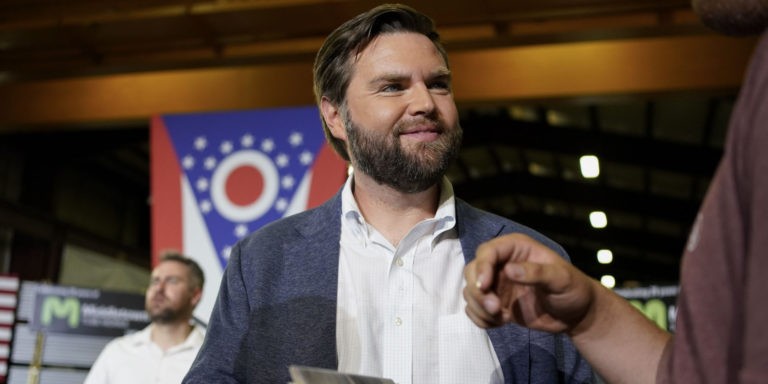
(Luis Cornelio, Headline USA) Sen. JD Vance skillfully countered a reporter’s claims downplaying concerns about illegal immigration, suggesting that “only a handful” of apartment complexes were seized by Venezuelan gangs in Colorado.
The viral exchange took place on the Sunday episode of ABC News’s This Week, with host Martha Raddatz dismissing former President Donald Trump’s assertions that illegal aliens wreaked havoc in Aurora, Colorado.
Citing Aurora Mayor Mike Coffman’s quotes, Raddatz told Vance, “I’m going to stop you because I know exactly what happened. …. The incidents were limited to a handful of apartment complexes and the mayor said, ‘Our dedicated police officers have acted on those concerns.’”
“A handful of problems,” she reiterated, downplaying the scope of the issue, all captured in a viral video.
Vance swiftly fired back, questioning Raddatz’s framing. “Martha, do you hear yourself? Only a handful of apartment complexes were taken over by Venezuelan gangs, and Donald Trump is the problem—and not Kamala Harris’ open border?”
Vance expanded on his point, highlighting that Americans are “fed up with what’s going on.” He then challenged Raddatz’s claims once more.
Vance specifically said, “I really find this exchange, Martha, sort of interesting because you seem to be more focused with nitpicking everything that Donald Trump has said, rather than acknowledging that apartment complexes in the United States of America are being taken over by violent gangs.”
The exchange followed viral footage showing armed Venezuelan nationals, allegedly members of the Tren de Aragua gang, patrolling apartment complexes in Colorado.
Authorities reported that the gang had seized several apartments, forcing residents to flee amid shootings and intimidation tactics.
This incident is one of many high-profile criminal cases involving Venezuelan nationals, who had once benefited from American temporary protection as they fled the brutal socialist regime of Nicolás Maduro. However, such compassion has sharply diminished as these cases continue to rise.
(Luis Cornelio, Headline USA) A disgraced former U.S. serviceman has been sentenced after pleading guilty to attempting to provide material support to ISIS in a failed plot to kill his fellow soldiers in the Middle East.
Cole Bridges, also known as Cole Gonzalez, will serve 13 years in federal prison after being caught in conversations with an undercover FBI official about helping ISIS.
The 24-year-old joined the U.S. Army in September 2019 but had already consumed online propaganda promoting jihadists and their extremist ideology, the DOJ announced Friday.
“Cole Bridges used his U.S. Army training to pursue a horrifying goal: the brutal murder of his fellow service members in a carefully plotted ambush,” said Damian Williams, the U.S. attorney for the Southern District of New York.
Today, Pfc. Cole Bridges was sentenced to 14 years in prison for attempting to provide material support to a designated foreign terrorist organization, and attempting to murder U.S. military service members, based on his efforts to assist ISIS to attack and kill U.S. soldiers. pic.twitter.com/2yQXQt8REv
— Army Counterintelligence Command (ACIC) (@Real_ArmyCI) October 11, 2024
Williams explained that Bridges plotted to attack the soldiers he was sworn to protect and eagerly offered assistance to individuals he believed were members of ISIS to carry out the attack.
“This is a betrayal of the worst order,” Williams added. “Today’s sentence makes clear that that this Office—along with our partners in law enforcement and the U.S. military—will work tirelessly to bring to justice those who, like Bridges, seek to harm members of our Armed Forces.”
According to the indictment, Bridges taught ISIS militants military maneuvers designed to maximize casualties in future attacks on U.S. servicemen. He also advised them on how to defend against U.S. Special Forces ambushes.
In January 2021, Bridges sent the undercover FBI agent a video of himself in military uniform, standing in front of an ISIS flag and making a gesture symbolic of support for the terrorist group.
In addition to his 13-year prison sentence, Bridges will face 10 years of supervised release.
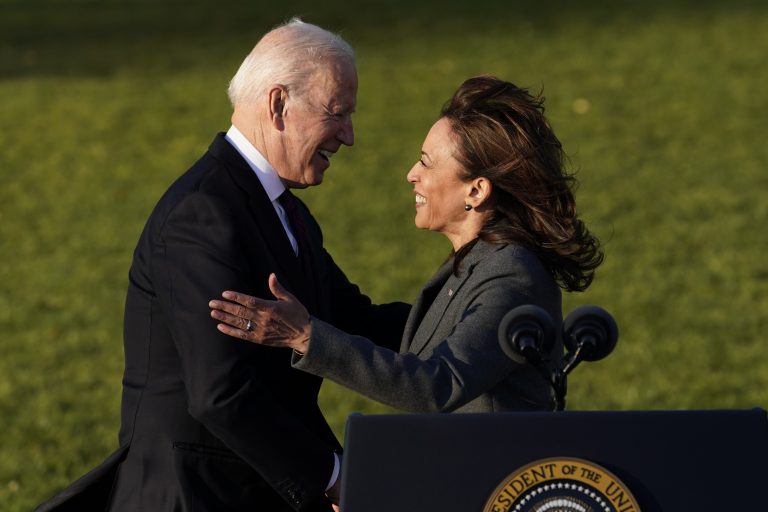
(Luis Cornelio, Headline USA) The Harris campaign and the Biden White House appear unable to stand each other, according to remarks given to Axios by 10 people familiar with the rift.
President Joe Biden’s allies are reportedly bitter about the pressure he faced from top Democrats to step aside, while Vice President Kamala Harris’s campaign is frustrated with the White House’s lack of effective messaging coordination.
“They’re too much in their feelings,” a Harris ally claimed referring to the White House. a Harris ally said, referring to the White House.
Others expressed their grievances about Biden publicly contradicting Harris’s statements. One instance of poor coordination occurred when Biden held an impromptu press conference last Friday, overlapping with Harris’s speech in Michigan.
🚨 NEW: The relationship between Kamala Harris' team and Joe Biden's White House has been increasingly fraught in the final weeks before Election Day, 10 people familiar with the situation tell @AlexThomp. https://t.co/VP0U7mLcJx
Earlier in the week, Biden debunked Harris’s criticism of Florida Gov. Ron DeSantis as Floridians dealt with a natural disaster.
Harris falsely claimed DeSantis had ignored her phone calls amid two hurricanes. In contrast, Biden praised DeSantis as “very gracious” and “cooperative.”
The two also seem to be on different pages regarding the economy. Biden has been promoting what he dubbed a robust economic outlook for the country, while Harris has focused on inflation’s negative impact on Americans.
“The White House is lacking someone in the room thinking first and foremost about how things would affect the campaign,” another Harris ally told Axios.
Adding to the tension is the slow pace of staffing Harris’s office to handle increasing workloads.
Meanwhile, Axios reported that White House staffers who moved to Harris’s campaign are seen as disloyal to Biden, causing friction.
Arguments have also erupted within the Harris campaign over who gets to appear on TV, with Biden’s former campaign members allegedly clashing with Harris’s newer team.