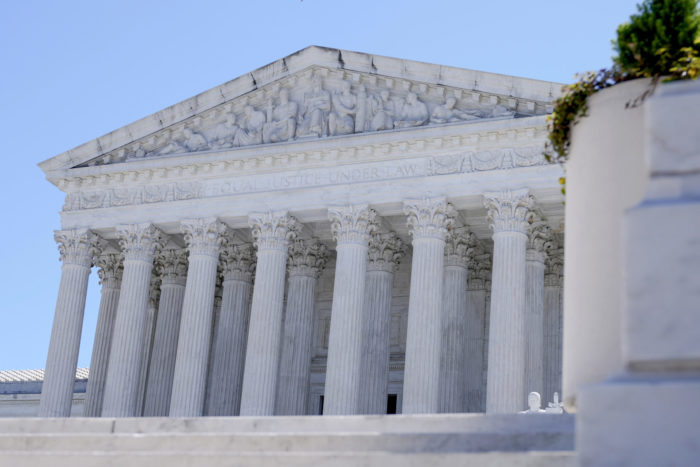
(Andrew Rice, The Center Square) The U.S. Supreme Court on Tuesday upheld state bans on biological men competing in women’s and girls’ sports.
The court upheld bans in Idaho and West Virginia that prohibited individuals who identified as transgender women and girls from competing in college and youth sports. Justices said the bans did not violate Title IX, a federal law that prohibits discrimination based on sex.
“Title IX allows schools to provide separate women’s and men’s sports teams defined by biological sex, and West Virginia has permissibly maintained female sports for biological females consistent with Title IX,” Justice Brett Kavanaugh wrote in the court’s majority opinion.
Lawyers for Linday Hecox, a transgender athlete in Idaho, said there is no competitive advantage for biological men to compete in women’s sports. The majority of justices on the high court disagreed.
“Safety and competitive fairness issues can arise when females are forced to compete against males,” Kavanaugh wrote. “In recent years, 27 states and various sports-governing bodies have all drawn the same line.”
Justices Sonia Sotomayor, Ketanji Brown Jackson and Elena Kagan agreed that Title IX protections do not fully apply to transgender athletes. Sotomayor said trangender athletes do not suffer the same discriminatory harm that Title IX was designed to protect against.
“In the context of athletics, the Javits Amendment and resulting regulations instruct that this brand of sex discrimination is permissible: The sexes may generally be separated,” Sotomayor wrote.
The majority also argued the Equal Protection Clause of the U.S. Constitution prevents biological men from competing in girls’ and women’s sports.
“The states argue – and the Court agrees – that the interests of safety and competitive fairness are important interests for purposes of equal protection analysis,” Kavanaugh wrote. “And the states’ sex-based classification – limiting women’s and girls’ sports to biological females – is substantially related to those interests.”
Sotomayor, Kagan and Jackson disagreed with the majority’s interpretation of the Equal Protection Clause.
“The Equal Protection Clause demands much more when a state deploys a sex classification to achieve legislative aims,” Sotomayor wrote. “Yet in an opinion unencumbered by fact or law, the majority today cuts off that process prematurely, deciding instead that B. P. J.’s case must end now.”
Judicial Crisis Network President Carrie Severino hailed the court’s ruling on X.
“Victory for women’s sports today at the Supreme Court,” Severino wrote. “Title IX was intended to protect women in sports, not abolish the category of women altogether. Today the Court came to the commonsense conclusion that limiting women’s sports to women isn’t constitutionally suspect. This is great news for the 27 states who protect female athletes from being forced to compete against biological men.”
In April 2021, West Virginia passed the Save Women’s Sports Act, which bars transgender individuals from participating in girls and women’s sports in public secondary schools and colleges.
Becky Pepper Jackson., a 16-year-old student who has identified as transgender since the third grade, said the law violated sex discrimination rules laid out in Title IX and questioned whether the 14th Amendment’s Equal Protection Clause preventing states from offering separate sports teams based on biological sex.
In 2020, Idaho enacted the Fairness in Women’s Sports Act, which imposes a ban on participation of transgender women and girls on public school sports teams from elementary school through college.
Hecox filed a lawsuit after attempting to join the Boise State University women’s track and cross country team.
In West Virginia, Pepper Jackson was allowed to continue on the team pending further litigation, contrary to Hecox. With clearance from the nation’s high court, Idaho, West Virginia and other states across the country will be able to move forward with the bans on transgender women and girls.
The American Principles Project celebrated the high court’s decision. Terry Schilling, president of the American Principles Project applauded justices in a statement to The Center Square.
“The Supreme Court has handed down a landmark victory for fairness and sanity by restoring sex-based categories that protect female athletes. Girls deserve their own playing fields and private spaces, free from biological men who seek to invade them,” Shilling said.
Maine State Rep. Laurel Libby, executive director of Lead Maine, said:
The US Supreme Court has made it clear that states have every right to preserve separate female athletic competitions, and they should. Today’s decision is a victory for common sense, for fairness, and for every girl who has worked hard to earn her place on the field, the court, or the podium. This decision affirms the constitutional backing of an obvious truth: Neither Title IX nor the Equal Protection Clause requires any state to allow biological males to compete in female categories.