About Yesterday’s Gold & Silver Pullback…

(Jesse Colombo, Money Metals News Service) Just days before the high-stakes U.S. presidential election, asset prices—from stocks to commodities—dipped amid heightened market volatility.

In any strong bull market, like the one we’re seeing in gold and silver, regular pullbacks are to be expected—some even sharp, intended to shake out “weak hands” or retail investors prone to panic.

Seasoned investors and traders, however, stay composed, following their game plan without letting emotions drive their decisions. In this update, I’ll show you where gold and silver stand following yesterday’s pullback.

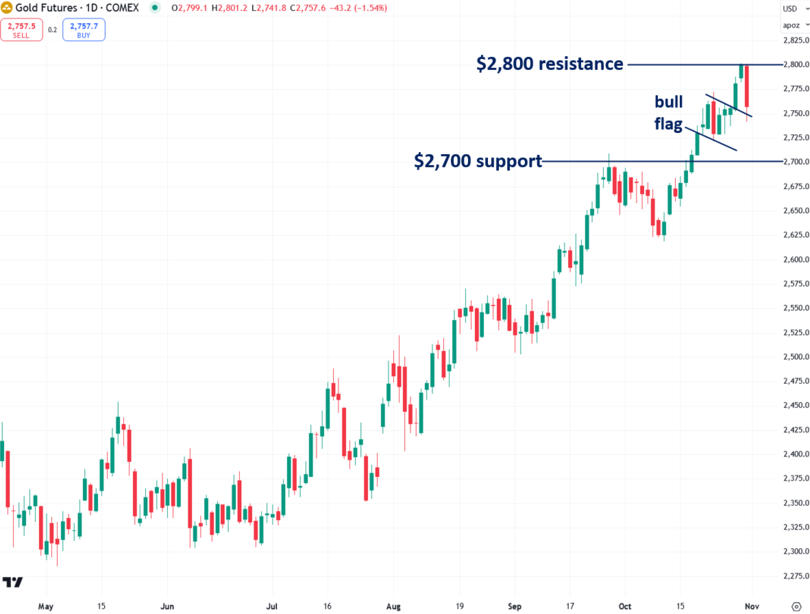
After a steady, nearly drama-free rise, gold pulled back by 1.56% today. On Tuesday, it broke out of a bull flag pattern but has since returned to the breakout level.

This pullback appears to be a simple backtest, keeping the breakout intact.

I monitor $100 increments in COMEX gold futures, as these levels frequently act as support and resistance. On Wednesday and Thursday, COMEX gold futures faced resistance near $2,800, similar to its behavior around the $2,700 level a few weeks prior.

Currently, prices are oscillating between $2,700 and $2,800, with a decisive close above $2,800 needed to confirm the next bullish signal.
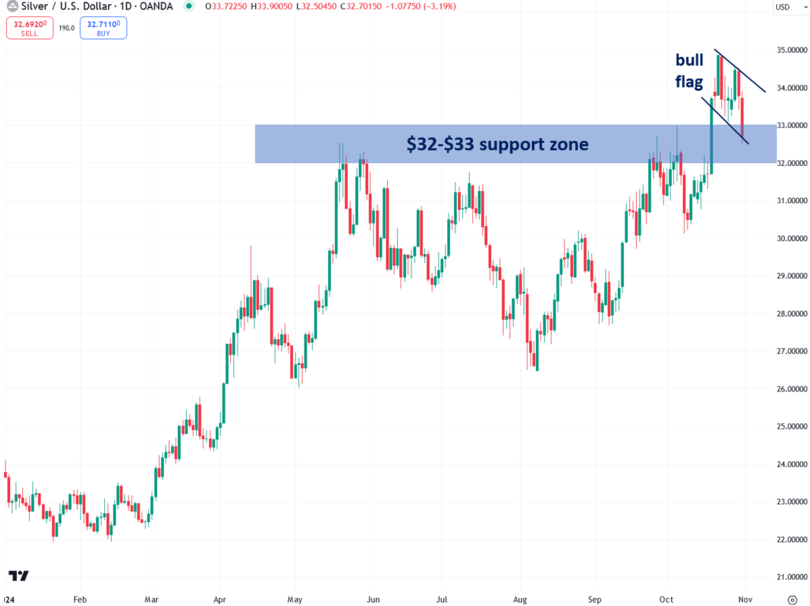
As I’ve explained recently, silver remains in a bull flag pattern that is still valid despite today’s 3.3% decline. On Friday, October 18th, silver achieved a critical technical breakout, which remains intact as long as it holds above the key $32-$33 support zone.

Following strong breakouts, it’s common for an asset to backtest the breakout level. A rebound from this support zone and a breakout from the bull flag would signal the start of the next leg in the rally.
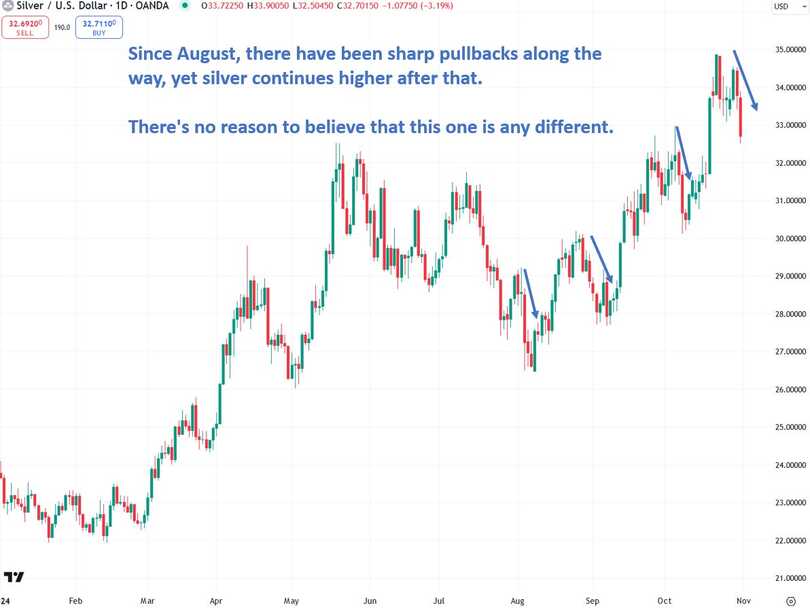
While some investors and traders may feel uneasy after today’s pullback in silver, it’s essential to remember that these dips have occurred regularly since silver’s rally began in August. There’s no reason to believe this pullback is any different.

Remember, an uptrend is characterized by “higher highs and higher lows”—exactly the pattern we’re seeing in silver. This confirms that silver is in an established uptrend, with momentum continuing to favor the upside.
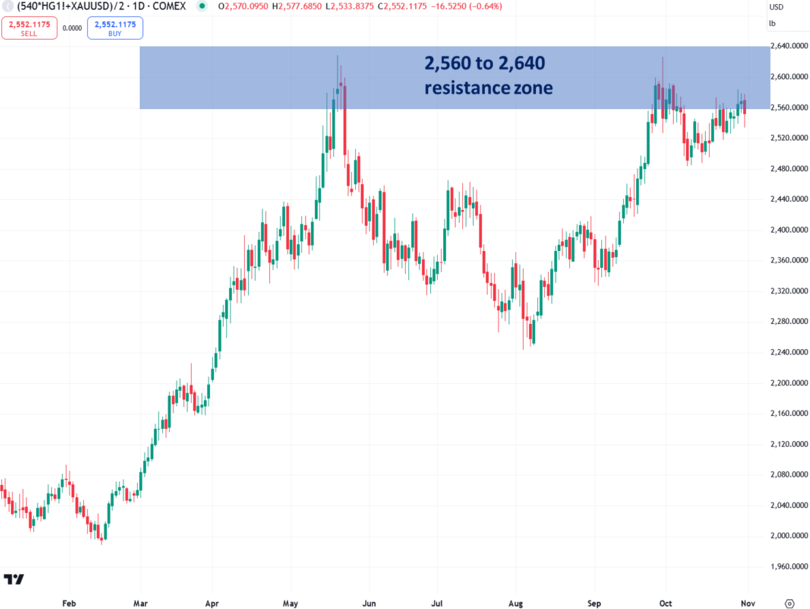
I often show the Synthetic Silver Price Index (SSPI), a custom indicator I developed to help validate silver’s price movements. The SSPI averages gold and copper prices, adjusting copper by a factor of 540 to prevent gold’s higher price from disproportionately influencing the index. Interestingly, the SSPI closely mirrors silver’s price despite silver not being an input.

I’m watching for a decisive close above the SSPI’s key resistance range, between 2,560 and 2,640, to generate an additional bullish confirmation signal for silver.

While silver had a breakout on October 18th, the SSPI has yet to follow suit, meaning it hasn’t confirmed silver’s breakout.

I believe this is a significant reason why silver hasn’t achieved escape velocity yet—it’s like an 8-cylinder engine firing on only six cylinders. I remain optimistic that this indicator will soon break out, however, providing silver with a much-needed boost.
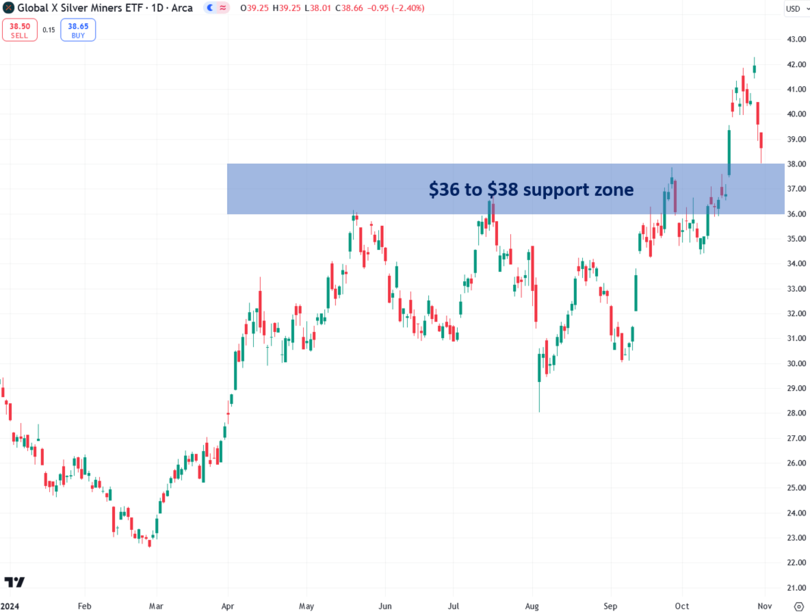
I monitor silver mining stocks, particularly the popular Global X Silver Miners ETF (SIL), to validate movements in silver prices. On October 18th, SIL surged above the $36-$38 zone and has since back-tested it. The breakout remains valid as long as SIL holds above this zone.

Such backtests are common in financial markets, often orchestrated to shake out “weak hands” and allow professional investors to accumulate more before the asset moves higher.
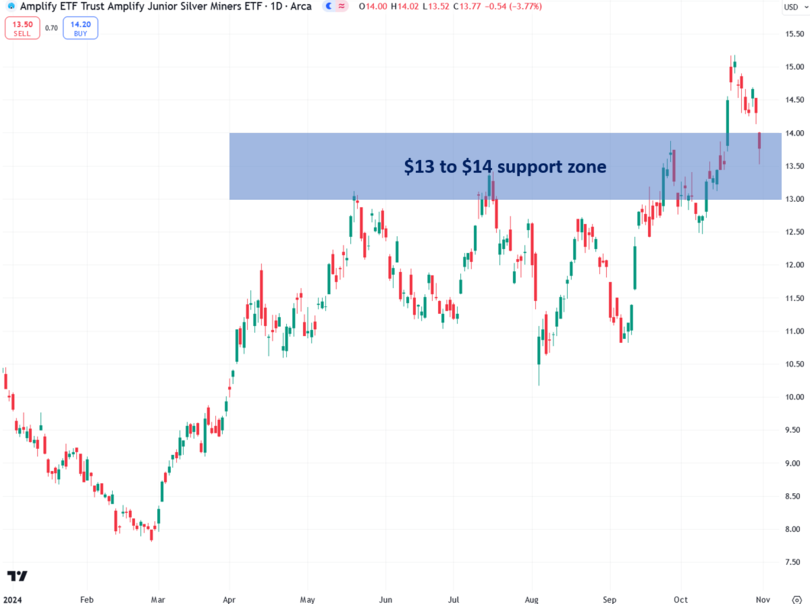
I also monitor the Amplify Junior Silver Miners ETF (symbol: SILJ), which is the main proxy for junior silver mining shares.

On October 18th, SILJ closed above the $13-$14 zone and has since back-tested it. The breakout remains valid as long as SILJ holds above this zone.
In conclusion, yesterday’s pullback in gold, silver, and related assets reflects the natural ebb and flow within a bull market, underscoring the importance of staying grounded during volatile periods.

Gold’s return to a key breakout level suggests a routine backtest, while silver remains within a bullish pattern, supported by the October 18th breakout. I’m still closely watching for a breakout in the Synthetic Silver Price Index to confirm that silver is poised to reach escape velocity.

As we head into a period of heightened market uncertainty, these assets maintain solid technical foundations, presenting attractive prospects for investors with a steady, long-term outlook.

Biden-Harris Gov’t Refusing to Tell Iowa How Many of Its Voters Aren’t Citizens

(Ken Silva, Headline USA) The U.S. Citizenship and Immigration Services has completed a review of the 2,176 registered voters in Iowa who’ve self-identified as non-citizens, after Iowa Secretary of State Paul Pate requested information about their status.

However, USCIS is refusing to make that information available to state election officials.

Iowa Sens. Chuck Grassley and Jodi Ernst wrote to USCIS Ur M. Jaddou on Thursday, demanding that she turn over the voter-eligibility data to Pate immediately.

“Time is of the essence, as voting in Iowa has been underway since October 16 and Iowa election law requires absentee ballots be separated from their carrier envelopes on Monday, November 4,” Grassley and Ernst said in their letter to USCIS.

“We expect a response to this letter and for the information to be released to Iowa’s Secretary of State by end of day Friday, November 1. If that doesn’t happen, you will be playing into the very serious concerns of Iowans that the Biden-Harris administration is not following federal law and not taking reasonable measures to ensure only citizens are voting in our federal elections.”

Grassley and Ernst’s letter came on the same day that Pate asked for their assistance with the matter. In an open letter to Grassley, Pate said information about whether the 2,176 self-purported non-citizens is crucial to ensure a fair election.

“The work has been done. The most current, verified information is avaiblae. Yet Washington DC will not share it with us. We have heard it before—‘see something, say something.’ The federal government has said it themselves but have not followed through,” Pate said.

“If the federal government has information that will ensure only U.S. citizens vote AND ensure naturalized citizens can cast their ballot as normal, that information must be shared.”

Pate also said that even if USCIS provides him with the info he seeks, he expects the Justice Department to challenge any effort to remove non-citizens from the voter rolls.

Ken Silva is a staff writer at Headline USA. Follow him at x.com/jd_cashless.

Central Bank Gold Buying Slowed Modestly in Q3 But Remained Strong

(Mike Maharrey, Money Metals News Service) Central bank gold buying slowed modestly in the third quarter but remained strong.

According to the latest data compiled by the World Gold Council, central banks globally increased gold reserves by a net 186 tons in Q3. This was down by about 8 percent from the second quarter.

Year to date, central banks have added a net 694 tons to their gold reserves. The pace is below the record set through the first three quarters of 2023 but is on pace with 2022 levels.

On a 12-month rolling basis, central banks have expanded gold reserves by 909 tons, well about the long-term average.

According to the World Gold Council, record prices have put a drag on central bank gold buying.

“Based on statements from some central banks, there are now clearer indications that the sharp increase in the gold price since March has indeed inhibited some buying, as well as encouraging some selling among banks that manage their gold reserves tactically.”

Nevertheless, selling was generally “subdued,” with only three central banks reporting a decrease in gold holdings of a ton or more.

The National Bank of Kazakhstan accounted for the bulk of the reported sales (13 tons). The Central Bank of the Philippines (2 tons) and the Central Bank of Mongolia (1 ton) were the other two sellers.

It is not uncommon for banks that buy from domestic production – such as Uzbekistan and Kazakhstan – to switch between buying and selling.

According to the World Gold Council, selling by the Philippines was more of a strategic move than any change in overall strategy.

“In late September, the Central Bank of the Philippines confirmed that its gold sales this year were driven by higher prices and form part of an active management strategy around its gold reserves.6 In the statement, the central bank noted that the sales did not compromise the “primary objectives for holding gold, which are insurance and safety”

Poland was the biggest buyer in the third quarter, as it was in Q2. The National Bank of Poland added another 42 tons to its reserves. That lifted its total gold holdings to 420 tons, 16 percent of its total reserves.

NBP Governor Adam Glapiński recently indicated the Bank of Poland will continue adding to its reserves with a goal of holding at least 20 percent of the country’s reserves in gold.

“This makes Poland a more credible country, we have a better standing in all ratings, we are a very serious partner, and we will continue to buy gold.”

In 2021, Glapiński announced a plan to expand the country’s gold reserves by 100 tons. The central bank reached that goal in September of ’23 and kept buying.

When he announced the initial plan to expand its gold reserves, Glapiński said holding gold was a matter of financial security and stability.

“Gold will retain its value even when someone cuts off the power to the global financial system, destroying traditional assets based on electronic accounting records. Of course, we do not assume that this will happen. But as the saying goes – forewarned is always insured.

“And the central bank is required to be prepared for even the most unfavorable circumstances. That is why we see a special place for gold in our foreign exchange management process.”

Glapiński also pointed out that “Gold is free from credit risk and cannot be devalued by any country’s economic policy. Besides, it is extremely durable, virtually indestructible.”

Hungary was another big buyer in Q3, increasing its reserves from 94 to 110 tons.

In a statement highlighting September’s purchase, the Hungarian central bank noted, “Amid increasing uncertainty in the global economy, the role of gold as a safe-haven asset and a store of value is of particular importance, as it enhances confidence in the country and supports financial stability. Gold continues to be one of the most important reserve assets globally, as shown by the significant purchases of gold by central banks in recent years.”

The Reserve Bank of India has been a consistent buyer in 2024, and the Indian central bank added another 13 tons of gold to its holdings in Q3.

The RBI has been buying gold since 2017. Over that period, it has increased its gold reserves by over 260 tons.

An Indian economist told the Times of India that the push to accumulate gold was based on both political and economic reasons. He said that the “reliability” of the U.S. dollar has “diminished.” He noted the “noticeable decline” in the confidence in U.S. dollar assets.

Another economist told the Times, “It makes a lot of sense (to invest in gold), given the increased volatility in the FX market, elevated interest rates in the U.S., and, of course, also as the central banks in each economy would like to diversify the asset classes in which they are parking their reserves.”

India recently transported 100 tons of its gold from the UK back into India.

State Oil Fund of Azerbaijan increased its gold holdings by 12 tons in the third quarter, adding to the 13 tons it accumulated through the first half of 2024. The fund now holds 127 tons of gold, accounting for just under 18 percent of the fund’s investment portfolio.

There were several other significant buyers in Q3.

  • Turkey – 10 tons
  • Uzbekistan – 9 tons
  • Serbia – 5 tons
  • Czech Republic – 5 tons
  • Qatar – 2 tons
  • Jordan – 1 ton
  • Iraq – 1 ton

Central bank gold buying is on pace to fall below record buying over the last two years. Even so, we’re still seeing a significant increase in gold reserves globally, and there is no sign that central banks are souring on the yellow metal.

According to the most recent World Gold Council survey released in June, 29 percent of central banks plan to add more gold to their reserves in the next 12 months. The WGC said it was the highest level since the survey began in 2018.

Only 3 percent said they had plans to decrease gold reserves.

Last year, central bank gold buying fell just 45 tons short of 2022’s multi-decade record.

According to the World Gold Council, central banks net gold purchases totaled 1,037 tons in 2023. It was the second straight year central banks added more than 1,000 tons to their total reserves.

Central bank gold buying in 2023 built on the prior record year. Total central bank gold buying in 2022 came in at 1,136 tons. It was the highest level of net purchases on record dating back to 1950, including since the suspension of dollar convertibility into gold in 1971.

China was the biggest buyer in 2023.

The U.S. Silver Market: A Complex Picture

(Mike Maharrey, Money Metals News Service) A complex picture. That’s how Metals Focus described the silver market.

This complexity is obvious simply by analyzing recent silver price movements.

Objectively, silver has had a fantastic year. The price has surged by over 30 percent. Most investors would kill for a 30 percent return.

But while gold seems to make new highs on a weekly basis and has eclipsed its record price in inflation-adjusted terms, silver remains well below its high in both nominal and inflation-adjusted terms.  Meanwhile, the gold-silver ratio remains historically high – above 80-1. This indicates that silver is historically underpriced compared to gold.

Due to these factors, many investors view silver as a laggard despite its strong returns. We often hear people ask, “What’s wrong with silver?”

Metals Focus is right. It’s complicated.

During the recent LBMA/LPPM Global Precious Metals Conference in Miami, Metals Focus attempted to assess the health of the U.S. silver market. Conference attendees characterized it as a market with “notable resilience and marked weakness.”

The global supply and demand dynamics support silver. Robust demand and lagging silver mine output have resulted in market deficits for three straight years, with demand expected to outstrip supply again this year.

Industrial demand is also the primary driver in the U.S. silver market, but the picture isn’t simple.

Industrial Silver Demand

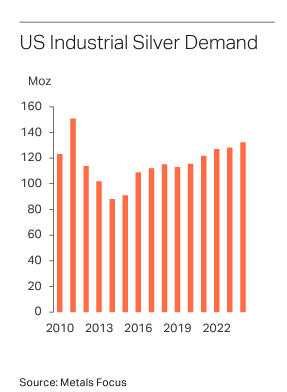
Globally, industrial offtake has been the bedrock of silver demand over the last couple of years. Industrial demand set a record of over 654 million ounces in 2023, and it’s expected to break that record again in 2024.

According to Metals Focus, U.S. industrial silver demand is on pace for a record year as well, with the exception of one sector – solar energy. According to Metals Focus, the U.S. has lost market share in photovoltaics due to the long-running trade war with China.

Even with the drag on PV demand in the U.S., other tech and industrial sectors are taking up the slack.

Metals Focus notes that many established market segments can no longer thrift and substitute silver in a meaningful way. That makes silver offtake more a matter of GDP growth along with non-price developments in specific sectors. Metals Focus cites the health of the local mining and energy industries as an example. It is driving “robust sales of brazing alloys for those sectors.” The installation of 5G infrastructure and general electrification are also supportive of silver demand.

But even the industrial demand picture is complex. Metals Focus said that some of its research contacts reported scaled-back orders. Instead of purchasing silver, these customers were running down existing stocks, some of which had become “excessive.” Automotive end-use was cited as an example.

“Vehicle production in North America may have risen by 2 percent y/y to end-September (and by 0.5 percent globally), but the various tiers of suppliers had built inventories to cope with higher expected levels of vehicle sales. This is particularly true for those hoping for a bonanza from battery electric vehicles (BEVs), which carry a much higher silver loading than internal combustion rivals, even if BEV production in North America was up by 19% to end-September (+8 percent globally).”

Higher silver content per unit helped mitigate lower vehicle sales.

According to Metals Focus, most of its contacts were still bullish about industrial silver demand in the U.S. Rebuilding after hurricanes Debby and Milton will likely support silver demand as it feeds through the supply chain in three to six months.

Meanwhile, supply chain inventories are normalizing.

Silver Investment Demand

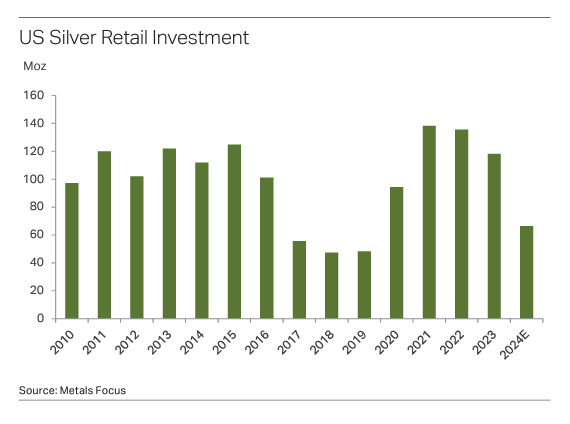
On the investment side of the coin (pun intended), U.S. retail investment is forecast to drop sharply this year while still holding above the 2017-19 trough.

Metals Focus’s contacts report a surge of individual investors selling coins and bars back. Some dealers reported buybacks outstripping silver coin and bar sales. This is a relatively rare phenomenon.

“Much was felt to have come from lower income groups who had used COVID-era savings and/or government support money to buy silver sub-$20 or in the low $20s and were now selling to fund inflated daily expenses or merely to take profits. The need to sell is highlighted by the fact that some of these investors may not have actually made a profit given the earlier very high premiums which compare with the far more modest by-back prices now being offered by dealers.”

Meanwhile, sales of newly minted coins and bars have lagged.

On a positive investment note, the amount of silver held in IRAs has grown. Advisors have apparently started recommending silver as part of a strong portfolio.

Silver Supply Factors 

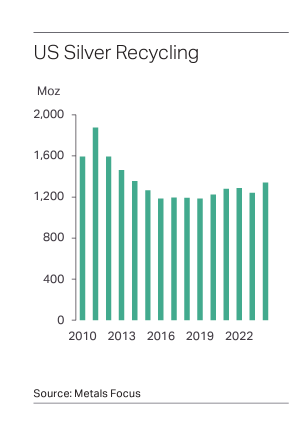
On the supply side, most analysts tend to focus on mine output, which has essentially plateaued since its all-time high in 2016. But scrap is also a significant source of silver.

Metals Focus called the scrap situation in the U.S. “complex,” with some contacts reporting stable volumes and others “heady gains.”

“Key to this is the mix of sources and of the suppliers to those sectors. For instance, industrial scrap (outside of ethylene oxide catalysts) looks to have risen a fraction, but that is more due to non-price factors such as a greater pool of product. Photographic scrap also continues its slow, steady retreat due to structural factors, while jewelry recycling remains quiet. Sources feel that you would have to see much higher prices and/or a worse economic backdrop, both of which might trigger remelt by manufacturers and distributors of unsold or slow selling inventory.”

Meanwhile, the meltdown of silverware has boomed in the U.S., with some refineries reporting double-digit gains. Money Metals called this “a surprise.”

“Many sources have long reported that depleted near-market stocks mean we would be unlikely to see much of a surge in the event of a price rally, especially one that failed to achieve record nominal highs.”

There has also been a boom in coin scrap.

Considering these factors, U.S. silver recycling is expected to grow by about 8 percent this year.


With so many factors playing into silver demand, it is sometimes difficult to forecast price movements – particularly in the short term. Nevertheless, at its core, silver is money, and it tends to track with gold over time. In fact, silver has historically outperformed gold in a gold bull market. With the Federal Reserve back in the inflation business and apparently intent on lowering interest rates, the environment seems friendly to monetary metals. If you are bullish on gold, you should probably be even more bullish on silver.

Feds Arrest Illegal Aliens Serving as ‘Handlers’ in $8 Million Gold Scam

(Ken Silva, Headline USA) After arresting several lower-level players over the last year in organizations that scam U.S. senior citizens out of their gold, federal law enforcement nabbed bigger fish last month—charging two alleged mid-level “handlers” who worked in an organization responsible for stealing at least $8 million in gold bars.

In early October, the FBI arrested five people as part of the scam, including 41-year-old Mehul Darji and 51-year-old Chintankumar Parekh, who are both living in the country illegally. Prosecutors have reportedly described Darji and Parekh as “handlers,” who would drive lower-level couriers around the country to meet with victims and retrieve gold bars.

According to the Justice Department, Darji and Parekh’s scam entailed telling victims that their bank accounts were compromised, convincing them to buy gold bars. They’d use their lower-level mules to pick up those bars, which were eventually sent to other members of the organization.

At a detention hearing last month, Darji’s lawyer blasted the DOJ for not identifying the leaders of the criminal enterprise.

“What seems to be missing from my read of this indictment was who, in effect, was in charge,” defense attorney David Tholen said, according to the Detroit News.

Darji and Parekh remain in detention pending trial. The Detroit News reported that prosecutors had expressed concern that they could flee the country, and that they could recover the $8 million in gold they stashed.

“Like a squirrel who buries his nuts in various places in the yard, this defendant could very well have dropped off these … gold bars in various jurisdictions that he travels between,” Assistant U.S. Attorney Terrence Haugabook said during an Oct. 8 detention hearing for Darji, according to the Detroit News.

Darji and Parekh reportedly face up to 30 years imprisonment. Their incarceration comes after the FBI arrested several lower-level mules earlier this year.

For instance, in June the FBI arrested 39-year-old Ramaraj Ganesan, who was part of a scam involving a fake FBI agent named “Jon Stryker.”

After officers allegedly found 36 ounces of gold bars in his backpack, Ganesan told them he was a courier, and that the gold came from a separate pick-up. He also told them he was being threatened by someone into participating in the scheme.

Ganesan’s story is similar to that of a woman who was arrested in a Florida gold scam in May. Like Ganesan, the woman, Swetaben Patel, told officers that she was simply a courier—in her case, for a man she knew as “King.”

She reportedly told officers that one of her trips was to North Carolina to collect $25,000 from an elderly woman.

It’s not clear whether the FBI’s arrests are isolated cases, or part of an operation against a larger organization.

Many such cases have been popping up around the country.

According to an FBI report released in April, scammers stole more than $3.4 billion from Americans aged 60 and older last year—and those are only the reported incidents. That includes victims losing over $55 million during the last eight months of 2023 to scams involving cash and precious metal couriers.

Idaho’s Department of Finance released a warning about the latest trend on May 16.

“Idahoans should be distrustful of anyone requesting the purchase of physical gold or precious metals for government or business purposes. Physical gold/precious metal scams are conducted by sophisticated illicit actors and organized crime groups, and it is vital for Idahoans to be diligent and take the necessary precautions to protect themselves,” said IDOF Director Patricia Perkins.

Ken Silva is a staff writer at Headline USA. Follow him at x.com/jd_cashless.

Are D.C. Businesses Boarding Up for Protests After Kamala’s Loss?

(Luis Cornelio, Headline USA) Businesses in Washington, D.C., are preparing for potentially violent riots ahead of the Nov. 5 presidential election, as shown in video and photos shared by photojournalist Andrew Leyden. 

“Work crews have begun covering up the windows of buildings and stores near the White House as the election comes down to the final week,” wrote Leyden on X, sharing four photos of boarded-up businesses. 

Among the businesses boarded up are McDonald’s and Frame Mender, located in the 750 block of 17th St NW. A professional building at 1750 Pennsylvania Ave, just a block from the White House, is also boarded up.

Leyden’s video showed workers boarding up windows while other individuals entered businesses that remained open at least until Election Day. 

Many buildings were boarded up in 2020 following violent protests after the announcement of the 2016 election results when Trump was declared president-elect.

In 2020, pro-Trump rioters breached the U.S. Capitol, protesting what they viewed as flawed election results. The violence primarily targeted the Capitol building.

By contrast, in 2017, hecklers and looters wreaked havoc on several businesses as Trump was inaugurated. 

On X, some commentators suggested that the safety measures were implemented in anticipation of a potential Trump victory this November. 

Among those commentators is Mike Benz, who warned that if Trump wins, America should prepare for two months of street riots. 

Several polls indicate that President Donald Trump and Vice President Kamala Harris are in a tight race for what is expected to be one of the most closely-watched presidential elections in history. 

Man Harasses Hooters, Becomes a ‘Woman,’ and Sues After Job Denial

(Luis Cornelio, Headline USA) A transgender woman is suing a New York-based Hooters over alleged discrimination after the restaurant denied several job applications. The restaurant, however, has a different story.

Before transitioning, Brandy Livingston allegedly made sexually explicit comments to staff, including remarks about masturbation and marrying a worker.

Livingston’s pre-transitioning behavior prompted Hooters to ban Livingston from the restaurant—until they returned.

By the time of the gender transition, Brandy had applied for a job at Hooters three times.  

During an interview with Hooters, Livingston told ABC10 to have asked whether the staff wanted to see past “experience or anything else.” 

In response, the interviewer allegedly responded, “Oh, we don’t care about experience. We hire on the basis of personality. And there’s an image that needs to be met.” 

The mistreatment alleged by Livingston did not stop there, as Hooters staffers refused to use preferred pronouns and questioned why the transgender woman was allowed to use the women’s restrooms. 

“I overheard one of the servers after I left the restroom talking to one of the managers and said that, ‘Why are you allowing him in the women’s restroom?’ And the manager said, ‘Oh, I don’t like it any more than you do’,” Livingston recalled. 

Despite claims of discrimination, Hooters asserted that Brandy was once threatened “to go to a gun range for practice for the next time you came to the restaurant.” 

Livingston denied ever saying anything about that, claiming instead: “My mom would take me to the gun range and for clay pigeon shooting, trap.”

The transgender woman added, “I feel like one of the servers might have overheard what me and my dad were talking about and misunderstood what we were talking about.”

In response, Livingston filed a complaint with the New York State Division of Human Rights, which reported finding evidence of potential rights violations. A hearing is scheduled for a date that has yet to be announced. 

DOJ Threatens Election Misinformation Offenders, Yet Gives Jimmy Kimmel a Pass

(Luis Cornelio, Headline USA) The Biden-Harris DOJ on Thursday condemned alleged election interference through voter disinformation, while turning a blind eye to leftist comedian Jimmy Kimmel’s targeting of Trump voters. 

In a strongly worded statement posted on X, the DOJ vowed to prosecute anyone who misleads voters about voting times or locations, calling it a “serious offense.”

“The Justice Department is vigilant in prosecuting those who try to mislead voters,” the statement read, alongside a graphic saying, “Ensure your information is accurate and report any misleading or fraudulent claims to local authorities or the FBI.”

The statement came a day after Kimmel opened his Jimmy Kimmel Live! monologue by telling Trump voters to vote “late” or on Nov. 7—two days after the actual election. 

“I don’t know if you guys know about this but we have an election coming up. If you can vote early, vote early. If you can’t vote, vote early, vote on time. If you want to vote for Trump, vote late, vote very late–do your voting on Thursday or maybe Friday,” Kimmel claimed, as seen in a video shared on his YouTube channel. 

Clips of the remarks made their way onto X on Thursday, with journalist and Grabien founder Tom Elliott among the first to share them.

Kimmel’s remarks, part of an apparent joke, drew ire from critics who accused the DOJ of failing to put its money where its mouth is.

Critics noted that the DOJ has prosecuted others with far less influence than Kimmel, whose show averaged roughly 1.6 million viewers on Tuesday, according to LateNighter. 

“Douglas Mackey was sentenced to prison for less, and he didn’t use federally licensed airwaves when spreading this election misinformation,” one user wrote on X. 

In 2023, Douglas Mackey, a social media personality known as Ricky Vaughn, was sentenced to seven months in federal prison on a “Conspiracy Against Rights” conviction.

The DOJ claimed Mackey established online group chats where he tricked Hillary Clinton’s supporters into believing they could vote via text message. It isn’t immediately clear whether anyone failed to vote because of the messages.

Many critics pointed out that the DOJ should apply the Mackey precedent and hold Kimmel accountable:


Instagram-Famous Squirrel Named Peanut Seized by New York State Authorities

(Headline USA) A New York man who turned a rescued squirrel into a social media star called Peanut is pleading with state authorities to return his beloved pet after they seized it during a raid that also yielded a raccoon named Fred.

Multiple anonymous complaints about Peanut—also spelled P’Nut or PNUT—brought at least six officers from the state Department of Environmental Conservation to Mark Longo’s home near the Pennsylvania border in rural Pine City on Wednesday, Longo said.

“The DEC came to my house and raided my house without a search warrant to find a squirrel!” said Longo, who is 34. “I was treated as if I was a drug dealer and they were going for drugs and guns.”

The officers left with Peanut, who amassed hundreds of thousands of followers on Instagram, TikTok and other platforms during his seven years with Longo. They also took Fred, a more recent addition to the family.

A spokesperson for the DEC said in a statement that the agency started an investigation after receiving “multiple reports from the public about the potentially unsafe housing of wildlife that could carry rabies and the illegal keeping of wildlife as pets.”

Longo, who runs an animal refuge inspired by his squirrel buddy called P’Nuts Freedom Farm Animal Sanctuary, took to Instagram to mourn Peanut’s loss.

“Well internet, you WON,” Longo posted. “You took one of the most amazing animals away from me because of your selfishness. To the group of people who called DEC, there’s a special place in hell for you.”

Longo fears that Peanut has been euthanized. “I don’t know if Peanut is alive,” he said in a phone interview Thursday. “I don’t know where he is.”

The DEC spokesperson did not respond to a question about whether Peanut had been euthanized.

Longo said he saw Peanut’s mother get hit by a car in New York City seven years ago, leaving the tiny squirrel an orphan.

Longo brought Peanut home and cared for him for eight months before trying to release the squirrel into the great outdoors.

“A day and a half later I found him sitting on my porch missing half of his tail with his bone sticking out,” Longo said.

Longo determined that Peanut lacked the survival skills to live in the wild and would remain an indoor squirrel.

Soon after Longo posted videos of Peanut playing with his cat, internet fame followed.
A scroll through Peanut’s Instagram account suggests that this is no ordinary squirrel.

Peanut leaps on to Longo’s shoulder, he wears a miniature cowboy hat, he eats a waffle while wearing crocheted bunny ears.

Over the years Peanut’s story has been featured on TV and newspapers including USA Today.

Longo, who works as a mechanical engineer, was living in Norwalk, Connecticut, until he decided to move to upstate New York last year to start an animal sanctuary.

P’Nuts Freedom Farm Animal Sanctuary opened in April 2023 and now houses about 300 animals including horses, goats and alpacas, said Longo, who runs the sanctuary with his wife, Daniela, and other family members.

Longo is aware that it’s against New York state law to own a wild animal without a license. He said he was in the process of filing paperwork to get Peanut certified as an educational animal.

“If we’re not following the rules, guide us in the right direction to follow the rules, you know?” Longo said. “Let us know what we need to do to have Peanut in the house and not have to worry about him getting taken.”

As for Fred, Longo said he only had the raccoon for a few months and was hoping to rehabilitate the injured creature and release him back to the woods.

Longo is not the first animal owner to protest the confiscation of a pet by New York authorities.

A Buffalo-area man whose alligator was seized by the DEC in March is suing the agency to get the 750-pound reptile back.

Adapted from reporting by the Associated Press

‘That’s Really Bizarre’: JD Vance Tells Joe Rogan How Becoming VP Nominee Affected His Kids

(Julianna Frieman, Headline USA) Republican vice presidential nominee JD Vance told popular podcaster Joe Rogan in an interview released Thursday how being selected as Republican nominee Donald Trump’s running mate affected his children.

Vance admitted being picked by Trump was not easy, coming with several lifestyle changes for him and his family. Despite this, Vance said he had no choice but to adapt.

Trump’s running mate told Rogan his kids were not used to U.S. Secret Service protection measures like being transported in a black SUV driven by personnel.

He provided another example of watching television with his family as agents could be seen from the window patrolling their home.

“We’re back at our house in Cincinnati the weekend after the RNC convention, and we’re sitting there watching like some stupid show, Emily in Paris on Netflix or something—which, sorry,” Vance continued. “I don’t mean to call that a stupid show.”

Vance proceeded to call the show “a masterpiece.”

“But set that to the side,” he added. “You know, you just see one guy walk past your window and you see another guy walk past your window and it’s just a Secret Service agent patrolling—just little things like that.”

Vance told Rogan his second-grader son and his classmates play a game called “Boss Man” where they pretend to be Secret Service agents.

“Basically, one man will walk down the hallway or on down the playground flanked by two separate second graders,” Vance explained.

Rogan laughed with Vance and compared it to “playing Secret Service.”

Vance spoke about the potential longterm effects of growing up with the security.

“On the one hand, that’s really bizarre, and I hope that doesn’t permanently screw up the psychological development of my kid,” Vance stated. “On the other hand, it’s kind of funny and you just go with the flow.”

Julianna Frieman is a freelance writer published by the Daily Caller, Headline USA, The Federalist, and The American Spectator. Follow her on Twitter at @JuliannaFrieman.