Another Ominous Milestone: U.S. National Debt Blows Past $36 Trillion

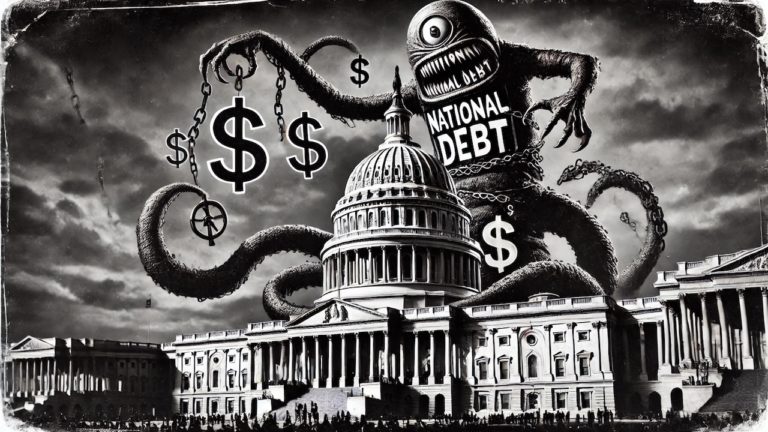
(Mike Maharrey, Money Metals News Service) It took 118 days to add another trillion dollars to the national debt. That’s just under 16 weeks.

On Thursday, Nov. 21, the national debt officially blew past $36 trillion.

To be exact, it hit $36,034,994,586,981.97.

You might be thinking, “Didn’t we just eclipse $35 trillion?

Yes.

It was on July 26, just under four months ago.

The growth of the national debt is actually accelerating. It took almost six months to grow it from $34 trillion to $35 trillion.

Going back a little further, when Congress effectively eliminated the debt ceiling on June 5, 2023, the national debt stood at $31.46 trillion. Since then, the Biden administration has added $4.54 trillion to the national debt. That’s in just 18 months for those of you keeping track at home.

This isn’t shocking when you realize Uncle Sam is blowing through about half a trillion dollars every single month. The Biden administration just ran the third-largest budget deficit in history.

To be fair, this isn’t just a Biden problem. Every president since Calvin Coolidge has left the U.S. with a bigger national debt than when he took office.

Trump has at least talked about slashing the size of government, but he’s going to need to do better than he did during his first term.

The Trump administration almost hit the $1 trillion mark in 2019 and was on pace to run a trillion-dollar deficit in fiscal 2020 before the pandemic, even as the U.S. supposedly enjoyed the “best economy” ever. The economic catastrophe caused by the government’s response to COVID-19 gave policymakers an excuse to spend with no questions asked, and we saw record deficits in fiscal 2020 and 2021.

Even if the Trump administration manages to slash discretionary spending as promised, that only accounts for 27 percent of total spending. The vast majority is for entitlements, and there is little political will to take the scissors to Social Security or Medicare.

To put the debt into perspective, every American citizen would need to write a check for $106,647 to pay off the debt.

Of course, a lot of people don’t pay taxes. That means the taxpayer burden is much higher. Every U.S. taxpayer would have to write a check for $272,821 to wipe out the debt.  And that’s on top of the taxes we already pay!

To put it another way, $36 trillion is more than the total economies of China, Japan, Germany, and the UK combined.

The debt to GDP ratio has climbed to 122.85 percent. Studies have shown a debt-to-GDP ratio of over 90 percent retards economic growth by about 30 percent.

You will find some more perspective on the enormity of the debt HERE.

What’s the Big Deal?

I consistently report on budget deficits and the growth of the national debt, but the truth is most people don’t really care.

In fact, a lot of people are under the illusion that the debt doesn’t matter.

James Madison disagreed. He called public debt “a public curse, and in a Rep. Govt. a greater than in any other.

Thomas Jefferson also disagreed. He called public debt “the greatest of dangers to be feared.”

So did George Washington.

“No pecuniary consideration is more urgent than the regular redemption and discharge of the public debt. On none can delay be more injurious or an economy of time more valuable.”

But why does it matter?

At some point, the world will decide it’s no longer interested in financing the U.S. government’s borrowing and spending.

Sure, there is a healthy demand for U.S. Treasuries — for now. But it isn’t infinite.

Ultimately, a lack of confidence in the U.S. fiscal situation could also lower demand for U.S. debt. There are already signs this is happening.

In fiscal 2024, the U.S. government spent over $1 trillion just making interest payments on the debt. It was the second biggest spending category in 2024, bigger than national defense and bigger than Medicare. The only spending category that was bigger was Social Security.

As demand for Treasuries drops, interest rates must rise even higher to attract investors, exacerbating the interest payment problem.

The hope is the Fed’s pivot to rate cuts will relieve some of the interest pressure, but so far, that hasn’t happened.

It’s quite possible that the Fed won’t be able to lower federal borrowing costs with even with deeper interest rate cuts.

Ultimately, the federal government needs the Fed to step in and put its big fat thumb on the bond market. That would mean a return to quantitative easing (QE).

In QE operations, the central bank buys Treasuries on the open market. This increased (artificial) demand drives bond prices higher and puts downward pressure on yields. This would be an ideal scenario for the U.S. government. It needs all the help it can get to facilitate its borrow/spend addiction.

But the Fed runs QE operations with money created out of thin air. The new money gets injected into the monetary system and the economy. This is, by definition, inflation.

As the Bipartisan Policy Center points out, the growing national debt and the mounting fiscal irresponsibility undermine the dollar.

“Confidence in U.S. creditworthiness may be undermined by a rapidly deteriorating fiscal situation, an increasing concern with federal debt set to grow substantially in the coming years.”

This could lead to lower economic growth, higher unemployment, and less investment wealth.

The bottom line is just because the debt hasn’t caused a crisis doesn’t mean it won’t. After all, things happen slowly and then all at once.

Precious Metals Magnate Stefan Gleason on Gold, Silver, and the Future of Money

(Money Metals News Service) On November 21, 2024, the Bryan Hyde Show featured Stefan Gleason, President and CEO of Money Metals Exchange. The discussion explored sound money, the role of precious metals, and current economic challenges.

Listen to the interview with Bryan Hyde and Stefan Gleason here:

Stefan Gleason’s Background and Money Metals Exchange

Gleason shared his journey from a 15-year career in public policy with the National Right to Work organization to his focus on monetary policy. His concerns about the Federal Reserve’s intervention in markets and the erosion of purchasing power led him to precious metals over 20 years ago.

In 2010, he launched Money Metals Exchange, alongside his brother Mike Geason and brother-in-law Clint Siegner, to popularize precious metals ownership.

Today, the company ranks among the top three U.S. precious metals dealers and operates the nation’s largest private depository.

What Is Sound Money?

Gleason defined sound money as stable, market-based money that retains its value over time. Unlike “political money” managed by central planners, sound money—historically gold and silver—is durable, divisible, and universally recognized. He emphasized that the U.S. monetary system, particularly since leaving the gold standard in 1971, has caused a 98% decline in the dollar’s value, contributing to inflation and economic instability.

Central Bank Digital Currencies (CBDCs): A Concern

Gleason expressed alarm over central bank digital currencies (CBDCs), calling them a potential tool for totalitarian control. Unlike private digital currencies like Bitcoin, CBDCs would allow governments to monitor and restrict financial transactions. He criticized this shift as a response to declining dollar credibility caused by fiscal mismanagement and devaluation.

The Importance of Tangible Assets

Gleason highlighted the advantages of owning tangible assets like gold and silver, which serve as hedges against inflation and currency devaluation. Despite gold prices reaching $2,700 per ounce this year (a 30% rise), precious metals remain under-owned in the U.S., with only 1-2% of people holding them. Gleason encouraged Americans to diversify their savings into gold and silver, noting their global liquidity, lack of counterparty risk, and historical role as money.

The Undervaluation of Silver

Silver’s current value, Gleason argued, is historically undervalued. The gold-to-silver ratio, typically around 40:1, now exceeds 80:1. He predicted silver’s revaluation, driven by its monetary and industrial applications. While silver’s volatility has disappointed investors, its potential remains significant, especially as global interest in tangible assets grows.

Challenges in Precious Metals Adoption

Gleason pointed to misinformation, financial industry bias, and unethical practices in parts of the precious metals market as barriers to wider adoption. He condemned predatory tactics by companies charging excessive premiums on collectible coins and emphasized Money Metals’ mission to provide fair, transparent pricing.

The Money Metals Depository

Located in Idaho, the Money Metals Depository is the largest private storage facility for precious metals in the U.S., with 40,000 square feet, including 9,000 square feet of Class 3 vaults. Gleason noted that while most clients prefer personal possession of their metals, the depository offers secure storage and quick liquidation options.

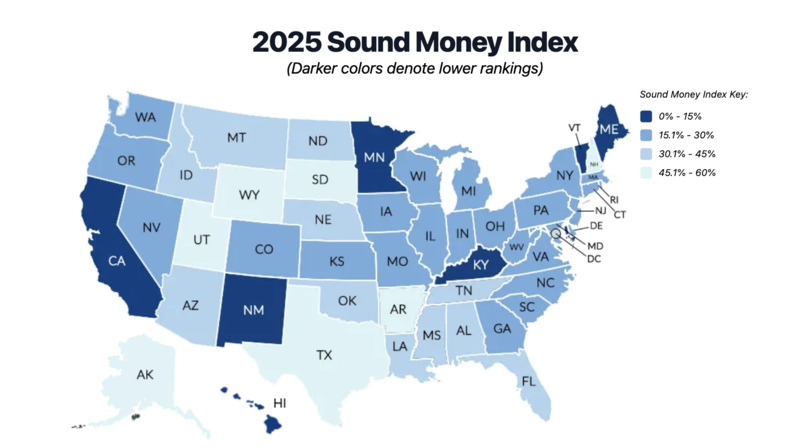
The Sound Money Index

2025 Sound Money Index

Money Metals Exchange annually ranks all 50 states on policies affecting sound money. The Sound Money Index evaluates 14 criteria, including tax treatment of precious metals and state reserves. Wyoming ranks at the top, while states like California and Vermont lag behind. Gleason encouraged listeners to visit the index at MoneyMetals.com and get involved in advancing sound money legislation.

Conclusion

Gleason’s insights underscored the importance of returning to sound money principles. He invited listeners to explore Money Metals’ resources, including the Sound Money Index and educational tools, to better understand and protect their financial future.

For more information, visit MoneyMetals.com or check the November 21, 2024, show notes at The Bryan Hyde Show.

Key Questions & Answers

In the November 21, 2024, episode of The Bryan Hyde Show, host Bryan Hyde interviewed Stefan Gleason, President and CEO of Money Metals Exchange, discussing topics related to sound money and precious metals. Key questions and Gleason’s responses included:

What is your background, and how did you become involved with Money Metals Exchange?

Stefan Gleason detailed his 15-year tenure in public policy with the National Right to Work organization, where he developed an interest in monetary policy and the Federal Reserve’s influence on markets. This led him to invest personally in precious metals over two decades ago. In 2010, he founded Money Metals Exchange with his brother and brother-in-law to promote precious metals ownership. The company has since become one of the top three precious metals dealers in the U.S. and operates the nation’s largest private depository.

How do you define ‘sound money’?

Gleason described sound money as stable, market-based currency that maintains its value over time, such as gold and silver. He contrasted this with “political money,” managed by central planners, which often leads to inflation and economic instability. He noted that since the U.S. departed from the gold standard in 1971, the dollar has lost approximately 98% of its value.

What are your thoughts on Central Bank Digital Currencies (CBDCs)?

Expressing concern, Gleason argued that CBDCs could enable governments to monitor and control individual financial transactions, potentially leading to totalitarian oversight. He advocated for free-market money and the ability for individuals to choose their preferred currency, including gold, silver, and private digital currencies like Bitcoin.

Why should individuals consider owning tangible assets like gold and silver?

Gleason emphasized that tangible assets, particularly gold and silver, serve as hedges against inflation and currency devaluation. He highlighted their global liquidity, absence of counterparty risk, and historical role as money. Despite gold prices reaching $2,700 per ounce in 2024—a 30% increase—he noted that only 1-2% of Americans own precious metals, indicating significant room for increased adoption.

Why is silver currently undervalued, and what is its potential?

Gleason pointed out that the gold-to-silver ratio, typically around 40:1, had exceeded 80:1, suggesting that silver is historically undervalued. He predicted that silver’s value would rise, driven by its monetary and industrial applications, including technology and healthcare uses. While acknowledging silver’s past volatility, he expressed optimism about its future performance.

What challenges exist in promoting precious metals ownership?

Gleason identified several obstacles: misinformation, a lack of recommendations from financial advisors, and unethical practices within parts of the precious metals market. He criticized companies that charge excessive premiums on collectible coins and emphasized Money Metals Exchange’s commitment to fair, transparent pricing.

Can you tell us about the Money Metals Depository?

Gleason described the Idaho-based facility as the largest private depository for precious metals in the U.S., encompassing 40,000 square feet, including 9,000 square feet of Class 3 vaults. He noted that while many clients prefer personal possession of their metals, the depository offers secure storage and facilitates quick liquidation when needed.

What is the Sound Money Index?

Gleason explained that the Sound Money Index is an annual ranking of all 50 U.S. states based on their policies affecting sound money. The index evaluates 14 criteria, such as tax treatment of precious metals and state reserves. He mentioned that Wyoming ranks at the top, while states like California and Vermont are at the bottom. He encouraged listeners to visit MoneyMetals.com to see their state’s ranking and to participate in efforts to promote sound money legislation.

Preserve Your Bitcoin Gains With Precious Metals

(Mike Maharrey, Money Metals News Service) Bitcoin investors have enjoyed quite the windfall in the last month, with the price surging from $68,000 to over $99,000

Bitcoin is known for its rapid price gains, but it also has a history of quick and significant selloffs. How can you protect your gains during the next downturn?

One option is to convert your Bitcoin to gold or silver during the correction period. This will protect your gains from both the selloff and the relentless devaluation of the dollar.

Bitcoin Is Volatile 

The price of Bitcoin has been generally upward over time, but it tends to be extremely volatile in the shorter term.

Since its inception in 2009, Bitcoin’s price has experienced dramatic swings. Starting at fractions of a cent, Bitcoin reached $1,000 in 2013, signaling its potential as a financial tool. However, this milestone was followed by a sharp correction. By 2017, Bitcoin had surged to nearly $20,000, attracting both institutional and retail investors. This was followed by a dip to $3,200 in 2018. In 2021, Bitcoin soared past $60,000, driven by macroeconomic factors like inflation and institutional adoption, only to dip again back into the 30s.

Here are some highlights and lowlights of Bitcoin’s price performance:

  • 2009–2010: Started at $0.0008, reaching $0.30 by the end of the 2010s.
  • 2013: Surpassed $1,000 for the first time.
  • 2013: Fell from $1,000 to $200.
  • 2017: Rallied to nearly $20,000
  • 2018: Dropped from nearly $20,000 to $3,200.
  • 2021: Rallied and peaked above $60,000.
  • 2022: Crashed from around $60,000 to near $20,000.
  • 2022: Stabilized between $15,000 and $30,000 amid global uncertainty.
  • 2024: Set a new record of just over $99,000

Each peak and correction in Bitcoin’s chart tells a story of evolving market dynamics and shifting investor sentiment coupled with significant volatility.

Bitcoin’s one-year volatility is around 50 percent. That’s more than double gold’s volatility.

Gold’s overall volatility is relatively low, historically running slightly above stock market volatility. This is in line with most fiat currencies over time. But gold doesn’t tend to devalue the way dollars and other fiat currencies do, making the yellow metal a great option for preserving one’s Bitcoin gains during the inevitable downturns. Given the level of historical volatility, it is likely to go through more significant selloffs within its long-term upward trajectory.

While silver is more volatile than gold, it is fundamentally a monetary metal and tends to track with gold over time.

Gold and Bitcoin Aren’t the Same

People often call Bitcoin “digital gold” and categorize them as similar assets. While there are some similarities, there are significant differences between the two, and they shouldn’t be considered “the same.”

As already noted, Bitcoin is much more volatile than gold, but that’s not the only difference. Bitcoin tends to behave more like a risk asset and correlates more closely with tech stocks.

For instance, Bitcoin failed as a safe-haven hedge as the markets tanked in 2018, instead correlating more closely with other risk assets. The cryptocurrency’s performance was down on par with tech stocks, falling 55 percent in the fourth quarter along with the stock market.

Meanwhile, gold was up significantly in the same period.

As a Bloomberg report noted, “The average long-term correlation between Gold and Bitcoin has been close to zero, which makes both together additive to multi-asset portfolios.”

In arguing that cryptocurrency isn’t a replacement for gold, the World Gold Council noted several gold fundamentals that differ from the Bitcoin market.

Gold
  • is less volatile
  • has a more liquid market
  • trades in an established regulatory framework
  • has a well-understood role in an investment portfolio
  • has little overlap with cryptocurrencies on many sources of demand and supply
  • is a safe-haven investment.

Gold as a Bitcoin Hedge

Bitcoin investors know the anxiety caused by protracted selloffs. One way to mitigate this is to sell Bitcoin as it goes into a bearish period and then buy again at the bottom.

But holding your profits in dollars exposes them to relentless inflationary pressure. To avoid this, savvy investors can use Bitcoin to buy gold (and silver as well). Holding precious metals through a Bitcoin bear market will preserve profits and possibly chart additional gains. When the market begins to recover, the investor can sell the precious metals and re-enter the Bitcoin market.

Money Metals was one of the first bullion dealers to accept Bitcoin as payment back in 2013. Since then, the company has expanded its services, facilitating both buying and selling transactions in cryptocurrencies using BitPay.

Money Metals Exchange can even make payments to clients using a variety of cryptocurrencies. We can purchase your metals and send you the digital coin of your choice as payment. This transaction can be done directly on our MoneyMetals.com website or over the phone.

Money Metals’ customers can also swap Bitcoin (and other crypto coins) for gold and silver to be stored by the Money Metals Depository. Storing with us makes it quicker to move back into cryptocurrency when the time comes and avoid the costs and hassle associated with shipping metals.

Consumer Debt, Trump, and Precious Metals: Insights from Greg Weldon

(Money Metals News Service) Mike Maharrey, reporter and analyst at Money Metals Exchange, interviewed Greg Weldon, CEO of Weldon Financial and editor of newsletters such as Weldon’s Money Monitor and Metal Monitor.

Weldon, often referred to as “The Gold Guru,” shared his macroeconomic insights on inflation, consumer debt, and precious metals, offering valuable guidance for investors navigating today’s economic complexities.

Economic Landscape and Debt Challenges

Greg Weldon highlighted how the current economic environment contrasts sharply with the 1980s. He explained that today’s high levels of debt fundamentally alter the U.S. economy’s ability to grow sustainably.

He pointed out that the Federal Reserve’s decision to tolerate higher inflation, as outlined in Jerome Powell’s 2018 Jackson Hole speech, reflects the challenges of managing the debt burden.

  • Debt under President Biden has outpaced Trump’s nearly 2:1 when excluding pandemic-related expenditures.
  • Current policies rely heavily on debt monetization, limiting options for managing inflation.
  • High interest rates, previously used to combat inflation in the 1980s, are less viable due to the debt load.

Weldon emphasized that the economic optimism following Trump’s election may falter as the reality of debt-driven constraints becomes clearer.

Consumer Credit Crisis

Weldon raised alarms about consumer credit conditions, suggesting the U.S. may be approaching a financial tipping point. He pointed to declining savings and rising delinquencies as signs of severe strain on American households.

  • Personal savings have fallen below total credit card debt for the first time since 2007.
  • Credit card delinquencies are now over 10%, matching levels from the 2008 financial crisis.
  • In one week, commercial bank loans fell by $19.3 billion, with $12.5 billion attributed to reduced credit card lending.
  • Credit card rejection rates for limit increases have doubled from 20% to 44% in just one year.

These trends, Weldon noted, indicate that consumers are nearing their borrowing capacity, potentially triggering broader economic challenges.

Precious Metals Outlook

Weldon remains optimistic about the long-term potential of gold and silver. He sees central bank demand and limited speculative interest as key drivers for future growth in the metals market.

Gold:
  • Projected long-term price: $4,900 within three years.
  • Low speculative interest offers room for upside.
  • Central bank demand remains a strong support factor.
Silver:
  • China’s increased demand for silver, driven by a new Peruvian port, underscores its global importance.
  • Technical breakout levels, such as $31.60, could signal a strong upward trend.
  • Silver continues to serve as both an industrial and monetary metal.

Weldon emphasized that corrections in precious metals markets often provide buying opportunities for long-term investors.

Weldon detailed several global risks shaping the economic landscape. Severe drought conditions in the U.S., geopolitical tensions, and inflationary pressures are creating a challenging environment for policymakers and investors alike.

  • Over 50% of the U.S. is experiencing moderate drought, with 25% in severe drought conditions.
  • Food prices are expected to rise due to weather-related supply constraints.
  • China’s resource accumulation, including silver, demonstrates its strategic advantage over the U.S.

These dynamics, Weldon explained, will likely exacerbate inflation and push the Federal Reserve toward more aggressive interventions.

Bitcoin and Crypto

Weldon offered a nuanced perspective on cryptocurrencies, recognizing their utility in combating currency devaluation while noting their speculative nature. He sees Bitcoin as distinct from gold, often behaving more like a risk asset tied to stock market movements.

  • Bitcoin has benefited from demand in countries facing severe currency devaluation, such as Angola and Nigeria.
  • Recent Bitcoin rallies have been fueled by large-scale accumulation by major players.
  • Risks include potential infrastructure disruptions, such as solar flares, which could render cryptocurrencies unusable.

Weldon advised investors to balance crypto holdings with physical assets like gold and silver to mitigate risks.

Strategies for Investors

To navigate the current economic landscape, Weldon stressed the importance of blending macro and microeconomic analysis. He highlighted opportunities in mining shares and suggested using technical analysis to identify key entry points.

  • Canadian miners, such as Torex and Wheaton, offer compelling value due to currency dynamics.
  • Uranium stocks are emerging as a hot sector, driven by increasing global demand.
  • Technical corrections in precious metals provide opportunities to build long-term positions.

Weldon encouraged investors to diversify across sectors and asset classes to hedge against economic uncertainties.

Final Thoughts

Greg Weldon concluded by emphasizing the importance of a comprehensive investment strategy that combines macroeconomic insights, technical analysis, and sector-specific knowledge.

For those interested in his research, Weldon offers detailed reports and managed account services. He can be reached at [email protected], and his podcast, Money Markets, and New Age Investing, is available on major platforms.

Key Questions & Answers

Greg Weldon Gold Guru on Money Metals Podcast Mike Maharrey Joshua D Glawson Money Metals Exchange

During the Money Metals Podcast, Greg Weldon addressed a wide range of pressing economic topics, offering insights into inflation, consumer credit challenges, precious metals, and cryptocurrencies. Below are some of the key questions posed by host Mike Maharrey and Weldon’s in-depth answers, providing valuable perspectives for investors navigating today’s complex markets.

How does the current economic environment differ from the 1980s?

The debt levels today are significantly higher, which fundamentally alters the economy’s ability to grow. Unlike the 1980s under Ronald Reagan, the U.S. no longer has the flexibility to manage inflation through high interest rates due to the massive debt burden.

What are the biggest concerns surrounding consumer credit?
  • Personal savings are now below total credit card debt, a scenario last seen in 2007.
  • Credit card delinquencies have exceeded 10%, matching levels from the 2008 financial crisis.
  • Weekly commercial bank loans fell by $19.3 billion recently, with $12.5 billion attributed to reduced credit card lending.
  • Credit card rejection rates for limit increases have surged from 20% to 44% in the past year.
What is the long-term outlook for gold?

Greg Weldon projects gold prices to reach $4,900 within three years, driven by strong central bank demand and limited speculative interest. Corrections in gold prices offer buying opportunities.

What are the key drivers for silver’s growth?

China’s increased demand for silver and its dual role as an industrial and monetary metal are critical. Silver’s technical breakout at $31.60 could signal a strong upward trend.

How do cryptocurrencies compare to gold?

Bitcoin behaves more like a risk asset tied to stock market movements than as “digital gold.” While useful for protecting against currency devaluation in some countries, cryptocurrencies face risks like infrastructure disruptions. Diversification with physical assets like gold is advised.

What are the investment opportunities in mining shares?

Weldon highlighted Canadian miners like Torex and Wheaton as strong candidates due to favorable technical setups and currency dynamics. Uranium stocks are also gaining momentum.

What are the biggest risks to the economy?

Severe drought conditions in the U.S., rising food prices, geopolitical tensions, and inflation pose significant challenges. These factors could force the Federal Reserve to act more aggressively, affecting market dynamics.

What resources does Greg Weldon offer for investors?

Weldon provides detailed reports like the Global Macro Strategy Report and The Gold Guru, along with managed account services. He can be contacted at [email protected] or through his podcast, Money Markets, and New Age Investing.

Where can people purchase gold and silver?

People can purchase gold and silver at MoneyMetals.com.

Trump Plans to Reinstate Ban on Transgenderism in Military on Day 1

(Julianna Frieman, Headline USA) President-elect Donald Trump will reportedly sign an executive order removing all transgender members from the U.S. military as early as his first day in office, defense sources told The Times in a report published Monday.

The potential order would result in up to 15,000 members who are transgender being medically discharged and deemed unfit for service, according to the outlet.

It would also reportedly prevent transgender people from joining the military.

Trump’s transgender military ban would likely be implemented as soon as he is inaugurated on Jan. 20, 2025, the outlet reported.

This comes as Trump has been a frequent critic of high-ranking officers more concerned with the race and gender of soldiers rather than their ability to protect the U.S. from adversaries.

In his first term, Trump instated a ban on transgender people joining the military, but this did not stop existing transgender personnel from keeping their jobs.

President Joe Biden reversed his predecessor’s order within his first week as president, soon incentivizing transgender people to join the military in exchange for “free” sex-change surgeries and hormones therapies at the taxpayer’s expense.

Rachel Branaman, executive director of Modern Military Association of America, an LGBT military advocacy group, told London’s The Times that Trump’s transgender purge would further exacerbate the military manpower shortage.

“Should a trans ban be implemented from day one of the Trump administration it would undermine the readiness of the military and create an even greater recruitment and retention crisis, not to mention signaling vulnerability to America’s adversaries,” Branaman claimed.

However, Branaman failed to mention the role diversity, equity and inclusion initiatives have played in deterring young men from joining the forces.

Trump nominated former Fox News host Pete Hegseth as his defense secretary. Hegseth, an army veteran, previously spoke out against “woke” policies in the military.

“They committed a Bud Light,” Hegseth said of the Biden administration’s DEI policies in the military. “In search of non-traditional constituents, they offended their core constituents.”

Julianna Frieman is a freelance writer published by the Daily Caller, Headline USA, The Federalist, and The American Spectator. Follow her on Twitter at @JuliannaFrieman.

Iconic ‘Wheel of Fortune’ Host, Hollywood Conservative Dies at 83

(Headline USA) Chuck Woolery, the affable, smooth-talking game show host of Wheel of Fortune, Love Connection and Scrabble who later became a right-wing podcaster, skewering leftists and accusing the government of lying about COVID-19, has died. He was 83.

Mark Young, Woolery’s podcast co-host and friend, said in an email early Sunday that Woolery died at his home in Texas with his wife, Kristen, present.

“Chuck was a dear friend and brother and a tremendous man of faith, life will not be the same without him,” Young wrote.

On social media, conservative supporters paid tribute to one of the rare conservatives unafraid to speak out in far-left Hollywood without fear of getting cancelled.

Although Woolery’s career did pay a heavy cost, he succeeded, as always, in reinventing himself, and he lived to see the president for whom he had taken a stand be reelected just weeks prior to his passing.

Woolery, with his matinee idol looks, coiffed hair and ease with witty banter, was inducted into the American TV Game Show Hall of Fame in 2007 and earned a daytime Emmy nomination in 1978.

In 1983, Woolery began an 11-year run as host of TV’s Love Connection, for which he coined the phrase, “We’ll be back in two minutes and two seconds,” a two-fingered signature dubbed the “2 and 2.”

In 1984, he hosted TV’s Scrabble, simultaneously hosting two game shows on TV until 1990.

Love Connection, which aired long before the dawn of dating apps, had a premise that featured either a single man or single woman who would watch audition tapes of three potential mates and then pick one for a date.

A couple of weeks after the date, the guest would sit with Woolery in front of a studio audience and tell everybody about the date. The audience would vote on the three contestants, and if the audience agreed with the guest’s choice, Love Connection would offer to pay for a second date.

Woolery told the Philadelphia Inquirer in 2003 that his favorite set of lovebirds was a man aged 91 and a woman aged 87. “She had so much eye makeup on, she looked like a stolen Corvette. He was so old he said, ‘I remember wagon trains.’ The poor guy. She took him on a balloon ride.”

Other career highlights included hosting the shows Lingo, Greed and The Chuck Woolery Show, as well as hosting the short-lived syndicated revival of The Dating Game from 1998 to 2000 and an ill-fated 1991 talk show. In 1992, he played himself in two episodes of TV’s Melrose Place.

Woolery became the subject of the Game Show Network’s first attempt at a reality show, Chuck Woolery: Naturally Stoned, which premiered in 2003. It shared the title of the pop song in 1968 by Woolery and his rock group, the Avant-Garde. It lasted six episode and was panned by critics.

Woolery began his TV career at a show that has become a mainstay. Although most associated with Pat Sajak and Vanna White, Wheel of Fortune debuted Jan. 6, 1975, on NBC with Woolery welcoming contestants and the audience. Woolery, then 33, was trying to make it in Nashville as a singer.

Wheel of Fortune started life as Shopper’s Bazaar, incorporating Hangman-style puzzles and a roulette wheel. After Woolery appeared on The Merv Griffin Show singing “Delta Dawn,” Merv Griffin asked him to host the new show with Susan Stafford.

“I had an interview that stretched to 15, 20 minutes,” Woolery told the New York Times in 2003. “After the show, when Merv asked if I wanted to do a game show, I thought, ‘Great, a guy with a bad jacket and an equally bad mustache who doesn’t care what you have to say—that’s the guy I want to be.’”

NBC initially passed, but they retooled it as Wheel of Fortune and got the green light. After a few years, Woolery demanded a raise to $500,000 a year, or what host Peter Marshall was making on Hollywood Squares. Griffin balked and replaced Woolery with weather reporter Pat Sajak.

“Both Chuck and Susie did a fine job, and ‘Wheel’ did well enough on NBC, although it never approached the kind of ratings success that ‘Jeopardy!’ achieved in its heyday,” Griffin said in “Merv: Making the Good Life Last,” an autobiography from the 2000s co-written by David Bender. Woolery earned an Emmy nod as host.

Born in Ashland, Kentucky, Woolery served in the U.S. Navy before attending college. He played double bass in a folk trio, then formed the psychedelic rock duo The Avant-Garde in 1967 while working as a truck driver to support himself as a musician.

The Avant-Garde, which tourbed in a refitted Cadillac hearse, had the Top 40 hit “Naturally Stoned,” with Woolery singing, “When I put my mind on you alone/I can get a good sensation/Feel like I’m naturally stoned.”

After The Avant-Garde broke up, Woolery released his debut solo single “I’ve Been Wrong” in 1969 and several more singles with Columbia before transitioning to country music by the 1970s. He released two solo singles, “Forgive My Heart” and “Love Me, Love Me.”

Woolery wrote or co-wrote songs for himself and everyone from Pat Boone to Tammy Wynette. On Wynette’s 1971 album “We Sure Can Love Each Other,” Woolery wrote “The Joys of Being a Woman” with lyrics including “See our baby on the swing/Hear her laugh, hear her scream.”

After his TV career ended, Woolery went into podcasting. In an interview with the New York Times, he called himself a gun-rights activist and described himself as a conservative libertarian and constitutionalist. He said he hadn’t revealed his politics in leftist Hollywood for fear of retribution.

He teamed up with Mark Young in 2014 for the podcast “Blunt Force Truth” and soon became a full supporter of Donald Trump.

“President Obama’s popularity is a fantasy only held by him and his dwindling legion of juice-box-drinking, anxiety-dog-hugging, safe-space-hiding snowflakes,” Woolery said.

Woolery also was active online, retweeting articles from Conservative Brief, warning that Democrats were trying to install a system of Marxism and spreading headlines such as “Impeach him! Devastating photo of Joe Biden leaks.”

During the early stages of the pandemic, Woolery initially accused medical professionals and Democrats of lying about the virus in an effort to hurt the economy and Trump’s chances for reelection to the presidency.

“The most outrageous lies are the ones about COVID-19. Everyone is lying,” Woolery wrote in July 2020.

“The CDC, media, Democrats, our doctors, not all but most, that we are told to trust,” he continued. “I think it’s all about the election and keeping the economy from coming back, which is about the election. I’m sick of it.

Trump retweeted that post to his 83 million followers.

Just days later, Woolery changed his stance, announcing his son had contracted COVID-19.

“To further clarify and add perspective, COVID-19 is real and it is here,” Woolery posted before his account was deleted. “My son tested positive for the virus, and I feel for of those suffering and especially for those who have lost loved ones.”

Woolery later explained on his podcast that he never called COVID-19 “a hoax” or said “it’s not real,” just that “we’ve been lied to.”

Woolery also said it was “an honor to have your president retweet what your thoughts are and think it’s important enough to do that.”

In addition to his wife, Woolery is survived by his sons Michael and Sean and his daughter Melissa, Young said.

Adapted from reporting by the Associated Press

Three of Trump’s ‘Midnight Appointments’ Raise Concerns among MAGA Faithful

(Ben Sellers, Headline USA) Evoking the notorious “midnight appointments” that second President John Adams used to slip Federalist judges into the government prior to Thomas Jefferson’s inauguration, President-elect Donald Trump announced eight staffing selections after business hours on Friday, including the final picks for his official Cabinet.

Although praised for his completion of it in record time, and for the ideological diversity of his choices, some raised eyebrows not simply among leftist media critics, but also among his MAGA supporters.

Three of Trump’s Friday nominations in particular drew apprehension, if not outright backlash, from some conservative supporters who were, at the very least, interested in understanding more about the vetting process.

Treasury Secretary-nominee Scott Bessent, Labor Secretary-nominee Lori Chavez–DeRemer, and Surgeon General-nominee Janette Nesheiwat all notably raised red flags over past work experiences, positions or statements that may warrant extra scrutiny.

SCOTT BESSENT

The biggest concern may surround Bessent who, despite being a longtime Republican donor, was also one of the top money managers for George Soros prior to Trump’s first presidential term.

“Before becoming a Trump donor and adviser, Bessent donated to various Democratic causes in the early 2000s, notably Al Gore’s presidential run,” noted the Canadian Broadcasting Corporation.

“He also worked for Soros [… and] had an influential role in Soros’s London operations, including his famous 1992 bet against the pound, which generated huge profits on ‘Black Wednesday,’ when the pound was de-linked from European currencies.”

Bessent was promoted to become Soros’s chief investment officer, filling the role from 2011 to 2015, which is when he left to form his own hedge fund, Key Square Capital Management. Soros provided $2 billion in backing for the new company.

Newsweek reported that “after leaving Soros Fund Management, Bessent maintained ties to organizations Soros supported, such as the International Crisis Group, which received substantial funding from Soros.”

Even country-music star John Rich, a staunch Trump supporter, seemed puzzled by the choice.

“I hate to keep asking questions, but WHY is a former colleague of Soros the nominee for Treasury Sec?” he posted on X.

Trump haters were equally shocked by the selection, mocking MAGA as the “Dumbest f**king cult in human history.”

Records from the Federal Election Commission indicate that Bessent has consistently donated to a diverse array of Republicans, from Rand Paul to Mitt Romney, with his political donations dating back to 2010.

However, he also donated $25,000 to the Ready for Hillary PAC in 2013.

Meanwhile, some in the mainstream media carped over Bessent’s potential status as the new highest-ranking gay man to be appointed—supplanting soon-to-be-former Transportation Secretary Pete Buttigieg.

LORI CHAVEZ–DEREMER

Concerns over Chavez–DeRemer, who recently lost her House re-election bid in deep-blue Oregon, center largely around her union backing.

“Lori’s strong support from both the Business and Labor communities will ensure that the Labor Department can unite Americans of all backgrounds behind our Agenda for unprecedented National Success – Making America Richer, Wealthier, Stronger and more Prosperous than ever before!” Trump said in his statement announcing the pick.

Trump’s decision to choose the union-friendly Republican reportedly came at the urging of Teamsters president Sean O’Brien.

O’Brien, who spoke at the Republican National Convention, may have played a significant part in Trump’s political success in Rust Belt states like Pennsylvania, Michigan and Wisconsin.

While reclaiming union support for his populist candidacy may be a political masterstroke on Trump’s part the real-world implications of courting Big Labor may prove to be politically precarious.

The selection elicited criticism from the Wall Street Journal editorial board, which noted in particular Chavez–DeRemer’s backing from notorious teachers union boss Randi Weingarten, the driving influence behind COVID-era school shutdowns and many of the woke curricular demands currently infiltrating classrooms.

“Why would Mr. Trump want to empower labor bosses who oppose his economic agenda and spent masses to defeat him?” asked the editorial board.

Chavez–DeRemer’s efforts could undermine Trump’s plans to reform—if not abolish—the federal Education Department under longtime backer and transition-team leader Linda McMahon.

“Teachers unions across the country could block education reforms and limit school choice via collective bargaining,” noted the Journal editorial.

JANETTE NESHEIWAT

Some of the biggest backlash on social media was directed at Dr. Janette Nesheiwat, Trump’s nominee for surgeon general. On Monday morning, “surgeon general” was still a trending Twitter topic, with some 76,200 posts reacting to the choice of Nesheiwat, a staunch supporter of controversial COVID-era vaccination mandates, shutdowns and even censorship of skepticism.

Her positions are likely to clash with those of Trump’s nominee for Health and Human Services secretary, Robert F. Kennedy Jr., whose vaccine skepticism is well known.

Confoundingly, some took to X to show that Nesheiwat had also made contradictory statements supporting natural immunity and risk-based assessments, suggesting her views on COVID may have evolved through the course of the pandemic.

Like several other candidate selections, Nesheiwat’s main qualification for the job seems to have been her regular appearances on Fox News and her “central casting” look, along with her outspoken support for Trump.

Some pointed out the obvious snub to the eminently qualified Dr. Ben Carson, a former neurosurgeon who served in Trump’s first Cabinet.

Ben Sellers is the editor of Headline USA. Follow him at x.com/realbensellers.

Texas Offers Land for Use for Trump Deportations

(Bethany Blankley, The Center Square) Texas is offering state land to be used for President-elect Donald Trump’s mass deportation plan.

Trump has said he plans to declare a national emergency on his first day in office, citing the border crisis. Doing so will enable him to utilize the military to secure the border and begin a deportation process that first prioritizes removing violent criminal foreign nationals who are in the U.S. illegally. The next priority is removing those illegally in the country with deportation orders. Combined, they total several million, The Center Square has reported. A majority of Americans polled support the plan, The Center Square reported.

“The moment that President Trump puts his hand on that Bible and takes the oath of office, as he has said, the occupation ends and liberation day begins,” Stephen Miller, who’s been named deputy chief of staff for policy in Trump’s new administration, told Fox News. “He will immediately sign executive orders sealing the border shut, beginning the largest deportation operation in American history.”

Trump’s border czar Tom Homan has said deporting violent criminals is his top priority. He’s said he plans to do this by coordinating with multiple federal agencies to remove criminal foreign nationals in the country illegally, followed by those with deportation orders and local jail detainer requests. Part of his plan also involves identifying those on the FBI’s Terrorist Watchlist who were reportedly released into the country by the Biden-Harris administration, as well as those with local jail detainer requests and imposing consequences for local jurisdictions that refuse to cooperate.

In an effort to aid the administration, Texas Land Commissioner Dawn Buckingham offered state property the GLO acquired last month in Starr County. Next week, the state breaks ground building a new section of Texas’ border wall on the property.

Buckingham is offering part of the land to be used for Trump’s deportation plan, more than 1,400 acres, to construct deportation facilities and staging areas.

The GLO is “prepared to enter into an agreement with the Department of Homeland Security, Immigration and Customs Enforcement, or the United States Border Patrol to allow facility to be built for the processing, detention, and coordination of the largest deportation of violent criminals in the nation’s history,” Buckingham wrote Trump.

“As Texas Land Commissioner and steward of over 13 million acres, it’s been my promise to all Texans since assuming my role at the GLO to use every tool at my disposal to gain complete operational control of our southern border,” Buckingham said in a statement. “This is why I am offering President-elect Trump over 1,400 acres of state land on the southern border to aid his administration in carrying out their deportation plans to place the safety and well-being of all Americans first and foremost.”

Buckingham has also taken other actions to help Texas secure the border.

Last June, the GLO declared 170 acres on Fronton Island in the Rio Grande Valley and 45 acres of two islands south of Eagle Pass as state property allowing Operation Lone Star officers to clear what was previously used as a staging area by cartel operatives, The Center Square reported.

In far west Texas, the GLO also purchased the largest privately owned ranch in Texas, which spans more than 350,000 acres and 552-square-miles, for border security and conservation efforts, The Center Square reported.

Texas Gov. Greg Abbott has praised Trump’s plan, also arguing that Texas should be able to remove illegal foreign nationals through a bill the state legislature passed that he signed into law, SB 4. The Biden administration sued to stop it. The case is currently before the Fifth Circuit Court of Appeals.

Texas is also daily expanding Abbott’s border security efforts, including continuing to build Texas’ border wall on state land and putting in place marine and concertina wire barriers. The Biden administration also sued to stop these efforts, and Texas continued to build them. Those cases are also before the Fifth Circuit.

University of Maryland to Offer ‘Intro to Fat Studies’ Course

(Tate Miller, The Center Square) The University of Maryland is offering a course called “Intro to Fat Studies: Fatness, Blackness and Their Intersections” this spring.

The three-credit course will be taught by Professor Sydney Lewis on Tuesdays and Thursdays and looks at “fatness as intersectional,” particularly highlighting “the relationship between fatness and blackness,” according to the course description.

When contacted twice by The Center Square, Lewis did not respond.

“Intro to Fat Studies” will examine “fatness as an area of human difference subject to privilege and discrimination that intersects with other systems of oppression based on gender, race, class, sexual orientation, and ability.”

“We approach this area of study through an interdisciplinary humanities and social-science lens which emphasizes fatness as a social justice issue,” the description said.

“The course closes with an examination of fat liberation as liberation for all bodies with a particular emphasis on performing arts and activism as a vehicle for liberation and challenging fatmisia,” according to the description.

Fatmisia is the hatred of fatness, versus fatphobic which means fear of fatness, according to the Simmons University Library.

“Intro to Fat Studies” is offered through the University of Maryland’s Harriet Tubman Department of Women, Gender and Sexuality Studies.

Other courses available through the Department of Women, Gender and Sexuality Studies (WGSS) include Gender, Race and Computing; Quare/Queer Contentions: Exploration of Sexualities in the Black Community; and Feminist, Critical Race, and Queer Theories.

Lewis strives to “blur the boundaries between the academy, art, and activism” in her teaching, according to a school bio. Her subject interests are black feminist theory and culture, black queer theory, mad studies, and disability justice to name a few.

In the winter of 2022, Lewis taught a course called “Bodies in Contention.”

The class looked at bodies that, according to the course description, cause “societal discomfort,” and how observing these “marginalized” groups encourage people to consider all body types “as socially constructed.” Such bodies were stated as “non-white bodies, fat bodies, disabled bodies, queer, intersex, and trans gender bodies.”

The Center Square reached out to WGSS academic program manager Gwen Warman and University of Maryland media relations. Warman did not respond, while the university’s media relations did not provide comment in time for publishing.

Charlotte Airport Workers Plan to Strike During Busy Thanksgiving Travel Week

(Headline USA) Service workers at Charlotte Douglas International Airport plan to go on strike during a busy week of Thanksgiving travel to protest what they say are unlivable wages.

Employees of ABM and Prospect Airport Services cast ballots Friday to authorize the work stoppage in North Carolina, which is set to begin Monday at 5 a.m.

Officials with Service Employees International Union announced the impending strike in a statement early Monday, saying the workers would demand “an end to poverty wages and respect on the job during the holiday travel season.”

ABM and Prospect Airport Services contract with American Airlines to provide services including cleaning airplane interiors, removing trash and escorting passengers in wheelchairs.

Workers say they previously raised the alarm about their growing inability to afford basic necessities, including food and housing. They described living paycheck to paycheck, unable to cover expenses like car repairs while performing jobs that keep countless planes running on schedule.

“We’re on strike today because this is our last resort. We can’t keep living like this,” ABM cabin cleaner Priscilla Hoyle said in a statement. “We’re taking action because our families can’t survive.”

Several hundred workers were expected to walk off the job and continue the work stoppage throughout Monday.

Most of them earn between $12.50 and $19 an hour, which is well below the living wage for a single person with no children in the Charlotte area, union officials said.

Charlotte Douglas International Airport officials have said this holiday travel season is expected to be the busiest on record, with an estimated 1.02 million passengers departing the airport between last Thursday and the Monday after Thanksgiving.

In addition to walking off the job, striking workers plan to hold an 11 a.m. rally and a 1 p.m. “Strikesgiving” lunch “in place of the Thanksgiving meal that many of the workers won’t be able to afford later this week,” union officials said.

“Airport service workers make holiday travel possible by keeping airports safe, clean, and running,” the union said. “Despite their critical role in the profits that major corporations enjoy, many airport service workers must work two to three jobs to make ends meet.”

ABM said it would take steps to minimize disruptions from any demonstrations.

“At ABM, we appreciate the hard work our team members put in every day to support our clients and help keep spaces clean and people healthy,” the company said in a statement last week.

Prospect Airport Services said last week that the company recognizes the seriousness of the potential for a strike during the busy holiday travel season.

Adapted from reporting by the Associated Press