Apple to Pay $95M to Settle Lawsuit Accusing Siri of Eavesdropping

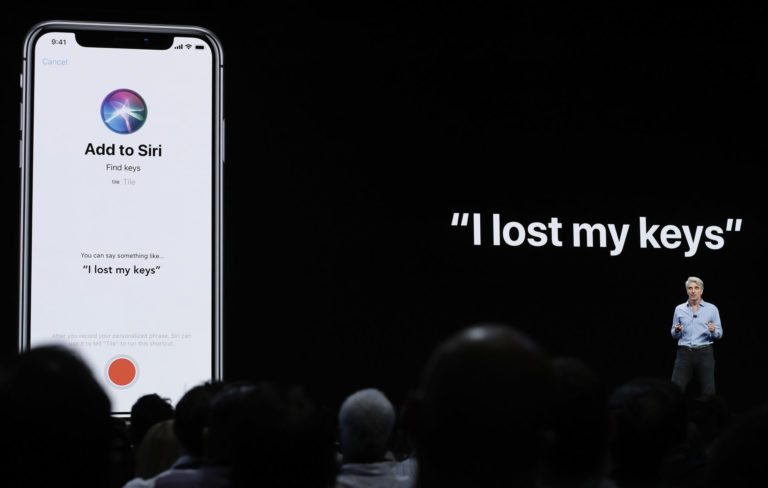
(Headline USA) Apple has agreed to pay $95 million to settle a lawsuit accusing the privacy-minded company of deploying its virtual assistant Siri to eavesdrop on people using its iPhone and other trendy devices.

The proposed settlement filed Tuesday in an Oakland, California, federal court would resolve a 5-year-old lawsuit revolving around allegations that Apple surreptitiously activated Siri to record conversations through iPhones and other devices equipped with the virtual assistant for more than a decade.

The alleged recordings occurred even when people didn’t seek to activate the virtual assistant with the trigger words, “Hey, Siri.”

Some of the recorded conversations were then shared with advertisers in an attempt to sell their products to consumers more likely to be interested in the goods and services, the lawsuit asserted.

The allegations about a snoopy Siri contradicted Apple’s long-running commitment to protect the privacy of its customers—a crusade that CEO Tim Cook has often framed as a fight to preserve “a fundamental human right.”

Apple isn’t acknowledging any wrongdoing in the settlement, which still must be approved by U.S. District Judge Jeffrey White. Lawyers in the case have proposed scheduling a Feb. 14 court hearing in Oakland to review the terms.

If the settlement is approved, tens of millions of consumers who owned iPhones and other Apple devices from Sept. 17, 2014, through the end of last year could file claims.

Each consumer could receive up to $20 per Siri-equipped device covered by the settlement, although the payment could be reduced or increased, depending on the volume of claims.

Only 3% to 5% of eligible consumers are expected to file claims, according to estimates in court documents.

Eligible consumers will be limited to seeking compensation on a maximum of five devices.

The settlement represents a sliver of the $705 billion in profits that Apple has pocketed since September 2014.

It’s also a fraction of the roughly $1.5 billion that the lawyers representing consumers had estimated Apple could been required to pay if the company had been found of violating wiretapping and other privacy laws had the case gone to a trial.

The attorneys who filed the lawsuit may seek up to $29.6 million from the settlement fund to cover their fees and other expenses, according to court documents.

Adapted from reporting by the Associated Press

The Next Phase of Gold’s Bull Market Could Be Starting Soon

(Jesse Colombo, Money Metals News Service) The past two months following the U.S. presidential election have been challenging for gold bulls as the yellow metal pulled back and settled into a choppy trading range.

However, as I’ve consistently stated, this consolidation phase is just a healthy pause— allowing gold to catch its breath before continuing its upward trend.

Over the past year, gold has displayed a steady, orderly growth pattern, advancing through a series of consolidation phases in a stair-step fashion. The encouraging news is that this current consolidation period may be nearing its end, positioning gold to resume its climb toward all-time highs.

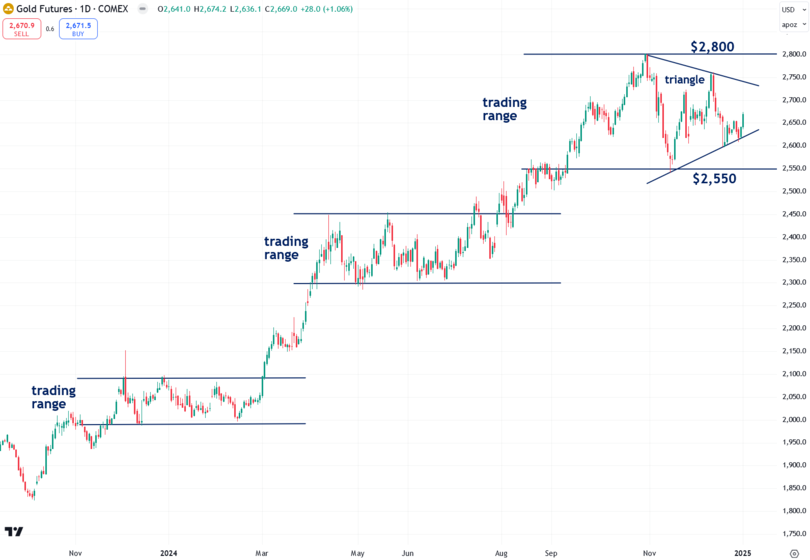
COMEX gold futures are currently trading within a range of $2,550 to $2,800, forming a triangle pattern within this range.

For confirmation that gold’s bull market has resumed, a decisive, high-volume close above both the triangle pattern and the $2,800 resistance level is necessary. A successful breakout should propel gold to $3,000 and beyond in short order.

I closely monitor gold priced in other currencies, as it removes the impact of U.S. dollar fluctuations and offers a clearer picture of gold’s underlying strength. Over the past two months, gold priced in other currencies has outperformed gold priced in U.S. dollars, largely due to the powerful dollar rally, which has made gold appear weaker than it truly is.

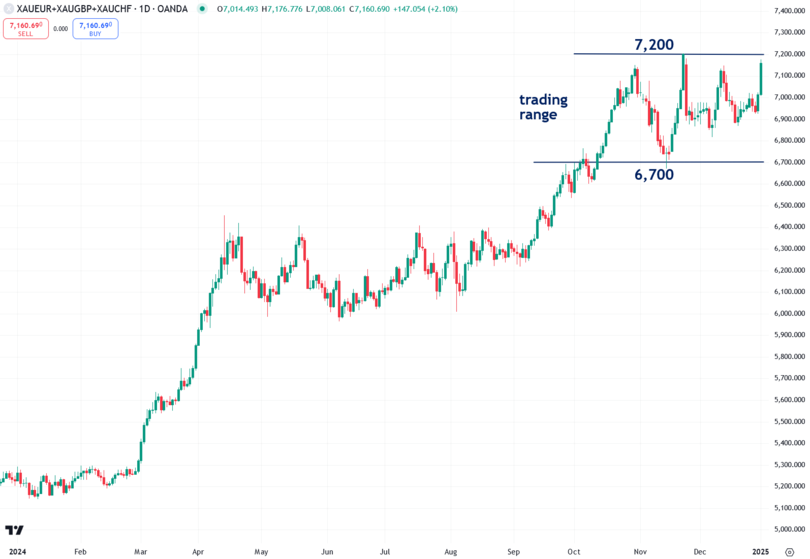
The chart below shows gold priced in euros, British pounds, and Swiss francs. I find that this particular mix shows gold’s movements very clearly. Gold priced in this mix of currencies is currently in a trading range between 6,700 and 7,200.

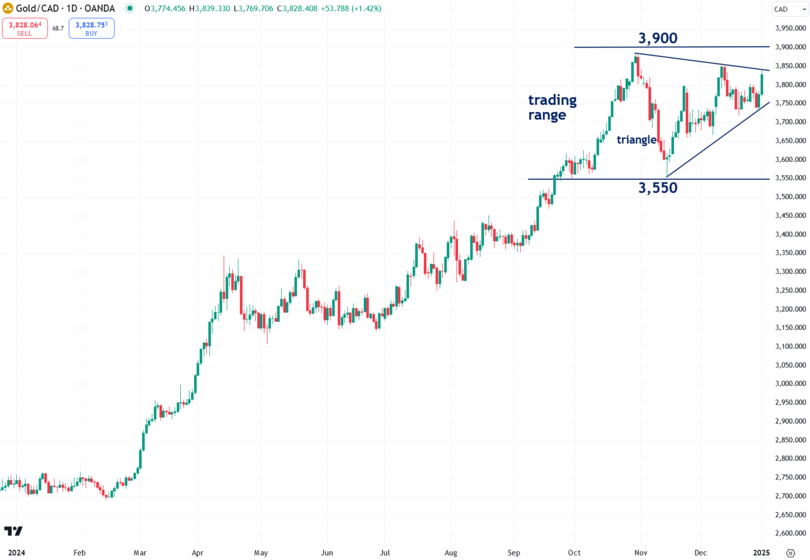
Gold priced in Canadian dollars is currently trading within a range between 3,550 and 3,900. A triangle pattern has formed within this range, mirroring a similar setup in gold priced in U.S. dollars. This chart holds particular significance as Canada ranks among the world’s top gold producers, claiming the fourth spot globally with 200 metric tons of gold produced in 2023.

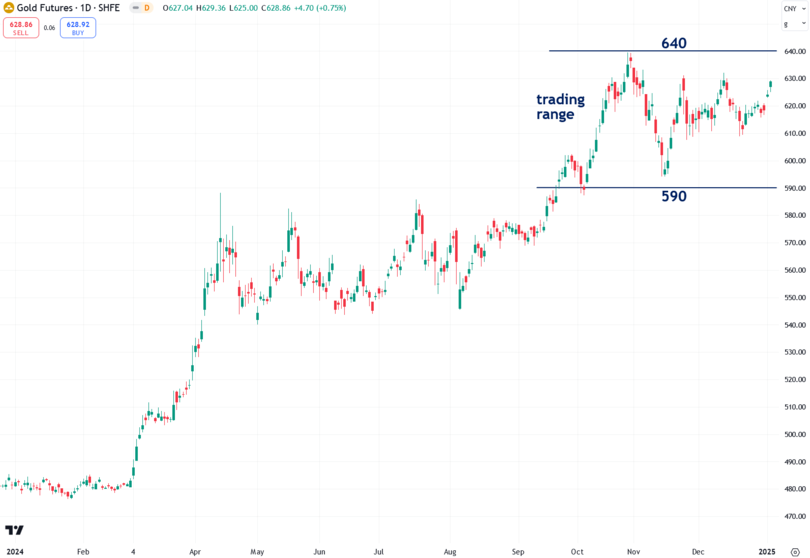
China’s gold benchmark, the Shanghai Futures Exchange (SHFE) gold futures, is currently trading within a range of 590 to 640. As the world’s largest producer of gold—producing 370 metric tons in 2023—and one of its largest consumers, China plays a pivotal role in the global gold market.

For months, I’ve theorized that a resurgence of Chinese gold futures traders—who were instrumental in driving gold’s surge in March and April—could be the catalyst to propel prices toward $3,000 and beyond. A bullish breakout from this trading range should turn that forecast into reality.

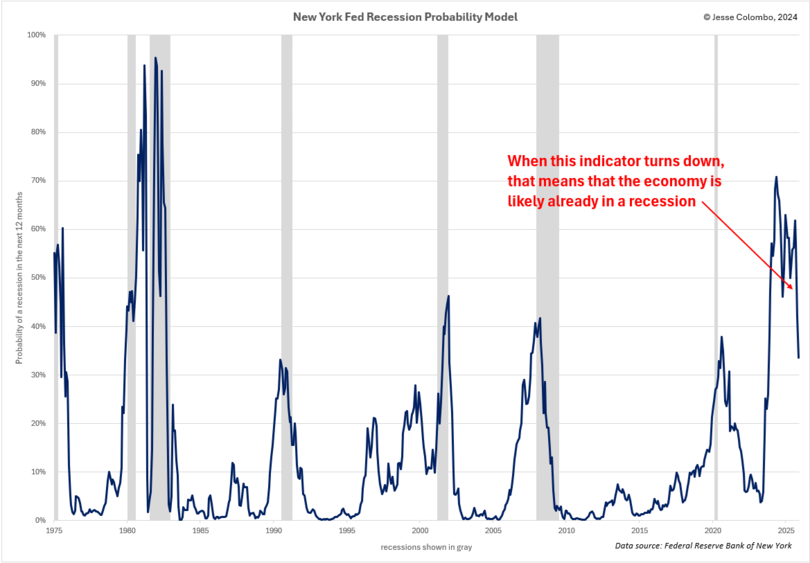
Adding weight to the idea that gold may be poised to resume its bull market is the likelihood that the U.S. economy is already in a recession. Recessions are typically bullish for gold, as they lead to interest rate cuts and quantitative easing (QE)— essentially digital money printing.

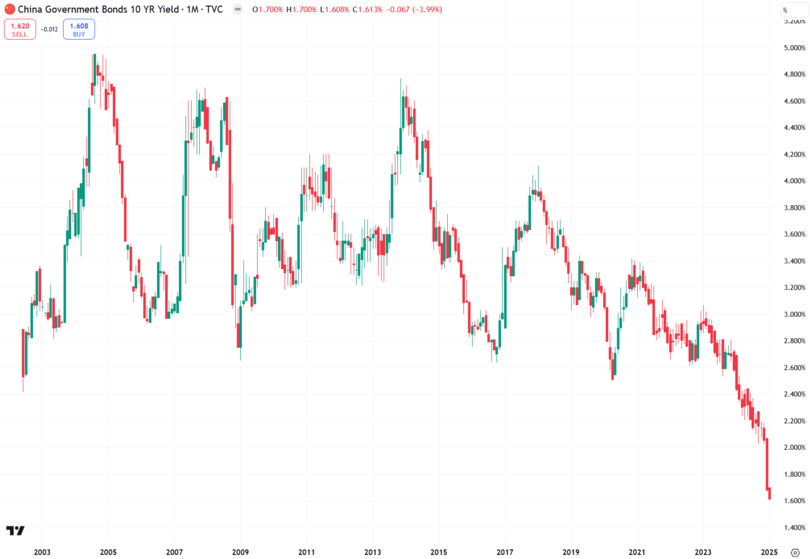
It’s not just the U.S. at risk of a recession—China faces similar challenges. Much like the U.S. during the 2008 financial crisis, China is grappling with a severe real estate and stock market bust, which has triggered a sharp economic downturn.

Government bond yields in China have plunged to all-time lows, signaling a deepening deflationary crisis. It’s inevitable that China will soon respond with a massive stimulus ‘bazooka’ to combat this deflation, a move that should be highly bullish for gold, silver, and other commodities.

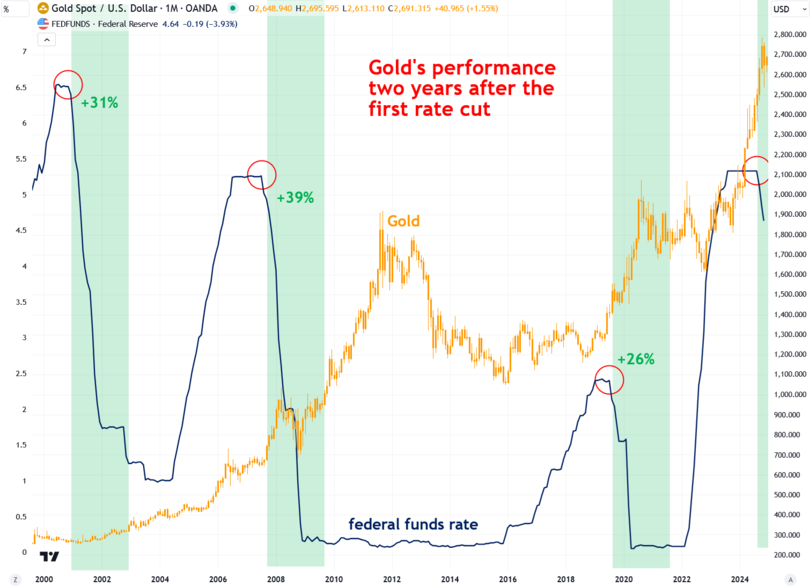
There are other reasons to believe that gold’s bull market still has plenty of gas left in the tank. For example, there is a strong tendency for gold to continue to rise strongly after the first Fed funds rate cut in a rate-cutting cycle.

As the In Gold We Trust report aptly stated, “rate cuts are like rocket fuel for gold.” The report showed that over the past three rate-cutting cycles, gold has risen an average of 32% within two years of the initial rate cut.

If gold follows a similar trajectory this time—following the Fed’s rate cut on September 18—it could rise to $3,380, representing a 27% increase from its current level of $2,658.

For now, I’m waiting for gold to decisively close above the key resistance levels I highlighted to confirm that the bull market is ready to resume.

Several catalysts could trigger this breakout, including a major Chinese stimulus announcement and worsening U.S. economic data as the recession unfolds. While the past couple of months have been frustrating for gold bulls—myself included—I firmly believe that our patience will be richly rewarded once gold climbs to $3,000 and much higher.

Garbage Into Gold: British Royal Mint Using Electronic Waste to Produce Gold and Silver Jewelry

(Mike Maharrey, Money Metals News Service) How awesome would it be to dig around in your garbage can and find gold?

Well, that’s pretty much what the British Royal Mint is doing.

No, you won’t find mint employees dumpster diving, but they have developed a process to turn electronic waste into gold and silver jewelry.

The Royal Mint is looking for new revenue streams as the use of coins declines. According to the New York Times, cash use plummeted during the pandemic, and demand for new coins evaporated. Coin production at the mint dropped by about 90 percent last year.

To fill that revenue hole, the mint has turned to garbage. As the NYT put it, the mint “is betting millions of pounds that the key to its survival is the precious metal recovery plant, which started operating in earnest last summer.”

According to the Times, as of 2022, the world had produced 62 billion kilograms of e-waste. Less than a quarter of it had been recorded as collected and recycled.

One Man’s Trash Is Another Man’s Treasure

Did you know your cell phone and laptop have gold in them?

I wouldn’t recommend ripping your phone apart to get the gold. The average cell phone contains about 0.034 grams. That’s worth around $2 at the current gold price. To put that into some perspective, it would take about 41 phones to recover a gram of gold.

A standard laptop contains $30 to $40 worth of gold.

So, no, you’ll not get rich pilfering gold from your electronic devices. But if you had access to a large number of old laptops, well, you’d be in business.

And the Royal Mint is in business.

Mint officials say they expect to process around 4,500 tons of electronic waste annually, including circuit boards from TVs, computers, medical equipment, and cell phones.

Turning Trash Into Gold Jewelry

The Royal Mint has converted a foundry at its complex in Wales into an e-waste collection and processing site.

Smaller circuit boards that have visibly high gold content go straight to the mint’s chemical plant to remove the gold. The rest of the waste goes into a “depopulation machine.” This slowly rotating cylinder heats the circuit boards to 446 degrees. This process melts the solder, freeing individual components from the circuit boards.

Very little waste goes to waste in this process. Metals, including iron, nickel, and copper, are sold to scrap metal markets. Plastics and other materials are shredded and turned into building materials.

The gold is easily removed from the circuit boards using a patented solution that oxidizes the metal and makes it soluble. Another chemical process reverts the gold into a solid powdered form. The powder is then melted at above 2,012 degrees and then cooled to form gold nuggets that are sent to another site where they are refined to 99.9 percent purity.

Once it is purified, the gold is returned to the mint, where it goes through a sequence of heating and cooling cycles (annealing) to make the metal more malleable. It is then hand-formed into jewelry at the mint.

Silver jewelry is produced through a similar process.

The Royal Mint named its line of jewelry “886,” the year the mint first began producing coins. Products include necklaces, bracelets, earrings, and rings.

Dilly, Dilly: Consumers Learned to Relish the Pickle in 2024

(Headline USA) When did we know for sure?

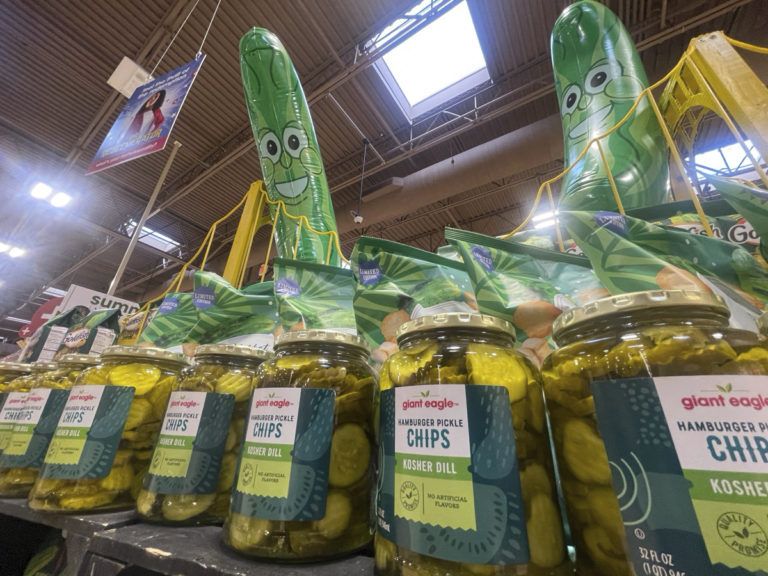
Was it April, when Nature Made introduced its pickle-flavored gummy vitamins? Was it November, when Petco’s “Pickle Mania” promotion offered 26 different pickle-themed toys for dogs and cats?

Maybe it was the December day that a food scholar was heard to utter, “Everyone can kind of see their needs met by pickles.”

Or perhaps it was just a couple weeks ago, when Instagram chef itsmejuliette (no stranger to online pickle activities) posted a cheeky challenge on her “cooking with no rules” feed: “this is your sign to surprise your neighbor with a pickle wreath.”

More than 70,000 people liked her style, or at least her post.


View this post on Instagram


A post shared by @itsmejuliette

At the intersection of health and edginess, traditionalism and hipsterism, global culture and the American stomach, the pickle in 2024 found itself caught in a mealstrom of words like “viral” and “trending” just as its food-as-fetish-object cousins—bacon and ranch dressing, notably—experienced in years past.

Prepared Foods, an industry newsletter, said it outright in September: “The pickle obsession is at an all-time high.”

Tangy Pickle Doritos. Grill Mates Dill Pickle Seasoning for your steak. Portable pouches of pickles. Pickle mayonnaise, pickle hummus, pickle cookies, pickle gummies. Spicy pickle challenges.

Pickleback shots at the bar. Pickle juice and Dr. Pepper, heaven help us. Corn puffs colored and flavored like pickles and called, naturally, Pickle Balls.

In Pittsburgh, the cradle of the modern American pickle (talkin’ to you, H.J. Heinz), a summer festival called Picklesburgh that draws aficionados of the sour and the puckery from several states away for copious amounts of pickle beer washed down by brine, or vice versa.

As 2025 begins, two possible conclusions present themselves. First: The previously nobrow pickle has embedded its sour self at the nucleus of the American gastro-zeitgeist for the foreseeable future. Second: This maybe has played itself out, and the pickle has (to mix a metaphor) jumped the shark.

But let’s not get ahead of ourselves.

“I think pickling in general has had a resurgence,” said Emily Ruby, who would know.

She is a curator and expert on the history of the Heinz company for the Heinz History Center in Pittsburgh, a couple miles downriver from this industrial borough where Henry J. Heinz churned out his first packaged pickles in the 19th century.

Indeed, pickles are now a $3.1 billion annual market in the United States and growing consistently.

Let’s dispense with the obvious hanging question. In short: Sour nation, sour mood, sour foods? Maybe just a little.

“It’s been a scary few years for a lot of people. In 2024 we needed something we could agree on. Maybe it’s pickles,” said Alex Plakias, an associate professor at Hamilton College in New York who teaches the philosophy of food.

“I was surprised at how the pickle could be all things to all people,” said Plakias, whose most recent book is about awkwardness. “All these different food identities in 2024, and no matter who you think of, pickles can be for them.”

To see how that might have happened, we can look to the potent pathways of marketing and social media.

The garden-variety American cucumber pickle is crunchy and sour, with an aggressive taste of its own but a clear elasticity that accommodates other “flavor profiles” (Ghost pepper pickles! Garlic pickles! Horseradish pickles! Bread and butter chips!).

They’re also absurdly low fat—the rare food trend that’s not outright bad for you—and some offer the probiotic benefits of fermentation. Key marketing points all.

From a positioning perspective, somehow the pickle exists at the crossroads of homey-slash-traditional (Mom, Lower East Side, preserves, harvests) and edgy-slash-slightly subversive (sour, intense flavors, startup pickle factories in reclaimed industrial neighborhoods).

“It’s not like I come from a long line of picklers. But I realized that a cucumber is a blank slate and you get to paint it with all kinds of different brines and spices and salts and sugars,” said John Patterson, who founded Pittsburgh Pickle with his brothers out of a church kitchen a decade ago.

“A pickle is something you can rely on and count on,” he said. “A pickle is always funny, for some reason. A pickle is never nefarious or mean. It’s a peaceful, wholesome business to be in.”

(Of the cucumber itself, he has this to say: “It’s almost like God intended them to be pickled.”)

The pickle is also, let’s be candid, usually green and bumpy and intrinsically unattractive. That means even social-video newbies don’t need precision lighting to crank out reasonably compelling pickle content.

Credit—or blame—TikTok for some of the frenzy. Watching the meticulous chronicling of pickle-cake baking, pickle-wreath making and pickle-pizza crafting, you get the sense the social platform was made as much for dills as for dancing.

Pickle videos there regularly top 2 million viewers, and as of this week TikTok reported more than 251 million pieces of pickle content for the snacking.

Then there is the Great Glickle Surge of 2024—another social media oddity that involves someone pouring “edible glitter” (who knew?) into a jar of pickles and making “glickles”—ostensibly a sexier, blingier, even Instagrammier version of pickles (again, who knew?).

Finally, COVID likely played a pivotal role.

After years of rising locavore ethos, the pandemic’s forced inward focus in 2020 and 2021 led many Americans to revisit DIY approaches to food, including baking sourdough bread and, yes, pickling things.

It’s what Nora Rubel, who researches food and culture, calls “an embrace of ‘grandmothercore’ culture” by, well, grandchildren. “Gen Z is taking pickles as their thing. This is the new avocado toast,” said Rubel, a professor of Jewish studies at the University of Rochester.

“Pickles are also kind of funny. They’re just sort of goofy. You can make a lot of puns about pickles. It’s intense flavor, but there’s also a kind of silliness about them,” Rubel said. (She also was heard to say: “The sweet pickle is something that’s very deceptive and upsetting to me.”)

If you’re seeing a thread emerging, it’s this—not entirely new, but worth repeating: Packaged food is no longer positioned as merely something to eat. Instead, like the most immersive restaurants, these days it often presents itself as a multimedia experience—something to be talked about and reveled in, to join likeminded communities over, to incorporate into your own personality. Lifestyle pickles, as it were.

“It symbolizes how we engage with food in daily life and with each other in 2024,” said MinJi (MJ) Kim, an assistant professor of communication at Flagler College in Florida who studies how media affects people’s food choices.

“Sour has duality. When milk or meat or vegetables develop a sour smell, it signals spoilage. It’s a natural warning system. We equate sourness with risk,” Kim said. “On the other hand, when sourness is intentional—lemons, cider vinegar, greek yogurt—it becomes a marker of health and appeal. It shifts the perception of sourness from risk to something acceptable.”

There you have it: sourness as acceptable, delicious, even worthy of obsession.

So as the popularity of pickleball—no direct relation—continues to spike, as fried pickles transcend their novelty status and become bar-food stalwarts across the land, and as someone’s pet plays with one of 26 pickle holiday toys, we’ll leave you with two dueling thoughts as America crunches its way into a new year.

From Rubel, this: “You can get pickle everything now. This is really my time.”

And from Delish, the food website, this: “Can we give pickles a break in 2025? They’re tired. And we’re tired for them.”

Adapted from reporting by the Associated Press

How Has Russia Used Gold to Support Its Wartime Economy?

(Mike Maharrey, Money Metals News Service) Russia’s use of gold during its war with Ukraine reveals one of the reasons why so many countries are stockpiling the yellow metal.

Central banks around the world have bought thousands of tons of gold over the last several years. The pace of buying picked up after the U.S. and its allies froze Russian dollar assets and locked the country out of the SWIFT payment system.

This weaponization of the dollar was a wake-up call for many countries, especially those with strained relations with the U.S. and the West. Worried that the United States and its allies could use the dollar against them, many countries have attempted to diversify their reserves to minimize that possibility. An Indian economist summed up the thinking of many, telling the Times of India that the “reliability” of the U.S. dollar has “diminished” and noting the “noticeable decline” in confidence in U.S. dollar assets.

Gold provides the perfect alternative. It is recognized as money around the world, is accepted virtually everywhere, and comes with no counterparty risk.

Russia’s Gold Reserves

Gold has served as a lifeline for the Russian economy in the wake of aggressive sanctions after it invaded Ukraine.

The Rand Corporation, a global policy think tank, recently completed a study of Russia’s wartime gold use commissioned by the Sanctions Directorate in the UK’s Foreign, Commonwealth and Development Office.

The study found, “Gold has become a strategic resource for the Russian state.”

The Bank of Russia was one of the biggest central bank gold buyers in the years before it invaded Ukraine. At the same time, the central bank divested itself of most of its U.S. Treasury holdings.

The Rand study called Russia “the world’s most important sovereign buyer of gold” over the last decade. Over that time, the country accumulated more than 2,000 tones of gold. Its official reserves rank fifth in the world, and the study notes that, like China, the country holds “an undisclosed – and possibly sizeable – amount of gold and precious stones.”

Russia also produces a significant amount of gold. In 2023, Russia was tied with Australia as the world’s number two gold producer.

Prior to the invasion of Ukraine, the Russians transferred all its National Welfare Fund holdings into yuan (60 percent) and gold (40 percent). The Rand study notes, “This was an indication that Russia was preparing for increased Western economic pressure. During the war, Russia has been using these funds to support the budget.”

How Is Russia Using Its Gold? 

Russia has put its significant gold holdings to use during the war. According to the Rand study, “Gold has a bearing on Russia’s revenue generation capacity and its monetary policy; it is central to Russia’s international campaign for de-dollarization; and it plays an important part in Russia’s wartime trade relations, notably as a means of payment.”

“The Russian state is evidently encouraging barter and exchange-in-kind, and otherwise resorting to gold to secure hard currency and foreign goods, but the scale, terms and participants in these activities is unknown.”

According to the Kyiv Independent, Russia is exchanging gold for other currencies, including dollars and euros. The country has also used gold directly for purchases.

“There is little doubt that Russia is already using gold to pay for goods it cannot procure conventionally, or for transactions it wishes to obscure. An open-source investigation by Sayari, for example, revealed that unsanctioned banks were trading gold for cash in Turkey. Russia has also partly paid Iranian drone manufacturer Sahara Thunder in gold for 6,000 Shahed drones and related equipment.”

Last month, the United States and Great Britain announced a new round of sanctions targeting the illicit gold trade. The UK government froze the assets of four people it said were involved in gold smuggling and a fifth individual who allegedly bought $300 million in Russian gold.

“Russia uses the illicit gold trade to launder money and evade sanctions, in doing so bolstering Putin’s war efforts,” the British Foreign Office said in a statement.

Despite their best efforts, the West will find it difficult to stop Russia from using its gold due to its fungible nature (easy to exchange) and the global demand for the precious metal.

This is not to justify Russia’s wartime actions. It merely underscores the nature of gold as money and its important role in the global economy. When fiat currencies are cut off or fail, gold will always remain a viable alternative.

This is precisely why so many countries are accumulating gold at a rapid pace.

‘It’s His Entire Family!’: CNN Panel Erupts as Defense Attorney Slams Dem Lawfare Against Trump

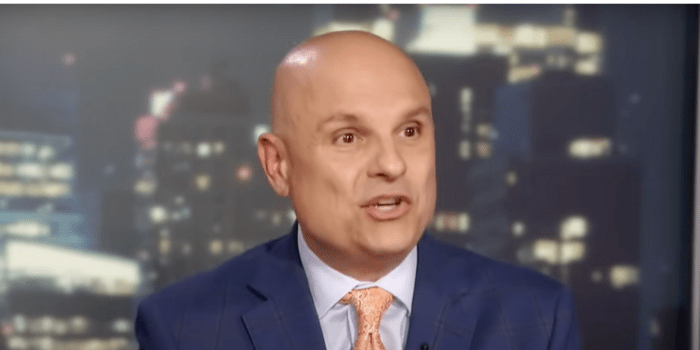
(Julianna Frieman, Headline USA) CNN panelists on Thursday’s episode of NewsNight erupted as criminal defense attorney Arthur Aidala slammed Democrats for their legal warfare against President-elect Donald Trump during his first term and the 2024 election.

After former GOP Rep. Joe Walsh flipped out about Trump’s weeks-old comments suggesting his administration would be open to looking into jail time for corrupt January 6 Select Committee members, Aidala did not hesitate to set the record straight.

“Congressman, his, the Democratic administration just went after Trump and his whole family. His whole family!” the defense attorney exclaimed.

CNN host Abby Phillip stopped Aidala in his tracks by asking him to clarify what he meant about the “Democrat” administration.

“Last time I looked, Joe Biden is a Democrat. Last time I looked, the attorney general, Merrick Garland, is a Democrat. They hired a special prosecutor who went after him in several jurisdictions. The Democratic Manhattan DA went after him. The Democratic attorney general in the state of New York went after him—” Aidala responded, going down the list of government officials who targeted Trump before Phillip interjected.

The CNN host retorted, “None of these things… none of these things mean what you said at the beginning.”

Aidala remained undeterred as other panelists challenged his position that Democrats weaponized the law against Trump and his family.

“They did! The Democrats went after Donald Trump and they—” he spat out as those around the table battled to overpower his claim.

Aidala made the point that the incoming president can empower anyone he wants to key roles because “it’s his administration.”

“It’s his administration and it’s his entire family!” the defense attorney said of the legal warfare that ravaged the Republican’s first term and subsequent election bids. “Ivanka had to testify. Donald Jr. has to testify. Eric had to testify.”

Phillip honed in on Trump’s federal classified documents case and suggested the resident-elect could have resolved the matter by welcoming federal officials into Mar-a-Lago, which was eventually raided by the FBI on Aug. 8, 2022.

“That case wound up being dismissed on technical legal grounds,” Aidala shot back, to which the CNN host replied with “okay, no.”

The defense attorney asked Phillip what she means by “no” and passionately reiterated that the case was dismissed.

Julianna Frieman is a freelance writer published by the Daily Caller, Headline USA, The Federalist, and the American Spectator. Follow her on Twitter at @JuliannaFrieman.

‘He’s Good. For Real’: Trump, Vance Take a Day to Play Golf w/GOP Senator

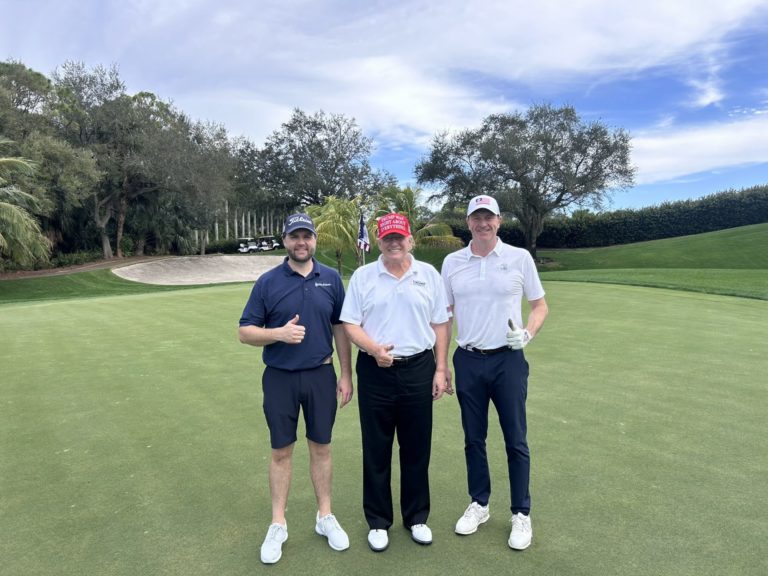
(Julianna Frieman, Headline USA) President-elect Donald Trump and Vice President-elect J.D. Vance took a day to play golf with Sen. Eric Schmitt, R-Mo., photos and videos posted on social media showed Thursday.

Schmitt shared video of himself and the incoming president at the golf course late Thursday, with one clip showing the senator take a swing at the ball.

Trump, dressed in his white shirt and a red MAGA hat, watched Schmitt hit the ball from a golf cart as Vance stood beside it.

“Fun day with @realDonaldTrump and @JDVance. Played well. You gotta love it,” Schmitt wrote on X with an American flag emoji.

In another post, Schmitt shared a photo of himself standing beside Trump and Vance. All three men smiled as they posed before a background of the golf course’s green grass and blue sky.

“2025 here we go @realDonaldTrump @JDVance,” the senator wrote with two American flag emojis.

Schmitt touted Trump’s golf skills in a second video, which showed the president-elect take an impressive swing at the golf ball.

The Republican lawmaker told his followers that praise of Trump’s golf skills was much warranted.

“I tell people all the time @realDonaldTrump can play. He’s good. For real,” Schmitt wrote on the social media platform.

This is not the first time Schmitt played golf with Trump. In July, the Kentucky senator reposted footage from the PGA Tour’s official X account and confirmed that Trump’s golf playlist was fire, which he conveyed through use of a flame emoji.

Following the president-elect’s election victory, Schmitt took to Facebook and congratulated Trump on his win with a photo of the two smiling on the golf course.

“Congrats to Donald J. Trump,” Schmitt wrote on Nov. 6. “He is tireless. He fights for us. He’ll Make America Great Again.”

Julianna Frieman is a freelance writer published by the Daily Caller, Headline USA, The Federalist, and the American Spectator. Follow her on Twitter at @JuliannaFrieman.

GOP Congressman Would Rather Chop His Fingers Off Than Vote for Trump’s House Speaker Pick

(Julianna Frieman, Headline USA) Rep. Thomas Massie, R- Ky., said Thursday that he would rather chop all of his fingers off than vote for another term of House Speaker Mike Johnson, R-La..

Johnson can only afford to lose one GOP vote, according to CNN, to remain in power over the 119th Congress, which begins on Friday.

President-elect Donald Trump endorsed Johnson on Monday and has reportedly been personally involved in lobbying Johnson critics, including Reps. Chip Roy, R-Texas, and Victoria Spartz, R-Ind., in an effort to assure a smooth transition of power and prevent Democrats from trying to derail the upcoming certification of the Electoral College votes.

But that did not stop Massie, a staunchly libertarian budget hawk and Ukraine war opponent, from taking a hardline stance against the Republican leader from Louisiana.

On the debut episode of former congressman Matt Gaetz’s primetime One America News Network show, Massie told his former colleague that he would not vote for Johnson under any circumstance.

“If Chip Roy were asked to serve as chairman of the Rules Committee, would that be enough to get your vote for Mike Johnson?” Gaetz asked.

Massie responded with a colorful rejection of the idea, suggesting that even torture could not coerce him.

“Oh, no. You could pull all my fingernails out, you can shove bamboo up in them,” he said. “You can start cutting off my fingers. I am not voting for Mike Johnson tomorrow, and you can take that to the bank.”

Massie made clear his staunch opposition to Johnson’s reelection all week leading up to Friday’s vote.

The Kentucky congressman hit back at former House Speaker Newt Gingrich, who called him a “contrarian” for going against Trump’s pick.

“Even if Mike’s entire goal is to do everything Trump wants without debate or question (which I would argue is not healthy for the institution of Congress), he’s not going to be good at it,” Massie posted to X on Tuesday afternoon as part of a multi-paragraph explanation of his anti-Johnson stance.

“He already demonstrated this month that he won’t tell the President what is achievable and what is not achievable in the House, and he lacks the situational awareness himself to know what can pass and what cannot,” Massie added, in reference to Johnson’s near- capitulation to Democrats on a continuing resolution to fund the government.

An effort by Trump to push for a two-year expansion of the debt ceiling, which would allow him to act on his ambitious agenda without seeking congressional approval, failed in the House, with several Republicans joining Democrats to defeat it.

After Trump endorsed Johnson, Massie said the president-elect’s “endorsement of Mike Johnson is going to work out as well as his endorsement of Paul Ryan.”

Ryan, the RINO ex-lawmaker who led the House at the start of Trump’s first presidential term, ultimately became a staunch NeverTrumper before retiring and ceding the House to Rep. Nancy Pelosi, D-Calif., during the 2018 midterm election.

“We’ve seen Johnson’s partner with the democrats to send money to Ukraine, authorize spying on Americans, and blow the budget,” Massie wrote on Monday.

Julianna Frieman is a freelance writer published by the Daily Caller, Headline USA, The Federalist, and The American Spectator. Follow her on Twitter at @JuliannaFrieman.

Video Exposes Pelosi’s Strange Behavior and Deteriorating Health at 84

(Luis Cornelio, Headline USA) A viral video of former House Speaker Nancy Pelosi, D-Calif., seemingly struggling to speak and stay awake has reignited demands for term limits—just as she filed paperwork to run for re-election in 2026. 

“Hi, it’s Nancy. I’m on my way to Washington to proudly represent the people of San Francisco in Congress—I’m honored to do so to share our San Francisco values. Thank you for giving me that honor,” Pelosi stated Thursday while sitting on a commercial flight. 

In the awkward clip, Pelosi sported her signature haircut, but her eyelids appeared sunken and red. Her eyes were visibly tired and barely open. At 84, Pelosi is one of the oldest members of Congress. 

Notably, Pelosi posted the video just weeks after she suffered a significant fall on an official foreign trip, which resulted in a fractured hip and necessitated hip replacement surgery. 

This fall occurred just days after Senate Minority Leader Mitch McConnell, R-Ky., tripped and fell at the U.S. Capitol. The 82-year-old Republican lawmaker injured his wrist and cut his face due to the fall. Both incidents fired up online discussions about term limits for aging politicians. 

In response to Pelosi’s video, critics expressed their concerns about her fitness to serve. She is currently on her 20th congressional term after being first elected in 1987. 

“There’s something clinical about being as old and frail as this woman and still refusing to retire,” remarked RedState writer Bonchie on X. “She just had to have emergency surgery in Germany because she can’t be trusted to walk safely.” 

Podcast host Graham Allen echoed Bonchie’s thoughts, stating, “This is why we need term limits…” 

Libs of TikTok shared the video with the caption: “I saw it so now you have to.” 

X user Dave Toussaint raised questions about whether Pelosi should be resting after her hip replacement surgery: “Something is off here. I thought she just broke her hip a few weeks ago?”  

Sanders Exposes Inconvenient Truth: H-1B Visas Keep Wages Down

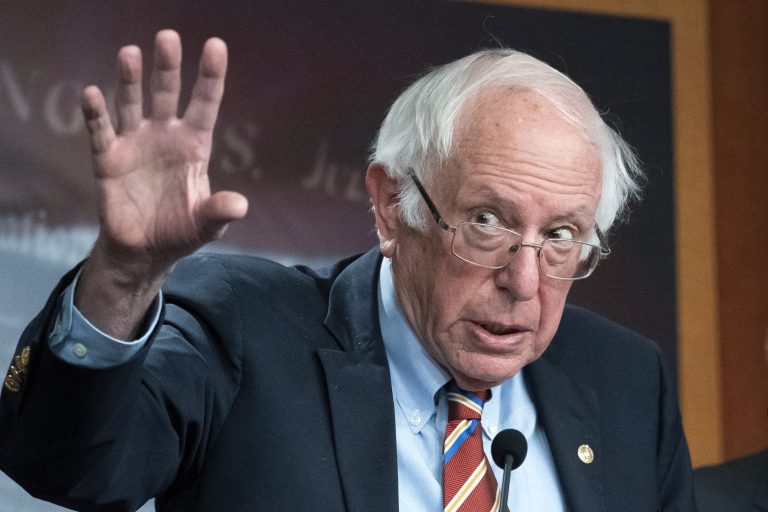
(Luis Cornelio, Headline USA) Sen. Bernie Sanders, I-Vt., has publicly opposed H-1B visas, directly challenging Elon Musk and accusing corporations of exploiting the immigration system to replace American jobs with “low-wage indentured servants from abroad.” 

Sanders made his position known Thursday in a press statement shared on X, the same platform where Musk pledged to “go to war” in support of H-1B visas under the incoming Trump administration.

Musk argued that companies, including Tesla, use these visas to hire qualified candidates amid workforce shortages. Sanders disagrees. 

“The main function of the H-1B visa program and other guest worker initiatives is not to hire ‘the best and the brightest,’ but rather to replace good-paying American jobs with low-wage indentured servants from abroad,” Sanders wrote. “The cheaper the labor they hire, the more money the billionaires make.” 

According to Sanders, the top 30 companies using H-1B visas have laid off around 85,000 American workers while simultaneously hiring over 34,000 foreign individuals through the program. He argued this undermines claims that the visas are critical to address labor shortages.  

Sanders also correctly noted there are millions of Americans with advanced degrees in science and tech who are currently not employed in their fields.  

“If there is really a shortage of skilled tech workers in America, why did Tesla lay-off over 7,500 American workers this year – including many software developers and engineers at its factory in Austin, Texas – while being approved to employ thousands of H-1B guest workers?” Sanders asked. 

His remarks came amid an online debate about the future of H-1B visas and whether President-elect Donald Trump would suspend the program after his inauguration on Jan. 20, 2025. 

Musk posted several affirmations on X supporting H-1B visas, stating that he entered the U.S. using a visa and attributing much of his companies’ success to the program. Tesla ranks 16th among companies employing the most H-1B visa workers. 

Trump also expressed support for H-1B visas, noting that he has several employees in his properties under this program. The president-elect’s comments conflicted with some MAGA supporters who recalled videos from the 2016 election cycle where Trump seemed to disavow the program.

“I didn’t change my mind,” Trump said in response to the online criticism on New Year’s Eve. “I’ve always felt we have to have the most competent people in our country, and we need competent people. We need smart people coming into our country. We need a lot of people coming in. We’re going to have jobs like we’ve never had before.”