“You can look at one poll and say ‘oh gee, he’s popular in some places in the country,’” Pritzger said in response to a recent YouGov poll that showed Trump’s approval rating at 53%.
“Frankly I look at what’s happening to working class families as a result of his policies and I’m speaking out against that,” Pritzker added.
But it may not be the “own” that Pritzker thinks it is. Things in Illinois have gotten so bad that all but the most hardcore leftist residents are being compelled to flee the state.
Migration data from a moving company showed Illinois was near the top of the list for states with the most outbound moves.
The 2024 North American Van Lines Annual Migration Report shows Illinois was second in the country for outbound moves behind only California. In Illinois, 60% of moves were outbound while 40% were inbound. It is the first time in 10 years Illinois didn’t lead the country in outbound moves.
The company said it examined several metrics, including researching population reports and getting input from top companies in the moving industry to gain insider knowledge.
Marketing director Ryan Cox said ever since Pritzker locked down Illinois with COVID-19 restrictions in 2020, Illinoisans have been flocking to one specific area of the country.
“The top inbound states are North and South Carolina, Idaho, Tennessee and Georgia, and a lot of people from Illinois are actually moving to the Carolinas,” said Cox.
Cox said high taxes and cost of living prompts people to move, especially when it comes to housing.
“I think quality of life is one of the top concerns for people moving,” said Cox. “With household prices skyrocketing in Illinois, they are finding more reasonable, affordable housing.”
Property taxes are also a main driver to prompt people to pack up and leave. Illinois has the second highest property taxes in the country. According to Rocket Mortgage, at 2.08% of the home’s value each year, the owner of a median priced home in Illinois of $432,500 will pay just over $9,000 a year.
In comparison, a homeowner in South Carolina pays 0.57% for a median priced home of $383,900. That comes out to $2,175 per year.
According to the report, the top inbound cities were Greenville, South Carolina; Charlotte, North Carolina; and Nashville, Tennessee.
The most popular day to move in 2024 was Friday, and the most popular month was August.
(Morgan Sweeney, The Center Square) Data from a new Gallup survey suggested that close to half of Democrats want their party to move more toward the middle, while more than 40% of Republicans are happy with their party.
Today, 45% of Democrats and left-leaning independents surveyed indicated they would prefer a more moderate Democratic Party, up 11% from 2021, according to Gallup.
Meanwhile, the number of Republicans who want their party to stay the same—43%—has similarly climbed over the same time by 9%. Those wanting a more conservative party declined by 12%.
“Both party groups’ preferences have shifted significantly since 2021, at the start of Joe Biden’s presidency, the last time Gallup measured opinions on this question,” wrote Gallup Senior Editor Megan Brennan.
This just days after, Gallup released another survey showing of the five living American presidents, former President Barack Obama was the most liked, and former President Joe Biden was the least.
Forty-eight percent of Americans surveyed had a favorable opinion of President Donald Trump and former President Bill Clinton, though more people were unfavorable toward Trump (12% answered as having “no opinion” on Clinton).
The data from the latest Gallup survey coincides with data from another poll the analytics firm released in January showing “that partisans have grown more ideologically polarized in the past few years.”
That poll reflected all-time highs in the number of Republicans and Democrats identifying as conservative and liberal.
Seventy-seven percent of Republicans identified as conservative in the January poll, with 24% saying they were very conservative, while 55% of Democrats identified as liberal and 19% as very liberal.
Each of these were record highs, with the percentage of those describing themselves as conservative growing by four points from 2023.
Many U.S. adults said the federal government had been overspending—but polling also showed that many Americans, including Republicans, agreed the country was spending too little on protecting Social Security.
As Trump and and top economic adviser Elon Musk, the chair of the Department of Government Efficiency, push for extensive cuts throughout the federal government, slashing funding for foreign aid and turning their attention to the Department of Education and the military, about two-thirds of respondents said the retirement plan that many working Americans have spent their careers paying into remains off limits, according to a January AP-NORC poll.
Another 6 in 10, roughly, say “too little” money was going for assistance to the poor. A similar share said spending was too low for Medicare, the national health care insurance program for seniors, and most also said Medicaid was under-funded by the federal government. About half said border security was not receiving enough funding.
The perpetual challenge for lawmakers, however, is that although U.S. adults mostly think the government isn’t spending enough on key issues and programs, they are broadly in favor of cuts to the federal budget.
Foreign aid is one area where there is broad consensus that the U.S. is overspending. The 2023 AP–NORC polling suggests that Americans tend to believe too much money is going to other countries.
Roughly 7 in 10 U.S. adults said the government was putting too much money toward “assistance to other countries.”
About 9 in 10 Republicans and just over half of Democrats agreed that the country was overspending on foreign aid at the time.
Richard Tunnell, a 33-year-old veteran living in Huntsville, Texas, said the United States gets involved in other countries’ problems too often.
“Americans need to worry about Americans,” said Tunnell, an independent who voted for Trump in November.
“There’s atrocities happening on American soil just as much as there is on foreign soil,” he added. “You know, if we can’t clean up our own house, why the hell are we trying to clean up somebody else’s house?”
At the same time, polling has shown that U.S. adults tend to overestimate the share of the federal budget that is spent on foreign aid. Surveys from KFF have found that, on average, Americans say spending on foreign aid makes up 31% of the federal budget rather than the actual answer: closer to 1% or less.
On both sides of the political aisle, very few U.S. adults think the country is spending too much on Social Security and Medicare, according to the January AP-NORC poll. But there are bigger divides on spending for the military, border security, Medicaid and assistance to the poor.
About one-third of U.S. adults say the federal government is spending “too much” on the military. About one-third say the military is getting “too little” funding, and another one-third say it takes in “about the right amount.” But most Republicans say the military is underfunded, while slightly less than half of Democrats say it’s getting too much money.
Jeremy Shouse, a 38-year-old Democrat in Durham, North Carolina, said he believes government assistance programs for ordinary Americans should be as well-funded as the U.S. military is.
“I think it’s really a slap in our faces as Americans,” he said, referring to the underfunding of programs like Medicaid, which he has needed to use.
“When it comes down to school, Medicaid, any type of government assistance programs, the money is just kind of not there,” he said. “Not like it is for the military or the Army.”
Strong majorities of Democrats say the U.S. government spends “too little” on assistance to the poor, education, Social Security, Medicare and Medicaid. They are divided on funding for border security—about 4 in 10 say the funding is about the right amount, while 3 in 10 say it’s too high and about 3 in 10 say it’s too little—and tend to say federal law enforcement agencies such as the CIA and the FBI are getting the right amount of funding.
Republicans tend to want more money for border security, Social Security and the military. About 8 in 10 Republicans say too little money is allocated to border security, and about two-thirds say that about Social Security.
The AP-NORC poll of 1,147 adults was conducted Jan. 9-13, using a sample drawn from NORC’s probability-based AmeriSpeak Panel, which is designed to be representative of the U.S. population. The margin of sampling error for adults overall is plus or minus 3.9 percentage points.
WTHR in Mooresville reported Friday that the local police received a tip earlier this week from the FBI about someone who was potentially planning a school shooting on Valentine’s Day.
“During the department’s investigation, officers identified the person of interest as Trinity Shockley, of Mooresville,” WTHR reported. “Court documents say Trinity is transgender, going by the name Jamie.”
Court records reportedly state that Shockley sent numerous threatening messages to people on the gaming platform Discord. Those messages included, “”I’ve been planning this for a YEAR,” and “Parkland part two”—a reference to the Parkland school shooting, where Nikolas Cruz killed 14 students and three staff members on Feb. 14, 2018.
Shockley also allegedly posted photos of 10 AR-15 magazines, as well as a photo of South Carolina mass shooter Dylan Roof.
Mooresville police detectives executed a search warrant on Shockley’s home on Wednesday, reportedly finding multiple photos of Roof, Cruz and Andrew Blaze—who killed three co-workers at a Pennsylvania supermarket in June 2017—in her bedroom.
Shockley reportedly told police she was “joking” and “would never do that and does not have access to a gun.” A law enforcement affidavit further stated that “Trinity wants to be in the FBI and is planning to attend Ivy Tech for criminology after she graduates in three months.”
She was arrested anyway, and is being held without bond.
She faces one count of conspiracy to commit murder and two counts of intimidation, threat to commit terrorism.
“Detectives also spoke with school officials, as the head of mental health for the district allegedly said Shockley sought mental health resources multiple times since Shockley was a freshman,” WTHR added.
“However, the official said Shockley’s father denied Shockley’s access to the resources, with the official saying Shockley’s father “did not believe in mental health treatment and did not take (Shockley’s) conditions seriously,” according to court documents.”
Shockley’s arrest is the latest case where a mentally disturbed teenager plotted an act of terrorism on Discord.
Perhaps the most infamous Discord-linked shooting occurred in May 2022, when white supremacist Payton Gendron killed 10 people at a Buffalo supermarket. Disturbingly, Gendron may have been chatting on Discord with a “retired federal agent” moments before he killed 10 people at a Buffalo supermarket, according to The Buffalo News.
Gendron’s shooting was followed by other attacks that had early warning signs on Dicord.
In January 2024, 17-year-old mass shooter Dylan Butler—who killed a sixth grader, injured four others and fatally shot himself at a school in Iowa—was reported to have been in an extremist Discord chatroom. NBC reported days after the shooting that Butler was a member of a Discord group called “School Massacres Discussion,” which was dedicated to discussing school shootings. According to NBC, another Discord user had notified the FBI about the chatroom months before the attack.
Another Discord-linked shooting occurred some two months after the Butler shooting on Sept. 4, when 14-year-old Colt Gray opened fire at a Georgia high school and killed four people. After Gray’s shooting, the FBI admitted that Gray had been on its radar—but insisted that there was “no probable cause for arrest or to take any additional law enforcement action” against the teenager before his shooting spree.
About three months later, 15-year-old female student Natalie Rupnow, who went by the name Samantha, opened fire during a study hall at Abundant Life Christian School in Wisconsin—killing another student and a teacher, and wounding six others before killing herself.
Rupnow’s apparent manifesto, which was published on Discord before her shooting, references previous school shooters, including the same ones that apparently infatuated Shockley.
(Jan Nieuwenhuijs, Money Metals News Service) The U.S. Treasury can draw up to $700 billion in new funding from its gold revaluation account at the Federal Reserve. And the Treasury could invest this “new money” in a sovereign wealth fund (increasing the money supply by an equal amount).
Using its gold revaluation account would emphasize gold’s strength versus the dollar, something the United States government has been trying to downplay for decades. This turn of events would be bullish for gold and weaken the dollar.
Introduction
I started writing about central bank gold revaluation accounts (GRAs) in 2022, to show how they can use a trick to write-off assets, such as government bonds, from their balance sheet with new money from their GRAs. The German central bank even wrote me in an email that it doesn’t rule out this possibility for the future.
Then I discovered how central banks have been using their GRAs to absorb losses, like the Central Bank of Curaçao and Saint Martin did in 2021. Coincidentally, as interest rates went up in 2022 and central banks globally experienced shortfalls, officials from the Dutch and German central banks commented that their massive GRAs underline the soundness of their balance sheets. Providing a solvency backstop, if you will.
What Is a Gold Revaluation Account, and How Can It Be Used?
A gold revaluation account (GRA) is an accounting item on the liability side of a central bank balance sheet that records unrealized gains of gold assets.
When the price of gold denominated in fiat currency rises, as it inevitably does in the long run, gold assets increase in value, and concurrently, the GRA swells.
As a formula:
GRA = present gold market value – gold purchasing cost
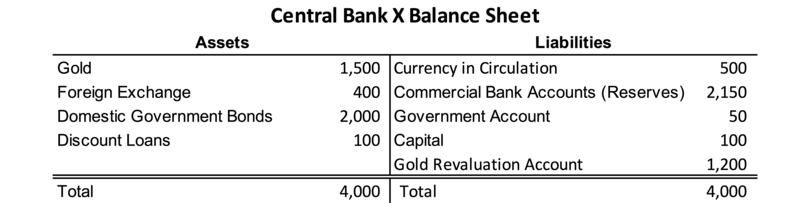
In this example, central bank X once bought gold for $300, and the present value of that gold has gone up to $1,500, creating a GRA of $1,200. Capital and the Gold Revaluation Account is the central bank’s equity.
In many textbooks you will read GRAs are meant to cushion a decline in the price of gold, but because gold is scarce and the denominator (fiat) on central banks’ balance sheets is not—visible in large GRAs of banks that own gold for a long time—there are far more creative possibilities for it.
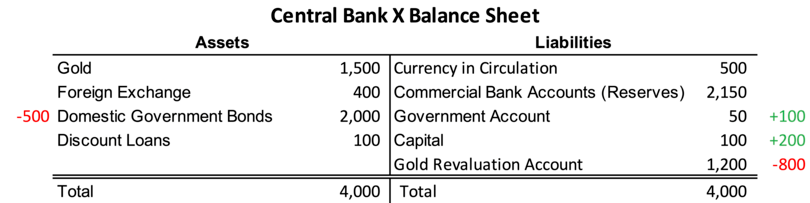
In the example below, I have illustrated that a central bank can transfer entries from its GRA to its own capital position and absorb losses (+200); to the government’s checking account held at the central bank (+100); or to write-off assets (-500).
It’s just numbers.
If central bank X draws $800 from its GRA, there is still (1200 – 800) $400 left to cushion a potential decline in the price of gold.
The American Setup
Take notice that the central bank of the United States owns not one ounce of gold. With the Gold Reserve Act of 1934, the Federal Reserve transferred all its monetary gold to the Treasury in return for a special series of gold certificates valued at $35 an ounce. These gold certificates are purely an accounting item and can’t be redeemed for gold.
Because the U.S. has always been reluctant to raise the statutory price of the gold in its books to downplay the strength of gold versus the dollar, the Fed’s gold certificates today are still valued at 42.22 dollars an ounce, a price approved by Congress during the demise of Bretton Woods in the early 1970s.
On February 3, 2025, President Trump signed an executive order for the creation of a sovereign wealth fund within one year. Standing next to him when he signed the order was Treasury Secretary Scott Bessent, who told reporters, “We’re going to monetize the asset side of the U.S. balance sheet for the American people.”
What asset can that be? He could be referring to selling off federal lands or vacant government office buildings, but the Financial Times speculated on February 7 that it’s a reference to gold:
Some hedge fund contemporaries of Scott Bessent, the hedgie-turned-US Treasury secretary, are speculating about a revaluation of America’s gold stocks.
This week, such chatter intensified after Bessent both pledged to “monetise the asset side of the US balance sheet” — in other words, to focus on assets as much as liabilities — while also promising to lower 10-year Treasury yields.
Perhaps the Trump administration does want to draw on the Treasury’s gold revaluation account at the Fed, as happened in 1972 when the official gold price was raised from $35 to $38, and in 1973 from $38 to $42.22 an ounce.
Doing so would allow the Treasury to spend hundreds of billions of dollars without increasing the national debt.
Once the value of the Fed’s gold certificates on its balance sheet goes up, the Treasury’s checking account at the Fed, commonly referred to as the Treasury General Account (TGA), increases by the same amount.
As the Fed doesn’t own any gold, a windfall from the revaluation of its gold certificates is for the owner of the physical gold, which is the Treasury. Note that when GRAs are used for spending, it creates new money and thus has to be done through central banks. Welcome to the wonderful world of accounting!
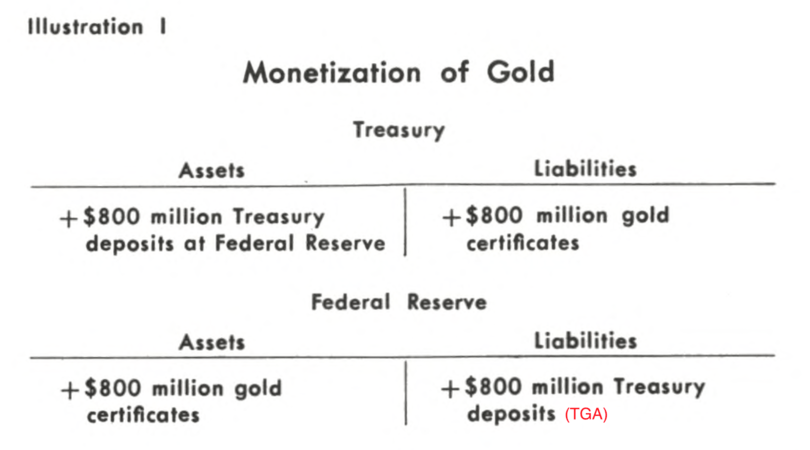
The below illustration is from a paper by Albert E. Burger, published by the Federal Reserve Bank of St. Louis in 1974: “The Monetary Economics of Gold.” When, in 1972, the statutory price of gold was revalued to $38 from $35 an ounce, the TGA increased by roughly $800 million.
On May 15, 1972, the Treasury took steps to monetize the increased value of the gold stock. This occurred as follows: the Treasury issued to the Federal Reserve Banks gold certificates equal to the increased official dollar value of the gold stock and, in return, the Treasury received from the Federal Reserve an increase of an equal amount in its deposits at the Federal Reserve Banks [TGA].
Following the revaluation of the U.S. monetary gold in 1972, the Treasury spent $800 million at the private sector—without selling an ounce of gold—increasing the monetary base (reserves) and broad money supply (deposits) by an equal amount.
How Much Can Trump Spend?
Currently, the Treasury owns 8,133 tonnes of gold valued at $42.22 an ounce, which equals $11 billion, while the prevailing market value of the gold is roughly $750 billion.
Treasury can deplete its gold revaluation account via the Fed in full but then runs the risk that the free market price of gold falls below the new U.S. statutory price, which would undercollateralize America’s balance sheet.
So, either Trump draws less than $750 billion from this trick, or he takes it all and puts a floor under the free market price of gold, which brings us one step closer to a gold standard. Either scenario would be bullish for gold, highlighting its role in the monetary system.
The Federal Reserve could counter the Treasury’s expansion of the monetary base by selling bonds, but this would drive up interest rates, which is not what Trump wants. Trump, firmly in charge since in office, is thought to want a weaker dollar to boost exports.
Expanding the monetary base by drawing on the United States’ GRA would do just that and allow him to invest in a sovereign fund. Two birds with one stone.
Originally a sound engineer in the Dutch movie industry, Jan Nieuwenhuijs has devoted the last decade to in-depth gold market research. His commentary and analysis has earned him international recognition as a top expert on the Chinese gold market, the COMEX futures market, the London Bullion Market, and the Turkish gold market. At Money Metals, he writes about the international monetary system, central bank gold policies, the mechanics of the global gold market, the gold price, and economics in general.
(Mike Maharrey, Money Metals News Service) DOGE has got its work cut out for it. Even as the new Department of Government Efficiency ferrets out wasteful spending, the constant budget deficits serve as a sobering reminder of just how much the federal government overspends month after month.
The January budget deficit came in at $128.64 billion, according to the latest Monthly Treasury Statement. That pushed the budget shortfall through the first four months of fiscal 2025 to a record $839.6 billion.
Uncle Sam took in $513.3 billion in tax receipts and revenue last month. That was a 7.5 percent increase over January 2024. So far, in fiscal 2025, government revenues total $1.6 trillion. That’s roughly unchanged from the same period last year, but according to a Treasury Department official, the 2024 revenue figure was inflated by deferred tax payments from 2023 related to natural disasters.
The real problem is on the spending side of the ledger.
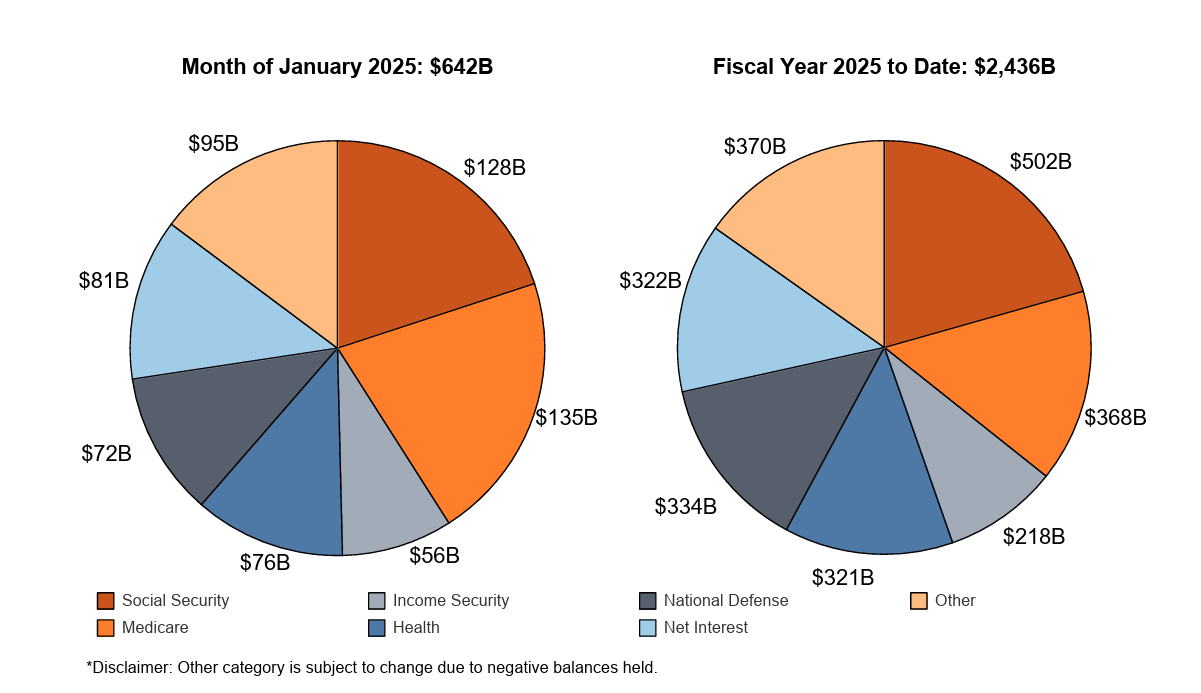
The federal government blew through $641.9 billion in January alone, pushing total spending in fiscal 2025 to $2.44 trillion. That represents a 15 percent increase in spending compared to the first four months of fiscal 2024.
You might recall that President Biden promised that the [pretend] spending cuts would save “hundreds of billions” with the debt ceiling deal (aka the [misnamed] Fiscal Responsibility Act).
That never happened.
The federal government continues to find new reasons to spend money, whether for natural disasters at home or wars overseas. The Biden administration spent a staggering $6.75 trillion in fiscal 2024, a 10 percent increase over 2023 outlays.
The federal government spent $83.8 billion to cover interest on the national debt in January. That brought the total interest expense for the fiscal year to $392.2 billion, up 9.8 percent over the same period in 2024.
So far, in fiscal 2025, the federal government has spent more on interest on the debt than it has on national defense ($334 billion) or Medicare ($368 billion). The only higher spending category was Social Security.
Uncle Sam paid $1.13 trillion in interest expenses in fiscal 2023. It was the first time interest expense has ever eclipsed $1 trillion. Projections are for interest expense to break that record in fiscal 2025.
Much of the debt currently on the books was financed at very low rates before the Federal Reserve started its hiking cycle. Every month, some of that super-low-yielding paper matures and has to be replaced by bonds yielding much higher rates. And even with the recent Federal Reserve rate cuts, Treasury yields have pushed upward as demand for U.S. debt sags.
Some people claim that borrowing, spending, and big national debts don’t matter.
They do.
According to the national debt clock, the current debt level represents 122.99 percent of GDP. Studies have shown a debt-to-GDP ratio of over 90 percent retards economic growth by about 30 percent.
“Confidence in U.S. creditworthiness may be undermined by a rapidly deteriorating fiscal situation, an increasing concern with federal debt set to grow substantially in the coming years.”
This could lead to lower economic growth, higher unemployment, and less investment wealth.
Lack of confidence in the U.S. fiscal situation could also lower demand for U.S. debt. This would force interest rates on U.S. Treasuries even higher to attract investors, exacerbating the interest payment problem. As already mentioned, we saw a big spike in Treasury yields despite Fed rate cuts.
Biden ran the debt higher at a dizzying pace, but to be fair, this isn’t just a Biden problem. Every president since Calvin Coolidge has left the U.S. with a bigger national debt than when he took office.
DOGE has done a great job of pointing out government waste, but it’s going to take more to get the borrowing and spending under control. Even if the Trump administration manages to slash discretionary spending as promised, that only accounts for 27 percent of total spending. The vast majority is for entitlements, and there is little political will to take the scissors to Social Security or Medicare.
And the sad fact is that most people in positions of power are content to kick the debt can down the road. They reason, ‘Nothing has happened yet, so why worry?’ But the problem with playing kick the can down the road is that you eventually run out of road.
Mike Maharrey is a journalist and market analyst for MoneyMetals.com with over a decade of experience in precious metals. He holds a BS in accounting from the University of Kentucky and a BA in journalism from the University of South Florida.
(Mike Maharrey, Money Metals News Service) Fundamentally, gold is money, but it is also an extremely useful metal, especially in tech applications.
Demand for gold in industry and tech was up 7 percent in 2024, driven by growth in the electronics and computing sectors.
Industry and technology used 326 tons of gold last year, propelled by the strongest fourth quarter since 2021.
Gold is an important input in the electronics sector. The metal is an excellent conductor, efficiently dissipates heat, and, unlike copper or silver, doesn’t oxidize or corrode over time. Gold is also extremely malleable and can easily be formed into very thin wires and sheets.
The electronics industry used 270.6 tons of gold in 2024, a 9 percent year-on-year increase.
The growth of artificial intelligence (AI) helped push overall industrial demand for gold higher. AI processors and High-performance Computing Chips (HPCs) use gold-plated receptors and bonding wires to ensure reliable connections. Gold is also used in massive AI data centers in server motherboards, connectors, and fiber-optic transceivers to maintain efficiency, reduce data transmission losses, and prevent corrosion.
After a weak 2023, the consumer electronics sector showed signs of recovery last year.
Market analysts estimate that smartphone shipments grew by 6 percent in 2024, driven by “super aggressive” growth among Chinese vendors focusing on sales of low-end devices within China and to other emerging markets. However, sales for higher-end phones that tend to contain more gold fell last year, and Apple and Samsung both reported declining market share.
On the positive side, increasing penetration of WiFi 7 into the marketplace will likely drive gold demand in the wireless sector higher in the coming quarters. WiFi 7 infrastructure requires considerably more power amplifiers than WiFi 6, and that requires more gold.
The aerospace sector also uses gold. The proliferation of satellites for communications and internet service may represent a potential long-term source of demand for gold from both printed circuit boards and wireless components.
According to the World Gold Council, further growth in demand for low-Earth-orbit satellites (LEOS), along with the corresponding upgrades needed in many ground stations, will continue to support tech demand for gold.
Global demand for gold in other industrial and decorative applications fell by 4 percent in Q4. This was chiefly driven by losses in Italy and East Asia due to slow sales of branded accessories and de-stocking by retailers.
Offsetting this decline, demand in India grew by 5 percent as high gold prices impacted the affordability of fine gold items and prompted greater demand for gold-plated articles and jewelry.
The use of gold in the dental sector continued to decline, with a 6 percent year-over-year drop in Q4.
Gold Is Far From “Useless”
Warren Buffett once said, “Gold gets dug out of the ground in Africa or someplace. Then we melt it down, dig another hole, bury it again, and pay people to stand around guarding it. It has no utility. Anyone watching from Mars would be scratching their head.”
You’ll sometimes hear this notion that gold is “useless” from commentators on mainstream financial networks.
As you can see by the growing demand for gold in technology and electronics, this is just silly.
In fact, gold is one of the most useful metals in the world. Due to its utility, coupled with its scarcity, gold is also one of the most valuable metals in the world.
In the first place, gold is beautiful. That’s why people all over the world love to wear gold. About three-quarters of gold demand is for jewelry production. About 1,877 tons of gold were used in jewelry fabrication last year.
But gold isn’t just pretty. As already mentioned, the metal’s inherent physical and chemical properties make it useful in many industrial and technological applications.
This is why we see gold increasingly used in the tech sector. In fact, gold would probably be used even more if it weren’t so rare and expensive.
Gold is also important in the medical field. Its inherent stability and unique optical properties make it perfect for use in diagnostic testing. The World Gold Council said that gold is “at the heart of the hundreds of millions of Rapid Diagnostic Tests (RDTs) that are used globally every year.
“This well-established and critically important technology has changed the face of disease diagnosis in the developing world over the last decade.”
Gold nanoparticles are used in testing for malaria, HIV, hepatitis, and other illnesses.
Gold has even been used in some exotic applications. In 2018, a team of Chinese researchers partially restored the sight of blind mice by replacing their deteriorated photoreceptors – sensory structures inside the eye that respond to light – with nano-wires made of gold and titanium.
The point is that gold is far from useless.
But fundamentally, gold is money. And everybody wants to have money – especially real money.
Mike Maharrey is a journalist and market analyst for MoneyMetals.com with over a decade of experience in precious metals. He holds a BS in accounting from the University of Kentucky and a BA in journalism from the University of South Florida.
(Headline USA) A federal judge on Wednesday removed a key legal hurdle on Wednesday that was stalling President Donald Trump’s plan to downsize the federal workforce with a deferred resignation program.
U.S. District Judge George O’Toole Jr.’s order in the challenge filed by a group of labor unions was a significant legal victory for the Republican president after a string of courtroom setbacks.
The Boston-based judge, a Bill Clinton appointee, found that the unions weren’t directly affected, so they didn’t have legal standing to challenge the program, commonly described as a buyout.
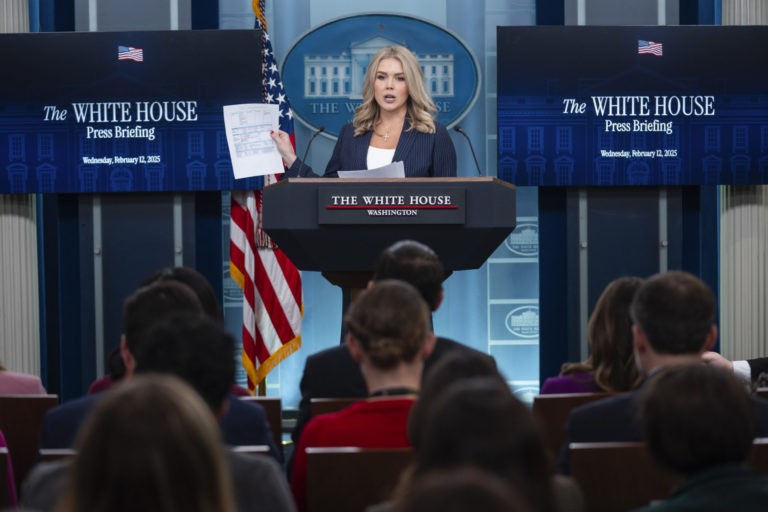
“This goes to show that lawfare will not ultimately prevail over the will of 77 million Americans who supported President Trump and his priorities,” said White House press secretary Karoline Leavitt.
Another group of unions filed a lawsuit in Washington, D.C., late Wednesday, though its potential impacts were not immediately clear.
About 75,000 federal workers accepted the offer to quit in return for being paid until Sept. 30, according to McLaurine Pinover, a spokesperson for the Office of Personnel Management. She said the deferred resignation program “provides generous benefits so federal workers can plan for their futures,” and it was now closed to additional workers.
American Federation of Government Employees National President Everett Kelley said in a statement that the union’s lawyers were assessing the next steps.
“Today’s ruling is a setback in the fight for dignity and fairness for public servants,” Kelley said. “But it’s not the end of that fight. Importantly, this decision did not address the underlying lawfulness of the program.”
The union continues to maintain that it’s illegal to force American citizens to make a decision, in a few short days, without adequate information, about “whether to uproot their families and leave their careers for what amounts to an unfunded IOU from Elon Musk,” the statement said.
The deferred resignation program has been spearheaded by Musk, who is serving as Trump’s top adviser for reducing federal spending overseeing the Department of Government Efficiency. Under the plan, employees can stop working and get paid until Sept. 30.
A Justice Department lawyer has called the plan a “humane off ramp” for federal employees who may have structured their lives around working remotely and have been ordered to return to government offices.
Leavitt’s comments come as Trump faces questions about the constitutionality of some of his executive orders, which have been wide-ranging and frequent since he took office.
“Many of the outlets in this room have been fear-mongering the American people into believing that there is a constitutional crisis taking place here at the White House,” Leavitt said.
Trump faces dozens of lawsuits against his executive orders, setting him up for a series of delays and lengthy court battles.
“In fact, the real constitutional crisis is taking place within our judicial branch where district court judges in liberal districts across the country are abusing their power to unilaterally block President Trump’s basic executive power,” Leavitt added.
Trump is likely to face even more legal action as he releases new executive orders almost daily on a variety of important federal issues. He has also worked with Elon Musk to aggressively cut the size of the federal government, prompting lawsuits from workers.
Leavitt said Trump’s orders have been met with a dozen injunctions in the last two weeks alone because of “judicial activists.”
“We believe these judges are acting as judicial activists rather than honest arbiters of the law,” Leavitt continued.
(Thérèse Boudreaux, The Center Square) A bill preventing future presidents from unilaterally banning hydraulic fracking made its way to the Senate last week after passing the House 226-188.
Sixteen Democrats joined all Republicans in voting for the Protecting American Energy Production Act, which will block future bans on hydraulic fracking without congressional approval, if enacted.
“When President Biden took office, his administration took a ‘whole of government’ approach to wage war on American energy production, pandering to woke environmental extremists and crippling this thriving industry,” the bill’s sponsor, Rep. August Pfluger, R-Texas, said on X following the vote. “My legislation that passed today is a necessary first step in reversing Biden’s war on energy.”
Former president Joe Biden enacted several regulations against oil drilling and restricted liquified natural gas (LNG) exports during his term, prompting several lawsuits.
On his first day in office, President Donald Trump declared a national energy emergency and called for the “unleashing” of American energy. His now-confirmed pick for Energy secretary, Chris Wright, is the founder of fracking company Liberty Energy.
Wright has pledged to enact Trump and Republicans’ plan to ramp up domestic gas and oil production and make the U.S. energy independent again.
“Today’s passage of the Protecting American Energy Production Act helps restore American energy dominance and protects the jobs of hardworking men and women,” said House Speaker Mike Johnson.
“This bill ensures fracking will remain an essential tool in our nation’s energy production, allowing us to harness regions like the Permian Basin rather than turning to foreign adversaries for our energy needs, and helping to fully unleash America’s energy potential,” he added.
Led by production in the Permian Basin, Texas crude oil production set new records in six of the past 12 months in 2024, The Center Square reported. Sen. Ted Cruz, R-Texas, recently introduced a bill to repeal Biden-era executive orders that ban offshore oil drilling.