(Thérèse Boudreaux, The Center Square) While Democratic lawmakers and experts said Tuesday that the Biden administration effectively facilitated a crackdown on speech it disliked, they maintained those efforts did not amount to unconstitutional censorship.
The claim made by Republicans that the previous administration headed a “censorship industrial complex” – composed of the administrative state, Big Tech, universities and NGOs – is a “myth” according to Mary Anne Franks from The George Washington University Law School.
Franks, who authored “The Cult of the Constitution: Our Deadly Devotion to Guns and Free Speech,” told the Senate Judiciary Committee in a hearing Tuesday that the First Amendment does not forbid the government from advocating its preferred viewpoints through a non-government apparatus.
“No official can dictate what Americans can say, think, or believe. The First Amendment constrains the government from interfering with freedom of speech,” Franks said. “[But] the government has the right to prefer certain viewpoints, and it is even allowed to communicate those preferences through persuasion, encouragement, and funding.”
“What the government may not do is compel private actors to think or speak a certain way through coercion or threats,” Franks added.
During the Biden administration, the Department of Homeland Security coordinated with a multitude of entities to censor speech deemed “misinformation, disinformation, or malinformation,” the latter referring to information “based on fact, but used out of context to mislead, harm, or manipulate.”
The DHS particularly pushed social media platforms, including Meta, to censor speech not aligned with the administration’s views about the COVID-19 virus and vaccine, Ukraine, and Hunter Biden’s laptop, among other things.
The agency even tried to create a “Disinformation Governance Board” in 2022, which would have used “federal law enforcement power to address disinformation,” but paused the project due to backlash.
Citing these instances and more, other experts called to testify by Republicans argued that the federal government using non-governmental agencies to facilitate a multifaceted suppression of politically incorrect speech, or control public conversation around certain topics, amounts to the government infringing on free speech.
Jonathan Turley, also a professor at The George Washington University Law School, said that the Biden administration “made censorship efforts part of its official mission” that created “a cottage industry of disinformation experts” funded by millions of taxpayer dollars.
“For years, many in Congress opposed every effort to expose this censorship system,” Turley added. “With the release of the Twitter files, that narrative collapsed. Emails showed government officials directly targeting individuals and groups for censorship or other forms of speech curtailment.”
Benjamin Weingarten, a journalist and contributor to RealClearInvestigations, urged in his testimony that the Republican-controlled Congress act now and shut down any remaining federal censorship initiatives.
“Suffice it to say, if we want to preserve our republic, let alone restore it to greatness, we must abolish this censorship regime,” Weingarten said.
(José Niño,Headline USA) National security adviser Michael Waltz continues to face scrutiny after he included Jeffrey Goldberg, the editor-in-chief of The Atlantic, in a Signal chat where war plans about bombing Yemen were being discussed.
On Wednesday, it was revealed that his Venmo friend list was publicly accessible until very recently.
Mike Waltz (of Signal chat fame) forgot to lock down his Venmo and it’s full of journalists lol. @DRBoguslaw scooped the whole list:https://t.co/n4376ImTBg
During a phone interview on Tuesday with NBC News, President Trump initially defended his national security adviser before the press, saying “Michael Waltz has learned a lesson, and he’s a good man,” adding that “it was one of Michael’s people on the phone. A staffer had his number on there.”
However, the controversy did not end there. Progressive media outlet The American Prospect found that Waltz’ Venmo account was still public at the time of the Signal controversy.
Roughly 10 minutes after requesting comment, Waltz’s Venmo account suddenly disappeared. Wired was the first media outlet to report on this development.
In a statement, National Security Council spokesperson James Hewitt did damage control, noting that “NSA Waltz was previously a U.S. Congressman and Fox News contributor. He has relationships with people who work in media. There should be nothing surprising here.”
Waltz’s public Venmo account displayed a friend list of 328 individuals, which included journalists, government officials, military personnel, and lobbyists.
This list potentially included individuals with whom he may have engaged in financial transactions.
Fox News personalities feature prominently in Waltz’s contact list.
Notable names include:
Griff Jenkins, a Washington-based national correspondent
Brian Kilmeade, co-host of Fox & Friends
Porter Berry, president and editor-in-chief of Fox News Digital
Other media figures in Waltz’s contacts include:
Leland Vittert, a national correspondent for NewsNation
Brianna Keilar, co-anchor of CNN News Central’s afternoon edition
Lauren Peikoff, an executive producer at MSNBC
A particularly noteworthy contact is Judith Miller, formerly of The New York Times. Miller gained infamy for her early-2000s bogus reporting on the likelihood that Iraq possessed weapons of mass destruction, which was largely based on information from Vice President Dick Cheney. Her erroneous reporting contributed to the deaths of thousands of Americans and Iraqis, and ultimately led to her dismissal from the newspaper.
The incident is not isolated, as other high-ranking officials like White House Chief of Staff Susie Wiles also had public Venmo accounts with sensitive information.
After inquiries from media outlets, Waltz’s and other officials’ Venmo accounts were quickly set to private, raising questions about why these precautions weren’t taken earlier.
For Waltz, the matter did not end there. Investigative journalist Paul E. Sperry revealed that the national security advisor has a long history of donating to Republicans who are part of the neoconservative establishment, while not donating a cent to President Donald Trump.
NEW: FEC records for ex-Cheney aide Michael Waltz, now Trump's nat'l security adviser who "accidentally" leaked to The Atlantic, show he's contributed $8,150 to NeverTrumpers and zero $ to Trump:
Mitt Romney … $5,000 John McCain … $450 Jeb Bush … $2,700 Donald Trump … $0
(Headline USA) A once-powerful former North Dakota lawmaker was sentenced Wednesday to 10 years in prison for traveling to Europe with the intent to pay for sex with a minor.
Former state senator Ray Holmberg’s attorney, Mark Friese, confirmed the sentence to The Associated Press but declined to comment after the hearing, which KFGO radio reported included seven hours of testimony, victim statements and an apology from the shackled 81-year-old.
Holmberg pleaded guilty last year in U.S. District Court in Fargo, North Dakota, to one count of traveling with intent to engage in illicit sexual activity.
KFGO reported that during Wednesday’s hearing, the defense and prosecution agreed that Holmberg should serve about three years because of his age and poor health, but federal Judge Daniel Hovland said Holmberg is still a threat to underage boys. Hovland called Holmberg’s character “egregious and despicable” and said that a 37-month sentence wouldn’t deter others.
While Holmberg denied actually having sex with anyone under 18, Hovland said he can “read between the lines,” the radio station reported.
Prosecutors said Holmberg traveled at least 14 times from 2011 to 2021 to Prague, Czech Republic, to pay for sex with adolescent-age boys. In court last year, Holmberg admitted to paying young male masseuses, some of whom he had sexual contact with at an alleged brothel. But he claimed not to know for certain how old they were.
Acting U.S. Attorney Jennifer Klemetsrud Puhl said the crime was “an assault of the dignity of many young boys.” And the majority and minority leaders in the North Dakota Legislature described Holmberg’s crimes as “evil” in a statement that vowed additional resources to law enforcement to help combat increases in criminal sexual assaults and human trafficking, KFGO reported.
Holmberg served 45 years in the North Dakota Senate. He resigned in 2022 after The Forum of Fargo-Moorhead reported on his many text messages with a man in jail in connection with child sexual abuse material. Holmberg chaired two powerful legislative panels, including the Senate’s budget-writing committee.
Records previously obtained by The Associated Press show that Holmberg made dozens of trips throughout the U.S. and to other countries since 1999. Destinations included cities in more than 30 states as well as Canada, Puerto Rico and Norway. At least one of Holmberg’s trips to Prague was state-funded through a teacher exchange program, the Klemetsrud Puhl wrote in court filings last week.
“Holmberg’s offending conduct over the course of decades … can only be described as corruption,” she wrote. “That is, he used his position to serve his own ends.”
In one example the prosecutor described, Holmberg brought a University of North Dakota student to the university president’s suite for hockey games, representing “a right to access some of the most influential people in the state” — including the UND president, governor and congressmembers — with the expectation of him engaging in sexual activity with Holmberg, she wrote.
In 2012 and 2013, Holmberg posed as a teenage boy in an online chatroom for teens who had undergone circumcision, and misled and manipulated a 16-year-old Canadian boy into sending him explicit photos, the filing said.
The full story of the relationship is unclear because the boy later took his own life in 2021, “but no doubt Holmberg’s conduct contributed to his struggles,” Klemetsrud Puhl said.
Former U.S. Attorney Tim Purdon said the acts described in the prosecutor’s filing paints a picture for the judge of Holmberg’s overall character.
“What we see here is a defendant who has a decades-long track record of identifying extremely vulnerable young men, grooming them and eventually using them for sex,” Purdon said.
(Mike Maharrey, Money Metals News Service) Gold has broken above $3,000 and appears poised to push even higher. So far, platinum has not followed gold’s lead but seems to be watching from the sidelines.
What is causing this divergence?
Over the last two years, platinum has shown a moderate correlation with gold (+0.47), however, the yellow metal has recently left its cousin in the dust.
In early 2023, platinum was trading around $1,080, while gold was in the $1,820s. Since then, gold has surged by 65 percent, while platinum has remained rangebound between $843 and $1,153. As of today, platinum is trading at around $985.
To put the platinum price into perspective, the metal hit an all-time high of $2,213 an ounce in March 2008. This was higher than the record price gold hit in 2011.
One of the factors driving that 2008 record was a severe supply shortage due to a power crisis and labor strikes in South Africa, the world’s leading platinum producer.
Before 2011, platinum was generally more expensive than gold. In 2015, this historical trend reversed, with the spread between gold and platinum growing wider.
What Drives Gold and Platinum?
Gold and platinum have decoupled because the dynamics driving them are as different as the metals themselves.
Industrial demand accounts for the majority of platinum offtake.
Its primary industrial application is in catalytic converters for vehicles. Platinum is also crucial in the chemical industry for producing fertilizers, in petroleum refining, and in various electronic components due to its excellent conductivity and resistance to corrosion. The metal is also increasingly being used in green technologies such as hydrogen fuel cells.
While industrial demand dominates, platinum is also popular in jewelry and as an investment metal.
Meanwhile, gold primarily trades as a financial asset. As Metals Focus explains, the yellow metal has benefited from “a very different set of tailwinds.”
“Strong central bank demand for gold has provided price support and instilled confidence among investors. Separately, heightened geopolitical risks and growing concerns over sovereign debt have boosted gold’s appeal as a safe-haven asset. These divergent drivers have propelled gold to repeated record highs, even as platinum has trailed.”
Platinum’s Fundamentals Are Far From Weak
While it has yet to drive the price higher, there is a significant platinum shortage developing. The market posted a 749,000-ounce deficit in 2023, followed by a 527,000-ounce shortfall last year. Another 470,000-plus ounce deficit is expected this year.
According to Metals Focus, “These deficits reflect constrained primary supply, disrupted autocatalyst scrap flows, and a rebound in autocatalyst demand after the semiconductor shortage.”
So, why haven’t these market dynamics supported the platinum price?
Because a significant above-ground platinum stock remains after seven years of surpluses running between 2016 and 2022. The combined 2023-2025 deficit will total around 1.7 million ounces. This will leave around half of that seven-year surplus available.
However, there are still issues on the supply side. According to Metals Focus, the concentration of above-ground stocks is “inaccessible to key end-users.” This is exacerbating perceived supply tightness.
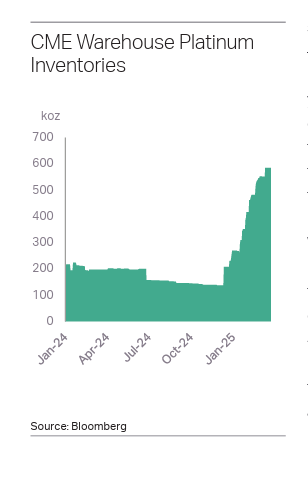
“Since Trump’s election victory in November 2024, tariff concerns have driven CME warehouse holdings higher, climbing by 445koz to 585koz. This has triggered a backwardated platinum market in 2025, where spot prices exceed future prices, reflecting a premium for immediate delivery. Similarly, heavy flows to China in 2021–2022 absorbed surplus stocks, keeping the market tight and platinum in backwardation through much of that period.”
Investment demand for platinum has also created some market tightness.
Platinum ETFs currently hold around 3.3 million ounces of metal, effectively removing it from industrial use. According to Metals Focus analysts, “While they signal investor confidence and support prices by reducing available supply, they also pose a risk; in the event of a breakout, profit taking could quickly release metal back into the market, capping gains.”
China: The Key to the Platinum Market
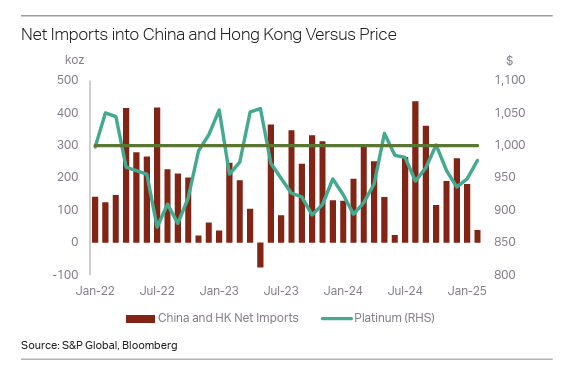
It appears that China holds the keys to the platinum market. Imports of metal into the country plunge when the price rises above $1,000 an ounce. However, imports spike whenever the price drops into the low $900s.
According to Metals Focus, this pattern has reinforced platinum’s narrow trading band.
“On recent research trips, industrial buyers frequently highlighted the low $900s as an attractive entry point. CFTC data shows that on the CME, platinum’s managed money positioning – typically fast-moving speculative funds – has frequently swung between net long and net short over the past two years. This pattern reflects traders capitalizing on short-term price moves within a well-defined range.”
While this pattern seems likely to continue in the near term, there are opportunities for investors who work within the current dynamics. In the longer term, continued supply shortages could open the door for a breakout.
Mike Maharrey is a journalist and market analyst for Money Metals with over a decade of experience in precious metals. He holds a BS in accounting from the University of Kentucky and a BA in journalism from the University of South Florida.
(Luis Cornelio, Headline USA) A Texas man was arrested on Tuesday for allegedly ramming his mini four-wheeler into several Tesla vehicles in separate incidents, according to law enforcement officials.
Demarkeyun M. Cox, 33, was busted after security footage captured him allegedly ramming a Tesla at full speed with his four-wheeler.
The video, shared on X by journalist Andy Ngo, showed Cox aggressively maneuvering the four-wheeler, with his large frame visible as he drove. He was wearing an oversized blue shirt, dark sweatpants, and carrying a backpack filled with unknown items.
A heavyset man in Texarkana, Texas was arrested on March 25 after allegedly starting a Tesla vandalism spree using a mini four-wheeler outside an all-you-can-eat buffet.
Demarkeyun M. Cox, 33 (originally inaccurately named as Demarqeuyun Cox), is suspected of damaging Tesla… pic.twitter.com/z6LOefFP8z
The Texarkana Texas Police Department stated on Facebook that Cox was charged with one count of felony Criminal Mischief and Failure to Identify.
The incident occurred in the parking lot of the Golden Palace restaurant on Summerhill Road. When officers responded to a 911 call, they received another report of a similar incident at a Lowe’s parking lot.
Shortly after, Officer Blake Lummus spotted Cox riding the mini four-wheeler. Although Cox provided Lummus with a false name, he was eventually identified and arrested.
After Cox’s arrest, law enforcement authorities received a third report of damage to another Tesla near Genesis Prime Care. Officers are working to determine whether Cox is responsible for these incidents as well.
“If they determine he is, additional charges may be filed,” the Texarkana Texas Police Department said. “He is currently being held in the Bi-State Jail as the investigation continues.”
Police have not yet revealed if Cox’s actions are related to widespread leftist campaigns against Elon Musk, who owns Tesla and is supporting President Donald Trump’s DOGE initiative.
The DOJ has warned that individuals committing crimes to protest Musk’s role in DOGE could be charged as domestic terrorists, as their actions aim to intimidate Musk, who is effectively a government official.
“The days of committing crimes without consequence have ended,” Attorney General Pamela Bondi said in a statement. “Let this be a warning: if you join this wave of domestic terrorism against Tesla properties, the Department of Justice will put you behind bars.”
Numerous videos have captured individuals vandalizing Teslas, including one person who was caught inserting his fingers into his anus and then rubbing them on a Cybertruck, one of Tesla’s models.
(Luis Cornelio, Headline USA) An individual was arrested on Tuesday after allegedly beating two college students with a metal bike lock—likely in protest of their ties to the conservative nonprofit Turning Point USA.
Liam Thanh Tam Nguyen, a transgender-identified individual, was caught on video swinging the lock at Paige Neumann, the TPUSA chapter president at the University of Texas at Dallas and her secretary Grace.
The students were tabling on campus when the assault occurred.
Nguyen now faces charges of two felony counts of aggravated assault with a deadly weapon, one count of attempting to take a weapon from an officer and one count of assaulting a peace officer, according to the Dallas Observer.
The alleged perpetrator was also charged with resisting arrest and two counts of criminal mischief—all misdemeanors.
The outlet reported that Nguyen listed “Alyssa” as a preferred name in Collin County Jail records.
Nguyen does not have an attorney, and as of Wednesday evening, no bail amount had been set.
UT Dallas refused to confirm whether Nguyen is an active student, only confirming the alleged assault occurred on campus, the Dallas Observer reported.
TPUSA founder Charlie Kirk condemned the attack, calling out Nguyen’s use of violence to protest the organization’s presence at the university.
“Our TPUSA students are the tip of the spear on college campuses across the country. They are brave, strong, and resilient. Thank God for these amazing students,” Kirk wrote on X, where he shared footage of the assault.
In a separate post, Kirk reacted to Nguyen’s transgender identity, warning about “more trans violence,” seemingly referencing past violent attackscommitted by trans-identifying individuals.
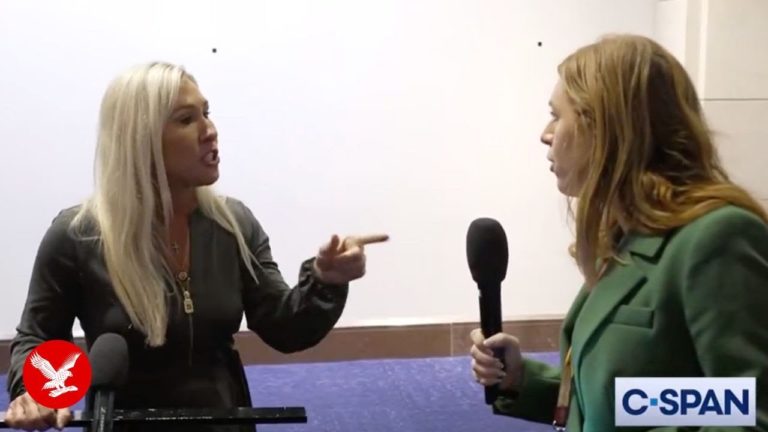
(Luis Cornelio, Headline USA) Rep. Marjorie Taylor Greene, R-Ga., shut down a British reporter who attempted to press her on whether Defense Secretary Pete Hegseth should resign over a texting scandal. Greene bluntly told the reporter to “go back” to her country and report on its own issues.
Greene made the fiery comments during a press conference on Republican efforts to cut taxpayer funding for NPR and PBS—both leftist-biased outlets accused of misleading reporting.
But some reporters were uninterested, focusing instead on the Trump administration’s mistaken inclusion of Jeffrey Goldberg, editor-in-chief of The Atlantic and anti-Trump activist, in a Signal group chat discussing an airstrike against the Houthis.
“Should the Defense Secretary…” began Sky News reporter Martha Kelner, before Greene cut her off to ask, “What country are you from?”
“From the U.K.,” Kelner replied.
“Okay, we don’t give a crap about your opinion and your reporting. Why don’t you go back to your country where you have a major migrant problem? You should care about your own borders,” Greene shot back.
As the reporter tried to continue, Greene didn’t let up.
“Let me tell you something, do you care about people from your country? What about all the women that are raped by migrants?” she asked.
The Georgia Republican then turned to an American reporter, who asked, “Thank you, I’m an American and I’d like to hear your answer to what she’s asking.”
“I’m not answering her question because I don’t care about her network,” Greene responded.
Greene’s remarks came as the legacy media ramped up attacks on President Donald Trump, accusing him of sharing classified information with Goldberg via the Signal chat.
The group chat, created by National Security Advisor Michael Waltz, was meant for Trump officials—including Vice President JD Vance and Secretary of State Marco Rubio—to discuss the airstrike.
Trump has dismissed the criticism, saying his officials have learned their lesson.
(Money Metals News Service) In this week’s episode of the Money Metals Midweek Memo, host Mike Maharrey issued a stark warning about the state of the U.S. economy, monetary policy, and the Federal Reserve’s quiet but significant moves.
Maharrey argued that the economy is addicted to easy money, comparing it to a drug dependency that requires larger and larger doses to maintain the same high. He used this metaphor to describe the Federal Reserve’s increasingly desperate efforts to keep the economy afloat through artificial stimulus.
According to Maharrey, the Fed’s latest policy shift may indicate that it is already out of control—and setting the stage for a larger financial crisis.
Monetary Policy Moves: The Real Headline
Although mainstream headlines focused on the Fed keeping interest rates steady during its March 2025 FOMC meeting, Maharrey emphasized a far more consequential action.
The Fed announced that beginning in April, it will significantly slow the pace of its balance sheet reduction. Treasury securities runoff will decline from $25 billion to just $5 billion per month.
This change was overshadowed by interest rate projections but represents a major loosening of monetary policy. Mortgage-backed securities will still have a $35 billion cap, but the Fed has never consistently reached that level.
Maharrey cited an analyst who described this as the equivalent of a rate cut without the Fed openly announcing it.
In other words, the Fed has quietly shifted back into an easing stance while still speaking the language of inflation concern.
Fed’s Forecasting Track Record: Not Reassuring
Maharrey took aim at the Fed’s so-called “dot plots,” which project future interest rate moves. Despite being produced by the very officials setting policy, these forecasts have only proven accurate 34 percent of the time.
Maharrey questioned whether this should be seen as sad or amusing, given the responsibility the Fed holds over monetary policy.
If the institution tasked with steering the economy can’t predict its own actions with better accuracy, it raises serious questions about the credibility of its broader economic outlook.
Quantitative Easing: The Inflation Engine
Maharrey explained how the Fed has used its balance sheet to inject money into the economy through quantitative easing.
Before the 2008 financial crisis, the Fed’s balance sheet stood at around $900 billion. By the end of the pandemic-era stimulus, it was just shy of $9 trillion. This represents more than $8 trillion in newly created money added in just 14 years.
The Fed claimed these were temporary emergency measures, but the promised unwinding never happened. Instead, it doubled down during the pandemic, expanding the balance sheet by nearly $5 trillion in a much shorter timeframe.
Maharrey reminded listeners that this is inflation by definition: an increase in the money supply. He pointed out that while the public focuses on rising prices, the root cause is monetary expansion.
Money Supply (M2) Trends
The M2 money supply, often used as a base measure of money in the economy, began shrinking in April 2022 as a result of rate hikes and quantitative tightening.
It bottomed out in October 2023 at $2.69 trillion and has since been climbing. By January 2025, M2 had reached $2.56 trillion, the highest since January 2022.
Maharrey concluded that since October 2023, the Fed has been actively loosening monetary policy again, even as it continues to publicly claim inflation remains a concern. The latest move to slow balance sheet reduction will only accelerate this trend.
Debt Ceiling and Monetary Policy Collision
Maharrey tied the Fed’s recent decision to a broader concern: the federal government’s rising debt and its inability to borrow more under the current debt ceiling.
In early 2025, the U.S. government hit the borrowing limit and began relying on “extraordinary measures” to fund operations. This includes suspending contributions to retirement funds and shifting money between accounts.
According to minutes from the Fed’s January meeting, policymakers worried that shrinking the balance sheet too aggressively could collide with these debt ceiling dynamics and destabilize money markets.
In other words, the Fed is backing off its tightening measures not because inflation is under control, but because it must accommodate the federal government’s spending addiction.
Maharrey predicted that within six months, the Fed may halt balance sheet reduction entirely.
On the other, it faces mounting pressure to cut rates due to high levels of debt throughout the economy—including the national debt.
The Fed cannot both tighten and loosen monetary policy at the same time, but that is exactly what it appears to be trying to do.
Maharrey argued that this impossible balancing act makes the Fed increasingly vulnerable to losing control of the economic narrative and outcome.
History Repeating? The 2008 Parallels
To further his case, Maharrey drew a detailed comparison between today’s policy trajectory and the lead-up to the 2008 financial crisis.
Following the dot-com bust, the Fed slashed interest rates to 1 percent by 2002, igniting a housing boom. As inflation pressures emerged, the Fed began raising rates, peaking at 5.25 percent in 2006.
Maharrey noted how similar that language sounds to Jerome Powell’s current claims that inflation pressure is caused by tariffs rather than monetary policy. He warned that in both eras, policymakers and media downplayed growing risks until it was too late.
Today, just as in 2007, a small group of analysts is sounding alarms, while the mainstream insists everything is fine.
Recession on the Horizon?
Despite Powell’s insistence that there is no recession risk, data tells a different story. The Atlanta Fed’s GDPNow forecast dropped from a projected 2.3 percent growth in February to -1.8 percent in March. The Fed also quietly reduced its full-year 2025 GDP growth projection from 2.1 percent to 1.7 percent.
While not an outright recession call, this downward revision signals less optimism than Powell’s public remarks suggest. Maharrey reminded listeners that the Fed manages expectations carefully and never reveals its full concerns all at once. A gradual shift in messaging typically indicates deeper worries behind the scenes.
What Comes Next? Maharrey’s Warning
Maharrey made clear that, based on historical precedent, the next phase is predictable. When economic conditions deteriorate—whether through a stock market crash, commercial real estate collapse, or financial crisis—the Fed will return to zero interest rates and aggressive money printing.
That is the pattern, and he sees no indication it will change this time. The long-term consequence is a continued devaluation of the dollar and a further erosion of personal purchasing power.
The Fed’s policies have created enormous distortions and misallocations of capital, and when the bubble bursts, those consequences will be felt broadly.
Solution: Real Money = Gold and Silver
To protect against inflation and currency devaluation, Maharrey urged listeners to own physical precious metals. He emphasized that gold and silver represent real money and a hedge against fiat policy mistakes.
Money Metals now offers a monthly installment plan allowing people to begin investing with as little as $100 per month. This allows individuals to build a reserve of sound money over time without needing thousands of dollars upfront.
Maharrey encouraged listeners to call Money Metals or visit the website to learn more about how precious metals can fit into their portfolio.
Closing Notes
Maharrey closed by recommending his recent interview with G. Edward Griffin, author of The Creature from Jekyll Island, available on the Money Metals Friday Market Wrap podcast.
He urged listeners not just to worry, but to prepare.
The Federal Reserve’s actions are clear, and their implications for the dollar and the economy are significant. Maharrey stressed the importance of taking control of one’s financial future in the face of reckless monetary policy.
For updates and insights on gold, silver, and economic trends, he encouraged listeners to subscribe to the podcast and sign up for Money Metals’ newsletter.
(Ken Silva, Headline USA) Former Justice Department lawyer Jessica Aber, who was the top prosecutor in the Eastern District of Virginia, was reportedly found dead in her home at the age of 43 by Virginia authorities on Saturday.
As U.S. Attorney for the Eastern District of Virginia, Aber, 43, was in charge of a jurisdiction right next to Washington DC—making her responsible for numerous politically charged cases, including ones with links to a variety of domestic and international intelligence agencies.
Given some of the high-profile and controversial cases Aber oversaw, the 43-year-old’s death sparked some speculation that foul play was involved.
But police in Alexandria, Virginia reportedly say that Aber likely died of natural causes. Her family reportedly says the same.
“Her family reiterated that it is believed Aber died from natural causes and said she ‘suffered from epilepsy and epileptic seizures for many years,’” ABC reported Wednesday.
“The case will remain open until the Office of the Chief Medical Examiner rules on the manner and cause of death.”
Her family added that they expect to have more info in the “coming weeks.”
Reporter Ford Fischer noted that Aber handled the case of Russell Richardson Vane IV, the former Pentagon analyst who joined a militia and promoted terrorism. Vane was arrested after he was publicly expelled by his militia, but he was only sentenced to “time served”—despite the FBI having found a deadly poison in his home, and despite the fact that he seemingly stole classified documents from his workplace.
Others pointed to the fact that Aber helped extradite an Israeli national who was helping facilitate the illegal entry of Israeli citizens into the U.S.
The mainstream media, meanwhile, blamed the usual culprit: Russia.
“In November 2024, a Virginia-based company and two of its senior executives, were accused [by Aber] of running ‘three different schemes to illegally transship sensitive American technology to Russia,’ including sending equipment to a Russian telecommunications company linked to the Kremlin and Russia’s notorious FSB security agency,” Newsweek reported.
Aber resigned effective Jan. 20. It’s not clear where she worked after that.
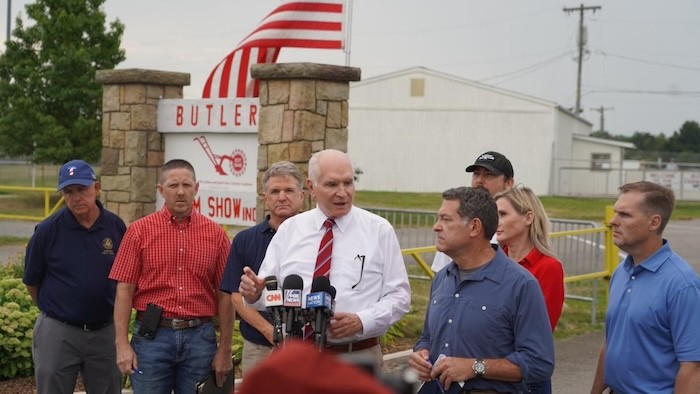
(Ken Silva, Headline USA) When Rep. Mike Kelly, R-Pa., was appointed as chairman of the Task Force to investigate the Trump assassination attempts last year, he promised to get to the bottom of what happened at the deadly July 13 campaign rally in Butler, Pennsylvania.
But more than four months after his Task Force issues its final report last December, Kelly admitted that his investigation failed, according to a Wednesday report from the Daily Mail.
“In an interview with the Daily Mail, Kelly admits that report was insubstantial,” the outlet reported. “For his part, Kelly blames federal law enforcement for obstructing his task force’s investigation by refusing to hand over important information.”
Kelly’s comments to the Daily Mail were similar to those he made when the Task Force released its report last December—when he blamed the FBI for stonewalling him. He told the Daily Mail that “they’re very good at stonewalling and then dismissing people as conspiracy theorists.”
“Well, if you answered our questions, we wouldn’t be having these different theories,” he added.
Since taking office, Trump has done remarkably little to find answers about what led to his near death—twice—last year.
On March 6, he said he expected to be briefed on the matter within a week. He also said the results of his briefing would be made public.
🇺🇸 President Trump announces he wants to release the information on his would-be assassin within days.
"They are giving me a report next week sometime. I want to release the report."pic.twitter.com/gWqDzQ0nRu
“They are giving me a report next week sometime, and I do believe I’ll be releasing it, I want to release the report. A lot of people have asked that question,” Trump said.
“You had one who had three apps, two of which were foreign, supposedly, and who has the biggest white-shoe law firm in Pennsylvania [working for them], even though they don’t live in, necessarily, a white-shoe area. What’s that all about?” the President said—referring to the fact that Crooks used encrypted chat apps based in Germany, New Zealand and Belgium, and that his parents have hired the Pittsburgh-based law firm Quinn Logue.
“I want to find out, and I would be willing to release it. Maybe there’s a reason we shouldn’t, so I don’t want to get too far out in front of my skis. But I would be very willing to release it. I’d like to see it. Not only you—I want to see that one myself,” he said.
However, the Trump administration hasn’t provided any updates since Trump’s March 6 comments, nor have any of the White House press corps asked about the matter.
Ken Silva is the editor of Headline USA. Follow him at x.com/jd_cashless.