
EXCLUSIVE: Inside the Fight over 3D-Printable Guns

(José Niño, Headline USA) It started in September 2024 as a copyright dispute between two leaders in the 3D-printable firearms industry.

Since then, the case between Defense Distributed CEO Cody Wilson and 3D firearms designer Matthew Larosiere has become increasingly contentious—replete with allegations of illegal international gun trafficking, a death threat, and even a connection to the recent assassination of UnitedHealthcare CEO Brian Thompson. And according to Wilson, the case could also have wide-ranging implications for open-source 3D printing, as well as with U.S. regulations on exporting firearms.

“This is no run-of-the-mill Copyright Act dispute,” says Wilson, who spoke to Headline USA for this story.

Larosiere, who also spoke to this publication, first sued Wilson, Defense Distributed, and another entity called “Defcad” last September, alleging that they infringed on his copyrights.

Larosiere accused Wilson of stealing his copyrighted gun designs, and selling them without permission. Wilson allegedly sold the designs behind a paywall on Defcad.com, as well as through Defense Distributed’s commerce site, ghostguns.com, which mails customers USB drives with 3D gun designs. Larosiere said in his lawsuit that his 3D-printable firearms designs include the Plastikov V4, BUBAR, SF5, KF5, MPP99, and others.

At first, Larosiere’s lawsuit was a straight-forward copyright action. When Headline USA reached out to Larosiere, he stressed that he had worked in the gun industry for many years and had “never given anyone the right to sell my models.”

Wilson, for his part, contests Larosiere’s copyright claims on “fair use” grounds. Additionally, according to Wilson, digital files of functional objects, including firearms, are not subject to copyright protection in the first place.

But on a deeper level, Larosiere’s copyright claims aren’t valid because they “arise from illegal conduct,” and are therefore unenforceable, Wilson argues.

And that’s where the dispute becomes sensational. In a counterclaim filed against Larosiere and several other entities, Wilson accuses them of running a “full-fledged criminal racketeering enterprise”—which, if true, would render his copyright claims obsolete.

From Copyright to Criminal Conspiracy?

According to Wilson, Larosiere runs yet another file-sharing site called The Gatalog, which offers 3D firearms designs without any restrictions—unlike Defcad, which is paywalled; and Defense Distributed, which sells physical USB drives to customers. The fact that The Gatalog offers 3D firearm designs online without any restrictions is what violates arms trafficking restriction, Wilson argues. And because The Gatalog’s business is illegal, Larosiere’s copyright claims are therefore invalid, according to Wilson.

Wilson explained to Headline USA: “Although Americans have the right, in theory, to exchange 3D gun files with each other, I can hand you a USB drive, for example, the direct publication of technical data to the Internet, unrestricted, still violates federal law. Weaponizing copyright doesn’t change that.”

According to Wilson, The Gatalog’s unrestricted platform has led to illegal file transfers to foreign developers in places such as Brazil and Myanmar.

“The Gatalog has been devoted to the repeated illegal transmission of defense-related technical data to agents of the armed wing of the National Unity Government of Myanmar, better known as The People’s Defence Force. File transfers or requests to the PDF are openly facilitated in the public and private chat rooms administered by The Gatalog ‘for the people in Myanmar fighting for their freedom,’” Wilson said in his Jan. 3 counterclaim.

Wilson also tarred The Gatolog for helping arm alleged left-wing assassin Luigi Mangione, who is accused of gunning down a health insurance executive last December.

“Just days after Defense Distributed filed its original pleading, UnitedHealthcare CEO Brian Thompson’s killer used 3D-printed weaponry (a pistol and suppressor) that The Gatalog provided 3D printing files for in violation of the Commerce Department’s EAR regime (the pistol) and the State Department’s ITAR regime (the suppressor),” the counterclaim stated.

Additionally, Wilsom claims to have received a death threat from someone affiliated with The Gatalog.

“On November 7, 2024, a Gatalog member, acting as an agent of the enterprise, sent a message to Cody Wilson via his DEFCAD account that contained a direct and explicit threat of physical violence entailing murder. The message stated: ‘Cody, you realize there’s a bounty on your head, right? … Have fun sleeping tonight with this information,’” Wilson said in his counterclaim.

Larosiere has strongly denied Defense Distributed’s counterclaims, including that he runs The Gatalog. He recently told the Florida Bulldog that Defense Distributed’s counterclaim was a “harassment lawsuit” intended to divert attention away from his copyright lawsuit. The attorney also said the assertion that The Gatalog is a criminal organization “is completely unfounded.”

When talking to Headline USA, Larosiere took exception to Wilson’s strategy of elevating the case from copyright disputes to federal racketeering charges, which he described as an “insane” tactic that will be easily dismissed in court. He also said he believes Wilson is using this strategy to effectively get the federal government to impose regulations that favor his businesses, thereby establishing a de facto “monopoly.”

Larosiere further told Headline USA that he disagrees with Wilson’s interpretation of copyright. He suggested that Wilson’s copyright arguments are fundamentally flawed

According to Larosiere, “you cannot use copyright to prevent somebody from doing something physically.” Further, he said his case has “nothing to do with being able to 3D print a gun,” but is instead about the sale of his art — in this case, his gun designs.

“A 3D model or drawing of a useful article is per se, not a useful article, and it’s very obviously entitled to copyright protection,” according to Larosiere.

When it comes to Larosiere’s contention that Wilson’s counterclaims will be easily defeated, it’s not clear whether a judge agrees. On Feb. 12, Larosiere asked the magistrate judge to stop the case’s discovery process until his motions to dismiss Wilson’s claims could be fully litigated.

“If this Court grants [my] motion to dismiss as to all counterclaims, any discovery taken between now and the Court’s ruling will have been unnecessary. Even if only some claims are dismissed, the scope of permissible discovery could well narrow,” Larosiere argued in his Feb. 12 motion.

The judge denied Larosiere’s motion, meaning that he must continue to comply with Wilson’s demands for discovery.

“Taking a “preliminary peek” at [Larosiere’s] motion to dismiss, and without expressing any opinion as to final resolution of the motion, the Court is not convinced that [Larosiere’s] motion to dismiss is ‘truly case dispositive,’” U.S.  Magistrate Judge Leslie Hoffman Price ruled on March 6.

“As [Wilson and Defense Distributed] correctly point out, (and as the Moving Parties allude to), neither at [Larosiere’s] nor [Wilson’s] motions to dismiss will dispose of every claim or counterclaim,” Price said.

It’s unclear when Judge Price might rule on the motion to dismiss. The parties are scheduled to have a mediation hearing on May 15. A trial is set for Nov. 2 if they can’t reach a settlement by then.

The case, Larosiere v. Wilson, can be found here.

José Niño is the deputy editor of Headline USA. Follow him at x.com/JoseAlNino

Gun Rights Group Urges Trump to Pardon Navy Vet Targeted by ATF

(José Niño, Headline USA) Patrick “Tate” Adamiak, a former Navy Master-at-Arms, is currently serving a 20-year prison sentence following his 2022 conviction for possessing and selling unregistered machine guns and destructive devices—charges stemming from him being targeted by an undercover ATF informant over his collection of historical parts and replicas.

The National Association for Gun Rights, a pro-Second Amendment organization, is demanding that President Donald Trump pardon Adamiak.

In an X post published last Friday, the National Association for Gun Rights called for President Trump to “immediately” pardon Adamiak. 

Adamiak’s case has become a lightning rod in Second Amendment circles, with supporters arguing he is the victim of government overreach and prosecutorial misconduct.

He was an active-duty sailor who ran a side business called Black Dog Arsenal that sold military surplus items and firearms parts.

“I was buying guns, military surplus and replica firearms,” Adamiak told pro-Second Amendment writer Lee Williams. “My idea was to build a military display museum. I started buying, selling and trading to start my business, while I was in the Navy.”

Despite the innocuous nature of Adamiak’s activities, he was targeted by an undercover ATF informant. The informant was working off his own criminal charges.

“He used to own a machine gun shop,” Adamiak told Williams. “The ATF raided his house, found a gun and charged him with felon in possession. He kept asking me for a machinegun, which I never got him. I got him a shroud off of Gun Broker. The ATF paid him around $8,000 for my case alone.”

In October 2022, he was convicted on the following federal charges:

  • Three counts of receiving and possessing an unregistered destructive device
  • One count of receiving and possessing an unregistered firearm
  • One count of unlawful possession and transfer of a machine gun

During an April 2022 search of his Virginia Beach home, investigators reportedly found “25 additional unregistered firearms, as well as two grenade launchers and two antitank missile launchers”.

At trial, the ATF argued these items constituted “machine guns” or “destructive devices” under the National Firearms Act (NFA).

Adamiak’s legal team and supporters contend that his conviction was based on ATF misconduct, flawed evidence, and unconstitutional reinterpretations of firearm regulation/ 

Adamiak received a 20-year prison sentence in June 2023.

Patrick Adamiak filed his notice of appeal on June 27, 2023, following his October 2022 conviction and subsequent 20-year sentencing for federal firearms charges. 

The case (United States v. Adamiak, No. 23-4451) was docketed in the U.S. Court of Appeals for the Fourth Circuit on July 5, 2023.

As of the publication of this article, his appeal remains pending.

Defenders of Adamiak, which includes Williams, claim he “never sold a single real firearm—not one—even though he sold $10,000 per month of military gear and gun parts legally on his former website”. Organizations like San Diego Gun Owners argue he was selling demilitarized (“demilled”) parts kits that are not legally considered firearms and have been approved for import and sale by the ATF itself.

Williams also noted that an ATF technician modified RPGs so that they had holes drilled into their pipes and components removed—“taking the needed parts from one of ATF’s live RPGs and installing them and a subcaliber kit.

“Once restored, the ATF monkey managed to squeeze off one live 7.62x39mm round, which unfortunately, was all the jury needed to see,” Williams observed. 

When asked about Adamiak’s ordeal, Taylor Rhodes, the Director of Communications at the National Association for Gun Rights, said the following:

President Trump should pardon Adamiak immediately. His case is a chilling example of the lingering effects of Biden’s ATF is weaponizing vague rules to target political enemies.

A major development in Adamiak’s case occurred last Wednesday, when the Supreme Court handed down its decision in Bondi v. VanDerStok figures prominently in the legal battle surrounding Adamiak’s conviction. The VanDerStok decision upheld the ATF’s authority to regulate ghost guns under the Gun Control Act (GCA) of 1968. 

Following that decision, interim US Attorney Erik Siebert’s letter to the Fourth Circuit Court of Appeals, arguing that the SCOTUS decision supports the Justice Department’s prosecution of Adamiak. He asked the appeals court to affirm Adamiak’s conviction.

If Adamiak’s appeal is denied, pro-gun advocates such as Lee Williams warn the case could embolden ATF overreach. In addition, Rhodes told Headline USA that “unless the executive branch rolls back the rule and pardons Adamiak, the conviction stands.”

Before his arrest, Adamiak had served in the Navy for roughly 10 years.

Adamiak was also on track to become a SEAL officer. He has a service record that included “the Enlisted Expeditionary Warfare Specialist qualification, a Navy/Marine Corps Achievement Medal, and a Good Conduct Medal.” 

José Niño is the deputy editor of Headline USA. Follow him at x.com/JoseAlNino
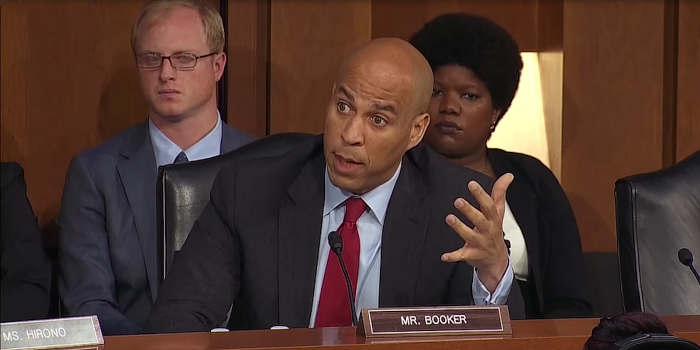
 

New Jersey Sen. Cory Booker Launches Overnight Speech to Protest Trump’s Agenda

(Headline USA) New Jersey Democratic Sen. Cory Booker carried an all-night speech in protest of President Donald Trump’s agenda into Tuesday morning.

Booker took to the Senate floor on Monday evening saying he would remain there as long as he was “physically able.” He was still on the floor more than 14 hours later.

“These are not normal times in our nation,” Booker said at the start of his speech. “And they should not be treated as such in the United States Senate. The threats to the American people and American democracy are grave and urgent, and we all must do more to stand against them.”

Booker railed against cuts to Social Security offices led by Trump adviser Elon Musk’s Department of Government Efficiency and spoke to concerns that broader cuts to the social safety net could be coming, though Republican lawmakers say the program won’t be touched.

Donning and doffing reading glasses, Booker read what he said were letters from constituents. One writer was alarmed by the Republican president’s talk of annexing Greenland and Canada and a “looming constitutional crisis.”

“I hear you. I see you, and I’m standing here in part because of letters like yours,” Booker said.

On Tuesday morning, Booker got some help from Democratic colleagues, who gave him a break from speaking to ask him a question. Booker said he would yield for questions but would not give up the Senate floor.

According to the Senate’s website, the record for the longest individual speech belongs to Strom Thurmond of South Carolina, who filibustered for 24 hours and 18 minutes against the Civil Rights Act of 1957.

Booker invoked Thurmond and the civil rights leader Rep. John Lewis of Georgia on Tuesday morning, arguing that changing history would require the public to get involved.

“You think we got civil rights one day because Strom Thurmond — after filibustering for 24 hours — you think we got civil rights because he came to the floor one day and said, ‘I’ve seen the light,'” Booker said. “No, we got civil rights because people marched for it, sweat for it and John Lewis bled for it.”

Booker, 55, is serving his second term in the Senate. He was an unsuccessful presidential candidate in 2020, when he launched his campaign from the steps of his home in Newark.

He dropped out after struggling to gain a foothold in a packed field, falling short of a threshold to meet in a January 2020 debate.

Before taking to the national political stage, Booker was considered a rising star in the Democratic Party, serving as mayor of Newark, New Jersey’s largest city, from 2006 to 2013. A Rhodes Scholar and graduate of Stanford University and Yale Law, he started his career as an attorney for nonprofits. He served on the Newark City Council before becoming the city’s mayor.

He was first elected to the U.S. Senate in 2013 during a special election held after the death of incumbent Democrat Frank Lautenberg. He won his first full-term in 2014 and then reelection in 2020.

Adapted from reporting by the Associated Press

Maui Mayor’s Plan to Phase Out Vacation Rentals Would Increase Housing but Shrink the Economy

(Headline USA) An unprecedented proposal from Maui’s mayor to phase out vacation rentals would alleviate a severe housing shortage aggravated by the 2023 wildfires but would also shrink the economy, University of Hawaii economists said in a report published Monday.

Mayor Richard Bissen introduced the policy idea last year to boost Maui’s limited supply of long-term housing after the fires wiped out more than 3,000 housing units in Lahaina.
Trey Gordner, one of the study’s authors and a researcher at the University of Hawaii Economic Research Organization, said there are always trade-offs associated with decisions of this kind.

“We find that the policy would increase housing affordability somewhat at the cost of jobs, incomes and tax revenues,” he said a news conference. Visitor spending is likely to sharply decline, according to the report.

Bissen said the report was a valuable first step in understanding the potential economic impact of his proposal. But he said economic models don’t reflect the lived experiences of residents crowded into multigenerational homes, commuting long distances and leaving Maui because they can’t afford housing.

“Most importantly, they fail to acknowledge the cultural loss we face when our people are forced to leave—when generations of knowledge, tradition, and aloha are displaced from the very communities that shaped them,” Bissen said in a statement.

The Maui County Council’s Housing and Land Use Committee may be able to take up a bill incorporating the mayor’s proposal in about 60 days, depending on the budget review and deliberation schedule, Council Chair Alice Lee said in a text message.

She said her concern is that the study doesn’t address the legal implications and associated costs of the policy.

“My understanding is that many (short-term rental) owners will elect to retain their units and not sell or rent their units and use them when they visit Maui,” Lee said. “The Council would like to establish a fair and equitable solution that works for all parties.”

About one-third of Maui’s visitors use vacation rentals. They tend to cost less than hotels and are easy to reserve on websites like Airbnb and Vrbo. Many have workspaces and kitchens, so people can work remotely and families can prepare their own food.

They have also become a source of tension on Maui, particularly after the Lahaina wildfire — the deadliest in the U.S. in more than a century — destroyed so much housing.

The report said the mayor’s proposal was unique in scale because the vacation rentals in question account for 21% of Maui County’s housing supply. In contrast, vacation rental regulations in Los Angeles affected 0.9% of local housing and those in Barcelona affected 2.6%, the report said.

The policy would add up to 6,127 vacation rental units to Maui’s long-term housing stock, increasing supply by 13%.

Because only about 600 new housing units are built in the county each year, this would be equivalent to a decade’s worth of new housing development. Condo prices would drop 20-40%, the study estimates.

Most of the affected owners would not be Maui residents because 85% of Maui’s apartment-zoned vacation rental owners are from out-of-state — particularly California and Washington state — as well as Canada.

Another benefit would be that switching the units to long-term housing wouldn’t require the county to develop additional water sources, which are scarce on Maui.

At the same time, the study predicted the policy would eliminate one-quarter of Maui County’s visitor accommodations and shrink visitor spending by 15%. Some 1,900 jobs or 3% of the county’s payroll would disappear.

Gross domestic product would contract by 4% and property taxes would likely decline by up to $60 million annually.

The report said the county could attain some of the desired housing boost with less economic disruption if it instead increased taxes on vacation rentals, taxed empty homes and adopted zoning and permitting reform.

Capping the number of vacation rental licenses and auctioning them off would be another approach.

Steven Bond-Smith, an assistant professor at the university and report co-author, said he wasn’t aware of a community that has done this with vacation rentals but it’s a common practice for taxi medallions and is used to manage fisheries.

Auctioning licenses would push less profitable units out of the vacation rental market because the cost wouldn’t justify the expense, the report said.

The university conducted the study at the request of the Hawaii Community Foundation, a nonprofit organization.

Adapted from reporting by the Associated Press

Fiscal Experts Urge Republicans to Gut Green Energy Subsidies via Tax Legislation

While top Republican lawmakers discuss how to offset the cost of extending President Donald Trump’s tax cuts, dozens of fiscal and energy policy organizations are telling them to start with cutting green energy subsidies.

House Republicans have been struggling for months over how to finance their $4.5 trillion budget resolution that would extend the 2017 Tax Cuts and Jobs Act for the next 10 years.

To partially offset their proposed budget resolution, House Republicans planned to raise the debt ceiling by $4 trillion, cut $2 trillion in other federal spending, and assume that the extension will add $2.6 trillion in economic growth.

But many in the party, especially those in the Senate, believe that making $2 trillion in cuts that leave Medicaid and SNAP untouched simply isn’t doable. As a result, GOP leaders are considering using the “current policy” baseline rather than the traditional “current law” baseline when calculating the budget resolution’s deficit impact.

This would make the tax portion of the House’s $4.5 trillion budget resolution, in theory, cost zero dollars rather than trillions. But nearly all tax and budget organizations are calling this a “gimmick” that would explode the national debt.

Instead, organizations are advocating that lawmakers stick with the 10-year extension and focus on finding the trillions in offsetting cuts in unconventional places, such as the 2022 Inflation Reduction Act.

Dozens of budget, tax, and energy organizations urged lawmakers to repeal all green energy tax credits created by the IRA, originally advertised as deficit neutral but more recently estimated to cost trillions over the next few decades.

In a March report analyzing the impacts of repealing the IRA, the Cato Institute revealed that the IRA’s uncapped tax credits for renewable energy and greenhouse gas reduction projects will cost between $2 trillion and $4.6 trillion by 2050.

If Congress uses the reconciliation process to repeal only the production tax credit and the investment tax credit, the federal government could save $130 billion per year by 2034.

“IRA repeal could also be the centerpiece of a fiscally responsible reconciliation bill that extends Trump’s first-term tax cuts,” Cato summarized. “[The] IRA is a massive source of spending that could be used to offset tax cuts.”

Other green energy-related cuts that would help offset the House’s $4.5 trillion budget resolution include $15 billion per year from electric vehicle tax credits, $8.5 billion per year from carbon oxide sequestration tax credits, and billions more in similar subsidies.

But if lawmakers receive the green light from Senate parliamentarian Elizabeth MacDonough to use current policy baseline, they will no longer have to find as many offsets and will likely pursue making the tax cuts permanent.

Republicans are hoping to get a completed reconciliation package to Trump’s desk by Memorial Day.

LA Could Lose $270M if 2028 Olympics Go Awry; Already Faces $1 Billion Deficit

The city of Los Angeles could be on the hook for $270 million if the 2028 Olympics are not on budget. With the city already facing a $1 billion deficit and the state infamous for the ballooning $135 billion budget for its high speed rail program, many wonder if the city can handle the Olympic games.

L.A. famously turned a profit from its 1984 Olympics by minimizing new construction, and has sought to do so for the 2028 games. The latest plan for the “no build” games has moved some events to Oklahoma City — canoe slalom and softball — which could be an attempt to minimize local costs.

L.A. City Controller Kenneth Mejia, who has been warning the city is “broke” since 2024, has pointed out difficulties the city may have in hosting the games, especially compared to Paris, which hosted the game in 2024.

“L.A. is the next Summer Olympics host city. Will we be ready?,” said Mejia on X. “Compared to Paris, Los Angeles has 2x the population, 10x the unsheltered population, 1/10 the transit ridership, ¼ the transit vehicles per million people, 3x the road deaths.”

The city is on the hook for the first $270 million over budget the Olympics costs in excess of the approved $6.9 billion budget, with the state of California — which itself faces annual deficits rising to the tens of billions of dollars — taking the next tranche.

In 2019, then-mayor Eric Garcetti said he expects the city to earn $1 billion in profit from the 2028 games. Not a single Summer Olympics has generated a profit since the 1984 L.A. Olympics, with games typically running billions of dollars over budget.

Astronauts, Navy Talk about Returning to Moon

Astronauts on Monday joined Navy officers in front of a test space capsule on the well deck of the amphibious craft USS Somerset in San Diego to talk at a news conference about going back to the moon.

The main reason to return?

“It’s cool,” said astronaut Stan Love, who will be in Mission Control in Houston during next year’s Artemis II mission as one of the seven CapComs communicating with the crew in space. NASA has a long tradition of astronauts getting on headsets in Mission Control and talking to their colleagues in orbit or on their way to the moon.

The Artemis II crew will orbit the moon, but won’t land. That is scheduled to happen in 2027 during Artemis III.

The return to the moon will bring knowledge that will ultimately mean learning more about Earth, Love told The Center Square after the news conference on the Navy’s vessel.

He added that computers on spacecraft have become more sophisticated since the Apollo missions, but engines haven’t changed much since 1969 when Neil Armstrong stepped on the moon.

Astronaut Andre Douglas was also among the speakers and expressed his enthusiasm for the mission. Douglas is the backup astronaut for Artemis II and will be on the mission if any of the NASA astronauts suddenly become unable to go.

The crew of three NASA astronauts and one Canadian Space Agency astronaut will take off from Cape Canaveral. After the launch, Douglas is scheduled to go to Johnson Space Center in Houston to join Love and other CapComs talking to the astronauts in space.

Two other astronauts not associated with Artemis appeared at the news conference, which focused on the Navy’s preparations for retrieving the Artemis crew and capsule after its splashdown.

Despite DOGE, Trump’s Spending on Pace to Exceed Biden’s

(José Niño, Headline USA) Elon Musk has been vocal about his goal to reduce federal spending by $1 trillion. This amount would halve the federal budget deficit and significantly move the U.S. closer to curbing the growth of its debt relative to the economy’s size.

However, early indications are that spending under the early Trump administration is already at a higher rate than it was under Biden.

Musk claims that $130 billion has been saved to date, equating to approximately $2 billion in daily savings since President Donald Trump returned to the Oval Office in late January.

But verifying his claims is challenging for reporters and analysts, as there have been documented cases of inaccuracies and examples of alleged savings disappearing from the list of reported cost-cutting measures.

According to Chris Matthew of MarketWatch, Musk’s Department of Government Efficiency has further complicated fact-checking by removing federal identification numbers from its website’s source code, which would have allowed outsiders to precisely identify the grants and contracts referenced.

One of DOGE’s largest claimed savings is the cancellation of a $1.9 trillion IT modernization contract. However, the contractor involved stated last month that the contract was actually canceled in November, during President Joe Biden’s administration. 

On top of that, the Federal Procurement Data System—a database tracking federal procurement projects—shows that no funds were ever spent on this grant, despite the IRS being authorized to allocate $1.9 billion over the span of seven years.

Broader federal spending data also casts doubt on DOGE’s claims of saving taxpayer money. 

According to The Hamilton Project, which studies federal spending using daily Treasury statements, the federal government had spent $1.893 trillion in 2025 as of March 26, compared to $1.763 trillion by the same date in 2024—a year-over-year increase of 7.4 percent.

While federal expenditures often increase next to economic growth, current spending levels are largely governed by a continuing budget resolution that maintains funding levels set by President Biden in 2024. 

By contrast, at the end of the first quarter in 2024, federal spending was projected to be 1.6 percent lower than in 2023, though total spending for 2024 ultimately ended up 3 percent higher than in 2023.

“[M]ost of the cuts they have talked about are pretty small-bore, and I think that’s the major takeaway,” Wendy Edelberg, former chief economist at the Congressional Budget Office and director of the Hamilton Project, said to MarketWatch. 

“It’s less surprising when you consider that most of the cuts they have talked about are pretty small bore, and I think that’s the major takeaway,” she continued.

Slashing the national debt will be a tall order for policymakers.

As of March 31, 2025, the U.S. national debt stands at approximately $36.66 trillion, according to data from the U.S. Treasury and recent reports.

José Niño is the deputy editor of Headline USA. Follow him at x.com/JoseAlNino

Praise the Lord: Sen. Raphael Warnock’s Church Bankrolls His $1M Luxury Residence

(Luis Cornelio, Headline USA) He sure is blessed and highly favored. 

Sen. Raphael Warnock, D-Ga.—in addition to taking in $174,000 in his taxpayer-funded salary—reportedly lives in a lavish $1 million mansion paid for by none other than Ebenezer Baptist Church, the same church he serves as a senior pastor. 

Built in 2022, the home is located in DeKalb County and boasts luxurious amenities such as a 100-bottle wine fridge, a Bluetooth-enabled steel cooking range, custom crown molding, a walk-in closet and a European bathroom with remote-controlled curtains. 

Even more eyebrow-raising, Warnock lives in the home for free, having moved in during 2023, according to reporting by the Washington Free Beacon.  

The outlet found that while Georgia records show Warnock lists the property as his primary residence, real estate records show Ebenezer Baptist Church as the official owner. 

State law bars churches from collecting rent on properties, but it does not prevent them from purchasing tax-exempted homes for pastors as long as “no income is derived from the property,” the Free Beacon noted. 

Warnock previously owned his own home in Atlanta when his church plowed through $989,000 to purchase the DeKalb home. Shortly thereafter, Warnock sold his Atlanta home and relocated to the church property. 

Warnock’s attorney, Jacquelyn Lopez, acknowledged the property as the “Senator’s personal home,” but warned the Free Beacon that revealing the address could expose him to “grave risk of physical harm.” 

The arrangement between the church and Warnock took a potentially troubling turn in March 2025, when he called on the congregation to contribute to a $3.5 million fundraising campaign to reduce “our mortgage debt.” 

Warnock made a direct appeal to the congregation: “So give what you would normally give. Do that first. Then maybe you want to give an anniversary [gift] … $139. Everybody who can … give at least that much.” 

He continued, “There are others who say, I can do better. I can give $500. I can give $1,000. Somebody might want to give their bonus. Why are y’all laughing? I ain’t laughing, I’m serious. You might want to give your bonus. You might want to give a week’s salary. All of us are blessed at different levels.” 

It remains unclear what other properties Ebenezer Baptist Church owns in addition to Warnock’s residence. 

In addition to his church salary of $31,800 and $461,000 in book royalties, Warnock also owns a $1.15 million Capitol Hill townhouse, which he purchased in 2023—two years after becoming a U.S. senator. 

Elon Musk Says He Doesn’t Know Whether Ashley St. Clair’s Baby is His 

(Luis Cornelio, Headline USA) Tech mogul Elon Musk has had enough of the baby momma drama. 

On Monday, Musk took to X to respond to a viral video showing his alleged baby mother—conservative influencer Ashley St. Clair—selling her $100,000 Tesla, claiming Musk had slashed nearly 60% of child support payments. 

The video, captured by the Daily Mail and shared on X, showed St. Clair handing over the Tesla’s keys to a car salesperson while answering questions from reporters. 

Asked if she believed Musk was deliberately targeting her, St. Clair replied: “Yeah, that’s his modus operandi when women speak out.”  

She claimed their last communication was on Feb. 13 and, when asked about the Tesla boycott, quipped, “You can check the stocks, I’m not the only one who is cleaning up after his messes.” 

The video sparked backlash, including from journalist Laura Loomer, called St. Clair a “gold digger” and “professional gaslighter.” 

Musk responded to Loomer’s post, revealing he had given St. Clair millions despite not knowing if the child—born sometime in 2024—was his. 

“I don’t know if the child is mine or not, but am not against finding out. No court order is needed,” Musk wrote. “Despite not knowing for sure, I have given Ashley $2.5M and am sending her $500k/year.” 

St. Clair fired back, claiming she had asked Musk to confirm paternity before the child’s birth. 

“You refused,” she wrote. 

“And you weren’t sending me money, you were sending support for your child that you thought was necessary… until you withdrew most of it to maintain control and punish me for ‘disobedience.’ But you’re really only punishing your son,” St. Clair added. 

She ended with a final jab: “America needs you to grow up, you petulant man-child.” 

St. Clair and Musk’s public feud began on Feb. 14, 2025, when St. Clair announced on X that she had Musk’s child after meeting him just a year prior. 

She claimed she was forced to go public because “tabloid media” intended to break the news, likely putting the child’s privacy in jeopardy. 

St. Clair, a social media influencer previously associated with The Babylon Bee, met Musk when the satirical outlet’s CEO, Seth Dillon, interviewed him at X headquarters. Their relationship soured after the disclosure of the pregnancy, which Musk reportedly wanted to keep private. 

If confirmed, this would be Musk’s 14th child.