10,000 Pages of Records about RFK’s 1968 Assassination are Released

(Headline USA) About 10,000 pages of records related to the 1968 assassination of Sen. Robert F. Kennedy were released Friday, including handwritten notes by the gunman, who said the Democratic presidential candidate “must be disposed of” and acknowledged an obsession with killing him.

Many of the files had been made public previously, but others had not been digitized and sat for decades in federal government storage facilities. Their release continued the disclosure of historical investigation documents ordered by President Donald Trump.

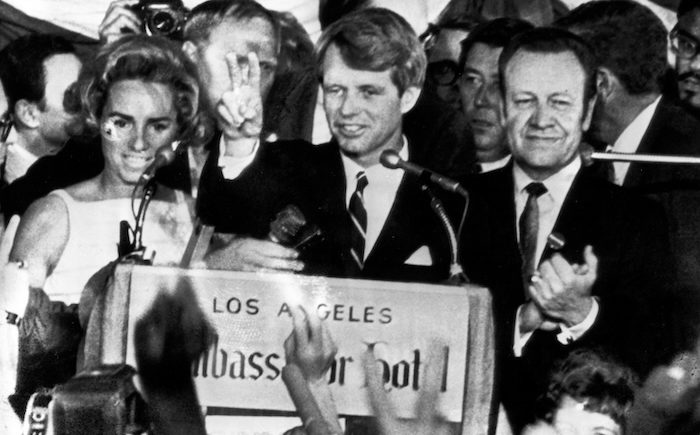
Kennedy was fatally shot on June 5, 1968, at the Ambassador Hotel in Los Angeles moments after giving a speech celebrating his victory in California’s presidential primary. His assassin, Sirhan Sirhan, was convicted of first-degree murder and is serving life in prison.

The files included pictures of handwritten notes by Sirhan.

“RFK must be disposed of like his brother was,” read the writing on the outside of an empty envelope, referring to Kennedy’s older brother, President John F. Kennedy, who was assassinated in 1963. The return address was from the district director of the Internal Revenue Service in Los Angeles.

Sirhan also filled a page of a Pasadena City College notebook with variations of “R.F.K must die” and “R.F.K must be killed.” In a note dated May 18, 1968, he wrote: “My determination to eliminate R.F.K. is becoming more of an unshakable obsession.”

In another of the documents, the assassin said he advocated for “the overthrow of the current president.” Democrat Lyndon Johnson was in the White House at the time of Robert F. Kennedy’s death.

“I have no absolute plans yet, but soon will compose them,” wrote Sirhan, who pledged support for communist Russia and China.

Documents include interviews with assassin’s acquaintances

The files also included notes from interviews with people who knew Sirhan from a wide variety of contexts, such as classmates, neighbors and coworkers. While some described him as “a friendly, kind and generous person” others depicted a brooding and “impressionable” young man who felt strongly about his political convictions and briefly believed in mysticism.

According to the files, Sirhan told his garbage collector that he planned to kill Kennedy shortly after Martin Luther King Jr. was assassinated on April 4, 1968. The sanitation worker, a Black man, said he planned to vote for Kennedy because he would help Black people.

“Well, I don’t agree. I am planning on shooting the son of a bitch,” Sirhan replied, the man told investigators.

FBI documents describe interviews with a group of tourists who had heard rumors about Kennedy being shot weeks before his death. Several people who visited Israel in May 1968 said a tour guide told them Kennedy had been shot. One person said he heard that an attempt on Kennedy’s life had been made in Milwaukee. Another heard that he was shot in Nebraska.

The National Archives and Records Administration posted 229 files containing the pages to its public website.

The release comes a month after unredacted files related to the assassination of President Kennedy were disclosed. Those documents gave curious readers more details about Cold War-era covert U.S. operations in other nations but did not initially lend credence to long-circulating conspiracy theories about who killed JFK.

Trump, a Republican, has championed in the name of transparency the release of documents related to high-profile assassinations and investigations. But he’s also been deeply suspicious for years of the government’s intelligence agencies. His administration’s release of once-hidden files opens the door for more public scrutiny of the operations and conclusions of institutions such as the CIA and the FBI.

Trump signed an executive order in January calling for the release of government documents related to the assassinations of Robert F. Kennedy and King, who were killed within two months of each other.

Lawyers for Kennedy’s killer have said for decades that he is unlikely to reoffend or pose a danger to society, and in 2021, a parole board deemed Sirhan suitable for release. But Gov. Gavin Newson rejected the decision in 2022, keeping him in state prison. In 2023 , a different panel denied him release, saying he still lacks insight into what caused him to shoot Kennedy.

RFK still stands as a hero to American liberals

Kennedy remains an icon for liberals, who see him as a champion for human rights who also was committed to fighting poverty and racial and economic injustice. They often regard his assassination as the last in a series of major tragedies that put the U.S. and its politics on a darker, more conservative path.

He was a sometimes divisive figure during his lifetime. Some critics thought he came late to opposing the Vietnam War, and he launched his campaign for president in 1968 only after the Democratic primary in New Hampshire exposed President Johnson’s political weakness.

While Kennedy’s campaign inspired hope among some Democrats, he still trailed Minnesota Sen. Hubert Humphrey for the party’s presidential nomination after winning the California primary.

Kennedy’s older brother appointed him U.S. attorney general, and he remained a close aide to him until JFK’s assassination in Dallas. In 1964, he won a U.S. Senate seat from New York and was seen as the heir to the family’s political legacy.

One of his sons, Robert F. Kennedy Jr., now serves as health and human services secretary. He commended Trump and Tulsi Gabbard, the director of national intelligence, for their “courage” and “dogged efforts” to release the files.

“Lifting the veil on the RFK papers is a necessary step toward restoring trust in American government,” the health secretary said in a statement.

Adapted from reporting by the Associated Press
 

Cuban CIA Operative’s Son Killed in FSU Shooting

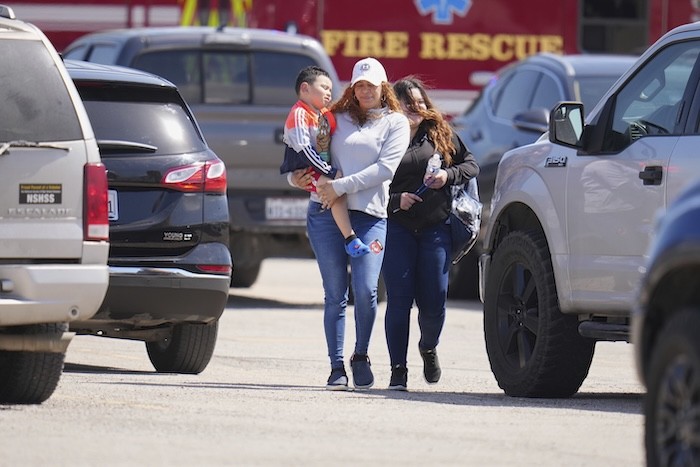
(Headline USA) Two people were killed and six others were injured when a gunman opened fire at Florida State University, sending students fleeing from the student union and putting the Tallahassee, Florida, campus under lockdown.

Authorities have identified the shooter as Phoenix Ikner, a 20-year-old Florida State student who is the son of a sheriff’s deputy. He began firing with his mother’s former service weapon before he was shot and wounded by officers when he refused to comply with commands, investigators said.

Authorities have not yet revealed a motive for the shooting, which began around lunchtime Thursday just outside the student union.

Officials have also not identified the victims, though family members have said that university employee Robert Morales was one of those who were killed. Here is what we know about Morales.

Robert Morales

Robert Morales was a university dining coordinator who had worked at Florida State since 2015, according to his LinkedIn profile.

“Today we lost my younger Brother, he was one of the victims killed at FSU,” Ricardo Morales Jr. posted on social media late Thursday. “He loved his job at FSU and his beautiful Wife and Daughter. I’m glad you were in my life.”

Morales had studied criminology at the school in the early 1990s, according to the LinkedIn profile.

The profile also said he was CEO of Black Bean Food Group, though state records show that the business was dissolved a decade ago.

The Morales brothers’ father, Ricardo Morales, was a Cuban exile turned CIA operative in South Florida with the nickname “Monkey.” Ricardo Morales Jr. describes his father’s work as a contract agent for the CIA in the forthcoming book, “Monkey Morales: The True Story of a Mythic Cuban Exile, Assassin, CIA Operative, FBI Informant, Smuggler, and Dad,” which is expected to be published later this year.

“Dubbed ‘The Monkey’ for his disruptive and unpredictable escapades, Morales grabbed headlines for decades as tales of his bombings, arrests, assassination attempts (both those he executed and those he suffered), and testimony constructed a real-life spy adventure unlike anything brought to page or screen,” reads promotional material from publisher Simon & Schuster.

The elder Morales was fatally shot in a bar brawl in 1982 at the age of 43.

Adapted from reporting by the Associated Press
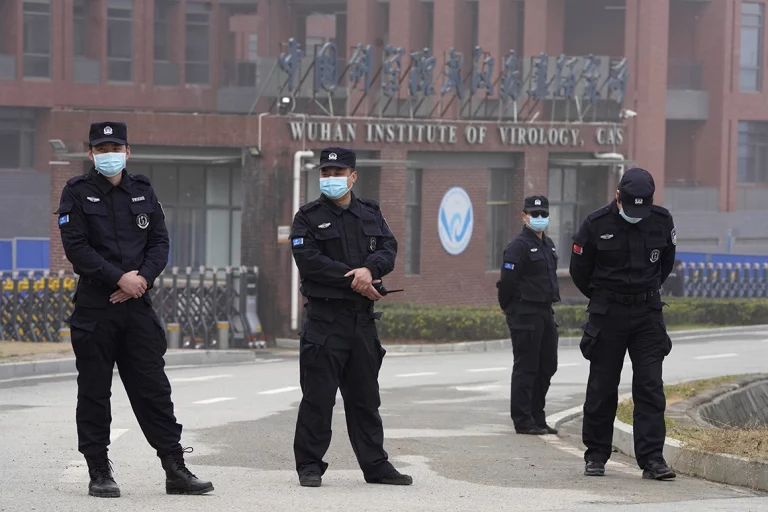
 

White House COVID Website Now Tells Truth about Lab Leak Theory

(Ken Silva, Headline USA) A federal website that used to feature the mainstream narrative on COVID-19 has been transformed into a page supporting the theory that the pandemic originated with a lab leak.

The covid.gov website shows a photo of President Donald Trump walking between the words “lab” and “leak” under a White House heading. It mentions that Wuhan, China, where the coronavirus first began spreading, is home to a research lab with a history of conducting virus research with “inadequate biosafety levels.”

The web page also accuses Dr. Anthony Fauci, the former director of the National Institute of Allergy and Infectious Diseases, of pushing a “preferred narrative” that COVID-19 originated in nature.

The origins of COVID have been disputed for years, but the FBI and some other intelligence officials had surmised since early 2020 that it likely came from the Wuhan Institute of Virology.

As has been widely documented, the FBI concluded with “moderate confidence”in 2020 that COVID likely originated from a lab leak. Three scientists at the National Center for Medical Intelligence, part of the Pentagon’s Defense Intelligence Agency, also reportedly concluded that “Covid-19 was manipulated in a laboratory in a risky research effort.”

However, those findings never made it to the desk of President Joe Biden, according to a Wall Street Journal article from last December. The Journal’s article focused on what’s been deemed the “90-day sprint”—when Biden ordered his intelligence agencies to conduct an expedited study into Covid’s origins.

“The intelligence officials who briefed Biden in August 2021 at the White House all wore masks to protect them against the still-raging pandemic, as did the president. The participants included [Avril] Haines, the president’s top intelligence official, and Murphy, from the National Intelligence Council. They were accompanied by another analyst from Haines’s office and a technical expert from the Central Intelligence Agency,” the Journal reported.

“Since the National Intelligence Council was among proponents of the zoonotic theory, and the CIA, like two other agencies, had declined to take a stand either way, the makeup of the briefing meant that no proponents of the lab leak theory were present.”

The Journal also reported that the National Center for Medical Intelligence’s findings weren’t included in the DIA’s final report on the matter.

Multiple COVID-era health officials have flip-flopped on the lab-leak theory in recent years.

Former National Institutes of Health director Dr. Francis Collins, for instance, reportedly admitted in January 2024 that the COVID-19 lab-leak hypothesis is plausible—a drastic reversal for a scientist who was involved in attempts to suppress information that COVID may have leaked from a lab.

Dr. Collins further admitted that the “6 feet apart” social distancing recommendation promoted by federal health officials was likely not based on any science or data.

Dr. Collins’s interview with the Coronavirus Subcommittee follows a 14-hour interview of former NIH head Anthony Fauci, who also admitted to the lab-leak theory’s plausibility.

The Associated Press contributed to this report.

Ken Silva is the editor of Headline USA. Follow him at x.com/jd_cashless.

DOJ Drops Controversial Pistol Brace Charge in High-Profile Firearms Case

(José Niño, Headline USA) In a move with sweeping implications for gun owners nationwide, the Justice Department has dropped a federal charge against Taylor Taranto for possessing a braced pistol, signaling a potential retreat from aggressive enforcement of the ATF’s controversial pistol brace rule.

Taylor Taranto was arrested on June 28, 2023, following an incident in Washington, D.C., that began when he drove into the Kalorama neighborhood. This area is monitored by the Secret Service due to its proximity to prominent government figures, including former President Barack Obama. 

Per court documents, Taranto had been livestreaming himself and exhibiting what authorities described as “erratic behavior,” allegedly suggesting he had outfitted his vehicle with a detonator. When approached by Secret Service agents, Taranto fled into nearby woods before being apprehended.

During a search of Taranto’s vehicle, law enforcement discovered a CZ Scorpion pistol equipped with a stabilizing brace and multiple magazines. This discovery led to two separate charges against Taranto for the same firearm:

  1. A local D.C. charge for carrying a pistol without a license
  2. A federal charge under the National Firearms Act (NFA) for possessing an unregistered short-barreled rifle

The case gained attention because it presented a peculiar legal contradiction: the government simultaneously claimed that the same firearm was both a pistol (for the D.C. licensing violation) and a rifle (for the federal NFA violation).

Stabilizing braces were originally designed to help disabled gun owners by allowing them to “brace” a handgun against their forearm, making it possible to shoot heavier firearms with one hand. 

For years, the ATF approved these devices for use on pistols of various types, explicitly stating that attaching such accessories to handguns did not transform them into short-barreled rifles.

This position changed significantly under the Biden administration, which directed the ATF to target firearms equipped with pistol braces. In 2023, the ATF issued a new rule classifying most braced pistols as short-barreled rifles (SBR), which would require registration under the NFA. This reclassification potentially affected millions of firearms — estimates suggest up to 40 million braced pistols are in private ownership throughout the United States.

As Headline USA previously reported, the ATF’s pistol brace rule faced immediate legal challenges from several gun rights organizations, including Gun Owners of America (GOA) and the Firearms Regulatory Accountability Coalition (FRAC). 

Multiple courts found the rule defective on various grounds, issuing injunctions against its enforcement. Ultimately, a federal judge in Texas vacated the rule entirely on June 13, 2024.

Despite these court rulings, Taranto’s case revealed that the DOJ continued pursuing NFA violations based on braced pistols. In court filings, DOJ lawyers argued: “ATF is not barred from continuing to enforce the underlying statute as it always has: by making case-by-case determinations about whether particular braced firearms constitute ‘rifles’ under the statute.”

Critics viewed this as an attempt to enforce the same policy that courts had rejected, simply through a different legal mechanism.

In April 2025, the DOJ filed a motion to dismiss the NFA charge against Taranto “in the interest of justice.” This motion came shortly after GOA and the FRAC sent a letter to the U.S. Attorney’s Office in Washington, D.C., urging them to reconsider the prosecution.

The charge was dismissed “without prejudice,” meaning the U.S. Attorney could potentially refile it before the statute of limitations expires. On top of that, Taranto still faces the D.C. charge of carrying a pistol without a license, which is a felony punishable by up to five years in prison and/or a $12,500 fine.

Headline USA reached out to National Association for Gun Rights President Dudley Brown for comment on this development. 

The NAGR president declared, “This is a victory for 2A activists.  For years the ATF made wildly fluctuating pronouncements on stabilizing braces, criminalizing millions of Americans with the stroke of a bureaucrat’s pen.  Now, it seems the Trump administration is listening to gun owners and the US Constitution.” 

While the dismissal represents a clear victory for gun rights supporters, the future of pistol brace regulation remains uncertain, with further legal and political battles likely on the horizon.

José Niño is the deputy editor of Headline USA. Follow him at x.com/JoseAlNino 

Good Friday and Silver’s Role in the Story

(Mike Maharrey, Money Metals News Service) Today is Good Friday, when Christians commemorate the crucifixion of Christ. With the markets closed in observance, I thought it would be interesting to delve into the role silver played in the crucifixion narrative.

According to biblical accounts, Judas betrayed Jesus in exchange for 30 pieces of silver. The Gospel of Matthew describes it this way:

“Then one of the Twelve—the one called Judas Iscariot—went to the chief priests and asked, ‘What are you willing to give me if I deliver him over to you?’ So, they counted out for him thirty pieces of silver. From then on, Judas watched for an opportunity to hand him over.”

Just how much money did Judas receive in exchange for his betrayal?

Old Testament prophecy gives us some context by explaining the relative value of the money. According to Zechariah (11:12-13), 30 pieces of silver were the “handsome price” given for a shepherd’s wages.

I told them, “If you think it best, give me my pay; but if not, keep it.” So they paid me thirty pieces of silver. And the Lord said to me, ‘Throw it to the potter’—the handsome price at which they valued me! So, I took the thirty pieces of silver and threw them to the potter at the house of the Lord.”

This foreshadowed Judas returning the money and the priests using it to buy a potter’s field.

The obvious sarcasm in the use of the term “handsome price” reveals that 30 pieces of silver was not considered a significant sum of money.

This is reinforced by Exodus 21:32, where we learn that 30 pieces of silver were the price paid for a slave who had been gored by an ox.

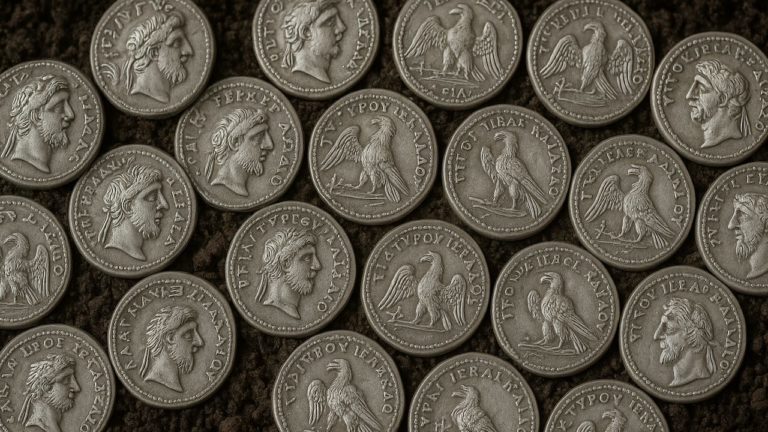
The biblical account doesn’t reveal the exact coins Judas accepted, but we can speculate based on the archeological evidence.

During the time of Christ, there were several different types of coins in circulation, including Roman coins such as the denarii, provincial coins influenced by the Greeks, and temple coins accepted by Jewish authorities.

The most likely candidate for Judas’s payment was the Tyrian shekel. These coins were valued for their purity (94 percent silver or greater) and were accepted in the Jerusalem temple for payment of temple taxes.

The fact that Judas later threw the coins into the temple and the priests used the money to buy a potter’s field implies that the coins were temple-compliant. This would not have been the case for Roman or Greek coins due to their less consistent purity and their pagan imagery.

Tyrian shekels also featured pagan imagery – the head of Melqart, a Phoenician god identified with Heracles. However, this was considered less offensive than some of the Roman and Greek coinage and was mitigated somewhat in the eyes of Jewish officials due to the coins’ consistent weight and purity.

A Tyrian shekel weighed around 14 grams. Given the weight, the 30 coins would have weighed in at around 420 grams or 13.5 ounces. At today’s silver price, the coins would be worth about $442.

That’s not an insignificant sum, but it seems like a rather paltry price for a man’s life.

If Judas had collected his fee in gold, he would have had over $45,000 at the current price.

Whether you believe the biblical account or not, it certainly reveals some universal truths about human nature. It also underscores an economic truth – silver and gold have served as money for thousands of years. It had value then, and it retains that value today.


Mike Maharrey is a journalist and market analyst for Money Metals with over a decade of experience in precious metals. He holds a BS in accounting from the University of Kentucky and a BA in journalism from the University of South Florida.

Can the Gold Bull Keep Up This Pace?

(Mike Maharrey, Money Metals News Service) Gold’s record run has been nothing short of astounding, and it appears the bulls have plenty of strength left in them.

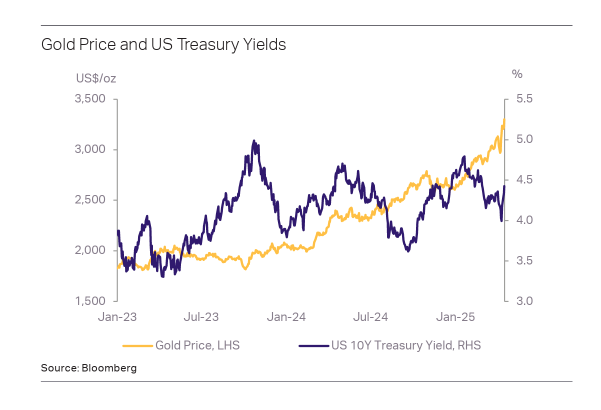
Since the beginning of the year, the price of gold is up by over 25 percent. That’s on top of a 26.5 percent increase in 2024. The yellow metal is by far the best-performing asset of the year.

According to Metals Focus, “considerable” fresh inflows from institutional investors have been a major factor in the latest leg of this bull run. We see this trend in significant flows of gold into ETFs. According to the latest data from the World Gold Council, gold-backed funds accumulated 226 tonnes of gold in the first quarter, the largest quarterly increase since the third quarter of 2020 at the height of the pandemic shutdowns.

ETF demand has been strong across all regions, and while Western investment continued to dominate global ETFs, demand has ramped up in China and India as well. Gold ETFs in China added 29 tonnes of gold in the first eleven days of April. That surpassed total inflows in Q1.

Can the Bull Keep Running?

According to analysts at Metals Focus, the bull run still has plenty of momentum behind it.

“Uncertainties are likely to remain elevated for some time, and this looks likely to drive prices to new highs in the coming months.”

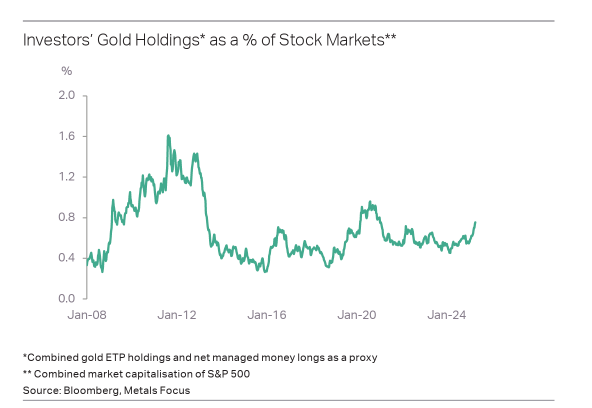
Despite rising investment inflows, investor gold allocations remain below levels seen at the height of the pandemic and well below the Great Recession.

“This leaves considerable room for further investment inflows, particularly among those investors with a medium-to-long-term view.”

Higher gold prices have created some headwinds in the gold market, particularly in jewelry demand. Metals Focus analysts argue that this market tightness will eventually ease.

“As physical markets become accustomed to higher prices and become convinced the uptrend is here to stay, gold’s fundamentals should improve.”

What is driving this gold bull market?

The simple answer is the trade war and the uncertainty that comes along with it. But it’s important to remember that gold started climbing long before President Trump moved into the Oval Office, and there are other factors in play, including de-dollarization, geopolitical instability with military conflicts in Ukraine and the Middle East, and inflation worries.

However, tariffs are currently in the spotlight. Metals Focus noted, “President Trump’s hardline trade policies have rekindled fears of stagflation, which subsequently led to a sharp pullback in U.S. equities.”

Federal Reserve Chairman Jerome Powell even raised the specter of stagflation during a speech earlier this week.

It’s interesting to note that gold was the last safe haven standing during the stock market rout last week. Metals Focus pointed out that other haven assets, including bonds and the U.S. dollar, have not fared well.

“Unlike previous equity routs, when the dollar and Treasuries typically benefited due to their safe haven appeal, both have suffered massive sell-offs in early April. It is worth noting that, prior to the latest bond market rout, US debt had already attracted increasing attention, as both high debt levels and interest rates make servicing them expensive. Trump’s unpredictable policies have undoubtedly exacerbated concerns as to whether the US dollar and Treasuries should still be viewed as the ultimate risk-free assets.”

Monetary easing has also created tailwinds for gold. Central banks in India, New Zealand, and the Philippines all cut rates last week, and the European Central Bank delivered another cut this week. While the Federal Reserve has held rates steady, the markets have priced in three rate cuts this year. That assumes no major economic meltdown. If the economy crashes, as many now expect, the U.S. central bank will almost certainly slash rates to zero and relaunch quantitative easing, unleashing another tidal wave of inflation.

Central bank gold buying has supported this gold rally from the beginning. Central banks globally have added over 1,000 tonnes of gold to their reserves for three straight years. To put that into perspective, central bank gold reserves increased by an average of just 473 tonnes annually between 2010 and 2021.

Metals Focus notes that “factors that had encouraged central banks to diversify portfolios in recent years have remained intact so far this year.”

“If anything, uncertainty surrounding U.S. foreign and trade policies and recent Treasury market volatility all justify an accelerating pace of de-dollarization, which tends to benefit gold.”

Metals Focus maintains a “positive view” toward gold prices in the coming months, with economic and geopolitical uncertainty remaining high.

“Despite a 90-day pause and some relief, current U.S. tariff rates still stand at their highest in the post-war period. A short-term slowdown appears inevitable, considering the likely inflationary effects and the resulting hit to purchasing power.”

Metals Focus said it is too early to forecast a recession, but it doesn’t seem to be factoring in the bubble economy blown up by the Federal Reserve’s monetary policy into its analysis.

However, it is considering the broader ramifications of U.S. trade policy.

“The Trump administration’s economic policies are likely to raise more questions about the prospects for U.S. assets, including equities, Treasuries, and the dollar. Against this backdrop, diversification is often seen as a prudent strategy, as does an allocation to gold.”

Keep in mind that while the overall environment is extremely bullish for gold, it won’t likely be a ride straight up.

“Near-term corrections are likely to occur as tactical players take profits or perhaps experience margin calls triggered by another round of equity liquidations. The downside, however, should be limited, as there are still investors sitting on the sidelines waiting for opportunities to enter the market.”


Mike Maharrey is a journalist and market analyst for Money Metals with over a decade of experience in precious metals. He holds a BS in accounting from the University of Kentucky and a BA in journalism from the University of South Florida.

DOJ Wants to Return $62,813 Seized from a Jan. 6 Provocateur—but a Judge is Blocking It

(Ken Silva, Headline USA) When left-wing activist John Sullivan was convicted in November 2023 of entering the Capitol on Jan. 6, 2021, the U.S. government seized the $62,813.76 that he earned selling footage of the event.

After the Sullivan received a pardon in January and the Justice Department dropped its case against him for good, he moved to have that money returned to him. The DOJ agreed to return the money to him.

However, U.S. Judge Royce Lamberth is blocking the DOJ from returning the seized funds to Sullivan. In an order issued last week, Judge Lambert suggested that returning the money to Sullivan would be illegal if the money is already sitting in the Treasury Department.

“It seems obvious that this Court’s power to grant Mr. Sullivan the relief he seeks, and the government’s lawful authority to remit Mr. Sullivan’s funds—as it has expressed its intention to do—depend on whether Mr. Sullivan’s funds have passed at any time into the custody of the United States Treasury,” Judge Lamberth said in an order on Saturday.

“Neither party’s brief engages with any of the case law identified above, nor have the parties provided the Court with any information concerning the whereabouts of Mr. Sullivan’s seized funds.”

Judge Lamberth ordered the DOJ to tell him where Sullivan’s funds are, and not to give him any money until he rules on the matter.

On Tuesday, the DOJ told Judge Lambert that Sullivan’s funds indeed made it to the Treasury. But DOJ lawyers said he should get his money anyway.

For starters, the DOJ noted that Sullivan’s conviction was never finalized because he still had an appeal pending when he was pardoned. Moreover, while the funds are technically deposited in the Treasury, it’s the U.S. Marshalls that control the money, according to the DOJ.

“Since their deposit on December 27, 2023, the funds have been and continue to be held in the Seized Asset Deposit Fund (“SADF”). Based on consultations with the representatives from [U.S. Marshals Service], the SADF is a deposit fund in the U.S. Treasury,” the DOJ said.

“Practically speaking, on information and belief, the USMS continue to exercise control over the funds.”

The DOJ offered to brief Judge Lambert on the matter further if he desires it. The judge hasn’t indicated when he’ll issue a ruling.

While the DOJ is siding with Sullivan, most Jan. 6 protestors have accused him of being a nefarious left-wing provocateur. To their point, Sullivan allegedly brought to the Capitol a retractable knife with an almost four inch blade. He also encouraged violence by telling other protestors, “We’re taking this shit to the ground,” “burn this shit down,” and “let’s fuck this shit up.”

Sullivan did pay for his crimes. Along with the money sent to him, he spent more than a year in solitary confinement, according to filings from his lawyers, who said they saw “a dramatic decrease in his mental stability and his overall physical presence” during that time.

Ken Silva is the editor of Headline USA. Follow him at x.com/jd_cashless.

US, Ukraine Sign ‘Memorandum of Intent’ To Move Forward on Minerals Deal

(Dave DeCamp, Antiwar.com) A Ukrainian official announced on Thursday that the US and Ukraine had signed a “memorandum of intent” to move forward with an economic deal that would give the US a piece of Ukraine’s rare earth minerals and other natural resources.

“We are happy to announce the signing, with our American partners, of a Memorandum of Intent, which paves the way for an Economic Partnership Agreement and the establishment of the Investment Fund for the Reconstruction of Ukraine,” Yulia Svyrydenko, Ukraine’s first deputy prime minister and economy minister, wrote on X.

The exact details of the deal are unclear, but it’s expected to give US companies access to Ukraine’s natural resources and involve them in the country’s reconstruction.

“We hope that the Fund will become an effective tool for attracting investments in the reconstruction of our country, modernization of infrastructure, support for business, and the creation of new economic opportunities,” Svyrydenko said.

President Trump said on Thursday that the US and Ukraine are expected to sign the final deal next week. He has previously suggested that the agreement would ensure the US continues providing military aid to Ukraine.

Ukrainian President Volodymyr Zelensky was initially set to sign a minerals deal when he visited the US on February 28, but the deal fell apart when he got into an argument with Trump and Vice President JD Vance in the Oval Office. Following the blow up, the US briefly paused military aid and intelligence sharing, but it was quickly resumed.

This article originally appeared at Antiwar.com. 

US Removing Hundreds of Troops From Syria, 1,400 Will Remain

(Dave DeCamp, Antiwar.com) The United States military has started removing hundreds of troops from Syria but will leave over 1,000 in the country, at least for now, The New York Times reported on Thursday.

US officials told the Times that the US was shuttering three of its eight bases in northeast Syria and that it would bring troop levels down from 2,000 to 1,400. After 60 days, the US military will assess the situation and potentially make additional cuts to the troop presence.

The report said that US commanders have recommended leaving about 500 troops in Syria. For years, the Pentagon claimed there were only 900 US troops occupying Syria, but the Biden administration revealed late last year that the real number was 2,000.

News of the drawdown comes after the US-backed Kurdish-led SDF signed an integration agreement with the HTS-led Syrian government. Under the deal, the SDF has been handing over territory in northern Syria to government forces, which has eased tensions with Turkey and ended fighting between the SDF and the Turkish-backed SNA.

The SDF integration agreement was seen as a step toward a potential US withdrawal or drawdown since it would lessen the threat of Turkey launching another military offensive against the Kurds.

Israeli media recently reported that the US had informed Israel it would be removing some troops from Syria and that Israel is opposed to any US drawdown or withdrawal from the country due to its concerns over Turkey expanding its presence.

Since the regime change that ousted former Syrian President Bashar al-Assad, which Israel supported, the Israeli military has invaded southern Syria and has been bombing military targets across the country. Israel now appears focused on keeping Turkish forces out of central Syria, warning it would impede the Israeli military’s “operational freedom” in the country.

During the first Trump administration, Israel played a role in convincing President Trump to keep troops in Syria after he announced plans for a withdrawal. At the time, Israel didn’t want Iran or its allies, which included the Assad government, gaining a foothold in the areas currently occupied by the US, which include oil and gas fields.

This article originally appeared at Antiwar.com.

Cruz, Zeldin: Roll Back Biden-Era Regulations Targeting Oil and Gas Industry

(Bethany Blankley, The Center Square)  U.S. Sen. Ted Cruz and Environmental Protection Agency Administrator Lee Zeldin on Thursday visited with oil and natural gas producers in Midland, Texas, to highlight the Trump administration’s plan to “unleash American energy.”

Zeldin is traveling nationwide to highlight EPA deregulatory efforts in individual states. It was the first time an EPA administrator had ever been to Midland, the center of oil and natural gas production in Texas.

Texas leads the U.S. in oil and natural gas production and emissions reductions, breaking records in recent years, The Center Square reported.

The visit also came at a time of uncertainty for the industry as Texas producers, operatives and business owners have expressed serious concerns about Trump administration trade policies they argue are driving up costs and causing the price of oil to crash, The Center Square reported.

Zeldin highlighted an initiative he launched last month: what he says is the largest deregulatory action in U.S. history. Zeldin announced 31 actions the EPA was taking to fulfill Trump’s pledge “to unleash American energy, lower cost of living for Americans, revitalize the American auto industry, restore the rule of law, and give power back to states to make their own decisions.”

The EPA’s deregulatory efforts will roll back trillions of dollars in regulatory costs and hidden “taxes” on U.S. families, he said when announcing the 31 initiatives. “We’re unleashing energy dominance and putting more power in the hands of the states,” he said. The EPA’s deregulatory effort is about “applying common sense, unleashing energy dominance, and empowering states to do more.”

The Texas energy industry not only drives the state’s economy but also defines Texas, Cruz said; “It’s who we are. I spend a lot of time out here in Midland-Odessa because I love the people of West TX and I think the entrepreneurial spirit here is unlike any place on earth.”

Many at the roundtable expressed frustration over federal regulatory burdens they argue stifle investment, including extensive permitting delays.

Their concerns were similar to those expressed by longtime industry executive and Houston-based Richard Welch and Texas-based oil and natural gas trade associations, who have called on the Trump administration and Congress to implement permitting reforms and eliminate duplicative federal oversight, enabling states to play the primary regulatory role, The Center Square reported.

Of the 31 actions the EPA is taking, many directly impact the U.S. oil and natural gas industry, including regulations like a mandatory Greenhouse Gas Reporting Program the Biden administration implemented in the Clean Air Act that “imposed significant costs on the American energy supply;” wastewater regulations for oil and gas development; a Biden-Harris Risk Management Program rule that made U.S. oil and natural gas refineries and chemical facilities “less safe;” and revising a Biden-Harris “social cost of carbon” measurement that was used to advance their climate agenda, according to the EPA’s deregulation list.

Trump EPA deregulatory efforts will reduce “the cost of living for American families,” making it “more affordable to purchase a car, heat homes, and operate a business,” Zeldin argues.

Deregulatory efforts “will be more affordable to bring manufacturing into local communities while individuals widely benefit from the tangible economic impacts,” reversing Biden and Obama era regulations that “suffocated nearly every single sector of the American economy,” he said.