The Growing Role of Artisanal and Small-Scale Gold Mines

(Mike Maharrey, Money Metals News Service) Artisanal and small-scale mining (ASM) is becoming an increasingly important source of global gold supply.

Artisanal mines are small-scale operations generally run by individuals, families, or small groups using simple tools and minimal mechanization.

The sharply higher gold price has increased the profitability of small-scale mines over the last couple of years. The lack of employment opportunities in some countries has also driven people into mining out of necessity.

According to Metals Focus analysts, increasing technical expertise, wider access to equipment, and increasing demand from some refiners have also provided the ASM sector with a boost.

Meanwhile, several emerging market central banks have committed to buying gold from small-scale operations, securing a stable source of gold for the central banks and a reliable buyer for artisanal operators.

In 2016, ASM produced about 20 percent of the global gold output. In 2025, its share had increased to 24 percent.
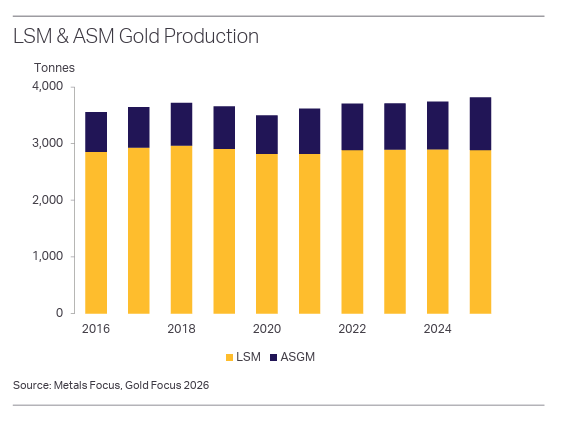
Based on preliminary data, ASM operations produced 932 tonnes of gold in 2025, a 10 percent year-on-year increase.

Where Are the Small-Scale Gold Mines?

ASM operations tend to be clustered in emerging market countries where mining provides a viable income in an economy otherwise lacking high-paying jobs.
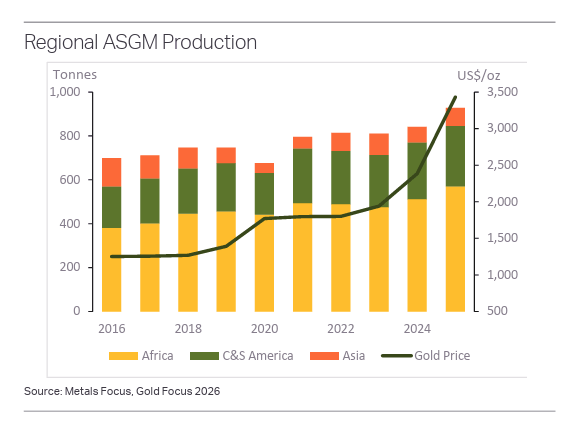
Small-scale and artisanal mines in Ghana lead the world in ASM production.  Ghana ranks as Africa’s top gold producer and the world’s sixth-largest. In 2024, the country produced around 4.9 million ounces of the yellow metal.

Last year, small-scale mines in Ghana produced 102 tonnes of gold, outstripping the large-scale operations for the first time since 2010.

Small-scale mines operate with little oversight. The Ghanaian government is trying to change that. Earlier this year, the government announced a scheme to buy 127 tonnes of gold from “artisanal” and small-scale mining (ASM) every year.

Under the new government policy, the Ghana Gold Board (GoldBod) will purchase a minimum of 2.45 tonnes of ASM gold every week. According to Reuters, the government board will “consolidate purchases into a formal pipeline targeting more than $20 billion of annual inflows.”

Ghana’s Minister of Finance, Cassiel Ato Forson, said that under the new rules, GoldBod will negotiate offtake agreements and sell the gold it procures through official channels. The board will also be authorized to raise financing to hold three to four weeks of gold supply and deploy derivative and hedging tools to manage risk.

GoldBod was created last year to regulate the ASM sector. It serves as the sole legal aggregator, assayer, and exporter of domestically produced gold. According to Metals Focus, “GoldBod aims to strengthen oversight of the ASM market, improve traceability and reduce both smuggling and environmental degradation.

Peru is the top ASM gold producer in South and Central America. According to Metals Focus, ASM output in Peru has surged by over 160 percent in the last decade.

“Growth has been driven by high prices and the provision of economic opportunities in low-income communities. Expansion into remote areas, such as Madre de Dios in the Amazon region, together with greater mechanization, has also supported production gains.”

Small-scale gold mining has a positive downstream economic impact. According to Metals Focus, “The rapid expansion of the sector has also supported the growth of industries servicing ASM. According to the Instituto Peruano de Economía, the number of registered gold trading and processing companies has increased by 250 percent since 2015.”

Unlike Ghana, the ASM sector remains largely unregulated in Peru.

Bolivia is another top ASM gold producer. In 2025, small-scale mines dug up an estimated 55 tonnes of gold.

Bolivia’s mining industry is dominated by mining co-ops. While legally recognized, the ASM sector remains relatively informal. According to Metals Focus, the dominance of big companies in Bolivian mining created limited incentive for formalization.

However, the country’s central bank is deeply involved in the sector. Last year, the central bank bought 17 tonnes of ASM gold, adding the metal to its reserves.

Indonesia has the largest ASM sector in Asia. Small-scale mines produced an estimated 50 tonnes of gold in 2025.

Many Indonesians turned to mining after the Asian financial crisis.

Like many countries, Indonesia is struggling to regulate small-scale mining operations. According to Metals Focus, the government recently cracked down on illegal mining operations, especially those backed by foreign investors.

“This has highlighted the scale of production occurring outside official channels. The government has introduced programs to formalize the sector and eliminate mercury use. However, most of the miners within the sector still lack key permits to operate.”


Mike Maharrey is a journalist and market analyst for Money Metals with over a decade of experience in precious metals. He holds a BS in accounting from the University of Kentucky and a BA in journalism from the University of South Florida.

A Beautiful (and Valuable) Trophy

(Mike Maharrey, Money Metals News Service) They call soccer a beautiful game.

I’m not so sure.

But I will give it this – soccer has a beautiful gold trophy. And by the way, it is by far the most valuable trophy in sports.

But as for the game – I have questions.

First off, what’s with all the falling down?

I mean, I get it. I know it hurts to get kicked in the leg. But do you know what else hurts? Getting hit with a hockey puck. And I don’t roll around on the ice like I’m on death’s door every time the puck hits me. It feels like in soccer culture, the goal is to act as hurt as possible all the time. In hockey, we prefer to hide our injuries and pretend we’re fine. I’ve seen guys with their teeth lying on the ice react less dramatically than some of these soccer dudes.

The fact that players generally jump up moments after this apparently fatal injury, as if nothing happened, makes it seem that much more ridiculous.

Don’t misunderstand. I get it’s a strategy. They are trying to draw the ref’s attention and get a foul or perhaps a penalty kick. I just think it’s a silly strategy that makes footballers seem like big wusses.

And then there’s offside.

I can’t see it.

I’ve had it explained to me dozens of times. I’ve watched videos. I’ve asked soccer friends to help. I get the concept.

But I can’t see it.

This drastically reduces my viewing enjoyment. I get all excited about a goal, and inevitably the ref raises his little flag to tell me it’s offside. How he knew remains a mystery, but there ya go.

I’m looking forward to the day when I see it myself. But I’m not going to hold my breath.

Along those same lines, the video review system in soccer is – interesting. And by interesting, I mean incomprehensible.

I saw a goal called off the board because of a foul that occurred long before on the opposite end of the field. If it were like basketball and there was plenty of scoring, it wouldn’t really matter. But when you may only see one goal a game, having it disallowed because of a phantom foul 30 seconds earlier on the other side of the pitch is a tad frustrating.

A Beautiful Gold Trophy Growing in Value

But about that trophy.

It is beautiful.

And it is gold.

Sculptor Silvio Gazzaniga designed the World Cup trophy. It depicts two figures holding up the Earth.

The trophy weighs in at 6.175 kilograms and is formed from 18-karat gold. In other words, the metal is 75 percent pure gold. Doing some simple math, we find that the gold weight comes in at approximately 4631 grams (4.631kg).

So, what is the melt value of the trophy?

Gold is right around $4,000 an ounce, and 4,631 grams equals 148.89 troy ounces. That means the current melt value of the World Cup trophy is about $596,000.

Now consider this. The last time they played a World Cup (2022), the average gold price was around $1,734 per ounce. At that price, the melt value of the trophy was only $258,170. In other words, the value of the gold in the World Cup trophy is up 130.9 percent in four years!

When they created the World Cup trophy in 1974, the gold was valued at just $25,000!

Interestingly, the trophy is insured for more than $20 million. That goes to show the intangible value far exceeds the cost of the metal.

Unfortunately for the winner, they don’t get to keep the original trophy. The team gets a gold-plated replica, and each player receives a smaller bronze version of the iconic trophy.

In fact, the World Cup trophy cannot leave Switzerland unless it is being transported to a World Cup event.

At any rate, the value of the trophy reflects the value of gold. It’s almost certain that when they play the next World Cup in 2030, the trophy will be worth even more. Or I should say, the value of the dollar we price the trophy in will be less.


Mike Maharrey is a journalist and market analyst for Money Metals with over a decade of experience in precious metals. He holds a BS in accounting from the University of Kentucky and a BA in journalism from the University of South Florida.
Antifa the Focus at Rubio-Hosted International Summit

(The Center Square) Secretary of State Marco Rubio highlighted what he described as the growing threat of left-wing terrorism Thursday at a ministerial he convened at the State Department comprising representatives from over 60 countries.

The summit comes months after the Trump administration designated Antifa a domestic terror organization, followed by Rubio designating a handful of European Antifa groups as foreign terror organizations.

The secretary warned against the growing threat of left-wing violence against Western civilization, noting that the threat is getting worse.

“You are here because this is real and it is getting worse, and it can no longer be denied, and it can no longer be ignored because it’s time to crush this evil forever,” Rubio told the international coalition.

The secretary tried to debunk dismissive claims from critics that the threat is not real or is inflated by conservatives.

“The simple fact is, none of this that I’ve described is new. Far left political terrorism is not a recent day modern novelty,” Rubio said. “It’s not a fiction manufactured by conservative politicians for most of the modern era. It was in fact the dominant form of political violence.”

The secretary accused some of dismissing the violence as long as it served the interests of “left-wing” activists.

“It is a poisonous resentment cloaked in the language of equality, justice, liberation – an overwhelming need to tear down what greater men have built, to wreck what is beautiful and right,” Rubio said.

“So many people in positions of power have repeatedly dismissed acts of violence and terrorism as legitimate forms of political expression, so long as they served a left-wing cause,” the secretary added.

Rubio broke down the pipeline between Antifa in the U.S. and Europe, characterizing it as a dark, underground network.

“Antifa militants and their comrades travel from across Europe and to the Americas to participate in each other’s attacks, to funnel propaganda and training, materials and target information through shared encrypted channels, moving through underground networks of safe houses, and finance and sustain their operations through transnational funds,” the secretary added.

He went on to connect “hostile nations,” like Iran and Cuba, working with Antifa, claiming they “share their mission” to destroy the West.

“They despise the west because the west is great,” Rubio argued.

As part of the Trump administration’s commitment to fight the scourge of political violence, Rubio is vowing to “dismantle” the terror networks “brick by brick.”

Treasury Secretary Scott Bessent also took part in the summit, focusing on targeting the financial network funding the movement.

“We are examining where tax-exempt status has been exploited, where charitable entities have become financial conduits for foreign influence, and how those entrusted with stewardship of these organizations have instead enabled violence,” said Bessent.

The secretary peppered in some personal experience of being targeted by left-wing political violence.

“I was the subject of an assassination attempt February 2024 by an addled left-wing activist two hours after being sworn in to my job,” Bessent said. “So any of you who want to report that this is a fiction and does not exist, be there for the sentencing this August.”

The terror designations paved the way for the State Department to target individuals or groups by cutting off or freezing their access to global financial systems to curb potential attacks.

The designations came after The Center Square asked the president if he would designate the group a foreign terror organization during a roundtable in October at the White House on Antifa, comprised of independent journalists, to which Trump responded, “Let’s get it done.”

The State Department identified four European-based organizations, which either claimed or have been accused of carrying out a series of violent attacks in a handful of countries.

The groups include German-based Antifa Ost, which the State Department says has been known for “wielding hammers in premeditated attacks.” The group was designated a terror organization in Hungary in September after a “series” of attacks in Budapest occurring in February 2023. The group has also been accused of several attacks in Germany between 2018 and 2023.

The second group, The International Revolutionary Front, an Italian-based group, is described as a “coalition of violent anarchists,” which has claimed responsibility for a shooting and injuries suffered by several people after the group “sent a series of bombs” to political leaders, embassies and civilians. The State Department stated that, despite the group operating out of Italy, it has “proclaimed affiliates” in Europe, South America and Asia.

The third group, a Greek-based organization, the Armed Proletarian Justice group, is described as anarchists who have waged “armed conflict against police officers and state infrastructure.” State said in a failed attack, the group planted a homemade dynamite bomb near a riot police headquarters in 2023.

The final group, also a Greek-based anarchist organization, known as the Revolutionary Class Self Defense, claimed responsibility for an attack on the Greek Ministry of Labor in 2024 and recently targeted major railway offices in April. The State Department says that the group used improvised explosive devices in those attacks.

The State Department has indicated that there could be more organizations designated as the Trump administration continues to “identify and disrupt Antifa’s terror networks across the world.”

The foreign designations came less than two months after The Center Square asked the president in the Oval Office if he would designate the leftist group a domestic terror organization, which he said he’d do. A week later, the group was officially designated a domestic terror organization.

Trump Highlights Election Integrity Threats, Accuses China of Meddling

(The Center Square) In a primetime address Thursday, President Donald Trump highlighted the need for election integrity while accusing China of meddling in U.S. elections, citing over a dozen states that he said have been compromised.

Trump began his address by touting the achievements of his administration, citing the economy, lowered prescription drugs, Trump RX, Trump Accounts, the border and the conflict in Iran before leading into a litany of allegations of potential voter meddling.

During his 25-minute address, the president made several allegations against China and its involvement in U.S. elections, announcing the declassification of evidence his administration claims reveals election vulnerabilities.

“Tonight, I’m announcing the immediate declassification and release of critical intelligence, revealing shocking vulnerabilities in our election infrastructure,” Trump said.

The president claims his administration gathered evidence that exposed “hacking, exploration, and foreign interference.”

As part of the documentation, Trump says his administration has released documents surrounding China’s involvement in the 2020 election, describing it as the “largest compromise of election data in history,” adding that it led to “China’s illicit acquisition of 220 million U.S. voter files.”

“That information includes names, addresses, phone numbers, political party preferences, and other sensitive data that would be needed to register to vote and engage in other nefarious activities, which is exactly what was happening,” said the president.

“This data loss presents on unprecedented election security nightmare. The intelligence event shows that China assigned a data exploitation unit specifically to this new project, compounding the travesty.”

Among the evidence, Trump claims China engaged in election meddling, accusing China of compromising “tens of millions of voters’ data in 18 states have been bought, stolen, or hacked by China.”

“Starting during the 2020 election cycle, China carried out what is believed to be the largest compromise of election data in history,” Trump said during his address.

The president says the CIA obtained information pointing to China’s meddling in U.S. elections, claiming, “for many years Americans were blatantly lied to about the security of our election infrastructure, including voting machines and ballot county systems.”

He also accused the “deep state” within the federal government of burying the evidence.

In addition, Trump cited that the Department of Homeland Security found that approximately 278,000 non-citizens “are registered to vote in federal elections,” adding, “since Democrat states refuse to share their voter files, the real number is actually much higher than that.”

Trump warned that “hundreds of millions of U.S. voter files are in the hands of foreign governments. Our machines and ballot counting systems are exposed to hacking, manipulation and corruption.”

He added that “hundreds of thousands of non-citizens and dead people are listed and active on the voter rolls, any yet we still have elections with no voter ID, proof of citizenship, and tens of millions of ballots floating aimlessly through the mail.”

Trump also announced that the secretary of Homeland Security will hold a briefing Friday to “outline his department’s recent work confirming cyber vulnerabilities in our electronic voting systems.”

The president concluded his address with a push for passage of the Save America Act, calling on Americans to pressure their members of Congress to approve the landmark legislation that would require voter ID and curb mail-in ballots.

MAGA Civil War Erupts Over Trump’s Celebrity Whisperer

(José Niño, Headline USA)  Rep. Randy Fine, R-Fla., has put White House officials on notice that he intends to torpedo every rule hitting the House floor until President Donald Trump drops adviser Alex Bruesewitz, NOTUS reported, citing three sources.

For weeks Fine has worked his colleagues with the same message, that Bruesewitz must go, one source told NOTUS, and his push sharpened recently. Fine stood alone among Republicans on Tuesday in opposing the rule that sets the terms for how the chamber takes up certain bills this week. Two sources familiar with the matter told NOTUS that Fine informed the White House the no votes keep coming until Trump cuts Bruesewitz, who draws no federal salary but commands the president’s attention.

The pressure falls on House Speaker Mike Johnson, whose narrow Republican cushion cannot absorb defections. NOTUS reported the impasse could freeze any meaningful legislation ahead of the midterms.

“The White House will continue working closely with members to advance the President’s agenda,” a White House official told NOTUS.

Fine and Bruesewitz both stayed silent when NOTUS sought comment.

Their clash ignited after Bruesewitz sat down for “The Tucker Carlson Show”, where the host tagged Fine as “that creepy fat guy from Florida who endorsed genocide.” Bruesewitz then swung toward Fine’s primary opponent, influencer Dan Bilzerian, and dismissed the pair of them.

“We have two extremes running that race, both I don’t agree with. So we have Dan Bilzerian, maybe one of the people who’s helped bring degeneracy to young men in America more than anybody. And Randy Fine. Maybe we need some better choices,” Bruesewitz said.

Fine hit back last month, calling out Bruesewitz, Carlson and Candace Owens on X.

“There is a mind virus that is trying to infect the Republican party,” he wrote. “Tucker, Alex Bruesewitz, and Candace Owens fundamentally hate the American origin story. They seek to pit Jews and Christians against each other and fetishize Islam to distract from its stated goal to destroy the West.”

Bruesewitz, 29, keeps close ties to Trump and to top West Wing staff. He built out Trump’s 2024 podcast tour and pulled young men toward the ticket, NOTUS noted. He also brought rapper Nicki Minaj into MAGA politics.

Trump has not budged. Bruesewitz has shared photographs from inside the Oval Office with Minaj and the president while Fine keeps pressing his demand, NOTUS reported.

Trump backed Fine when he claimed the seat in a 2025 special election. Bilzerian and other Republicans now challenge him in an August primary.

José Niño is the deputy editor of Headline USA. Follow him at x.com/JoseAlNino 


Hunter Biden’s $1.7 Million Defamation Victory Is Short-Lived

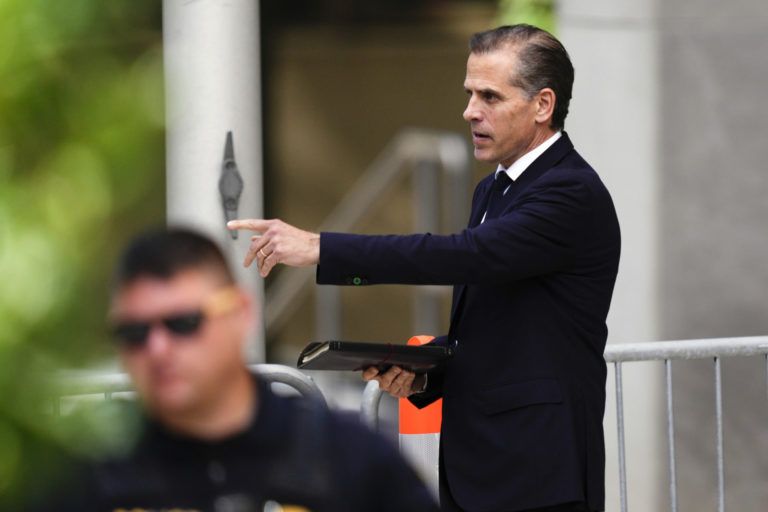
(Luis CornelioHeadline USA) Just last week, disgraced former first son Hunter Biden celebrated after a federal judge awarded him over one million dollars in connection with a defamation lawsuit. But that victory may be short-lived after his former attorneys filed a lien seeking the proceeds.

The June 10 $1.7 million judgment stems from Biden’s lawsuit against former Overstock CEO Patrick Byrne, whom Biden alleged falsely accused him of participating in an $800 million bribery scheme.

On Thursday, Biden’s former attorneys at Winston Taylor filed a lien seeking the $1.7 million judgment to recover payment for legal services they say remain unpaid, as reported first by the Washington Free Beacon.

Attorneys Shawn R. Obi and Scott M. Ahmad wrote in the court filing that they represented Biden on an hourly basis from Dec. 23, 2022, through March 12, 2025.

In the lien filing, Obi and Ahmad noted that the amount Biden owes them “substantially” exceeds the $1.7 million judgment.

According to the filing, Biden retained Obi and Ahmad to represent him in matters tied to congressional oversight and investigations, as well as the criminal investigations led by the DOJ and David C. Weiss, the former U.S. attorney for the District of Delaware and former special counsel.

The attorneys also represented Biden in the defamation lawsuit against Byrne, which was filed on Nov. 8, 2023. They added that they have filed a separate collection lawsuit against Biden in the Superior Court of the District of Columbia.

U.S. District Judge Stephen Wilson presided over the defamation case and entered Biden the $1.7 million judgment against Byrne after Byrne seemingly failed to properly respond to the lawsuit.

Despite celebrating the ruling in multiple posts on X, Biden made no mention of his former attorneys. Biden has repeatedly claimed to be broke, saying his painting business faltered after his father, former President Joe Biden, left the White House in 2025.

He has since attempted a media comeback by appearing on unconventional programs, including The Candace Owens Show, and by giving an interview to Nick Fuentes.

Chuck Schumer Dodges Question about Senate Floor ‘Fart’

(Luis CornelioHeadline USA) Senate Majority Leader Chuck Schumer, D-N.Y., remained tight-lipped on Thursday when confronted about whether he let one loose during a speech a day before.

Schumer declined to address online rumors that he may have farted while delivering remarks on the Senate floor on Wednesday, as captured live by C-SPAN.

“Did you fart yesterday on the Senate floor?” TMZ reporter Jacob Wasserman asked as Schumer wrapped up fielding questions outside the U.S. Capitol.

Schumer, seemingly unfazed by the question, did not respond as he walked toward his black SUV, accompanied by bodyguards.

Wasserman’s question came after Schumer gained viral attention on social media when an audible sound was picked up through his microphone during his remarks.

Before the noise was picked up, Schumer was about to discuss the Iran war and Senate Democrats’ blockade of the $1.15 trillion National Defense Authorization Act for Fiscal Year 2027.

“Now on Iran and the NDAA,” Schumer said, with his hands in his pants pockets, before a sound resembling an air leak was heard.

Critics online quickly speculated that the sound was a “loud fart,” pointing to Schumer’s reaction as he briefly appeared uncomfortable, looked upward and then shifted his position.

Schumer’s team has not addressed the viral attention either.

Illinois Rep. Pleas not Guilty, Wants to Delay House Investigation

(Sean Reed, The Center Square) Illinois State Rep. Carrol Ammons, recently federally indicted on multiple charges of wire fraud, pleaded not guilty in her first court appearance Thursday morning.

With the courtroom gallery at its maximum capacity of 49 people, roughly 30 people, consisting of members of the public — along with friends, family and supporters of the representative — were sent to watch the hearing in an overflow room in the Urbana federal court building.

Ammons, charged with eight counts of wire fraud and one count of witness tampering, entered a not guilty plea beside her two lawyers, Mutaquee Akbar – who is from Florida – and Angela Reany – an attorney from the Carbondale area.

Federal Magistrate Judge Eric Long, of the Central District of Illinois, scheduled a virtual discovery hearing for 11:30 a.m. on Aug. 24.

After being processed, Ammons, and her husband, Aaron Ammons – who is the Champaign County clerk – addressed reporters outside the court building, flanked by their lawyers, family and supporters.

Ammons gave her first in-person statement since being charged.

“I want to offer my appreciations to everyone who’s reached out with encouragement, prayers and support. I respectfully ask for patience as this process moves forward. My legislative record is clear and speaks for itself, and today is about protecting the judicial process,” Ammons said. “I maintain that these allegations are not true and I look forward to responding to them through the legal process where the facts can be formally examined.”

One self-described “reparations activist,” Kamm Howard of Chicago, announced the establishment of a Representative Carol Ammons and Aaron Ammons legal defense fund, and described the indictment against both as targeting the movement advocating to give reparations to Black Americans.

“We are now witnessing a disturbing change in passive resistance to active federal enforcement against reparations initiatives. In September last year, the Department of Justice warned officials of Asheville and Buncombe County, North Carolina, that it stood ready to investigate and enforce federal law if they added recommendations to develop a community reparations process,” Howard said.

Howard also referenced a motion last month by the DOJ to dismantle Evanston’s reparations program.

“We’ve done resolutions recently so that African Americans can close what’s ethnocide that’s happened to us as a result of the trafficking period. That’s House Resolution 453,” Ammons said.

HR 453 is a congratulations for a local union president’s retirement.

Ammons, however, sponsored HR 211, which called for the return of artifacts known as the the Benin Bronzes, which originated in Africa and were taken from slaves by slave traders, and subsequently obtained by the British Museum.

If found guilty of the charges, Carol Ammons could face up to 15 years in prison, and potential financial penalties, plus payment of restitution for funds she is alleged to have defrauded the state of, according to Long

There is no minimum to the potential punishment if she is found guilty, according to the judge.

As for the special legislative committee in the Illinois House, a spokeswoman for Minority Leader Tony McCombie told The Center Square they expect more details on the timeline to convene sometime before the end of the week.

Asked if the representative would seek to use her right to representation and attendance at special investigative committee hearings, Akbar said they want the legislature to hold off for now.

“We’re looking into that part as well. Of course, we don’t want that proceeding to get in the way of this proceeding,” Akbar said. “Hopefully we can postpone that so we can focus our attention on her due process rights in federal court.”

Long set a trial date for Sept. 22.

Bipartisan Bill Would Force Vote Before Social Security Cuts Hit

(Brett Rowland, The Center Square)  A bipartisan group of senators introduced legislation that would fast-track a floor vote on Social Security’s looming insolvency, using an independent board to draft a starting plan Congress could no longer easily ignore.

The Protecting Retirement Opportunities and Maintaining Income Security for Everyone, or PROMISE Act, would direct the Social Security Advisory Board to submit a base bill guaranteeing at least 50 years of solvency. Congress would then be forced to debate, amend and vote on it within 100 hours, bypassing the inaction that has left the retirement trust fund six years from depletion.

Eight senators from both parties are behind the bill: Senate Democratic Whip Dick Durbin, D-Ill., and Sens. Bill Cassidy, R-La., Tim Kaine, D-Va., Thom Tillis, R-N.C., Angus King, I-Maine, John Cornyn, R-Texas, Chris Coons, D-Del., and Alan Armstrong, R-Okla. Three of them – Durbin, Cassidy and Tillis – are leaving the Senate at the end of their terms.

More than 70 million Americans receive Social Security benefits. The 2026 Social Security Board of Trustees report found the retirement trust fund will be depleted in 2032, triggering an automatic 22% cut to benefits – about $450 a month for someone receiving the average benefit of $2,071, according to the senators’ release.

“Here is our chance to agree on a bipartisan process to rescue Social Security this year,” said Durbin. “We were elected to solve problems — and there’s no greater problem than the solvency and future of Social Security.”

The PROMISE Act follows a House effort. Reps. Tom Cole, R-Okla., and Tom Suozzi, D-N.Y., introduced the Bipartisan Social Security Commission Act in June, which would create a 13-member commission to develop a 75-year solvency plan, with its own expedited path to a floor vote if Congress fails to act within three legislative days of receiving the commission’s report.

Maya MacGuineas, president of the Committee for a Responsible Federal Budget, called the bill “a thoughtful bipartisan process to help Congress do its job.”

“Social Security is going to need to collect more revenue, slow projected cost growth, or some combination,” she said. “There’s no magic third alternative that doesn’t involve borrowing hundreds of trillions of dollars and thrusting the country into a debt spiral.”

Anqi Chen, associate director of savings and household finance at the Center for Retirement Research at Boston College, said the PROMISE Act does not itself solve Social Security’s shortfall but could help.

“The PROMISE Act is a process bill, so it does not provide any solutions,” Chen told The Center Square. “Think of it as a teacher setting up interim milestones or check-ins so students don’t wait until the last minute to do their assignment.”

Chen said a 50-year solvency requirement, short of the traditional 75-year standard, is still meaningful given the timeline.

“The Social Security Trust Fund will be depleted in six years,” she said. “A 50-year solvency plan would be a celebrated improvement from no plan.”

Chen said routing the process through the Social Security Advisory Board gives lawmakers a starting point rather than a blank slate.

“This process can hopefully help lawmakers get started,” she said.

A spokesperson for Senate Finance Committee Chairman Mike Crapo, R-Idaho, did not respond to a request for comment by publication time.

Shai Akabas, vice president of economic policy at the Bipartisan Policy Center, said the bill’s forcing mechanism sets it apart from past reform efforts.

“With Social Security’s primary trust fund just six years from depletion – and an automatic 22% benefit cut the legally mandated consequence of inaction – Congress simply cannot afford to keep letting this issue stall,” Akabas told The Center Square. “What makes the PROMISE Act credible is that it doesn’t just ask Congress to act; it changes the procedural calculus to make action harder to avoid.”

Akabas said the bill’s decennial review requirement means the 50-year solvency bar isn’t a ceiling.

“Fifty years of solvency would be a monumental achievement,” he said. “The PROMISE Act also mandates a once-per-decade solvency review, with the same fast-track procedure triggered automatically if future shortfalls are projected – so 50 years isn’t a ceiling, it’s a floor.”

AARP and the Alliance for Retired Americans, two advocacy groups representing older Americans, did not respond to requests for comment by publication time.

Three of the bill’s sponsors will not be in the Senate to see whether it succeeds.

Lawmakers Cast Doubt on Ex-Obama Official’s Testimony About Epstein Ties

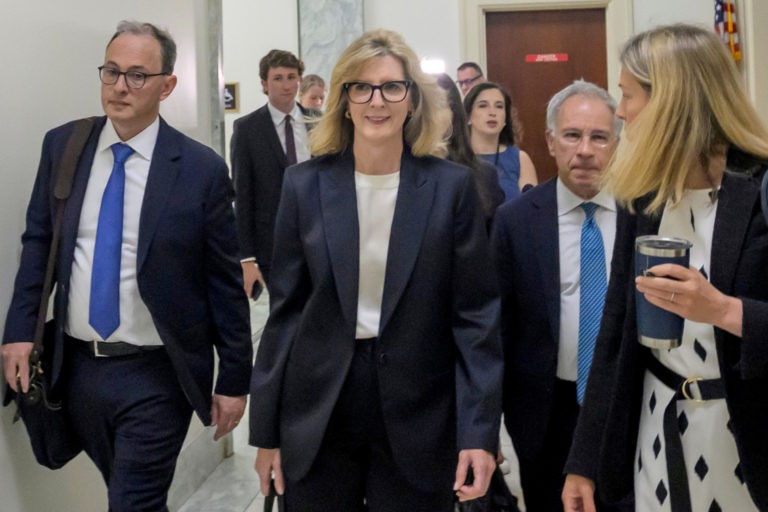
(Headline USA) Lawmakers said Kathryn Ruemmler, the former top lawyer at Goldman Sachs and White House counsel to President Barack Obama, was not being truthful Wednesday about her relationship with Jeffrey Epstein, rejecting her testimony that Epstein had merely “used” her.

Ruemmler in her opening remarks told members of the House Oversight Committee that “it was a mistake to deal with” Epstein, but she insisted she never witnessed criminal activity. She said Epstein “used me and other respectable people to legitimize his standing.”

Democrats emerged from questioning Ruemmler saying she was not being forthcoming about her ties to Epstein.

“It is difficult to see how she’s being completely truthful in there with the answers she’s given the committee,” Rep. Robert Garcia of California, the top Democrat on the committee, told reporters.

Jennifer Connelly, a spokeswoman for Ruemmler, said in response that Ruemmler had “testified openly and truthfully for six hours and answered every question the committee asked.”

Ruemmler is the latest prominent figure called before the House Oversight Committee as lawmakers investigate the network of powerful people connected with Epstein. The bipartisan inquiry has already included testimony from more than a dozen high-profile witnesses, including Microsoft co-founder Bill Gates and former President Bill Clinton, as lawmakers examine how Epstein’s wealth and influence may have helped shield him from scrutiny.

Ruemmler served as White House counsel under Obama from 2011 to 2014 and was briefly considered for attorney general. She served as Goldman Sachs’ general counsel for six years before announcing in February that she would step down amid backlash over her correspondence with Epstein. Although she said she would step down on June 30, she remains employed by Goldman Sachs.

Lawmakers have focused on Ruemmler’s close relationship with Epstein in the final years of his life, pointing to affectionate communications between the two.

“For her to deny that there was any type of real relationship there, I just don’t buy it,” Garcia said. “And so, again, the fact she is not under oath is very problematic.”

While Ruemmler has tried to downplay their relationship in more recent statements, thousands of documents released by the Justice Department showed that Ruemmler and Epstein had an extensive relationship. The files included personal emails, social plans and gifts that extended beyond formal legal work. Documents showed she had called Epstein “Uncle Jeffrey” in emails and said she adored him.

Ruemmler said in her opening remarks that she first met Epstein in 2014 regarding potentially working with him and Gates “to set up a large donor-advised fund.” Soon after, according to Ruemmler, she learned about Epstein’s 2008 conviction on sex crimes, when he became a registered sex offender.

She said Epstein expressed remorse about it, and that he did not know the women were underaged. She said she “relied on the resolution reached by federal and state prosecutors and validated by a judge as being a proportionate and final resolution of his criminal conduct.”

House Oversight Chair James Comer told reporters Wednesday that the “most concerning” part of Ruemmler’s communications with Epstein is how she “tried to rehabilitate his image after he was convicted of solicitation of a minor.”

Comer said Wednesday that Ruemmler is the 18th person to testify as part of their broader investigation.

Billionaire investor Leon Black was subpoenaed last month after lawmakers said he refused to answer some questions about his yearslong relationship with Epstein.

Comer said Wednesday that Black will appear for a formal deposition on Sept. 3 but that he expects to have Black’s nondisclosure agreements by “the end of the week.”

The committee has also expressed interest in questioning acting Attorney General Todd Blanche, whose nomination to permanently lead the Justice Department is pending before the Senate. Former Attorney General Pam Bondi identified Blanche as the department’s point person on the release of the Epstein documents, a process that has drawn bipartisan scrutiny.

“Hopefully Blanche will come in as soon as his confirmation is over,” Comer said.

During a lengthy podcast interview with Joe Rogan released Wednesday, Vice President JD Vance said the administration “absolutely” mishandled the communications surrounding the Epstein files and its contents. Vance pointed largely to Bondi, who infamously stated that an alleged “client list” of Epstein’s was “sitting on my desk right now.”

Adapted from reporting by the Associated Press