


Warren Buffett Explains Why His Kids, Not the Gates Foundation, Will Now Give Away All His Fortune

(Headline USA) Billionaire Warren Buffett said Wednesday that his decision to cut the Gates Foundation out of his charitable giving is more about believing his three kids are ready to handle giving away his entire fortune than it is about Bill Gates’ ties to convicted sex offender Jeffrey Epstein.

Buffett told CNBC that Gates’ association with Epstein was “distasteful,” but the 95-year-old investor suggested that Gates’ actions weren’t much different from mistakes he himself had made over the years in hiring the wrong person or in choosing friends.

“No one bats a thousand in the business of choosing people,” Buffett said on CNBC.

Buffett said he “read a great deal since Jan. 1 in terms of what happened with Bill and Epstein. And I have read his remarks to Congress given under oath, and I read the cross-examination.” He noted that Gates eventually ended his relationship with Epstein.

Buffett said Gates wasn’t surprised by the decision Buffett announced Tuesday to eventually donate all the rest of his $140 billion of Berkshire Hathaway stock to foundations associated with his family and his three children, Howard, Susie and Peter. 

Gates flew to Omaha a few weeks ago and spent several hours talking with Buffett. The two hadn’t spoken much since before additional details about Gates and Epstein started to come out when the federal government began releasing files from the Epstein investigation.

Gates has said that he only met with Epstein because he thought it might help him raise money for charitable causes, and he didn’t know about Epstein’s ongoing crimes.

Epstein, who was accused of sexually abusing dozens of underage girls, was found dead at the Manhattan federal lockup in August 2019. His death was later ruled a suicide by New York City’s medical examiner.

Gates called Buffett “one of the greatest philanthropists of all time, and a dear friend” who he hopes to spend much more time with in the future.

“His wisdom, generosity, and deep sense of purpose have defined both his life and his philanthropy. His support for the Gates Foundation, at nearly $50 billion over the past twenty years, has been unprecedented, and it has helped save millions of lives,” Gates said in a statement.

Buffett said in 2024 that he planned to cut off donations to the Gates Foundation after he died and let his three children decide how to distribute the rest of his fortune.

The Gates Foundation will still have tremendous resources: its endowment was worth nearly $90 billion at the end of last year and Gates has promised to donate nearly all his remaining fortune to the foundation.

In other news from the CNBC interview, Buffett revealed that he recently broke his leg and underwent surgery for it, but he said he is recovering well.

Buffett said he wants his own Berkshire shares to be distributed even quicker than he has previously indicated: by the end of 2034. To do that, he will have to drastically increase the amount he donates every year, to more than $17 billion annually.

Right now he is giving roughly $6 billion to the Susan Thompson Buffett Foundation and the foundations his children run: the Sherwood Foundation, the Howard G. Buffett Foundation and the Novo Foundation. Buffett filed documents with the Securities and Exchange Commission Wednesday afternoon that showed he had donated a total of 12 million Class B Berkshire shares a day earlier to those foundations.

The majority of that is going to the foundation named in honor of his late wife, which may quickly become one of the world’s largest such organizations. Buffett also traditionally gives additional gifts to his family foundations around Thanksgiving each year.

He has said that after his death, a new foundation will be created to distribute the rest of his shares and that his children will have to agree unanimously on where to donate them. He wants his children to be able to make those decisions before they die or become senile, and his oldest daughter will be nearly 81 in eight years.

The accelerated pace of Buffett’s plan to give away his fortune over the next eight years rather than doing it over the 10 years following his death will mean that his successor at Berkshire Hathaway, Greg Abel, won’t be able to count on the support of Buffett’s family as the company’s biggest shareholder for as long as he thought. Buffett currently controls nearly 30% of the voting power with his 188,290 Class A shares.

Nevertheless, Buffett said he believes it’s clear that Abel is the right man to lead the conglomerate he built, and “that becomes more evident by the day.”

However, Buffett did note that Berkshire’s big investment in Google’s parent company, which has grown in value considerably over the past year, is one he initiated and not an investment Abel picked, though Abel did agree on it. Just last month, Berkshire agreed to invest another $10 billion in Alphabet after previously tripling its stake in the company. 

Adapted from reporting by the Associated Press

US Mint Produces a $1 Coin Bearing Trump’s Face to Help Celebrate America’s 250th Birthday

(Headline USA) The U.S. Mint has begun producing a new $1 coin bearing President Donald Trump’s face to help celebrate America’s 250th birthday, the Treasury Department said Wednesday.

The final design for the commemorative coin, being released in the fall, was approved earlier this year by the U.S. Commission of Fine Arts, whose members were appointed by Trump. But the finished product unveiled Wednesday differs from that version in a few aspects, including that it is not made of gold but rather has a gold finish.

The coin is intended “to honor the enduring legacy of liberty and a lasting symbol of patriotism,” Treasury Secretary Scott Bessent said in a post on X. “Featuring President Trump, it celebrates the strength of American values, and the promise of a nation dedicated to preserving freedom for all.”

The president on Wednesday told Fox Business Network that the move to put his face on a coin is “very unusual, but I was honored by it,” adding that “it’s very cute they gave me a coin.”

Trump, a Republican, has a penchant for putting his name and likeness in the historical record, following his renaming of the U.S. Institute of Peace, the Kennedy Center performing arts venue and a new class of battleships, among other tributes. The move to put his face on the gold coin has drawn criticism in particular because federal law prohibits the depiction of a living president on U.S. currency, though the treasury secretary has the authority to authorize the minting and issuance of coins in some circumstances.

The front of the coin features an image of Trump in a suit and tie and with a stern look on his face. Lettering on the top half of the coin’s arc spells “LIBERTY,” with the dates 1776-2026 on the bottom half of the arc. The words “IN GOD WE TRUST” are in the middle.

The reverse side depicts the traditional image of the bald eagle in the Great Seal of the U.S., with “UNITED STATES OF AMERICA” on the top half of the coin and the Latin phrase “E PLURIBUS UNUM,” meaning “Out of many, one,” on the shield emblazoned on the bird’s breast.

Among the other differences from the design approved earlier this year is that Trump doesn’t have his fists resting on top of what is supposed to be a desk as he leans forward. The Treasury Department did not specify Wednesday why the final product diverged from the originally approved design.

The Treasury Department announced in March that it would be putting Trump’s signature on all new U.S. paper currency.

Traditionally, U.S. paper currency carries the signatures of the treasury secretary and the treasurer, not the president.

Adapted from reporting by the Associated Press

Republican Senator Says Blanche Must Meet Epstein’s Accusers to Earn His Vote for Attorney General

(Headline USA) A Republican senator whose vote Todd Blanche needs to advance his nomination as attorney general suggested Thursday that his support hinges on Blanche first meeting with Jeffrey Epstein’s accusers.

Sen. Thom Tillis’ comments came a day after Blanche was pressed during his confirmation hearing over the Justice Department’s handling of millions of files related to Epstein’s sex trafficking investigation.

Tillis said Thursday that he has a “positive predisposition” toward Blanche but has not made up his mind. Tillis pointed to Blanche’s remarks Wednesday expressing a willingness to meet Epstein’s accusers, and added that he expects such a meeting to occur before he’s “willing to vote out of this committee.”

Shortly after Tillis’ remarks, Blanche arrived at a Senate office building, where Blanche told reporters he had hoped to meet with Epstein accusers but “it didn’t work out.” Blanche said they were trying to find another time later Thursday or another day to schedule the meeting.

“The Department of Justice will always meet with victims or their representatives, and if those victims or their representatives have evidence that anybody committed a crime — whether it has to do with Jeffrey Epstein or anybody else — we will of course move forward and investigate and prosecute,” Blanche said.

One Epstein accuser, Dani Bensky, told lawmakers earlier Thursday that women harmed by Epstein repeatedly asked to meet with Blanche “through multiple channels and he never responded.”

“We deserve to be heard directly, not dismissed and ignored,” Bensky said.

Blanche has pushed back on suggestions that the Justice Department has been dismissive of the late financier’s accusers, saying Wednesday that officials have spoken with more than 30 representatives of the women over the course of its sweeping review of the files.

Blanche has also defended the department’s staggered release of the Epstein files, a process beset by problems, including redaction errors that left exposed nude photos showing the faces of potential victims.

Blanche said during his confirmation hearing on Wednesday that he takes responsibility for mistakes that were made, but noted that department lawyers were given a “herculean task” to quickly review millions of files for release. Blanche said department lawyers took pains to protect the women involved, and quickly fixed any errors that were found.

“I am sorry that in about 1% of the documents mistakes were made,” Blanche said Wednesday. “But what I will say on top of that is we put tons of resources to rectifying those mistakes immediately, including pulling down documents within minutes of being informed that there were mistakes.”

Adapted from reporting by the Associated Press.

US Government Runs Another Big Deficit in June as Interest Expense Climbs

(Mike Maharrey, Money Metals News Service) Tariff refunds and a jump in spending driven by higher interest expense drove yet another big budget deficit in June.

Last month, the Trump administration spent $120.3 billion more than it took in. That was a 545 percent increase over the June 2025 deficit (a $27 billion surplus).

The June budget shortfall drove the fiscal 2026 deficit to $1.37 trillion with three months left to go. That is almost the same deficit reported at this point in fiscal 2025.

The headlines blamed the June deficit on a sharp decrease in tariff revenue. The federal government collected $23.6 billion in tariffs but paid out $49.2 billion in refunds. Net tariff income was -$25.6 billion. Last month, the government repaid $21.9 billion in tariffs after the Supreme Court ruled Trump’s unilateral tariffs unconstitutional.

With the drop in tariff revenue, total federal receipts fell 6 percent year-on-year to $496 billion in June.

However, even with the recent drop-off, federal revenue is still up 4 percent through the first 9 months of fiscal 2026, coming in at $4.15 trillion.

The real problem is on the spending side of the ledger.

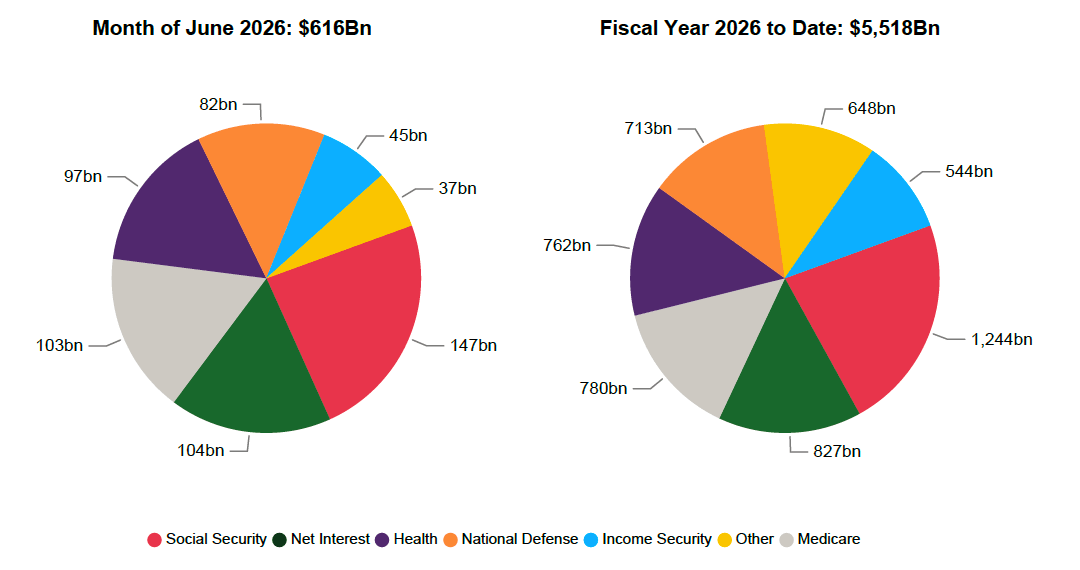
The Trump administration blew through $616.07 billion last month. That was a 23 percent increase from June 2025 spending. However, the last day of June fell on a weekend last year, meaning some of June’s spending was pushed back into May. When adjusting for calendar effects, spending was up about 3.3 percent compared to last year.

So far in fiscal 2026, Uncle Sam has spent $5.52 trillion. That’s a 3 percent increase compared to the same period last year.

A 3 percent increase in spending might not sound significant. But weren’t we told there would be spending cuts?

In fact, there were some cuts in the Big Beautiful Bill (along with spending increases).

The increased spending comes despite cuts to the EPA and the Department of Education budget, along with staffing reductions that are now showing up in the data. Lower disaster spending also helped moderate spending levels through the first two months of fiscal ’26.

However, looking at the big picture, the spending trajectory is up. Even with all the hype about DOGE and some lip service to cutting spending during the early days of the Trump administration, the U.S. government spent just over $7 trillion last year. That’s an average of $583.3 billion per month or $19.2 billion per day.

And now there’s a war.

Despite some non-specific talk about “spending cuts,” there seems to be little to no commitment to dealing with the runaway spending substantially. In fact, the powers-that-be constantly find new reasons to spend money, whether it is a crisis at home or a war overseas.

The Cost of the Debt

The cost of servicing the debt continues to climb in this higher interest rate environment as the government keeps piling on new debt.

Interest expense has grown into the second-largest spending category in the federal budget behind only Social Security.

In June, the Treasury forked out $185.2 billion on interest payments alone. That was up nearly 40 percent from the prior month and set a second straight monthly record.

June interest payments pushed total interest expense to $1.05 trillion through the first nine months of fiscal 2026. That was up 14.23 percent compared to the same period in fiscal ’25.

Interest on the national debt cost $1.2 trillion in fiscal 2025. That was up 7.3 percent over 2024.

Net interest (interest expense – interest receipts) was $104 billion in June.

Through the first nine months of the fiscal year, the federal government spent more on interest on the debt than it did on national defense ($713 billion) or Medicare ($780 billion). The only higher spending category is Social Security ($1.2 trillion).

Much of the debt currently on the books was financed at very low rates before the Federal Reserve started its hiking cycle. Every month, some of that super-low-yielding paper matures and must be replaced by bonds yielding much higher rates.

When people say the spending is unsustainable, it feels like an understatement. In fact, it’s fair to call the federal government insolvent.

However, very few people in the political class seem the least bit interested in tackling the problem. The bad news is that at some point, the problem is going to tackle them.


Mike Maharrey is a journalist and market analyst for Money Metals with over a decade of experience in precious metals. He holds a BS in accounting from the University of Kentucky and a BA in journalism from the University of South Florida.

The Bullish Case for Silver

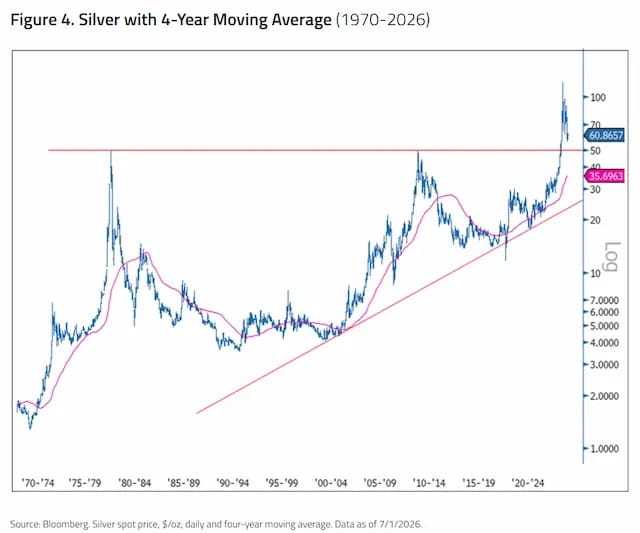
(Mike Maharrey, Money Metals News Service) The shine has come off silver since it skyrocketed to over $100 an ounce in January. The price has dropped by over 50 percent from the record high. However, there are still reasons to be bullish on silver moving forward, including persistent supply deficits and growing industrial demand.

In a recent precious metals analysis, Sprott strategist and managing partner Paul Wong noted that silver recorded its largest monthly dip since September 2011 in June, capping off a quarter when silver fell by $16.57 per ounce, a 22 percent decline. It was the worst quarter since the first quarter of 2020, during COVID panic selling.

“Silver’s selling wave in June tracked gold’s plunge and was driven by the same macro forces: an expectedly hawkish Fed raising short-term rates and the U.S. dollar. Silver easily broke below support levels in a near-waterfall pattern, suggesting capitulation-driven selling sentiment.”

Wong noted that volatility isn’t unusual in the silver market.

“Silver has shown significantly greater volatility than gold due to its smaller and less liquid market. Sharp drawdowns are a normal feature of silver bull markets, not evidence that the underlying fundamentals have failed. Historically, some of silver’s strongest advances have occurred following periods of severe volatility and investor frustration.”

With this in mind, Wong thinks silver remains in a “strong positive position” from both a fundamental and technical standpoint.

“Despite the recent wrenching volatility, over a multi-decade period, the silver chart remains among the most bullish chart patterns we are aware of.”

Wong categorized silver as “one of the most volatile parts of the precious metals complex,” noting that the sharp correction and wild price movements have “tested sentiment.

“But silver’s long-term bullish fundamentals appear unchanged. These rest on the combination of constrained supply and growing demand.”

Not Enough Metal

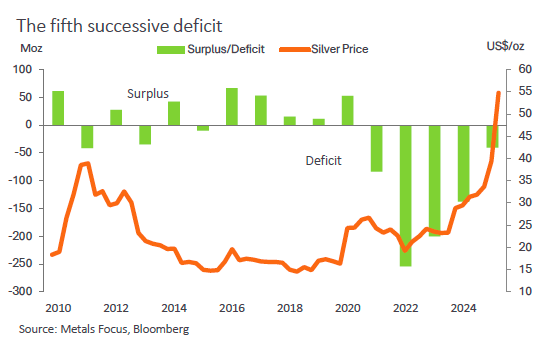
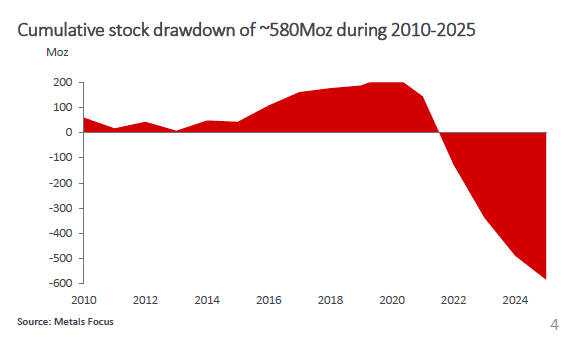
Silver has been in a structural market deficit for five years, meaning demand for the metal has outstripped mining and recycling output. Last year, demand outstripped supply by 40.2 million ounces (1,250.36 tonnes). That drove the 5-year market deficit to 716 million ounces. To put that into perspective, total silver mining output last year was 846 million ounces.

Metals Focus expects the supply shortfalls to continue, with a projected 46.3-million-ounce supply deficit this year.

Before this string of successive market deficits, there was a cumulative above-ground stock rise of 243 million ounces between 2010 and 2020. Taken together, there has been a stock rundown of around 473 million ounces in the last 15 years.

This shortage of metal was the root cause of two silver squeezes. The first drove silver to over $50, and the second took it to well over $100.

When silver demand outstrips mining and recycling output, silver users must tap into aboveground stocks. That generally means rising prices to incentivize those holding silver to give it up.

As Metals Focus explained, that’s exactly what happened last fall.

“Against this backdrop, shifts in inventories into CME vaults, rising ETP holdings, and a spike in physical demand created an unprecedented liquidity squeeze in October.”

Tariff worries drove a flood of metal from London to New York in the spring of 2025. When silver demand spiked last fall, there wasn’t enough metal in London vaults to meet the sudden offtake. While the movement of metal back to London eased the immediate strain, it didn’t solve the fundamental problem – not enough physical metal.

As Wong explained, silver supply is relatively inelastic, meaning it doesn’t respond quickly to rising prices.

“Unlike many commodities, there are few large new mining projects that could materially alter the medium-term supply outlook. Silver supply is relatively inelastic even as demand continues to expand.”

Meanwhile, the growing solar industry and the AI buildout continue to increase industrial demand for silver.

“Several secular growth trends support demand. Solar panel manufacturing, electrification, electric vehicles, AI infrastructure, data centers and a wide range of technology applications underpin industrial demand for silver. Military consumption is also becoming increasingly important as silver’s conductivity and strategic importance gain recognition across defense supply chains. Even in a slower economic environment, many of these end markets are likely to remain supportive.”

The higher price has increased silver investment demand.

“Investors often focus on gold as the primary monetary metal, but silver has historically participated in periods of currency debasement and monetary uncertainty. In this environment, silver benefits due to its growing appeal as an alternative store of value, essentially a higher-beta expression of the same themes that support the gold market.”

Wong said he wouldn’t be surprised if deficits continue for the next seven or eight years.

Wong also noted the outsized impact of paper silver on the market. He pointed out that massive bets in the options markets helped drive prices to record highs. Wong said call options outstanding and open interest reached four or five standard deviations above their norm during the price spike.

“Until you get rid of all these crazy options positions, it’s more of a meme stock than a commodity in the short term. But eventually what happens is you’ll shake out the option guys.”

Over the last several months, the call options have generally returned to the mean, and the unwinding of those positions has magnified the price decline.

Despite the impact of paper trading, Wong said the physical market will ultimately win the day.

“Tightness in physical inventories and ongoing delivery pressures have reinforced the view that physical demand remains strong relative to available supply,” he wrote. “As more metal flows toward Asian markets and physical ownership continues to gain importance, paper-market pricing mechanisms may become less influential over time.”

Given these dynamics, Wong said he thinks silver’s long-term price outlook remains “positive.”

“Silver’s unique combination of persistent supply deficits, expanding industrial demand, increasing monetary relevance, and tight physical market conditions provides multiple avenues for future appreciation.”


Mike Maharrey is a journalist and market analyst for Money Metals with over a decade of experience in precious metals. He holds a BS in accounting from the University of Kentucky and a BA in journalism from the University of South Florida.

Trump Still Won’t Admit the US Is Responsible for the Minab School Massacre

President Trump is still refusing to acknowledge that the US was responsible for the strikes that hit an elementary school in Minab, southern Iran, on February 28, an attack that massacred over 100 school children, claiming in a Fox News interview that it’s possible no one will ever know what happened.

“I don’t think anybody will ever be able to say what happened there. While things like that happen in war, there were missiles flying all over the place. And I don’t know how anybody could say that we shot it,” Trump told Fox News reporter Trey Yingst when asked if he would commit to releasing the findings of the investigation into the attack.

US officials have told several media outlets that the Pentagon’s investigation found that the US was responsible for the strike and that it was carried out due to old intelligence, with CNN recently reporting that US military commanders bypassed warnings in critical databases that intelligence about potential targets in Iran was severely out of date and approved the strike.

Sources told CNN that US military officials “knew within days (of the strike on the school) how the mistake happened,” yet the administration continues to claim it’s unclear what happened.

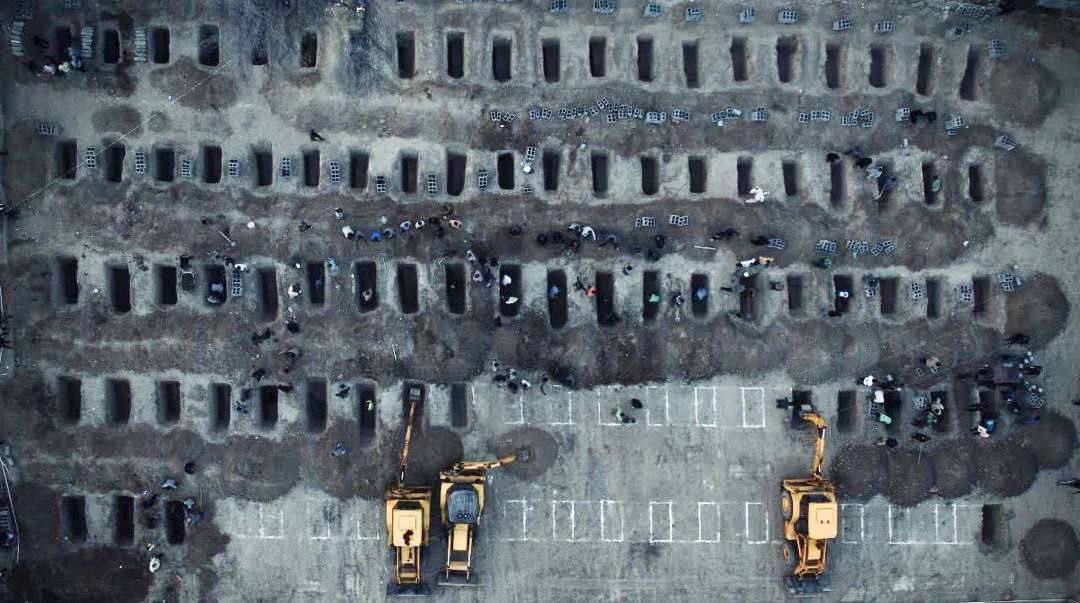
Photo released by Iran of graves being dug for the children killed at the Minab school

Yingst asked Trump about the fact that photos show remnants of US Tomahawk missiles at the school, and the president claimed they could be “AI-generated” images. He previously made the false claim that Iran has Tomahawk missiles, a weapon that is only used by the US and a few of its allies.

“I will say that the Tomahawk, which is one of the most powerful weapons around is … sold and used by other countries. You know that. And whether it’s Iran, (which) also has some Tomahawks. They wish they had more. But whether it’s Iran or somebody else, the fact that a Tomahawk — a Tomahawk is very generic. It’s sold to other countries,” Trump told reporters in May.

While the death toll in the attack on the school in Minab varies, with some reports saying 168 people were killed and others putting the number at 175, the general prosecutor in Minab said in early April that the final death toll was 156, including 120 students — 73 boys, 47 girls — 26 female teachers, seven parents, a school bus driver, and a technician at a nearby clinic.

Over 100 Democrats Vote To Cut Military Aid to Israel

(Dave DeCamp, Antiwar.comOver 100 House Democrats on Wednesday voted in favor of an amendment put forward by Rep. Thomas Massie (R-KY) to cut $3.3 billion in military aid to Israel, marking a major shift as congressional Democrats grapple with growing skepticism of the US-Israel relationship among their voter base.

The amendment would have removed $3.3 billion in Foreign Military Financing, a State Department program that provides foreign governments with funding to purchase US weapons, from the 2027 National Security, Department of State, and Related Programs Appropriations Act.

Massie’s amendment was defeated in a 104-314 vote, but more Democrats supported the effort than voted against it. A total of 103 Democrats voted yes, 98 voted no, 10 voted present, and four didn’t vote. Massie was the lone Republican to support the amendment.

US Air Force Airmen and Israeli military members unload cargo from a US Air Force C-17 Globemaster III on a ramp at Nevatim Base, Israel, Oct. 15, 2023 (US Air Force photo)

Ahead of the vote, there was a split among Democratic leadership, with House Minority Leader Hakeem Jeffries (NY) saying that he would oppose it and House Minority Whip Katherine Clark (MA), the number 2 Democrat in the House, coming out in support of Massie’s amendment.

Clark appeared to criticize Massie’s effort, suggesting it was a “cynical effort” to “divide people,” but added that it was a “chance to say clearly that the status quo is not acceptable.”

“There is no country that should be given a blank check for military aid that is not in line with our interests and values as Americans,” Clark said.

The vote is a stark contrast to an amendment last year offered by former Rep. Marjorie Taylor Greene (R-GA) to strip $500 million in military aid for Israel from the 2026 National Defense Authorization Act, which overwhelmingly failed in a vote of 6-422.

Wednesday’s vote comes as the US continues to support Israel’s wars and occupations in Lebanon, Syria, and the West Bank, and as the IDF continues killing Palestinians and taking control of more territory in Gaza in violation of the US-backed ceasefire deal signed in October 2025. Ahead of the vote, Massie said he would “vote against using American tax dollars to fund genocide.”

This article originally appeared at Antiwar.com.

Netanyahu To Attend Lindsey Graham’s Funeral in DC, Seeks Meeting With Trump

(Dave DeCamp, Antiwar.comIsraeli Prime Minister Benjamin Netanyahu will fly to Washington DC on Saturday night to attend the funeral of Sen. Lindsey Graham and will also seek a meeting with President Trump, according to Israeli media.

Israeli officials told The Jerusalem Post that Netanyahu’s visit would be centered around Graham’s funeral since the late senator was a staunch supporter of Israel and the US-Israel relationship.

“Lindsey understood that the security of Israel and America are inseparable. He devoted his life to defending America, strengthening our alliance and standing up for the free world,” Netanyahu said in a statement on Graham’s death.

Graham meeting Netanyahu in Jerusalem in 2021 (Israeli Government Press Office)


The officials speaking to the Post said that Netanyahu will meet with President Trump, though the meeting hasn’t been scheduled yet and there’s been no confirmation from the White House.

Netanyahu’s last visit to the White House occurred on February 11, 17 days before the US and Israel launched the war against Iran. According to a report from The New York Times, Netanyahu provided Trump with an intelligence briefing at the time to sell the idea of attacking the Islamic Republic.

The report said Netanyahu made a series of predictions about the war that proved to be wrong, including the idea that Iran was ripe for regime change, that its ballistic missile program could be destroyed within weeks, and that it would be too weak to close the Strait of Hormuz.

Netanyahu has traveled to the US for meetings with Trump seven times since the US president was inaugurated for his second term. If Netanyahu does get his meeting this time, the discussions are expected to revolve around Iran and Israel’s continued wars and occupations in Lebanon, Syria, and Gaza.

This article originally appeared at Antiwar.com.

JD Vance to Joe Rogan: US Engaged in a ‘Delicate Diplomatic Dance’

(Dave DeCamp, Antiwar.comVice President JD Vance appeared on an episode of Joe Rogan’s podcast that came out on Wednesday and was asked why President Trump keeps claiming that a deal has been reached with Iran but then goes back to bombing the country.

The interview, recorded on Tuesday, comes as the US has intensified its airstrikes against Iran and Iranian forces have been launching heavy retaliation against US bases and continue targeting ships attempting to cross the Strait of Hormuz, as both sides have said the US-Iran Memorandum of Understanding (MoU) was effectively over.

Vance insisted that the US was “on the right trajectory, it’s just going to be really messy, and there’s going to be a lot of starts and stops.” He claimed that the deal had been imperiled by a split among Iranian officials and that recent attacks on ships were due to hardliners who opposed the MoU, a narrative that Iranian officials have rejected and have called a disinformation campaign.

He said that the hardliners “freaked out” over the amount of oil that exited the Strait of Hormuz and worried that Iran was giving up its “leverage,” though Iran’s most senior diplomatic officials have maintained a unified front on their stance that they view any transits through the strait that aren’t authorized by Tehran as a violation of the deal.

“So they shot at a couple of ships we responded, and I think that’s entirely appropriate, of course, if they’re going to shoot at ships, we are going to shoot at the people who are shooting at the ships, or we’re going to destroy the facilities that they’re using to shoot at ships,” Vance said.

“So that happens, okay, and then the Iranians are like, “Oh no, no, fine, you’re right, we shouldn’t have been shooting at ships.” So then they come back to the table, and there’s a few more days of negotiation, and then the phase they’re in right now is that the hardliners have really, really reacted strongly to all the oil that’s coming out of the Strait of Hormuz, and they’ve basically said we’re going to try to shut this thing down,” he added.

The US vice president went on to describe the current US policy, which appears to be an attempt to bomb Iran into submission, as a “diplomatic dance.”

“Again, do I know how this is ultimately going to shake out? Of course I don’t. But what we’re doing is a delicate diplomatic dance where we’re using economic leverage points. We’re using carrots and sticks. We’re trying to talk to the pragmatists. And then, of course, when they commit acts of violence, we’re responding to it. And all those things are happening simultaneously to get us on a better trajectory,” he said.

“Now that said, yes, right now there’s shooting right now. Last night they shot at some ships. But with all that said, is their nuclear program still destroyed? Yes. Are the straits not necessarily fully pre-war traffic, but are we getting enough oil and gas out of the Strait of Hormuz to prevent a worldwide energy crisis? Yes. And all of these things are happening in the context of the broader negotiation,” he added.

In this interview, Vance also criticized hawks who he said wanted the US to bomb Iran “into oblivion” and didn’t have a real solution, though that appears to be President Trump’s current strategy as he is threatening to escalate airstrikes into bombing power plants and bridges.

This article originally appeared at Antiwar.com.

‘We CANNOT Give Up’: Trump Wants ICE to Continue Traffic Stops

(Headline USAPresident Donald Trump wants Immigration and Customs Enforcement officers to keep pulling over vehicles, signaling his opposition Wednesday to plans announced just a day earlier to suspend most traffic stops.

It’s not clear whether ICE will quickly reverse course and resume most stops, which have been a key tool in Trump’s illegal immigration crackdown.

Ending those stops, Trump wrote, would be “playing right into the criminal’s hands.”

“We CANNOT give up one of ICE’s most important and effective Crime Fighting tools, THE TRAFFIC STOP!” Trump wrote Wednesday on his social media site.

Hours after Trump made his views known, Homeland Security Secretary Markwayne Mullin issued his own statement saying people illegally in the country would be “arrested and deported wherever they are.” While Mullin didn’t directly say whether ICE officers will be allowed to carry out traffic stops, he later said in a statement that he and Trump “are on the same page,” and that they want ICE officers “to have all options available to keep them safe while executing our mission.”

Three people died while fleeing federal officers within a week. In Florida, a 28-year-old man was killed Tuesday after he was hit by a tractor trailer while running from immigration and other federal officers, authorities said.

Before that, two runaway motorists were shot and killed by ICE officers — one in Texas last week and another in Maine on Monday.

Adapted from reporting by the Associated Press