Here’s Where Gold & Silver Stand

(Jesse Colombo, Money Metals News Service) Both gold and silver are undergoing healthy consolidation phases after their strong rallies, allowing them to reset and work off overbought conditions.

It’s time for an updated look at where things stand. Three weeks ago, I suggested that gold may have temporarily peaked after a strong rally, and that a period of sideways movement or a minor pullback would be both healthy and necessary to cool off its overbought condition.

That’s exactly what we’ve seen since—gold has moved sideways, consolidating its gains. Here’s what I’m seeing now and what I believe is likely to happen next.

For technical analysis purposes, I prefer to focus on COMEX gold futures rather than spot prices, as futures tend to respect and form support and resistance levels in clean $100 increments—such as $3,000, $3,100, $3,200, and so on.

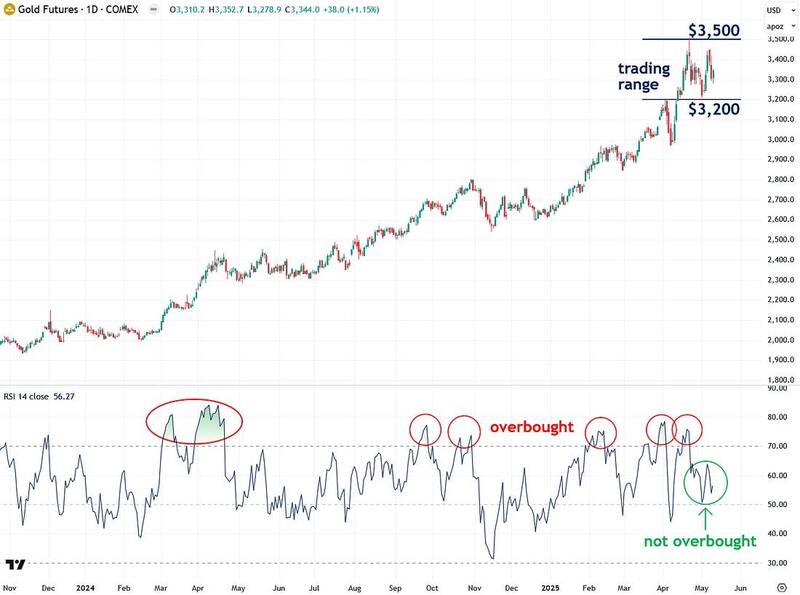
Since peaking on April 22nd, when gold briefly tested $3,500 before pulling back, futures have been consolidating in a range between $3,200 and $3,500.

This type of sideways action is common in strong bull markets and often serves as a launchpad for the next leg higher.

I’m currently watching for a breakout scenario, which would be confirmed by a decisive close above $3,500 on strong volume. If that occurs, I believe gold could surge to $4,000 an ounce fairly quickly—echoing a recent forecast by JP Morgan. I’ll be monitoring this closely.

Back on April 22nd, I pointed out that a candlestick pattern known as a spinning top had formed in gold—a classic sign of indecision that often marks the end of a rally. I suggested that this could signal a temporary peak and the start of a consolidation phase, which is exactly what we’re seeing now.
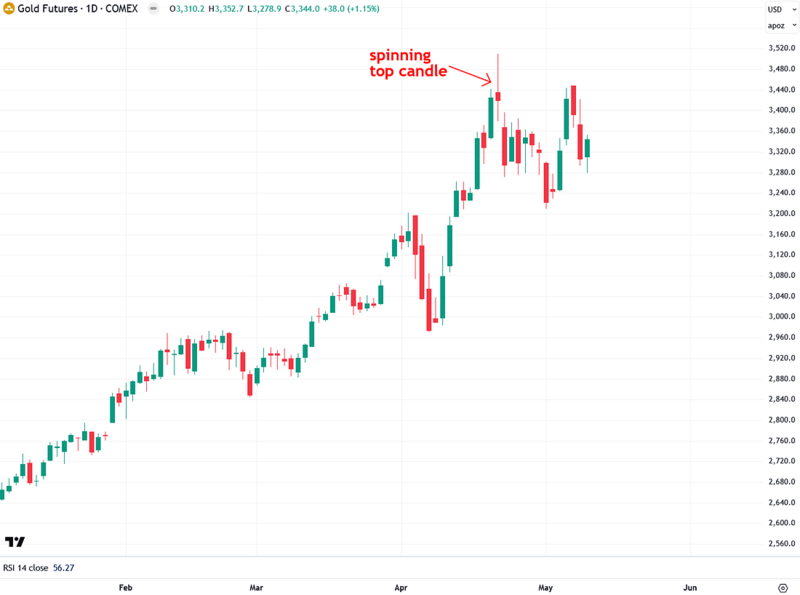
Interestingly, almost exactly one year ago, a spinning top candlestick appeared around the $2,400 level following gold’s surprise $400 rally (see the chart below)—and that marked the beginning of several months of consolidation before gold broke out again in August 2024.

I see strong parallels between that April 2024 candle and the one we just saw in April 2025.

If this pattern holds, gold is likely to continue moving sideways for a few more months in a healthy pause before making another run higher. I welcome this kind of consolidation—it’s far better for gold to build a solid base than to surge too quickly and risk a sharp correction.

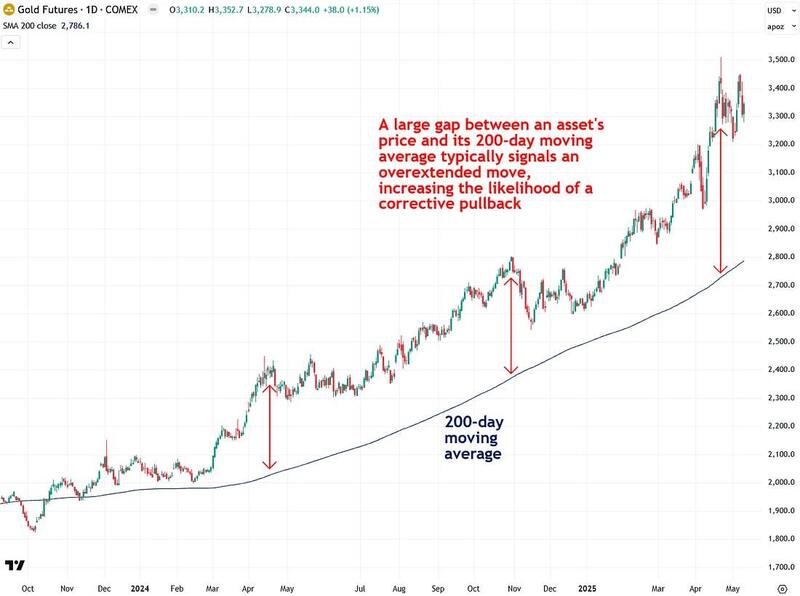
One useful way to gauge whether an asset has surged too far, too fast is by comparing its price to its 200-day moving average.

When an asset becomes significantly stretched above its 200-day moving average, it often signals that a consolidation phase is due—but that doesn’t necessarily mean a sharp pullback. It can take the form of sideways movement as the market digests recent gains.

As the chart below shows, gold became notably extended above its 200-day moving average in April 2024 and October 2024, and in both cases, it entered a healthy consolidation phase to work off those excesses.

The same pattern emerged again in April 2025, so it’s no surprise we’re now seeing gold cool off.

Although we’re already a couple of weeks into this pause, I wouldn’t be surprised if it continues a bit longer until gold and its 200-day moving average converge a bit more.
Another effective way to assess whether an asset like gold has gotten ahead of itself is by looking at the Relative Strength Index (RSI)—a widely used momentum indicator that gauges whether an asset is overbought, oversold, or in neutral territory.

When I published my last update on April 22nd, gold was in overbought territory. Since then, however, the RSI shows that gold has successfully worked off that condition—without requiring a sharp pullback. That’s a very encouraging sign, as it indicates gold is resetting and could soon be in a strong position to resume its rally.
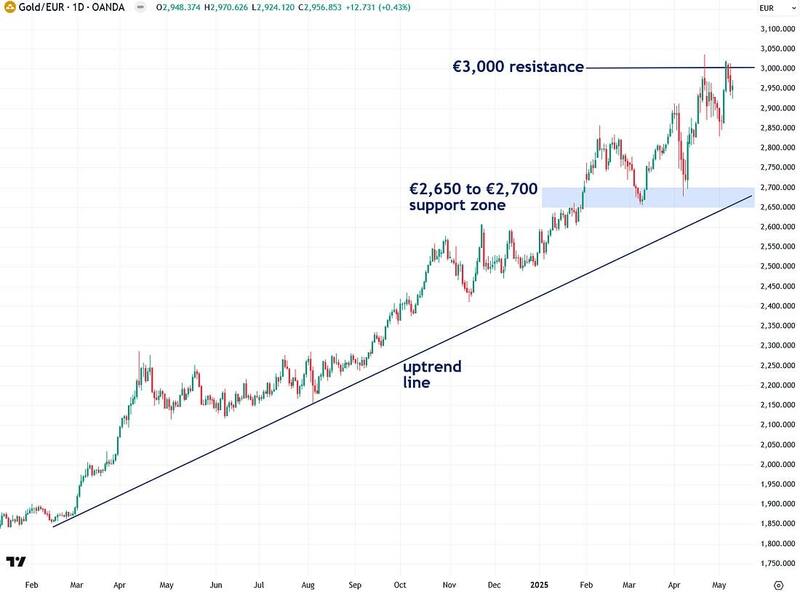
I also like to analyze gold priced in international currencies, as it removes the influence of the U.S. dollar and reveals gold’s true intrinsic strength. One of the key charts I watch is gold priced in euros, and by that measure, the uptrend remains firmly intact. It’s currently hovering just below the critical €3,000 resistance level—a breakout above that would strongly signal the start of gold’s next major rally leg.
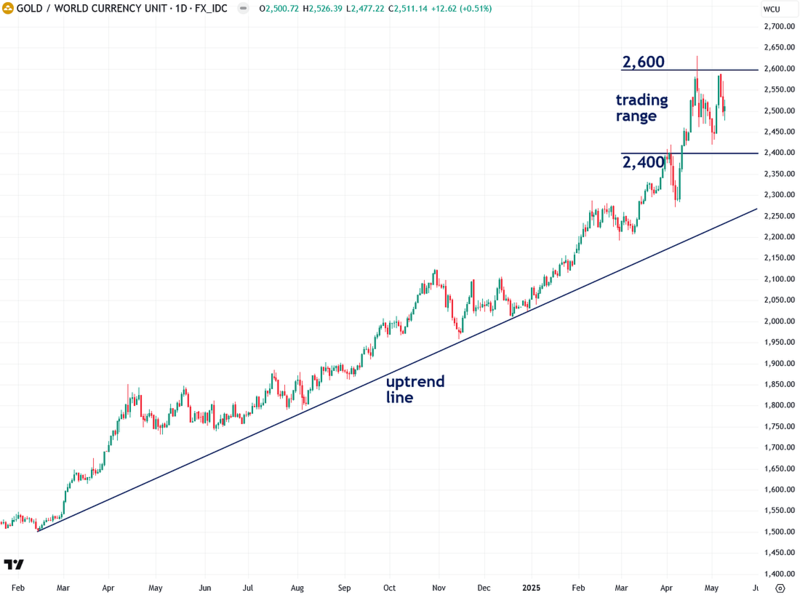
I’ve recently begun tracking gold priced in the World Currency Unit (WCU)—a composite currency based on the GDP-weighted average of the world’s 20 largest economies. In many ways, it offers one of the most balanced and accurate reflections of gold’s true global performance, which is why I’ve been paying close attention to it.

Based on that measure, gold remains in a healthy, confirmed uptrend but has been consolidating in a trading range between 2,400 and 2,600 in recent weeks. Ideally, a breakout above the 2,600 level would signal that gold is ready for its next leg higher.
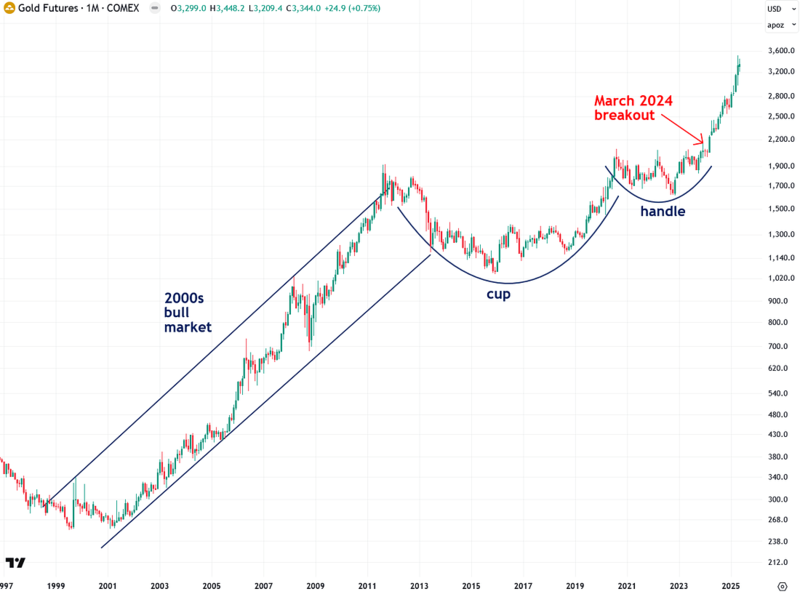
While I do believe a healthy consolidation in gold is likely in the near term, I strongly disagree with those claiming that gold is at a long-term peak and that the recent highs are as good as it gets.

One key reason is that gold broke out of a major cup-and-handle pattern just a year ago (see the chart below)—and historically, breakouts from patterns of that magnitude don’t fizzle out quickly. They typically fuel multi-year bull markets lasting five to ten years or more.
Next, let’s turn to silver, which has been playing second fiddle to gold’s recent surge.

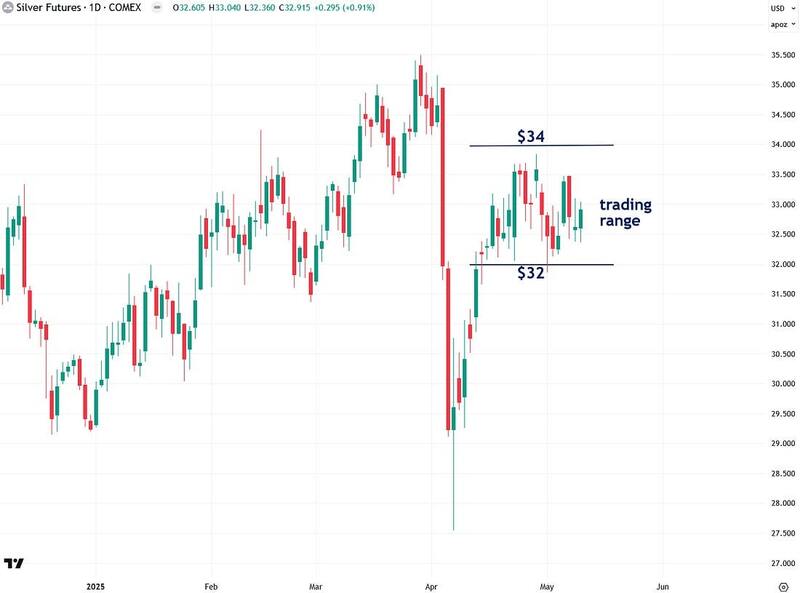
As the chart below shows, COMEX silver futures have remained steady in recent weeks, consolidating in the $32 to $33 range while holding above a key uptrend line—a positive sign.

To confirm that the next leg of silver’s bull market is underway, I’d like to see a decisive breakout above both the $32–$33 resistance zone and the $34–$35 resistance zone. For now, it’s a waiting game.

I also want to highlight something I’m seeing in silver’s short-term price action: a trading range between $32 and $34, which has formed alongside a similar range in gold. I’m closely watching to see which direction these ranges break, as it should offer an important clue about the next major move for both metals.
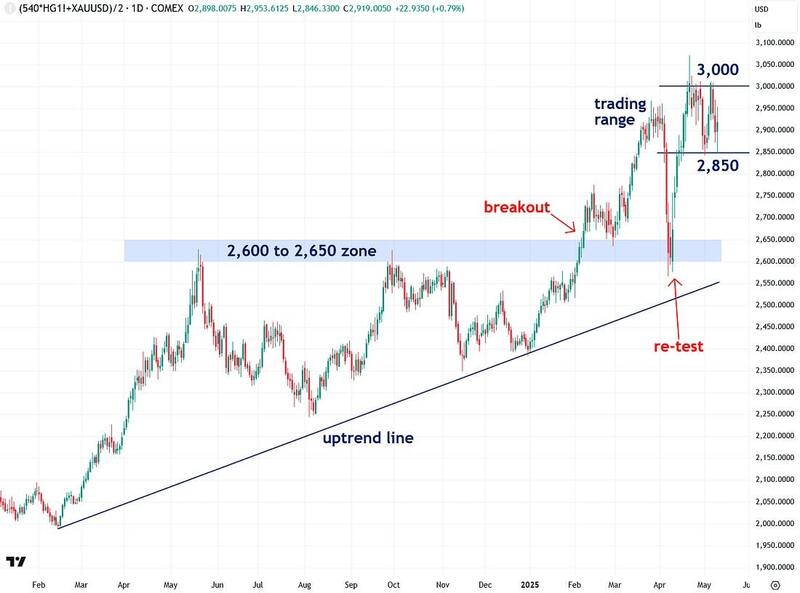
I’ve developed a custom indicator called the Synthetic Silver Price Index (SSPI), designed to help confirm—or challenge—price moves in silver. It’s calculated as the average of gold and copper prices, two metals that exert significant influence on silver. Interestingly, despite silver not being an input, the SSPI has shown a remarkably strong correlation with silver’s price—making it a valuable tool for cross-verifying trends and potential breakouts.

Like silver and gold, the SSPI is currently trading within a range—between 2,850 and 3,000. A breakout from this zone will signal the direction of the next major move and offer valuable insight into where silver is headed next. I’ll be watching it closely.
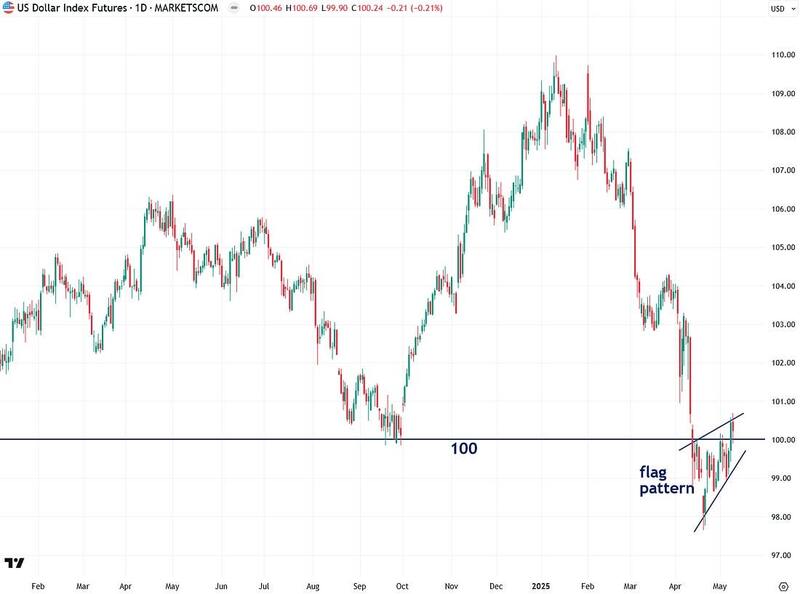
I’m also keeping a close eye on U.S. Dollar Index futures, as I recently explained, because they’re hovering right at the critical 100 level. A decisive breakdown below this key support would signal renewed dollar weakness and fuel further strength in precious metals. On the other hand, a breakout above 100 could create headwinds for metals, given the inverse relationship between the dollar and gold and silver.

On Thursday, U.S. Dollar Index futures briefly popped above the 100 level, but I’m not convinced by the move just yet. The breakout occurred on lackluster volume, and a flag pattern appears to be forming—a breakdown from which would point to further bearish action. I’ll continue monitoring this closely, but for now, the outlook remains inconclusive.
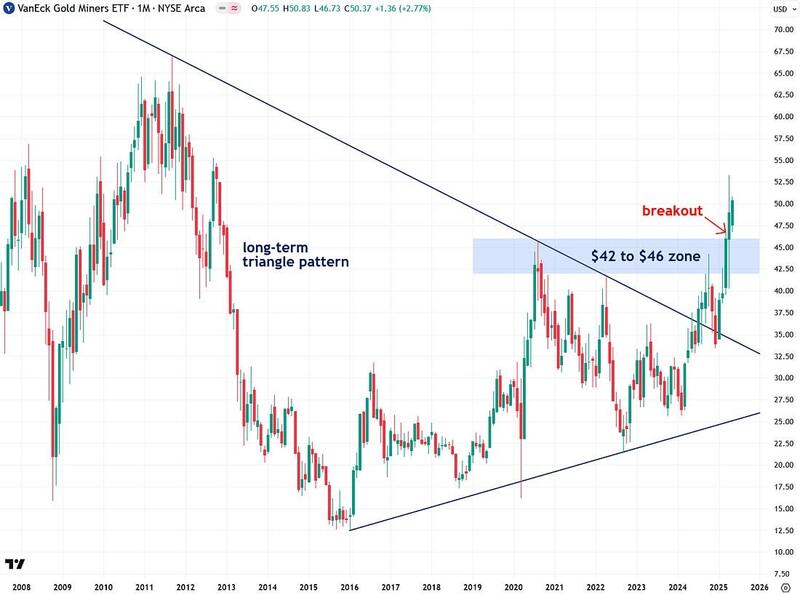
Next, let’s turn to the gold mining sector—starting with the large-cap VanEck Gold Miners ETF (GDX). As I’ve noted in recent updates, GDX recently broke out of a long-term triangle pattern that stretches all the way back to 2011—a major bullish development. However, I also pointed out that a decisive breakout above the key $42–$46 horizontal resistance zone would be needed to fully confirm the move.

That breakout occurred a few weeks ago and remains intact, holding up well despite the recent pause in gold’s price. That’s why I’m launching a new series of in-depth reports detailing my bullish thesis on the gold and silver mining sector—beginning with the first installment, which lays out the long-term bullish case for gold itself. If you haven’t already, I strongly recommend reading it so you’re fully up to speed and ready for what’s coming next.
Silver mining stocks, as measured by the Global X Silver Miners ETF (SIL), are also performing well—though they’re slightly lagging behind gold miners. SIL broke out of a long-term triangle pattern a few months ago, which is a bullish development. However, a decisive close above the key $48–$52 resistance zone is still needed to fully confirm that the bull market in silver mining stocks is underway.
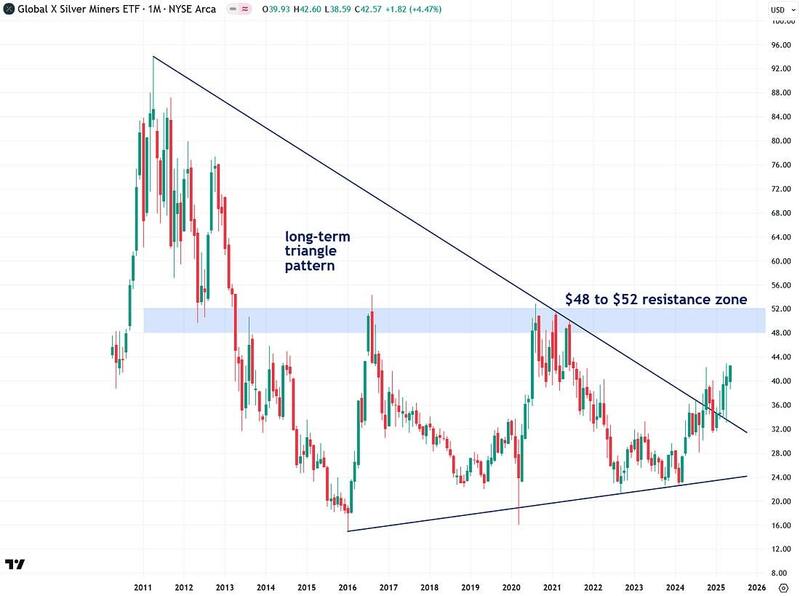
In summary, I’m seeing clear signs that precious metals have entered a healthy consolidation phase following a strong rally. This pause is helping them work off their overbought conditions—particularly gold, which is more extended than silver.

That said, I believe there’s still plenty of fuel left in the tank, and this looks more like a breather than a top. Silver, in particular, appears poised to take the spotlight next, and I’m hopeful it does.

For now, I’m closely watching to see which direction gold and silver break from their current consolidation patterns.

If you found this report valuable, click here to subscribe to The Bubble Bubble Report for more content like it.


Jesse Colombo is a financial analyst and investor writing on macro-economics and precious metals markets. Recognized by The Times of London, he has built a reputation for warning about economic bubbles and future financial crises. An advocate for free markets and sound money, Colombo was also named one of LinkedIn’s Top Voices in Economy & Finance. His Substack can be accessed here.
DOJ Charges USAID Officer w/ Fraud

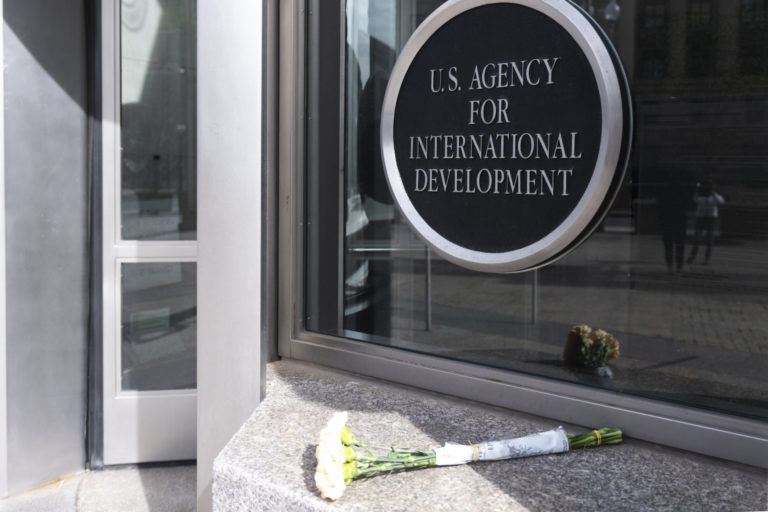
(Ken Silva, Headline USA) The Justice Department filed a criminal charge Friday against Yusuf Akoll, a former senior procurement contract specialist for the U.S. Agency for International Development, which was recently shuttered and folded into the State Department.

According to the DOJ, Akoll formed a shell company in November 2020 to fraudulently obtained $16,666 in loans through the Paycheck Protection Program—the COVID-era program designed to help small businesses stay afloat.

In the charging papers filed Friday, the DOJ said that Akoll formed a company in November 2020 called SAQ Naagode Consulting LLC. In his PPP loan applications, Akoll allegedly said that his company earned $40,000 in 2019, when it actually didn’t earn anything.

“This statement regarding SAQ Naagode’s gross income in each loan application was materially false, AKOLL knew each statement was materially false, and AKOLL submitted these materially false statements to Lender #1 in order to receive each PPP loan,” the DOJ charging papers state.

COVID fraud could reach more than $1 trillion, according to an article from the Daily Wire, which first reported the charges against Akoll.

The charges against Akoll come about two months after another govermnet official was sentenced to 15 months in prison for perpetrating an $880,000 in PPP fraud. That fraudster, former DC Homeland Security and U.S. Department of Agriculture employee Wendy Nicole Villatoro, allegedly submitted eight PPP loan applications with various financial institutions, and 15 Economic Injury Disaster loans with the Small Business Administration—all of which contained materially false statements.

The DOJ said Villatoro submitted loans on behalf of fake businesses and inflated the number of employees, the average monthly payroll, the gross yearly revenue, or the cost of goods sold.

“In doing so, the DOJ said she tried to steal between $2.6 million and $5.5 million,” the DOJ said in a press release.

“While most of Villatoro’s loan applications were denied, she successfully secured over $844,000 in PPP and EID funds. Villatoro used the funds to pay off her student loans, pay off the car loan on a BMW SUV, and buy luxury items,” the DOJ said.

Ken Silva is the editor of Headline USA. Follow him at x.com/jd_cashless.

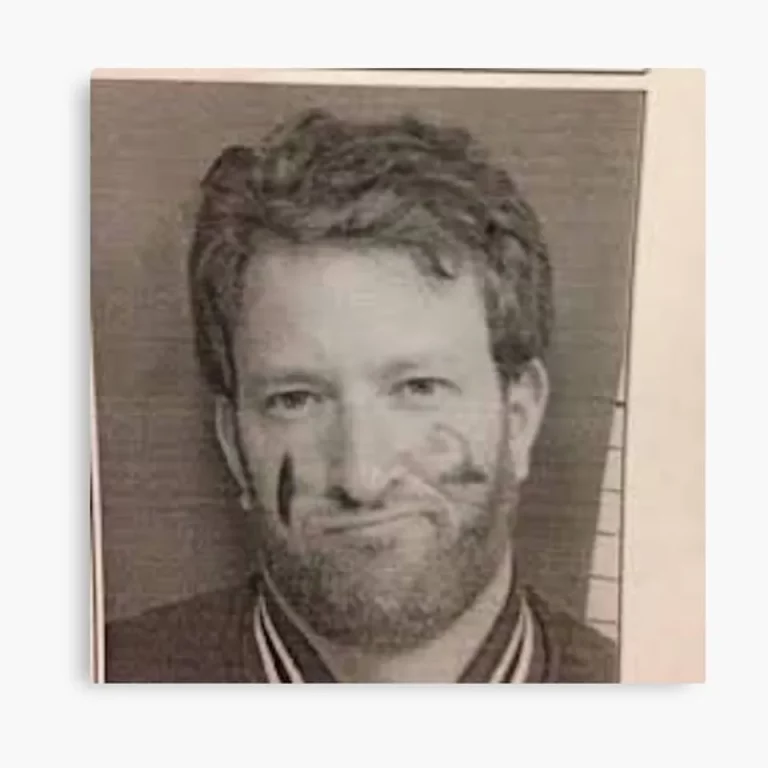
Barstool Owner Dave Portnoy’s Degenerate Past Resurfaces amidst Antisemitism Controversy

(José Niño, Headline USA) Just as Barstool Sports founder Dave Portnoy battles backlash over an antisemitic incident at his bar, the internet is digging up a 14-year-old scandal that refuses to stay buried. 

Earlier this month, several patrons displayed a “F*** the Jews” sign at the Barstool Sansom Street bar in Philadelphia during bottle service. 

This incident prompted Portnoy to fire employees, collaborate with authorities, and initially propose sending the individuals involved to Auschwitz for a “learning experience.”

However, his aggressive stance also drew attention to his history of controversial behavior. As Temple University suspended students and legal battles emerged, social media users such as Spinachbrah began revisiting Portnoy’s 2011 posting of explicit photos of Tom Brady’s then-20-month-old son, Benjamin.  

In August 2011, Portnoy published paparazzi photos of Brady’s naked son on Barstool Sports, adding commentary about the child’s genitalia. The images, taken during a family beach outing, showed the toddler fully unclothed. Portnoy defended the post as a reference to “Curb Your Enthusiasm” humor but faced immediate backlash.

Brady’s then-wife Gisele Bundchen issued a cease-and-desist letter to David Portnoy, leading to further repercussions. Massachusetts state police visited Portnoy’s home, resulting in his decision to remove the controversial photos. In response to the incident, WEEI radio station dropped Portnoy as a contributor, with Jason Wolfe, the station’s vice president of programming, saying Portnoy’s behavior constituted a violation of “common decency.” 

At the time, legal experts weighed in on the situation, debating the possibility of Portnoy facing child exploitation charges. However, they largely agreed that the images lacked the “lascivious intent” necessary to qualify as child pornography.

Portnoy later admitted the police visit influenced his decision to take down the content. He told The Boston Globe: “I’ve never had cops knock on my door for anything in my life.”   

Portnoy has not publicly addressed the resurfaced allegations, focusing instead on damage control for the antisemitism incident that took place at his bar. 

At the center of the present controversy involving Portnoy is Mohammed Adna Khan, a 21-year-old Temple University student who uploaded a video to Instagram showing a waitress at Portnoy’s Barstool Sansom Street bar holding a sign reading “F*** the Jews” during a bottle service order, which went viral. 

Portnoy initially accused Khan of orchestrating the incident and offered to send him to Auschwitz for Holocaust education, but retracted the offer after Khan denied responsibility, claiming he was merely “reporting” the sign as a “citizen journalist”.

Khan launched a GiveSendGo fundraiser, raising over for legal defense, which drew scrutiny after Portnoy disputed his account of this incident. 

While the 2011 incident did not result in legal consequences, its resurgence underscores how digital footprints persist and resurface during moments of public vulnerability. 

As the spotlight intensifies, Portnoy’s legacy may ultimately be defined by how he handles both old wounds and new crises.

José Niño is the deputy editor of Headline USA. Follow him at x.com/JoseAlNino 

Hamas Says It Will Release US-Israeli Citizen Edan Alexander

(Dave DeCamp, Antiwar.com) Hamas said on Sunday that it would release Edan Alexander, a dual US-Israeli citizen and IDF soldier who was captured during the October 7 attack, and confirmed that it had been in direct talks with the US on a potential Gaza ceasefire deal and the entry of humanitarian aid into the Palestinian territory.

“As part of the efforts being made by our mediator brothers to achieve a ceasefire, Hamas has been in contact with the US administration over the past few days,” said Hamas official Dr. Khalil al-Hayya, according to Drop Site News.

“The movement has expressed a high degree of positivity, and the release of Israeli soldier Edan Alexander, a dual US citizen, will be part of the steps being taken to achieve a ceasefire, open the crossings, and allow aid and relief to reach our people in the Gaza Strip,” al-Hayya added.

According to Axios, US envoy Steve Witkoff spoke with Alexander’s parents and told them he should be released soon. Israeli media is reporting that a Hamas official said Alexander would be released on Monday at noon.

The office of Israeli Prime Minister Benjamin Netanyahu said that Hamas would release Alexander “without any compensation or conditions as a gesture of goodwill toward the US.

“The US conveyed to Israel that this move is expected to lead to negotiations for the release of additional hostages, based on the original Witkoff framework—which Israel has already accepted,” Netanyahu’s office said.

The “Witkoff framework” refers to a temporary ceasefire deal the US and Israel tried to get Hamas to agree to after Israel ended the truce established by the agreement signed in January, which would have led to the release of all the hostages and an Israeli withdrawal from Gaza if fully implemented.

Reuters first reported on Sunday that the US and Hamas were holding direct talks. The US previously held direct negotiations with Hamas, but they ended abruptly after a leak to the media, which was likely an effort by Israel to sabotage the talks.

News of the US-Hamas talks comes amid a series of reports that say President Trump is frustrated with Israeli Prime Minister Benjamin Netanyahu and may be looking to pressure him to agree to a ceasefire deal in Gaza.

Israel’s Channel 12 has reported that Witkoff recently told the families of Israeli captives who remain in Gaza that the US “wants to return the hostages, but Israel is not ready to end the war.” He added that Israel “is prolonging the war, even though we do not see where further progress can be made.”

Israel has repeatedly rejected Hamas’s offer to release all remaining Israeli captives in exchange for a permanent ceasefire, and Netanyahu has said that freeing the hostages is not his priority. Israel has been demanding that any deal must include the disarmament of Hamas, but the US has reportedly backed down on that demand.

This article originally appeared at Antiwar.com.


U.S. and China Reach Trade Agreement

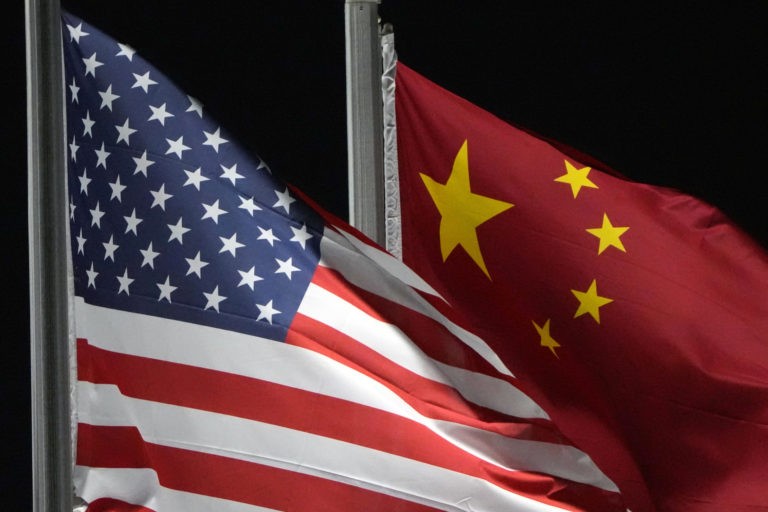
(The Center Square) Market implications are expected Monday morning worldwide following Sunday’s announcement of a trade agreement between the United States and China.

No details were announced between countries doing an estimated $600 billion in trade annually. The two superpower countries have sparred since President Donald Trump’s January inauguration and subsequent tariff implementations.

The deal was reached in Geneva, Switzerland. Tariffs between the countries have escalated to 145% from America on Chinese imports, and 125% from China on American imports.

“We will be giving details tomorrow, but I can tell you that the talks were productive,” Treasury Secretary Scott Bessent said in a Sunday afternoon statement released by the White House.

The strength of economies created a natural resilience between the countries, China saying it would not be bullied and Trump saying America would be first. Following Trump’s Liberation Day moves on April 2, American businesses reported negative impact for the near-term which the president said would later turn positive. Reports say contraction in China’s manufacturing sector was the fastest rate since February 2024.

“We had the vice premier, two vice ministers, who were integrally involved, Ambassador Jamieson, and myself. And I spoke to President Trump, as did Ambassador Jamieson, last night, and he is fully informed of what is going on. So, there will be a complete briefing tomorrow morning.”

He and Trade Ambassador Jamieson Greer said the meetings were “constructive” and Swiss hosts were instrumental in helping move things along.

“It’s important to understand how quickly we were able to come to agreement, which reflects that perhaps the differences were not so large as maybe thought,” Greer said in the White House statement. “That being said, there was a lot of groundwork that went into these two days.”

And he added, “Just remember why we’re here in the first place – the United States has a massive $1.2 trillion trade deficit, so the president declared a national emergency and imposed tariffs, and we’re confident that the deal we struck with our Chinese partners will help us to work toward resolving that national emergency.”

Vice Premier He Lifeng represented China in the meetings with Bessent and Greer.

Late Saturday, Trump on social media said the conversations were going well and agreements on many areas were coming into place. He called it a “total reset.”

According to the Peterson Institute for International Economics, tariffs by China on American products and America on Chinese products was 21.5% or lower from January 2018 until this year. Since Feb. 4, China has four times retaliated against imposed U.S. tariff increases. Chinese tariffs on U.S. exports have gone from 6.5% in January seven years ago to 147.6%, and U.S. tariffs on Chinese exports have gone, respectively, from 10.3% to 124.1%.

Before the weekend, Trump was said to be considering lowering the tariffs to 80%.

Late-Term Abortion Clinic Closes after 50-Plus Years of Killing Babies

(Headline USA) For over 50 years, the Boulder Abortion Clinic served as a resource for women who sought abortions in the second or third trimester because of medical reasons “or other circumstances.”

Finally, the baby killing is over. That clinic quietly closed last month, leaving the U.S. with just a handful that offer abortions after 28 weeks into pregnancy — many on a case-by-case basis.

The 87-year-old clinic founder, Dr. Warren Hern, says he is deeply upset: “It became impossible to continue, but closing is one of the most painful decisions of my life.”

Anti-abortion advocates have celebrated the closure, calling it a step forward in protecting mothers and unborn children. While most abortions take place in the first trimester, clinics like the one in Boulder have killed thousands of babies over the decades.

Federal data shows just 1% of abortions come after 21 weeks of pregnancy, but experts believe that number is higher because some states, including California, don’t give the feds their abortion statistics.

For years, Hern was the only provider in the U.S. to offer later abortions, starting in 1973 and developing specialized techniques and even innovating certain tools.

He and his medical team received constant death threats. Someone shot through the windows of the clinic five times in 1988. Five of Hern’s colleagues who offered similar services were assassinated throughout his career, including the 2009 slaying of Dr. George Tiller in Kansas.

When Hern announced the clinic’s closure in late April, the anti-abortion group Susan B. Anthony Pro-Life America declared the news as a “VICTORY” in a social media post.

In the end, financial issues made it almost impossible to operate the clinic. Hern said patients increasingly were having trouble paying for the procedure, which hovers around $10,000 and is often not covered by insurance. Longtime personal donors were also dwindling.

According to the Later Abortion Initiative by Ibis Reproductive Health, fewer than 20 clinics provide abortions after 24 weeks into pregnancy in the U.S. — though that number isn’t considered comprehensive and excludes hospitals and a handful of other clinics for security reasons.

Currently, the group lists three clinics — in New Mexico, Maryland and Washington, D.C. — that provide services after 28 weeks. Five others — in Maryland, New Jersey, New York, Oregon and Washington state — will consider patients depending on physician recommendations or fetal and maternal conditions.

Adapted from reporting by the Associated Press

Hegseth Announces Fate of DEI at West Point and Military Academies

(Luis Cornelio, Headline USA) It’s a new day at West Point. 

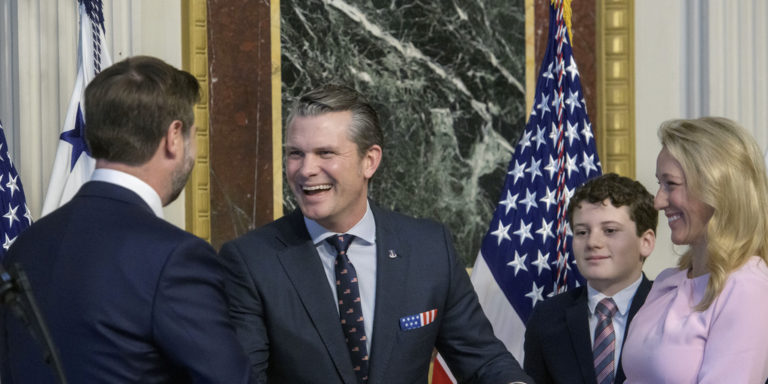
Defense Secretary Pete Hegseth announced Friday that admissions at the military academy will now be based “exclusively” on merit—not race, ethnicity or sex. 

Hegseth published the change in a memo shared on X, effectively reversing the Biden administration’s forced inclusion policies. 

In the memo, Hegseth orders all Military Service Academies to certify that their 2026 incoming class follows the new merit-only criteria. 

Each service secretary has 30 days to ensure no consideration of race, ethnicity or sex in admissions decisions. 

“Our officers will be the best of the best—full stop,” Hegseth wrote, tagging West Point, the Naval Academy and the Air Force Academy. 

Echoing these remarks, Pentagon spokesperson Sean Parnell called the service academies the “cornerstone of the Department’s efforts to produce the world-class military officers required to lead a ready, lethal fighting force that is prepared to deter war and defend our nation.” 

He affirmed this shift will “develop strong officer corps, foster a culture of excellence, and achieve the mission, now and in the future.” 

The memo also directs Jules W. Hurst, the under secretary of defense for personnel and readiness, to certify compliance after the 2026 cycle. 

Hegseth emphasized, “The Department must remain steadfast in its pursuit of excellence and never compromise the high standards at our MSAs. A strong officer corps is essential to ensuring the United States military remains the most lethal the world has ever known.” 

This move follows President Trump’s executive order instructing his cabinet to roll back so-called diversity, equity and inclusion policies across the federal government.

Read the memo below.

Pete Hegseth’s Memo Undoing DEI Practices at West Point by Luis Cornelio

Name-Changing Trans Lawmaker Seethes over Renaming Gulf of Mexico

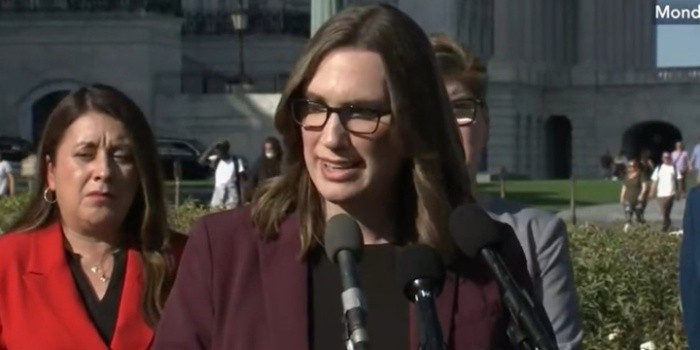
(Luis Cornelio, Headline USA) Rep. Sarah McBride, D-Del., drew widespread mockery online after criticizing the House’s move to codify President Trump’s renaming of the “Gulf of Mexico” to the Gulf of America. 

McBride, a biological male who identifies as the first transgender member of Congress, posted a video on the Capitol subway calling the bill “the dumbest” piece of legislation the House could be spending its time on. “This is ridiculous,” McBride said of the bill. 

Critics pointed out the irony given McBride’s own name change after transitioning.

Born Timothy McBride, the lawmaker adopted the name Sarah shortly after reaching adulthood and went on to win the 2024 House race as the first openly transgender member of Congress. 

“A dude who calls himself ‘Sarah’ thinks it’s dumb to rename something,” podcast host Matt Walsh quipped on X. 

Daily Wire editor Cabot Phillips added, “You switched genders but think switching a name on the map is too much?” 

Legal expert Sarah Parshall Perry wrote: “If Tim McBride can change his name to Sarah McBride, why can’t Congress vote to change the name of Gulf of Mexico to Gulf of America?” 

“The stones on this guy….” Perry added. 

Anti-transgender activist Chloe Cole tweeted, “You of all people should be receptive to name changes…” 

Activist Paula Scanlan piled on, “okay, why don’t you keep the name Tim then?” 

Another user, DataRepublican, noted McBride’s past support for renaming Mount McKinley to Denali.

DataRepublican shared a post of McBride complaining: “Conservatives are outraged Mt. McKinley will be renamed #Denali and say we are losing our heritage. Forced to Google William McKinley.” 

New Trump DOJ Appointee Hints at Impending Russiagate Hoax Investigations

(Luis Cornelio, Headline USA) During his stint as Interim U.S. Attorney for the District of Columbia, Ed Martin spent months investigating the architects of the Russia collusion hoax—seemingly laying the groundwork for his incoming role head of the Justice Department’s new weaponization task force. 

Martin has also launched probes into the Biden administration’s lawfare tactics and the aggressive prosecution of the Americans who protested the certification of the 2020 election inside the U.S. Capitol on Jan. 6, 2021. 

Martin told the New York Post on Saturday that since there “was no limit to the weaponization,” there “may be no limit to the targets.” 

“It’s a nationwide and frankly, international docket where the government was used against the citizens, where the government was weaponized,” he continued. “Sometimes there’ll be crimes involved, in which case we’ll prosecute. Sometimes there’ll be just the need to make clear this is not how it’s supposed to go.” 

Martin’s remarks came just a day after President Donald Trump withdrew his nomination for Martin to permanently serve as the U.S. attorney for the District of Columbia.  

That nomination was derailed by Sen. Thom Tillis, R-N.C., who bumped heads with Martin over his vocal defense of Jan. 6 defendants. 

Instead, Trump announced that Martin would lead a newly formed Weaponization Working Group tasked with investigating how Joe Biden, the disgraced former president, exploited the federal government to go after his political opponents. 

“In these highly important roles, Ed will make sure we finally investigate the Weaponization of our Government under the Biden Regime, and provide much needed Justice for its victims. Congratulations Ed!” Trump wrote on Truth Social Friday.  

Martin’s interim post expires on May 20.

As recounted by the Post, during his time in the role, he demoted half a dozen prosecutors who had previously championed Jan. 6 prosecutions and penned letters backing key Russiagate figures. 

Among them were Andrew Weissman—described as Special Counsel Bob Mueller’s “pitbull”—and Mary McCord, who led early Trump-Russia investigations. 

Another target was disgraced former FBI official Charles McGonigal, who had worked on the Russia probe.  

Ironically, McGonigal is now serving a 78-month sentence for colluding with a Russian oligarch to evade U.S. sanctions and for concealing information about a $225,000 payment linked to the Albanian government. 

“The truth is important, and we need it,” Martin said of his new mission. “We need to move forward. But then, after the truth is known, we need to hold those accountable that did the wrongdoing, and we need to also help those who are victims. We have both of those obligations.” 

Justice Sotomayor Begs Lawyers to ‘Fight This Fight’ against Trump’s Agenda

(Luis Cornelio, Headline USA) Leftist Justice Sonia Sotomayor appeared to urge lawyers to “stand up” and “fight this fight” amid legal battles targeting President Donald Trump’s agenda following his victory in the 2024 presidential election 

“If you’re not used to fighting, and losing battles, then don’t become a lawyer,” Sotomayor said at an American Bar Association event on Thursday. “Our job is to stand up for people who can’t do it themselves.” 

“Right now, we can’t lose the battles we are facing,” she added, as quoted by the New York Times. 

While her comments did not directly address Trump, they coincided with mounting lawsuits filed by powerless Democrats aimed at thwarting his administration’s priorities.  

Many of these left-driven lawsuits are likely headed for the Supreme Court. What’s more troubling, Sotomayor openly backed attorneys willing to “fight this fight,” while strategically avoiding any direct mention of Trump. 

“We need trained and passionate and committed lawyers to fight this fight,” she added. “For me, being here with you is an act of solidarity.” 

Sotomayor’s remarks sparked backlash from Republican figures on social media, with many calling for her to recuse herself from upcoming cases involving Trump. 

Author and Judicial Network President Carrie Severino wrote on X that Sotomayor’s comments make “a mockery of any appearance of objectivity in cases challenging the administration or involving the ABA.” 

Similarly, Sen. Thom Tillis, R-N.C., stated: “This is incredibly rich after liberals spent all of last year freaking out about the political views of Justice Alito’s wife. It is not the job for Justice Sotomayor or any other judge to be partisan politicians in robes.”  

“Their job is to follow the Constitution,” he added. 

Legal scholar and Fox News host Mark Levin blasted her as the “dumbest, most unethical, and politically leftwing lawyer” on the court. He also called her remarks a rallying cry for “ambulance-chasing attorneys to continue their unconstitutional attack on the presidency and separation of powers.” 

“Sotomayor is a shameless disgrace,” Levin concluded. 

President Barack Obama appointed Sotomayor to the high court in 2009. She has long angered conservatives with her politically charged comments. 

At a Harvard event in 2024, she admitted, “There are days that I’ve come to my office after an announcement of a case and closed my door and cried. There have been those days. And there are likely to be more.”