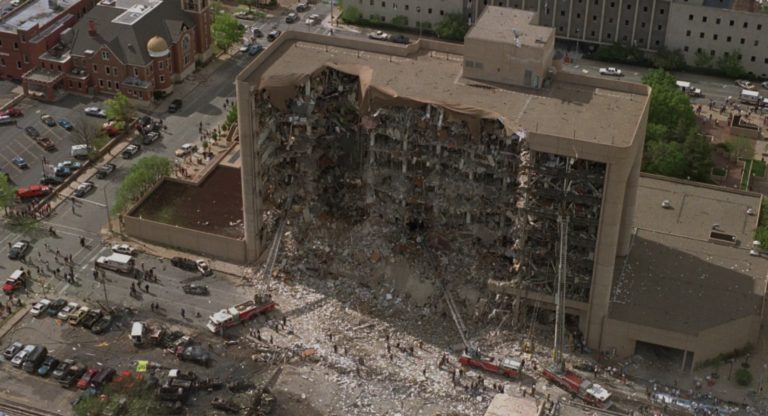
SPECIAL REPORT: The OKC Bombing Sting Operation and the Ford Bronco

Note to readers: The following special report is reprinted with the permission of Oklahoma City bombing researcher Richard Booth, whose work can be found here.

(Richard Booth, OKC Facts) An otherwise obscure FBI 302 report recently sourced from records in the 2004 Terry Nichols State Trial adds an interesting dimension to the theory that the April 19th, 1995 Oklahoma City bombing may have been a sting gone awry.

The memo, which describes a Ford Bronco driving slowly around the Murrah Federal Building at 2:30 A.M. between two to three times — 15 miles per hour, seems innocuous enough.

However, that is only if you’re not familiar with the notion that the Oklahoma City bombing may have been connected to a sting operation—one in which a team of FBI and ATF agents were out all night expecting the delivery of a bomb in the middle of the night.

The theory is not a new one. For years, critics and investigators have pointed out glaring contradictions in the investigation, including specific warnings given to the federal government by informants prior to the bombing.

The most well-known of these informants is Carol Howe, whose reporting to the ATF was specific and detailed, with Howe telling Diane Sawyer at ABC News “I gave them warnings of targets, specific targets, addresses of targets, names of targets.”

Informants reporting on matters related to the bombing are not exclusive to Howe; reports from at least two others seemingly confirm her information: that a group of white supremacists based out of Elohim City, including a gang of bank robbers and a German national named Andreas Strassmeir, were plotting to blow up the Murrah building and had even cased the building with one of the informants. Strassmeir may hold the key to unlocking the mystery concerning the failed sting operation.

Andreas Strassmeir, when interviewed by Ambrose Evans-Pritchard for his 1997 book The Secret Life of Bill Clinton, revealed what can only be said to be “insider knowledge” of the bombing operation—indeed—knowledge of a sting operation that was underway. Strassmeir’s disclosure jibes with what ATF official Lester Martz told reporter J.D. Cash—that his own ATF agents were not at the Murrah building in the morning because they had “been out on an all-night surveillance operation.” A sting operation?

The below excerpt, from page 90, lays out the scenario:
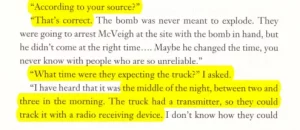
Passage from The Secret Life of Bill Clinton

In this passage, we have Andreas Strassmeir stating that, according to his source, a sting operation was underway, expecting a bomb delivery between 2 and 3 in the morning.

This is where our recently discovered 302 report comes into the story; it concerns a Ford Bronco that approached the purported FBI and ATF surveillance site during that time, when agents would have been on high alert for any activity at the bombing site:
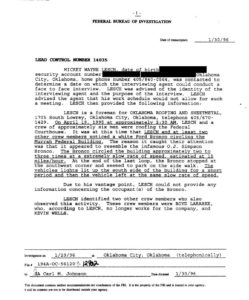
FBI report about a Bronco being seen by the Murrah building about 7 hours before the OKC bombing.

Bronco Would Have “Lit Up” Fed Comm Chatter from the Sting Team When It Rolled Up at 15 Miles Per Hour

So, at the exact moment when the bomb is expected, a Ford Bronco approaches.

It is driving 15 miles per hour, very slowly.

The Bronco circles the building two to three times, according to roofers working across the street atop the courthouse. This is highly irregular, and the vehicle would have been under intense scrutiny as it passed through the area. Any surveillance team operating there would have taken immediate notice of the approaching Bronco, made notes concerning the vehicle, and it is also highly likely there would be radio chatter among the sting operation team about the vehicle’s slow movement into the area, including its parking for a moment, shining it’s lights at the Murrah Building.

The waiting agents would have been very concerned.

With this in mind, let’s take a look at what Roger Charles had to say to Headline USA editor Ken Silva on February 9, 2022 (in his last interview before succumbing to a heart attack just over a week later). In this wide-ranging interview, Charles tells Silva about the Aryan Republican Army—purported by J.D. Cash and David Paul Hammer to have been McVeigh’s “ground crew” in OKC for the bombing.

Charles describes how ARA members Richard Guthrie and Peter Langan utilized top-quality scanners and frequency countermeasures devices to, for example, (1) tune to FBI and law enforcement frequencies before, during, and after their crimes, and also (2) use a scanner to detect any nearby FM transmitter device (of the type used for vehicle tracking devices in 1995):
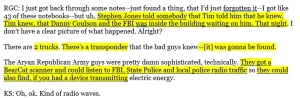
Ken Silva interview excerpt

Find below the full audio of the February 9, 2022, interview with Roger Charles, starting with a story in which Roger describes J.D. Cash’s off-the-record interview with Tim McVeigh.

Cash’s first question to McVeigh was, “how’d you get past all that surveillance that was out there that night?”

Cash says McVeigh just rocked his chair back, crossed his arms, and put on a big “shit eating grin” — like “wouldn’t you like to know.”

Well, we now may understand how McVeigh knew: because his security team went through the area and likely found chatter on specific frequencies in use (meanwhile the ARA was said to have had a list of FBI and ATF frequencies—from where?) and they discovered the sting operation’s communications channel, recognized the area was under surveillance, and had even by that time already found a tracking device that was to be put on the Ryder truck, which the bad guys had other plans for (put it on a decoy truck and send that one off to Fort Smith or elsewhere).

A Hypothetical Scenario – The Bronco Arrives During the Surveillance Op

Assume this Bronco is entering the scene of the sting operation, slowly pulling in at 15 miles per hour at the exact moment the delivery of the bomb is supposed to occur — between 2 and 3 AM.

The streets are vacant; it’s the middle of the night on a weekday. Nobody is out here.

What if the person inside that Bronco circling the Murrah building is operating a BearCat scanner (or any number of other excellent frequency scanners available at that time to hobbyists—I’ve had a few myself) and is either scanning local frequencies for traffic—to identify the sting operation’s frequency—or is already tuned to the sting operation’s channel?

Well, they would know immediately that they had entered surveillance… and would leave after making their circle around the building 2 to 3 times.

And so maybe that’s how “Tim knew that Danny Coulson and the FBI were waiting on him” that night.

Was it because Richard Guthrie or someone else on McVeigh’s 4/19 on-the-ground “security team” confirmed it using a frequency scanner?

Richard Guthrie of the Aryan Republican Army just so happened to own a Ford Bronco, per this January 3 1996 FBI memo from Omaha to Director, FBI:
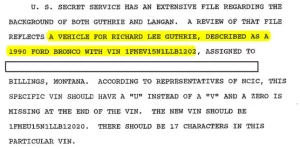
FBI report about Richard Lee Guthrie's Bronco
FBI report about Richard Lee Guthrie’s Bronco

For more information on the FBI’s failed Oklahoma City sting operation, see kennethtrentadue.com, libertarianinstitute.org/okc, and visit @BlowBackBook on X to read about an upcoming book which may shed some light on the cover-up of what was supposed to be a simple sting.

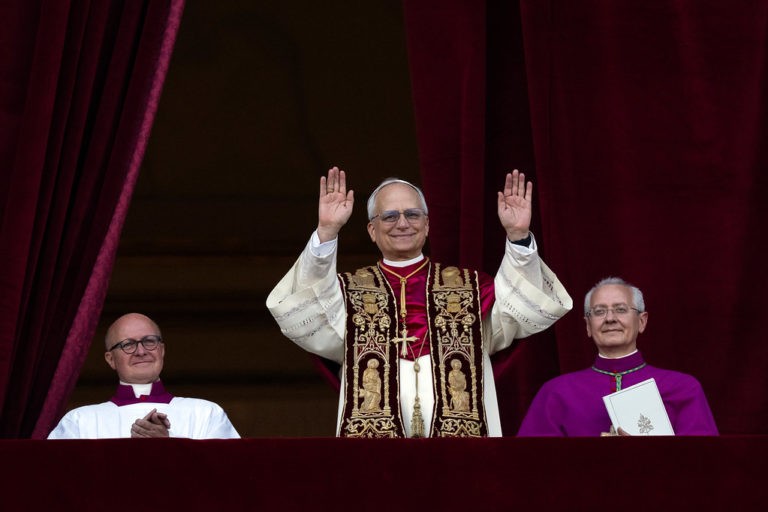
Pope Leo XIV Calls for Peace in Gaza, End to Israeli Blockade on Aid

(Dave DeCamp, Antiwar.com) Pope Leo XIV called for a ceasefire in Gaza and an end to the Israeli blockade of aid on Sunday in his first Sunday blessing since being elected pontiff last week.

“I am deeply pained by what is happening [in Gaza,” Leo said from the loggia of St. Peter’s Basilica. “Let the fighting cease immediately, let humanitarian aid be provided to the exhausted civilian population, and may all hostages be released.”

The pope also called for a ceasefire in Ukraine, saying, “I carry in my heart the sufferings of the beloved Ukrainian people. Let everything possible be done to achieve genuine, just and lasting peace as soon as possible.”

Leo, the first US-born pontiff, welcomed the ceasefire between India and Pakistan and made an appeal to world leaders for peace and an end to war. “In today’s dramatic context of a third world war fought piecemeal … I too appeal to the powerful of the world by repeating these ever-relevant words: ‘never again war!’” he said.

The pope made the remarks after singing the Regina Caeli (Queen of Heaven) prayer, which is recited throughout the Easter season. He closed his address with a “heartfelt appeal” to Mary Queen of Peace, “so that she may present it to the Lord Jesus and obtain for us the miracle of peace.”

Leo’s comments signal he will continue the late Pope Francis’s emphasis on the issues of war and peace. Francis frequently called for peace in Gaza and was highly critical of Israel’s conduct, suggesting in his last book that there should be an investigation into whether it constitutes genocide.

Francis also kept in close contact with the Holy Family Catholic Church in Gaza City, often holding nightly calls with the priest and parishioners. His final call with the church occurred on April 19, just two days before his death.

Francis called for a ceasefire in Gaza in his last public address, which was delivered by an aide the day before his death. “I think of the people of Gaza, and its Christian community in particular, where the terrible conflict continues to cause death and destruction and to create a dramatic and deplorable humanitarian situation,” he said. “I appeal to the warring parties: call a ceasefire, release the hostages, and come to the aid of a starving people that aspires to a future of peace!”

This article originally appeared at Antiwar.com.

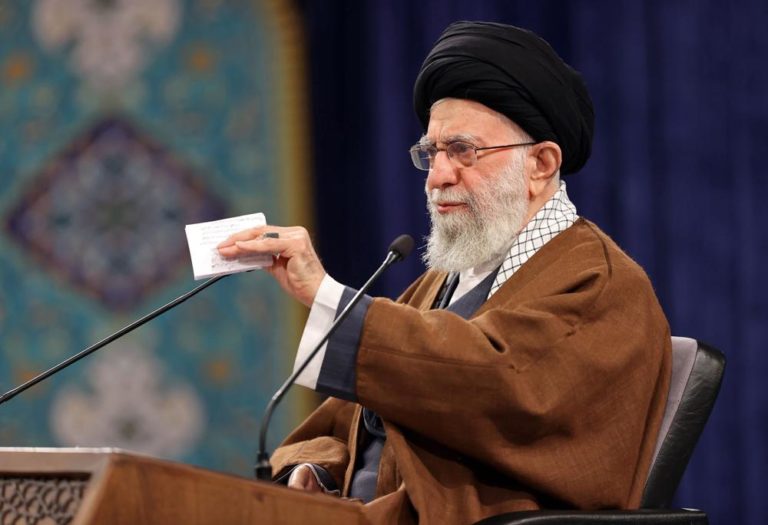
Iran Says Fourth Round of Talks With US ‘Difficult But Useful’

(Dave DeCamp, Antiwar.com) Iran said on Sunday that the fourth round of negotiations it held with the US earlier in the day were “difficult but useful,” and both sides have agreed to hold more talks.

“The fourth round of indirect Iran-US negotiations is concluded; difficult but useful talks to better understand each other’s positions and to find reasonable & realistic ways to address the differences,” Iranian Foreign Ministry spokesman Esmaeil Baqaei wrote on X. “Next round will be coordinated and announced by Oman.”

A US official told Axios that an agreement was reached on moving forward and working out the technical details of a potential nuclear deal. “We are encouraged by today’s outcome and look forward to our next meeting, which will happen in the near future,” the official said.

The US delegation was led by President Trump’s Middle East envoy, Steve Witkoff, and the Iranian side was led by Iranian Foreign Minister Abbas Araghchi. According to the US official speaking to Axios, negotiations were held both indirectly and directly.

It remains unclear exactly what kind of conditions the US is looking to impose on Iran’s nuclear program. Publicly, US officials have been calling for Iran to eliminate its nuclear enrichment program, which is a non-starter for Tehran.

“Enrichment capability is one of the honors and achievements of the Iranian nation,” Aragchi said ahead of Sunday’s talks, adding that the issue was “non-negotiable.”

President Trump said last week that the US hasn’t decided yet if it would agree to a deal that would allow Iran to continue enriching uranium. He has been threatening to bomb Iran if a deal isn’t reached, even though his intelligence agencies recently reaffirmed that there’s no evidence Tehran is building a bomb or that Ayatollah Ali Khamenei has reversed his ban on the development of nuclear weapons.

This article originally appeared at Antiwar.com.

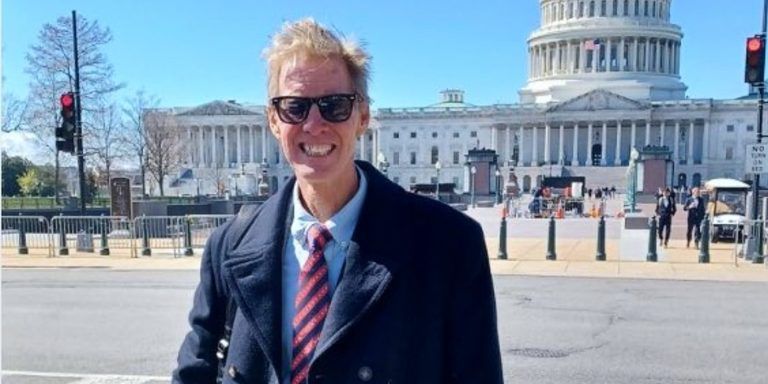
Police Encountered Ryan Routh 9 Days before Alleged Trump Assassination Attempt

(Ken Silva, Headline USA) It’s been widely reported that the feds received numerous reports about Ryan Routh in the years leading up to his alleged Sept. 15 assassination attempt on President Donald Trump. Those reports came from Routh’s associates in Ukraine, who were raising flags about his recruitment of foreign refugees to fight in the war against Russia.

However, few, if any, media outlets have reported that local law enforcement also received a report on Routh just nine days before his alleged attempt. According to previously unpublicized information from a Florida Highway Patrol arrest warrant, deputies conducted a Sept. 6 “welfare check” on Routh at a truck stop where was thought to have been living in the weeks leading up to his alleged attempt.

The Florida Highway Patrol arrest warrant, which was filed in December but has remained largely unpublicized, also indicates that Routh may have been committing a crime right under law enforcement’s nose during that Sept. 6 encounter.

The arrest warrant states that on Sept. 6, deputies were called to GR’s Truck Stop in South Bay, about 45 miles away from Trump International Golf Course. According to the arrest warrant, Routh identified himself to PBSO deputies, and told them he was only staying at the truck stop temporarily because he “found a shady spot.”

However, Routh found more than just shade at the GRS Truck Stop. Parked near Ryan’s Nissan Xterra was a tree-trimming truck belonging to Taurus Transportation owner Puja St. Louis. According to the Florida Highway Patrol arrest warrant, Routh the truck’s Florida license plate #97EEED, and put it on his Xterra.

The stolen license plate was found on the Xterra when Routh was apprehended by law enforcement after his Sept. 15 alleged attempt on Trump. Moreover, law enforcement’s investigation determined that Routh was using the stolen license plate since at least Sept. 2—meaning that he had the plate in his possession when PBSO conducted its Sept. 6 welfare check on him at the truck stop.

The PBSO didn’t respond to Headline USA’s questions about whether the stolen license plate was attached to Routh’s vehicle during the Sept. 6 encounter. Nor did the PBSO respond to questions about whether deputies noticed the license plate—and, if so, why they didn’t charge Routh with a crime for having it.

The PBSO also denied a request for bodycam footage and other documents about the Sept. 6 incident, citing an ongoing investigation.

The day after his encounter with the PBSO, Routh continued his alleged assassination plot with a visit to Palm Beach International Airport, purportedly to conduct surveillance on where Trump parked his plane.

The PBSO realized the significance of the Sept. 6 welfare check the day after the Sept. 15 assassination attempt, when deputies returned to the truck stop.

“On September 17, 2024, PBSO Deputy S. Barge, having learned of the September 6, 2024, welfare check involving Routh at the GRS Truck Stop in South Bay, visited the scene. BWC from Dep. Barge revealed that there were several empty cans of Armour brand Vienna sausages located in the exact spot where Routh had previously had the Xterra parked and was apparently living,” the arrest warrant states.

“This is noteworthy because deputies who located Routh’s sniper’s nest after the shots were fired on September 15, 2024, also located Vienna sausages along with the rifle, the backpacks, and the camera.”

Routh faces state charges of attempted assassination, as well as an attempted felony murder charge for allegedly causing a car crash that badly injured a young girl after the PBSO stopped him on Sept. 15. He also faces federal charges for attempted assassination, and has a hearing in that case schedule for Wednesday.

Correction: This story initially incorrectly reported that the arrest warrant was issued by the PBSO, when it was in fact issued by the Florida Highway Patrol. 

Ken Silva is the editor of Headline USA. Follow him at x.com/jd_cashless.

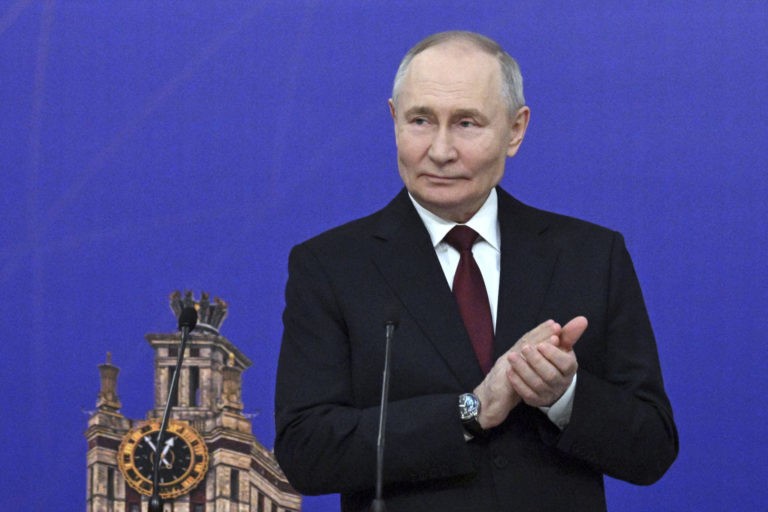
Putin Proposes Direct Talks With Ukraine, Zelensky Says Ceasefire Must Happen First

(Dave DeCamp, Antiwar.com) On Sunday, Russian President Vladimir Putin proposed starting direct peace talks with Ukraine without preconditions in Turkey this Thursday.

Ukrainian President Volodymyr Zelensky initially responded by saying there must be a ceasefire before talks could be held. He later said that he was willing to meet with Putin in Istanbul this Thursday, but made clear it would still be conditional on a ceasefire.

“We await a full and lasting ceasefire, starting from tomorrow, to provide the necessary basis for diplomacy. There is no point in prolonging the killings,” Zelensky wrote on X. “And I will be waiting for Putin in Türkiye on Thursday. Personally. I hope that this time the Russians will not look for excuses.”

In his announcement proposing the talks, Putin said that Ukraine had rejected previous Russian ceasefire offers, including the three-day truce he declared for Russian Victory Day, which ended at midnight on May 11. Throughout the three days, both sides accused the other of violating the ceasefire.

“I will repeat: we have proposed steps towards a ceasefire on many occasions. We have never refused to engage in dialogue with the Ukrainian side,” Putin said.

President Trump said that he wanted Ukraine to accept Putin’s offer for direct talks without a ceasefire. “President Putin of Russia doesn’t want to have a Cease Fire Agreement with Ukraine, but rather wants to meet on Thursday, in Turkey, to negotiate a possible end to the BLOODBATH. Ukraine should agree to this, IMMEDIATELY,” he wrote on Truth Social.

“At least they will be able to determine whether or not a deal is possible, and if it is not, European leaders, and the U.S., will know where everything stands, and can proceed accordingly!” he added.

Despite Trump’s post, Zelensky said he expects a ceasefire to begin on Monday. “Starting tomorrow, we await a ceasefire — this proposal is on the table. A full and unconditional ceasefire, one that lasts long enough to provide a necessary foundation for diplomacy, could significantly bring peace closer,” he said.

European leaders have been threatening to increase sanctions on Russia and ramp up military aid to Ukraine if Moscow doesn’t agree to a 30-day ceasefire, and reportedly have the Trump administration’s support to do so.

This article originally appeared at Antiwar.com.

Trump Signs Sweeping Order to Lower the Cost of Prescription Drugs

(Headline USA)  President Donald Trump said he will set a 30-day deadline for drugmakers to lower the cost of prescription drugs in a sweeping executive order that he will sign on Monday.

The order calls on the health department, led by Robert F. Kennedy Jr., to broker new price tags for drugs, according to a White House official who briefed the press on the executive order ahead of its signing.

If a deal is not reached, a new rule will kick in that will tie the price of what the U.S. pays for medications to lower prices paid by other countries.

Trump teased the executive order in a social media post on Sunday evening.

“I will be instituting a MOST FAVORED NATION’S POLICY whereby the United States will pay the same price as the Nation that pays the lowest price anywhere in the World,” the Republican president posted, pledging to sign the order on Monday morning at the White House.

The federal government spends hundreds of billions of dollars on prescription drugs, injectables, transfusions and other medications every year through Medicare, which covers nearly 70 million older Americans.

The nation’s leading pharmaceutical lobby on Sunday pushed back, calling it a “bad deal” for American patients. Drugmakers have long argued that any threats to their profits could impact the research they do to develop new drugs.

“Importing foreign prices will cut billions of dollars from Medicare with no guarantee that it helps patients or improves their access to medicines,” Stephen J. Ubl, the president and CEO of PhRMA, said in a statement. “It jeopardizes the hundreds of billions our member companies are planning to invest in America, making us more reliant on China for innovative medicines.”

Trump’s so-called “most favored nation” approach to Medicare drug pricing has been controversial since he first tried to implement it during his first term. He signed a similar executive order in the final weeks of his presidency, which called for the U.S. to only pay a lower price that other countries pay for drugs administered in a doctor’s office.

But even that more narrow executive order faced hurdles, with a court order that blocked the rule from going into effect under President Joe Biden’s administration. The pharmaceutical industry argued that Trump’s 2020 attempt would give foreign governments the “upper hand” in deciding the value of medicines in the U.S.

Trump has played up the announcement, saying it will save taxpayers big money.

“Our Country will finally be treated fairly, and our citizens Healthcare Costs will be reduced by numbers never even thought of before,” Trump added.

He has touted immediate savings, but the health department is limited in its control of drug pricing. It has the most authority around the drug prices it pays for Medicare and Medicaid, which covers roughly 80 million poor and disabled Americans. The price that millions of Americans covered by private insurance pay for drugs is harder for the agency to manipulate.

Trump boasted in his post that the plan will save “TRILLIONS OF DOLLARS.”

The executive order will also encourage the Department of Justice and the Federal Trade Commission to examine enforcement action the agencies can take around the pricing of drugs.

The U.S. routinely outspends other nations on drug prices, compared with other large and wealthy countries, a problem that has long drawn the ire of both major political parties, but a lasting fix has never cleared Congress.

Trump came into his first term accusing pharmaceutical companies of “getting away with murder” and complaining that other countries whose governments set drug prices were taking advantage of Americans.

On Sunday, Trump took aim at the industry again, writing that the “Pharmaceutical/Drug Companies would say, for years, that it was Research and Development Costs, and that all of these costs were, and would be, for no reason whatsoever, borne by the ‘suckers’ of America, ALONE.”

Referring to drug companies’ powerful lobbying efforts, he said that campaign contributions “can do wonders, but not with me, and not with the Republican Party.”

Adapted from reporting by the Associated Press.

Consumer Borrowing Remained Sluggish in March Hinting Economic Stress

(Mike Maharrey, Money Metals News Service) After crashing in February, consumer borrowing remained tepid in March, a worrying sign for an economy that runs on credit cards.

Borrowing has been slowing for the past several months, raising the prospect that Americans may finally be edging close to their credit limits.

Total consumer credit rose 2.4 percent in March after contracting in February, according to the latest data from the Federal Reserve. March borrowing was close to January levels.

Even with the slowdown in borrowing, American consumers are still buried under $5 trillion in consumer debt.

The Federal Reserve consumer debt figures include credit card debt, student loans, and auto loans, but do not factor in mortgage debt. When you include mortgages, U.S. households are buried under a record level of debt. As of the end of 2024, total household debt stood at $18.4 trillion.

Revolving credit, primarily reflecting credit card debt, rose by just $1.9 billion, a 1.7 percent annual increase. This compares with a 5 percent increase in January and a 20.2 percent surge in December.

Americans have now run up their credit card balances to a record $1.32 trillion.

The double whammy of rising debt and interest rates exacerbates the debt problem. The average annual percentage rate (APR) currently stands at 20.12 percent, with some companies still charging rates as high as 28 percent. The average is only slightly down from the record high of 20.79 percent set last August.

Rates aren’t coming down much, even with Federal Reserve rate cuts. According to an ABC News report, despite a full percentage point in rate cuts, credit card companies are charging a higher margin “to weather default risk, cover overhead costs and recoup profits, experts added.

Credit card rates are high, and they’re staying high,” Bankrate analyst Ted Rossman told ABC News.

The Fed’s pause in rate cuts is more bad news for consumers buried in debt.

Americans are starting to struggle to pay those high credit card bills.

According to the New York Fed, in the fourth quarter of 2024, “Aggregate delinquency rates ticked up 0.1 percentage point (ppt) from the previous quarter to 3.6 percent of outstanding debt in some stage of delinquency.”

According to PYMNTS Intelligence, credit cards are the loan type with the highest share of balance 90+ days delinquent, currently at 11.5 percent.

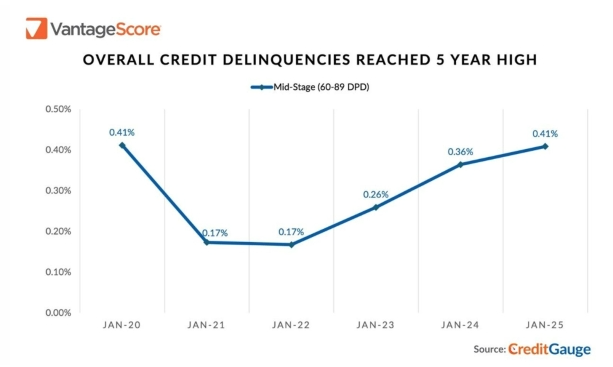
According to CreditGauge, consumer credit delinquencies hit the highest level in five years in 2024.

“The combination of rising mid-to-late-stage credit delinquencies and rising credit balances suggests a growing debt burden that some consumers are increasingly struggling to manage.”

As traditional credit avenues creep closer to their limits, it appears that consumers are turning to buy-now-pay-later to keep spending. According to PYMNTS, “The torrid pace of activity at the likes of Sezzle and Affirm — as many categories saw double-digit spending (and Sezzle notched triple-digit revenue growth) — has far outstripped the growth in the Fed’s data.

Subprime credit card borrowers are struggling the most, with delinquency rates nudging upward by about 5.6 percent since the Federal Reserve began raising rates to battle price inflation.

Despite strong retail spending in December for the holiday season, the bigger picture reveals a consumer under stress.

Given these dynamics, it’s no wonder consumers are trying to borrow less.

Non-revolving credit, primarily reflecting outstanding auto loans, student loans, and loans for other big-ticket durable goods, rose by $8.2 billion, a 2.7 percent increase.

This was a significant slowdown from the 5.2 percent in December and is more in line with the tepid growth of around 2 percent in non-revolving credit over the last year, as consumers cut back on big-ticket spending to cover the increasing costs of day-to-day necessities.

Before the pandemic, revolving credit growth averaged 5 percent.

This big drop in consumer borrowing reverts to a trend we saw developing last fall. Credit card spending tanked in August and remained muted in September. They pulled out the plastic again for the holidays, but that might have been a last gasp for the American consumer.

The bottom line is that Americans have blown through the savings they accumulated during the pandemic and have run their credit cards close to the limit. An economy run on Visa and Mastercard simply isn’t sustainable. When Americans finally hit their credit limit, it will have major implications for economic growth.


Mike Maharrey is a journalist and market analyst for Money Metals with over a decade of experience in precious metals. He holds a BS in accounting from the University of Kentucky and a BA in journalism from the University of South Florida.

Sen. Cornyn: Federal Probe Started Into Islamic Community in North Texas

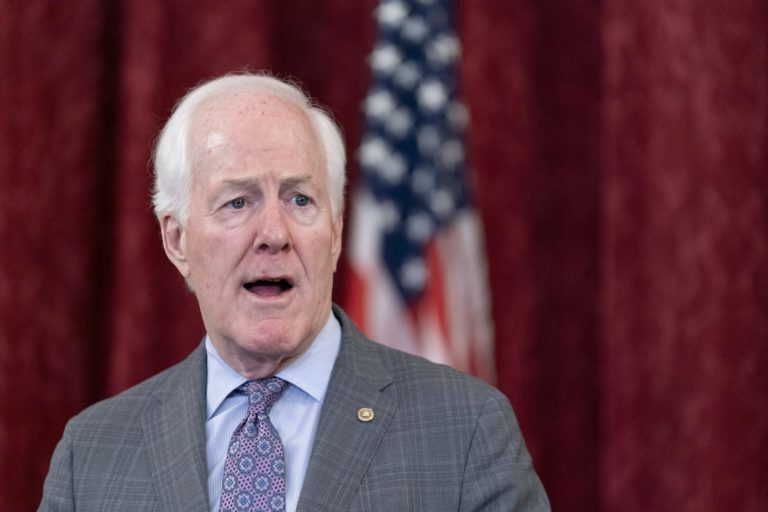
(Headline USA) The U.S. Department of Justice has opened a federal civil rights investigation into a Muslim-centered planned community around one of the state’s largest mosques near Dallas, U.S. Sen. John Cornyn said Friday.

Cornyn requested the federal probe of the development last month, citing concerns it could discriminate against Christians and Jews. He announced in a post on X that U.S. Attorney General Pam Bondi had notified him of the investigation.

The developers of the proposed planned community tied to the East Plano Islamic Center, which has not yet been built, have said they are being bullied because they are Muslim.

The Justice Department did not immediately respond to a request for comment or to confirm Cornyn’s announcement.

A federal probe would further escalate pressure on the proposed EPIC City, which is already facing mounting criticism and multiple investigations from Republican Gov. Greg Abbott and other GOP state officials who claim the group is trying to create a Muslim-exclusive community that would impose Islamic law on residents.

Among its chief critics is the state’s hard-right Attorney General Ken Paxton, who is challenging Cornyn for his Senate seat in 2026.

“Religious discrimination and Sharia Law have no home in Texas,” Cornyn, of Texas, wrote in his post on X. “Any violations of federal law must be swiftly prosecuted, and I know under (President Donald Trump’s) administration, they will be.”

Dan Cogdell, an attorney for EPIC City who defended Paxton in his 2023 impeachment trial when he was acquitted by the state Senate, said the developers have “done nothing illegal and we will cooperate fully with all investigations-regardless of how misguided and unnecessary they are.”

The state investigations include whether the development is violating financial and fair housing laws and whether the mosque has conducted illegal funerals.

Cogdell has said none of the investigations would be happening if the community was planned around a church or temple.

The attacks on the project about Islamic law and other claims “are not only completely without merit and totally misleading but they are dangerous as well,” Cogdell said Friday. “These folks are US Citizens, law abiding and Texans.”

The Council on American-Islamic Relations in the Dallas area also has criticized the state probes as bullying the Muslim community and a violation of constitutionally protected religious expression.

Plans for the mixed-used development include more than 1,000 homes and apartments, a faith-based school for kindergarten through 12th grade, a community college, assisted living for older residents and athletics fields.

EPIC City would be near the community of Josephine, about 30 miles (48 kilometers) northeast of Dallas.

Adapted from reporting by the Associated Press.


Indian Jewelry Market Reveals the Push and Pull of Higher Gold Prices

(Mike Maharrey, Money Metals News Service) Rising gold prices have spurred investment demand, especially in the East, and helped drive Q2 gold demand to the highest level since 2016. In China, demand for gold bars and coins charted the second strongest quarter on record.

However, high prices put a drag on jewelry demand in the first quarter.

In volume terms, gold jewelry demand fell 21 percent year-on-year to 380 tonnes. However, in dollar terms, demand increased by 9 percent to $35 billion.

The Indian jewelry market captures aspects of both consumer and investment demand, offering a window into the push and pull that higher gold prices have on demand. It ranks as the biggest gold jewelry market in the world.

India reported a sharp 25 percent drop in jewelry demand to 71 tonnes. It was the lowest quarterly volume since Q3 2020. However, the value of that demand rose by 3 percent.

The price of gold has hit a record level in rupee terms, and the local price surpassed the key level of Rs.100,000/10g in late April. After a brief correction, the price has pushed back toward that psychologically significant level.

As Metals Focus described the Indian jewelry market dynamics, “This persistent strength has undermined consumers’ ability to buy gold jewelry.

Indian consumers typically have a relatively fixed budget for jewelry purchases. Given the higher prices, it follows that sales volume would fall.

According to Metals Focus, the drop in discretionary spending for lower-priced daily wear jewelry was particularly pronounced, while wedding purchases were more resilient.

There was also a growing number of consumers exchanging old jewelry for new. Metals Focus analysts estimate that the share of exchange during Q1 was as high as 60 percent.

One result of this higher price environment could be the growth in the adoption of 14 and 18-karat jewelry. Jewelry retailers can stock more 14 and 18-karat pieces for the same capital outlay.

Gold jewelry is viewed differently in India than in the West. It is seen as not only an adornment but also an investment. Much Indian jewelry is made from 22-carat gold, as opposed to the 14- and 18-karat pieces more common in the U.S. and Europe. Many Indian families use gold jewelry as savings. According to Metals Focus, about 75 to 80 percent of the Indian jewelry sales are made up of 22-karat pieces.

In addition to a shift to lower-karat pieces, the jewelry trade introduced lighter-weight products across bridal and daily wear segments to offset the impact of rising prices.

According to Metals Focus, the sale of 14-karat gold jewelry has grown exponentially over the last few years.

“This segment includes modern, trendy, and lightweight design catering to the young demographic. Given that India has a large youth population, whose taste and style of dressing is far more western in nature, this category has seen its popularity grow, especially in urban centers.”

Deeply ingrained cultural views on gold will likely make the shift toward lower-purity gold jewelry slow. While many Indian consumers are currently suffering from sticker shock, if prices remain elevated, they will likely adjust their expectations. And as Metals Focus pointed out, the wedding jewelry market is much less elastic.

“Wedding-related purchases were more resilient, reflecting the essential nature of wedding demand and the fact that these purchases cannot be held back for a long period.”

On the other side of the demand coin, higher prices could incentivize more jewelry buying for investment purposes.

If gold prices continue to rise, it will be interesting to see how Indian consumers continue to adjust. One thing is pretty certain — they will likely find ways to have gold.


Mike Maharrey is a journalist and market analyst for Money Metals with over a decade of experience in precious metals. He holds a BS in accounting from the University of Kentucky and a BA in journalism from the University of South Florida.

Here’s Where Gold & Silver Stand

(Jesse Colombo, Money Metals News Service) Both gold and silver are undergoing healthy consolidation phases after their strong rallies, allowing them to reset and work off overbought conditions.

It’s time for an updated look at where things stand. Three weeks ago, I suggested that gold may have temporarily peaked after a strong rally, and that a period of sideways movement or a minor pullback would be both healthy and necessary to cool off its overbought condition.

That’s exactly what we’ve seen since—gold has moved sideways, consolidating its gains. Here’s what I’m seeing now and what I believe is likely to happen next.

For technical analysis purposes, I prefer to focus on COMEX gold futures rather than spot prices, as futures tend to respect and form support and resistance levels in clean $100 increments—such as $3,000, $3,100, $3,200, and so on.

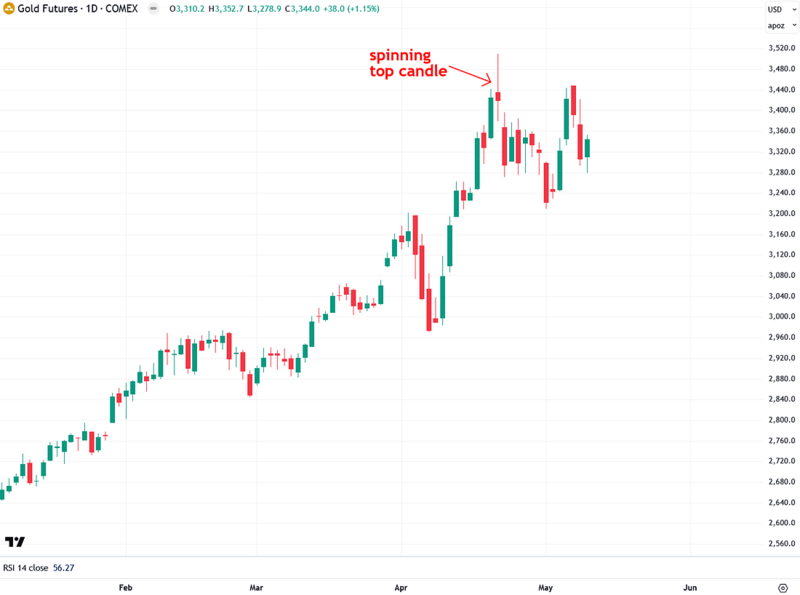
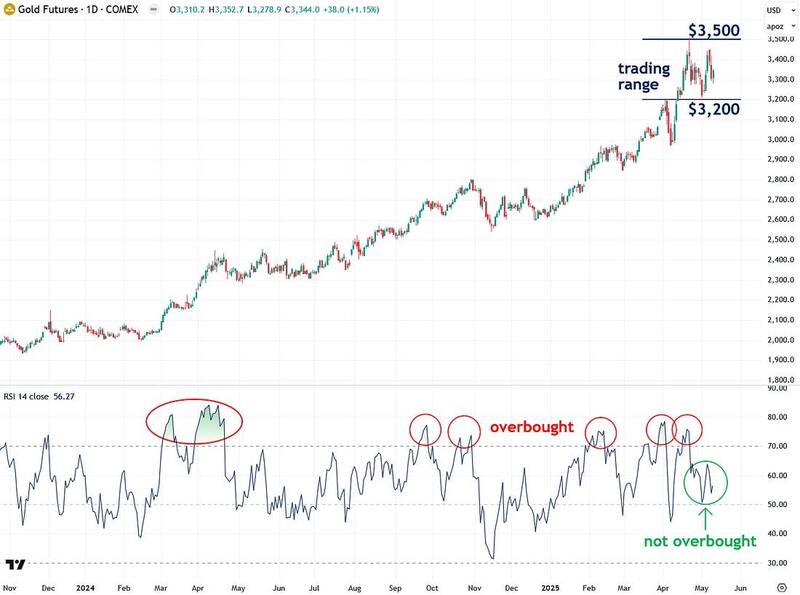
Since peaking on April 22nd, when gold briefly tested $3,500 before pulling back, futures have been consolidating in a range between $3,200 and $3,500.

This type of sideways action is common in strong bull markets and often serves as a launchpad for the next leg higher.

I’m currently watching for a breakout scenario, which would be confirmed by a decisive close above $3,500 on strong volume. If that occurs, I believe gold could surge to $4,000 an ounce fairly quickly—echoing a recent forecast by JP Morgan. I’ll be monitoring this closely.

Back on April 22nd, I pointed out that a candlestick pattern known as a spinning top had formed in gold—a classic sign of indecision that often marks the end of a rally. I suggested that this could signal a temporary peak and the start of a consolidation phase, which is exactly what we’re seeing now.

Interestingly, almost exactly one year ago, a spinning top candlestick appeared around the $2,400 level following gold’s surprise $400 rally (see the chart below)—and that marked the beginning of several months of consolidation before gold broke out again in August 2024.

I see strong parallels between that April 2024 candle and the one we just saw in April 2025.

If this pattern holds, gold is likely to continue moving sideways for a few more months in a healthy pause before making another run higher. I welcome this kind of consolidation—it’s far better for gold to build a solid base than to surge too quickly and risk a sharp correction.

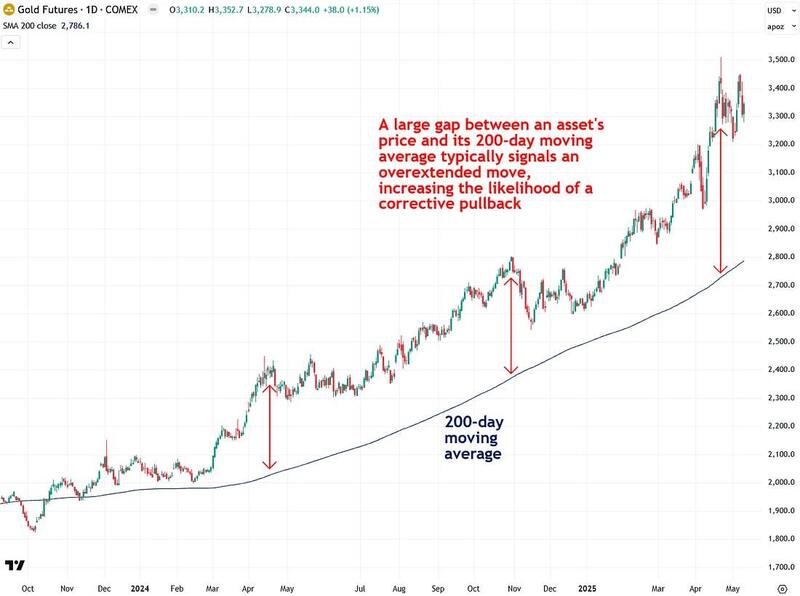
One useful way to gauge whether an asset has surged too far, too fast is by comparing its price to its 200-day moving average.

When an asset becomes significantly stretched above its 200-day moving average, it often signals that a consolidation phase is due—but that doesn’t necessarily mean a sharp pullback. It can take the form of sideways movement as the market digests recent gains.

As the chart below shows, gold became notably extended above its 200-day moving average in April 2024 and October 2024, and in both cases, it entered a healthy consolidation phase to work off those excesses.

The same pattern emerged again in April 2025, so it’s no surprise we’re now seeing gold cool off.

Although we’re already a couple of weeks into this pause, I wouldn’t be surprised if it continues a bit longer until gold and its 200-day moving average converge a bit more.

Another effective way to assess whether an asset like gold has gotten ahead of itself is by looking at the Relative Strength Index (RSI)—a widely used momentum indicator that gauges whether an asset is overbought, oversold, or in neutral territory.

When I published my last update on April 22nd, gold was in overbought territory. Since then, however, the RSI shows that gold has successfully worked off that condition—without requiring a sharp pullback. That’s a very encouraging sign, as it indicates gold is resetting and could soon be in a strong position to resume its rally.

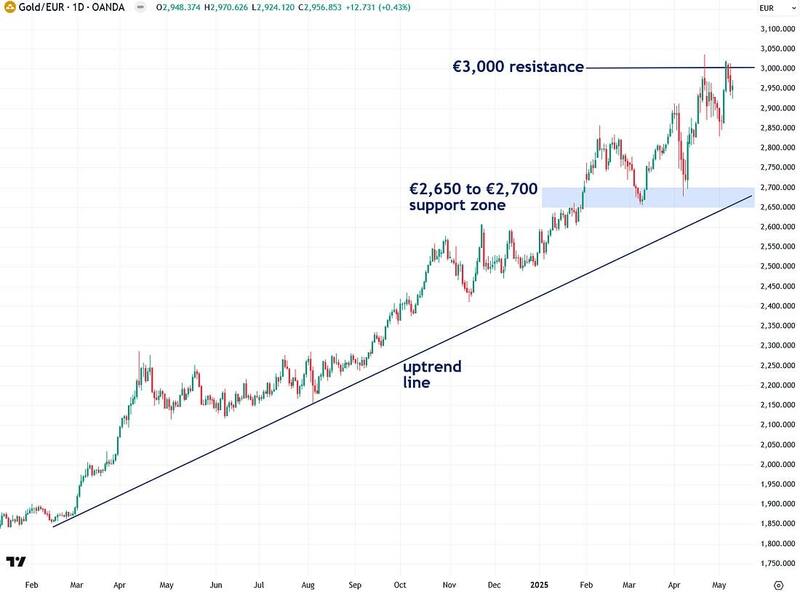
I also like to analyze gold priced in international currencies, as it removes the influence of the U.S. dollar and reveals gold’s true intrinsic strength. One of the key charts I watch is gold priced in euros, and by that measure, the uptrend remains firmly intact. It’s currently hovering just below the critical €3,000 resistance level—a breakout above that would strongly signal the start of gold’s next major rally leg.

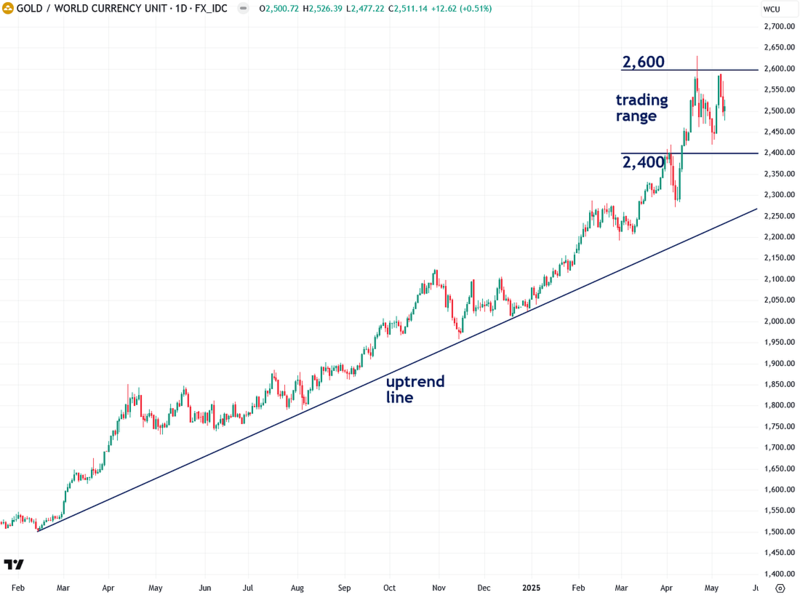
I’ve recently begun tracking gold priced in the World Currency Unit (WCU)—a composite currency based on the GDP-weighted average of the world’s 20 largest economies. In many ways, it offers one of the most balanced and accurate reflections of gold’s true global performance, which is why I’ve been paying close attention to it.

Based on that measure, gold remains in a healthy, confirmed uptrend but has been consolidating in a trading range between 2,400 and 2,600 in recent weeks. Ideally, a breakout above the 2,600 level would signal that gold is ready for its next leg higher.

While I do believe a healthy consolidation in gold is likely in the near term, I strongly disagree with those claiming that gold is at a long-term peak and that the recent highs are as good as it gets.

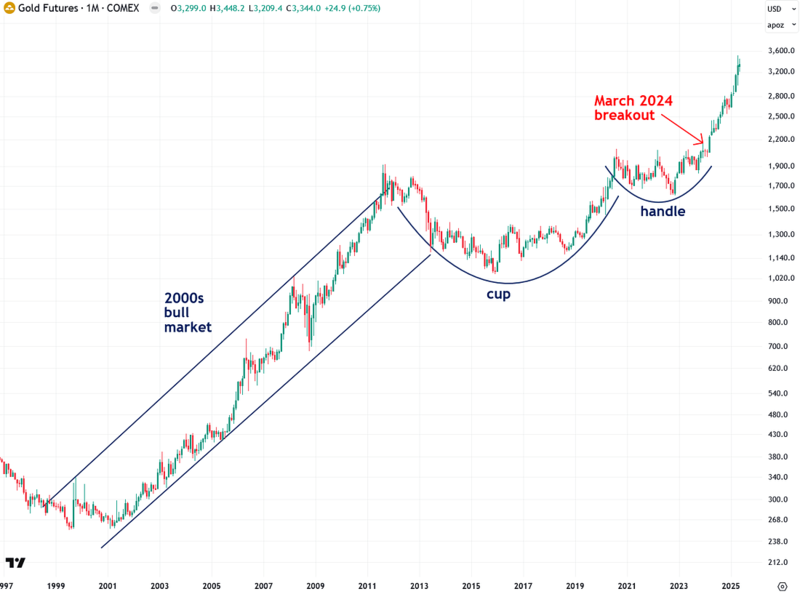
One key reason is that gold broke out of a major cup-and-handle pattern just a year ago (see the chart below)—and historically, breakouts from patterns of that magnitude don’t fizzle out quickly. They typically fuel multi-year bull markets lasting five to ten years or more.

Next, let’s turn to silver, which has been playing second fiddle to gold’s recent surge.

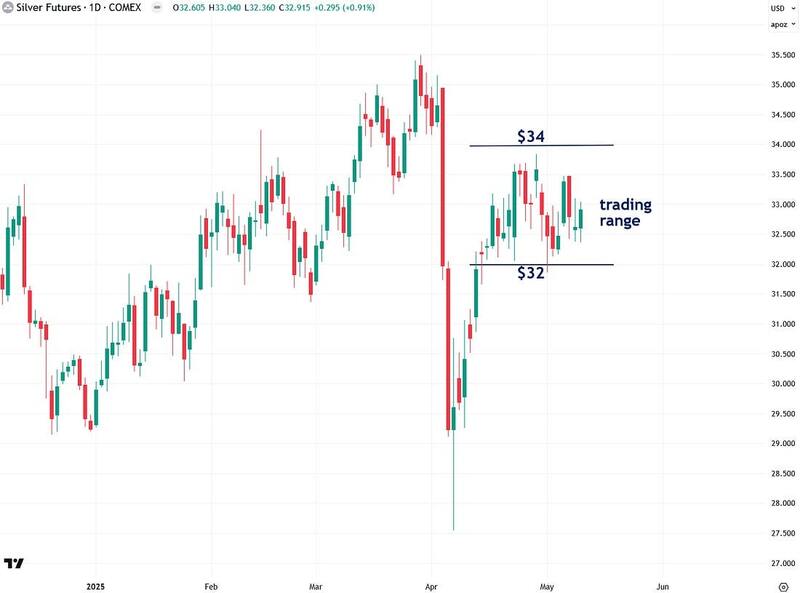
As the chart below shows, COMEX silver futures have remained steady in recent weeks, consolidating in the $32 to $33 range while holding above a key uptrend line—a positive sign.

To confirm that the next leg of silver’s bull market is underway, I’d like to see a decisive breakout above both the $32–$33 resistance zone and the $34–$35 resistance zone. For now, it’s a waiting game.

I also want to highlight something I’m seeing in silver’s short-term price action: a trading range between $32 and $34, which has formed alongside a similar range in gold. I’m closely watching to see which direction these ranges break, as it should offer an important clue about the next major move for both metals.

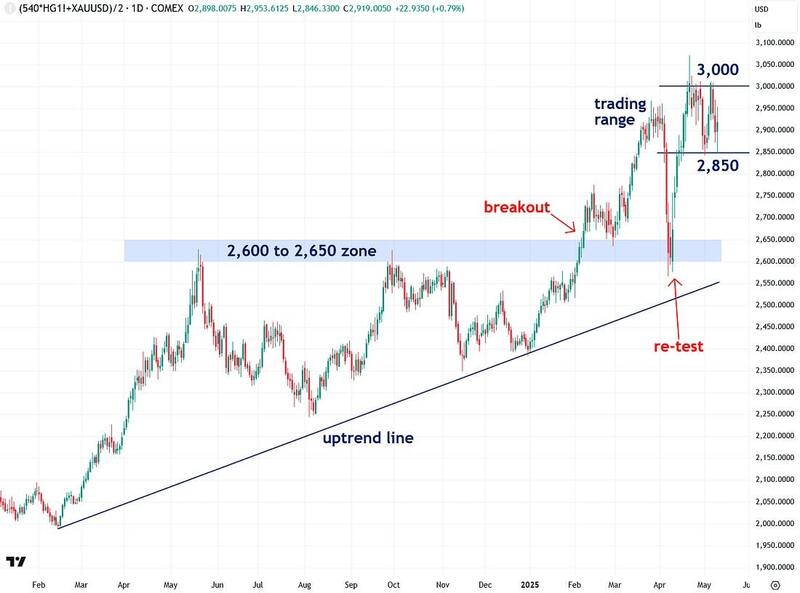
I’ve developed a custom indicator called the Synthetic Silver Price Index (SSPI), designed to help confirm—or challenge—price moves in silver. It’s calculated as the average of gold and copper prices, two metals that exert significant influence on silver. Interestingly, despite silver not being an input, the SSPI has shown a remarkably strong correlation with silver’s price—making it a valuable tool for cross-verifying trends and potential breakouts.

Like silver and gold, the SSPI is currently trading within a range—between 2,850 and 3,000. A breakout from this zone will signal the direction of the next major move and offer valuable insight into where silver is headed next. I’ll be watching it closely.

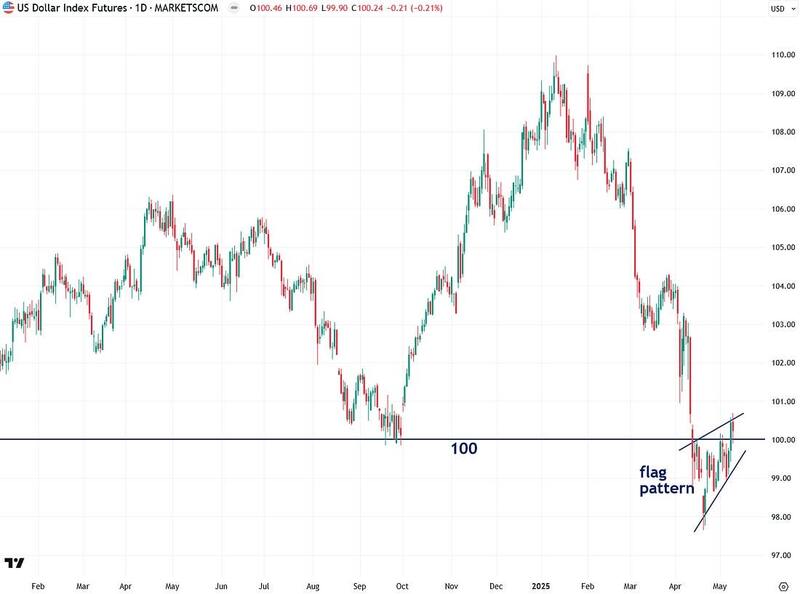
I’m also keeping a close eye on U.S. Dollar Index futures, as I recently explained, because they’re hovering right at the critical 100 level. A decisive breakdown below this key support would signal renewed dollar weakness and fuel further strength in precious metals. On the other hand, a breakout above 100 could create headwinds for metals, given the inverse relationship between the dollar and gold and silver.

On Thursday, U.S. Dollar Index futures briefly popped above the 100 level, but I’m not convinced by the move just yet. The breakout occurred on lackluster volume, and a flag pattern appears to be forming—a breakdown from which would point to further bearish action. I’ll continue monitoring this closely, but for now, the outlook remains inconclusive.

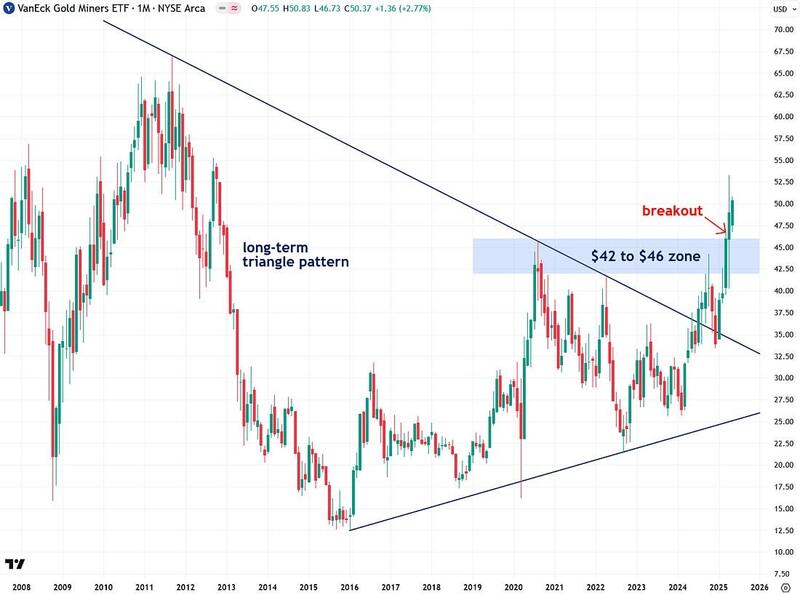
Next, let’s turn to the gold mining sector—starting with the large-cap VanEck Gold Miners ETF (GDX). As I’ve noted in recent updates, GDX recently broke out of a long-term triangle pattern that stretches all the way back to 2011—a major bullish development. However, I also pointed out that a decisive breakout above the key $42–$46 horizontal resistance zone would be needed to fully confirm the move.

That breakout occurred a few weeks ago and remains intact, holding up well despite the recent pause in gold’s price. That’s why I’m launching a new series of in-depth reports detailing my bullish thesis on the gold and silver mining sector—beginning with the first installment, which lays out the long-term bullish case for gold itself. If you haven’t already, I strongly recommend reading it so you’re fully up to speed and ready for what’s coming next.

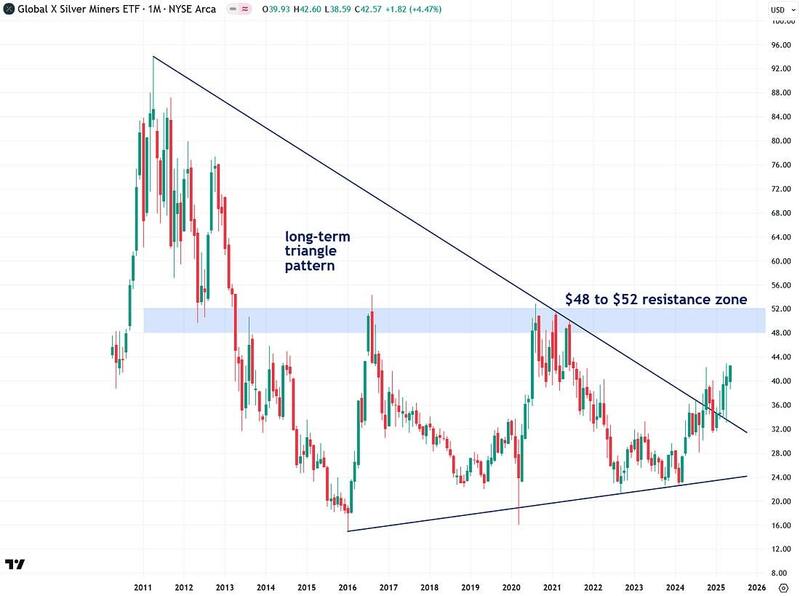
Silver mining stocks, as measured by the Global X Silver Miners ETF (SIL), are also performing well—though they’re slightly lagging behind gold miners. SIL broke out of a long-term triangle pattern a few months ago, which is a bullish development. However, a decisive close above the key $48–$52 resistance zone is still needed to fully confirm that the bull market in silver mining stocks is underway.

In summary, I’m seeing clear signs that precious metals have entered a healthy consolidation phase following a strong rally. This pause is helping them work off their overbought conditions—particularly gold, which is more extended than silver.

That said, I believe there’s still plenty of fuel left in the tank, and this looks more like a breather than a top. Silver, in particular, appears poised to take the spotlight next, and I’m hopeful it does.

For now, I’m closely watching to see which direction gold and silver break from their current consolidation patterns.

If you found this report valuable, click here to subscribe to The Bubble Bubble Report for more content like it.


Jesse Colombo is a financial analyst and investor writing on macro-economics and precious metals markets. Recognized by The Times of London, he has built a reputation for warning about economic bubbles and future financial crises. An advocate for free markets and sound money, Colombo was also named one of LinkedIn’s Top Voices in Economy & Finance. His Substack can be accessed here.