


Could a Shift Away from U.S. Equities Hasten De-Dollarization?

(Mike Maharrey, Money Metals News Service) Could the recent sale of U.S. equities signal the beginning of a long-term trend that speeds up global de-dollarization?

Some analysts think it does.

One could certainly write this sentiment off as a knee-jerk backlash against the aggressive tariff policy being implemented by the Trump administration, and it may cool once new trade deals are inked.  However, it’s undeniable that there has been a shift away from U.S. assets, and it’s important to consider at least those who are trying to tell us why.

According to a recent article published by the Financial Times, Wall Street banks see signs that investors are beginning to “trim their U.S. positions, on concerns over erratic policymaking, President Donald Trump’s attacks on the Federal Reserve chair, and the fallout from the trade war.”

More concerning is the assertion that “the dumping of U.S. assets in favor of Europe’s resurgent markets signals the start of a much longer-term move by pension funds and other big institutional money managers to cut back their huge exposure to dollar investments.

If this is a long-term trend, it could speed up de-dollarization.

The greenback’s role as the world’s reserve currency is already eroding. Last year, total holdings of dollar-denominated securities by foreign central banks fell by $59 billion.

As of the end of last year, dollars made up 57.8 percent of global reserves. That is the lowest level since 1994, representing a 7.3 percent decline in the last decade. In 2002, dollars accounted for about 72 percent of total reserves.

Now we’re beginning to see a decline in dollar-denominated assets held by investors.

While U.S. stocks have recovered most of their losses since the announcement of “Liberation Day” tariffs, they remain in negative territory for the year and are lagging foreign markets. According to a Bank of America survey, fund managers slashed their exposure to U.S. equities by a record amount in February and March. According to the survey, respondents were a net 36 percent underweight in U.S. equities.
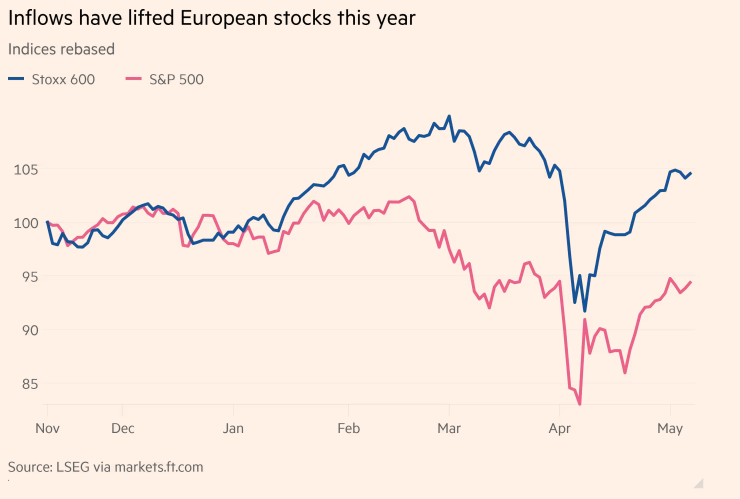
Meanwhile, the dollar has declined by around 7 percent this year. At the same time, the euro has surged along with German government bonds. Analysts say this suggests investors are seeking non-dollar safe-haven assets.

Deutsche Bank global head of FX research George Saravelos told the Financial Times he’s seen “significant selling of U.S. dollars from real money investors over the last three months,” and the CFO of an Australian pension company bluntly said, “Frankly, I think we’ve seen peak investment in U.S. assets.”

The flow of money out of European-based ETFs that invest in U.S. stocks and bonds is one sign of this trend. Outflows reached €2.5bn during April, the highest level since early 2023.

Morningstar principal Kenneth Lamont told the Financial Times the sale of dollar assets “reverses a long-term trend in which U.S. assets have been the beneficiary of consistently strong net inflows.”

Veritas Pension Insurance Company, based in Finland, cut its U.S. stock exposure. The company’s chief investment officer told the Times that given the high valuation of U.S. stocks, “the uncertainty and the communication around tariffs … the confusion and unpredictability associated with that made us question the idea that you should pay that sort of premium.”

Wellington Management analyst John Butler asked the key question.

“How far and how fast does it go?”

The U.S. has some things working in its favor. The U.S. stock market is supported by tremendous depth and liquidity, and the Treasury market is massive, totaling nearly $30 trillion. One investor told the Financial Times that they were having “an internal debate on U.S. exceptionalism.”

“Experience says that you need to be careful with these shifts and that betting against the U.S. hasn’t worked out well.”

Blowback

However, the U.S. could be playing with fire. The government’s weaponization of the dollar, especially in the wake of the Russian invasion of Ukraine, made many countries wary of holding greenbacks. Now the U.S. government has weaponized trade.

The backlash shouldn’t come as a surprise.

If you know something makes you vulnerable, what do you do?

You try to minimize that vulnerability.

So, if you’re worried that the U.S. and its allies might cut off your access to dollars, what would you do?

Minimize your dependence on dollars.

In other words, if you are concerned that the U.S. could pull the “dollar rug” out from under you, why not pull out from the dollar system first?

While the U.S. policies may be justified, it is still important to consider the potential blowback.

Ramifications

Even a modest erosion of the dollar’s status could create significant problems for the U.S. economy.

Simply put, the U.S. needs the world to need dollars.

The U.S. depends on this global demand for dollars supported by its reserve status to underpin its massive government. The only reason Uncle Sam can borrow, spend, and run massive budget deficits to the extent that it does is the dollar’s role as the world’s reserve currency. It creates a built-in global demand for dollars and dollar-denominated assets. This absorbs the Federal Reserve’s money creation and helps maintain dollar strength despite the Federal Reserve’s inflationary policies.

Even a modest de-dollarization of the world economy would cause a dollar glut. The value of the U.S. currency would further depreciate. That translates to more price inflation at home. In the worst-case scenario, the dollar could collapse completely, leading to hyperinflation.

There is a way to shield yourself from the impacts of de-dollarization — minimize your exposure to the dollar. Instead of holding U.S. government fiat currency, buy gold and silver.


Mike Maharrey is a journalist and market analyst for Money Metals with over a decade of experience in precious metals. He holds a BS in accounting from the University of Kentucky and a BA in journalism from the University of South Florida.

Feds Bust Chinese-Canadian Fraud Ring Operating in 37 States Targeting Seniors

(Bethany Blankley, The Center Square)  – Multiple Chinese nationals have been indicted for their role in orchestrating an elaborate transnational fraud and money laundering scheme targeting elderly U.S. and Canadian citizens.

Sixteen people were indicted overall, living in the states of California, Georgia, Hawaii, Maryland, New York, Rhode Island, Tennessee and Texas. Two are Canadian citizens; three are Canadian residents, according to U.S. Immigration and Customs Enforcement.

The indictment was unsealed in the U.S. District Court of Rhode Island in a case stemming from an ICE investigation that identified 300 victims in at least 37 states who lost a combined initial more than $5 million. Investigators also identified a bank account through which they believe approximately $16 million in additional suspected fraudulent funds were laundered.

The bust comes after the greatest number of Chinese and Canadian illegal border crossers were reported under the Biden administration, The Center Square exclusively reported.

According to the charging documents, the Chinese nationals sent pop-up messages to seniors’ computers purporting to be a well-known technology company claiming the victims’ financial accounts had been compromised, their computers had been hacked, or they were the focus of a criminal investigation. The messages instructed them to call a “live agent” who said their financial assets were at risk or could be garnished and they could help protect them. The seniors were then connected with other fraudsters who claimed to be their financial institution representatives or from government agencies, including the Federal Trade Commission and Federal Reserve Bank.

The fraudster then instructed the seniors to transfer their money through wire or cryptocurrency to accounts they claimed were managed by federal agencies. They also instructed them to withdraw their funds in cash and purchase gold bars and give the cash or gold bars to a purported government courier who would come to their home to transfer it to a secure government location, according to the charges.

Key indictments include Chinese nationals in New York including Nanjun Song, 27, who was illegally living in Brooklyn on an overstayed B2 visa. He was charged with conspiracy to commit wire fraud and conspiracy to commit money laundering and arrested by ICE Homeland Security Investigations Las Vegas agents. He remains in federal custody in Rhode Island.

Another is Chinese national Xiang Li, 37, living in Flushing, charged with conspiracy to commit wire fraud and conspiracy to commit money laundering. He was arrested by HSI Providence agents with assistance from HSI New York and the New York City Police Department.

Another arrested in New York was Chinese national Xuehai Sun, 37, living in Flushing, charged with conspiracy to commit wire fraud. He was arrested by HSI Providence agents with assistance from HSI New York and the NYPD.

Rhode Island and Connecticut officials helped arrest Chinese-Canadian citizen Jirui Liu, 23, of Scarborough, Ontario, who was also in the U.S. illegally on an expired visa. He was arrested by HSI Providence agents with assistance from the Connecticut State Police and Narragansett Police Department. Liu was charged with conspiracy to commit wire fraud and conspiracy to commit money laundering and remains in federal custody in Rhode Island.

In Massachusetts, Chinese national Fangzheng Wang, 24, of Westborough, was arrested by HSI Providence and HSI New England agents. He was charged with conspiracy to commit wire fraud and remains in federal custody in Rhode Island.

Arrest warrants were issued for two individuals in Canada: Chinese national Zhenyang Xin, 25, of Hamilton, Ontario, charged with conspiracy to commit wire fraud and Hong Kong-born Wing Kit Ho, 22, of Markham, Ontario, charged with conspiracy to commit wire fraud.

Of these key publicized indictments, the only non-Chinese national arrested was in Houston: Cynthia Jia Sun, 25, charged with conspiracy to commit wire fraud. HSI Houston agents arrested her with assistance from the Texas Department of Public Safety. She remains in federal custody in Houston awaiting transfer to Rhode Island.

Victims were residents of Alaska, Arizona, California, Connecticut, Georgia, Hawaii, Maine, Maryland, Massachusetts, Nebraska, Nevada, New Jersey, New York, North Carolina, Oklahoma, Pennsylvania, Rhode Island, South Carolina, Tennessee, Texas, Vermont, Washington, D.C., Wisconsin, Canada and elsewhere.

Technical Analysis: Here’s Where Gold & Silver Stand

(Jesse Colombo, Money Metals News Service) Gold and silver are currently consolidating in a healthy manner, which is likely laying the groundwork for their next leg higher.

I’m encouraged to see them consolidating in a healthy manner, which I believe is ultimately laying the groundwork for the next leg of the bull market. Precious metals are also finding support from Moody’s recent downgrade of U.S. debt—a sharp reminder that the nation’s fiscal crisis remains far from resolved. In this environment of debt saturation, precious metals continue to stand out as reliable safe havens and powerful hedges against systemic risk.

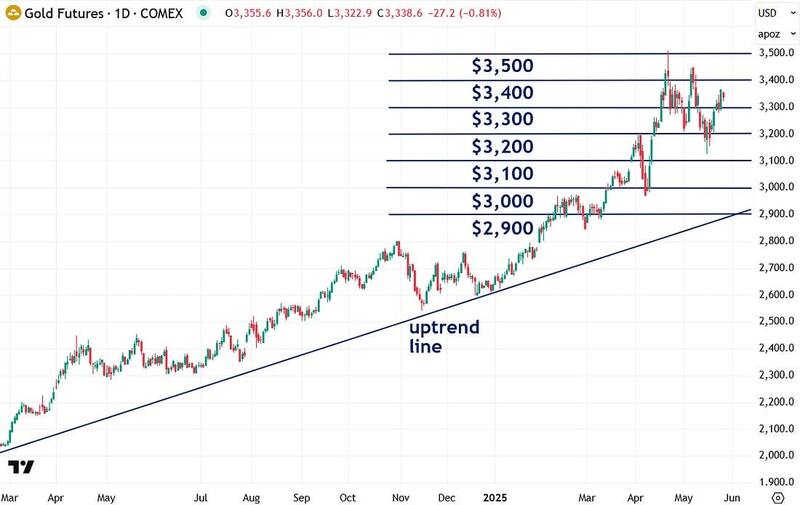
First, let’s take a look at gold in the form of COMEX futures. I’ve noticed that gold tends to move in clean $100 increments, with strong support and resistance forming around round numbers like $3,000, $3,100, $3,200, and so on.

After briefly dipping below $3,200 a couple of weeks ago, I’m encouraged to see that gold bounced back and even pushed above $3,300—an early sign of renewed strength.

At the moment, it appears to be consolidating sideways, catching its breath before the next move. The major resistance level to watch now is $3,500, which roughly aligns with the April 22nd high.

A decisive breakout above that level—especially on strong volume—would confirm that gold is ready to charge toward $4,000. That’s the scenario I’m watching for closely.

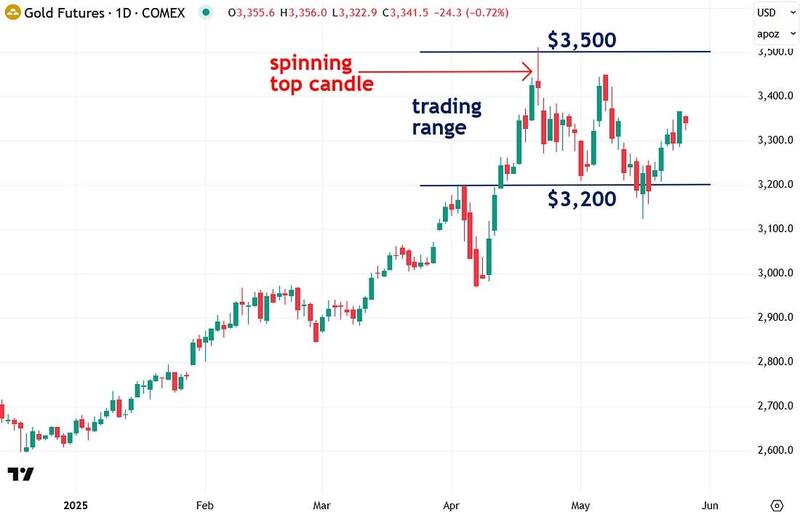
Back on April 22nd, I believed gold had likely hit a short-term peak and was due for a mild pullback—and that’s exactly what we’re seeing now. What tipped me off was the formation of a spinning top candlestick on that day, signaling indecision after a strong rally, combined with short-term overbought conditions that called for a cooling-off period.

At the moment, COMEX gold futures are trading within a $300 range between $3,200 and $3,500 as the metal digests those prior gains.

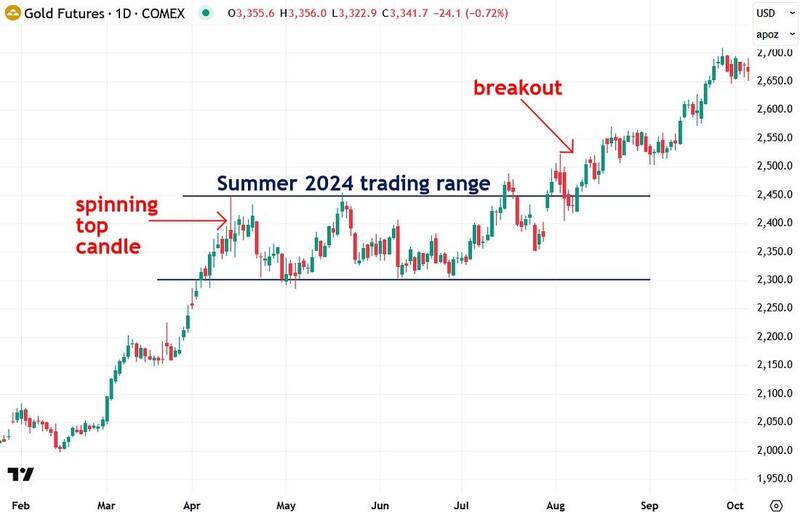
What I find particularly interesting—and encouraging—is the striking parallel between the current consolidation and what happened exactly one year ago. Back then, a spinning top candlestick also marked the peak of a powerful $400 rally during March and April, which left gold temporarily overbought. That was followed by a period of sideways consolidation, much like we’re seeing now, before gold broke out again in August 2024 and went on to post significant gains through November. It’s a compelling setup, and one worth watching closely to see if history repeats itself.

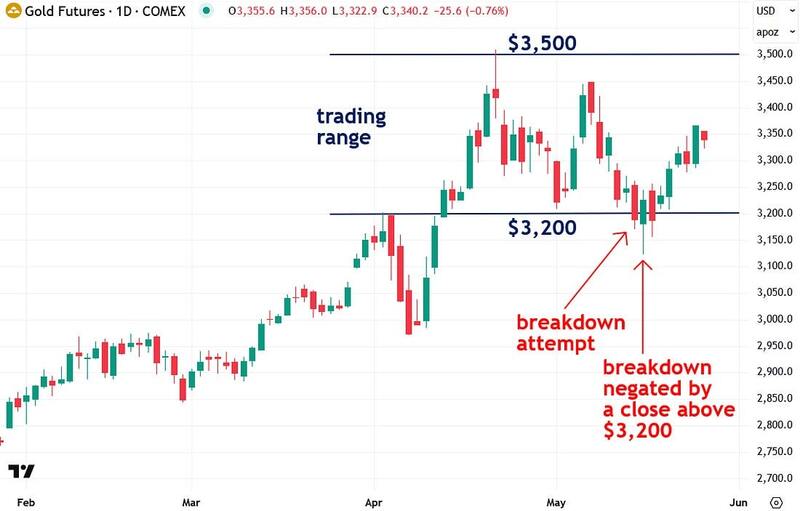
I also want to highlight how gold attempted to break below the $3,200 support level on May 15th but quickly reversed and snapped back into the trading range—a sign of underlying strength:

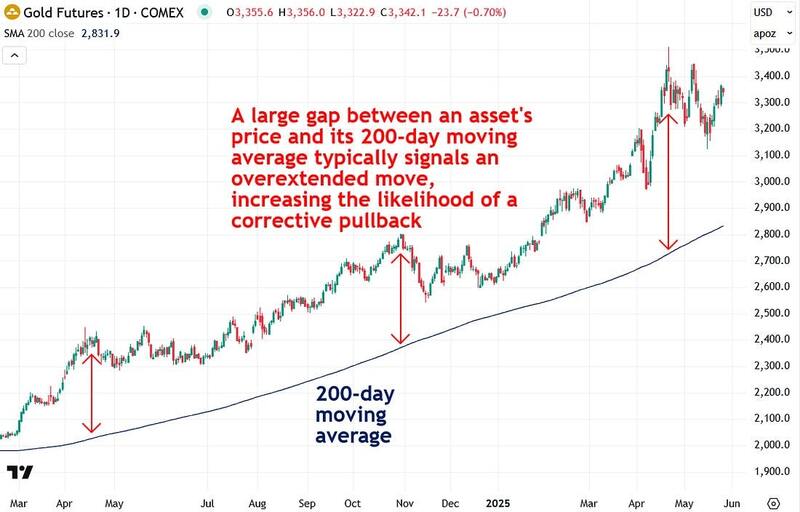
When assets like gold rally sharply, they often become overbought, making them susceptible to pullbacks or periods of consolidation to absorb the excess. A reliable way to gauge overbought conditions is by comparing the asset’s price to its 200-day moving average—a widely used indicator that smooths out short-term volatility and highlights the underlying trend.

When the price becomes significantly stretched above this moving average, it often signals vulnerability to a correction. That’s precisely what occurred in April 2024, October 2024, and again in April 2025.

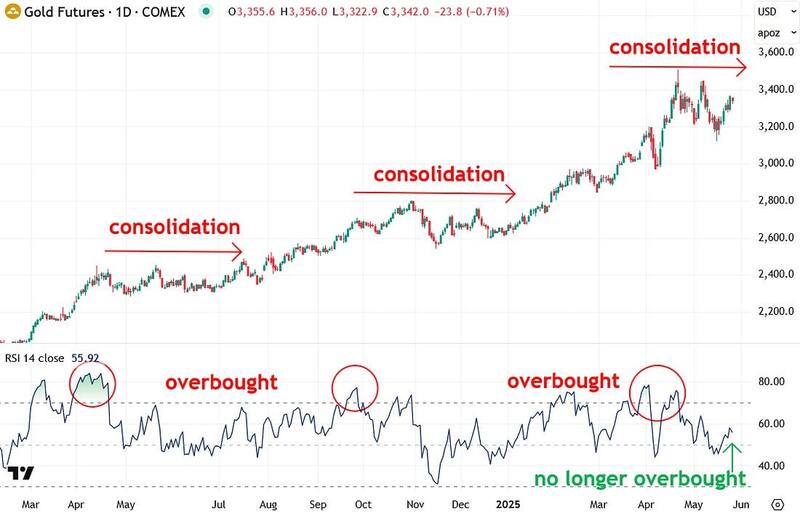
Another valuable tool I rely on is the Relative Strength Index (RSI)—a momentum oscillator that helps determine whether an asset is overbought, oversold, or in neutral territory. As the chart below illustrates, each time gold reached overbought levels on the RSI over the past year, it entered a healthy consolidation phase before resuming its upward trend. I believe that’s what’s happening now. Even more encouraging is that the RSI currently shows gold is no longer overbought, which indicates that the worst of the recent pullback is likely behind us.

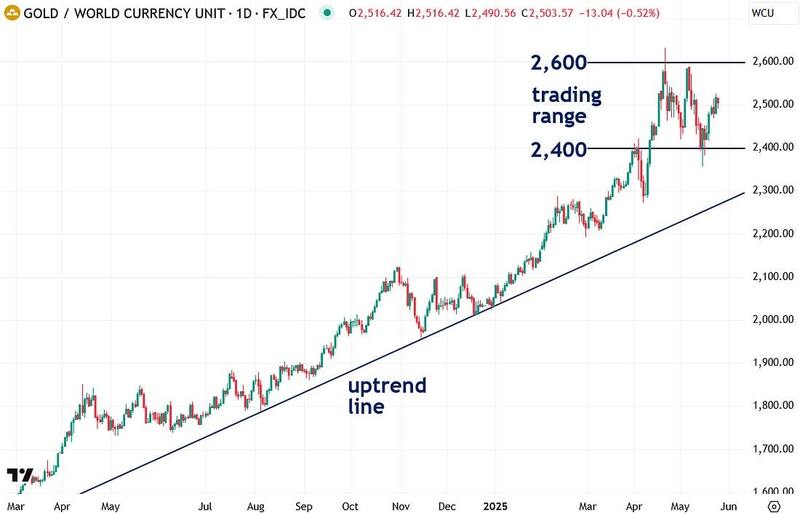
I’ve recently begun tracking gold priced in the World Currency Unit (WCU)—a composite currency based on the GDP-weighted average of the world’s 20 largest economies. In many ways, it offers one of the most balanced and accurate reflections of gold’s true global performance, which is why I’ve been paying close attention to it.

Gold priced in World Currency Units (WCUs) clearly demonstrates that its uptrend remains strong, with a well-defined trading range between 2,400 and 2,600 that’s important to watch closely:

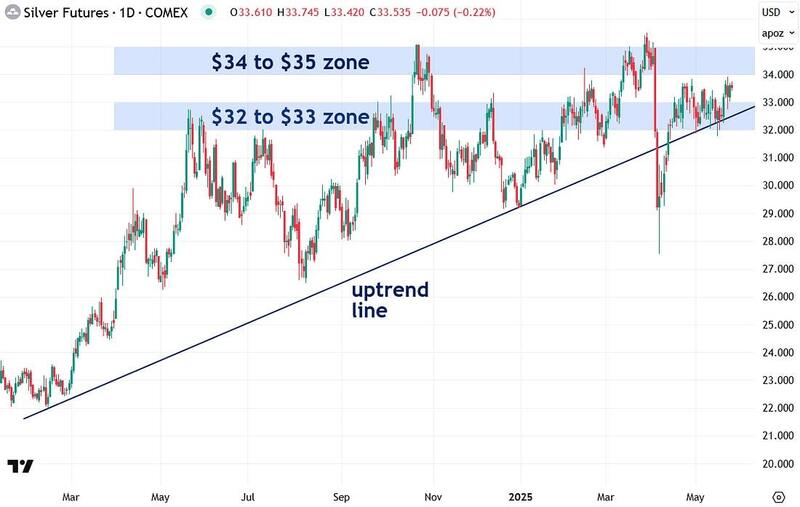
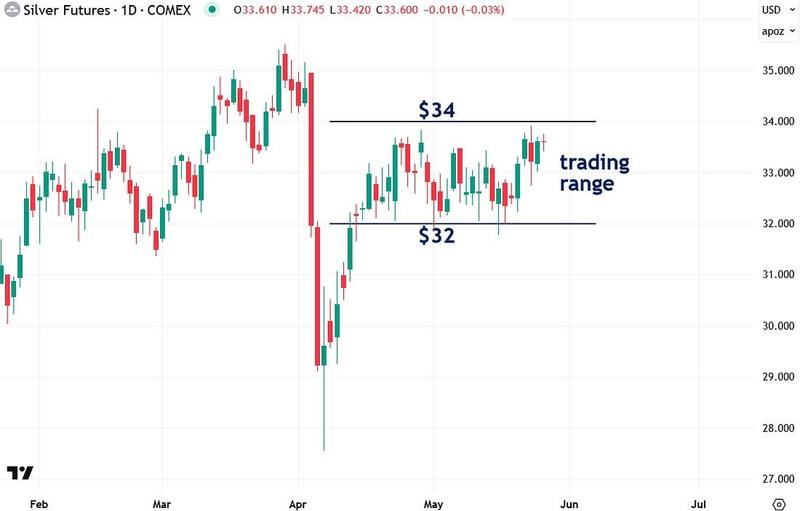
Next, let’s take a look at silver using COMEX futures, which tend to respect key $1 increments—such as $30, $31, and $32—as notable support and resistance levels. For the past year, silver has been trading sideways, capped beneath the critical $32–$33 resistance zone, followed by a secondary ceiling at $34–$35.

The good news is that silver recently broke above the $32–$33 zone—a sign of strength. The next key test is a decisive close above the $34–$35 zone, which would signal that silver is finally ready to launch into a sustained bull market, much like gold has done over the past year.

I’ve also been highlighting that silver has recently been trading within a range between $32 and $34. A bullish breakout above the $34 resistance level would be a strong confirmation that further gains are likely to follow.

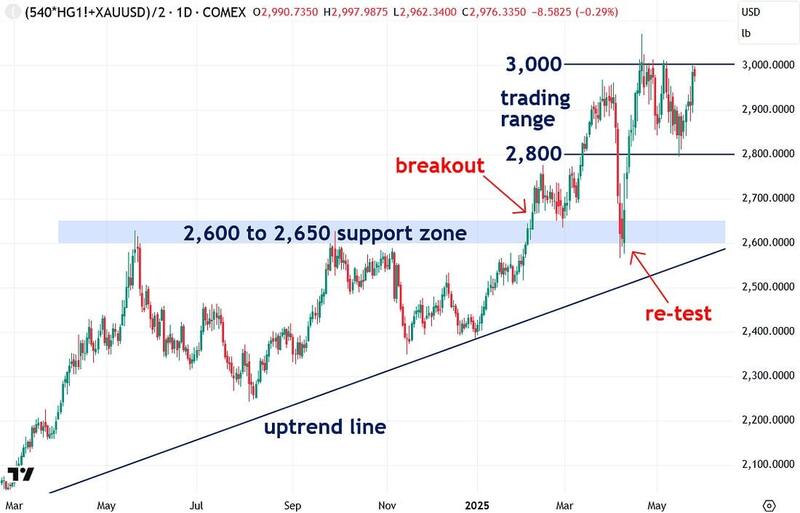
One of the key tools I’ve developed is the proprietary Synthetic Silver Price Index (SSPI)—an indicator designed to validate silver’s price action and help filter out potential fakeouts and false breakouts.

The SSPI is calculated as the average price of gold and copper, with copper adjusted by a factor of 540 to ensure gold doesn’t disproportionately impact the index. Remarkably, despite silver not being an input, the SSPI closely mirrors silver’s price movements.

Interestingly, the SSPI is currently consolidating within a range between 2,800 and 3,000. A breakout above the 3,000 resistance level would serve as a strong bullish signal for silver as well. I’ll be watching this development closely and will keep you all updated as it unfolds.

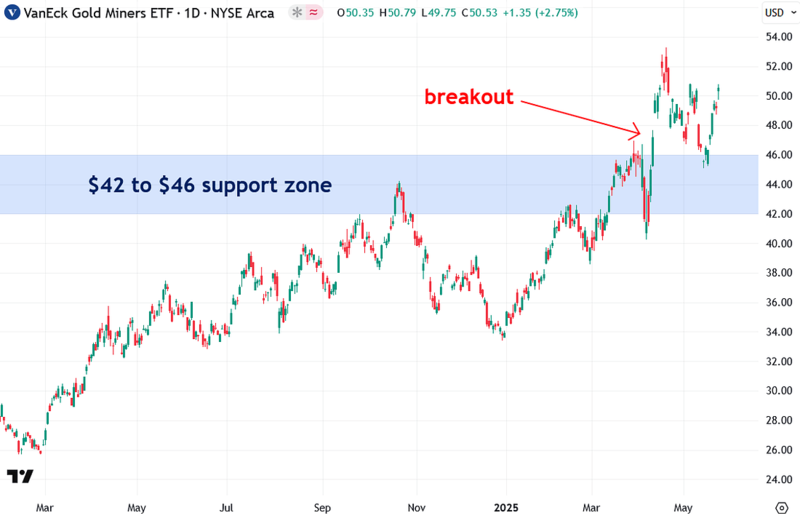
Next, let’s turn to gold mining stocks, as tracked by the popular large-cap VanEck Gold Miners ETF (GDX). Notably, GDX recently broke above the $42–$46 resistance zone I’ve been highlighting—a strong signal that gold miners are finally coming to life.

Even more encouraging, it successfully retested that zone as support and bounced, passing that technical test with flying colors. Assuming gold breaks out of its current consolidation, GDX is well-positioned to follow it higher.

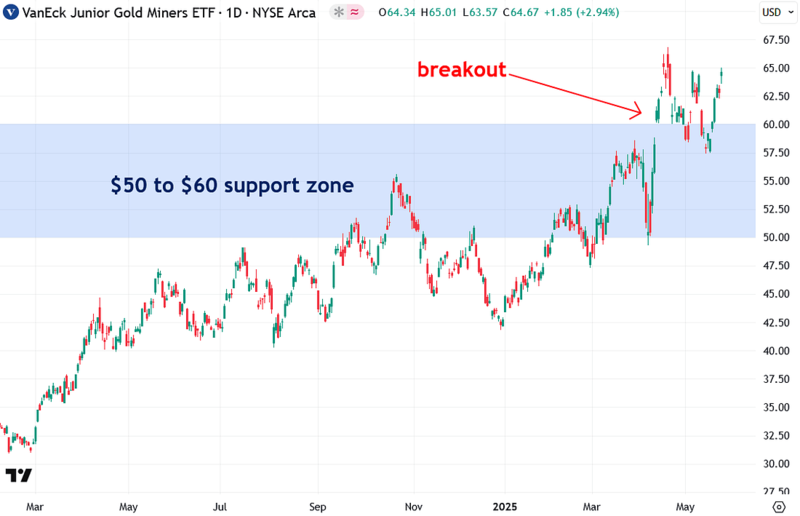
Junior gold mining stocks, as represented by the GDXJ ETF, have shown a similar pattern as GDX—breaking out above the $50–$60 zone and successfully retesting it as support. That’s a solid technical sign and further confirmation of growing strength in the mining sector.

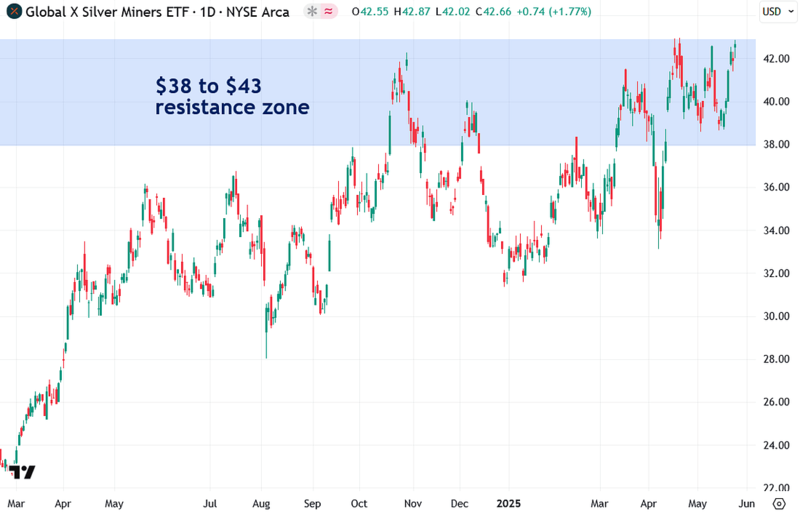
Next, let’s take a look at silver miners through the lens of the SIL ETF. It’s still trading within its $38–$43 resistance zone but is showing signs of attempting a breakout. If and when that breakout occurs—especially in tandem with a breakout in silver—I believe silver mining stocks will really shine.

These miners are essentially leveraged to the price of silver, which means their upside potential is even greater than silver itself once the silver bull market gets underway.

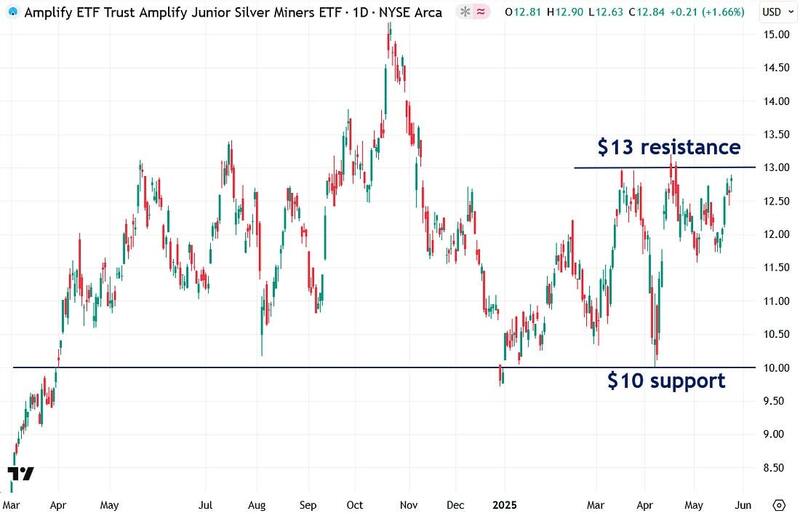
Silver junior mining stocks, as represented by the SILJ ETF, are currently trading within a range between $10 and $13. A breakout above the key $13 resistance level is the signal I’m watching for—it should mark the beginning of a strong rally or even the next major bull market phase.

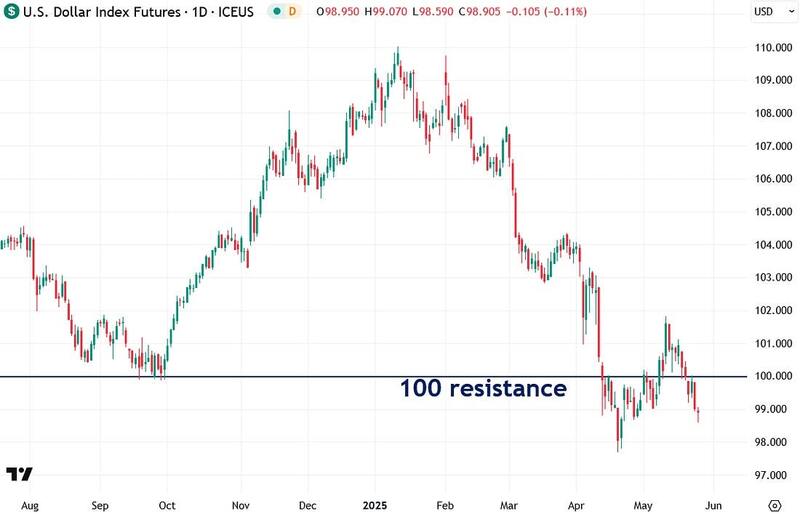
Finally, let’s take a look at the U.S. Dollar Index, which typically trades inversely with commodities like gold and silver.

The index has been hovering around the critical 100 level, producing false breakouts both above and below. Now that it’s trading back below 100, the odds favor continued dollar weakness—a potential tailwind that would help propel gold and silver out of their current trading ranges and into their next rally phases.

To summarize: although gold and silver have been relatively quiet lately, don’t mistake that for weakness. The reliable indicators I track show they’re simply consolidating and gathering strength for another potential move higher.

That said, confirmation will come only with the breakouts I outlined in this analysis. It’s also worth noting that gold may be consolidating for a similar length of time as it did last summer, given the parallels I’ve highlighted.

If you found this report valuable, click here to subscribe to The Bubble Bubble Report for more content like it.


Jesse Colombo is a financial analyst and investor writing on macro-economics and precious metals markets. Recognized by The Times of London, he has built a reputation for warning about economic bubbles and future financial crises. An advocate for free markets and sound money, Colombo was also named one of LinkedIn’s Top Voices in Economy & Finance. His Substack can be accessed here.

Germany’s Merz Says West Has Lifted Restrictions on Ukraine’s Use of NATO Weapons in Russia

(Dave DeCamp, Antiwar.com) German Chancellor Friedrich Merz said on Monday that there were no longer any restrictions on Ukraine’s use of Western-provided weapons in strikes on Russian territory.

“There are no more range limitations for weapons delivered to Ukraine. Neither from the Brits, nor the French, nor from us. Not from the Americans either,” Merz said.

“This means that Ukraine can now defend itself, for example, by attacking military positions in Russia. Until recently, it couldn’t do that, and apart from very few exceptions, it hadn’t done so either,” he added.

His comments suggest that Germany may provide Ukraine with its Taurus missile, which has a range of up to 310 miles (500 kilometers), and would give the Ukrainian military the ability to strike deep inside Russia.

Kremlin spokesman Dmitry Peskov responded to Merz’s comments, saying that if the claim is true, it runs counter to recent efforts for peace. “If such decisions have indeed been made, they are entirely at odds with our aspirations for a political resolution and with the efforts currently being made toward a settlement,” Peskov said. “Quite dangerous decisions, again – if they were indeed made.”

Moscow’s view is that strikes on its territory using Western-provided missiles put NATO in a direct war with Russia since Ukraine needs intelligence from the US to fire the weapons.

Last year, the Biden administration gave Ukraine the green light to fire US-provided Army Tactical Missile Systems (ATACMS) and British-provided Storm Shadow missiles into Russian territory, a step that marked a significant escalation of the proxy war. In response, Russian President Vladimir Putin formally changed Russia’s nuclear doctrine, lowering the threshold for the use of nuclear weapons.

The ATACMS have a range of about 190 miles, and the Storm Shadows can hit targets up to 155 miles, both short of the Taurus’s range. Merz’s predecessor, Olaf Scholz, had resisted calls for Germany to send Taurus missiles to Ukraine. But Merz, who assumed office on May 6, has previously suggested that he’d be open to providing Ukraine with the weapon.

This article originally appeared at Antiwar.com.

Ohio Deputy is Fatally Shot Responding to a Domestic Violence Call, Suspect is Wounded

(Headline USA) A sheriff’s deputy in Ohio who responded to a domestic violence call at a home was fatally shot by a suspect who was wounded, authorities said.

The Morrow County Sheriff’s office said the shooting occurred Monday night in the town of Marengo, about 35 miles (56 kilometers) north of Columbus. Speaking at a news conference on Tuesday, Sheriff John Hinton identified the deputy as Daniel Sherrer, 31, who had served with the department since March 2021.

Sherrer “always had a smile on his face, never in a bad mood,” Hinton said. He noted the death was a tough blow for the department but said everyone came into work Tuesday because “that’s what we have to do, it’s what he would have wanted.”

In a statement posted on the department’s Facebook page, Hinton said Sherrer was shot shortly after he arrived at the home. The deputy and the suspect were both taken to a hospital, where Sherrer was pronounced dead a short time later.

The sheriff said Tuesday he has not yet viewed body camera footage of the shooting, so he could not provide further details about what occurred.

The suspect remains hospitalized in serious condition. On Tuesday, Hinton spoke with disdain for the suspect and refused to publicly identify the person.

“You will never hear his name come from my lips, so if you want the name you will have to get it some other way, I’m not giving it to you,” Hinton told reporters. ”Why would I? He doesn’t deserve it.”

The Delaware County Sheriff’s Office will lead the investigation into the shooting, with assistance from the state’s Bureau of Criminal Investigation.

Adapted from reporting by the Associated Press.

DHS Accuses Dem. Lawmaker of ‘Siding w/ Vicious Cartels’

(José Niño, Headline USA) When Democratic state Rep. Aftyn Behn live-streamed an U.S. Immigration and Customs Enforcement (ICE) operation in Nashville, she set off a political firestorm that’s still burning.

Last week, the U.S. Department of Homeland Security (DHS) reportedly accused Behn of “siding with vicious cartels, human traffickers, and violent criminals” after she live-streamed herself following Tennessee Highway Patrol (THP) vehicles during a joint immigration enforcement operation with ICE.

Behn, a progressive Democrat and licensed social worker first elected in a 2023 special election, documented THP’s involvement in traffic stops targeting immigrant communities in South Nashville. 

According to a report by Axios, the operation, conducted in early May, resulted in 196 arrests by ICE, including 95 individuals with prior criminal convictions. 

DHS condemned Behn’s actions and described them as “doxxing” and “impeding ICE operations,” alleging they endangered federal agents and are “siding with vicious cartels, human traffickers, and violent criminals.” 

The department cited a 413% increase in assaults on ICE officers since 2021, connecting the trend to anti-enforcement activism.  

Behn defended her actions as a response to “state-sponsored fear and violence,” arguing THP’s collaboration with ICE eroded community trust and targeted vulnerable populations. She asserted that Dragnet “terrorize families, disrupt lives, and shatter trust between law enforcement and the communities they are supposed to serve” she stated, criticizing Tennessee’s expanded anti-immigrant laws under Governor Bill Lee. 

Rep. Andy Ogles, R-Tenn., amplified DHS’s criticisms, calling for congressional investigations into Nashville Mayor Freddie O’Connell’s executive order requiring Metro employees to report ICE communications to his office within 24 hours. 

Ogles accused O’Connell of “obstructing federal law enforcement” and shielding criminals by potentially alerting immigrants to pending enforcement actions. The order, revised in the middle of May, mandates transparency but has faced scrutiny over its timing and intent.  

Ogles also targeted O’Connell’s “Belonging Fund,” a public-private initiative to provide emergency aid to immigrants. 

After Ogles sought a congressional investigation, O’Connell insisted that no taxpayer funds were used for the new initiative. However, public records show that two nonprofits which contributed $30,000 each to the fund had previously received over $1 million from Metro Nashville, sourced from former President Joe Biden’s American Rescue Plan, per a report by The Tennessee Star. 

Despite demands for congressional oversight, the mayor has indicated he may pursue legal action against the Trump administration, alleging without evidence that some individuals detained by ICE and THP could be legal residents who simply lacked identification while driving in Nashville. 

O’Connell recently said, “I think there is a strong probability that people have been detained who are here legally but simply did not have documentation with them as they were driving on the streets in Nashville. We want to validate that.”

With lawsuits and investigations looming, the state’s immigration policies remain under intense scrutiny.

José Niño is the deputy editor of Headline USA. Follow him at x.com/JoseAlNino

Memorial Day Mass Shooting in Philly Hits 11, Kills 2

(Headline USATwo people were killed and nine others, including three teenagers, were injured in a shooting at a Philadelphia park, police said.

A man and a woman died in the Monday night shooting in Fairmount Park, police Commissioner Kevin Bethel said at a briefing Tuesday. Those injured in the Memorial Day shooting were listed in stable condition, he said.

Police identified those killed as Amya Devlin, 23, and Mikhail Bowers, 21.

The wounded include a 15-year-old boy and two girls, ages 16 and 17, police said. The other injured people, four women and two men, range in age from 18 to 28.

The shooting occurred despite officers’ presence in the park, Bethel said.

“We try to manage the crowds as they unfold, but at the same token, it is a challenge when individuals decide that they’re going to fire into a crowd,” Bethel said.

Police said no arrests had been made.

Police had not yet recovered any weapons, the commissioner said. Investigators don’t yet know if there was more than one weapon involved, Bethel said, but he noted that there was rapid fire in videos posted on social media.

Adapted from reporting by the Associated Press

U.S. Has 500 Troops in Taiwan in Major Challenge to China

(Dave DeCamp, Antiwar.comA retired US Navy admiral recently revealed that the US has 500 troops in Taiwan, a major challenge to Beijing’s red lines related to the island.

Ret. Adm. Mark Montgomery made the disclosure at a House hearing on May 15, where he was arguing that the US should send more military personnel to Taiwan.

“We absolutely have to grow the joint training team in Taiwan. That’s a US team there that’s about 500 people now, it needs to be 1,000,” said Montgomery, who now works for the Foundation for the Defense of Democracies (FDD), an extremely hawkish think tank.

“If we’re going to give them billions of dollars in assistance, sell them tens of billions of dollars worth of US gear, it makes sense that we’d be over there training and working,” he added.

So far, the Pentagon has not confirmed the number, but due to the sensitivity of the matter, the US military typically offers few details about its operations in Taiwan.

After Washington severed diplomatic relations with Taipei in 1979, the US would still deploy a handful of military trainers to Taiwan. The small US presence was always an open secret but wasn’t officially confirmed until 2021, when then-President Tsai Ing-wen became the first Taiwanese leader to acknowledge US troops were on the island since 1979.

At the time of Tsai’s acknowledgment, only a few dozen US troops were believed to be on the island for training purposes. In 2023, media reports said the US was increasing its military presence to about 200 soldiers.

Last year, Taiwan confirmed that some of the US military trainers were deployed to Kinmen, a group of islands that are controlled by Taiwan but located just off the coast of mainland China.

The US has significantly increased military support for Taiwan in recent years despite constant warnings from China that the island is the “first red line” in US-China relations that must not be crossed.

This article originally appeared at Antiwar.com.


FBI Informant in ‘764’ Network Avoiding Punishment for Heinous Crimes against Children

(Ken Silva, Headline USA) On April 25, 2024, Zachary Dosch was scheduled to be sentenced for horrendous crimes against children, which stem from his participation in a network of online Satanic chatrooms known as “764.”

However, Dosch’s hearing was cancelled at the last minute, and hasn’t been rescheduled. Dosch, who pled guilty to cyberstalking and distributing child porn, was released from custody in January without him having been sentenced. While Dosch’s case is still open on the court docket, it appears that his lack of punishment is due to him having become an FBI informant, or confidential human source (CHS).

Indeed, a recently unsealed case against another alleged 764 pedophile, U.S. Navy sailor Rumaldo Valdez, revealed that the FBI used a CHS against him as part of its investigation. Leading 764 researcher Becca Spinks reported Sunday that Dosch was the CHS used against Valdez, and the charging papers corroborate her—not only has Dosch avoided any punishment for his crimes against children; the charging papers in his case confirm that he provided information to the FBI about Valdez’s online Discord account, Duck#8030.

The search warrant in Valdez’s case further shows that the CHS provided information about his Duck#8030 account in early 2024—right around the time Dosch was set to be sentenced.

“The CHS, working with other members of the Offending Server, used Discord to threaten and coerce minors into creating child pornography and self-harm material, and that the CHS received child pornography as a result of those efforts,” the search warrant against Valdez states.

“In 2024, the CHS—who, at the time, was seeking leniency from the government in connection with sentencing … identified ‘Duck’ as an active member of the Offending Server,” the search warrant states.

“The CHS also reported having witnessed ‘Duck’ record online extortions. For example, the CHS reported that, on one occasion, the CHS witnessed ‘Duck’ coerce a minor female (approximately fourteen to sixteen years old) into creating a video showing the minor female masturbating.”

While Dosch may have snitched to the FBI about Valdez, it’s unclear whether his information was necessary to make a case against the Navy sailor. Charging papers against Valdez state that the FBI received at least four tips about him from Discord; and agents have a solid digital paper trail, statements from victims, and the physical hard drives that belonged to the defendant.

Dosch’s plea agreement states that paying restitution to his victims would be part of his sentence. Because Dosch has yet to be sentenced, it also appears that his victims haven’t received any restitution.

Headline USA has reached out to the DOJ, FBI and Dosch’s attorneys for comment on the matter.

Meanwhile, Valdez, who faces charges of possessing and distributing child porn, was ordered to remain in custody on Friday.

The Valdez case is the latest arrest in what the FBI has dubbed “Operation Restore Justice”—a campaign to crack down on the 764 group and other pedophile networks. David Scott, the head of the FBI’s Counterterrorism Division, reportedly told ABC News this month that he has 250-plus cases spanning all 55 of the bureau’s field offices.

FBI Director Kash Patel and Attorney General Pam Bondi have both promised zero leniency for the 764 pedophiles—though there’s apparently an exception for their confidential informants.

764 History

Headline USA has been covering the 764 network ever since the DOJ announced its first case in 2023.

The government’s crackdown on the Satanic pedophile network started in November 2021, when the FBI arrested 764 member Angel Almeida. Details of Almeida’s 764 activities weren’t made public until records about his case were unsealed late 2023.

In February 2024, 764 received more national attention when U.S. Marshals arrested 764 member Kyle Spitze on child porn charges. Spitze had previously made national news when his stepfather shot him in the ear while Spitze was recording him. That bizarre and disturbing story can be read here.

Several other arrests followed Spitze. More recently, 764 has been linked to two school shootings and two more alleged near-shootings.

The first shooting occurred in January, when a 17-year-old black student named Solomon Henderson allegedly opened fire—killing a female student and wounding one other before killing himself.

Henderson apparently operated the Twitter/X account @GroidCell, which is linked to the Satanic 764 pedophile network. His manifesto also claimed that he had connections with other school shooters, including 15-year-old Natalie Rupnow, who opened fire during a study hall last December.

Additionally, when investigators searched Rupnow’s phone, they found that she was part of a network of extremist and sadistic chatrooms, and that she was communicating with many other people.

One of those people was 20-year-old Alexander Paffendorf, who was also allegedly talking to Rupnow online about committing a mass shooting. Last week, a court reportedly granted a three-year gun violence restraining order against Paffendorf, which bars him from owning firearms for three years, according to Fox 5 in San Diego. Paffendorf has not been criminally charged over the matter.

Along with Paffendorf, Rupnow was also found to have been communicating with 22-year-old Damien Blade Allen. According to a detective’s affidavit released last week, the two were in a “conspiracy” to commit mass shootings.

Allen was arrested on April 27, just before he was about to carry out his intended shooting, according to law enforcement.

Ken Silva is the editor of Headline USA. Follow him at x.com/jd_cashless.

Trump to Pardon a Virginia Sheriff Convicted of Bribery

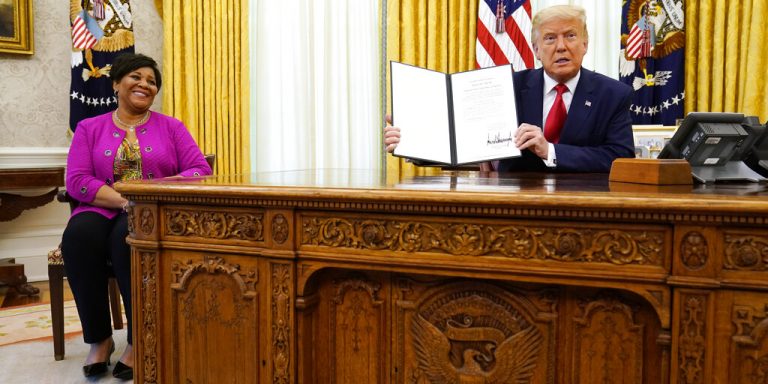
(Headline USAPresident Donald Trump said Monday that he is pardoning a former Virginia sheriff who was sentenced to 10 years in prison after a jury convicted him on federal bribery charges for deputizing several businessmen in exchange for cash payments.

Former Culpeper County Sheriff Scott Jenkins, 53, was found guilty on fraud and bribery charges and sentenced in March. But on Monday, Trump posted on his social media platform Truth Social that Jenkins and his family “have been dragged through HELL by a Corrupt and Weaponized Biden DOJ.”

“This Sheriff is a victim of an overzealous Biden Department of Justice, and doesn’t deserve to spend a single day in jail. He is a wonderful person, who was persecuted by the Radical Left “monsters,” and “left for dead,” Trump said in the post. “He will NOT be going to jail tomorrow, but instead will have a wonderful and productive life.”

Messages seeking comment were left with Jenkins’ lawyers. The U.S. Attorney’s Office for the Western District of Virginia was closed for the Memorial Day holiday.

Jenkins is the latest pardon Trump has given to loyal supporters. In April, he pardoned Nevada Republican Michele Fiore, who was awaiting sentencing on federal charges that she used money meant for a statue honoring a slain police officer for personal costs, including plastic surgery.

In January, Trump pardoned Ross Ulbricht, the founder of Silk Road, an underground website often used for selling drugs. Ulbricht had been sentenced to life in prison in 2015 after a high-profile prosecution that highlighted the internet’s role in illegal markets.

He also pardoned, commuted the prison sentences or vowed to dismiss the cases of all of the 1,500-plus people charged with crimes in the Jan. 6, 2021, U.S. Capitol uprising.

Jenkins was indicted in 2023 on 16 counts — including conspiracy, wire fraud and bribery — concerning programs receiving federal funds. In December, a jury found him guilty of one count of conspiracy, four counts of honest services fraud, and seven counts of bribery.

Jenkins took the stand in his own defense and said there was no connection between the payments he received and the badges he handed out, according to news reports. Testifying against Jenkins were two undercover FBI agents who were sworn in as auxiliary deputies in 2022 and immediately thereafter gave Jenkins envelopes with $5,000 and $10,000 cash, respectively.

Jenkins appealed his conviction in April.

Trump said Jenkins tried to offer evidence in his defense, but U.S. District Judge Robert Ballou, a Biden appointee, “refused to allow it, shut him down, and then went on a tirade.”

Acting United States Attorney Zachary T. Lee said at the time that Jenkins violated his oath of office “and this case proves that when those officials use their authority for unjust personal enrichment, the Department of Justice will hold them accountable.”

Adapted from reporting by the Associated Press