Trump Administration Moves to Cut Federal Contracts with Harvard

(Sarah Roderick-Fitch, The Center Square) In another blow to Harvard University, the Trump administration has moved to cancel federal contracts with the Ivy League school.

The General Services Administration announced that it is working with various federal agencies to “review” government contracts with the university in preparation to “terminate” or “transition” the contracts. The move by the independent federal government agency, funded only about 1% through congressional appropriation, comes at the behest of President Donald Trump.

In its explanation for terminating the contracts, the government agency says it is charged with the “safeguarding of taxpayer money” and that it has a duty to ensure that “procurement” money is distributed to “vendors and contractors who promote and champion principles of nondiscrimination and the national interest.”

The agency says Harvard has continued “to engage in race discrimination” in its admissions process, going opposite of a Supreme Court ruling in Students for Fair Admissions v. Harvard. The agency says the school “has shown no indication of reforming” its admissions process.

In addition, the agency “offering billions of dollars worth of products, services, and facilities that federal agencies need to serve the public,” per its website, accused the university of engaging in “discriminatory hiring practices.” That would be a violation of Title VII of the Civil Rights Act of 1964.

The agency also highlighted continual accusations from the Trump administration that the university isn’t doing enough to blunt the rise of antisemitism on its campus.

Trump suggested he could reallocate Harvard’s funding to trade schools.

In a social media post, the president said he was considering taking $3 billion in grant money “from a very antisemitic Harvard” and giving it to trade schools. He called it “a great investment that would be for the USA, and so badly needed!”

Supporters of the university say funding cuts would adversely impact critical medical research conducted by the university. Approximately 11% of Harvard’s operating revenues are federally sponsored.

The move to terminate federal contracts with Harvard and “its affiliates” follows a tumultuous week between the Trump administration and Harvard.

Last week, Homeland Security Secretary Kristi Noem announced the Trump administration would be terminating Harvard’s foreign student visa “privileges,” citing antisemitism and close ties with the Chinese Communist Party.

Harvard swiftly moved to block the order by filing a lawsuit with the U.S. District Court for the District of Massachusetts, saying the administration was violating the school’s First Amendment rights.

A federal judge temporarily blocked the administration from halting the university’s foreign visa program.

In April, the Trump administration announced it was freezing $2.2 billion in federal grants to the university. In addition, the president is threatening to revoke Harvard’s tax-exempt status.

Report: Tariffs Driving Up Cost of New Home Construction

(J.D. Davidson, The Center Square) The cost of building a new home in Ohio is expected to rise by $30,000 as the impact of President Donald Trump’s tariffs continues to drive up prices for homebuilders, a national property management group said in a recent analysis.

Evernest looked at lumber, steel and aluminum, copper and drywall costs in August and compared them to a 15.92% tariff rate to calculate expected material increases.

The group did not factor in labor or financing costs, only materials.

“Tariffs on building materials are pushing up the base price of new homes in every state,” the company said. “For younger buyers, the extra $30,000 is a real barrier and not just a line item. The data shows that these policies affect real affordability, especially in places where incomes haven’t kept pace with construction costs.”

In Ohio, the group estimates the cost for a 2,200-square-foot home would jump from $286,000 to more than $315,000 or a hike of $29,595.

That includes a more than $13 per square foot increase in construction materials.

According to the National Association of Home Builders, the biggest issue is lumber.

The association said in April, suppliers increased their prices by an average of 6.3% in response to tariff announcements and estimated a nearly $11,000 increase per home build.

The group also expects countervailing and antidumping duties to more than double in the fall, raising more concern for price jumps.

A recent poll from National Association of Home Builders and Wells Fargo showed 60% ofO builders said suppliers have already increased prices or plan to do so because of tariffs.

Hawaii is expected to see the largest price increases with new home construction jumping $102,000, according to the company. In California, the jump is $68,000, while Colorado and Maine are expected to have a $45,000 increase.

Seattle Protest Clash Clouds Police Department’s Recruitment Gains

(Spencer Pauley, The Center Square) A counterprotest that interrupted a religious rally in the city’s prominent LGBTQ neighborhood is overshadowing new data showing the Seattle Police Department’s success in recruiting more officers.

SPD on Saturday arrested 23 people at Cal Anderson Park during a rally hosted by On Fire Ministries that focused on the “#dontmesswithourkids” movement, which focuses on protecting children from transgender ideologies. Cal Anderson Park is within the Capitol Hill neighborhood – a prominent LGBTQ area – and where the Capitol Hill Occupied Protest – later known as the Capitol Hill Autonomous Zone – occurred in May 2020. 

In a statement following Saturday’s incident, Seattle Mayor Bruce Harrell called the rally far-right and said that it was held in Capitol Hill to provoke a reaction by promoting beliefs that “are inherently opposed to our city’s values.” This prompted backlash from the rally’s organizers, including Russell Johnson, who said in a social media post that the park was suggested by Harrell’s office over the preferred Victor Steinbrueck Park near the Pike Place Market.

Notably, permitting decisions are made by the Seattle Parks and Recreation Department

Harrell added “anarchists” infiltrated the counter-protestors group and inspired violence, which prompted SPD to make arrests and ask organizers to shut down the event early.

The event overshadows SPD’s efforts to show that it has made progress in improving staffing levels. On Tuesday, the Public Safety Committee was briefed on the police department’s hiring data from January through March of this year. According to the presentation, SPD hired 12 more hires and seven fewer separations than anticipated, and the department is now planning for between 12 and 49 additional hires and seven fewer separations in 2025. 

Based on the city’s straight-line projection, SPD could add as many as 76 net new officers. However, the department is not currently funded for this level of full-time positions, meaning additional funding may need to be included in the city’s mid-year supplemental budget.

Over 300 police officers have left the department since the beginning of 2020 when there were 1,339 officers. In a social media post, the Seattle Police Officers’ Guild blamed public safety political decisions by city leaders and their “lack of action against ANTIFA criminals who continue to dictate public safety political terms.”

Notably, the police officers’ guild warns Saturday’s rally may result in more staffing woes for SPD.

“If [Saturday] is a precursor of future events, we may see what was previously described as Seattle’s ‘Summer of Love’ once again turn into Seattle’s Summer of Violence and the decimation of a once renowned police force,” the Seattle Police Officers’ Guild wrote in a statement.

According to the guild, 284 of SPD’s remaining 847 deployable police officers are eligible to retire.

The religious organization Pursuit Northwest is holding a “Rattle in Seattle” rally in front of Seattle City Hall on Tuesday at 5 p.m. to “stand against the religious bigotry of Mayor Bruce Harrell and the Seattle City Council.” The Center Square will continue coverage of the events.

A Second Crypto Investor is Charged With Kidnapping and Torturing a Man in a Posh NYC Townhouse

(Headline USA)  A second cryptocurrency investor surrendered to police Tuesday in the alleged kidnapping of a man who said he was tortured for weeks inside an upscale Manhattan townhouse by captors seeking the password to his Bitcoin account.

William Duplessie, 32, faces charges of kidnapping, assault, unlawful imprisonment and criminal possession of a weapon, according to police.

His arrest comes four days after the alleged victim — a 28-year-old Italian national — escaped, bloodied and barefoot, from a lavish townhouse where he said he had been severely beaten, drugged, shocked with electrical wires and threatened with death for nearly three weeks.

On Friday morning, shortly after the man’s escape, the crypto investor John Woeltz, 37, was taken into custody and charged in the alleged kidnapping scheme.

Attorneys for Duplessie and Woeltz declined requests for comment.

The episode comes amid a spike in crypto theft, including a recent wave of violence directed at wealthy holders of digital currency.

Both Duplessie and Woeltz appear to be entrepreneurs focused on cryptocurrency. In online profiles, Duplessie is listed as the co-founder and head of sourcing at Pangea Blockchain Fund and an investor in other blockchain-based companies. An email seeking comment was sent to Pangea.

Woeltz has described himself in interviews as a blockchain investor who spent time in Silicon Valley before becoming involved in Kentucky’s burgeoning crypto-mining industry.

Authorities said Duplessie and Woeltz lured the victim into an eight-bedroom townhouse in Manhattan’s Soho neighborhood, one of the most expensive in the city, on May 6 to steal his Bitcoin fortune.

Over the next 17 days, the man told police he was bound by the wrists, shocked with electrical wires, pistol-whipped, cut on the leg with a saw and forced to smoke from a crack pipe. At one point, he said, he was dangled from the home’s top flight of stairs.

Believing he would soon be killed, the victim said he agreed Friday morning to give the men access to the password.

But as the men went to retrieve his computer, the victim was able to escape from the home and flag down a traffic agent on the street outside.

A search of the townhouse turned up a trove of evidence, prosecutors said, including cocaine, a saw, chicken wire, body armor, night vision goggles, ammunition and polaroid photos of the victim with a gun pointed to his head and a crack pipe in his mouth.

The victim was hospitalized with injuries to his wrists consistent with being bound, cuts to his face and other injuries, authorities said.

Earlier this month in Paris, the father of a crypto entrepreneur was rescued by police after attackers cut off one of his fingers. In a separate case, criminals tried but failed to abduct a crypto entrepreneur’s daughter off a street in broad daylight.

Last August in Danbury, Connecticut, a couple was forced out of their car, beaten and put into a van in a ransom plot targeting their son, who authorities allege was involved in a $240 million crypto heist the week before.

A recent FBI report tallied $16.6 billion in reported losses linked to internet crime in 2024, up nearly a third compared with the previous year. Victims of cryptocurrency theft reported the greatest losses, an amount that totaled more than $6.5 billion.

Adapted from reporting by the Associated Press.

Kennedy Says COVID Vaccines No Longer Recommended for Healthy Children and Pregnant Women

(Headline USA) U.S. Health Secretary Robert F. Kennedy Jr. on Tuesday announced that COVID-19 vaccines are no longer recommended for healthy children and pregnant women.

In a 58-second video posted on the social media site X, Kennedy said he removed COVID-19 shots from Centers for Disease Control and Prevention‘s recommendations for those groups. No one from the CDC was in the video, and CDC officials referred questions about the announcement to Kennedy and the U.S. Department of Health and Human Services.

U.S. health officials, following recommendations by infectious disease experts, have been urging annual COVID-19 boosters for all Americans ages 6 months and older.

A CDC advisory panel is set to meet in June to make recommendations about the fall shots. Among its options are suggesting shots for high-risk groups but still giving lower-risk people the choice to get vaccinated.

But Kennedy, a leading anti-vaccine advocate before becoming health secretary, decided not to wait. He said that annual COVID-19 booster shots have been recommended for kids “despite the lack of any clinical data” to support that decision.

Food and Drug Administration Commissioner Dr. Marty Makary and Dr. Jay Battacharya, head of the National Institutes of Health, appeared in the video with Kennedy.

Kennedy and other Trump administration appointees have been moving to narrow COVID-19 vaccine recommendations and added restrictions to a recent vaccine approval. Last week, the FDA announced routine COVID-19 vaccine approvals will be limited to seniors and younger people with underlying medical risks, pending new research for healthy adults and children.

HHS officials did not immediately respond to questions about why Kennedy decided to take the step now or release additional information about what went into the decision.

Adapted from reporting by the Associated Press.

A Murderous Ex-Police Chief Known as the ‘Devil in the Ozarks’ has Escaped Prison

(Headline USAAs law officers search Arkansas’ rugged Ozark Mountains for a former police chief and convicted killer who escaped prison this weekend, the sister of one of his victims is on edge.

Grant Hardin, the former police chief in the small town of Gateway near the Arkansas-Missouri border, was serving lengthy sentences for murder and rape and became known as the “Devil in the Ozarks.”

Hardin escaped Sunday from the North Central Unit in Calico Rock by disguising himself and wearing a “makeshift outfit designed to mimic law enforcement,” state prison officials said in a statement.

“I don’t think he will be taken alive,” said Cheryl Tillman, whose brother James Appleton was killed by Hardin in 2017. “He won’t go peacefully.”

Sheriff’s deputies in multiple northern Arkansas counties have been working with state prison officials to follow leads and search the rugged terrain in the Ozarks, Izard County Sheriff Charley Melton said in an update late Monday.

“To the citizens of Izard County and surrounding counties, please stay vigilant, lock your house and vehicle doors and report any suspicious activity by calling 911 immediately,” Melton said. Other sheriffs were issuing similar warnings about Hardin, who was the focus of a 2023 documentary, “Devil in the Ozarks.”

Gateway, the town of about 450 people where Hardin briefly was the police chief in 2016, is in the same large county as the headquarters of retail giant Walmart in Bentonville. However, Gateway and the northeast part of the county is far more rural and remote than Bentonville. The landscape only gets more rugged to the east, into the heart of the Ozarks and the Buffalo National River, toward Izard County where the escape happened.

In an interview Tuesday, Tillman said she wasn’t surprised when she heard that Hardin had escaped. But the news suddenly added fresh pain for her and other family members after dealing with the grief from the killing.

“He’s just an evil man,” she said. “He is no good for society.”

Hardin being on the run is also alarming to Tillman and other family members since they were witnesses in his court proceedings.

“We were there at his trial when all that went down, and he seen us there, he knows,” she said.

Hardin pleaded guilty in October 2017 to first-degree murder for fatally shooting Appleton, 59. Appleton worked for the Gateway water department when he was shot in the head on Feb. 23, 2017, near Garfield. Police found Appleton’s body inside a car.

Investigators at the time did not release a motive for the killing and Hardin was sentenced to 30 years in prison. He is also serving 50 years in prison for the 1997 rape of an elementary school teacher in Rogers north of Fayetteville.

Hardin had been held in Calico Rock since 2017. Tillman believes he had been planning his escape for a while.

“I’m sure it was in the makings for the eight years that he was there,” she said.

Adapted from reporting by the Associated Press

Golden Dome Project Includes Challenging Costs, Political Risks

(Brett Rowland, The Center Square)President Donald Trump‘s plans for a $175 billion missile defense shield include significant technical challenges and political risks.

Trump outlined plans for his Golden Dome in the Oval Office last week. The system Trump envisions would protect the U.S. and Canada using multiple layers of defense against diverse potential attacks, making it much more complex than previous proposals. The Golden Dome would also include space-based sensors and interceptors that the president said would be able to intercept missiles “even if they are launched from other sides of the world and even if they are launched from space.” 

The president said the missile defense system would be operational before he leaves office in 2029. Trump’s plan is loosely modeled after Israel’s Iron Dome – but on a much larger scale. Israel’s Iron Dome defends a nation the size of New Jersey against short-range missiles built in underground tunnels. Trump’s system would protect a much larger area – North America – against more challenging threats, including intercontinental ballistic missiles and hypersonic weapons.

The Congressional Budget Office, which helps Congress understand the cost of budget proposals, said in a letter earlier this month that lower launch costs could reduce the price tag for deploying a constellation of space-based interceptors designed to defeat one or two intercontinental ballistic missiles fired at the U.S. by a regional adversary, such as North Korea, a nation with limited resources.

CBO noted that a reduction in launch costs would “cause the total estimated cost of deploying and operating the SBI constellation for 20 years to fall from $264 billion to $161 billion (in 2025 dollars),” according to the letter. On the high side, the total estimate would fall from $831 billion to $542 billion, CBO said.

However, the system discussed in the CBO letter has little resemblance to what Trump is planning. Trump’s executive order on the Golden Dome called for deploying a missile defense system to protect the United States from attacks by regional adversaries and attacks by peer or near-peer adversaries, including those with military capabilities similar to the U.S.

“Such a defense could require a more expansive SBI capability than the systems examined in the previous studies,” CBO noted. “Quantifying those recent changes will require further analysis.” 

Nearly every president since Ronald Reagan has discussed a missile defense system for the U.S. In 1992, the U.S. Government Accountability Office concluded that a proposed space-based interceptor system known as “Brilliant Pebbles” was based on immature simulations that “use many unproven assumptions.” Some such projects cost taxpayers billions before being scrapped.

The Missile Defense Agency, a U.S. Department of Defense component, has been working on a Ground-Based Midcourse Defense system to defend the U.S. against a limited ballistic missile attack from potential adversaries such as North Korea and Iran since 2002.

Its latest project, called the Next Generation Interceptor, was designed to respond to new threats and eventually replace aging Ground-Based Interceptors. DOD’s Director for Cost Assessment and Program Evaluation estimated the total cost to design, develop, produce, operate and sustain an initial capability of 20 production unit NGIs and additional test articles would exceed $17 billion, according to a 2024 report from the Government Accountability Office. 

“MDA is making progress developing NGI and the program is currently estimating initial interceptor deliveries will occur by the fourth quarter of fiscal year 2027, 1 year ahead of schedule,” the GAO report noted. “However, we found that NGI’s schedule is optimistic when compared to DOD’s historical performance developing and testing systems similar to NGI.”

That GAO report further noted that the NGI “program’s prime contract development costs have increased by hundreds of millions of dollars in the last year (specific details are sensitive) but remain within the program’s current budget.”

Todd Harrison, a senior fellow at the American Enterprise Institute, said Trump’s ambitious project comes with challenges and risks. Scale will be a key challenge, he said. 

“The physics of space-based interceptors mean that they inherently have an absenteeism problem – each interceptor spends the vast majority of its time each orbit out of range of any missiles it could intercept,” Harrison wrote for AEI. “According to my calculations and using fairly generous assumptions for the performance of each interceptor, it takes about 950 interceptors spread out in orbit around the Earth to ensure that at least one is always in range to intercept a missile during its boost phase. If an adversary launches ten missiles in a salvo, it requires some 9,500 interceptors in space to ensure at least ten are within range to intercept all of the incoming missiles.”

The numbers get much bigger very quickly, Harrison said.

“Given that China has about 350 ICBMs and Russia has 306, not including their sub-launched ballistic missiles, scaling a space-based interceptor system to meet the threat quickly becomes impractical,” he wrote. “In peacetime competition, this means an adversary can build missiles faster and more affordably than we can build the space-based interceptors needed to counter them.”

Harrison said lawmakers should put expectations in check. 

“No matter how many different layers are included in Golden Dome, whether space-based or not, homeland missile defense will never be iron clad. Policymakers should limit their expectations for what can be deployed by the end of 2030,” he said. “The objective should be a system that can reliably defeat an attack by North Korea or Iran and merely blunt a large-scale attack by China or Russia. This much is technically feasible, but it will require substantial and sustained funding on the order of tens of billions of dollars over the next decade and beyond.”

Harrison noted the Golden Project faces political challenges as well. 

“Golden Dome is technically feasible and strategically sound overall, with the notable exception of space-based interceptors, which the laws of physics continue to render impractical,” he wrote. “The main mark against Golden Dome is the political risk that a future Congress or new administration will terminate it … The U.S. military could spend billions of dollars developing it only to have a subsequent administration kill the effort before it bears fruit. Golden Dome could become the poster child for waste and inefficiency in defense.”

Defense contractors are eager to join the effort. Lockheed Martin has already launched a Golden Dome website, suggesting how the company could help make it a reality. 


India Gold Imports Resilient Despite Price Pressure

(Mike Maharrey, Money Metals News Service) Despite high prices pressuring demand, Indian gold imports remained resilient in April.

India ranks as the world’s second-largest gold market behind China.

India imported $3.1 billion in gold in April, according to Ministry of Commerce data. That was significantly lower than March, but above the January-February average and 5 percent higher than April 2024.

Based on the data, the World Gold Council estimates the country imported between 30 and 36 tonnes of gold.

According to the World Gold Council, the import data “points to continued underlying demand, even in a high-price environment.

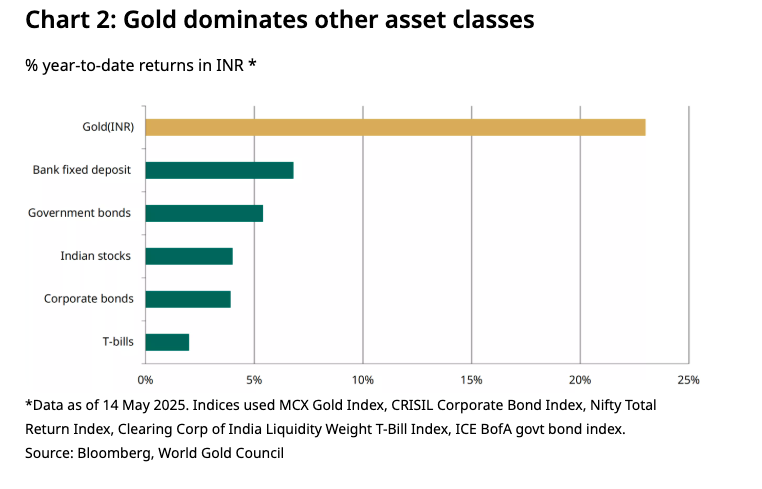
Gold is up 23 percent year-to-date in rupee terms, and the yellow metal has dominated every other Indian asset class.

Gold surged to record levels in April, hitting $3,500, but has corrected in May, falling by about 8 percent. The price followed a similar trajectory in rupee terms, although the correction has been more moderate (5 percent) due to the appreciation of the Indian currency.

The high prices have created headwinds for demand in India.

The World Gold Council described jewelry sales in April and early May as “subdued.”

The Akshaya Tritiya festival fell on April 30. According to the WGC, “overall demand during the festival was restrained and mixed as per market reports.”

“While large and corporate retailers reported higher footfalls and sales – largely driven by aggressive promotional and marketing campaigns – small and independent jewelers experienced sharp declines in demand.”

The investment bullion market was less impacted by high prices, with bar and coin sales relatively robust. According to the World Gold Council, low-weight coins were particularly popular.

“These were bought as ‘token’ purchases for the festival, with a notable share of sales occurring through online and e-commerce platforms. This behavior highlights a growing consumer shift towards organized players and investment-oriented gold products.”

Despite a drop in the volume of gold sold during the festival, the overall value of sales is projected to have increased, reflecting a nearly 30 percent increase in the gold price since last year.

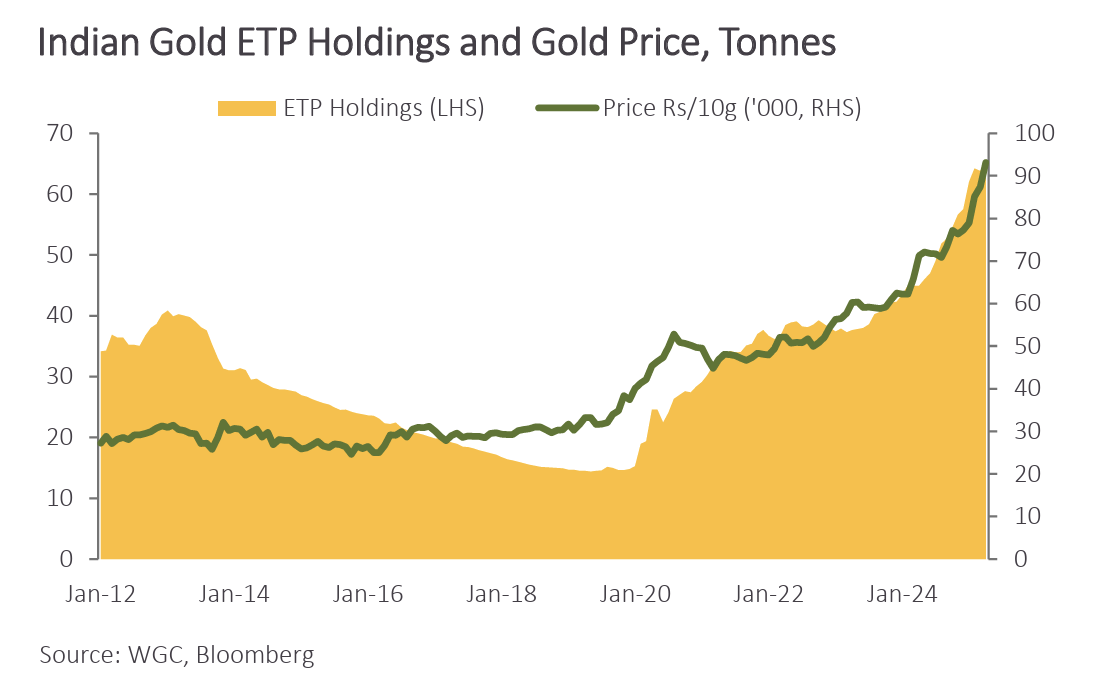
Higher prices also drove some profit-taking in the investment sphere. India-based gold ETFs recorded modest outflows of around 0.7 tonnes.

Even with the decrease in gold holdings, total assets under management (AUM) by India-based funds rose 4 percent month-on-month and 87 percent year-on-year.

Investor interest in gold was reflected by 180,000 new Indian gold ETF accounts. This brought the total number of gold ETF investor accounts to a record 7.1 million.

A gold ETF is backed by a trust company that holds metal owned and stored by the trust. In most cases, investing in an ETF does not entitle you to any amount of physical gold. You own a share of the ETF, not gold itself. ETFs are a convenient way for investors to play the gold market, but owning ETF shares is not the same as holding physical gold.

Indians have a longstanding love affair with gold.

The yellow metal is deeply interwoven into the country’s marriage ceremonies, along with its religious and cultural rituals. Festival seasons typically boost gold demand.

Indians have long valued the yellow metal as a store of wealth, especially in poorer rural regions. Around two-thirds of India’s gold demand comes from beyond the urban centers, where large numbers of people operate outside the tax system. Many Indians use gold jewelry not only as an adornment but as a way to preserve wealth.

In the West, gold is generally viewed as a luxury item. Not in India. Even poor Indians buy gold. According to a 2018 ICE 360 survey, one in every two households in India had purchased gold within the last five years. Overall, 87 percent of Indian households own some gold. Even households at the lowest income levels in India hold some of the yellow metal. According to the survey, more than 75 percent of families in the bottom 10 percent of income managed to buy some gold.

The yellow metal was a lifeline for Indians buffeted by the economic storm caused by the government’s response to COVID-19. After the Indian government locked down the country, banks tightened credit to mitigate the default risk. Unable to secure traditional loans, Indians used gold to secure financing. As Indians endured a second wave of lockdowns, many Indians resorted to selling gold outright to make ends meet.


Mike Maharrey is a journalist and market analyst for Money Metals with over a decade of experience in precious metals. He holds a BS in accounting from the University of Kentucky and a BA in journalism from the University of South Florida.

Congress to Investigate Nashville Mayor Over Directive Interfering with ICE

(Bethany Blankley, The Center Square)  – Another Democratic mayor is coming under fire for issuing a directive to city employees that appears to interfere with federal immigration operations.

Earlier this month, Nashville Mayor Freddie O’Connell issued Executive Order 30 requiring local law enforcement to track interactions with federal immigration officials. He also held a news conference stating that city officials “did not request this approach to safety, we do not support it,” referring to a targeted U.S. Immigration and Customs Enforcement operation.

Nashville’s City Review Board posted a notice on X urging residents who “experienced or witnessed an immigration-related event” to call a city-monitored hotline and file a complaint.

In response, U.S. Rep. Andy Ogles, R-Tenn., said the mayor’s order was “an outrageous directive requiring Nashville employees and first responders to report all communication with federal immigration authorities directly to the Mayor” and called on the U.S. House Judiciary and Homeland Security committees to investigate.

On Monday, Ogles announced that Congress was launching an investigation and he was requesting “any internal discussions or documents concerning ICE enforcement actions in Nashville or Davidson County” and “all correspondence involving Metro employees and affiliated NGOs regarding the arrest or detention of criminal illegal aliens within the city or county.”

Ogles said the mayor was “standing with rapists, drug traffickers, sexual predators, child traffickers, the list goes on, which is why I will always stand on the rule of law, and with ICE. I don’t just stand with ICE, I’ll stand in front of ICE because, ‘We the People’ have had enough.”

O’Connell’s statements and actions indicated he was potentially “aiding and embedding illegal immigration,” Ogles said, adding that the committees “will be conducting an investigation into the mayor of Nashville, his conduct and whether or not federal dollars have been used.”

Ogles also issued a warning to Tennesseans: “If you’re helping violent gangs destroy Tennessee by obstructing ICE – you belong behind bars.”

The escalation between the mayor and federal authorities occurred after ICE Nashville agents, working with federal partners and the Tennessee Highway Patrol, arrested 196 criminal foreign nationals with extensive criminal histories, including those who were previously deported and illegally reentered the country.

Federal and state authorities do not need a mayor’s permission to carry out targeted immigration enforcement operations but ICE has requested the cooperation of local authorities. Those who won’t comply risk losing federal funding, prosecution and other actions taken by the Trump administration, The Center Square has reported.

Under Republican Gov. Bill Lee, state law enforcement and the Tennessee National Guard have been involved in responding to border-related crime. The Tennessee Bureau of Investigations is actively targeting human trafficking operations run by the violent Tren de Aragua foreign terrorist organization. The Tennessee National Guard participated in Texas’ Operation Lone Star, The Center Square reported.

In response to O’Connell’s statement about not supporting ICE agents’ public safety efforts, the U.S. Department of Homeland Security posted mugshots of violent convicted criminals ICE agents arrested and took off of Nashville streets.

They include a Venezuelan national and TdA affiliate member; a Salvadoran affiliated with another foreign terrorist organization, MS-13, who has an active Red Notice in El Salvador for aggravated murder. His criminal history includes a conviction for possession of methamphetamines, possession of drug paraphernalia, failure to appear, and criminal impersonation.

Others include a Haitian national sentenced for possession of methamphetamine with intent to distribute and marijuana possession; a Guatemalan national sentenced to four years in prison for aggravated assault; an Iraqi national convicted of rape, larceny and false imprisonment. He was also arrested for failing to register as a sex offender and has a final order of removal from a judge dating Sept. 1, 2021.

Of the 196 arrested, 95 had prior criminal convictions and pending criminal charges; 31 were previously removed who illegally reentered the U.S.

Lee praised the work of THP troopers, saying he was proud of them “for assisting federal partners in the removal of dangerous criminals and drugs from our streets. Tennessee is safer today thanks to dedicated law enforcement who are leading the mission to restore public safety in America.”

Warren Buffett’s Gold Blind Spot

(Clint Siegner, Money Metals News Service) The Oracle of Omaha, Warren Buffett, recently announced he will be stepping down as CEO of Berkshire Hathaway. He built a reputation as one of the sharpest minds in investing.

Buffett’s folksy wisdom and knack for picking winners made him a household name. But when it comes to gold, Buffett maintains a stubborn bias against investing and has missed an absolutely huge move over the past 25 years.

Just before a generational bull market began in 2001, Buffett delivered a famous quip during a 1998 speech at Harvard, summing up his disdain:

“[Gold] gets dug out of the ground in Africa, or someplace. Then we melt it down, dig another hole, bury it again and pay people to stand around guarding it. It has no utility. Anyone watching from Mars would be scratching their head.”

At the time, it was a reasonable perspective. Gold had been floundering for nearly 20 years since the last bull market ended in 1980.

It is not reasonable today.

Buffett has turned more bearish on stocks given the sky-high valuations and a mixed economic outlook. He has also shared strong concerns about the U.S. dollar.

Buffett has even been vocal about dumping dollars in favor of other fiat currencies such as the Japanese yen. Yet he has shown no interest in gold.

That’s odd. Gold has already enjoyed an extraordinary run over the past 25 years, driven by many of the same concerns Buffett has now.

The Fed went berserk with bailouts, zero interest rates, and massive money creation. Federal debt has literally gone parabolic, and Congress still shows no inclination to rein that in. Japan and other developed nations appear just as irresponsible. Gold has performed even better relative to the yen.

The whole world is mired in an inflationary spiral. Despite that, Buffett has yet to acknowledge the utility of gold.

Gold’s Quiet Triumph Over the S&P 500

Gold’s results ought to be hard to miss or ignore.

Since 2000, gold has delivered a compounded annual growth rate (CAGR) of roughly 10.67%, climbing from around $280 per ounce to over $3,300 by May 2025.

Compare that to the S&P 500, which, including dividends, has posted a CAGR of about 6.5% over the same period. In raw terms, gold has surged over 800%, while the S&P 500, even with reinvested dividends, has gained around 400%.

Think about that. The “useless” metal has more than doubled the returns of US stocks. Importantly, the metal did better during turbulent times – the dot-com bust, the 2008 financial crisis, and the COVID market panic.

The stimulus-addicted equity markets look like a bubble, with record PE valuations. Gold, on the other hand, has proven its mettle as a safe haven. In 2008 alone, while the S&P 500 cratered 38%, gold gained over 4%.

It’s not just about price appreciation. Gold’s low correlation with stocks – recently at its lowest in a decade – makes it a powerful diversifier. When markets tank, gold often holds or climbs, cushioning portfolios.

Gold has worked great as an investment, an inflation hedge, and as a safe haven for 25 years. That is a ton of utility.

Gold vs. Berkshire Hathaway

Gold hasn’t just fared well versus the broad S&P 500 index. It also stacks up against Buffett’s own Berkshire Hathaway…

Since 1998, gold and Berkshire’s Class A shares have been neck-and-neck, each up roughly 500-550% through early 2025. Some periods tell an even starker story: from 2000 to 2020, gold climbed 532%, while Berkshire gained 322%.

That’s quite a feat for gold. Unlike Berkshire, the performance didn’t require Buffett’s genius along with teams of analysts handpicking stocks.

Buffett might have saved himself some trouble. He could have simply acknowledged that markets had been polluted by never-ending central bank intervention and unrestrained deficits, then made the single decision to buy gold and watch it appreciate.

Buffett’s Cash Hoard and Yen Gambit: A Risky Bet

Berkshire’s cash pile has ballooned to over $300 billion, as he’s been selling stocks like Apple and Bank of America. He is clearly uneasy about the market and looking to park a lot of cash.

He has also expressed real concerns about the US dollar. He’s even dipping his toes into the Japanese yen.

That is a bold move given the yen is tied to an economy with a shrinking population, massive government debt (over 250% of GDP), and near-zero interest rates. If anything, the yen might be in even more trouble than the dollar.

Give It Up Already and Buy Some Gold!

This isn’t 1965 America when Buffett took control at Berkshire Hathaway. It also isn’t 1980.

Times have changed, and Buffett acknowledges the need to change strategies. Based on recent public commentary, it seems Oracle has finally come close to understanding the utility of gold. It is clear he is nervous about holding overvalued stocks, and he understands the dark forces plaguing the dollar.

Too bad he is looking to stash some of the Berkshire cash hoard in the yen. Goldbugs could offer a better alternative, if only he would listen.


Clint Siegner is a Director at Money Metals Exchange, a precious metals dealer recently named “Best in the USA” by an independent global ratings group. A graduate of Linfield College in Oregon, Siegner puts his experience in business management along with his passion for personal liberty, limited government, and honest money into the development of Money Metals’ brand and reach. This includes writing extensively on the bullion markets and their intersection with policy and world affairs.