Inflation robs you of purchasing power by driving up the price of everything you buy. The government reports price inflation using the Consumer Price Index (CPI), but it’s a lot worse than they’re telling you.
In the first place, the CPI is rigged to understate the extent of price inflation. You probably realize this every time you go to the store.
But price inflation also manifests itself in ways a government formula could never capture, and you may not even notice. Not only do you pay more for everything you buy, but sometimes you get less for your money.
That’s called shrinkflation.
Pay More; Get Less
Central bank and government policies expand the money supply. This is, by definition, inflation. One result of this monetary inflation is rising consumer and producer prices. As more dollars circulate, each dollar becomes less and less valuable, resulting in a general decrease in purchasing power.
This price inflation squeezes producers just like they do consumers.
As the cost of materials, labor, and equipment goes up, company profits begin to shrink. Eventually, they have to pass those costs on to their customers.
But raising prices isn’t a popular move. Ideally, a company would love to hide the price increase from you.
Enter shrinkflation.
Instead of raising the price, the company just gives you less for the same amount of money. It does this by shrinking packages or putting less stuff in the same size container.
Shrinkflation doesn’t show up in the CPI, and most of the time, you probably don’t even notice. But the effect is the same as rising prices. You ultimately end up with less stuff.
It is stealth inflation.
Shrinkflation in the Wild
Buzzfeed senior editor Megan Liscomb recently found 20 examples of “hidden in plain sight” shrinkflation.
For example, Duncan Hines shrank its cake mix from 18 to 15.25 ounces. However, they compensated by making Dolly Parton’s likeness bigger, so that was nice.
Howard’s Feed-N-Wax wood polish cut its size in half between 2024 and 2025, but charges the same price.
Cascade cut the number of pods in its Free & Clear dishwasher soap from 62 to 47, but the company still charges $19.99 for the container.
Not to be outdone, SC Johnson shrank its Ziploc “mega pack” from 75 to 60 bags.
These are just a few of the many shrinkflation examples.
Most of the time, consumers don’t even notice shrinkflation. But when they do, they get mad. And their anger is usually directed at the “greedy” corporations that are charging them the same for less.
But there’s another culprit.
The Federal Reserve.
If the central bank didn’t constantly devalue your money, companies wouldn’t have to resort to such tactics to maintain their margins.
Companies can’t just ignore their cost problems. They can either raise prices, which will make you mad, or shrink package sizes, which will still make you mad, but you might not notice.
But the end result is always the same. You end up paying more and getting less.
Mike Maharrey is a journalist and market analyst for Money Metals with over a decade of experience in precious metals. He holds a BS in accounting from the University of Kentucky and a BA in journalism from the University of South Florida.
(Mike Maharrey, Money Metals News Service) As widely expected, the Federal Reserve maintained its wait-and-see position, taking no interest rate action during the July FOMC meeting.
However, there were some evident cracks in the committee as two members dissented from the majority decision. It was the first time multiple committee members opposed the majority since late 1993.
Until at least September, the federal funds rate will remain set between 4.25% and 4.5%.
The messaging coming out of the meeting was similar to the mantra last month. Inflation remains somewhat elevated. The economy is still strong. We don’t know the impact of tariffs. It’s a time to wait and see.
However, there was a subtle shift in the official FOMC statement that could be taken as more dovish. Instead of claiming economic activity “has continued to expand at a solid pace,” the committee said the “growth of economic activity moderated in the first half of the year.” The FOMC statement also said, “Uncertainty about the economic outlook remains elevated.”
During his post-meeting press conference, Powell said the committee decided to hold its policy rate “where it’s been, which I would characterize as modestly restrictive.”
“It seems to me, and to almost the whole committee, that the economy is not performing as though restrictive policy is holding it back inappropriately and modestly restrictive policy seems appropriate.”
Powell hinted that the majority of the FOMC isn’t in any hurry to make any policy shifts, saying, “We’ve learned that the process will probably be slower than expected.”
Many market observers read this as a hawkish signal that the central bank may not cut in September either. After stocks took a dip in the wake of Powell’s comment, New York Life Investments chief market strategist Lauren Goodwin told NBC News, “The markets seem to think that Powell pushed back on a September rate cut.”
However, Powell insisted, “We have made no decisions about September.”
“We don’t do that in advance. We’ll be taking that information into consideration and all the other information we get as we make our decision.”
It’s clear that the majority of the FOMC remains worried about price inflation. Based on the CPI, price inflation heated up in June. Powell said that tariffs have “begun to show through more clearly to prices of some goods,” but it is too early to determine their overall effect.
“Our obligation is to keep longer term … inflation expectations well anchored and to prevent a one-time increase in the price level from becoming an ongoing inflation problem.”
Equally concerned about higher inflation and a weakening economy, Powell and Company have adopted a “hurry up and wait” position.
President Trump has been pushing hard for rate cuts, and he took to social media to make his displeasure known.
“Jerome ‘Too Late’ Powell has done it again!!! He is TOO LATE. Put another way, ‘Too Late’ is a TOTAL LOSER, and our Country is paying the price!”
The Dissenters
The FOMC voted 9-2 to hold rates steady, with Michelle Bowman and Christopher Waller pushing instead for a quarter-point rate cut.
Bowman and Waller were both Trump appointees (as was Powell), and they are both considered to be on the short-list to replace Powell when his term ends next May.
Powell seemed to welcome the pushback.
“This was quite a good meeting all around the table, where people thought carefully about this and put their positions out there. You want that clear thinking and expression of your thinking, and we certainly had that today, I think, all around the table.”
The split in the committee will provide a little additional fuel for those pushing for looser monetary policy.
Is Monetary Policy Really Restrictive?
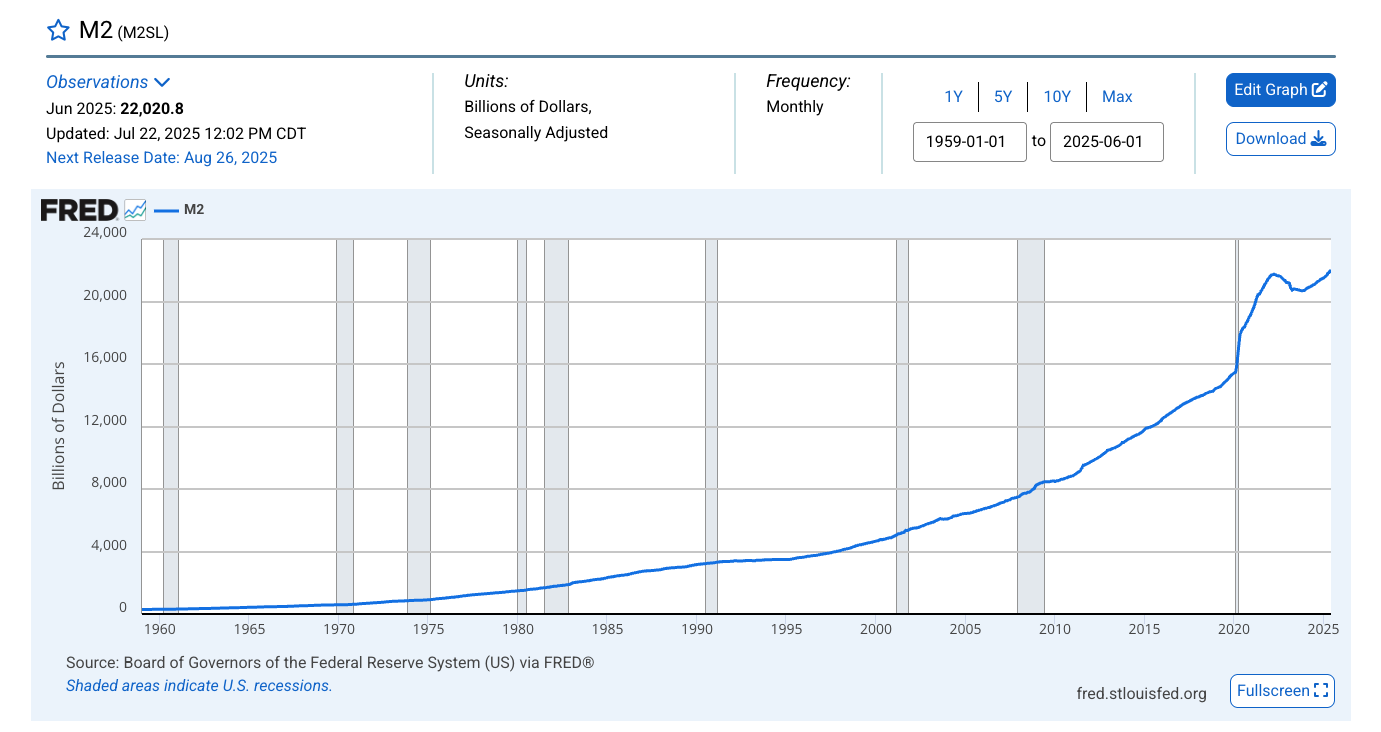
Powell called the current policy “modestly restrictive.” This characterization is debatable. As of the end of June, the money supply had expanded by more than $600 billion since its low point in mid-2023.
As of June, the M2 money supply stood at $22 trillion and is above the peak reached during the pandemic.
This is, by definition, inflation. And it certainly isn’t indicative of even modestly tight monetary policy.
The Chicago Fed’s own metric indicates that monetary policy remains historically loose. As of the week ending July 25, the National Financial Conditions Index (NFCI) stood at -0.57. A negative number reflects historically loose financial conditions. The NFCI remained negative even as the Fed was raising rates in 2023.
Looking at the historical data also reveals that the current interest rate level isn’t high at all.
So, why are so many people clamoring for rate cuts?
Because decades of artificially low rates and multiple rounds of quantitative easing since the 2008 financial crisis have addicted the economy to easy money. Fed policy incentivized a borrowing spree, and the economy is loaded up with debt. A debt-riddled economy can’t operate in an even modestly higher rate environment.
On the other side of the coin, you have inflation.
While the Federal Reserve tightened monetary policy enough to rein in rising prices, it never did enough to slay the inflation dragon.
When you break down the Fed’s messaging, it’s clear they’re torn between two worries. They know the economy is getting shaky, but they are also aware that inflation isn’t dead.
And what do we call high inflation coupled with low growth?
Stagflation.
It appears the plan is to stand pat and then address whichever side of the coin gets ugly first. If the CPI surges, rates will remain elevated, but if the economy begins to wobble, you can expect fast and aggressive cuts.
The Fed’s current inaction is exactly what you would expect given the Catch-22 it finds itself in. It simultaneously needs to cut rates to prop up the easy money-addicted economy and hold rates steady (or even raise them) to keep inflation at bay.
What is a central banker to do?
Wait and see.
Mike Maharrey is a journalist and market analyst for Money Metals with over a decade of experience in precious metals. He holds a BS in accounting from the University of Kentucky and a BA in journalism from the University of South Florida.
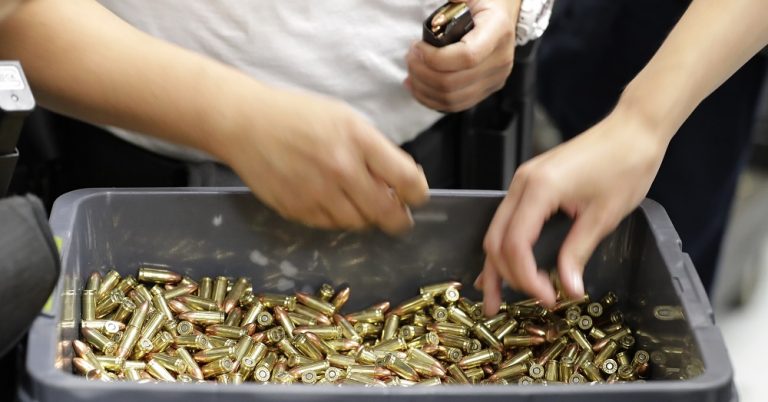
(Ken Silva, Headline USA) A community newspaper in Oregon published a bombshell scoop last week, reporting the theft of 12,000 rounds of ammunition from an FBI storage area at local firing range in January.
According to the scoop from The Columbian, Clark County Sheriff’s Office Deputy Thomas Yoder discovered the thefts on the morning of Jan. 15. He reportedly found the doors of two buildings left unsecured, one of them leading to an FBI storage facility. Security latches and padlocks on four storage sheds containing firearm targets, paint, maintenance gear and tools had also been cut or pried off, according to the report.
12,000 rounds of ammo stolen from FBI storage at Camp Bonneville, raising concerns from neighbors https://t.co/Z2YnQSBbuh
“I noticed bicycle tire tread marks left in the mud in front of the security gate. Those marks could then be seen coming from the direction of the equipment sheds,” Yoder said in his incident report. “The Camp Bonneville military reservation is surrounded by a security fence, and it is not open to the public, so it is unusual that someone would be riding around on a bicycle inside the property unless they bypassed the property fence and were trespassing on the property.”
According to The Columbian, items stolen from the FBI’s storage area included 10,000 rounds of 9 mm ammunition and 2,000 rounds of 5.56 rifle ammunition.
Camp Bonneville was reportedly established in 1909 as a U.S. Army rifle range and training facility for troops at Fort Vancouver. It was closed in 1995 and turned over to the Clark County government.
The Columbian reported that the facility is also used by the regional SWAT team, the Metro Explosive Disposal Unit and other law enforcement agencies.
However, the FBI’s contract to use the park as a shooting range reportedly expired late last year, right before the theft occurred. County public lands manager Kevin Tyler told the Columbian that the contract negotiations with the FBI are nearly complete, and should be finalized by September.
Local residents are now reportedly questioning why it took so long for the burglary to be publicized. Some of them don’t want the park to be used as a shooting range, either.
“The theft of 12,000 rounds from a facility used by the FBI should be a national story. The stolen ammunition also poses a serious threat to Clark County citizens,” Ann Shaw, who lives close to the county-owned property, told the Columbian. “Withholding information about this theft from the public is unconscionable.”
Another resident noted that the theft came on the heels of Department of Ecology officials who visited identifying last December several issues related to Camp Bonneville’s perimeter fencing, security gates and access to the central impact target area.
“Even as Clark County leadership was wrongly moving forward with Camp Bonneville’s continued misuse as a multi-agency law enforcement training facility, when its cleanup status remains in question, they at least assured the public that they would rein in law enforcement to minimize liability to the county and improve security. The details of this latest incident reveal that nothing has changed,” nearby resident and podcaster Karissa Halstrom reportedly said.
Ken Silva is the editor of Headline USA. Follow him at x.com/jd_cashless.
(Luis Cornelio, Headline USA) Rep. Carlos Giménez did not deny he is considering exiting Congress to seek another office—a move that would further diminish the GOP majority in the House of Representatives.
The claims that the Florida Republican is eyeing a potential run for Miami mayor first came to light thanks to journalist Laura Loomer.
She reported that sources said Giménez is using the recess to weigh quitting Congress after he failed to secure enough votes to become chair of the House Homeland Security Committee.
SCOOP:
Source tells me that GOP Florida Congressman Carlos Gimenez (FL-28) @RepCarlos is deliberating during the current August recess in his district in Miami, FL whether or not to leave Congress and abandon the House GOP ahead of the upcoming November 2025 City of Miami… pic.twitter.com/Xqaxe4D3QV
“If Gimenez does in fact resign from Congress to run for Mayor of the City of Miami, FL, he would be abandoning President Trump’s agenda and would set his Congressional seat up for a Special Election, which could be disastrous for the Republicans as they fight to keep the House majority in 2026,” Loomer wrote. “The Democrats only need 3 seats to take back the House.”
In response, Giménez dismissed Loomer’s reporting, claiming she was attacking him because of his staunch support for Venezuelans.
“Once again, Loomer doesn’t have the faintest idea of what she’s talking about,” Gimenez wrote. “She doesn’t like that I stand with the Venezuelan people in their fight for freedom.”
Giménez’s rebuttal invoking Venezuelans was odd, though he accused Loomer of preferring to “funnel millions into the pockets of the leaders of the Cartel de los Soles — a criminal narco-terrorist regime headed by none other than Nicolas Maduro and an officially designated global terrorist organization by President Trump.”
In a follow-up post, Loomer then reported that Giménez may position his son, attorney Carlos J. Giménez, to succeed him in a potential special election, while he runs for mayor.
The incumbent Miami mayor, Republican Francis Suarez, is term-limited.
Florida holds off-year elections, with the current term slotted to end in November 2025, though the Miami City Commission recently passed a resolution to move the election to 2026.
The change gives Suarez and the current city council an extra year in office—though Florida Gov. Ron DeSantis and Attorney General James Uthmeier said the resolution violates Florida law.
(Luis Cornelio, Headline USA) U.S. Immigration and Customs Enforcement’s detention of an illegal alien named Jesus Terán, who temporarily worked as a carpenter, has prompted left-wing media figures to draw comical parallels to Jesus Christ, the Son of God, who was also a carpenter.
Teran was arrested during one of his ICE appointments on July 8. He had previously been denied entry to the U.S. in 2015 and was later allowed in under the Biden administration in 2021.
While Teran’s case is no different from that of countless other illegal aliens who entered the country under the permissive immigration policies of the Biden administration, some media personalities fixated on his name, triggering the Christ comparisons.
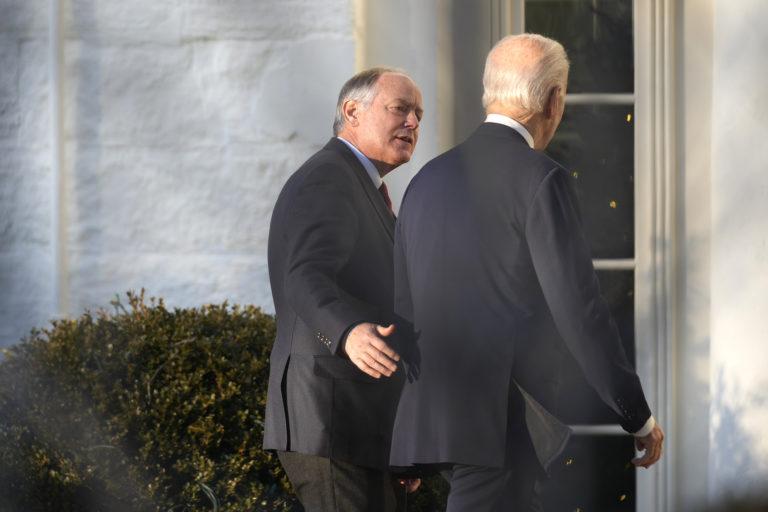
(The Center Square) Steve Ricchetti, who served as counselor to former President Joe Biden, appeared before a House committee Wednesday regarding the investigation into the former president’s mental and physical fitness.
Ricchetti testified before the House Committee on Oversight and Government Reform. He reportedly used the transcribed interview to refute Republicans’ assertion that Biden wasn’t in full control of his mental capabilities during his presidency.
Ricchetti defended the former president in a prepared statement obtained by The Hill, claiming he had complete faith in Biden.
“Let me be clear: At all times during his presidency, I believed that President Biden was fully capable of exercising his Presidential duties and responsibilities, and that he did so,” Ricchetti stated. “Neither I, nor anyone else, usurped President Biden’s constitutional duties, which he faithfully and fully carried out each and every day.”
Ricchetti tried to quash accusations of any conspiracies surrounding Biden’s presidency, nor an attempt to hide the former president’s “mental condition from the American people.”
He added, possibly alluding to concerns over the usage of the autopen and pardons, that he was “not aware of any effort by any member of the White House staff to usurp the President’s authority to make decisions or to sign important documents without his knowledge.”
However, Ricchetti acknowledged the former president did have his moments, but brushed them off, reiterating his confidence in Biden.
“Did he stumble? Occasionally. Make mistakes? Get up on the wrong side of the bed? He did – we all did. But I always believed – every day – that he had the capability, character, and judgment to be president of the United States,” Ricchetti added.
Ricchetti’s transcribed interview marks the second witness in less than a week to voluntarily appear before the committee.
Ron Klain, who served as former President Joe Biden’s chief of staff during the first half of Biden’s presidency, testified during a marathon hearing last Thursday.
Committee Chairman Rep. James Comer, R-Ky., told Newsmax that Klain answered every question, admitting that Biden’s “memory had deteriorated a little bit” and “wasn’t as sharp” in the lead-up to the former president dropping out of the race for reelection. However, Comer added that Klain told the committee that he believed Biden was still competent to lead – echoing Ricchetti’s statements.
Previous witnesses who have been subpoenaed include Annie Tomasini, who served as an assistant to the former president and deputy director of Oval Office Operations, former First Lady Jill Biden’s chief of staff, Anthony Bernal, and Dr. Kevin O’Connor, Biden’s physician. They all pleaded their Fifth Amendment right against self incrimination and refused to answer questions.
Comer claims those witnesses show “a pattern … seeking to shield themselves from criminal liability.”
Questions regarding Biden’s mental fitness were raised well before the 2020 presidential election. Republicans and many in the conservative media continued to raise questions regarding the former president’s health throughout his presidency.
However, the White House claimed Biden received regular medical exams, showing a healthy, competent president.
The House committee announced in early June that it was expanding its investigation into the “cover-up” of Biden’s “mental decline.”
Comer sent letters to five former senior Biden White House aides, “demanding they appear for transcribed interviews.” Comer’s committee is investigating “potentially unauthorized issuance of sweeping pardons and other executive action.”
The investigations have been fueled in part by a book written by Jake Tapper and Alex Thompson, “Original Sin,” which the congressman quoted as claiming, “Five people were running the country, and Joe Biden was at best a senior member of the board.”
Karine Jean-Pierre, who served as Biden’s press secretary; Ian Sams, former assistant to the president and senior advisor in the White House Counsel’s Office; Andrew Bates, former deputy assistant to the president and senior deputy press secretary; and Jeff Zients, Biden’s former chief of staff, have also been called to testify in front of the committee.
Mike Donilon, former senior advisor to Biden, is scheduled to sit down with the committee Thursday.
(Money Metals News Service) In this week’s Money Metals Midweek Memo, host Mike Maharrey returned from a cross-country hockey tournament to dig into two massive stories shaping the precious metals landscape: platinum’s under-the-radar explosion in value and the growing trend of nations demanding their gold be brought home.
Together, these shifts highlight the increasing global desire for monetary sovereignty and physical control over real assets.
That’s nearly double gold’s 25.9% rise and well ahead of silver’s 24.9% gain over the same period.
As of late July, platinum was trading around $1,405, pushing its lead even further.
What’s driving the surge?
The primary catalyst is a structural supply deficit. The World Platinum Investment Council (WPIC) reported that demand outpaced supply by 995,000 ounces in 2024, nearly a million ounces—46% more than analysts forecast.
For 2025, they expect another shortfall of approximately 848,000 ounces. Above-ground stocks dropped 23% last year and are forecasted to fall another 25% this year.
That means industrial users must dip into shrinking inventories, pushing prices higher.
Platinum also benefits from broader commodity momentum.
With the U.S. dollar showing weakness and precious metals in general performing well, platinum is enjoying a piggyback effect. But its fundamentals are strong on their own.
The metal is crucial in the automotive sector—particularly in catalytic converters used in hybrid and internal combustion vehicles. In fact, auto-sector demand reached a seven-year high in Q1 2025, and that trend is expected to continue due to stricter global emissions rules and the substitution of platinum for palladium.
Jewelry demand is rebounding as well, especially in India. A 53% increase in Indian platinum jewelry purchases helped drive global demand up 5% year-over-year in Q1. India’s growing appetite for platinum could be a long-term tailwind.
Historically, platinum was more expensive than gold.
In March 2008, platinum reached an all-time high of $2,213 per ounce—well above gold’s 2011 record of $1,920 at the time. But since 2015, gold has consistently outpaced platinum in price. That disconnect may not last.
With such a wide gap and platinum’s fundamentals strengthening, Maharrey suggests the metal could be poised for a longer-term revaluation. Even a partial return to historical price parity with gold would mean significant upside for platinum investors.
Repatriating Gold: The Sovereignty Movement Grows
As Maharrey transitions topics, he highlights an accelerating global trend: countries are repatriating their gold reserves, choosing to store them domestically rather than in foreign vaults in London, New York, or Switzerland. Serbia is the latest nation to take this step.
Serbia currently holds about 50.5 tons of gold—valued at roughly $6 billion—and has already brought most of it home. Only five tons remain in Swiss vaults, and the National Bank of Serbia has pledged to retrieve that gold “as soon as possible.”
Once completed, Serbia will become the first European nation to store its entire gold reserve within its own borders.
The reasoning behind this decision is clear: control, access, and security.
Serbian officials cited rising global uncertainty and crisis preparedness as reasons for repatriation. Simply put, when things go sideways, they want to be able to reach their gold without relying on foreign institutions or political goodwill.
This move is part of a much broader trend. India repatriated 200 tons of gold over the past two years. Poland, Hungary, Romania, Australia, the Netherlands, Belgium, and Germany have all taken steps to bring gold home in recent years.
In 2017, Germany completed a program to return roughly half its gold reserves. Now, public pressure is mounting in Germany and Italy to bring home the rest—fueled in part by growing concern over U.S. political unpredictability.
Some European critics point specifically to former President Donald Trump. Whether the concern is justified or not, the point remains: if foreign central banks believe the United States may become an unreliable custodian, they’re going to act accordingly. Policy decisions abroad are shaped by perceptions and risk mitigation, not wishful thinking.
From West to East: The Global Shift in Gold Ownership
Investigative reporter Jan Nieuwenhuis, writing for Money Metals, has been tracking the changing location of the world’s official gold reserves. In 1972, 49% of official reserves were stored outside New York and London. Today, that figure has jumped to 78%.
This shift is reshaping the global balance of financial power. According to Nieuwenhuis, non-Western countries—primarily in Asia—now hold 18,643 tons of gold. That compares to 21,470 tons held by Western nations.
The West still has the lead, but not for long. At 46% of global reserves, non-Western ownership is approaching majority status.
This change isn’t just symbolic. Gold has always been monetary power. As the saying goes, “He who holds the gold makes the rules.”
The movement of gold from West to East reflects the emergence of a multipolar global order. As countries like China, India, and Russia increase their reserves, they gain leverage to trade outside the dollar-based system and store their wealth in an asset beyond Western control.
After the United States and its allies froze over half of Russia’s $650 billion in reserves following the invasion of Ukraine, many central banks reevaluated their own vulnerabilities.
The World Gold Council found that 68% of central banks surveyed in 2023 intended to store their gold domestically, up from just 50% in 2020.
Counterparty Risk and the Case for Physical Gold
Maharrey drives home a key lesson from this global shift: owning physical gold eliminates counterparty risk.
Unlike paper money, bank deposits, or even ETFs, gold doesn’t depend on anyone’s promise to honor its value. It can’t be printed. It can’t be frozen by sanctions. Its value is intrinsic and universally recognized.
Storing gold abroad reintroduces risk.
That risk may be low—until it isn’t.
Central banks are waking up to the reality that gold stored in foreign jurisdictions is vulnerable to geopolitical tensions, economic warfare, and political intervention.
Transparency is also a growing concern.
The Federal Reserve has refused to disclose details about the gold it holds on behalf of foreign governments. It declined a Freedom of Information Act request from Headline USA asking for basic inventory data. Even members of Congress like Rep. Alex Mooney (R-WV) have been stonewalled when asking about these holdings.
Should You Store Gold at Home?
While central banks are bringing gold home, individual investors face a similar dilemma: store metals at home, or use a secure third-party depository?
Maharrey acknowledges that home storage comes with risks. Most home safes can be cracked by a determined thief. Even clever hiding places aren’t foolproof.
On the other hand, third-party storage introduces different risks—mainly trust and access.
The key is choosing a reputable depository. Money Metals offers a high-security storage facility in Idaho that’s fully insured by Lloyd’s of London. The metals are stored in segregated accounts, meaning your assets are not pooled or lent out. The vault is independent of Wall Street, major banks, and the federal government.
Whether you store gold at home or in a depository, the most important step is owning it.
Physical precious metals remain the most reliable hedge against inflation, geopolitical upheaval, and currency devaluation.
Final Thoughts
The platinum rally and the wave of gold repatriation underscore a growing global demand for real money, real assets, and real sovereignty. Nations are moving away from the dollar. Investors are seeking protection from inflation and instability.
The trend is clear: sound money is back in style.
If you’re considering your next step, this may be a prime moment to buy gold, silver, platinum, or palladium before the next leg up.
The foundation is already laid.
The world is waking up.
To explore investment options or storage solutions, visit MoneyMetals.com or call 1-800-800-1865 to speak with a knowledgeable precious metals specialist.
(Headline USA) A city councilman in Virginia was seriously injured Wednesday when a man stormed into his office at a local magazine store, doused him in gasoline and set him on fire — an attack that authorities say was rooted in a personal dispute, not politics.
Lee Vogler, 38, who has served on the Danville City Council for more than a decade, was taken by medical helicopter to a burn unit in North Carolina after the attack. Police said the assailant, 29-year-old Shotsie Michael Buck Hayes, forced his way into Vogler’s office at Showcase Magazine, confronted him, then chased him outside and set him ablaze.
Hayes was arrested at the scene on charges of attempted first-degree murder and aggravated malicious wounding.
Investigators stressed that the motive appeared personal and unrelated to Vogler’s work as a public official. Still, the assault added to growing unease over violence and harassment aimed at elected officials across the country, particularly as the boundaries blur between their public roles and private lives.
“There is no justification for lashing out,” said Andrew Scott Brooks, publisher of the magazine. “This type of act of senseless violence needs to stop.”
Two employees were in the building when the attack occurred, Brooks said. According to police and witnesses, Vogler ran through the office yelling for help after being doused in gasoline. A colleague called for help as Hayes chased Vogler outside and ignited the fire, the publisher said.
“Our door is locked,” Brooks said. “They forced their way into the office, and went to Lee. The next thing, Lee is running through the office covered in gasoline, yelling for our officemate to call 911.”
Hayes was being held without bond in the Danville City Jail, police said. A message left with a phone number listed for the suspect wasn’t immediately returned. A message was left with the Danville Public Defender Office asking whether they will be representing the suspect.
Showcase Magazine is a monthly publication about southwest Virginia and North Carolina. The magazine shares a small two-story building with several other businesses in Danville.
A woman who answered the door at the Vogler residence and identified herself as the sister of Vogler’s wife declined to comment. A man at an address listed for Hayes also declined comment.
Elected officials and politicians throughout Virginia quickly condemned the attack.
“Our prayers go out to Danville City Councilman Lee Vogler who was violently attacked at his workplace earlier today,” Republican Gov. Glenn Youngkin said in a statement. “We pray for a swift recovery for Lee and for peace to be on the entire Danville community.”
Brooks said he had no indication that Vogler felt unsafe at work or elsewhere. Vogler is a salesperson at the magazine, though at the small-city media company, everyone does a bit a bit of everything.
“He makes sales, but he also writes stories about our community,” Brooks said.
Brooks said that comes naturally to Vogler.
“His passion is being on the city council,” Brooks said. “He loves when people call them with a concern that he can help them with, and he has been an asset to the community for much of his adult life. He was young when he got on city council, early 20s. He has made that his life.”
Brooks said outside of work, Vogler is dedicated parent to his two kids.
“He’s the one who coaches their sports teams,” Brooks said.
Danville is about 140 miles north of Charlotte, North Carolina.
The Democrat and Oakland native, who lost the presidential race to Republican Donald Trump in November, said she gave the race serious thought and that she loves California and its people.
“But after deep reflection, I’ve decided that I will not run for governor in this election,” Harris, 60, said in her statement on X. “For now, my leadership – and public service – will not be in elected office.”
“I look forward to getting back out and listening to the American people, helping elect Democrats across the nation who will fight fearlessly and sharing more details in the months ahead about my own plans,” she said.
Harris did not comment on whether she would run for president again in 2028. If she did, she could be going up against California Gov. Gavin Newsom. The Democratic governor, who is being termed out, is widely expected to run in 2028 for president.
Harris, who worked as a prosecutor in Oakland, entered the political scene when she was elected the San Francisco district attorney in 2004. Six years later, she was elected California attorney general in 2010. She was elected a U.S. senator representing the state in 2016. In 2020, she was elected America’s first female vice president and was the first Black and South Asian American to served in the position.
Harris’ decision removes her as the possible frontrunner in a gubernatorial race with a large number of Democratic candidates: former U.S. Rep. Katie Porter (who represented Orange County in Congress), Lt. Gov. Eleni Kounalakis, former Los Angeles Mayor Antonio Villaraigosa, former California State Senate President Pro Tem Toni Atkins, Superintendent of Public Instruction Tony Thurmond, former state Controller Betty Yee and Diamond Resorts International founder Stephen J. Cloobeck.
The Republicans running for the office are Riverside County Sheriff Chad Bianco and former Fox News host Steve Hilton.
Under California’s election laws, the two candidates with the great number of votes in the 2026 primary, regardless of party affiliation, will face off in the general election.
(José Niño, Headline USA) Kyle Anzalone joins José Niño on Headline Geopolitics to discuss the latest flashpoints in global affairs.
From Israeli strikes in Gaza to U.S. proxy escalations in Syria, and rising tensions with Iran and Russia, this episode dissects the failures of American foreign policy through a non-interventionist lens.
Tune in for an unfiltered breakdown of imperial overreach and the global consequences of endless war.