(Luis Cornelio, Headline USA) A trove of newly declassified documents exposed how the DOJ under the first Trump administration failed to prosecute high-profile Democrats despite strong evidence, according to a summary report by Just the News.
Federal agencies like the FBI and IRS slow-walked or squashed probes into James Comey, Hillary Clinton and her foundation, Adam Schiff, Hunter Biden and other leftist figures—a stark contrast to how President Donald Trump was treated after leaving office in 2021.
For instance, the documents showed that the DOJ reportedly secured enough proof that Comey authorized the leak of classified information before the 2016 election.
Other reporting, also by Just the News, indicated how Schiff—a longtime Trump critic—allegedly leaked information to smear Trump in the Russian collusion hoax.
A tax probe into the Clinton Foundation was launched in 2019, then was abruptly shut down by the federal government.
The pattern of shielding high-profile Democrats extended to the Biden family, as whistleblower testimony revealed the feds slow-walked its criminal probe of Hunter Biden. In doing so, officials let key statutes of limitation expire.
Special Counsel John Durham, tasked with exposing the origins of the Russian hoax, largely failed to hold intel officials accountable for the scheme designed to undermine Trump’s 2016 win.
The permissiveness ended the exact moment Trump left office in 2021.
President Biden installed Attorney General Merrick Garland, who appointed Jack Smith as special counsel to target Trump.
Even leftist outlets, such as The New York Times, admitted Biden long wanted his DOJ to aggressively go after Trump.
Smith secured two grand jury indictments, one over document dispute between Trump and the National Archives, the other over Trump’s objections to the certification of the 2020 election.
Trump also faced a civil case from New York Attorney General Letitia James and a criminal indictment from Fulton County District Attorney Fani Willis.
The documents case collapsed when a federal judge ruled Smith’s appointment unconstitutional. The election case was ultimately tossed after the 2024 election.
The New York civil judgment against Trump was overturned on appeals and the Fulton County prosecution was indefinitely frozen amid an affair controversy between Willis and the man she hired to go after Trump.
(Ken Silva, Headline USA) The DOJ Inspector General released a report Monday, finding that an FBI agent illegally installed surveillance equipment on private property, and that the agent’s boss then covered up the illegal activity.
The boss—a now-retired FBI special agent-in-charge (SAC)—also reprimanded other bureau employees who reported the illegal surveillance equipment, the report said.
To top it off, the FBI SAC retired before being interviewed, and refused to talk to the DOJ-OIG thereafter.
An FBI agent illegally installed surveillance equipment on private property. Then, the agent's bossed covered up the crime — and in fact reprimanded other employees who reported the illegal surveillance. The OIG said he's provided the report to the FBI "for its information." pic.twitter.com/oeTGZvYOUz
“The OIG has the authority to compel testimony from current Department employees upon informing them that their statements will not be used to incriminate them in a criminal proceeding,” the inspector general’s report said.
“The OIG does not have the authority to compel or subpoena testimony from former Department employees, including those who retire or resign during the course of an OIG investigation.”
The inspector general said he provided his report to the FBI “for its information.”
Ken Silva is the editor of Headline USA. Follow him at x.com/jd_cashless.
(Dave DeCamp, Antiwar.com) The Israeli military on Monday massacred 20 Palestinians, including five journalists, in an attack on Gaza’s Nasser Hospital that involved a double-tap strike on rescue workers in the southern city of Khan Younis.
According to The Associated Press, the initial strike at 10:10 am Gaza time hit the fourth floor of the hospital, which has surgical operating rooms and doctors’ residences, killing at least two people. Once rescue workers and journalists arrived at the scene, a second strike hit, killing 18 more people, a double-tap attack that was caught on video.
Israel-based outlet 972 Magazinepublished an investigation last month that said that the IDF has adopted using double-tap strikes as a “standard procedure” in Gaza. Yuval Abraham, a reporter for 972 who wrote the report, said on Monday that the video of the double-tap strike on Nasser Hospital is “footage of murder.”
According to Reuters, the initial strike killed one of its contractors, cameraman Hussam al-Masri, who was killed near a live broadcasting position operated by Reuters on the upper floor of the hospital. Antiwar.com has a photo account with Reuters and has used several photos taken by al-Masri in previous news stories.
The Israeli newspaper Haaretzreported that the Israeli military said that the initial strike targeted a camera, which they claimed was a “Hamas camera” that was being used to observe IDF forces. They say that an Israeli tank shell struck the area, then another one was fired to make sure the camera was destroyed. Israeli Prime Minister Benjamin Netanyahu later claimed that the double-tap strike was a “tragic mishap.”
The other four journalists killed by the Israeli attack on the hospital were Mariam Abu Dagga, who freelanced for The Associated Press and other outlets, Mohammed Salama, who worked for Middle East Eye and Al Jazeera, Moaz Abu Taha, a freelance journalist who worked with several news outlets, and Ahmed Abu Aziz, another freelancer who also contributed to Middle East Eye.
Dagga recently co-authored a report for The Associated Press that highlighted the plight of malnourished children in Gaza who are being starved by the Israeli blockade. Middle East Eye said that its head of video production recently spoke with Salama about Israel’s starvation policy and that he expressed fear of being targeted by the IDF in the wake of the assassination of Al Jazeera reporter Anas al-Sharif.
The Israeli military has killed a huge number of journalists throughout its genocidal war on the Gaza Strip. According to the Palestinian Journalists Syndicate, the attack on the Nasser Hospital brought the total number of journalists killed by Israeli attacks to more than 244.
(Brett Rowland, The Center Square) The Congressional Budget Office’s estimated that President Donald Trump’s tariffs could bring in $4 trillion over the next decade, but will raise consumer prices and reduce the purchasing power of U.S. families.
The most recent estimate includes changes to tariffs through Aug. 19 that CBO Director Phillip Swagel said reduce total deficits by $4 trillion altogether over the next decade. Tariff revenue also is expected to reduce the need for federal borrowing and cut spending on interest by $700 billion.
The CBO report includes a caveat: “The estimates are subject to significant uncertainty, largely owing to questions about timing, possible exceptions, and a lack of precedents.”
The CBO said it estimated that the effective tariff rate for goods imported into the U.S. increased by about 18 percentage points when measured against 2024 trade flows.
That could mean more inflation and higher prices for consumers and businesses.
“The increases in tariffs will make consumer goods and capital goods (the physical assets that businesses use to produce goods and services) more expensive, which will reduce the purchasing power of U.S. consumers and businesses,” according to the CBO report. “Those increases in costs will put temporary upward pressure on inflation.”
Since retaking office, Trump has hit nearly every nation with new tariffs and is working to reshape global trade to give American companies homefield advantage. But it could cost U.S. consumers.
The White House has said that foreign nations and businesses will pay the tariffs, not American consumers.
Last month, the Federal Reserve’s latest anecdotal “beige book” survey found that businesses across the country reported passing the cost of tariffs on to U.S. consumers.
Economists, businesses and some publicly traded companies have warned that tariffs could raise prices on a wide range of consumer products throughout the U.S.
Trump has said he wants to use tariffs to restore manufacturing jobs lost to lower-wage countries in decades past, shift the tax burden away from U.S. families, and pay down the national debt.
A tariff is a tax on imported goods that the importer pays, not the producer. The importer pays the cost of the duties directly to U.S. Customs and Border Protection, a federal agency.
(Sarah Roderick-Fitch, The Center Square) Two weeks after declaring “Liberation Day” in Washington, D.C., to combat crime, President Donald Trump signed executive orders to end cashless bail in the nation’s capital, while taking steps to eliminate it throughout the country.
The president signed the executive orders on Monday morning in the Oval Office. The moves threaten to withhold federal funding from states and jurisdictions that don’t comply with his executive action, which could have a major impact on states like California and Illinois.
Touting 11 days without a homicide in the district, Trump moved to eliminate the controversial cashless bail policy that has been in effect in the district since 1992.
“[The order would] ensure that arrestees in the District of Columbia are held in Federal custody to the fullest extent permissible under applicable law, and shall pursue Federal charges and pretrial detention for such arrestees whenever possible, consistent with applicable law, to ensure that criminal defendants who pose a threat to public safety are not released from custody prior to trial,” according the order.
The White House says the policy has contributed to “disgraceful conditions,” adding that the current law is a revolving door for criminals where “dangerous criminals are sometimes rapidly released,” leaving “such criminals free to endanger American citizens.”
Following a decrease in crime since the Aug. 11 executive action, which Trump declared a crime emergency in the district, calling it “Liberation Day,” by deploying the National Guard to patrol the district. The president is setting his sights on other cities, including Chicago, New York and Baltimore.
As part of his effort to combat crime, the president signed a similar executive order Monday to “take steps” to eliminate cashless bail in cities and states that have such policies.
The order directs the attorney general to submit a list of states and “local jurisdictions that have, in the Attorney General’s opinion, substantially eliminated cash bail as a potential condition of pretrial release from custody for crimes that pose a clear threat to public safety.”
In addition, the order directs the head of each executive agency and department to identify federal funds, including grants and contracts, “currently provided to cashless bail jurisdictions identified” that “may be suspended or terminated, as appropriate and consistent with applicable law.”
“As President, I will require commonsense policies that protect Americans’ safety and well-being by incarcerating individuals who are known threats. It is therefore the policy of my Administration that Federal policies and resources should not be used to support jurisdictions with cashless bail policies, to the maximum extent permitted by law,” according to the order.
The Trump administration is touting the operation to “Make D.C. Safe Again” as a success, which has netted over 1,000 arrests since the crackdown began.
Supporters of the cashless bail measure argue that the practice of cash bail unfairly harms low-income and minority communities.
(Ken Silva, Headline USA) Earlier this month, the Justice Department announced a slew of charges against four Indian nationals for running a human trafficking ring out of several Nebraska hotels.
Court records reveal shocking details about the allegations against Ketankumar Chaudhari, Rashmi Ajit Samani, Amit Chaudhari, Amit Chaudhary, and Maheshkuma Chaudhari. Along with pimping out children, they also allegedly sold drugs, trafficked in stolen goods, harbored fugitives, and committed widespread visa fraud over the last five years out of those hotels, which were wired with hidden cameras.
However, law enforcement’s initial investigation of this crime syndicate had nothing to do with violent crime. Rather, it began as a probe into an Indian call center. According to charging papers, Indian scammers posing as Federal Trade Commission employees would call victims and bilk them for cash under the pretense of a federal investigation. As it turned out, many of those scammers lived in hotels owned by the leader of the conspiracy, Ketankumar, who first entered the country in 2008 as a visitor on a B1/B2 visa.
I dug into this case, and it's so much more disturbing than what's been reported so far. Indian illegal immigrants allegedly pimped out kids, sold drugs, harbored fugitives and committed rampant fraud over the last five years — working out of hotels wired with hidden cameras. 🧵 https://t.co/sVlPe9K8jvpic.twitter.com/Fx7Tb7actI
Ketankumar, for his part, is here illegally and has been denied numerous visas on the grounds that he committed fraud, including by entering a sham marriage. Rashmi was also in a sham marriage. In fact, the two are married to each other, and produced a child in America.
About four years ago, an FBI task force officer (TFO) in Sarpy County, Nebraska began investigating them for the more serious criminal activity occurring in several hotels they own.
The TFO had informants working for the hotels and living there as long-term residents. Those sources told the TFO that Ketankumar and his family were illegally importing illegal immigrants from India to work for them.
The TFO and other FBI agents interviewed the employees, who told them that they weren’t paid for their work. In fact, they were often told they owed Ketankumar money for living there.
“In order to pay rent, the employees were solicited for sex acts or solicited to steal property, including retail items like cologne and clothes, electronics, landscaping supplies and tools,” says an Aug. 11 FBI affidavit, which was published by CourtWatch.
Perhaps even more shockingly, the sources told law enforcement that Ketankumar would allow fugitives to stay in his hotels. If they paid him between $20-$40, his front desk worker, Maheshkuma, would tell U.S. Marshals that the people they were looking for weren’t there.
“Hotel staff would book the fugitives in under false names or move their rooms to an undocumented room within the hotel,” the FBI affidavit says.
Law enforcement had several brushes with the Chaudhari crime family, including once in 2022, when Ketankumar staged a phony robbery in a scheme to obtain insurance money and a visa for Rashmi.
In that case, Ketankumar had one of his long-term renters rob one of their businesses, a “Brow and Lash” beauty salon. The robber demanded money, flashed a gun, and then “pushed” Rashmi, which allowed her to apply for a “U visa”— a visa for a victim of serious crime.
In January 2023, law enforcement received a tip that the robbery was staged. Ketankumar arrested for conspiracy to commit a felony and was eventually found guilty of insurance fraud. It’s unclear why the Biden administration didn’t deport him then.
Because he wasn’t deported, Ketankumar was able to victimize an untold number of people over the next two years, including minor females. The females apparently looked so young that not even sex buyers would exploit them, according to court documents.
“Several people commented on how young the minors looked—including potential sex buyers who backed out upon seeing their pictures, citing age concerns and the as of yet unknown suspect who posted online commercial sex act ads featuring the victims,” the FBI affidavit says.
He also allegedly continued to sell drugs from his hotels. Often, the pedophile and drug activities were combined in a horrific fashion.
For instance, when law enforcement tried rescuing one minor victim in 2022, “she fled law enforcement while high on methamphetamine.”
Some of the trafficked women became informants, including one who had prostituted herself so he could live at one of Ketankumar’s hotels.
When the federal agents finally shut down this operation earlier in August, they reportedly recovered at least $565,000 in cash and jewelry. They also rescued 10 minors and 17 adults. More than 100 Nebraskan police officers reportedly worked on the case, along with the feds.
All four defendants are being held in pretrial detention. Headline USA will continue to cover this incredibly disturbing case as it develops.
Ken Silva is the editor of Headline USA. Follow him at x.com/jd_cashless.
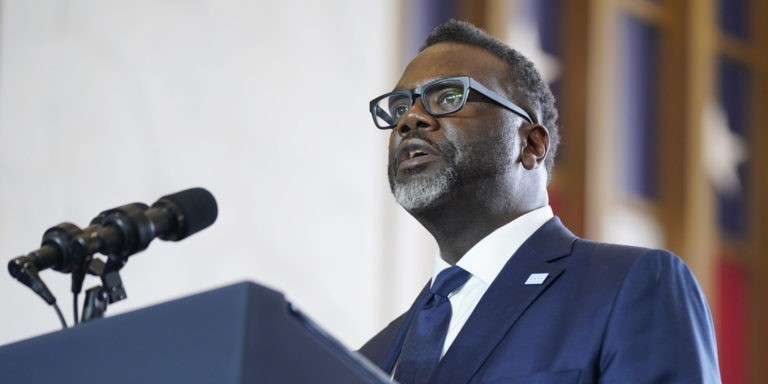
(Luis Cornelio, Headline USA) Echoing the rhetoric that got hundreds of Jan. 6 protestors thrown in the gulag, Chicago Mayor Brandon Johnson issued a threat against President Donald Trump amidst reports that the administration may deploy federal troops to tackle crime in the city.
Speaking on MSNBC’s The Weekend on Sunday, Johnson said local residents will rise up in the event of a federal troop presence in the Windy City.
“We’re gonna remain firm. We’ll take legal action, but the people of this city are accustomed to rising up against tyranny,” Johnson said.
“And if that’s necessary, I believe the people of Chicago will stand firm alongside me, as I work every single day to protect the people of this city,” he added.
Chicago Mayor Brandon Johnson says residents will “rise up” if President Trump moves to intervene in the city’s crime crisis.
Johnson’s comments came after Trump warned that Chicago may be next in his list of cities where he would increase federal presence to combat crime and illegal immigration. Trump indicated that the Midwestern city could receive similar treatment to what he’s done in Washington, D.C., where he’s deployed 2,000 troops on the streets.
“I think Chicago will be … next,” Trump said. “And then we’ll help with New York.”
The comments came as the Pentagon on Friday began ordering troops in Washington to carry firearms.
According to the leftist Washington Post, the Pentagon has been planning a federal takeover of the city for weeks.
It would follow D.C. and Los Angeles—both of which saw significant crime drops after Trump’s actions.
(Money Metals News Service) Share prices for precious metals mining companies finally started responding to higher metal prices.
The XAU — a popular index fund containing publicly traded companies mining for both gold and silver — began a run higher 18 months ago after going nowhere for the decade before.
Today, investors are wondering whether they should be buying mining shares. The answer is maybe — if you know what you are doing.
For investors, the conventional wisdom is that mining shares offer a leveraged bet on the prices of gold and silver. If gold and silver prices are rising, the companies producing them will outperform the metals.
The conventional wisdom certainly makes intuitive sense, but successful investing in mining companies is a lot more complicated than an investment in physical bullion.
An investor can’t just randomly purchase the shares of any gold miner and expect to win big if the price of gold rises.
The share price of Barrick Gold, one of the largest gold mining companies in the world, closed at $36.25 on Friday. Relative to the share price of around $21 just 6 months ago, that isn’t too shabby. But those shares traded above $40 in the mid ‘90s and closer to $50 in 2010-2011.
People who have owned Barrick stock for the past 30 years can attest to the reality that higher metal prices do not necessarily improve a mining company’s bottom line.
Mining shares can outperform the metal, but only under certain conditions. The company has to dodge big mistakes, avoid government money grabs and local community extortion, manage costs, avoid nasty surprises, and put shareholders first.
And, a mining company must, of course, find and mine good-quality deposits.
Make no mistake… mining is an extraordinarily difficult business.
This is visible in the production numbers. Global gold mine output peaked in 2018 and has been largely stagnant since, despite the run higher in gold prices. Output for silver is declining.
Difficulty isn’t the only challenge in the precious metals mining industry. There is also a problem with hype, which investors should understand.
Mark Twain once said, “A gold mine is a hole in the ground with a liar standing beside it.” That is obvious hyperbole, but the sentiment cannot be dismissed.
The mining space is littered with failed projects which put a torch to mountains of capital. Investors found out the hard way that the story they bought was way better than the reality.
One way to diversify and minimize the risk of picking individual stocks is to buy an index fund instead.
The trouble is the indexes aren’t outperforming the metal. In fact, they are a little behind.
Since Jan. 1, 2000, the gold price has risen 12.4 times. The HUI — a popular index fund focused on gold mining companies – is up 11.8 times.
The conventional wisdom about mining shares outperforming the metal isn’t exactly wrong, but it certainly doesn’t contain any of the nuance an investor needs. Based on performance in recent decades, one can’t just buy the index and expect to beat the metal.
To have the best shot of outperforming, investors probably need to pick individual stocks – or invest in the royalty and streaming companies in the sector.
All in all, investing in mining is a very tricky proposition. Most will likely be happier just buying the metal.
(Jesse Colombo, Money Metals News Service) Friday’s price action in precious metals and mining stocks was very encouraging and increases the probability of a bullish breakout that will lead to a powerful fall rally.
Gold, silver, and mining stocks rallied after Friday’s dovish Fed Jackson Hole speech, which lifted market sentiment and pushed spot gold up 0.97% and spot silver up 1.87%.
Ahead of the meeting, investors were on edge, worried that Fed Chair Jerome Powell might strike a hawkish tone on September’s potential rate cut amid rising stagflation fears.
Instead, Powell surprised markets by noting that “downside risks to employment are rising,” a comment widely interpreted as signaling that a September rate cut is essentially locked in.
In this update, I’ll break down where precious metals stand after this encouraging shift.
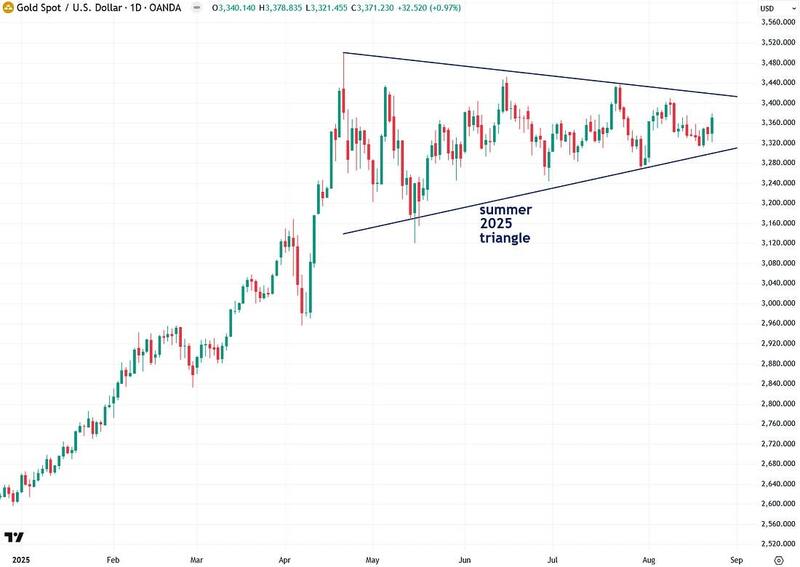
Gold reacted positively to the news, climbing about one percent, though it still hasn’t broken out of the triangle pattern I’ve been tracking. With the Jackson Hole speech now behind us, one major hurdle has been cleared, increasing the odds of a breakout in the days ahead.
The rally could very well continue into next week. To learn more, check out my recent articles on gold’s triangle pattern and volatility squeeze, which indicate the potential for significant gains this fall if a decisive breakout occurs.
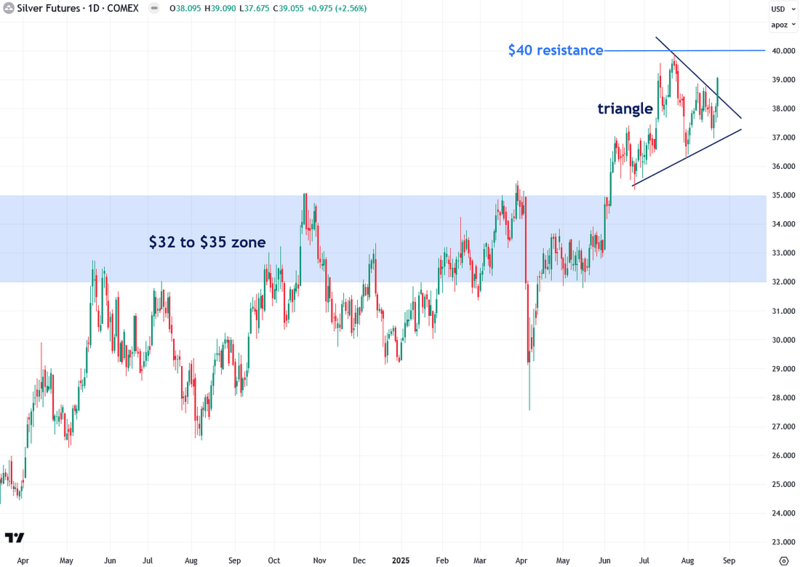
Silver also reacted strongly to the Fed’s dovish comments, with spot prices jumping 1.87% and COMEX silver futures surging 2.56%. Friday’s bullish action triggered a breakout from the triangle pattern that had formed over the past few months—a clear bullish signal.
The next major hurdle is the $40 resistance level, a key psychological barrier that silver failed to clear in late July before retreating.
If silver can decisively break above $40, I expect the bull market to accelerate quickly, with $50, $60, and even higher levels coming into play in short order.
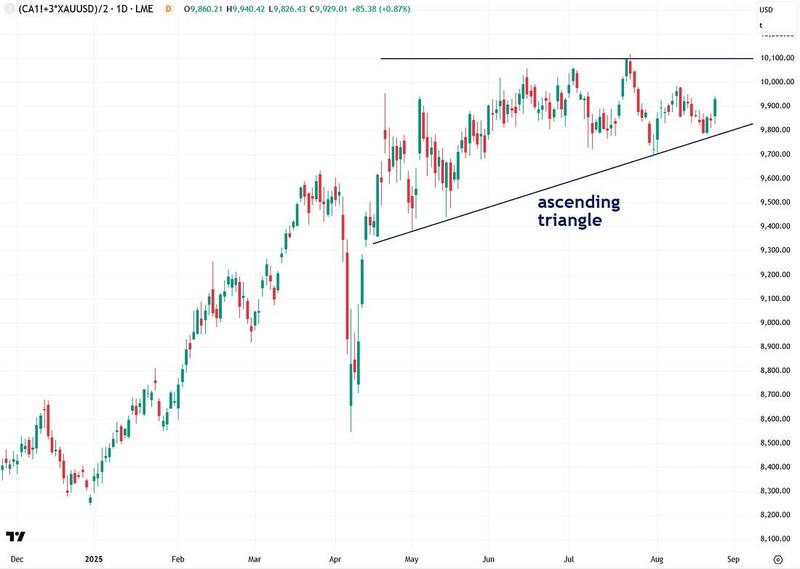
The Synthetic Silver Price Index (SSPI), a proprietary indicator I developed to confirm whether moves in silver are genuine or just noise or manipulation, climbed 0.87% on the Fed’s dovish comments, bringing it closer to breaking out of the ascending triangle pattern that has been forming over the past five months.
A decisive breakout from this pattern would be a strong signal that silver’s bull market is about to accelerate significantly. For a deeper understanding of this unique and powerful indicator, be sure to read my recent article on the SSPI.
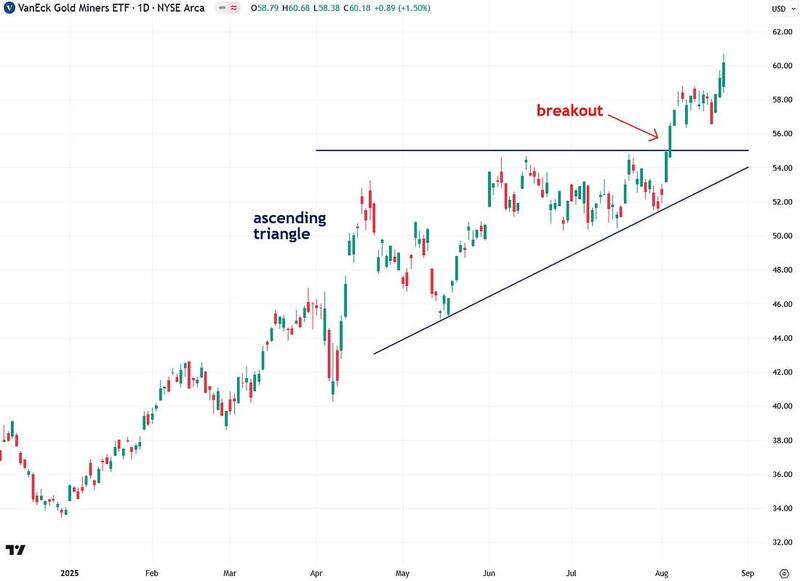
Gold mining stocks, as measured by the VanEck Gold Miners ETF (GDX), continue to gain momentum after breaking out of their ascending triangle earlier this month.
With multiple factors now aligning in their favor, I believe we are still in the very early stages of the bull market for gold miners.
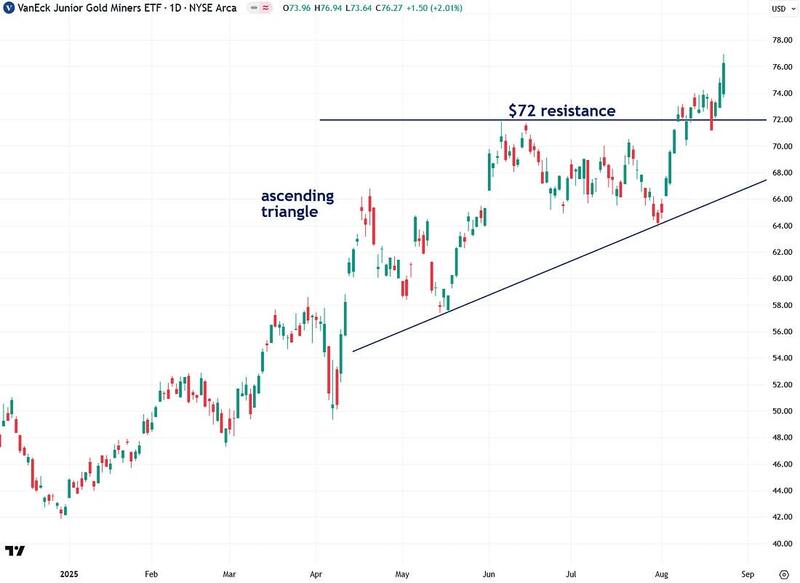
Junior gold miners, as represented by the VanEck Junior Gold Miners ETF (GDXJ), have also broken out of an ascending triangle pattern, adding further confirmation that a major bull market in gold mining stocks is just getting underway.
In addition to being bullish on gold mining stocks, I am also very optimistic about silver mining stocks and will be publishing a detailed report on them soon.
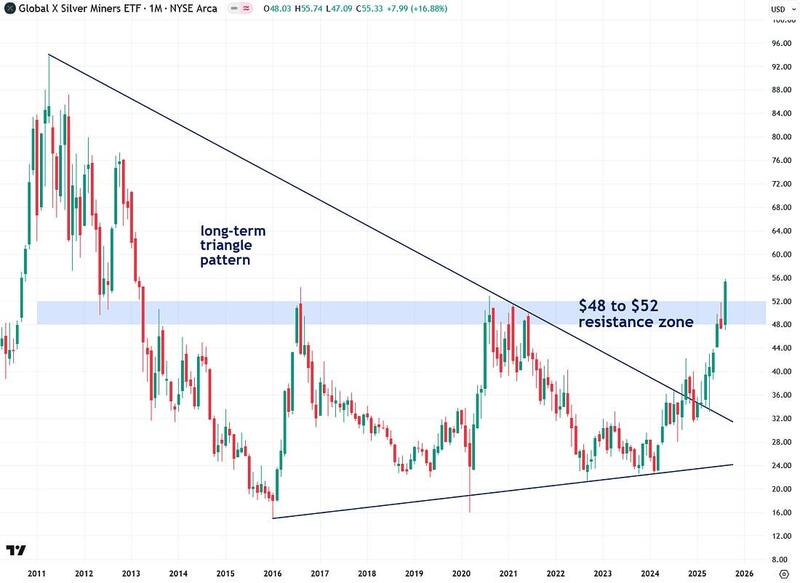
The monthly chart of the Global X Silver Miners ETF (SIL) shows a decisive breakout above the critical $48 to $52 resistance zone that has capped gains since 2016, which I view as a major bullish signal.
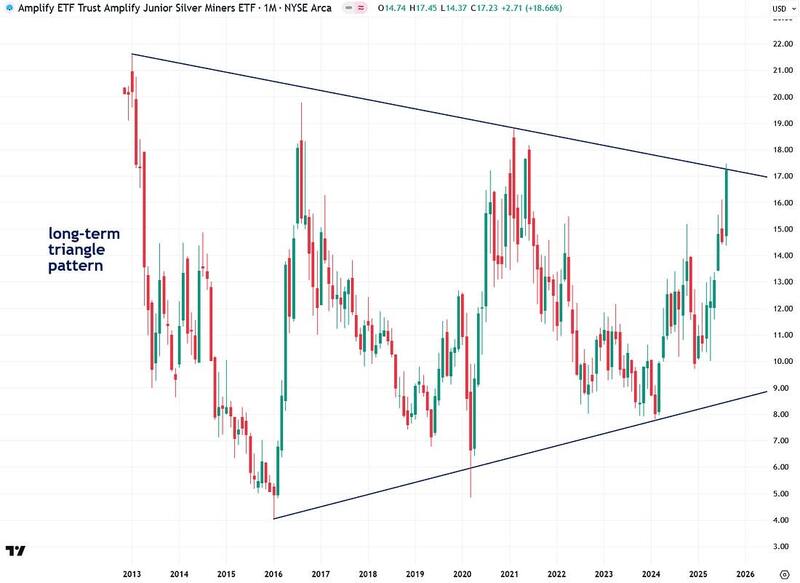
Junior silver mining stocks, which had been lagging until recently, are now waking up in a big way, and I am very bullish on their outlook.
The most popular junior silver mining ETF, trading under the symbol SILJ, is now on the verge of breaking out of a long-term triangle pattern that dates back to 2013.
Once a decisive breakout occurs, I expect explosive upside potential, particularly since junior mining stocks are highly leveraged to the price of the underlying metals and often outperform during broad precious metals bull markets.
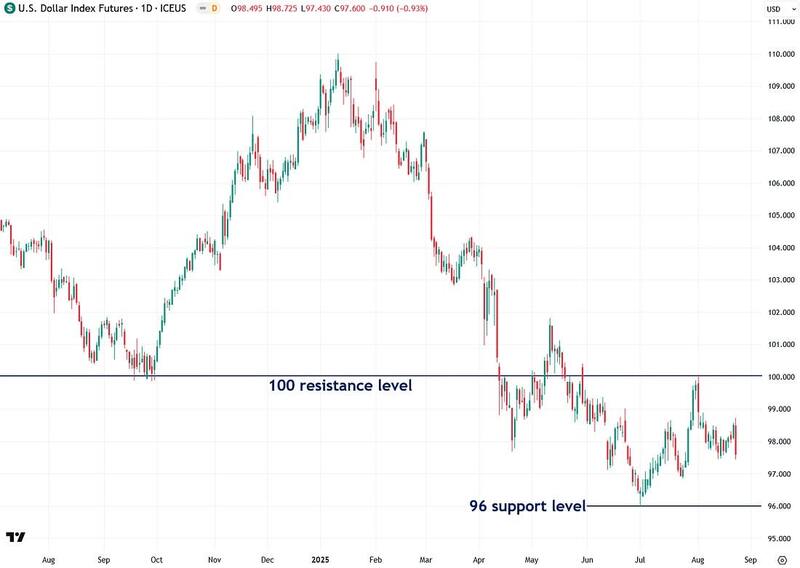
Jerome Powell’s dovish remarks sent the U.S. Dollar Index down 0.93%, which strongly contributed to the bullish action in precious metals due to their well-established inverse relationship with the dollar.
I have been correctly bearish on the dollar since January and reiterated that view after the index broke below the key 100 level.
While the Dollar Index has been trading sideways for the past five months, I am watching the 96 support level closely. A decisive close below that level would signal that the dollar’s bear market is gaining momentum, which would create a powerful tailwind for precious metals and mining stocks.
To wrap things up, as a precious metals bull, I am both pleased and relieved after Jerome Powell’s dovish remarks on Friday, especially given the uncertainty leading into the meeting and the very real concern that he might spook the markets with hawkish comments, particularly given his ongoing public tensions with President Trump.
Friday’s price action in precious metals and mining stocks was very encouraging and increases the probability of a bullish breakout that will lead to a powerful fall rally.
That said, gold still hasn’t broken out of its triangle pattern yet, but I believe it is getting close. As always, I will keep you all updated.
If you found this report valuable, click here to subscribe to The Bubble Bubble Report for more content like it.
Jesse Colombo is a financial analyst and investor writing on macro-economics and precious metals markets. Recognized by The Times of London, he has built a reputation for warning about economic bubbles and future financial crises. An advocate for free markets and sound money, Colombo was also named one of LinkedIn’s Top Voices in Economy & Finance. His Substack can be accessed here.