Drop in South African Mine Output Squeezing Global Platinum Supply

(Mike Maharrey, Money Metals News Service) Declining South African mine output is contributing to the structural deficit in the platinum market, and the situation isn’t likely to improve soon.

Platinum demand outstripped supply for the third straight year in 2024.

Platinum offtake outpaced supply by 995,000 ounces last year. That was 46 percent higher than forecast. The World Platinum Investment Council projects another market deficit of around 848,000 ounces in 2025.

Above-ground stocks of platinum fell by 23 percent in 2024 and are expected to drop another 25 percent this year. This represents less than four months of demand.

A drop in South African platinum output, particularly in the Western Limb region, is a significant factor in the declining global platinum supply.

The Western Limb accounted for 61 percent of global platinum output in 2010.
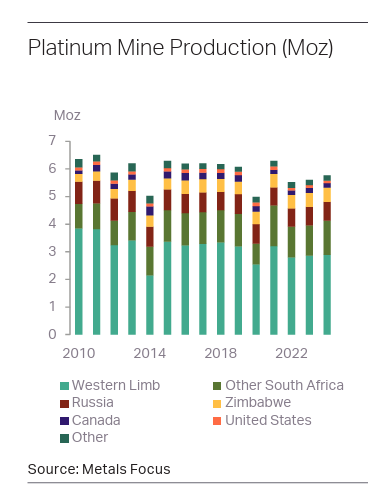
As Metals Focus put it, “Rarely in commodity markets has such a small tract of land supplied so much of the world’s demand for a single metal.

Last year, the region’s share of platinum output fell to 50 percent, and it’s projected to drop to 47 percent in 2025.

It’s not that the area is running out of metal. Analysts estimate the Western Limb contains 454 million ounces of unmined platinum. That’s roughly 39 percent of the total known underground stock. That’s enough platinum to maintain current production for more than 100 years.

So, the problem isn’t so much that the area is running out of platinum. The issue is that the remaining metal is more difficult to mine. As Metals Focus explained, the shallow, high-grade reserves have run out, leaving deeper, more complex ore bodies that aren’t conducive to cost-saving mechanization.

As Metals Focus put it, the “dipping ore bodies” inherent in the Western Limb have proved challenging for miners.

In 2010, conventional labor-intensive mining methods dominated, producing about two-thirds of South Africa’s platinum. By 2024, that total dropped to about one-half, and it is expected to fall further.

According to Metals Focus, “Capital has migrated instead to the Eastern and Northern Limbs as well as Zimbabwe, where ore bodies are typically shallower and thicker, lending themselves more readily to mechanization and, therefore, in many producers’ view, more competitive economics.

We saw a similar dynamic in South African gold mines. For most of the 20th century, South African miners dominated world gold production, accounting for around a quarter of all gold ever mined. However, mine output peaked in 1970. In 2024, South Africa supplied less than 3 percent of the world’s gold.

Three factors are working to the South African platinum miners’ advantage.

  1. Depreciation of the South African rand has kept labor costs low in dollar terms.
  2. An unprecedented surge in the price of rhodium between 2019 and 2022 delivered windfall cash flow and helped recapitalize some underfunded South African miners.
  3. Elevated chrome prices have also provided a shot in the arm for the mining industry more generally.

This has also brought some new mining interests into the region. However, the newcomers have not significantly altered the supply picture due to the timeline necessary to bring new mines to full production.

Metals Focus analysts don’t expect the overall trend to reverse. They project a continuation of the gradual decline of mine output. That means more market shortfalls in the coming years.

“With some exceptions, most incumbent producers’ mine plans indicate declining output as ageing infrastructure weighs on economics. Where new production has materialized, it has often come from restarts dependent on capital investment and infrastructure laid down in previous cycles, rather than from greenfield projects. As a result, the structural decline in platinum supply we forecast over the next five years is being driven above all by contraction in the Western Limb.”

Falling mine production and structural market deficits don’t mean we’re about to run out of platinum. But they do mean users of the metal have to tap into above-ground stocks. It generally requires higher prices to get those holding the metal to let it go.

With platinum demand increasing, the tightness on the production side is a reason to be bullish on the metal.

Platinum has been on quite a bull run this year. So far, the price is up over 48 percent. Even so, at around $1,300 per ounce, it remains far below its all-time high of $2,213 an ounce in March 2008. This was higher than the record price gold hit in 2011.

In fact, it wasn’t long ago that platinum was more expensive than gold.

It remains to be seen whether platinum will regain the price parity with gold we saw before the mid-2010s, but given the supply and demand dynamics, it is reasonable to be bullish on platinum in the near to mid-term. Given the price disparity with gold, this may signal a buying opportunity.


Mike Maharrey is a journalist and market analyst for Money Metals with over a decade of experience in precious metals. He holds a BS in accounting from the University of Kentucky and a BA in journalism from the University of South Florida.


Money Metals CEO: The Next Gold Surge Comes When the West Wakes Up

(Mike Maharrey, Money Metals News Service) Gold has been on quite the bull run, up 26 percent in 2024 and another 27 percent so far this year. This impressive run occurred despite American investors largely remaining on the sidelines.

Money Metals CEO Stefan Gleason has watched this dynamic play out firsthand. He recently appeared on Investing News with Charlotte McLeod to discuss recent trends in the gold market from his perspective as the head of one of the largest online precious metal dealers in America.

Gleason said that despite the fact gold has consolidated and traded sideways since hitting a record high of $3,500 an ounce in April, he thinks we are still “very early in what will be a very exciting long-term bull run in gold.

He specifically noted the lack of investor participation in the U.S. and other Western countries, calling the last two to three years a “sleeper period” in terms of Western gold demand.

“In fact, we, at least on the retail side, and as Money Metals is one of the largest online precious metal dealers in America, we saw more demand on the retail side during COVID, which was before gold and silver really started taking off and broke above $2,000 like it did about two years ago. But since then, since that breakout, we’ve actually seen very little participation from the U.S. retail investor, and even at the institutional level, only in the last few months that we started to see net inflows into the ETFs.”

Gleason emphasized that so far, these investors have missed the boat.

“As far as the west is concerned, it’s been sitting out, it’s been sitting out on this massive run in gold that’s taken us from $2,000 to almost $3,500 an ounce.”

The demand data backs up Gleason’s assertion.

Bar and coin demand was up by 11 percent in H1 2025, rising to 582 tonnes, with Chinese and Indian investors leading the way.

Chinese bar and coin demand grew by 44 percent year-on-year in H1. Chinese investors snapped up 115 tonnes of gold bars and coins in the second quarter alone. It was the strongest H1 for physical gold buying since 2013.

Meanwhile, Americans continued to sell their gold. Year-on-year bar and coin sales plummeted by 53 percent in H1. Demand in the second quarter was only 9 tonnes, the lowest quarterly level since Q4 2019.

According to the World Gold Council, “U.S. net investor demand was again affected by a double whammy of elevated profit taking and subdued levels of new purchases.

Gleason said he’s noticed an increase in selling here in the U.S.

“We’ve seen an increase in selling, more than what we have historically seen, from retail investors who’ve been sitting on gold for a long time. Many people are monetizing those gains and taking cash. I don’t think that’s necessarily a good idea for the long term, but we’re seeing that happen. We’re seeing a little less buying and we’re seeing more selling.”

Why have Western investors been reluctant to wade into this gold bull market? Gleason said they have primarily been focused on other assets, such as stocks.

“Gold has had a lot of competitors for Western investors, whether it’s been crypto, the stock market itself, other assets. Obviously, the bond market has struggled a little bit, but the stocks have done just fine. And so, I don’t think people are really feeling the impetus in the West to buy gold and silver.”

Gleason pointed out that Asian investment and central bank gold buying have supported the gold rally so far. The entrance of Western investors into the market would likely spur another significant leg-up in the gold price because “a big part of potential demand is in the West.

“Asia is still very strong. If the West kicks in while those things are ongoing in the East, and with central banks, then I think we see a very, very exciting further advance in gold prices. And I do think that that will be happening over the next year or two, but obviously we’re in a big sideways move here in the last few months.”

What will it take to bring Western investors to the table?

Gleason said it will likely require a significant stock market dip.

“I think the stock market continuing to be elevated and doing well is probably the biggest factor in why investors are not coming into gold in droves like they are in other parts of the world. So, I think there’s still a love affair with paper assets in the West. I think that people are very comfortable with that, and frankly, they haven’t been penalized for owning them. Stocks have done quite well, at least in nominal terms, and I think we’re going to need to see that reverse. And when that does, that’s when I think we see the U.S. demand pick up big time in gold and silver.”

He added that he also thinks another galloping move upward in the gold price could create some “fear of missing out” momentum.

In the meantime, Gleason said this is a great time for American investors to get in on the action early. While prices are elevated, premiums are relatively low, meaning there are good deals to be had.

“Pretty much everything is lower in terms of premiums, and that’s the amount that you pay above the spot price to buy any kind of physical form of gold or silver, whether it be a bar or a coin. So American Eagle coins have come way down. You can acquire those very close to spot now. They were $200 over spot, not too long ago. Really, the most efficient way would be like a 1-ounce gold bar, a 10-ounce, a 5-ounce gold bar, a kilo bar. These are available at very low premiums to spot, and frankly, probably the lowest… certainly the lowest premiums we’ve seen in about six years over spot, especially in percentage terms. And that’s again, that’s a reflection of lower retail demand, which is also manifested in more people selling, which has caused the premium structure to fall because not only there’s more secondary market inventory.”

Gleason said Fed rate cuts would also be bullish for gold because it could drive real interest rates negative.

“If they start cutting, which I expect them to do this fall and probably half a point by the end of the year, I think that that kind of environment, and especially if it continues, leads to more steeply negative real rates, and that is a very bullish condition for gold.”

Couple Fed easing with a stock market rollover, then you’ll have even stronger momentum turning toward gold.


Mike Maharrey is a journalist and market analyst for Money Metals with over a decade of experience in precious metals. He holds a BS in accounting from the University of Kentucky and a BA in journalism from the University of South Florida.

Silver Supply Tightens as Inflation and Monetary Shifts Loom

(Money Metals News Service) Mike Maharrey of the Money Metals Podcast sat down with David Morgan, CEO of The Morgan Report and author of The Silver Manifesto, to discuss the state of the silver and gold markets, inflation, central banks, and the future of global financial systems.

(Interview Starts Around 4:32 Mark) 

Silver Consolidation Near $40

Silver briefly touched $40/oz before consolidating around $38. Morgan welcomed this “stair-step” pattern, arguing it’s healthier than a parabolic surge. He expects sideways movement through summer, with potential breakout momentum after Labor Day (Sept. 22) or sooner if geopolitical shocks occur.

Industrial demand could become the catalyst. With deficits persisting for 3–4 years, Morgan highlighted that only about 1.3 billion ounces exist in bar form, and roughly 600 million ounces are already locked in ETFs. Since industry consumes ~600 million ounces annually, the market effectively has just one year of above-ground supply in commercial bars.

Gold Demand and Shifts in Asia

Morgan emphasized central bank buying as the top factor supporting gold.

In Asia, wealthier households are pivoting more toward gold than silver, while India shows a marked shift from jewelry to bars, coins, and ETFs. He noted cultural differences in jewelry premiums—Western buyers often pay 100–300% premiums.

Whereas in Asia, jewelry is closer to melt value.

Inflation Pressures Hidden in Plain Sight

Morgan blasted official CPI measures, calling them “CP-lie,” since food and energy are excluded. Diesel in his area rose nearly $1 in a month (a 20–25% increase), while food and rent continue to surge.

He noted widespread financial stress: bankruptcies among U.S. retailers and restaurants, shrinking corporate activity, and individuals working multiple jobs yet still unable to cover basics.

Meanwhile, M2 money supply is expanding again—“inflation by definition,” Maharrey observed. The PPI showed over 1% monthly gains in service prices, suggesting pressures far beyond tariffs. Morgan linked this to broader supply chain fragility, de-dollarization trends, and BRICS trade shifts.

Fed Policy and Bond Market Stress

Looking ahead, Morgan warned that a potential Fed rate cut in September could backfire. Cutting too soon risks a dollar selloff and surging commodities, while holding steady could unsettle bonds. Either way, Treasury markets—long billed as the world’s “safest”—are showing stress and volatility.

ISO 20022 and the “End Game” System

Morgan spotlighted ISO 20022, the new global standard replacing SWIFT.

Regardless of whether transactions use dollars, yuan, rupees, CBDCs, or even gold, all payments ultimately clear through central banks. He views this as evidence that global elites are preparing for a reset, possibly involving digital currencies, tokenized assets, and even biometric payment systems already tested in China.

Final Notes

Morgan also previewed his upcoming documentary Silver Sunrise, which will debut for past and current supporters before public release. His work can be found at TheMorganReport.com, with film trailers at SilverSunrise.tv. He remains active on X (formerly Twitter) under @SilverGuru22.

‘Maryland Man’ Surrenders to ICE in Baltimore, Faces Possible Deportation to Uganda

(Headline USA) Alleged MS-13 gang affiliate Kilmar Abrego Garcia surrendered to U.S. immigration authorities in Baltimore Monday and faces possible efforts by the Trump administration to deport him immediately.

The 30-year-old Salvadoran national spoke at a rally before he turned himself in. He needed a translator, because the “Maryland man” doesn’t speak English.

Abrego Garcia entered the offices of U.S. Immigration and Customs Enforcement in a downtown office building. His wife emerged without him a few minutes later, appearing to have tears in her eyes.

Department of Homeland Security Secretary Kristi Noem said in a tweet that Abrego Garcia was being processed for deportation. Abrego Garcia’s attorney, Simon Sandoval-Moshenberg, said a lawsuit had been filed in federal district court in Maryland shortly after his detention asking for an order that he not be deported.

Mainstream media have made Abrego Garcia the face of President Donald Trump’s hardline immigration policies, despite his criminal background. Bizarrely, media outlets have paid far less attention to the Trump administration targeting visa holders simply for criticizing Israel.

Abrego Garcia pleaded not guilty on June 13 to smuggling charges, which stem from a 2022 traffic stop for speeding in Tennessee during which Abrego Garcia was driving a vehicle with nine passengers. While officers suspected possible smuggling, Abrego Garcia was allowed to go on his way with only a warning. It was later reported that the FBI ordered the “Maryland man” to be released.

Body camera footage shows a calm exchange between officers and Abrego Garcia. The officers then discussed among themselves their suspicions of smuggling before letting him go. One of the officers says, “He’s hauling these people for money.” Another says Abrego Garcia had $1,400 in an envelope.

The federal indictment accuses Abrego Garcia of smuggling throughout the U.S. hundreds of people living in the country illegally, including children and members of the violent MS-13 gang.

Abrego Garcia was sent to an El Salvadorian supermax prison in March, in contravention of an immigration judge’s hold on his deportation. He was returned to the U.S. earlier this month to face the human smuggling charges.

Adapted from reporting by the Associated Press


Trump Blasts Democrat Maryland Gov After ‘Walk the Street’ Threat

(Luis Cornelio, Headline USA) President Donald Trump minced no words Sunday in response to Maryland Democrat Gov. Wes Moore’s remarks about a possible federal takeover of the Old Line State.

In a NewsNation interview, Moore scolded Trump as reports surfaced that the administration may soon deploy federal troops to Maryland to crack down on crime and illegal immigration.

Moore snapped at Trump to “keep our name out of his mouth,” before posing a challenge. “I’d love for the president to take us up on our offer and actually come walk the streets with us.”

Trump swiftly fired back on Truth Social.

“As President, I would much prefer that he clean up this Crime disaster before I go there for a ‘walk,’” Trump wrote. “Wes Moore’s record on Crime is a very bad one, unless he fudges his figures on crime like many of the other ‘Blue States’ are doing.”

Noting falling crime numbers after the federal takeover of Washington, D.C., Trump continued: “But if Wes Moore needs help, like Gavin Newscum did in L.A., I will send in the ‘troops,’ which is being done in nearby DC, and quickly clean up the Crime.”

Trump added that he would “walk the streets” of Maryland only if crime drops.

“P.S. Baltimore is ranked the 4th WORST CITY IN THE NATION IN CRIME & MURDER,” Trump added. “Stop talking and get to work, Wes. I’ll then see you on the streets!!”

Trump ended with a quip, reminding Moore how much federal money had gone to Maryland to rebuild the Francis Scott Key Bridge, which collapsed after being struck by a cargo ship.

Trump specifically wrote, “Also, I gave Wes Moore a lot of money to fix his demolished bridge. I will now have to rethink that decision??? Thank you for your attention to this matter. MAKE AMERICA GREAT AGAIN! President DJT.”

Read Trump’s full response below:

Clintons Welcomed Ghislaine Maxwell as ‘Honored Guest’ Despite Epstein Accusations

(Luis Cornelio, Headline USA) A shocking new report has revealed that the Clintons once celebrated Ghislaine Maxwell at a special event, even after she was publicly accused of being involved in Jeffrey Epstein’s sexual abuse of minors.

Photos, videos and documents obtained by leftist CNN showed that Maxwell attended the Clinton Global Initiative conference in September 2013 as an honored guest.

Maxwell was even greeted with applause at a lunch event, reportedly recognized as one of the “Commitment to Action” leaders.

Worse still, Maxwell’s inclusion on a list for individuals recommended for “complimentary access to the conference” suggests that her name likely came from former President Bill Clinton or his wife, Hillary Clinton, the twice-failed presidential candidate.

According to CNN, Maxwell was at the event as a representative for the TerraMar Project, which the leftist outlet described as an “ocean conservation non-profit she founded in 2012.”

The Clinton Foundation even highlighted TerraMar in a press release, praising its pledge to rally international support for “including oceans in the United Nations’ global priorities.”

“In 2013, the TerraMar Project committed to launch the Sustainable Oceans Alliance (SOA) to mobilize the international community and the public at large on the importance of the Oceans and the Seas and to ensure that the 193 UN Member States recognize and incorporate oceans in the Sustainable Development Goals (SDGs), to be adopted in 2015,” the press release read.

The Maxwell-Clinton ties come as the Democratic Party continues trying—albeit unsuccessfully—to implicate President Donald Trump in the Epstein/Maxwell criminal conspiracy. Maxwell herself recently told the DOJ that she never saw Trump acting inappropriately around her.

In a statement to CNN, a Clinton Foundation spokesperson downplayed Maxwell’s attendance at the event, claiming that there were more than 600 “comps approved at CGI in 2013.”

They insisted her participation was approved at “the staff level, which included the office of President Clinton.”

A spokesperson for Bill Clinton echoed the defense, insisting the event took place more than a decade ago.

“This is about someone working on ocean conservation attending a charitable conference 12 years ago, along with thousands of other people, and nothing more. As we have consistently said, the Clintons know nothing about Jeffrey Epstein’s terrible crimes,” the spokesperson added.

Report: Epstein Victim to Publish Book from the Grave

(Ken Silva, Headline USA) Virginia Giuffre, who was one of the most vocal victims of Jeffrey Epstein’s sex trafficking ring, reportedly committed suicide in April—but the world hasn’t heard the last from her.

According to a Sunday article in the US Sun, her autobiography, Nobody’s Girl, is set to hit the shelves in October.

“The book, to be published in October, will tell how she was ­trafficked as a teenager,” the Sun reported.

“Giuffre’s autobiography will contain ‘intimate and disturbing’ details of her relationship with Prince Andrew. The bombshell book will see her open up for the first time since the disgraced royal paid her millions to prevent claims of sex abuse going to court.”

An anonymous source told The Sun: “This is her ultimate revenge.”

Giuffre, formerly Virginia Roberts, alleged that Epstein and his associate Ghislaine Maxwell groomed her, starting at 16 years old, for Epstein’s “pleasure, including lessons in Epstein’s preferences during oral sex.” Giuffre said she was trafficked to prominent figures such as Prince Andrew, attorney Alan Dershowitz, politician Bill Richardson, and others.

She settled a lawsuit with Maxwell in 2017 and Prince Andrew in 2022, while dropping her lawsuit against Dershowitz—saying she may have made a “mistake” in accusing him of sexual assault.

Meanwhile, Maxwell is serving a 20-year sentence after being found guilty of conspiring with Epstein in 2021. Epstein was reportedly found dead in his prison cell in August 2019—allegedly of suicide, though Maxwell recently said she doubts that.

Maxwell recently was interviewed by the DOJ, which released transcripts of that interaction on Friday.

Ken Silva is the editor of Headline USA. Follow him at x.com/jd_cashless.

US Approves European-Funded Long-Range Cruise Missile Deal for Ukraine

(Dave DeCamp, Antiwar.comThe Wall Street Journal reported on Saturday that the US has approved a deal that will arm Ukraine with thousands of Extended Range Attack Munition (ERAM) air-launched missiles, which have a significantly further range than other missiles that the US has sent into the proxy war.

Two US officials told the Journal that the ERAMs can hit targets up to 250 miles away, nearly 100 miles further than the range of the Army Tactical Missile Systems (ATACMS), munitions the US began providing Ukraine in 2023.

The deal will provide Ukraine with 3,350 ERAMs as part of an $850 million weapons package that will mostly be funded by European countries. This year, NATO began a new scheme to provide Ukraine with more US weapons in deals funded by other NATO allies, known as the Prioritized Ukraine Requirements List (PURL) initiative.

The ERAMs are expected to arrive in Ukraine within six weeks, and the US officials said that the Ukrainian military will need Pentagon approval to use them.

The Journal report said that the Trump administration had been quietly blocking ATACMS strikes on Russian territory, which the Biden administration first greenlit toward the end of 2024. At the time, the US-backed ATACMS strikes marked a significant escalation of the proxy war, and Moscow responded by altering its nuclear doctrine to lower the threshold for the use of nuclear weapons.

The Journal report said that the Trump administration hasn’t allowed any Ukrainian ATACMS strikes on Russian territory since late spring, but the ERAMs deal signals that the US may be prepared to support missile attacks inside Russia once again. The news comes as there has been little progress toward a peace deal following the summit between President Trump and Russian President Vladimir Putin.

This article originally appeared at Antiwar.com.


Khamenei: US Wants Iran To Be ‘Obedient,’ Situation Cannot Be Resolved Through Negotiations

(Dave DeCamp, Antiwar.com) Iranian Supreme Leader Ayatollah Ali Khamenei said on Sunday that the US is seeking an “obedient” Iran and that the issues with the US cannot be “resolved” through negotiations.

“They want Iran, with its great history, and its people, with all their honor and glory, to obey the US,” Khamenei said, according to his website.

“Those who argue, ‘Why don’t you hold direct negotiations with America and resolve your issues?’ – in my opinion, they too are only seeing what’s on the surface. That is not the essence of the matter. This is not a matter that can be resolved,” the Iranian leader added.

Photo of Khamenei from his website

Khamenei said that the statements and actions from US officials attempting to force Iran into obedience were greatly insulting and that Iran “will stand with all its might against anyone who has such a wrongful expectation of it.”

“The US incited and aided the Zionist regime to attack Iran and finish the job. They had no idea that Iran, in response, would strike a blow so powerful that it would make them regret it,” Khamenei added.

Since the end of the 12-day US-Israeli war on Iran, the US has continued to demand that Iran not enrich uranium on its soil, and President Trump has threatened to bomb Iran again if it did restart enrichment.

Other Iranian officials have said they’re open to talks with the US if they can receive assurances that Iran won’t be attacked again during the negotiations, but threats from Trump and Israeli officials have likely had the opposite effect.

While Iran hasn’t engaged in negotiations with the US, it has agreed to resume talks with the UK, Germany, and France on its nuclear program as the three European countries have been threatening to re-impose so-called “snapback” sanctions that were lifted on Iran as part of the 2015 nuclear deal. The talks between Iran and the European powers are expected to resume this week.

This article originally appeared at Antiwar.com.


Hollywood Leftists Falsely Claim Sydney Sweeney’s Indie-Film Release Hurt by Jeans Ad

(Ben Sellers, Headline USA) After sending American Eagle’s stock skyrocketing with her much buzzed-about “great jeans” ad campaign, actress Sydney Sweeney’s own stock is also on the rise.

Sadly, she has also become the Left’s No. 1 target—and, in some cases, a scapegoat for liberal movie-industry execs to dubiously pin their own shortcomings on.

The Euphoria and White Lotus star currently has two movies in theaters—the Ron Howard-directed Eden and a limited-release indie film, Americana, which first premiered two years ago at the South by Southwest festival but only recently made it to theaters.

In Eden—a sort of modernized retelling of Lord of the Flies with sexy adults instead of schoolboys—Sweeney joins a top-notch ensemble cast, led by Jude Law, and is thus likely to be somewhat insulated from any insinuations that her recent embrace by MAGA is to blame in any way for the box-office take.

Still, don’t be surprised if it becomes a breakout hit—not in spite of but because of Sweeney’s new name recognition, tapping into an America First viewing audience that has mostly been relegated to Angel Studios releases and other smaller productions.

On the other hand, one be so bold as to think think that Lionsgate’s decision to release Americana was timed in response to Sweeney’s rapidly rising brand.

But that didn’t stop petty Hollywood leftists from blaming her for its perceived failures.

“One of the great things about movies is that they outlive the zeitgeist into which they were released,” complained the film’s writer/director, Tony Tost in a sparsely viewed X post. “As someone whose first film sorta got gobbled up by the zeitgeist, I’ll be curious to see how it’ll stand up after this moment is over.”

Following its Aug. 15 release in a paltry 1,123 theaters, the critically acclaimed Western crime-heist noir (think Martin McDonaugh or the Coen Brothers) pulled in an estimated $500,000.

That led the Hollywood Reporter to declare that the film had “bombed.” But after claiming that in its headline, the article explained that the long-delayed theatrical release of Americana was never intended to pull in gobs of money.

“Insiders say Americana is no way a disappointment, and that it is a perfect fit for the multi-platform strategy that defines its Lionsgate Premiere division, which targets specific audience, operates on a bare-bones marketing budget, focuses heavily on home entertainment—including premium VOD—and looks for titles that will boost the value of the overall film library,” the Reporter conceded.

Moreover, it acknowledged that Sweeney likely helped its take rather than hurt it.

“It’s tough to know whether the controversy had any impact; if anything, it could have boosted awareness (Lionsgate Premiere’s marketing spend was minimal, in keeping with its mandate),” said the Reporter article.

Indeed, as Deadline explained, the film was likely to be profitable when all was said and done.

After Lionsgate picked up the film on its art-house label for around $3 million, its domestic take alone was expected offset half of that, with around 60% of backed by foreign pre-sales.

“The expectation is for a final domestic take of $1.5M,” it noted, adding that “Americana is on a 30-day exclusive theatrical window instead of 17 days.”

Moreover, its streaming-release schedule via Starz was “very similar to theatrical with distributors strategically finding the right time to go digital,” Deadline wrote. “… Sources say that the label expects Americana to be in the black at the end of all of its windows.”

Sweeney even graciously promoted the film in an Aug. 13 Instagram post that received more than a million “likes.”

“[A] few years ago I filmed this little movie with some friends and now you get to meet penny jo,” she wrote.


View this post on Instagram


A post shared by Sydney Sweeney (@sydney_sweeney)

Those wishing to support Sweeney and stick it to her naysayers can visit the film’s website to find the closest theater—or wait (as Lionsgate intended all along) for it to stream on demand.

Ben Sellers is a freelance writer and former editor of Headline USA. Follow him at x.com/realbensellers.