Indiana Set to Execute Man Convicted of 2001 Rape and Murder of Small-Town Teenage Girl

(Headline USAIndiana will put to death a man who was convicted in the 2001 rape and murder of a teenage girl, the state’s third execution since resuming capital punishment last year.

The execution of Roy Lee Ward is scheduled before sunrise Friday at the state prison in Michigan City, Indiana. The 53-year-old has exhausted his legal options to challenge the sentence.

Ward’s execution by lethal injection comes amid questions about Indiana’s handling of pentobarbital, the drug it has used in recent executions.

Here’s a closer look at the case:

A brutal death shocks an Indiana town

Authorities say Ward entered the home of 15-year-old Stacy Payne on July 11, 2001, raped her and struck and stabbed the girl repeatedly with a dumbbell and a knife. She was airlifted from her town of Dale to a hospital and died hours later.

Matt Keller, former town marshal, discovered Stacy and arrested Ward who was still at the home.

“I cannot imagine the immense pain, suffering, and sheer terror that Stacy experienced during the last moments of her young life,” Keller said at Ward’s clemency hearing in Indianapolis last month.

Payne’s death rocked the southern Indiana community, which is home to about 1,500 people. Her father still lives at the house, her Raggedy Ann doll collection untouched.

A nearby church has planned a prayer vigil to honor the girl hours before the execution “with the sharing of cherished memories.”

A long court battle

Ward’s case has wound through the courts for decades. He was found guilty of murder and rape in 2002 and sentenced to death. But the Indiana Supreme Court overturned the conviction and ordered a new trial.

Ward then pleaded guilty in 2007. The U.S. Supreme Court declined to hear the case in 2017.

Two years later, he sued Indiana seeking to halt all executions. He argued that Indiana’s manner of carrying out “capital punishment is arbitrary” and “offensive to evolving standards of decency.”

The Indiana Supreme Court declined to stay the execution last month. That’s also when Gov. Mike Braun rejected Ward’s clemency after board members noted the killing’s “brutal nature.”

Arguing against clemency, the state’s attorneys mentioned Ward’s criminal history, including indecent exposure charges and a robbery conviction.

“He is a murderer and a rapist,” Deputy Attorney General Tyler Banks told the parole board. “He’s also predatory and manipulative.”

Ward has exhausted his legal avenues, attorneys said.

“He is pretty resigned to the fact that it’s happening and has been for awhile,” said Joanna Green, one of Ward’s attorneys. “He said, ‘If I could take every bit of the pain I caused with me, I would.’”

Questions about execution drugs

Indiana resumed executions in 2024 after a 15-year hiatus. State officials said they’d been able to obtain drugs used in lethal injections that had been unavailable for years.

But those drugs came at a high cost, more than $1 million for four doses. In June, Braun said the state wouldn’t immediately buy more, raising questions about if Indiana would consider a new execution method. The first-term Republican cited the high cost and short shelf life.

Ward’s attorneys challenged the use of the drug in court, saying it can cause flash pulmonary edema, in which fluid rushes through quickly disintegrating membranes into lungs and airways, causing pain similar to being suffocated. They noted that witnesses to the May execution of Ben Ritchie said the man lurched forward before he died.

“There are still a lot of unanswered questions about what happened during Ben’s execution,” Green said.

Among 27 states with death penalty laws, Indiana is one of two that bar media witnesses.

Indiana Department of Correction officials confirmed Wednesday that the agency “has enough pentobarbital to follow the required protocol” for the execution but didn’t comment further.

Green said they discovered through their lawsuit that the pentobarbital to be used in Ward’s execution is manufactured and not compounded. Ward’s attorneys said that means fewer concerns about the drug deteriorating quickly and they received assurances about proper handling of the drug, including temperature control. The lawsuit was dropped, as was another legal challenge over execution chamber conditions.

Remembered for a love of life

Relatives said Payne, who loved the song “You Are My Sunshine,” was full of life.

An honor student and cheerleader, she was saving money from her pizzeria job, her mother Julie Wininger told the parole board.

“Stacy’s life was so short but was filled with so much meaning,” she said.

Wininger tallies each of the 8,000 plus days since Payne’s passing. She asked the parole board for justice to be carried out.

“We will never see Stacy smile again,” Wininger said, crying. “We will never hear her voice, never have the joy of watching her grow into the incredible woman she was meant to be.”

His final days

Ward, who declined interview requests through his attorneys, has said little publicly.

He didn’t comment when sentenced in 2007. He also declined a parole board interview, saying he didn’t want to force the victim’s family travel to Michigan City. Attorneys also said he’s remorseful but has a hard time expressing it.

Ward was recently diagnosed with autism spectrum disorder, an issue attorneys had raised in challenges.

In a Sept. 17 affidavit, Ward said he declined a parole board appearance because “due to my learning disability and language impairments the messages I mean to convey are sometimes difficult for me to accurately express.”

While behind bars, he lost relatives, including his mother who moved to Michigan City to be closer to him. Through a prison program, he took care of a cat named Sadie, who was rehomed ahead of his execution.

He’s renewed his faith and was baptized in prison. He keeps close contact with spiritual advisers who say he’s expressed regret.

“He’s not hiding the fact that it happened,” said Deacon Brian Nosbusch. “He’s definitely a changed person.”

Adapted from reporting by the Associated Press

 

With Gold Over $4,000, Mainstream Analysts Scramble to Raise Price Forecasts

(Mike Maharrey, Money Metals News Service) With gold now over $4,000, mainstream analysts are scrambling to raise their gold forecasts.

On Tuesday, Goldman Sachs upped its 2026 gold target to $4,900, citing demand driven by continued central bank buying and a surge of Western investment.

The big investment bank previously called for a $4,300 gold price by the end of ’26.

The research note said “strong structural demand from central banks and easing from the U.S. Federal Reserve” would continue to support the gold price.

Gold has gained over 52 percent this year. Going back to January 2024, the price of yellow metal has surged by over 95 percent.

Western investors largely sat on the sidelines through the early stages of this bull market, as Asian markets led the way. This is particularly apparent when looking at bar and coin demand in the U.S. through the first half of the year. While Chinese bar and coin demand grew by 44 percent year-on-year in H1, Americans were selling their gold. Year-on-year bar and coin sales plummeted by 53 percent through the first six months of 2025. Demand in the second quarter was only 9 tonnes, the lowest quarterly level since Q4 2019.

Inflows of gold into North American ETFs were also relatively tepid earlier in the year.

But the trend has reversed in recent months, as indicated by robust inflows of gold into gold-backed exchange-traded funds. Western investors dumped $64 billion into gold ETFs through September, with $17.3 billion in inflows that month alone.

ETFs are a convenient way for investors to play the gold market, but although many Western investors prefer paper gold, owning ETF shares is not the same as holding physical metal.

SPDR Gold Shares, the world’s largest gold ETF, increased its gold holdings by 35.2 tonnes in September. It gobbled up 18.9 tonnes of gold in a single day (Sept. 19), the biggest single-day increase on record.

“In contrast, noisier speculative positioning has remained broadly stable,” Goldman analysts said. “Following the large September increase, the level of Western ETF holdings has now fully caught up with our U.S. rates-implied estimate, suggesting the recent ETF strength is not an overshoot.”

Goldman said that there is still untapped demand out there.

“We see the risks to our upgraded gold price forecast as still skewed to the upside on net, because private sector diversification into the relatively small gold market may boost ETF holdings above our rates-implied estimate.”

Goldman analysts split gold investors into two groups.

“Conviction buyers tend to purchase the yellow metal consistently, regardless of the price, and based on their view on the economy or to hedge risk.”

On the other hand, there are also “opportunistic buyers” who move in and out of the market based on price.

They may provide a floor under prices on the way down and resistance on the way up,” the research note said.

Goldman analysts also expect central banks to continue increasing their gold reserves. This dovetails with the World Gold Council’s forecast of central bank buying “close to the range seen over the past three years on continued elevated trade-related risks and uncertainty premia in U.S. assets.

The pace of central bank gold accumulation has moderated this year as prices have skyrocketed. However, gold buying was still 41 percent above the quarterly average that was typical between 2010 and 2021.

The World Gold Council notes that while central banks tend to make reserve decisions strategically, they are not totally insensitive to prices.

“As such, gold’s rally so far this year, up 26 percent, to new record levels, has likely contributed to the slowdown in central bank buying. But that they continue to add gold in the face of a higher price underscores their continuing favorable attitudes towards gold as a strategic asset amid such uncertainty.”

The Goldman note also pointed out that “speculative positioning in derivatives markets by large investors like hedge funds appears significantly bullish on gold.”

“The amount of net long gold bets on the futures and options exchange COMEX is in its 73rd percentile since 2014 as speculators build up their long positions betting on gold prices to rise.”

Goldman recommended investors diversify through commodities like gold.

“Equity-bond portfolios aren’t well protected against stagnant economic growth and elevated inflation in two situations in particular: when global policy uncertainty is elevated (e.g., markets debating the central bank’s ability to contain inflation) and when the economy is hit by a supply shock (such as a sudden interruption in energy supplies). For example, gold prices jumped in the 1970s as pronounced spending by the U.S. government and reduced central bank credibility stoked inflation.”

This dovetails with a recent seismic shift in investing advice by Morgan Stanley CIO Michael Wilson, who recently said investors should consider a 60/20/20 strategy, swapping half of the bond portfolio for gold to serve as a “more resilient” inflation hedge.

“Gold is now the anti-fragile asset to own, rather than Treasuries. High-quality equities and gold are the best hedges.”

If more mainstream advisors embrace this strategy, it could drive gold demand even higher. Currently, only about 38 percent of U.S. investors own any gold at all.

TD Securities and the Correction Risk

Many investors worry that gold might be oversold. That raises the specter of a major correction.

TD Securities’ Head of Market Strategy Bart Melek acknowledged this risk as he raised his price forecast to $4,400 by the second quarter of 2026. He called any price drops a buying opportunity.

“The yellow metal looks overbought, which suggests that anything that may question the speed of the Fed’s easing, or an increase in volatility, could generate a robust downside. This could see a significant unwind of the late-summer rally in the relative near term.”

He said a drop back to $3,600 wouldn’t be shocking. Nevertheless, he upped his gold forecast with any selloffs offering buying opportunities.

“We expect average price to reach a new record north of $4,400/oz in the first six months of 2026, as the Fed eases into a higher inflation environment, official sector keeps buying and discretionary funds again position long.”

Melek said he thinks a rate-cutting cycle by the Fed will entice some reluctant investors into the market.

“Money managers who likely missed much of the early part of this year’s rally, due to their discomfort of getting long while short-term rates were high, have now moved into the yellow metal through the late summer, as their carry costs were expected to drop along with the Fed’s renewed enthusiasm to ease.”

Melek noted that not only is the Fed cutting into an inflationary environment, but political pressure could incentivize the central bank to cut faster than it otherwise might.

“The concerns surrounding Fed credibility are raising speculation that there could be de facto partial monetization of U.S. debt, which would suppress real yields as inflation runs above target.”


Mike Maharrey is a journalist and market analyst for Money Metals with over a decade of experience in precious metals. He holds a BS in accounting from the University of Kentucky and a BA in journalism from the University of South Florida.

2 Pennsylvania Troopers Shot While Chasing Thieves, Suspect Killed

(Headline USATwo state police officers in Pennsylvania pursuing a vehicle were shot in an exchange of gunfire with a suspect who was killed on Wednesday—the second deadly police shooting in the state in as many months.

The troopers were taken to hospitals after Wednesday’s shooting, where they were in critical and serious condition, Pennsylvania State Police said in a statement.

They were responding to a theft call at a sporting goods store. Several suspects had fled in a vehicle, the statement said. The troopers saw the vehicle and there was a pursuit.

Spike strips stopped the vehicle. Two women came out and were taken into custody, the statement said.

A man in the vehicle “began shooting at troopers, striking two of them,” the statement said. “Troopers returned fire, fatally wounding the male.”

The shooting took place in southern Franklin County, which is about 85 miles northwest of Baltimore. It is at least the second deadly police shooting in as many months.

On Sept. 17, three police officers were fatally shot and two wounded in southern Pennsylvania, and the shooter was killed by police.

Those officers were at the scene, amid rolling farmland, to follow up on a domestic-related investigation that began the previous day.

The shooting erupted in the area of North Codorus Township, about 115 miles west of Philadelphia, not far from the Maryland line, authorities said.

Adapted from reporting by the Associated Press

 

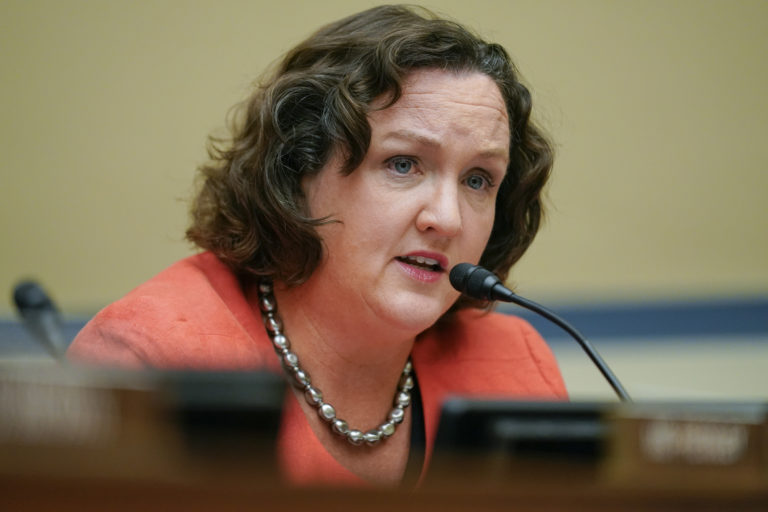
‘Get Out of My F—ing Shot!’ California Guv. Candidate Katie Porter Melts Down on Camera

(Ken Silva, Headline USA) Former Democratic Rep. Katie Porter, who is now running for California governor, has had a tough week. New footage shows her melting down on camera—twice.

On Wednesday, POLITICO released footage of Porter snapping at her staffer during an online conversation between her and then-Energy Secretary Jennifer Granholm in July 2021. Porter snapped when her staffer appeared in her camera to correct something the Democratic representative said about electric vehicles.

“Get out of my fucking shot!” she shouted. When the staffer told her why she was there, that didn’t help matters.

“You also were in my shot before that. Stay out of my shot,” Porter reiterated.

That footage followed another meltdown in which Porter couldn’t take mild pushback from Julie Watts, a CBS California reporter. In that clip, Watts asks the former congresswoman what her message is to supporters of President Donald Trump who she will need in the election. Porter puzzles over the question, lightly laughing, noting that a candidate in her party in heavily Democratic California could win a statewide race in California without catering to the much smaller slice of conservative voters.

Watts then asks what would happen if she faces another Democrat in November. After more back-and-forth, Porter stresses she represented a politically mixed district in Congress and has won GOP votes before.

The tone grows tense. At one point, Porter holds up both her hands and gestures toward Watts.

“I feel like this is unnecessarily argumentative. What is your question?” Porter asks.

After more sparring, the discussion breaks down.

“I don’t want to keep doing this. I’m going to call it,” Porter said, clapping her hands.

She later added, “I want to have a pleasant, positive conversation. … If every question you’re going to make up a follow-up question, then we’re never going to get there and we are just going to circle around.”

Watts asks if she will continue to answer questions. Porter says, “I don’t want this all on camera.”

Porter’s campaign said the interview on Sacramento CBS affiliate KOVR continued for 20 minutes after the testy exchange settled down.

Her Democratic rivals in the crowded 2026 contest to replace outgoing Gov. Gavin Newsom said the tense exchange showed Porter is too unsteady for the state’s highest job, with one calling on her to quit the race.

“Katie Porter is a weak, self-destructive candidate unfit to lead California. The stakes are simply too high for her to stay in this race,” former state controller Betty Yee said in a statement. “If she can’t take the heat of a few simple questions, she won’t be able to withstand the fire in a real crisis.”

Former Los Angeles Mayor Antonio Villaraigosa posted a link to Porter’s interview on the social platform X and wrote, “We need a leader who will solve hard problems and answer simple questions.”

Another Democratic candidate, former Biden administration health secretary Xavier Becerra, also linked to Porter’s interview on X and wrote, “I’m not interested in excluding any vote. Every Californian deserves affordable health care, safe streets, a roof over their head and a living wage.”

Long a favorite of the party’s progressive wing, Porter emerged as one of the leading candidates in a field that is expected to continue to grow. While in the House, she became a social media celebrity by brandishing her white board at congressional hearings to break down complex figures into assaults on corporate greed.

Her bid for the U.S. Senate failed in 2024.

The Associated Press contributed to this report.

Ken Silva is the editor of Headline USA. Follow him at x.com/jd_cashless.


Liberal Streamer ‘Destiny’ Had Sexual Relationship with Minor, Court Filings Show

(José Niño, Headline USA)  Explosive new court filings from last Friday show that popular political streamer Steven K. Bonnell II, better known as Destiny, engaged in a sexual relationship with a minor and attempted to transport her across state lines, according to evidence cited in the documents.

The revelation adds a new dimension to the ongoing federal lawsuit filed earlier this year, which already accused Destiny of sharing a nonconsensual sex video with a fan named “Rose.” Until recently, speculation surrounded whether Rose was underage, with Destiny repeatedly denying the claim in his online chatrooms.

However, the newly unsealed filings—specifically page 7 and Exhibit B, which includes a redacted Official Certification of Department of Motor Vehicles Driving Record—confirm Rose’s date of birth as Oct. 30, 2004. 

According to investigative journalist Sarah Fields, this finding matches a previously circulated traffic citation linked to her identity. As a result, court documents now establish that when Destiny exchanged pornographic content with Rose between March and October 2022, she was a minor.

Attorneys have since filed a motion to seal the case to protect Rose’s “substantial privacy interests,” citing the sensitivity of the allegations given her age at the time.

The underlying lawsuit, filed on Feb. 4, 2025, in the U.S. District Court for the Southern District of Florida, claims Destiny privately admitted to sharing a video of himself having sex with another content creator, known online as Pxie, to the same fan, Rose, in April 2022.

According to a report by The Wrap, the video later leaked online in November 2024 and was viewed more than 78,000 times across multiple pornography websites, including Kiwifarms, notfans.com, and thothub.com.

Pxie, who filed the lawsuit anonymously as Jane Doe, alleges she suffered “extreme humiliation, distress and emotional suffering” after trolls identified her from the leaked footage. She claims the video was recorded during a September 2020 encounter when she was 19 and Destiny 33, and that he sent it to Rose without her consent, despite never having met the recipient in person.

When Pxie confronted Destiny about the leak in November 2024, he allegedly admitted guilt in a Discord message, writing:

“I’m so sorry there’s literally no excuse … it’s worthless to say it at this point but I’m super sorry, there’s literally no excuse.”

The lawsuit also accuses Destiny of destroying evidence on Jan. 21, 2025 after learning a lawsuit was imminent.

Pxie’s forensic expert, Jesus Peña, labeled the evidence Destiny provided as “forensically unsound” and showing signs of “tampering and spoliation,” according to court filings. The expert concluded that Destiny’s mismanagement of electronic evidence “effectively breaks the chain of custody.”

Beyond the individual complaint, at least 15 other women have since contacted Pxie, claiming Destiny shared explicit content of them without consent, according to the filing.

“There is always room for improvement in my own behavior, and I’ve obviously reflected on and changed the way I’ve engaged with people in this space over the past couple of years,” Destiny said in the video. “This entire ordeal involves a video recorded five years ago and sent three years ago.”

According to The Wrap, Destiny called the legal action “irritating,” stating his “prioritizing Pxie’s well-being at every stage of this after the leaks has resulted in me being maligned so heavily.”

Two days before the lawsuit was filed, on Feb. 2, 2025, Destiny called the pending claim a “racket” during a livestream and claimed Pxie’s lawyers sought $15 million from him.

Pxie is seeking a jury trial, $1 million in compensatory damages, $1 million in punitive damages, and an additional $150,000 in statutory damages under federal revenge porn law, along with injunctions to stop further distribution of the material.

The court documents for this case can be found here

Main complaint: Doe v. Bonnell

Response in Opposition to Motion Document #139

Motion to Seal (Attorney) Document #140

José Niño is the deputy editor of Headline USA. Follow him at x.com/JoseAlNino 

Gold Breaks $4,000 as Wall Street’s “Conventional Wisdom” Starts to Crack

(Money Metals News Service) In this episode of the Money Metals Midweek Memo, host Mike Maharrey tackles a remarkable milestone in the gold market and a major shift in mainstream investing philosophy.

Gold has surged past $4,000 an ounce, marking an 87% rally since early 2024. Meanwhile, the long-standing 60/40 portfolio strategy—the bedrock of conventional investing—is showing cracks as even Wall Street begins to acknowledge gold’s role as a serious inflation hedge.

Maharrey uses a football analogy—the “prevent defense”—to highlight how conventional strategies often fail precisely when it matters most. Just as playing not to lose often leads to defeat on the field, investors who rely solely on outdated strategies risk being blindsided by today’s inflationary and debt-driven environment.

The Big Move: Gold Clears $4,000

Gold’s breakout above $4,000 stunned even seasoned watchers. Futures crossed the line on Tuesday, and spot hit $4,053 during the show. Since January 2024, gold has climbed 87 percent, a staggering rise fueled by fiscal instability, inflation concerns, and global safe-haven demand.

The current U.S. government shutdown adds short-term fear, but the deeper currents—massive government debt, endless spending, and fading confidence in fiat money—remain the lasting foundation for higher gold prices. A correction may come, but the long-term trend points higher.

Still Underowned: Only 38% Hold Gold

Despite gold’s record-setting performance, most Americans remain on the sidelines. A World Gold Council survey found that only 38 percent of investors hold any gold at all. The U.S. financial culture, driven by commission-based advice, has long sidelined hard assets.

The math tells the story. In 1929, the Dow Jones at 381.17, and gold at $20 valued the Dow at about 19 ounces. Today, with the Dow above 46,000 and gold around $4,000, the Dow is worth just 12 ounces—a 37 percent decline in gold terms across nearly a century. When measured in real money, stock market “gains” are illusions built on a weakening dollar.

The 60/40 “Prevent Defense” Is Failing

The traditional 60/40 portfolio—60 percent stocks, 40 percent bonds—was supposed to balance growth and safety. But in recent turmoil, both stocks and bonds fell together while gold surged. This inversion signals a structural shift in what qualifies as a true hedge.

Even Morgan Stanley now sees it. CIO Michael Wilson recommended a new model: 60/20, cutting bond exposure in half and replacing it with gold. He calls gold the “anti-fragile asset to own”—a durable hedge in an era where Treasuries no longer provide stability. When one of Wall Street’s biggest names breaks ranks, the paradigm is changing.

Dollar Down, Fiat Down—Gold Up

The U.S. dollar index is down nearly 10 percent this year, but the deeper truth is that every major currency is falling relative to gold. Silver, too, is approaching $50 per ounce and already at record highs in India.

This isn’t the collapse of a single currency—it’s the slow erosion of the entire fiat system. Holding cash that loses purchasing power every year is a guaranteed loss. Gold’s rally is the mirror image of paper money’s decay.

Policy Reality: Debt, Deficits, and the Press

America’s debt crossed $37 trillion in August, and the money supply has grown by $1.5 trillion since mid-2023—now higher than its pandemic peak. Neither party is showing the will to reverse course. Inflation is embedded, not transitory.

Consumer price indices capture only part of the problem. Inflation also manifests in asset prices. That’s why, priced in gold, the Dow has fallen for nearly a century. Monetary insurance isn’t speculation—it’s survival.

Central Banks: Net Buyers Even at Higher Prices

Even as prices climb, central banks keep buying. In August, they added roughly 15 tons of gold. The second quarter’s 166 tons was down 33 percent from the prior quarter but still 41 percent above the 2010–2021 average. Kazakhstan, Turkey, China, and the Czech Republic led purchases, and there were no major sellers.

For the first time since 1996, foreign central banks collectively hold more gold than U.S. Treasuries. Nations are hedging against Washington’s deficits and the declining credibility of the dollar.

Why Advisors Miss It (and Why You Shouldn’t)

Most financial advisors earn fees on stocks and bonds, not on gold. Many also came of age during the zero-interest-rate era and see gold as an outdated relic rather than monetary insurance. This blind spot has cost clients dearly.

As Brien Lundin of Gold Newsletter told Maharrey, timing a trade may be hard, but preserving wealth is always timely. The goal is to hold assets that keep value as currencies lose theirs.

Action Steps for Investors

If you’re among the 60 percent of investors with no gold, now is the time to change that. Start modestly if needed. Money Metals’ Installment Program allows participation from $100 per month, letting you accumulate gold or silver gradually.

You can purchase online at MoneyMetals.com or by calling 800-800-1865. Metals can be shipped directly or securely stored in Money Metals’ state-of-the-art depository.

Closing Thought

Gold’s surge isn’t just another price record—it’s a referendum on trust. For two years, gold and silver have been broadcasting the same warning: the fiat system is unstable at its core.

You can’t vote away debt or inflation.

You can only protect yourself.

The way to do that is simple—own real money.

Report: Trump Administration Working on Strategy To ‘Eliminate’ Venezuela’s Maduro

(Dave DeCamp, Antiwar.comThe Trump administration is working on a strategy to “eliminate” Venezuelan President Nicolas Maduro, according to a report from POLITICO’s National Security Daily.

The report focused on US special envoy Ric Grenell, who was recently instructed to halt his diplomatic efforts with the Venezuelan government. Sources told NatSec Daily that they didn’t think the move meant Grenell was on the outs, but rather that the US was now focused on escalating its efforts to oust Maduro.

“The president is serious. No more mixed messages. No more excuses,” a person familiar with the Trump administration’s thinking told NatSec Daily. “There is now a coherent whole-of-government strategy to eliminate Cartel de los Soles and its leader.”

The “Cartel de los Soles” is a term used to describe a network of Venezuelan government officials allegedly involved in drug trafficking. The group does not actually exist as an organization, but the US has declared it a “terrorist” group and has claimed Maduro is its leader.

Maduro and other Venezuelan officials have strongly denied the US allegations, pointing to data that shows the majority of the cocaine that is produced in Colombia doesn’t go through Venezuela. President Trump has framed the military campaign in the region, which has involved bombing at least four boats, as a response to overdose deaths in the US due to fentanyl, but fentanyl isn’t produced in Venezuela, and it does not go through the country on its way to the US.

The Trump administration appears to be determined to escalate things to the next level, which could involve bombing Venezuela or attempting to seize strategic ports or airfields in the country, steps that would almost certainly provoke a full-blown war with the government.

According to The New York Times, advocates of diplomacy with Maduro within the Trump administration, which includes Grenell, have warned that any attempts to carry out regime change in Venezuela risk putting the US into an extended war. The first Trump administration attempted to oust Maduro by backing opposition figure Juan Guaido and imposing harsh economic sanctions on Venezuela, an effort that failed but exacerbated an exodus of millions of migrants from the country.

Trump Says Hamas and Israel Have ‘Signed Off’ on First Phase of Ceasefire Deal

(Dave DeCamp, Antiwar.comPresident Trump has announced that Israel and Hamas have both “signed off” on the first phase of a Gaza ceasefire deal, an announcement.

“I am very proud to announce that Israel and Hamas have both signed off on the first Phase of our Peace Plan. This means that ALL of the Hostages will be released very soon, and Israel will withdraw their Troops to an agreed upon line as the first steps toward a Strong, Durable, and Everlasting Peace. All Parties will be treated fairly!” the president wrote on Truth Social on Wednesday night.

“This is a GREAT Day for the Arab and Muslim World, Israel, all surrounding Nations, and the United States of America, and we thank the mediators from Qatar, Egypt, and Turkey, who worked with us to make this Historic and Unprecedented Event happen. BLESSED ARE THE PEACEMAKERS!” Trump added.

Drop Site News reported earlier that Hamas and other Palestinian factions had agreed to a framework for a Gaza ceasefire deal. Before his announcement, President Trump said that a deal was “very close” and that he could be traveling to the region this weekend.

According to the Drop Site report, Hamas agreed to a deal that will involve Israeli troops remaining in Gaza after they release all of the Israeli captives. Hamas was initially opposed to a deal that didn’t include a full Israeli withdrawal along with the release of the hostages.

A source told Drop Site that Hamas was now trusting President Trump to guarantee that Israel won’t restart its genocidal war. “Trusting [Trump’s] word is the gamble they are taking. If it works, they will be considered geniuses. If it fails, they will be considered fools. It’s as simple as that,” the source said.

Israel previously broke a Gaza ceasefire deal that was signed in January and has constantly violated a Lebanon ceasefire deal that it signed in November 2024. After Trump’s announcement, Israeli Prime Minister Benjamin Netanyahu said that he will convene his government on Thursday to “approve the agreement and bring all our dear hostages home.”

Israel has continued to launch attacks in Gaza despite President Trump’s call to “immediately” stop the bombing. Since President Trump made that call, Israel has killed more than 100 Palestinians in Gaza. Israeli attacks haven’t been as intense over the past two days, but they haven’t stopped.

This article originally appeared at Antiwar.com.

Pentagon Still Funding Biden-era Fetal Research on Animals

(Luis CornelioHeadline USA) The Pentagon is actively funding Biden-era grants that paid for experiments involving the implantation of aborted human babies into lab animals, according to the watchdog group White Coat Waste.

WCW said the grants are worth millions of taxpayer dollars, with some beginning in 2022 and extending through 2026—one year into Trump’s second term.

“The DOD budgets for some of these experiments are scheduled to run until August 2026, and could be renewed and re-funded if Congress and the Pentagon don’t take action,” WCW noted on its Wednesday report.

Some grants reportedly funded an experiment in which the intestines of an unborn child were implanted onto the intestines of live mice.

In another case, a government grant paid for the implantation of fingers from an 18-week-old unborn baby into the backs of 5-day-old mice. The baby’s fingers were deliberately fractured four weeks later and left in place for an additional two weeks.

A third grant covered the harvesting and transplanting of scalps from aborted human children onto mice and rats.

WCW’s exposé came just days after the Trump administration’s National Institutes of Health (NIH) announced it would not renew similar Biden-era grants totaling $22 million.

Some of the Pentagon-funded grants were awarded to the University of Texas, Wistar Institute, University of California–Los Angeles, Rutgers University and the University of Wisconsin–Madison.

The Trump administration previously banned this type of research, but the ban was reversed by President Joe Biden in 2021.

Trump himself has repeatedly rebuked the use of tax dollars for similar experiments, including canceling an $8 million grant that covered experiments that made mice transgender.

Alleged Palisades Arsonist Was a Biden Voter

(Luis CornelioHeadline USA) The man facing a federal indictment for allegedly causing the deadliest wildfire in Los Angeles history was a donor to Joe Biden’s 2020 presidential campaign.

The relatively small donations shed light into the political leanings into of the suspect, 29-year-old Jonathan Rinderknecht.

According to the Federal Election Commission, Rinderknecht twice gave $2 to the former pro-Biden PAC ActBlue days before the 2020 election on Sept. 4, 2020. He gave one dollar to the same PAC on Sept. 11.

Rinderknecht was also registered to vote in Florida, though he did not list a party affiliation, according to New York Post, which was first to report on the donations.

His donations came to light just hours after the DOJ announced that he was indicted with maliciously starting a fire in California that eventually became the Palisades Fire of January 2025.

The revelation undercuts Democrats’ and former President Joe Biden’s claims that the Palisades Fire was the result of climate change.

The wildfire began on Jan. 7 and were not contained until Jan. 31, burning nearly 24,000 acres, leaving 12 individuals dead and destroying 6,837 structures.

The losses caused by wildfire are estimated to have surpassed $250 billion.

In a statement, Acting United States Attorney Bill Essayli said he hoped the case would bring “some measure of justice to those affected by this horrific tragedy.”