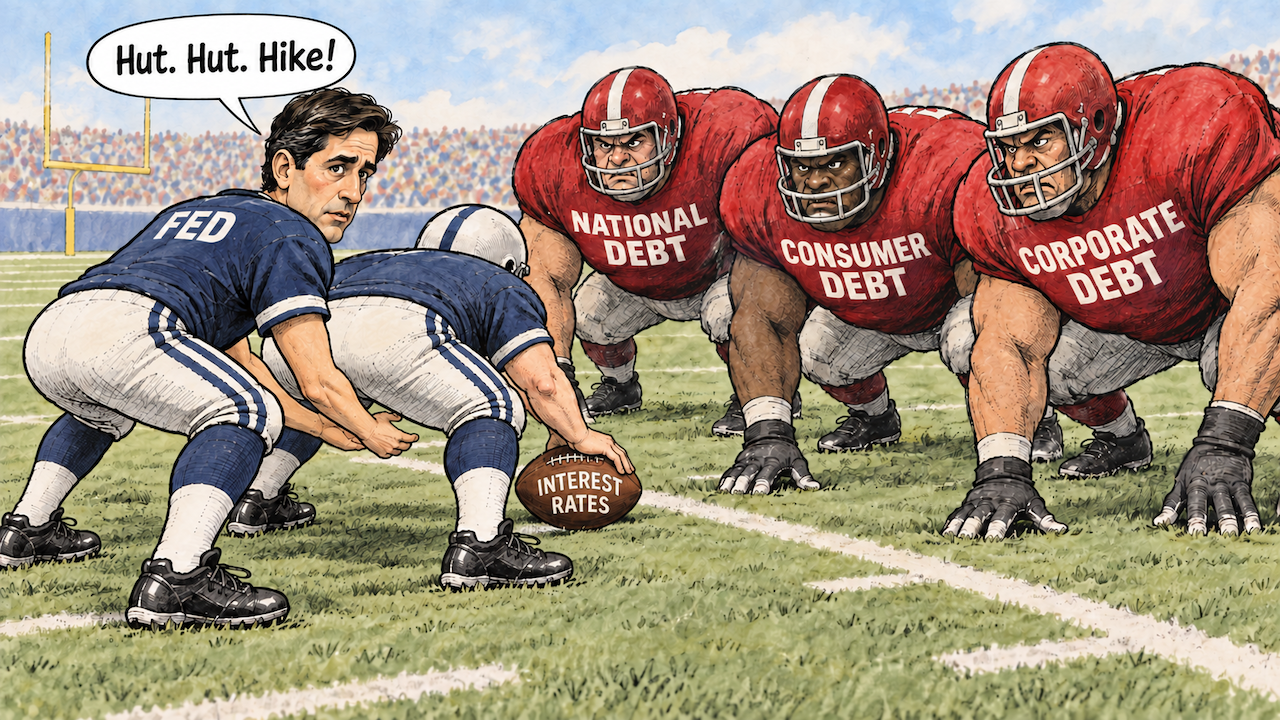
(Mike Maharrey, Money Metals News Service) The Kevin Warsh-led Fed is all in on the inflation fight.
The question now is: how long will it last?
My guess is not very long.
As expected, the Federal Reserve nudged interest rates higher by 25 basis points.
More significantly, they forecast at least one more hike this year, with several committee members projecting a third hike in 2027.
The rate hike boosts the federal funds target rate to between 3.75 and 4 percent. The vote was unanimous.
Little changed in the official FOMC statement. It continued to paint a rather rosy economic picture and once again asserted, “inflation remains elevated.”
The committee added language promising, “Today’s policy action will support a timelier return to the Committee’s 2 percent goal.”
Why Hike Now?
Warsh carried the heavy load of Fed messaging, and he continued to emphasize the central bank’s commitment to “price stability.”
I should add that when central bankers talk about price stability, it doesn’t mean prices are stable. It means they rise at a stable rate of 2 percent annually.
Regardless, Warsh & Co. want you to know fighting inflation is job number one.
For now.
“Our predominant focus is on the price stability side of our mandate,” Warsh said during his post-meeting press conference. “The plain fact is that inflation is too high and has been for too long.”
He’s not wrong.
Price inflation has remained mired above 2 percent for years. The August CPI came in at 3.4 percent. Core CPI (excluding more volatile food and energy prices) was much closer to the target at 2.4 percent but came in hotter than expected on a monthly basis (0.4 percent).
However, the inflation picture has looked this way for months, and the Fed has held rates steady.
Why hike now?
Warsh said several things have changed since the last meeting. He noted that recent data indicate a “strong economy,” inflation remains elevated over the summer (apparently he means August since we already knew this at the July meeting), and the geopolitical situation has deteriorated with no resolution to the war with Iran on the horizon.
“All three of those things lend themselves to a firm unanimous decision today.”
The Dot Plot Inflation Forecast
With markets already penciling in the 25-basis-point rate hike, all eyes were on the dot plots.
They indicated a suddenly much more hawkish Fed.
The majority of members anticipate one more hike this year, with the median federal funds rate projection coming in at 4.1 percent, up from 3.8 percent in June.

The dot plot also indicates rates will stay higher for longer, with several committee members penciling in yet another rate hike in 2027.
Notably, one committee member did not submit dots. This missing plotter was almost certainly Warsh, who also abstained from submitting a forecast in July. The new Fed chair has emphasized that he does not believe in “forward guidance.” He reiterated that message during his press conference.
“I’m not in the forward guidance business. The decision we made today was a sober decision, serious decision, responsible decision, one that we have been preparing for and thinking about in my 110 or [120] days here.”
Spurning this kind of forward guidance might not be a bad idea. The dot plots are notoriously bad at anticipating the trajectory of monetary policy.
Fund manager David Hay analyzed past dot plots and found the FOMC only got interest rate projections right 37 percent of the time. And as Hay pointed out, “They control interest rates!”
For instance, in March 2021, the FOMC projected the interest rate would still be .1 percent in 2022. The actual 2022 rate was 4.375 percent. And in 2023, the vast majority of FOMC members thought the rate would still be at .1 percent. The actual rate was over 5 percent (5.375 percent, to be exact).
Was a Hike the Right Move?
So, was the rate hike the right move?
Yes.
And no.
Remember, the Federal Reserve is caught in a Catch-22. So, there really is no good answer here.
Everything Warsh said about price inflation is correct. It’s too high. And it’s been too high for too long.
But will raising rates bring down price inflation?
Insofar as rising energy costs are driving prices higher, no. Higher interest rates won’t open the Strait of Hormuz, and they won’t pump any more oil out of the ground.
But it will likely slow money supply expansion. This is, by definition, inflation. A growing money supply will eventually show up as rising consumer and asset prices.
Given that money supply is growing at around 5 percent and price inflation remains elevated, one can certainly make the case for a rate hike. I would argue they should have hiked rates a long time ago. In fact, I would go even further and say they should have hiked much higher during the initial hiking cycle. The central bank never did enough to rein in the massive level of inflation generated during the pandemic era, much less the monetary flood during the Great Recession.
But this analysis ignores the 40-trillion-pound elephant in the room.
I’m talking about the Debt Black Hole, incentivized by the aforementioned loose monetary policy during the Great Recession and pandemic.
An economy buried in debt doesn’t function in a higher-rate environment.
Economist Daniel Lacalle recently made this very point, arguing that rate hikes aren’t appropriate right now given the state of the economy.
“The Fed is not going to bring down the price of oil or the price of natural gas, and obviously hiking rates would be completely useless as a tool on that front. But in terms of employment, it is going to be absolutely brutal because 90 percent of the job creation in the United States, as in the Euro area or any developed economy, comes from small and medium enterprises. We have already seen that job creation is significantly less robust than other macro indicators, and that comes mostly from the very aggressive levels of financing costs that small and medium enterprises suffer in the United States.”
Warsh & Company are gambling that this hike will be enough to establish their credentials as inflation fighters, but I guarantee you, they’re hoping the oil shock will ease, CPI will cool, and they can pivot to rate cuts. Because I agree with Lacalle. I don’t think the economy will survive two hikes.
In fact, I’m not sure it will survive this one.
I’m not a forecaster, but I would almost bet interest rates will be lower in 12 months rather than higher.
Why?
Well, what do central banks do when the economy gets shaky?
They cut interest rates.
Nothing slows the roll of an inflation hawk like a crashing stock market or collapsing labor market.
In my view, a one-and-done rate hike is the most likely scenario, and the central bank will make a pretty quick pivot back to rate cuts.
But even if they manage another hike, the Debt Black Hole will eventually have its way. Even now, interest rates are too high given the debt levels and the economy’s need for its easy-money drug. We’re still on the path to an economic reckoning, and the money printing will continue.
In other words, all roads lead to more inflation.
Mike Maharrey is a journalist and market analyst for Money Metals with over a decade of experience in precious metals. He holds a BS in accounting from the University of Kentucky and a BA in journalism from the University of South Florida.