


Not Enough Silver… or Just in the Wrong Location?

(Clint Siegner, Money Metals News Service) Early this year, high premiums developed for COMEX bars in the U.S. thanks to fears of tariffs on importing silver (and gold). In response, traders shipped an estimated 300 tons of silver from London to New York to alleviate that squeeze.

Last month, the London Bullion Market ran into some issues of its own with respect to silver – with huge premiums, high financing costs, and far more requests for delivery of actual bars than the market could handle.

The catalyst for the shortage in London was driven by demand from India – and this came on the heels of a partial drain of silver sent to the U.S., combined with new silver ETF investment inflows.

This year’s Diwali holiday saw many Indians shift from buying gold to silver because the yellow metal has become so expensive.

During the peak of buying in mid-October, premiums for silver there reached as high as $5/oz. Major Exchange Traded Funds (ETFs) for silver were unable to procure silver fast enough and suspended new subscriptions.

The holiday rush has passed, and demand has lessened. The surge in silver imports alleviated the supply crunch.

Indian silver premiums have fallen back to a more normal range of 25 to 40 cents an ounce.

The London silver market has also returned to a more even keel. However, the current equilibrium in the markets may be short-lived.

This year’s spike in demand from India likely isn’t a one-time phenomenon.

Silver ETFs in India now hold triple the amount of metal versus a year ago. That metal is stored in local vaults, and odds are most of it will remain there. In other words, it won’t be returning to London.

At the very least, unless gold prices fall substantially, we can expect another surge in silver demand from the huge population of India when Diwali rolls around next year.

The small shift in interest from gold to silver in India could be signaling a bigger trend. Given the dramatic rise in gold prices, it is fair to say Indians probably aren’t the only investors and consumers around the world who will increasingly turn to silver.

For its part, the Chinese government just made a change which could reduce the amount of silver coming to market. Silver was added to a list of supervised commodities effective November 1. Exports will be managed with an eye toward prioritizing domestic needs.

Given that Chinese exports of silver were equal to 13% of global demand last year, the move is likely to have significant repercussions.

The U.S. government just made a similar designation. Silver has just been officially added to the list of “critical minerals.” Only time will tell exactly what this designation will do, but government stockpiling of silver is one possible outcome.

Russia recently allocated $535 million in an effort to build strategic reserves of silver, platinum, palladium, and gold. Government officials there view precious metals as “sanction-proof.”

The European Union named silver in the Critical Raw Materials Act of 2023. The metal is now deemed vital in the EU’s dreams for an energy transition.

Governments around the world clearly have growing concerns over the availability of silver. Investors can expect these nations will make efforts to reduce exports, which feed markets such as London and the COMEX.

There is a good reason for concerns about supply. This year will be year number five of a large and ongoing supply deficit, according to the Silver Institute. Miners are not keeping up with demand from both investment and industry.

The recurring volatility in markets is another indication that there is not enough free float of silver in the markets to meet demand.

Unless silver miners can respond to demand, shortages probably aren’t going away. Higher silver prices ought to help, but increased production has yet to show up in forecasts.

The Silver Institute expects production will rise slightly in 2026 to 850 million ounces, then dwindle back towards 800 million ounces by 2030. Global demand, meanwhile, is expected to remain above 1.1 billion ounces.

Finding and building mines is a difficult business. Miners face challenges around the world ranging from geopolitical turmoil, such as ongoing strife in South Africa, to regulatory hurdles and depleting reserves.

The reported discoveries of new deposits are nowhere near sufficient to close the gap. Miners in the U.S. reported just 2.4% growth in primary silver reserves last year. In other parts of the world, published reserves are in decline.

Selling paper silver isn’t working out too well this year for traders – especially those who don’t actually have the bars to deliver.


Clint Siegner is a Director at Money Metals Exchange, a precious metals dealer recently named “Best in the USA” by an independent global ratings group. A graduate of Linfield College in Oregon, Siegner puts his experience in business management along with his passion for personal liberty, limited government, and honest money into the development of Money Metals’ brand and reach. This includes writing extensively on the bullion markets and their intersection with policy and world affairs.
Americans Report Strain From Increasing Household Debt

(Elyse S. Apel, The Center Square) More than half of U.S. households say they’re struggling with debt, according to a new WalletHub survey.

Total household debt increased to $18.59 trillion in the third quarter of 2025, which is $990 billion below the all-time 2008 high of $19.57 trillion.

Still, consumer debt is steadily rising for many, with more than two in five people expecting their household debt to increase in the next 12 months.

Chip Lupo, a writer and analyst for WalletHub, told The Center Square in an exclusive interview that the survey’s findings are very concerning.

“What stood out most to me about this survey is just how deeply Americans feel the weight of debt; not just financially, but emotionally and physically,” Lupo said. “More than half of households report struggling with debt; 36% feel ‘owned’ by credit card companies; and 38% say it affects their health. This combination of financial strain and personal stress is striking.”

The recently-released survey was done in conjunction with WalletHub’s Household Debt Report, which examined the latest economic data from the third quarter. Notably, the report found that the average American household had:

  • $108,425 in mortgage debt
  • $3,500 in home equity lines of credit debt
  • $13,727 in auto loan debt
  • $13,711 in student loan debt
  • $10,227 in credit card debt
  • $4,562 in other debt, which included personal loans and other financing

The survey sought to put these findings from the report in context. Across the nation, it found that American families are drowning in debt.

In total, 56% said their household is struggling with debt. Many don’t see an end in sight, with 46% anticipating they will still have debt when they die.

Credit card debt is causing the most strain for families, the survey found. In total, 46% of American households reported struggling with credit card debt the most, followed by mortgages at 23% and student loans at 13%.

Many pointed to high inflation and an ever-increasing cost of living as playing a role in their increasing debt.

“High inflation is seen as the primary driver of rising debt, and nearly half of Americans expect to carry debt to the grave,” Lupo said. “These figures highlight how critical it is for consumers to track their net worth and actively manage debt, especially credit card balances, as the survey shows that this is the most common source of financial stress.”

What Four Countries Dominate the Physical Silver Investment Market?

(Mike Maharrey, Money Metals News Service) Physical silver investment has become a significant driver of overall global silver demand, and four countries dominate the market.

Between 50 and 60 percent of silver demand comes from industrial and tech sectors, with the remaining half split between investment and jewelry demand. Industrial demand set a record in 2024, but investment demand lagged. However, with silver up more than 80 percent on the year, investment demand has grown.

Physical investment is the most volatile source of silver demand. It has ranged from a low of 157.2 million ounces in 2017 to a record high of 337.6 million ounces in 2022.

Physical investment accounted for around 20 percent of total silver demand in 2010. It jumped to 28 percent in 2015 but fell to around 16 percent last year.

Four Countries Dominate the Silver Investment Market

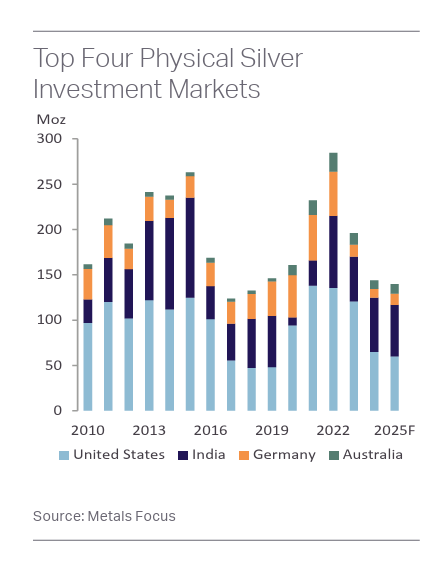
Silver investment demand is concentrated in four countries – the United States, India, Germany, and Australia. These four nations account for 80 percent of physical silver investment. That compares with a 60 percent market share between the top four gold investment countries.

USA

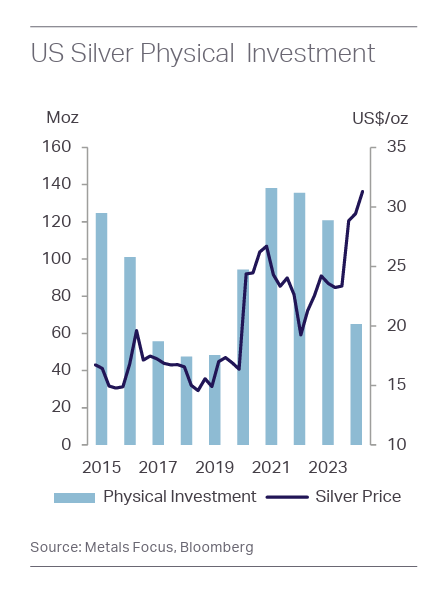
Historically, the United States has ranked as the top country for silver investment, although India surpassed the U.S. in 2018 and 2019, and it may do so again this year.

According to Metals Focus, the U.S. investors bought 1.5 billion ounces of silver between 2010 and 2024. That’s an average of 3,077 tonnes per year.

Up until the last few years, American investors weren’t selling. That means much of those 1.5 billion ounces remained in investors’ hands. As the price began to rise in 2023, investors seeking profits began selling, and that trend has accelerated this year. According to Metals Focus, selling drove a sharp drop in demand for newly struck coins and bars so far this year, with total U.S. retail investment likely to hit a seven-year low in 2025 (Investment demand is the net of buying and selling).

India

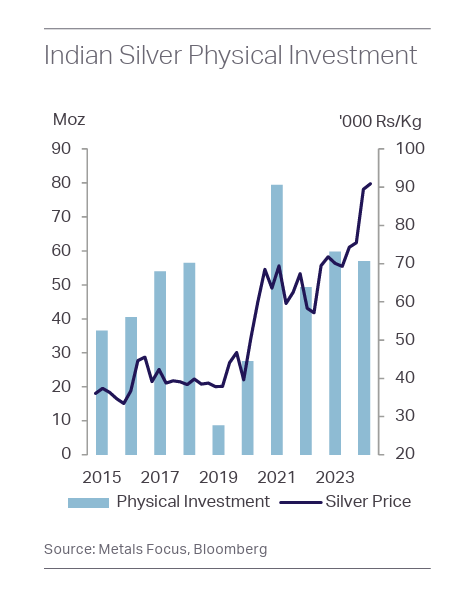
India has typically ranked second in physical investment silver demand, but occasionally jumps to the top.

Traditionally, Indian investors have held silver in bar form.

Between 2010 and 2024, cumulative Indian bar and coin demand stood at 840 million ounces (26,100 tonnes). According to Metals Focus, “In a broadly similar fashion to the U.S., these holdings have generally been quite sticky, reflecting Indian investors’ typically bullish price expectations.”

Silver prices hit records in rupee terms before they did so in the U.S. and have pushed through the psychologically important ₹100,000/kg level. Nevertheless, Metals Focus reports sales have been “surprisingly modest.”

“This mostly reflects how deeply held positive price expectations are in India, with many investors looking for the international price to revisit its record high in dollar terms.”

In 2022, Indian silver investment hit the highest level since 2015 as the pandemic era wound down. Silver purchases contracted significantly in 2023 but were still high in absolute terms. Indian silver demand was resurgent last year, especially after the Indian government cut the import duty on both gold and silver.

While Indian investors have historically favored physical metal, there is also a growing interest in silver ETFs. The first silver-backed fund launched in 2022. Over the past 18 months, ETF silver holdings have surged to 58 million ounces (1,800 tonnes), a jump of 51 percent since end-2024.

A silver ETF is backed by a trust company that holds metal owned and stored by the trust. In most cases, investing in an ETF does not entitle you to any amount of physical metal. You own a share of the ETF, not gold itself. ETFs are a convenient way for investors to play the silver market, but owning ETF shares is not the same as holding physical silver.

According to Metals Focus, ETFs seem to be attracting investors already active in the equities market, who typically might not have bought physical metal.

Germany

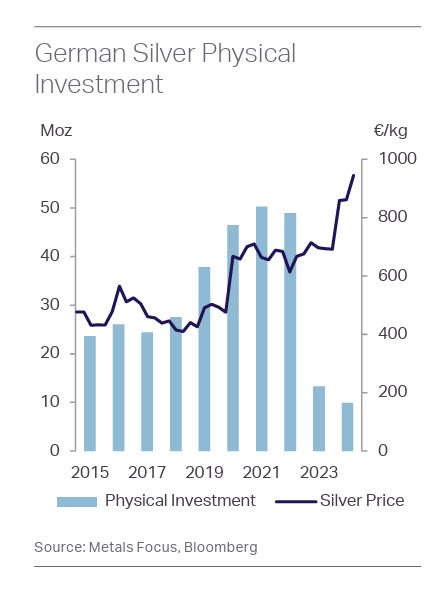
Germany ranks as the third-largest market for silver bar and coin investment.

Between 2012 and 2018, German retail silver purchases averaged a relatively modest 24.6 million ounces (764 tonnes) annually. The market was already showing signs of heating up with the pandemic, and Russia’s invasion of Ukraine spiked demand.

German physical silver investment doubled, averaging 48.5 million ounces (1,510 tonnes) in the period of 2020-22.

A tax change in 2023, along with inflation and a return to positive real rates, tanked silver demand, with sales plunging to 13.3 million ounces. These headwinds continued into 2024.

According to Metals Focus, a rise in selling occurred as investors sought to lock in profits and access cash to cover growing expenses in an inflationary environment.

“To put this into perspective, in just two years, German net silver demand had slumped by 80 percent or roughly 39 million ounces (1,200 tonnes).

There has been a modest recovery in demand this year, in part because selling has eased. Metals Focus projects a 25 percent year-on-year increase in physical investment silver demand in 2025.

Australia

Silver demand in Australia has increased over the last five years, making the country the fourth-largest physical silver investment market.

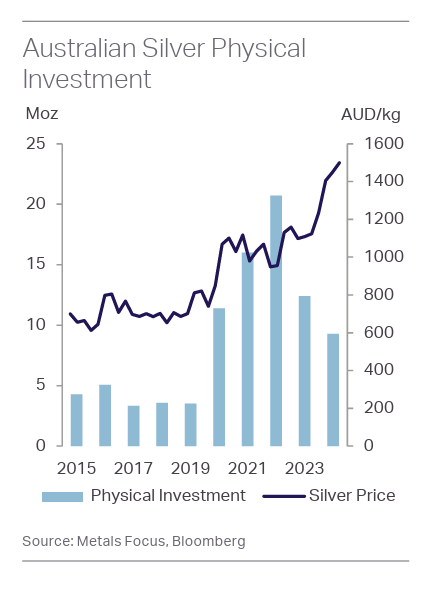
As recently as 2019, Australian silver demand was a paltry 3.5 million ounces. By 2022, it had surged to 20.7 million ounces. According to Metals Focus, along with the general macro fundamentals underpinning the precious metals markets, two factors specific to Australia drove this increase – the growing popularity of investing silver in superannuation, or retirement accounts, and the favorable tax structure applicable to physical silver investment products.

As for the favorable tax treatment, investment-grade silver in Australia is sales tax-free, although it is subject to capital gains tax (CGT). Silver invested in retirement accounts attracts different CGT rates if the investor sells before retirement, but after that point, it becomes capital gains tax-free.

As with other markets, silver demand sagged in the post-COVID era, in part due to profit-taking. However, demand remained well above pre-2020 levels.

Metals Focus forecasts an 11 percent increase in investment silver demand this year as cost-of-living pressures ease.

“There also appears a growing perception that silver is undervalued compared with gold, which is therefore attracting renewed interest in silver.”

For a more detailed breakdown of physical investment silver demand, download the full Metals Focus report HERE.


Mike Maharrey is a journalist and market analyst for Money Metals with over a decade of experience in precious metals. He holds a BS in accounting from the University of Kentucky and a BA in journalism from the University of South Florida.

Ford Strike Group Spotted in Caribbean as Venezuela Tensions Heighten

(Sarah Roderick-Fitch, The Center Square) The Navy’s largest and newest aircraft carrier, the USS Gerald Ford, has arrived in the Caribbean region, according to spotters in the region.

U.S. Naval Institute News cited boat spotters in Puerto Rico who eyed the destroyer, USS Bainbridge, on Tuesday. The Bainbridge, part of the Gerald Ford aircraft carrier strike group, was traveling with the carrier.

The arrival of the Ford in the SOUTHCOM area of responsibility signals a major buildup of naval and military presence in the region as the Trump administration continues targeting marine vessels suspected of trafficking narcotics headed for the U.S.

​​Over the weekend, The Center Square reported that several naval ships are already in the region, including the USS Iwo Jima Amphibious Ready Group, according to the USNI. The Iwo Jima is a Wasp-class amphibious ship, one of the larger classes of ships in the Navy.

The Iwo Jima Amphibious Ready Group deployed in August, carrying over 4,500 sailors and Marines, according to the Department of War. The group includes the Iwo Jima, USS Fort Lauderdale, USS San Antonio and the 22nd Marine Expeditionary Unit.

As of early last week, the institute reported that, in addition to the group, three Navy guided-missile destroyers are operating in the Caribbean, including the USS Jason Dunham, USS Gravely, and USS Stockdale. In addition, USNI reported the USS Lake Erie (CG-70) and the USS Wichita (LCS-13) are operating in the Caribbean.

The buildup of Navy ships in the region points to the Trump administration’s commitment to prioritizing targeting narco-terrorists. Still, it could also signal a shift in the U.S.’s focus on potential adversarial threats in Latin America.

Neither the Department of War nor the Navy has confirmed or commented on the arrival of the Ford in the Caribbean.

Defense Secretary Pete Hegseth told The Center Square last month at an event in the White House that the Department of War is keeping its eyes on adversaries in the region after The Center Square asked the secretary and the president if they had plans to expand U.S. Naval operations in Puerto Rico, specifically Roosevelt Roads, a Navy base closed in 2004.

“We’re familiar with the location that you’re referring to, and we will make sure that we’re properly placed in order to deal with the contingency we’re dealing with there, and also any ways in which other countries would attempt to be involved also, so we can walk and chew gum. We’re definitely keeping our eyes on near peer adversaries at the same time,” Hegseth told The Center Square.

The secretary’s response cemented the administration’s “America first” policy, which is beginning to shift focus to its “own backyard.”

“But we think sending a message on these cartels, these narco-terrorists, is an important, important inside our hemisphere, which for far too long other presidents, as the president pointed out, they’ve ignored our own backyard and allowed other countries to increase their influence here, which only threatens the American people. We’re changing that,” Hegseth concluded.

The naval buildup in the region could highlight concerns in recent years that Venezuela, under the dictatorship of socialist Nicolas Maduro, has aligned the country with American adversaries, such as Russia, China and Iran.

In 2022, Venezuela hosted military drills with countries including Russia, China and Iran.

The Center for Strategic and International Studies warns that Latin America is ripe for U.S. adversarial influences.

“While Western observers have focused their attention on joint connivances of Russia and Iran in Eastern Europe, Eurasia, and the Middle East, where Russo-Iranian military-security operations directly affect U.S. and European interests, the Western Hemisphere is not isolated from the two countries’ quests for global influence. In fact, in many ways it is an essential piece of the puzzle. First, both Iran and Russia perceive Latin America and the Caribbean (LAC) as a fertile ground for exploiting popular resentment vis-à-vis the United States and the ‘collective West,’ which they – rather successfully – harness to advance their view of a multipolar world,” according to CSIS.

India Speeds Up Efforts to Bring Its Gold Home

(Mike Maharrey, Money Metals News Service) India has sped up efforts to bring its gold home.

According to Bloomberg report, the Reserve Bank of India repatriated 64 tonnes of gold through the first six months of its fiscal year, which began in April.

The RBI now holds 65 percent of its gold reserves within India’s borders.

India has also been adding to its gold reserves.

The Reserve Bank of India was the third-largest gold buyer in 2024, upping its gold holdings by 73 tonnes. The RBI added to its gold reserves every month except for December. At the end of 2024, the RBI’s gold reserves totaled 876 tonnes, accounting for 11 percent of total reserves.

The pace of purchases has slowed, but the RBI has continued to add gold to its reserves this year.

This reflects a longer trend. The RBI has been buying gold since 2017. Over that period, it has increased its gold reserves by over 270 tons.

The Times of India reported that de-dollarization is one of the primary motives behind India’s gold-buying spree.

“India’s central bank has shown a preference for increasing gold reserves instead of U.S. Treasury bills to strengthen its foreign exchange holdings. This is part of a broader global shift towards diversifying national reserves beyond dollar-based assets.”

An economist told the Times, “It makes a lot of sense (to invest in gold), given the increased volatility in the FX market, elevated interest rates in the U.S., and, of course, also as the central banks in each economy would like to diversify the asset classes in which they are parking their reserves.

India isn’t alone. A large number of countries have been increasing their gold holding. According to a report by the Atlantic Council, “In recent years, and especially since Russia’s invasion of Ukraine and the Group of Seven (G7)’s subsequent escalation in the use of financial sanctions, some countries have been signaling their intention to diversify away from dollars.

India has slowed the pace of purchases, adding around 4 tonnes of gold this year, but has indicated that it plans to continue growing its reserves.

There’s No Place Like Home!

India currently holds 880 tonnes of gold, with 576 now stored domestically. Gold held within Indian borders only totaled 38 percent of reserves in 2022.

In the spring of 2024, India brought 100 tonnes of gold home, repatriating it from vaults in the UK. Over the past four years, India has repatriated 280 tonnes of gold.

After the big move, an anonymously quoted central bank official told Reuters, “We did have it [gold] held in London… but now we’ve transferred it back to our country to hold as a safe haven asset and to keep it safe.

Invesco’s head of official institutions, Rod Ringrow, told Reuters this reflects a widely held view.

“‘If it’s my gold then I want it in my country,’ has been the mantra we have seen in the last year or so.”

While the push for more gold is being driven by a loss of faith in the dollar, repatriation seems to be motivated by a desire to keep Indian assets under Indian control. According to Bloomberg, “The RBI didn’t give a reason for the shift, but the move was aimed at likely enhancing control over the nation’s bullion assets after Group of Seven nations, including the U.S. and the European Union, seized Russia’s reserves in 2022 following its invasion of Ukraine.”

Here again, India isn’t alone.

The world has taken notice of the way the U.S. (and other Western powers) weaponized the dollar after Russia invaded Ukraine. Some countries were already trying to limit exposure to the dollar to minimize the impact of U.S. economic pressure before Russia invaded Ukraine, and de-dollarization has accelerated since.

According to a World Gold Council survey in 2023, a “substantial share” of central banks expressed concern about potential sanctions after the U.S. and other Western countries froze almost half of Russia’s $650 billion gold and forex reserves in the wake of its invasion of Ukraine. According to the WGC, 68 percent of the banks surveyed said they plan to keep their gold reserve within their country’s borders. This was up from 50 percent in 2020.

There has been a growing chorus of voices calling for Germany and Italy to bring their gold home.

There has also been speculation that other countries have been moving gold and other assets out of the U.S. in the wake of economic sanctions on Russia. However, this has been difficult to confirm because the Federal Reserve will not release information on the amount of gold in its vaults.

The gold repatriation trend started long before the West slapped sanctions on Russia. In 2019, Poland brought home 100 tons of gold. Hungary and Romania also repatriated some of their gold reserves around that same time. In the summer of 2017, Germany completed a project returning roughly half of its gold reserves inside its borders. In 2015, Australia launched efforts to bring half of its reserves home. The Netherlands and Belgium have also initiated repatriation programs.

This gold repatriation trend underscores the importance of holding physical gold free from counterparty risk.

If you store your gold and silver with a third party, you could lose your metal through theft, fraud, or an act of God. Of course, you could lose silver and gold stored in your home the same way (except for fraud), so you have to weigh the risk of using third-party storage and keeping large amounts of silver and gold at home.

If you opt for third-party vaulting, it is important to choose a trusted company.

Money Metals offers secure precious metals storage in its state-of-the-art facility.

Here are just a few advantages of storing with Money Metals:

  • Money Metals Depository contents are fully insured by Lloyd’s of London.
  • Metals stored in your account are segregated and never commingled or rehypothecated — and cannot be used as collateral for a loan by anyone but you.
  • Depository holdings are independent and removed from any bank, Wall Street, or Washington, D.C.

Mike Maharrey is a journalist and market analyst for Money Metals with over a decade of experience in precious metals. He holds a BS in accounting from the University of Kentucky and a BA in journalism from the University of South Florida.

ETFs Globally Report Boost in Gold Holdings for Fifth Straight Month

(Mike Maharrey, Money Metals News Service) After charting the highest level of gold inflows on record in September, the flow of gold into ETFs slowed modestly in October but remained comfortably above the year-to-date average.

It was the fifth straight month of net gold inflows into ETFs globally.

In total, 54.9 tonnes of gold flowed into gold-backed funds last month. As of the end of October, gold ETFs held 3,893 tonnes of metal, about 1 percent below the all-time high reached during the pandemic.

Assets under management (AUM) by gold ETFs rose 6 percent to a record $503 billion.

North American funds led the way, adding another 47.2 tonnes of gold to their holdings, busting AUM by $6.5 billion. This occurred despite some profit-taking at the end of the month that drove $1 billion in outflows. Before the gold selloff, North American funds were on track for another record month.

According to the World Gold Council, “Geopolitical risk, lower yields, and equity market frothiness may have been key drivers of gold demand as investors seek portfolio diversification.”

Asian funds also reported significant inflows of 44.8 tonnes of gold. Chinese ETFs dominated in the East, adding $4.5 billion to their holdings. According to the World Gold Council, “The US-China tension flare-up in early October, alongside the gold price strength, sparked renewed gold interest among local investors. And slowing growth in Q3 also boosted local investor safe-haven demand.

Meanwhile, Japanese ETFs have reported inflows of metal for 13 straight months, while Indian funds charted their fifth month of positive flows.

On the flip side of the coin, European funds reported significant outflows of -37.4 tonnes totaling $4.5 billion. It was the region’s second-largest outflow on record.

Switzerland was the bright spot, reporting gold inflows, but it wasn’t enough to offset a record decrease in UK-based fund gold holdings. German ETFs also reported significant outflows.

According to World Gold Council analysts, the outflows in Europe were driven by a combination of profit-taking and portfolio rebalancing.

Funds in other regions, including Australia and Africa, reported modest gold inflows of 0.3 tonnes.

ETFs are a convenient way for investors to play the gold market, but owning ETF shares is not the same as holding physical gold.

ETFs are relatively liquid. You can buy or sell an ETF with a couple of mouse clicks. You don’t have to worry about transporting or storing metal. In a nutshell, it allows investors to play the gold market without buying full ounces of metal at the spot price.

Since you are just buying a number in a computer, you can easily trade your ETF shares for another stock or cash whenever you want, even multiple times on the same day. Many speculative investors take advantage of this liquidity.

But while a gold ETF is a convenient way to play the price of gold on the market, you don’t actually possess any gold. You have paper. And you don’t know for sure that the fund has all the gold either, especially when the fund sees inflows. In such a scenario, there have been difficulties or delays in obtaining physical metal.

Gold Trading Volumes

Gold trading volumes surged in October, hitting a record high of $561 billion per day. That was a 45 percent month-on-month increase.

Trading volume in tonnage terms rose 31 percent month-on-month to 4,287 tonnes per day. That was just 1 percent below the record set in April at the height of tariff tensions.

Exchange-traded volume rose 59 percent month-on-month, averaging $300 billion per day. There was strong activity on both the COMEX and the Shanghai Futures Exchange.

Over-the-counter trading was up 28 percent on the month to $245 billion per day. That was 92 percent higher than the 2024 average.

The government shutdown prevented updates to net long positioning. However, futures open interest fell 4 percent month-on-month to $235 billion by month-end. This signals a decline in long positions.


Mike Maharrey is a journalist and market analyst for Money Metals with over a decade of experience in precious metals. He holds a BS in accounting from the University of Kentucky and a BA in journalism from the University of South Florida.

National Task Force to Combat Antisemitism Expands Focus to Include Right Wing Extremism

(José Niño, Headline USA) An antisemitism task force with ties to the Heritage Foundation revealed on Thursday it would sever its relationship with the conservative organization following widespread criticism of the think tank’s support for Tucker Carlson and his interview with nationalist commentator Nick Fuentes.

The National Task Force to Combat Antisemitism’s co-chairs disclosed in a Thursday email obtained by Jewish Insider that they would pursue their mission “outside the Heritage Foundation for a season.”

One task force member speaking to Jewish Insider indicated the group remains open to future collaboration with Heritage should the organization change course. “We hope that one day we’ll be able to collaborate with Heritage again,” the member stated, requesting anonymity due to the sensitive nature of internal conversations.

Established after the Oct. 7, 2023, Hamas attacks, the task force played a central role in developing Project Esther, Heritage’s primary antisemitism countermeasure framework launched last year as a response to the Biden administration’s national strategy addressing the rise of antisemitism.

Project Esther contained no references to right-wing antisemitism. The co-chairs announced in their Thursday correspondence that this gap can no longer be overlooked, and that the task force will focus on right-wing so-called extremism, too.

“The NTFCA will also now expand our work to fight the rising scourge of antisemitism on the Right, beyond our previous work combating the pro-Hamas movement on the Left,” the co-chairs stated, revealing plans to co-host a conference titled “Exposing & Countering Extremism and Antisemitism on the Right” on Nov. 18 in Washington alongside the Conference of Christian Presidents for Israel.

Leading the task force are Mario Bramnick, a Florida pastor serving as president of the Latino Coalition for Israel; Victoria Coates, vice president of the Kathryn and Shelby Cullom Davis Institute for National Security and Foreign Policy at the Heritage Foundation; Ellie Cohanim, former deputy antisemitism special envoy during the first Trump administration; and Luke Moon, a pastor and executive director of the Philos Project.

Heritage Foundation has faced mounting criticism since president Kevin Roberts published a video standing by Carlson as the podcaster weathered backlash over his Fuentes interview.

During a Wednesday staff meeting, Roberts issued an apology for the video, which continues to remain posted on X. He conceded the video failed to adequately clarify that while he opposes “canceling” individuals like Carlson, this stance does not constitute “endorsing everything they’ve said.”

However, he has declined requests to take down the video, according to someone with knowledge of the internal discussions. Removing the video was among the measures recommended earlier in the week by task force members.

The four co-chairs committed to advancing the work they initiated under Heritage Foundation’s umbrella. According to the task force member, the organization provided substantial support for the group’s launch and operations, including meeting spaces, publishing capabilities, research support, and funding for administrative and policy staff. The co-chairs have not disclosed the task force’s next institutional home.

“The future of the Conservative movement will include a broad coalition of people that love America and all she stands for,” the co-chairs stated. “We cannot allow the Conservative movement to be corrupted and destroyed by those consumed with attacking America’s Judeo-Christian heritage and values, thereby distracting us all from the real challenges facing our nation.”

José Niño is the deputy editor of Headline USA. Follow him at x.com/JoseAlNino 


California Teachers Sue Over Law They Say Silences Debate on Israel and Palestine

(José Niño, Headline USA)  A coalition of California teachers, students and parents filed a federal lawsuit arguing that a new state law designed to combat antisemitism in schools actually censors legitimate classroom discussion about Israel and Palestine.

The American Arab Anti Discrimination Committee filed a federal lawsuit last Sunday, challenging a California law that educators say will censor classroom discussions about Israel and Palestine. The suit, filed in United States District Court for the Northern District of California, argues that Assembly Bill 715 violates constitutional protections for free speech and due process.

Gov. Gavin Newsom, D-Calif. signed the legislation on October 7, despite vocal opposition from civil rights organizations, teachers unions and education advocates. The law amends California’s Education Code to address antisemitism in public schools, but critics say it conflates legitimate criticism of Israeli government policies with bigotry.

The plaintiffs include California public school teachers, students, parents and the Los Angeles Educators for Justice in Palestine, a group advocating for academic freedom and awareness of Palestinian human rights. According to a report by Truthout, they are suing Governor Newsom, Attorney General Rob Bonta and Superintendent of Public Education Tony Thurmond, all in their official capacities.

At the heart of the dispute lies what plaintiffs describe as unconstitutional vagueness. AB 715 does not explicitly define antisemitism but directs school districts to follow the Biden Administration’s National Strategy to Combat Antisemitism, which references the International Holocaust Remembrance Alliance definition. 

Educators argue this definition treats criticism of Israel and Zionism as antisemitism, creating uncertainty about what teachers can discuss without facing discipline.

“Unless I create an exception to the use of standard definitions or simply abandon the topic completely, I will be at risk under the new law AB 715,” teacher Andrea Prichett stated in the complaint.

The lawsuit argues that California’s Education Code already prohibits discrimination based on race, religion, ethnicity and national origin. The only plausible reason for the new law, according to the filing, is to alter or expand those definitions in ways that target specific viewpoints about Israel.

Teachers fear they could face disciplinary action for presenting factually accurate historical information, such as the displacement of Palestinians during Israel’s creation or the ongoing occupation of the West Bank. Student plaintiff J.J. expressed concern that the law would inhibit “meaningful discussions that are necessary to learn about different perspectives so that common ground can be reached.”

In a statement, the Council on American Islamic Relations characterized the legislation as classroom censorship that “silences Muslim, Arab, Palestinian, Jewish, and other marginalized voices in California public schools by shielding a foreign government — Israel — from legitimate criticism and criminalizes honest discussions on Palestine and other global human rights issues.” .

“Our children’s rights are not negotiable. Compromised politicians in California do not have the right or authority to muzzle our children and strip away their First Amendment rights. AB 715 does exactly that, it rips up the First Amendment and hands classrooms to a foreign agenda,” ADC National Executive Director Abed Ayoub said in a statement announcing the lawsuit. “By signing this bill into law, Gov. Newsom has made it clear — he has sided with foreign interests instead of students and parents.”

The lawsuit seeks several remedies from the federal court. It asks for a declaration that the law violates teachers’ due process rights under the Fourteenth Amendment because of its vague language. 

The complaint also requests findings that the amendments violate First Amendment protections for both teachers and students by being overbroad and viewpoint discriminatory. Finally, the plaintiffs seek an injunction preventing state officials from enforcing the contested provisions.

“AB 715’s intent and effect is classroom censorship. It — probably intentionally — does not define the conduct it targets, then points schools to federal guidance that blurs legitimate criticism of a foreign state with bigotry,” ADC National Legal Director Jenin Younes declared. “That combination guarantees arbitrary punishment of educators, chills valuable classroom instruction and discussion, and deprives students of the vigorous debate the Constitution protects. We brought this case to keep classrooms free to teach the truth.”

The case can be found here.

José Niño is the deputy editor of Headline USA. Follow him at x.com/JoseAlNino 


Rep. Massie Still Investigating Jan. 6 Provocateur Ray Epps

(Ken Silva, Headline USA) Remember Ray Epps, the J6er who encouraged others to go into the Capitol and committed violence against police officers, only to receive a year of probation for his crimes?

Rep. Thomas Massie, R-Ky., hasn’t forgotten. Massie announced on Friday that he wrote a letter to the FBI about Epps last month, seeking answers about its investigation into him.

Massie asked why the FBI initially closed its investigation into Epps by July 2021, despite having an abundance of evidence about him.

According to FBI records, agents had “photographic/and or video evidence that James Ray Epps conspired to and/or recruited others to storm the United States Capitol Building.”

However, a July 29, 2021, FBI report said that its “investigation did not reveal sufficient evidence that Epps … engaged in acts of violence or committed any other criminal violations.” That’s despite the fact that video had already surfaced showing him pushing a sign into a group of police officers, and that Epps had admitted to trespassing on Capitol grounds.

The Justice Department apparently reopened the Epps case after Massie, Revolver News and other conservatives began to question whether he was being protected by government. The DOJ eventually slapped him with a lone misdemeanor count of disorderly conduct, and he received one year of probation in January 2024.

“This disparate treatment is particularly troubling when contrasted with the cases of most January 6 defendants,” Massie said in his recent letter to FBI Director Kashyap Patel. “Moreover, it raises the broader question of whether other defendants were similarly spared prosecution under comparable circumstances.”

Massie seeks all internal communications between FBI Headquarters and its Phoenix field office, which initially investigated Epps. He also seeks all communications between the FBI and DOJ about him.

Additionally, Massie wants to know whether the DOJ or any of its components, including the FBI, had any communication with Epps prior to the Jan. 6, 2021, Capitol Hill protest. Such communications might indicate whether Epps was working for the government at the time.

Massie sought answers by Oct. 10. It’s unclear whether the FBI ever responded to the congressman’s letter, which is dated Oct. 3.

Ken Silva is the editor of Headline USA. Follow him at x.com/jd_cashless.

FBI Director’s Girlfriend Sues Right-Wing Influencer for Tweeting Photo of Her

(Ken Silva, Headline USA) FBI Director Kashyap Patel’s girlfriend, Alexis Wilkins, has sued two more right-wing influencers for suggesting that she’s an Israeli asset. One of the influencers didn’t say she’s an asset, but merely tweeted a suggestive photo of her and Patel.

Wilkins’s lawsuit stems from a Sept. 14 tweet where a Twitter/X account explained how females from the Mossad—Israeli’s intelligence agency—have been used as “honeypots” to seduce government officials and other targets. In response to that tweet, right-wing influencer Elijah Schaffer tweeted a photo of Patel and Wilkins.

Schaffer didn’t explicitly say that Wilkins was an Israeli honeypot sent to seduce Patel. Nevertheless, his post prompted Wilkins to file a lawsuit on Oct. 28 in federal court.

“While [Schaffer] may not have included any caption to spell out the meaning of his post, he didn’t have to,” her lawsuit says.

“Ever since Kash Patel was appointed as Director of the FBI in February 2025, the conspiratorial corners of the internet and social media have been spreading a false narrative that Ms. Wilkins is an Israeli Mossad agent, spy, or ‘honeypot,’ who is only in a relationship with Kash Patel to spy on and manipulate the United States government.”

The lawsuit further outlines Schaffer’s history of anti-Israel rhetoric to support Wilkins’s argument that his photo of her and Patel was intended to smear her.

Schaffer, for his part, blasted the lawsuit as an attack on free speech. He says he plans to fight the lawsuit vigorously, including by obtaining discovery to see if Patel is the one pushing it.

“Does Kash Patel know about this? If he doesn’t know that his girlfriend is waging million-dollar lawsuits … what kind of FBI director doesn’t know that his girlfriend is waging frivolous lawsuits against the press?” he said. “Now if he does know, this is a proxy lawsuit by Kash Patel.”

Along with Schaffer, Wilkins also sued right-wing influencer Sam Parker on Oct. 31. In that case, Parker posted an essay about Wilkins in February 2025 entitled “Who is Alexis Wilking—Girlfriend of Kash Patel?”

“I think it’s a fair question to ask why a young devout Christian woman pining for traditional Christian values is dating an Indian Hindu man old enough to be her father?” Parker said. “A man who swore his oath of allegiance to America on the Bhagavad Gita. Is all that ‘Old-Fashioned?’”

Wilkins seeks $5 million from both men. Those cases follow an initial lawsuit she filed against former FBI agent Kyle Seraphin in August over his allegations that she’s a “former Mossad agent.”

Seraphin filed a motion to dismiss the lawsuit earlier this month, saying that he was was joking when he made those comments.

The rumors about Wilkins stems from her work for PragerU, which constantly pumps out pro-Israel propaganda. PragerU’s CEO, Marissa Streit served in Unit 8200—Israel’s equivalent of the NSA—and its founder, Dennis Prager, has gone on secret missions on behalf of Israel. Prager has talked about Israel sending him on a secret mission to smuggle Jewish artifacts into the Soviet Union when he was 20 years old.

However, there is no evidence that Wilkins is an intelligence agent, Mossad or otherwise.

Ken Silva is the editor of Headline USA. Follow him at x.com/jd_cashless.