Silver on Track for Fifth Straight Supply Shortfall and Other Silver News

(Mike Maharrey, Money Metals News Service) Silver charted its fifth consecutive structural market deficit in 2025 based on preliminary analysis of the data. The shortfall will likely exacerbate tight supply issues that have precipitated a significant silver squeeze.

This is one of several stories covered in the latest issue of Silver News, published by the Silver Institute.

A convergence of market dynamics, including tariff concerns, a liquidity squeeze resulting in record-high lease rates, and ongoing geopolitical risks, drove silver up just under 148 percent in 2025. However, there is one overwhelming issue impacting the market – there isn’t enough silver.

Silver demand outstripped supply for four straight years, and even with a 4 percent year-on-year drop in demand, the Silver Institute projects that 2025 will be the fifth. The structural market deficit came in at 148.9 million ounces in 2024. That drove the four-year market shortfall to 678 million ounces. Including the projected 2025 shortfall, the market deficit will likely be well over 800 million ounces, an entire year of mining output.

In 2025, the global mined silver supply is expected to remain flat year-on-year at 813 million ounces. Higher Mexican and Russian production will be offset by lower output in Peru and Indonesia.

The Silver Institute covered several other silver-related stories in the latest issue of Silver News.

  • The United States Geological Survey (USGS) has added silver to its 2025 Critical Minerals List, a roster that includes copper, uranium, aluminum, and nickel, raising the total number to 60 minerals from 50 in 2022. Adding silver to the list could encourage accelerated support for streamlining permit processes, reducing regulatory burdens, providing federal investment incentives, and introducing strategic stockpiling and trade policies that could include tariffs to reduce dependence on imports.
  • The world’s largest silver bar was unveiled during the Dubai Precious Metals Conference in November. The bar weighs in at 1,971kg (4,345 pounds). The 999.9 pure bar measures 1.3 meters (4.3 feet) in length. It pays homage to 1971, the year that the United Arab Emirates (UAE) was founded. The bar will reportedly be tokenized, allowing fractional ownership of the bar.
  • Corning hopes that a $1.5 billion investment in a new Michigan solar wafer facility will spur domestic end-to-end production of solar cells. Solar wafers are the substrate upon which solar cells are produced, and the wafers will be sent to other U.S. companies for use in manufacturing the cells.
  • The Reserve Bank of India will allow silver to be used as collateral for loans beginning in April. According to government officials, the move is designed to make credit more accessible to those who own silver coins and jewelry in the same way that gold can be used to back loans.
  • A new study could boost the use of silver as a catalyst. Researchers from the University of Minnesota Twin Cities College of Science and Engineering and the University of Houston’s Cullen College of Engineering have measured the tiny amount of an electron that makes catalytic manufacturing possible. This ability to measure the fraction of an electron involved in catalysis could lower costs and increase speed in many industries, from manufacturing to oil production.

Mike Maharrey is a journalist and market analyst for Money Metals with over a decade of experience in precious metals. He holds a BS in accounting from the University of Kentucky and a BA in journalism from the University of South Florida.

Hong Kong Billionaire Put a Quarter of His Wealth in Gold; Says You Should Do the Same

(Mike Maharrey, Money Metals News Service) While many Western investors still lack exposure to precious metals, a Hong Kong billionaire has allocated a quarter of his wealth to gold and advises others to do the same.

Bloomberg described Cheah Cheng Hye as “the face of value investing” in Asia. Hye built his company, Value Partners Group, into a “multi-billion-dollar stock picking powerhouse.

Value investing is a strategy that involves identifying undervalued investments based on fundamentals and holding them until the market catches up. Value investors try to determine the intrinsic value of an asset by evaluating its earnings and cash flow, balance sheet strength, competitive position in the market, and valuation metrics compared to other similar assets and historical trends.

According to the Bloomberg report, Hye now holds about 25 percent of his $1.4 billion personal wealth in gold. The former fund manager has upped his position from about 15 percent last year.

Hye told Bloomberg that he’s always included gold in his investment strategy.

“I was a very patient investor — I bought precious metals, didn’t trade them, and considered them part of my lifetime savings. Eventually, the whole thing became larger and larger.”

With gold gaining around 65 percent last year, it has earned plenty of time in the spotlight, but even so, most high-net-worth investors still hold very little of the yellow metal. This is particularly true in the West. According to the UBS Global Family Office Report 2025, the average allocation to gold and precious metals was 2 percent in 2024.

Retail investors in the West have even less exposure to gold – around 1 percent.

As Money Metals CEO Stefan Gleason recently noted, “Imagine if the percentage of Americans buying physical gold or silver went from just 1 percent to 2 percent. That’s a 100 percent increase, a staggering amount of volume for dealers and mints to handle.

In the early stages of this gold bull run, Asian investors drove the market, with North Americans largely sitting on the sidelines. It wasn’t until the last quarter of 2025 that North American investors began hopping in with both feet.

Like Morgan Stanley CIO Michael Wilson, Hye has spurned the traditional 60/40 portfolio and recommends a 60/20/20 portfolio with at least 20 percent allocated to precious metals instead of bonds, and he has put his money where his mouth is.

Hye told Bloomberg he began making small bets on precious metals in 2008, and his gold investing picked up speed about a decade later with large investments in physical gold ETFs. He said he’s gained around $251.1 million, a 167 percent increase.

A gold ETF is backed by a trust company that holds metal owned and stored by the trust. In most cases, investing in an ETF does not entitle you to any amount of physical gold. You own a share of the ETF, not gold itself. ETFs are a convenient way for investors to play the gold market, but owning ETF shares is not the same as holding physical gold.

Hye said he also bought physical bars and coins, along with mining stocks. He told Bloomberg that while he had plenty of success with ETFs, “For Asia-based investors, it is much preferable to buy physical gold rather than paper gold.

Hye expressed concern about America’s weaponization of the dollar, telling Bloomberg the world is entering a period of massive “vault flight.” He said Asian families are moving more of their money back into their own region “to insulate themselves from U.S. sanctions or potential asset seizures.”

He said gold and silver are ideal ways to protect wealth because they don’t come with counterparty risk.

“If you have the physical gold in the warehouse or in your bank safe, nobody owes you anything.”

Since Wilson floated the 60/20/20 portfolio strategy, the idea seems to be picking up speed. While some may view the new model as a radical break from traditional portfolio strategy, Wisdom Tree analysts said it could be seen as “less a radical break than a quiet return to first principles: holding something that no one else owes you.


Mike Maharrey is a journalist and market analyst for Money Metals with over a decade of experience in precious metals. He holds a BS in accounting from the University of Kentucky and a BA in journalism from the University of South Florida.

Ohio GOP Chair, Who Champions Vivek Ramaswamy, Stands to Benefit from H-1B Expansion

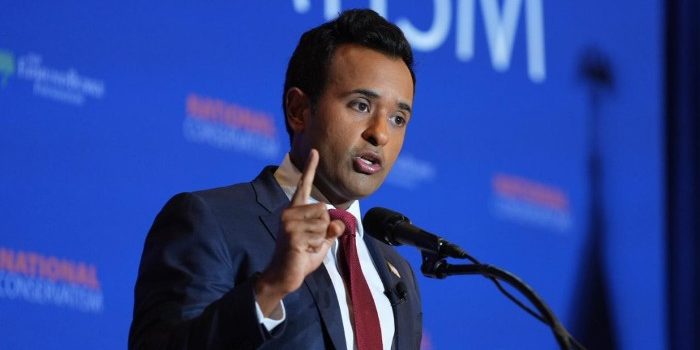
(José Niño, Headline USA) The Ohio Republican Party chairman championing Vivek Ramaswamy’s gubernatorial bid works at a law firm that profits from the same H-1B visa system his candidate vows to dismantle.

Alex Triantafilou serves as partner at Dinsmore & Shohl, a Cincinnati law firm with a dedicated immigration practice that secures H-1B visas for corporations hiring foreign workers.

Between 2022 and 2024, Dinsmore filed five Labor Condition Applications for H-1B visas with a 100 percent approval rate, according to federal records. The firm’s Immigration Group represents corporations, universities, and research institutions seeking work visas and permanent residency for foreign employees.

Triantafilou simultaneously leads Republican support for gubernatorial candidate Vivek Ramaswamy, who campaigns on eliminating the H-1B visa program. In January, Triantafilou praised Ramaswamy’s running mate selection. He previously called Ramaswamy “a brilliant visionary leader” in a twitter post published on Dec. 20, 2025. 

In May 2025, Triantafilou orchestrated the Ohio Republican Party’s endorsement of Ramaswamy, the earliest the state party has ever backed a non-incumbent gubernatorial candidate. The vote produced a 60 to 3 victory over Attorney General Dave Yost.

Ramaswamy has called the H-1B program “indentured servitude” and vowed to “gut” it as governor. “The lottery system needs to be replaced by actual meritocratic admission,” he said. “I’ll gut it.”

However, his business behavior tells a different story. Ramaswamy’s biotech company Roivant Sciences received approval for 29 H1B applications between 2018 and 2023 for positions including computational chemists and machine learning engineers with salaries from $75,000 to $215,000.

As Headline USA has previously reported, Ramaswamy has criticized Americans’ work ethic, in an attempt to justify the expansion of tech visas.

A Twitter user criticized Ramaswamy’s connection to Triantafilou, writing “You are a partner with Dinsmore who is in Kentucky right now bulldozing neighborhoods down for Amazon warehouses.”


Triantafilou has not publicly stated personal positions on H1B visas during his 17 years leading county and state Republican parties. His relationship with Ramaswamy appears based on political alignment rather than personal friendship.

Dinsmore employees contributed $33,826 to Democratic Senator Sherrod Brown and $32,215 to Vice President Kamala Harris during the most recent election cycle, compared to $2,923 to Donald Trump, according to OpenSecrets data.

St. Paul Church Congregant Says ‘We Were Surrounded’

(The Center Square) A member of Cities Church said protesters who disrupted a Sunday morning service in St. Paul were seated throughout the congregation before the service began.

Caleb Phillips, speaking with The Center Square in an exclusive interview on Monday, said, “The entire congregation came alive. Individuals who are planted from front to back throughout the entire place stood up. It felt like we were surrounded, because they were all throughout the congregation.”

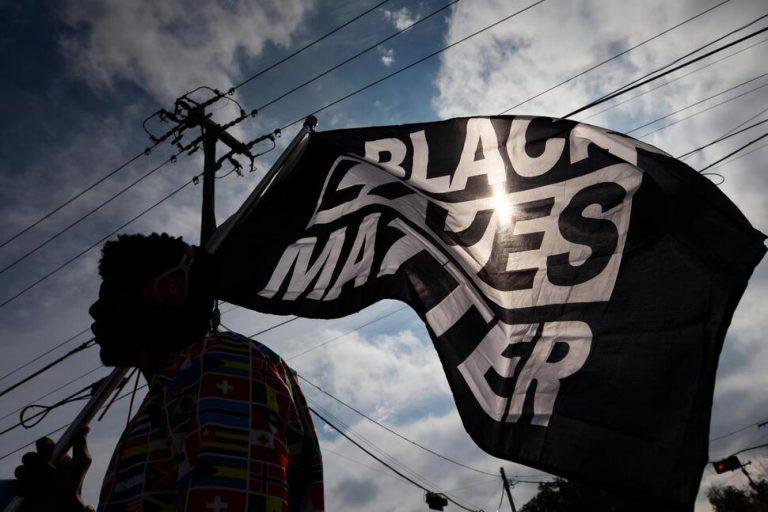
The U.S. Department of Justice is investigating the protest organized in part by Black Lives Matter Minnesota.

Video posted by the group shows protesters chanting “ICE out” and “justice for Renee Good” during the service. Another video circulating on social media shows a protester calling congregants “pretend Christians” and “comfortable white people.”

Phillips said it was a very tense situation for the congregation, and attendees initially were excited to have so many new people at the service.

“Most of them definitely were already sitting in the congregation with other congregants,” Phillips said. “Some of them had talked with these people, assumed that they were visitors or new attendees, and asked them a little bit about themselves, and just tried to welcome them.”

Published reports say the protesters discovered one of the church’s pastors works for U.S. Immigration and Customs Enforcement. A descriptor used is a “clandestine mission.”

Enhanced enforcement of federal immigration law has been increased in the Twin Cities in recent weeks. Tensions have escalated, with federal agents often impeded by people trying to prevent them from doing their work.

Phillips said that the church is standing by David Easterwood, a pastor at Cities Church and also head of a local U.S. Immigration and Customs Enforcement field unit. The congregation met again Sunday evening to finish the interrupted service; Phillips said Pastor Jonathan Parnell addressed the protest.

“He said that David Easterwood has worked in law enforcement for the entire time that he’s known him,” Phillips said. “He also said that David Easterwood is a good man and a just and righteous man.”

Phillips said the church’s support for Easterwood is not political.

“He is our pastor and our brother in Christ,” he said. “We love him and we are going to stand with him, regardless of what the current public opinion on his job is.”

Shootings each of the last two Wednesdays, one fatal, have added more tension and rhetoric in conversations. On Jan. 7, 37-year-old Renee Nicole Good drove onto a street with ICE officers conducting immigration enforcement. Her vehicle struck a federal agent and she was killed by what Homeland Security says were “defensive shots” fired.

Tricia McLaughlin, assistant secretary of Homeland Security, said Good’s vehicle was “attempting to run over our law enforcement officers” and that an officer fired after fearing for his life. Homeland Security Secretary Kristi Noem called the incident an “act of domestic terrorism.”

City and state leaders have disputed that account, saying ICE’s presence in the community has created chaos and harm.

On Jan. 14, an agent trying to detain a person believed illegally in the country was beaten by others before firing a defensive shot. Four suspects, including the initial person wanted by the agents, were taken into custody.

Widespread protests, school closures and violence have risen in the nearly two weeks since Good was killed.

Federal officials said Sunday’s protest will receive significant attention, as the Justice Department and the Federal Bureau of Investigation work together to pursue charges for federal crimes. Some of those crimes could include violations of the Freedom of Access to Clinic Entrances (FACE) Act of 1994, which prohibits obstruction or threats at abortion clinics and places of worship.

“There are already two prosecutors from my office on their way to Minneapolis,” said Harmeet Dhillon, assistant attorney general for the DOJ’s Civil Rights Division. “There is no more sacred right in our Constitution than the right to assemble and pray to God.”

Phillips, who has lived in the Twin Cities his entire life, explained in more detail the events of Sunday morning’s protest. He said the 10:30 a.m. service was proceeding normally until the sermon began.

“The lead pastor gets up, prays and tells us to open our Bibles to John Chapter 13,” he said. “And then this lady stands up in the back and she says, ‘Excuse me, pastor.’”

Phillips said she then accused the church of employing an ICE official as a pastor. As church members attempted to escort her out, dozens of people throughout the congregation then stood up and began chanting.

“A lot of the children just immediately started crying, because it was so sudden and so loud and just frightening for them,” Phillips said, explaining there were a couple different reactions from the congregation to the protest. “Some people helped the families that had young children … a lot of others stayed in the sanctuary, and we were either praying or singing or reading Scripture.”

Phillips said he read aloud from the Bible until he lost his voice and church staff eventually directed remaining members to a smaller chapel while police removed the protesters.

Church officials and Republicans have been responding to the protest, which quickly captured national attention far beyond Minnesota. Alex Plechash, chairman of the Republican Party of Minnesota, called out Democrats.

“When government closed churches, Democrats cheered,” Plechash said. “When mobs disrupt worship, Democrats look the other way. Governor Tim Walz and Senator Klobuchar: condemn this now!”

Phillips said it has been a surreal experience to see his church in the national news, but warned that there has also been a lot of misrepresentations about what actually happened.

“I was there, and I know exactly what happened,” Phillips said. “I’m seeing all these people who are like, ‘Well, I watched a livestream and I know exactly what happened,’ and it’s like, no, you really don’t.”

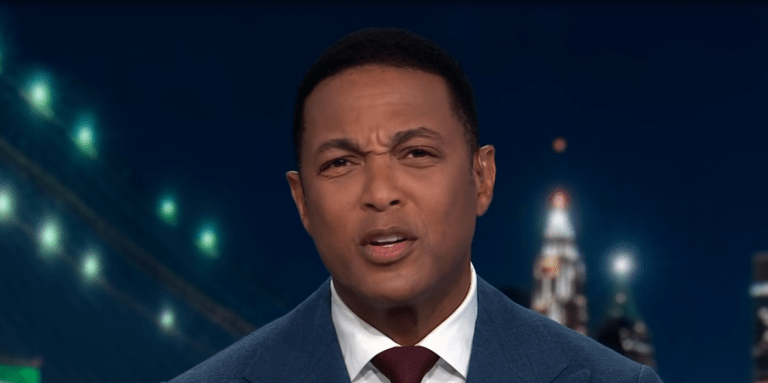
So far, Democrats both in Minnesota and nationally have been largely silent regarding the church protest. Others, like journalist Don Lemon, who was on the ground in the church covering the protest, defended the protestors’ actions.

“I imagine it’s uncomfortable and traumatic for the people here,” Lemon said. “But, that’s what protesting is about.”

Some commentators are calling for Lemon’s arrest. Dhillon directly addressed those calls during a Monday morning interview.

“Don Lemon himself has come out and said he knew exactly what was going to happen inside that facility,” Dhillon said. “He went into the facility, and then he began ‘committing journalism,’ as if that’s sort of a shield from being an embedded part of a criminal conspiracy. It isn’t.”

Dhillon promised there will be serious repercussions for those involved in the protest.

“Come next Sunday, nobody should think in the United States that they’re going to be able to get away with this,” she added. “The fullest force of the federal government is going to come down and prevent this from happening and put these people away for a long, long time.”

While Phillips said he hopes there is justice in the wake of the protest, he is grateful because of the reaction of “love, forgiveness, and prayer” from the congregation.

“Our response is love for one another,” he said. “Hopefully, in that, even the people who seem to hate us so deeply, will see Jesus Christ in us.”


WATCH: 100 Vehicles Crash in Michigan as Snowstorm Moves Across the Country

(Headline USAMore than 100 vehicles smashed into each other or slid off an interstate in Michigan on Monday as snow fueled by the Great Lakes blanketed the state.

The massive pileup prompted the Michigan State Police to close both directions of Interstate 196 Monday morning just southwest of Grand Rapids while officials worked to remove all the vehicles, including more than 30 semitrailer trucks. The State Police said there were numerous injuries, but no deaths had been reported.

Pedro Mata Jr. said he could barely see the cars in front of him as the snow blew across the road while driving 20-25 mph before the crash. He was able to stop his pickup safely, but then decided to pull his truck off the road into the median to avoid being hit from behind.

“It was a little scary just listening to everything, the bangs and booms behind you. I saw what was in front of me. I couldn’t see what was behind me exactly,” Mata said.

The crash is just the latest impact of the major winter storm moving across the country. The National Weather Service issued warnings about either extremely cold temperatures or the potential for winter storms across several states starting in northern Minnesota and stretching south and east into Wisconsin, Indiana, Ohio, Pennsylvania and New York.

A day earlier, snow fell as far south as the Florida Panhandle and made it harder for football players to hang onto the ball during playoff games in Massachusetts and Chicago. Forecasters warned Monday that freezing temperatures are possible overnight into Tuesday across much of north-central Florida and southeast Georgia.

The Ottawa County Sheriff’s office in Michigan said multiple crashes and jack-knifed semis were reported along with numerous cars that slid off the road. Stranded motorists were being bused to Hudsonville High School, where they could call for help or arrange a ride.

Officials expected the road to be closed for several hours during the cleanup.

One of the companies helping remove the stranded cars, Grand Valley Towing, sent more than a dozen of its trucks to the scene of the chain-reaction crash. Several towing companies responded in the brutally cold weather.

“We’re trying to get as many vehicles out of there as quickly as possible, so we can get the road opened back up,” manager Jeff Westveld said.

Adapted from reporting by the Associated Press


Trump Says US Will Seize Greenland Over Peace Prize Snub

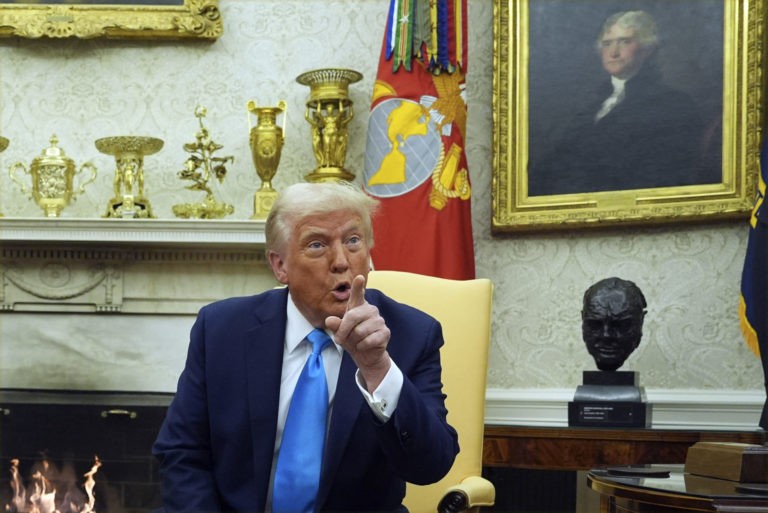
(Kyle Anzalone, Antiwar.comPresident Donald Trump said he shifted his foreign policy in response to not receiving the 2025 Nobel Peace Prize. The President explained that his new worldview has led him to seek total control of Greenland.

“Considering your Country decided not to give me the Nobel Peace Prize for having stopped 8 Wars PLUS, I no longer feel an obligation to think purely of Peace,” Trump wrote in a letter to Norwegian Prime Minister Jonas Gahr Store that Bloomberg obtained.

“Although it will always be predominant, but can now think about what is good and proper for the United States of America.” He continued, “The World is not secure unless we have Complete and Total Control of Greenland.”

Store responded by saying he previously explained to Trump that the Norwegian government does not award the Peace Prize. “Regarding the Nobel Peace Prize, I have several times clearly explained to Trump what is well known, namely that it is an independent Nobel Committee, and not the Norwegian government, that awards the prize,” he told Bloomberg.

Venezuelan opposition figure María Corina Machado was awarded the Peace Prize in 2025. She has advocated for the US to sanction and use military force against Venezuela. After US military forces kidnapped President Nicolas Maduro, Machado gifted her Peace Prize medal to Trump.

However, Trump has dismissed Machado as a potential future leader in Venezuela.

Trump has argued that the US must seize Greenland to protect the Danish colony from Russia and China. “Denmark cannot protect that land from Russia or China,” Trump wrote in the letter to Store. “The World is not secure unless we have Complete and Total Control of Greenland.”

Many European countries have opposed Trump’s plan to seize Greenland. On Sunday, Trump placed a 10% tariff on eight European countries that have objected to his efforts. The President said the tariffs will increase if the nations do not drop their opposition.

This article originally appeared at Antiwar.com.


Indiana Judge Shot at His Home; Suspect on the Loose

(Headline USAAn Indiana state court judge and his wife were in stable condition Monday as authorities continued to search for suspects who shot the couple the day before at their Lafayette home.

Steven Meyer, a Tippecanoe Superior Court judge, suffered an injury to his arm and his wife, Kimberly Meyer, had a hip injury from the attack, authorities said.

Officers responded Sunday afternoon to a report of a shooting in the residential area about 60 miles northwest of Indianapolis to find the couple injured. They were treated for their wounds, and officers recovered shell casings from the scene.

Lafayette Police said the investigation remains active and involves local, state and federal agencies. They have not released a motive or suspect description.

Mayor Tony Roswarski assured the community that every available resource was being used to apprehend the person or people responsible for what he called “this senseless unacceptable act of violence.”

Kimberly Meyer said in a statement Monday that she has “great confidence” in investigators and is grateful to the officers and medical professionals who helped her and her husband.

The shooting had other Indiana judges worried for their safety, with state Supreme Court Chief Justice Loretta H. Rush urging them to “please remain vigilant in your own security.”

“I worry about the safety of all our judges,” she wrote in a letter to the state’s judges. “As you work to peacefully resolve more than 1 million cases a year, you must not only feel safe, you must also be safe. Any violence against a judge or a judge’s family is completely unacceptable.”

Adapted from reporting by the Associated Press


FBI Probing Viral Theft After Independent Journalist Was Dragged by Car

(Luis CornelioHeadline USA) The FBI is reportedly investigating an incident in which a Somali immigrant allegedly stole the camera of independent journalist Nick Sortor and then allegedly dragged him with his running vehicle.

“We’re on it,” the FBI’s rapid response team wrote on X Monday, responding to video shared by Sortor of the alleged theft.

In the footage, Sortor is seen struggling with an unidentified individual inside a vehicle. He said the person had stolen his camera. Sortor then exits his car and pursues the man, who is seen entering a vehicle. Seconds later, Sortor appears to be dragged as his hand becomes caught in the car’s door handle.

“A group of Somali thugs just ROBBED me of my $1,000 camera in the Cedar Riverside neighborhood of Minneapolis,” Sortor wrote. “They then DRAGGED ME DOWN THE STREET as my hand got trapped in their door handle.”

He added, “NOBODY bothered helping. DHS MUST RAID THIS PLACE!”

In another video posted by Sortor, a Minneapolis police officer advised him to leave the area to avoid further confrontations with local Somali residents.

The Sortor incident is the latest flare‑up in Minnesota following the deployment of federal immigration agents.

ICE agent fatally shot Minneapolis activist Renée Good, an event that sparked widespread protests and ongoing scrutiny of federal tactics.

DOJ Puts Don Lemon ‘on Notice’ After Video Showed Him Embedded With Church Rioters

(Luis CornelioHeadline USA) Former CNN anchor turned YouTuber Don Lemon appeared to admit he was embedded with a group of anti-ICE protesters who disrupted a church service in Minnesota on Sunday, according to video he recorded ahead of the incident.

In the footage, Lemon said he conducted “reconnaissance” alongside the protesters before the disruption unfolded, as seen in a clip shared on X by the Media Research Center.

“These are resistance protesters, they’re planning an operation we’re going to follow them on,” Lemon stated. “I can’t tell you exactly what they’re doing, but it’s called Operation Pull-Up.”

He later added, “So that’s what we’re doing here, and after we do this operation, you’ll see it live, these operations are surprise operations, again I can’t tell you where they’re going.”

The protest, which went viral on social media and was largely documented by Lemon for his online show, disrupted a church service after anti-ICE activists claimed one of the church’s pastors also served as a federal immigration officer.

The disruption has drawn scrutiny for potential violations of the federal FACE Act.

Lemon himself was later put “on notice” by Assistant Attorney General Harmeet Dhillon after he defended the protest inside the church.

“A house of worship is not a public forum for your protest! It is a space protected from exactly such acts by federal criminal and civil laws! Nor does the First Amendment protect your pseudo journalism of disrupting a prayer service,” Dhillon wrote. “You are on notice!”

Dhillon has suggested in subsequent media appearances that Lemon himself could face a federal investigation, along with other activists involved in the disruption.

Indian Gold Demand Resilient Despite Record Prices

(Mike Maharrey, Money Metals News Service) Indian gold demand has remained resilient, despite record-high prices, driven by strong investment demand.

India ranks as the world’s second-largest gold market.

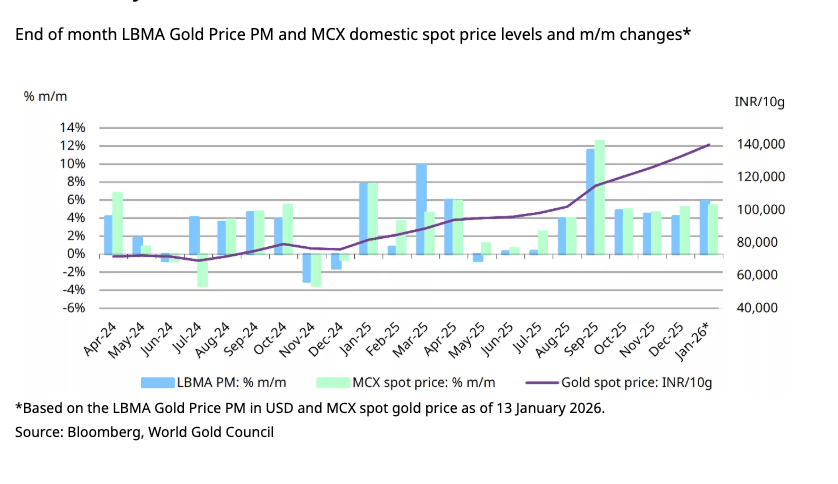
The gold price continued to surge in the final month of 2025, with domestic prices in India broadly tracking the global price.

Higher prices have created headwinds for Indian jewelry sales. Sales volumes are down. However, the value of jewelry sales is up thanks to the appreciating price. According to survey work by the World Gold Council, “Needs-based wedding purchases remain steady, providing key support to overall jewelry demand.

While Indian consumers haven’t sworn off gold, some have shifted toward lighter-weight pieces, and in some cases, lower-purity gold.

Historically, Indians have used gold jewelry as an investment as well as an adornment and have preferred 22-karat pieces. However, more consumers are now opting for 18 and 14k gold to economize.

Meanwhile, according to the WGC, “Exchange activity continues to be robust, highlighting value-conscious consumer behavior: some retailers report that over 40 percent of their jewelry sales are driven by old jewelry exchange.

The drop in sales isn’t hurting retailers. They are making up for lower volume with higher prices. Listed Indian jewelry retailers reported strong revenue growth ranging from 37 percent to 51 percent on an annual basis in Q4, supported by festival and wedding demand.

While rising prices are creating headwinds for jewelry demand, it is boosting investment interest. Sales of gold bars and coins have been robust. The World Gold Council says the market is attracting new participants hoping to cash in on the price momentum.

Strong ETF growth also reflects growing Indian investment demand. Gold has flowed into Indian funds for eight straight months. Gold inflows set a record of ₹116 billion in December.

Cumulative holdings increased by a record 8.6 tonnes in December, lifting the 2025 total to a historic high of 95 tonnes.

According to the World Gold Council, “Investor appetite was supported by muted equity market performance and sustained gold price momentum, reinforcing the role of gold ETFs as a preferred portfolio diversifier.”

Indians have historically preferred physical gold, but interest in ETFs swelled last year. There was a 60 percent annual increase in accounts (folios). As of the end of December, there were 10.2 million Indian ETF accounts, with 3.8 million added last year.

A gold ETF is backed by a trust company that holds metal owned and stored by the trust. In most cases, investing in an ETF does not entitle you to any amount of physical gold. You own a share of the ETF, not gold itself. ETFs are a convenient way for investors to play the gold market, but owning ETF shares is not the same as holding physical gold.

There was also a healthy increase in digital gold purchases through the Unified Payments Interface (UPI). Transaction values nearly tripled last year, rising from ₹8 billion ($88 million) in January to ₹21 billion ($231 million) in December.

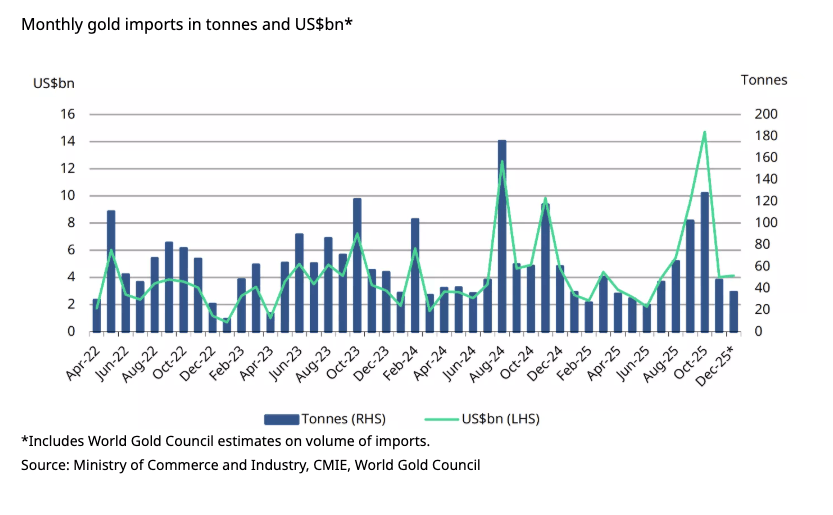
Indian gold imports grew by 3 percent in value terms month-on-month in December. However, the World Gold Council estimates import tonnage declined modestly from 48 tonnes in November to 35-40 tonnes last month.

Through 2025, the Indian gold import bill was similar to the previous year at around $59 billion. However, volumes declined by over 20 percent, reflecting higher gold prices.

Indians love gold for both cultural and economic reasons.

The yellow metal is deeply interwoven into India’s marriage ceremonies, along with its religious and cultural rituals. Festival seasons typically boost gold demand.

Indians also value the yellow metal as a store of wealth, especially in poorer rural regions. Around two-thirds of India’s gold demand comes from beyond the urban centers, where large numbers of people operate outside the tax system. Many Indians use gold jewelry not only as an adornment but as a way to preserve wealth.

In the West, gold is generally viewed as a luxury item.

Not in India. Even poor Indians buy gold.

According to a 2018 ICE360 survey, one in every two households in India had purchased gold within the last five years. Overall, 87 percent of Indian households own some gold. Even households at the lowest income levels in India hold some of the yellow metal. According to the survey, more than 75 percent of families in the bottom 10 percent of income managed to buy some gold.

The yellow metal was a lifeline for Indians buffeted by the economic storm caused by the government’s response to COVID-19. After the Indian government locked down the country, banks tightened credit to mitigate the default risk. Unable to secure traditional loans, Indians used gold to secure financing. As Indians endured a second wave of lockdowns, many Indians resorted to selling gold outright to make ends meet.


Mike Maharrey is a journalist and market analyst for Money Metals with over a decade of experience in precious metals. He holds a BS in accounting from the University of Kentucky and a BA in journalism from the University of South Florida.