State Dept. Officer Goes on Stabbing Spree

(José Niño, Headline USA) A road-rage confrontation on the Capital Beltway erupted into a chaotic stabbing spree Sunday, on the outer loop of Interstate 495 in Annandale, Virginia, leaving one woman and a dog dead and three other women seriously wounded, per a report by FOX 5 DC. 

Virginia State Police said the violence followed a crash in the southbound lanes shortly after 1:20 p.m., with the damaged vehicles stopped along the highway’s breakdown lane, according to The Washington Post. WTOP News reported that as authorities rushed in, the normally clogged corridor ground to a halt, with law enforcement shutting down lanes and emergency responders working to reach victims on the shoulder. 

When a trooper arrived, police said he was confronted by a man carrying a knife and fired in self-defense. The suspect—identified as Jared Llamado, 32, of McLean—was transported to a hospital and later died, per FOX 5 DC. The trooper was not injured and has been placed on administrative leave, a standard step while the officer-involved shooting is reviewed, as WTOP News reported. 

Police identified the deceased victim as Michelle Adams, 39, of Fairfax. Fox 5 DC noted that three other victims—Dana Bonnell, 36; Mary C. Flood, 37; and Heather Miller, 40—were hospitalized with serious injuries. A dog also died in the attack. Authorities have not publicly explained the victims’ relationship to one another, including whether they were traveling together or stopped to assist after the crash. 

FOX 5 DC reported that the case drew immediate attention after the State Department confirmed that Llamado was a Foreign Service Officer, offering condolences but deferring further comment to the ongoing Virginia State Police investigation. According to CBS News, officials have not released a motive beyond classifying the incident as “road rage,” and they have said it is not believed to be terrorism-related. 

José Niño is the deputy editor of Headline USA. Follow him at x.com/JoseAlNino 

‘I’m Done’: Hillary Clinton Goes Berserk in Epstein Deposition

(Luis CornelioHeadline USA) Newly released deposition videos show Hillary Clinton lashing out at Republican lawmakers during questioning about her ties to Jeffrey Epstein. 

The footage, released Monday by the House Oversight Committee, captures Clinton clashing with Reps. Lauren Boebert, R-Colo., and Nancy Mace, R-S.C., during the closed-door Feb. 26 deposition. 

In one exchange, Clinton erupted after her attorney objected to the apparent leak of a photo from the closed-door hearing. 

Boebert appeared to acknowledge taking the photo, prompting Clinton to snap, shouting: “I’m done with this. If you guys are doing that, I am done. You can hold me in contempt from now until the cows come home. This is just typical behavior.” 

Boebert interjected, saying the photo had been taken before the deposition began, to which Clinton replied, “It doesn’t matter! We all are abiding by the same rules.” 

Shortly thereafter, Clinton got up from the table as the deposition paused. “Yeah, I’m done, for now,” she said. 

Later, Clinton sparred with Mace over questions about Commerce Secretary Howard Lutnick, whose name appeared in recently released Epstein-related DOJ documents.  

The emails show Lutnick had once invited Epstein to attend an “intimate” fundraiser with Clinton while she ran for president in 2016. 

“You asked the question! I’m going to answer your question,” Clinton shouted after being interrupted. 

When Mace said she was “a survivor trying to look out for others,” Clinton fired back: “And I was taking care of the people who lost 3,000 lives at the World Trade Center.” 

The deposition followed months of resistance, with Clinton and her husband, former President Bill Clinton, defying multiple subpoenas before finally appearing under oath.

Ret. Air Force General Goes Missing under Unknown Circumstances

(Luis CornelioHeadline USA) A retired general from the U.S. Air Force has gone missing in New Mexico, and authorities are sounding the alarm over medical concerns.

The Bernalillo County Sheriff’s Office in Albuquerque is urgently searching for William Neil McCasland, a 68-year-old top military official who once led the Air Force’s multi-billion-dollar science and technology programs.

According to a Silver Alert issued by BCSO, McCasland was last seen at 11 a.m. on Feb. 27 near a local street in Sandia Heights, New Mexico.

The semi-arid neighborhood features adobe-style homes set against the Sandia Mountains.

Authorities do not know his last clothing description or direction of travel.

The BCSO warned that “due to his medical issues law enforcement is concerned for his safety.”

McCasland was commissioned in 1979 after graduating from the U.S. Air Force Academy. His decorated career includes the Distinguished Service Medal, Defense Superior Service Medal, and the Legion of Merit with oak leaf cluster.

Before retiring in 2013, he was promoted from Brigadier General to Major General in 2007 at Kirtland Air Force Base, New Mexico.

Austin Terror Shooter Was Not on the FBI’s Radar

(Headline USA) ​​The gunman who opened fire outside a crowded Texas bar and killed two people in an attack that wounded 14 others was not on the radar of authorities before the shooting, federal and local investigators said Monday.

Both the FBI and police in Austin said Monday that it’s too soon to identify the motive behind the mass shooting early Sunday that the FBI has said is being investigated as a potential act of terrorism, coming after the U.S. and Israel launched an attack on Iran.

“Our ultimate goal in everything we do is to determine the motive,” Alex Doran, the acting agent in charge of the FBI’s San Antonio office, said during a news conference.

Police identified the gunman as 53-year-old Ndiaga Diagne. He was wearing clothes with an Iranian flag design and bearing the words “Property of Allah” during the attack, a law enforcement official told The Associated Press.

Investigators are poring over thousands of hours of video and police said there are more than 150 witnesses to interview. “We are still in the early hours of this investigation,” said Austin Police Chief Lisa Davis.

The gunman legally bought the weapons used in the attack several years ago in San Antonio, Davis said.

She identified the two victims as 21-year-old Savitha Shan and 19-year-old Ryder Harrington.

Harrington was a member of the Beta Theta Pi fraternity at Texas Tech University, his fraternity said in an Instagram post.

Diagne was originally from Senegal, according to multiple people briefed on the investigation who spoke on the condition of anonymity because they were not authorized to publicly discuss the investigation.

He first entered the U.S in 2000 on a B-2 tourist visa and became a lawful permanent resident six years later after marrying a U.S. citizen, according to the Department of Homeland Security.

Associated Press reporters on Monday were unable to reach Diagne’s family members in the Austin area or his former wife, who recently was listed as living near San Antonio. A person who answered the door at a house listed for his ex-wife declined to comment and told a reporter to talk with investigators.

The shooting erupted outside Buford’s Backyard Beer Garden along Sixth Street, a nightlife destination filled with bars and music clubs close to the University of Texas at Austin.

The gunman drove past the bar that was packed with students before circling back and firing the first shots from his SUV at people on the sidewalk and inside the bar, police said.

Inside the bar and across the street next to a food truck, some students dove for cover while others were motionless, trying to understand what was happening.

The shooting stopped for a moment.

The suspect parked, got out with a rifle and began shooting at others before officers rushed to the intersection and shot him, the police chief said.

University of Texas at Austin President Jim Davis said Sunday that some of those affected included “members of our Longhorn family.”

The FBI said just hours after the shooting that they found “indicators” on the gunman and in his vehicle leading them to look into the possibility of terrorism.

Adapted from reporting by the Associated Press


FBI Joins Cincinnati Police Search for Cincinnati Mass Shooter

(Headline USA) ​​Federal authorities joined local police Monday in the search for a suspect in a weekend nightclub shooting in Cincinnati that wounded nine people.

The nine were hospitalized with non-life threatening injuries after shots rang out around 1 a.m. Sunday inside the music venue Riverfront Live. Interim Cincinnati Police Chief Adam Hennie said all the victims were in stable condition.

The FBI was working with the Cincinnati Police Department on the investigation, said spokesperson Todd Lindgren, and the federal Bureau of Alcohol, Tobacco, Firearms and Explosives offered a $5,000 reward for information identifying a suspect.

Though it occurred almost simultaneously to a deadly bar shooting in Austin, Texas, which is being investigated as a potential act of terrorism, authorities in Ohio have not provided any details about a motive in the Cincinnati shooting.

Bill Halusek, spokesperson for the Cincinnati ATF, said that at this time, the Cincinnati shooting is not suspected to be an act of terrorism.

Anton Canady was at Riverfront Live when he said he heard “commotion” that sounded like a fight. He said music continued to play and shortly after, he heard gunshots. That’s when he and his girlfriend, Brandi Willis, began running for the exit.

Canady said Willis fell while trying to escape and to avoid her being trampled, he laid on top of her to protect her.

“I don’t think it was like they was doing it purposely or intentionally, I just think nobody wanted to die in there,” he said.

The 40-year-old Cincinnati resident spoke to The Associated Press from a hospital in Cincinnati while he waited for Willis to receive more medical attention for injuries she suffered during their attempted exit. Canady said his legs were cut and bruised.

When he finally exited the venue, he learned one of the people shot was his cousin.

“I hurried up, found something out of the car that was next to us. And I tied her wounds up so we can get that pressure. And we try to do the next step, which is call 911 and get her the attention she needed,” he said.

Canady said he spoke to his cousin on the phone Monday and she is “doing good” but is “in shock.”

Jermaine Tandy, also known as DJ Fresh, was hosting a birthday celebration at the venue, according to a post on his Facebook page. Management representing DJ Fresh said they were “devastated” by the events that took place during the celebration.

“Our hearts go out to the victims, their families, and everyone impacted by this senseless act of violence,” the statement said. “This event was intended to be an opportunity for us to come together and enjoy great music; and have fun celebrating life, it is deeply frustrating that the actions of one individual ruined the evening for so many.”

According to the post, the venue owners were responsible for security at the event under the DJ’s rental agreement.

Riverfront Live sits along the Ohio River not far from Riverbend Music Center and often draws customers from concertgoers to the much larger outdoor venue, which is closed in winter.

It was rebranded Riverfront Live in 2018 after gaining attention for criminal activity. Portions of the property have also held the names Stage Forty-Three and Inner Circle, but it is best known as the former site of the iconic rock club Annie’s, which hosted performances in the 1990s and early 2000s of well-known rock acts.


Adapted from reporting by the Associated Press

Trump and Hegseth Won’t Rule Out Sending Troops to Iran for a Mission They Won’t Define

(Dave DeCamp, Antiwar.com) President Trump said in an interview with The New York Post on Monday that he won’t rule out sending troops into Iran as the war the US and Israel launched against the Islamic Republic on Saturday morning continues to rage.

“I don’t have the yips with respect to boots on the ground — like every president says, ‘There will be no boots on the ground.’ I don’t say it,” Trump told the paper. “I say ‘probably don’t need them,’ [or] ‘if they were necessary.’”

Earlier in the day, US Secretary of War Pete Hegseth held a press briefing with Chairman of the Joint Chiefs of Staff Gen. Dan Caine, where he also refused to rule out sending troops into Iran and went on a tangent about how the US military doesn’t need to brief the American people on its plans.

When asked if there were currently US “boots on the ground” in Iran, Hegseth said, “No, but we’re not going to go into the exercise of what we will or will not do. I think it’s one of those fallacies for a long time that this department or presidents or others should tell the American people this — and our and our enemies, by the way — here’s exactly what we’ll do.”

Hegseth also contradicted Trump’s earlier remarks by saying it was not a “regime change war,” but he added that the “regime sure did change,” though the Iranian government remains intact despite the killing of Supreme Leader Ayatollah Ali Khamenei, which hasn’t slowed the Iranian military’s response.

While insisting the US wouldn’t get into an open-ended conflict or “quagmire” in Iran, Hegseth did not directly answer when asked what the administration’s “exit strategy ” is, as neither he nor Trump has clearly defined the goal. “As far as time frame, I would never hang a time frame from our perspective. The commander-in-chief sets the tempo and terms of this fight,” he said.

Trump previously estimated that the war could last four to five weeks, but said on Monday that the US has the capability to go “far longer” than that.

Caine said during the briefing with Hegseth that the US was deploying more troops and fighter jets into the region. “This work is just beginning and will continue,” he said.

This article originally appeared at Antiwar.com.  

Marjorie Taylor Greene Calls Out Vance and Gabbard for Previous Opposition to War With Iran

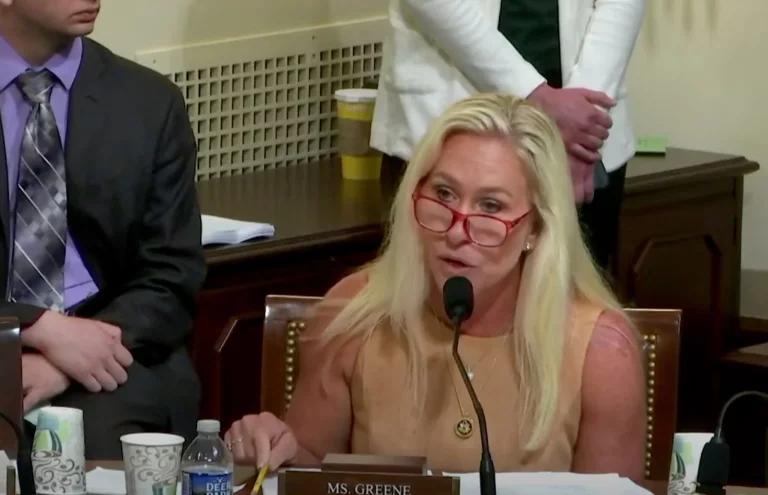
(Dave DeCamp, Antiwar.com) Former US House Rep. Marjorie Taylor Greene on Sunday urged Vice President JD Vance and Director of National Intelligence Tulsi Gabbard to speak out against the US war against Iran, citing their previous opposition to a conflict with the Islamic Republic.

“[Vance] and [Gabbard] you both need to speak out against the war in Iran. People are paying attention, very close attention. Silence won’t cut it. You were both on record repeatedly, publicly, and loudly against going to war with Iran,” Greene wrote on X.

“Our friend, Charlie Kirk was adamantly against war with Iran. You cannot be silent. Americans are dying. You both know this is not what we campaigned for and this is 100% what we said would not happen. We said, I said, you said: NO MORE FOREIGN WARS AND NO MORE REGIME CHANGE. All we wanted was America FIRST. This is not it,” she added.

During the first Trump administration, then-House Rep. Gabbard ran a presidential campaign and made “no more regime change wars” a major plank of her campaign. She was also harshly critical of President Trump’s escalations against Iran, which included the January 2020 killing of Iranian Gen. Qasem Soleimani.

“This was very clearly an act of war by this president without any kind of authorization or declaration of war from Congress, clearly violating the Constitution,” Gabbard said at the time. Trump also launched the current war with Iran without any authorization from Congress.

Amid the US and Israeli attacks on Iran, a clip of Vance warning against the idea of war with the Islamic Republic has resurfaced on X. “Our interest, I think, very much is in not going to war with Iran.  It would be a huge distraction of resources. It would be massively expensive to our country,” he said while on the campaign trail in October 2024.

Greene came out strongly against the US attacks on Iran hours after they began on Saturday and has cited Trump’s overseas interventions and support for Israel as it’s committing atrocities in Gaza as one of the reasons for her falling out with the president and recent resignation from Congress.

This article originally appeared at Antiwar.com

Undercover FBI Agents Bought Strippers for Defendant in Trump Assassination Plot Case

(Ken Silva, Headline USA) The trial of the man accused of working for Iran in an assassination plot against Donald Trump began last week, and new details are pouring out about the FBI’s role in the case.

The defendant in the case, Pakistani national Asif Merchant, is accused of attempting to hire two undercover FBI agents as “hitmen” to target politicians, including potentially Trump. Merchant was introduced to the two agents by an FBI informant, who knew him since 2017. The informant reportedly worked for the U.S. Army as a linguist in Afghanistan before becoming a government spy.

Last week, one of the undercover agents testified. The agent said that after the FBI informant introduced him to Merchant, they had a meeting in a strip club. There, the agents bought Merchant “exotic dancers” as he “cryptically explained” his plan, according to the New York Times.

The Times reported Monday that Merchant appeared nervous at the strip club, and told the agents the targets would be given to him “in person” in Pakistan. Merchant was arrested July 12, 2024—the day before Trump was shot at Butler—as he was attempting to leave the U.S.

Merchant eventually scrounged up $5,000 as a down payment for the undercover agents. Instead of getting the money himself, Merchant acquired the cash in a roundabout way: his cousin from overseas called the FBI informant to say that the money was ready. The informant then collected the $5,000 from the unnamed “associate” while Merchant took a bus from Boston to New York for the pickup. The FBI informant met Merchant at a New York City bus station and gave the cash to him. Merchant later went to Manhattan to give the money to the two undercover FBI agents posing as hitmen.

Pretrial proceedings revealed that Merchant had been under U.S. surveillance before he entered the country in April 2024. Merchant was let in despite being on a terrorism watchlist—suggesting that it may have been the government’s plan to set him up all along.

After U.S. bombings killed Iran Supreme Leader Ayatollah Ali Khamenei on Saturday, Trump cited the purported Iranian assassination threat as a motivating factor.

“I got him before he got me. They tried twice. Well I got him first,” Trump told ABC News reporter Jonathan Karl.

It’s unclear whether Trump was referring to the Merchant case, or to conspiracies pushed by Israeli Prime Minister Benjamin Netanyahu and others that Iran was linked to the Butler shooting and the Palm Beach assassination attempt.

Ken Silva is the editor of Headline USA. Follow him at x.com/jd_cashless.

Sprott: Gold in the Spotlight as Deglobalization Trend Accelerates

(Mike Maharrey, Money Metals News Service) Gold is going to become increasingly important as the deglobalization and de-dollarization trend that took off last year continues to gain steam, according to a recent report published by Sprott.

What do we mean by “deglobalization?”

As Sprott described it, it’s the impact of a breakdown in post-WWII alliances, erosion of political and military norms, and an upending of foundational assumptions underpinning currencies and commodities.

“Deglobalization has become a structural transformation and reversal of the market trends of the past several decades, which will define market behavior for years to come.”

This will drive persistent inflation, elevated geopolitical risk premiums, and asset revaluation, including precious metals and “critical minerals.”

Sprott analysts Paul Wong and Jacob White say this growing disorder will accelerate de-dollarization, with gold increasingly filling the gap.

“Gold is gaining prominence as the globally accepted neutral reserve asset, reinforcing its role as a hedge against systemic risk and geopolitical uncertainty. The global debasement further amplifies the demand for gold.”

In an interview with Kitco News, Wong said that even as political alliances fragment and shift, power blocks will continue to trade with each other. Gold will play a key role as the global economy reorients.

“There’s still going to be investments, capital flows. That’s part of the reason why gold is so attractive to any power block, is that it acts as the neutral reserve currency, meaning that it’s a reference price. If you want to trade between block A and block B, there is a reference value, a neutral reserve value that everyone can agree on – or so far, they seem to be agreeing on.”

Central bank gold buying reflects the growing importance of the yellow metal in the quickly evolving global economy.

Last year was the fourth-largest expansion of central bank gold reserves on record. The all-time high was set in 2022 (1,136 tonnes). It was the highest level of net purchases on record, dating back to 1950, including since the suspension of dollar convertibility into gold in 1971. We also saw central bank purchases eclipse 1,000 tonnes in 2023 and 2024. To put that into context, the annual average for 2010-2021 was 473 tonnes.

The Sprott report notes the growing debasement trade with investors rotating out of “fiat-denominated assets and into stores of value such as gold, other precious metals, and select commodities.”

“A year ago, the debasement trade was outside of the mainstream, but it has evolved into a structural allocation theme.”

This is due to growing worries about global debt and surging inflation. The Sprott report argues that “the pandemic-era policy mix of greater debt, deficits and stimulus has entrenched fiscal dominance as a structural regime.”

“In this environment, government spending dictates monetary policy, and central banks increasingly prioritize debt sustainability over inflation control. This dynamic underpins the debasement trade, a secular shift toward hard assets as fiat currencies rapidly lose purchasing power.”

Due to the Debt Black Hole, Sprott believes central banks will adopt a “run-it-hot” monetary policy, choosing inflation over a potential economic meltdown.

“The combination of fiscal dominance and monetary accommodation sets the stage for a reflationary impulse in 2026. Traditional hedges lose efficacy as policy deliberately undermines real returns. In this environment, precious metals, real assets, commodities and inflation-linked instruments become favorable allocations in a world where policy-driven liquidity becomes a primary driver of asset prices.”

The Sprott analysts say they think “the debasement trade is likely to accelerate, reinforcing the strategic case for hard assets in institutional portfolios.”

They also take aim at the notion that gold is overbought. Wong and White concede it looks that way, but the yellow metal remains underinvested. Central bank buying laid the foundation for the current gold market, but a lot of investors still haven’t hopped on the bandwagon.

“If you pull the chart, your first thought is, ‘Man, this thing really looks overbought.’ Then you go around, you ask investors and most investment funds, and they’re thinking, ‘Boy, I wish I could own a little bit more.’ And that’s the issue. It’s literally come to the point now where there aren’t really any sellers of any real size or duration, and there’s a large set of buyers underneath it all, and the trends just keep building and reinforcing the [price] action.”

The tide seems to be turning, especially after Morgan Stanley CIO Michael Wilson said investors should consider abandoning the traditional 60/40 equity/bond portfolio allocation and adopt a 60/20/20 distribution with 20 percent allocated to precious metals.

On average, most Western investors (institutional and private) hold less than 1 percent of gold in their portfolios. If investors take even modest steps toward that allocation, it will add significant demand to the equation, further increasing upward price pressure.

Given the evolving economic and market dynamics, Sprott analysts say gold is positioned to shine.

“In a world of competing currency blocs, persistent deficits, and policy codependence, gold stands as a globally accepted store of value. While gold’s 2026 price action may not match its remarkable 2025 rally, the risk skew remains to the upside, particularly under renewed liquidity waves or geopolitical shocks. While price charts may indicate overbought conditions, gold remains under-owned among most investors.”

Wong summed it up with a rhetorical question.

“What’s the best bearish argument on gold? The fact it’s gone up too much? To me, that’s not a great argument.”


Mike Maharrey is a journalist and market analyst for Money Metals with over a decade of experience in precious metals. He holds a BS in accounting from the University of Kentucky and a BA in journalism from the University of South Florida.


Could the Rising Popularity of ETFs Dent Indian Physical Gold Demand?

(Mike Maharrey, Money Metals News Service) Indians have a longstanding love affair with gold. Historically, they have preferred to hold physical metal. However, over the last two years, investment in Indian gold ETFs has exploded. Could surging investments into paper gold cut into physical demand?

Analysts at Metals Focus don’t think so, arguing that there won’t likely be a material decline in bar and coin demand because “a substantial base of investors continues to prefer physical gold, including those who value holding physical metal and purchases funded through unaccounted income.

India ranks as the second-largest gold market in the world behind China. The country accounts for nearly 20 percent of global retail offtake. Demand climbed by 17 percent year-on-year in 2025, driven by heightened investor interest as gold repeatedly scaled new record highs.

Over the last decade, Indian investors have snapped up 1,800 tonnes of gold coins and bars, highlighting Indian passion for the yellow metal.

In 2015, the Indian government created a sovereign gold bond (SGB) program. Issued by the Reserve Bank of India, these government-backed securities were denominated in grams of gold. They paid 2.5 percent annually over 8 years and were redeemable based on the current gold price at maturity.

SGBs opened the door for Indian investors to gain exposure to gold in a low-risk way without holding the metal, and demand for SGBs accelerated sharply post-COVID, with nearly 80 percent of total inflows recorded after April 2020.

Gold ETFs became available in India in 2007, but weren’t very popular. However, when the government discontinued new issuances of SGBs in February 2024, ETF flows began to increase.

A gold ETF is backed by a trust company that holds metal owned and stored by the trust. In most cases, investing in an ETF does not entitle you to any amount of physical gold. You own a share of the ETF, not gold itself. ETFs are a convenient way for investors to play the gold market, but owning ETF shares is not the same as holding physical gold.

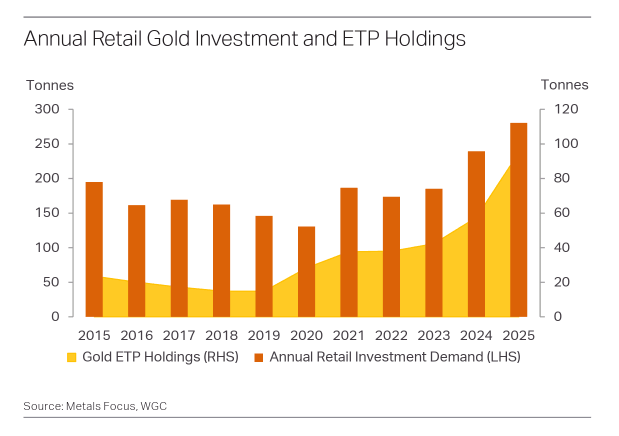
In December 2023, Indian ETF gold holdings stood at 42.3 tonnes. As of January 2026, Indian ETFs held 110.5 tonnes of gold. That’s a 161 percent increase.

Indian ETFs charted their ninth straight month of gold inflows in January, totaling ₹240 billion ($2.5 billion). That drove assets under management (AUM) to a new high of ₹1.8 trillion. AUM by Indian-based gold funds has more than tripled on a year-over-year basis.

Investor participation has also grown by leaps and bounds. In January, Indian funds reported another 1.2 million accounts, pushing the total number of gold ETF folios to 11.4 million.

According to Metals Focus, several factors beyond surging gold demand generally have supported ETF growth.

“First, the discontinuation of SGBs redirected a portion of incremental flows toward ETPs. Second, the launch of several new multi-asset funds, which allowed for 15-20 percent allocations to gold, created an additional channel supporting ETP inflows. As a result, inflows into gold ETPs have surpassed equities for the first time in January 2026. More recently, the government’s decision to allow pension funds to allocate up to 1 percent of assets to gold could generate further incremental demand for ETPs. Structural features have also improved accessibility. With each ETP unit typically representing 0.01g of gold, investors allocating through systematic investment plans can deploy fixed amounts without worrying about minimum quantities, unlike physical gold where even 1g purchases require a higher ticket size. For instance, in February 2023, 1g gold cost around ₹6,000, which has now jumped to roughly ₹16,000.”

ETFs accounted for just 2 percent of annual investment inflows in 2023. That jumped to 6 percent in 2024 and then to 13 percent last year.

“If sustained, this trend would signal a structural shift in retail activity away from physical gold toward ETPs.”

However, Metals Focus analysts don’t anticipate the rising popularity of ETFs to drive a decline in physical gold demand because there are plenty of Indians who prefer to hold bars, coins, and gold jewelry. Furthermore, a large percentage of the Indian population lives in rural areas that lack the technology infrastructure to support electronic investing.  Around two-thirds of India’s gold demand comes from beyond the urban centers.

Instead of stealing from physical gold demand, it appears ETFs are merely adding to it.


Mike Maharrey is a journalist and market analyst for Money Metals with over a decade of experience in precious metals. He holds a BS in accounting from the University of Kentucky and a BA in journalism from the University of South Florida.