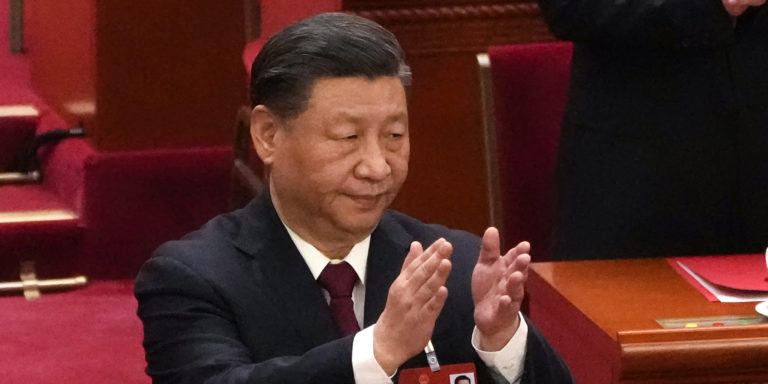
(Luis Cornelio, Headline USA) A recent report has exposed a staggering surge in Chinese nationals attempting illegal entry into the United States via the southern border, with over 24,000 individuals intercepted in 2023 alone.
This number surpasses the combined total of Chinese migrants apprehended over the past 10 years, marking an unprecedented spike in this demographic’s attempts to enter the country illegally.
According to the New York Times, the journey for these illegal aliens often begins with visa-free flights to Ecuador. From there, they all rely on human smugglers to navigate the deadly route of the Darien Jungle between Colombia and Panama.
An alarming trend accompanying this surge is the notably high rate at which these immigrants are filing for asylum claims. Even those who do not apply for asylum manage to stay in the U.S. due to China’s refusal to accept them back, posing a significant challenge to immigration authorities.
A government official disclosed that among the staggering 1.3 million individuals subject to final deportation orders, approximately 100,000 are Chinese nationals.
“More than 24,000 came to the United States during the 2023 fiscal year, according to government data. Over the previous 10 years, fewer than 15,000 Chinese migrants were caught crossing the southern border illegally,” the report alleged.
This surge in immigration has not escaped the scrutiny of national security concerns. Reports from the New York Post earlier this month emphasized the potential risks associated with this exponential increase.
“Clearly that border is a big opportunity,” remarked Rebecca Grant, a national security analyst at IRIS Independent Research.
Adding to the apprehension, news anchor David Asman raised alarms on Twitter about the possible infiltration of “terrorists” and “saboteurs” from regions like the Middle East and China.
“Thousands of ‘gotaways’ are potential terrorists and saboteurs from Mideast and China,” Asman said on Twitter. “Human smugglers banking $billions and using profits to finance more deadly fentanyl smuggling. Biden admin’s open border policies are enabling America’s worst enemies.”
The Biden administration’s open border policies have come under intensified scrutiny for enabling alleged adversaries of the United States to exploit the southern border. The current chaos ignited an impeachment effort against DHS Secretary Alejandro Mayorkas.
INSANE: ‘CBS Mornings’ had a full story (over four-minutes long) cheering the explosion of Chinese illegal immigrants pouring across the U.S. southern border.
Nothing about the country being communist and run by a regime with concentration camps. Instead, they said what the… pic.twitter.com/awr6mgUdZr
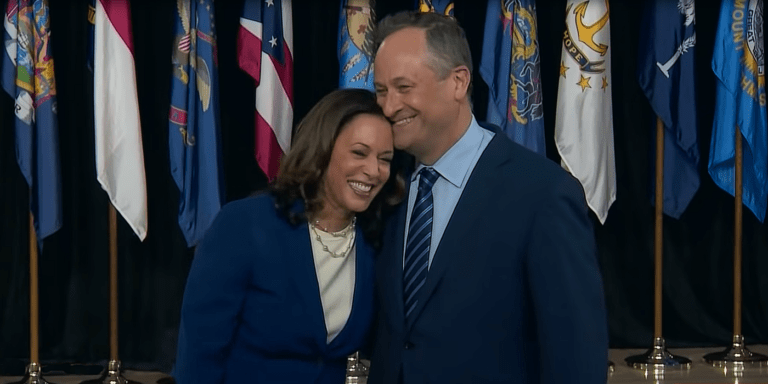
The image captured Harris and Second Gentleman Doug Emhoff in a cheesy Thanksgiving embrace in front of what appeared to be a gas stove, igniting fiery criticism over an apparent hypocrisy on the use of such appliances.
“Is that a gas stove?” questioned Rep. Mike Collins, R-Ga., sparking scrutiny over Harris’s tweet captioned, “From our family to yours, Happy Thanksgiving.”
Former Wisconsin Gov. Scott Walker and investigative journalist Laura Loomer swiftly echoed the sentiment, raising eyebrows and questioning the use of the gas stove in the photo.
Sen. Ted Cruz, R-Texas, seized the opportunity to highlight what he perceived as a contradiction, tweeting, “Wait…that’s a gas stove! The same kind Dems want to BAN you from owning.”
As reported by Fox News, the criticism pointed at Harris came after the Biden administration contemplated a gas stove ban following warnings by Richard Trumka, the Consumer Product Safety Commission’s top leader, about safety concerns associated with these appliances.
“This is a hidden hazard,” Trumka cautioned in an interview with Bloomberg. “Any option is on the table. Products that can’t be made safe can be banned.”
Trumka acknowledged discussions on a potential ban but clarified it would pertain solely to new appliances.
In response to the uproar, White House Press Secretary Karine Jean-Pierre attempted to address questions about the proposed ban, stating in July that any such measure would “not take into effect until 2029.”
“On appliances, from this administration we’ve seen them go after gas stoves…How many more home appliances will Americans eventually have to replace?!”
KJP: “It is proposed…It would not take into effect until 2029…It’s going to help consumers save about $11 billion a… pic.twitter.com/uNDN2jgcE5
However, conflicting reports surfaced, indicating a different approach by the Department of Energy. As reported by Fox News and the Daily Caller, the department aimed to impose energy efficiency standards on gas stove manufacturers.
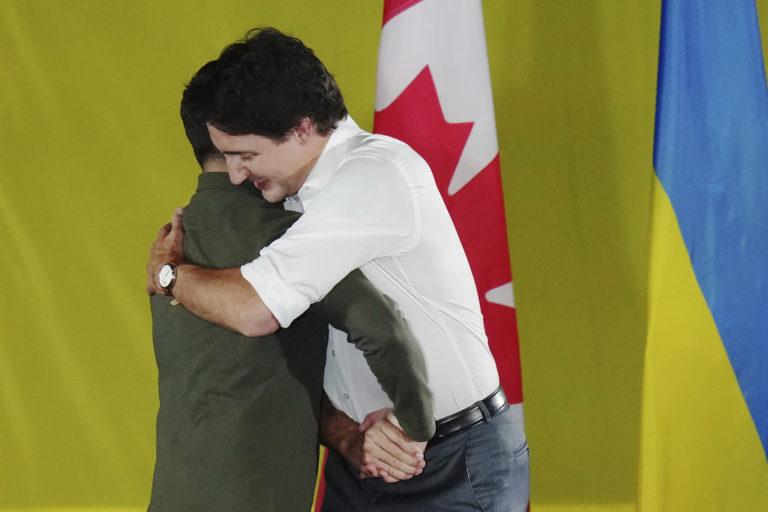
(Luis Cornelio, Headline USA) Canadian Prime Minister Justin Trudeau attributed the dwindling financial support for Ukraine to what he labeled as a resurgence of right-wing, American-inspired ideologies rather than the growing corruption scandals within the Ukrainian government.
In a recent press conference reported by CBC, Trudeau placed blame on the growing influence of MAGA ideology, claiming it had led Canadian Conservatives, originally supporters of Ukraine, to turn away from endorsing financial backing for the scandal-ridden country.
Justin Trudeau says the Canadian conservatives are being tricked by “MAGA conservatives” who “parrot Russian disinformation.” pic.twitter.com/qxop8zrzNN
“The real story is the rise of a right-wing, American MAGA-influenced thinking that has made Canadian Conservatives — who used to be among the strongest defenders of Ukraine, I’ll admit it — turn their backs on something Ukraine needs in its hour of need,” Trudeau claimed a press conference with European leaders.
“All Canadians should be concerned when the Conservative Party of Canada and Pierre Poilievre turn their backs on history, turn their backs on our friends and allies, turn their backs on the international rules-based order and our support for the UN charter on territorial integrity,” Trudeau added.
Trudeau’s anti-Republican rhetoric came during a contentious debate within Canada over the renewal of a free trade agreement with Ukraine. 109 Conservative lawmakers opposed the bill, a move that marked the first multi-party discord on support for Ukraine, according to CBC.
Opposition leader Pierre Poilievre criticized Trudeau’s focus on implementing a left-wing-led “cruel” and “disgusting” carbon tax within the agreement.
“I really think it speaks to how pathologically obsessed [Justin] Trudeau is with the carbon tax that, while the knife is at the throat of Ukrainians, he would use that to impose his carbon tax ideology on those poor people,” Poilievre remarked, before adding, “The last thing they need is a carbon tax when they’re trying to rebuild from war, and from this illegal invasion by Russia.”
Trudeau hosted European Council President Charles Michel and European Commission President Ursula von der Leyen in Newfoundland and Labrador, where the Canadian leader diverted attention from ongoing corruption scandals plaguing the highest echelons of the Ukrainian government.
Recent probes into lawmakers suspected of involvement in bribery schemes have further exposed the depth of alleged corruption, reported Reuters.
Allegations of widespread corruption have cast a shadow over Ukraine’s plea for international aid, with two aides of Ukrainian President Volodymyr Zelenskyy openly acknowledging the rampant theft within the government. “People are stealing like there’s no tomorrow,” one aide revealed to Time Magazinein October.
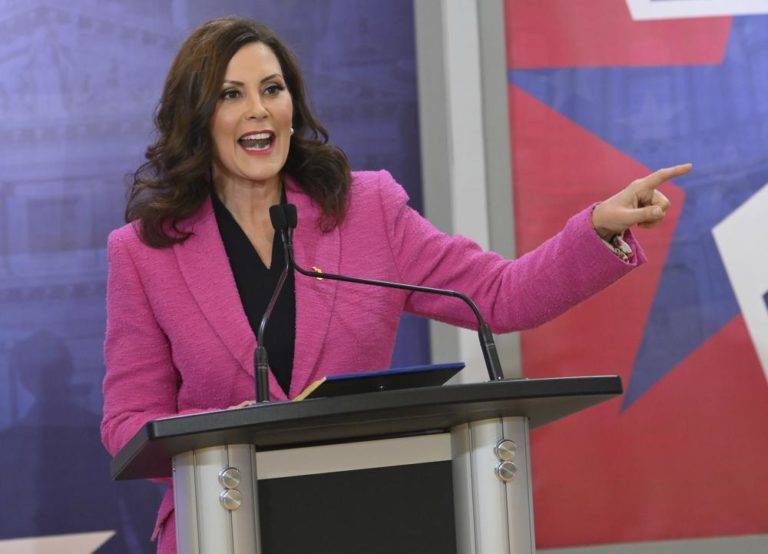
(Ken Silva, Headline USA) Earlier this year, Michigan Gov. Gretchen Whitmer signed a law into effect that allows the government to confiscate firearms from anyone a judge deems an “extreme risk.”
In protest of that law, Holton Township trustees reportedly passed a resolution earlier this month that designates the community as a “Second Amendment Sanctuary” and establishes a local militia.
“The people of Holton Township, through their duly elected members of Holton Township Board, hereby designate Holton Township as a Second Amendment Sanctuary in order to preserve for the people, on and in Holton Township, the inalienable rights guaranteed by the Constitution,” stated the resolution, passed on Nov. 14.
“Holton Township will not acknowledge any new laws that are associated with red flag laws, or any other infringement of the Second Amendment.”
The resolution further stated that the township won’t recognize gun laws passed after March 2021.
According to Michigan news station WoodTV8, Township Supervisor Alan Jager said the resolution was the result of concerns that residents’ Second Amendment rights were being violated.
“Whether they’re trying to pass something where they’re taking your rights away without you having due process. And I want you to be able to have due process,” Jager said.
Jager reportedly said there’s no plan for the forthcoming militia to patrol the area. He reportedly said that the militia will give residents greater legal protections to prevent guns from being taken away.
“We’re not trying to skirt anything. We’re just trying to make it so you have a fighting chance if you ever go to court. They can’t just take your guns away because you belong to a militia like the United States government says we have a right to do,” Jager said.
WoodTV8 also interviewed an attorney who said the township’s resolution probably won’t have much legal significance.
“I think a resolution is more of a statement,” Attorney Randall Levine told the news station. “There’s nothing in the creation of a militia which is going to alter in any way the prescriptions in Michigan law that pertain to responsible gun ownership and use.”
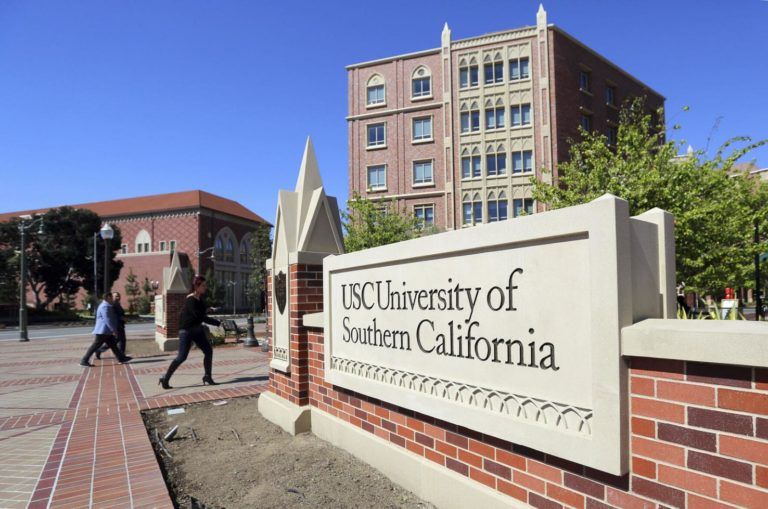
(Casey Harper, The Center Square) The Department of Education is investigating several colleges and universities over reports of anti-Semitic activity. The federal agency said allowing that kind of behavior could risk the educational institution’s federal funding.
The DOE sent a letter to all colleges and universities earlier this month reminding them of the Title VI provision requiring the institutions to create an educational environment free from discrimination based on race, ethnicity or ancestry.
“Hate has no place in our schools, period. When students are targeted because they are—or are perceived to be—Jewish, Muslim, Arab, Sikh, or any other ethnicity or shared ancestry, schools must act to ensure safe and inclusive educational environments where everyone is free to learn,” Secretary of Education Miguel Cardona said in a statement.
The investigations are ongoing. The DOE said in a press release that schools that refuse to address these issues “can ultimately lose federal funding or be referred to the U.S. Department of Justice for further action.”
While no university has lost its funding over this kind of issue, the schools always eventually comply with the federal government because the threat of lost funding is an “existential threat,” Adam Kissel, an education expert at the Heritage Foundation, told the Center Square.
“No university has actually lost its funding over a civil rights issue,” Kissel said.
The rise in on-campus protests and tension over this issue comes after the Oct. 7 attack by the terror group Hamas, which left at least 1,200 dead and hundreds of hostages, including Americans.
“Many university leaders failed to show moral clarity after Hamas barbarically attacked Israel, so it is no surprise to see allegations that their universities failed to address civil rights issues on their own campuses,” Kissel said.
Israel has responded with bombings and incursions into Gaza which have left their own unclear death toll and destroyed much of Gaza’s buildings. Israel’s response has sparked backlash, but the issue has been ongoing for decades between the two groups so far with little resolve.
One student at Cornell University, Patrick Dai, was arrested and charged for allegedly threatening in graphic detail to kill Jewish people, including babies.
In another notable on-campus controversy, a group of 30 Harvard student groups signed a letter blaming Israel for the Hamas attacks, sparking major backlash and withdrawal of donor support for Harvard. The identity of those students was later apparently made public after many businesses publicly said they would not want to hire such a student.
Harvard President Claudine Gay also issued a statement distancing the institution from the letter, saying those students do not speak for Harvard. Soon, thousands of faculty, alum, and students had signed on to a statement blasting the original letter.
Harvard, though, does not appear to be under investigation from the DOE’s Office of Civil Rights on this issue. According to the federal database, below are the colleges, universities and school districts with open investigations around discrimination based on ancestral heritage that began since the Oct. 7 attacks though are not necessarily related:
Hillsborough County Schools
University of Tampa
Columbia University
Cornell University
Lafayette College
Maize Unified School District
Wellesley College
University of Pennsylvania
The Cooper Union for the Advancement of Science and Art
Wilson County Schools
Community School of Davidson
Kissel argues the anti-Semitism is part of a bigger problem with Diversity, Equity and Inclusion programs on college campuses which have ballooned in recent years.
“DEI offices generally treat people in terms of identity groups rather than as individuals, and they often divide students more than they unite students,” he told the Center Square. “University leaders should not trust DEI offices to properly address anti-Semitic incidents on campus.”
Earlier this month, the White House warned of both anti-Semitism and Islamophobia since the Oct. 7 attacks.
House Republicans led a hearing earlier this month titled, “Confronting the Scourge of Antisemitism on Campus” where Republicans largely echoed the idea that DEI in schools is to blame.
“The modern form of antisemitism is more subtle, for it is often disguised under progressive political innuendos,” Rep. Burgess Owens, R-Utah, who chairs the Subcommittee on Higher Education and Workforce Development, said at the hearing.
“For example, Offices of Diversity, Equity, and Inclusion steeped deeply in the doctrine of Marxism are anything but inclusive for Jews,” he added. “Evidence shows that campus DEI bureaucracies play a major role in propagating the spread of anti-Semitism.”
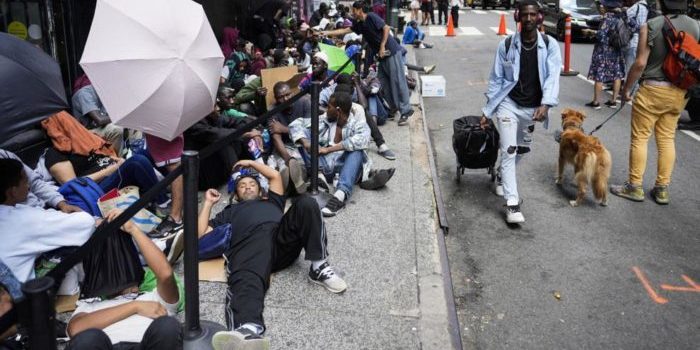
This Thanksgiving, for instance, many were passed over in favor of illegals by food trucks giving away food to the needy, according to an Instagram video posted by the Federation for American Immigration Reform, an organization dedicated to saving the “American way of life” in the midst of the immigration crisis—the “true national emergency.”
In the video, FAIR spokesman Joey Chester notes that low income earners in the borough of Queens have had to compete with the influx of some 8,000 illegals to receive their welfare benefits since President Joe Biden took office.
According to one resident who lives in the Queensbridge public housing development, those benefits are instead distributed to illegal immigrants who are “using the system to survive.”
“Why do we have to take the butt of everything?” wondered Georgia Butler, adding that her “community is already suffering.”
The illegals have been beating out residents of the New York City Housing Authority during free-food handouts, including a recent one for Thanksgiving turkeys.
Clashes between the groups got so bad that one person recently ended up hospitalized.
“We would never turn anyone away for a meal, but there simply just is not enough for both NYCHA residents and the migrant shelter residents,” said Council member Julie Won.
As the city strains under the burden of thousands of foreigners, New York City Mayor Eric Adams announced budget cuts to help pay for the immigration crisis.
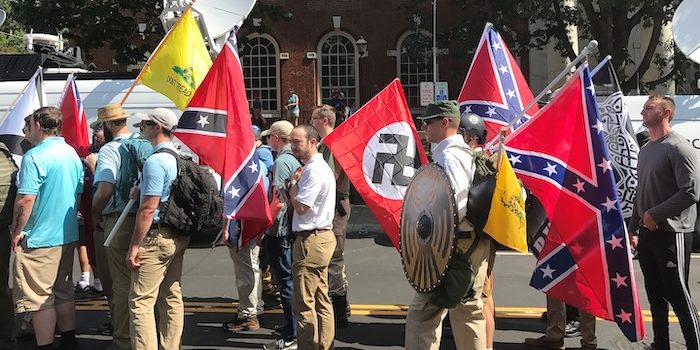
(Ken Silva, Headline USA) Over the last several years, prison inmate Bill White has filed numerous lawsuits that identify alleged FBI informants in the neo-Nazi movement. These filings have underpinned a series of Headline USA articles dubbed the “Fed Files.”
White now faces potential court sanctions over his disclosures. In a Sept. 26 motion, Justice Department prosecutors argued that White is trying to circumvent prison mail restrictions by identifying informants in his court records.
However, the DOJ’s own filings against White have also exposed the identities of alleged FBI informants, including ones that weren’t previously public. And ironically, the DOJ outed the alleged informants in the same case where White faces sanctions.
The DOJ’s apparent blunder occurred in its Sept. 26 motion to dismiss White’s August 2021 lawsuit against the Bureau of Prisons—a lawsuit involving allegations that the BOP retaliated against White for his legal filings, and that the U.S. government is punishing him for refusing to cooperate in an ongoing murder investigation.
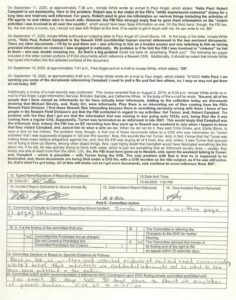
Attached to the DOJ’s motion to dismiss are unredacted records of White’s email correspondences with Paul Angel, the editor of americanfreepress.net. In those email exchanges disclosed by the DOJ, White named numerous alleged informants, including Robert Campbell, Michael Blevins, Hal Turner, Elisha Strom and Chris Drake.
Robert Campbell
The emails disclosed by the DOJ focus on Campbell in particular.
In one email exchange, Angel told White that Campbell was trying to get in touch with him. White responded by warning Angel that Campbell is an FBI informant.
“Hello Paul: Robert Campbell is not trustworthy. Here’s the problem: Robert was in the midst of the FBI’s ‘white supremacist extremist’ drama for a long time and relatively well informed … However, the FBI files strongly imply that he gave them information on the ‘violent activities I was involved in all over the country,’ which would have been false information on me,” White told Angel on Sept. 11, 2020.
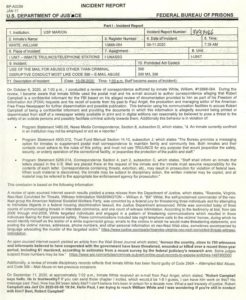
This incident report, which identifies alleged FBI informants, was disclosed by the DOJ.
“The real story is murky, but I would not deal with Robert at this time. If he wants to get in touch with me, he can write to me.”
Later in September 2020, White told Angel that he confirmed Campbell was an informant.
“Robert Campbell is the Newark CHS (confidential human source) referenced in the two enclosed documents … My problem is if he told the FBI I was involved in ‘violence,’ he lied to them—and was double-crossing me,” White said. “So that’s a big problem.”
Campbell could not be reached for comment. Angel told Headline USA that Campbell denied being an informant.
“Robert Campbell has always vigorously denied he was ever an FBI informant,” Angel said, adding that he no longer can communicate with White.
“The only way I ever communicated with Bill was via the prison system email program, which I was denied access to several years back after Bill filed a few lawsuits against the prison system,” he said.
This incident report, which identifies alleged FBI informants, was disclosed by the DOJ.
“The BOP deemed our correspondence a threat to prison security, which I thought was quite ludicrous because, the majority of our conversations revolved around manuscripts he was writing about ancient history or his fundraising efforts.”
Von Bluvens
The DOJ’s motion also included an earlier White email from August 2019, in which White named former National Socialist Movement member Michael Blevins as an alleged FBI informant. As Headline USA previously reported, the NSM was co-founded by an FBI informant and has had informants in prominent positions throughout the decades.
Along with being a former NSM member, Blevins once hosted the white nationalist radio program, the Von Bluvens Show.
In an October 2020 application for compassionate release, White provided more information about Blevins.
According to White, Blevins often co-hosted his show with undercover federal agent Robert Killian, who in the mid-2000s posed as a neo-Nazi biker named “Doc.” At the time, Killian was operating out of an FBI front group called the 1st SS Kavallerie Brigade Motorcycle Division, which was used by law enforcement to conduct a sting against several other neo-Nazi outlaw bikers.
Blevins couldn’t be reached to respond to White’s allegations or verify that Killian was his co-host, and Headline USA was unable to find archived recordings of the Von Bluvens Show.
A May 2003 article on the white nationalist site Vanguard News Network does state that Blevins co-hosted his show with a man named “Doc,” which was Killian’s undercover name. However, the “Doc” that co-hosted with Blevins described himself as a pastor—not an outlaw biker—and a purported photo of the radio host does not appear similar to the undercover agent.
Headline USA wrote to White for more details about Blevins, Killian and their radio show. White replied that he’s surprised the show isn’t still online.
“If you find old recordings of the Von Bluvens Show, you can tell by the voice its him. I met ‘Doc’ in early 2005, if I recall … Anyways, he made up some crazy story about he was going to start the ‘Fourth Generation of the Ku Klux Klan’ and had bought land near Roanoke to set up a charity called ‘The White Cross,’” White said.
“His visit, and Blevins’s, were right around the time I had decided that I was tired with the FBI’s harassment of my business and was about to get back into things. So, anyways, Doc and Von Bluvens were not a big secret. I’m surprised the website isn’t still up somewhere.”
Sanctions?
After the DOJ disclosed the alleged FBI informants in its Sept. 26 motion to dismiss, White responded with a court filing that apparently discusses the same alleged informants. That filing from White was quickly stricken from the record, and U.S. District Judge Stephen McGlynn ordered the inmate to explain by Nov. 14 why he shouldn’t face sanctions.
In his Nov. 14 response, White informed the judge that he only named the alleged FBI informants because they were already disclosed by the DOJ.
“It is clear that the court is threatening me without having reviewed the record … All the ‘confidential informants’ discussed by name in my motion have been placed on the public record by the United States. Since the United States has placed their names on the public records without sanctions, I have the belief that I can discuss those public filings without sanctions,” White said.
“The United States has placed the informant names in the record and the Court should have taken the time to review the record before threatening me with anathemas. I did nothing wrong in discussing the public record,” White added.
The DOJ has not responded to White’s Nov. 14 filing, and Judge McGlynn has yet to rule on the matter.
When Informants Go Public
The U.S. government has a long history of exposing its own undercover informants, either by accident or on purpose.
Along with posing a risk to the informants themselves, these disclosures have at times had severe consequences for the FBI’s public reputation.
The most prominent example of this is when the U.S. government released the identity of former FBI informant John Matthews, who worked in the 1990s on an undercover operation code-named Patriot Conspiracy, or PATCON.
Matthews had been retired for more than a decade when he saw that the FBI exposed his identity in records released through the Freedom of Information Act. When he saw that his cover was blown, Matthews decided to become a whistleblower.
“All those years, I’ve been a good boy and kept my mouth shut,” Matthews said in 2011, explaining his decision to go public. “Then you [the FBI] release my name? What kind of shit is that?”
Matthews revealed numerous bombshell facts about PATCON, alleging that the operation was essentially designed to provoke right-wing groups to violence. Headline USA corroborated this allegation last month.
Matthews’s most jolting claim was that he saw Oklahoma City bomber Timothy McVeigh in 1994 with a German national named Andy Strassmeir.
According to former ATF undercover informant Carol Howe, Strassmeir had been plotting to bomb the same federal building that McVeigh eventually attacked—an allegation that Strassmeir vociferously denied in an interview with Headline USA earlier this year. Matthews’s purported citing of McVeigh with Strassmeir lends credence to Howe’s claims, and it suggests that the U.S. government had foreknowledge of the OKC bombing.
Matthews, for his part, is unavailable because he has been off the grid since around 2014, when he was going to testify as a witness for Utah attorney Jesse Trentadue in his lawsuit against the U.S. government. Matthews changed his mind about testifying the night before he was supposed to take the stand, leading to Trentadue alleging that the FBI engaged in witness tampering and threatened Matthews.
Trentadue’s allegations have been subject of a court-appointed investigation for the last nearly eight years. The investigation has been conducted behind closed doors, with gag orders on all parties.
(Andrew Hensel, The Center Square) As big box retailers get ready for Black Friday and Cyber Monday, many are reminding shoppers not to forget Small Business Saturday as a way to support smaller shops.
The Thanksgiving weekend is one of the busiest shopping weekends of the year, with many retailers offering lower prices on different items.
Many shoppers may think of Black Friday and Cyber Monday first, but Charlie Owens of the National Federation of Independent Business is reminding shoppers of Small Business Saturday.
“It was first observed in 2010 during the holidays, and it is the counterpart to those big events, Black Friday and Cyber Monday,” Owens told the Center Square. “Those two events tend to feature more big box stores and large online retailers.”
Owens said Illinois and other states have small businesses that can offer as much as, if not more than, some big retailers.
“They’re going to have great deals,” Owens said. “The real important thing is lots of times they will have products you don’t find in those other two venues.”
Many small businesses rely on this holiday weekend, he said.
“I can tell you that for a lot of retailers, they will do anywhere between 60% and 90% of their gross receipts during the last three months of the year due to the holidays,” Owens said.
According to the U.S. Chamber of Commerce, consumers spend an estimated $184 billion on Small Business Saturday.
(Bethany Blankley, The Center Square) In fiscal 2022, 28 states didn’t have enough revenue to pay all of their bills, according to the 14th annual Financial State of the States report, published by the Chicago-based nonprofit Truth in Accounting.
The report provides a comprehensive analysis of the fiscal health of all 50 states based on the latest available data from states’ fiscal year 2022 annual comprehensive financial reports.
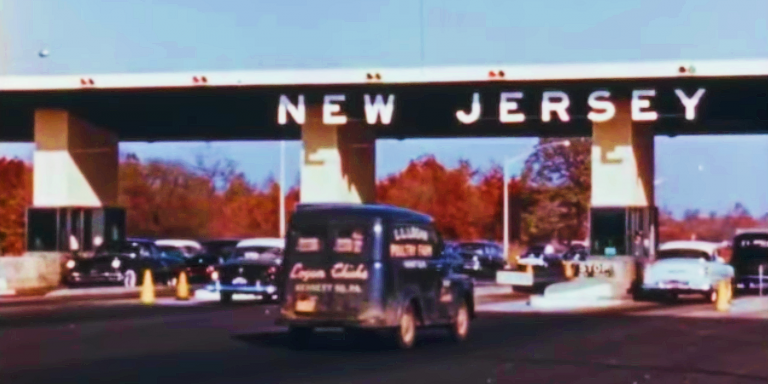
New Jersey ranked last for having the worst fiscal health and the greatest taxpayer burden. Not far behind was Connecticut, followed by Illinois, Massachusetts, Hawaii, Kentucky, Delaware, Louisiana, California and Vermont in the bottom 10.
With the exception of Vermont, all had Democrat governors at the time, although Louisiana has since elected a Republican, former state Attorney General Jeff Landry.
By contrast, 22 states reported surpluses, the majority of which are led by Republican governors.
Alaska ranked first for having the best fiscal health and highest taxpayer surplus. North Dakota, Wyoming, Utah, Tennessee, Nebraska, Idaho, Oregon, South Dakota and Oklahoma ranked in the top 10.
Total debt obligations of all 50 states was $938.6 billion, down from $1.2 trillion at the end of fiscal year 2021, the report found.
Overall, state debt appeared to have decreased primarily because “tax revenue increases due to the lockdowns ending, and millions, if not billions, of dollars in federal COVID funds received by the states.”
Tourism and individual spending also increased. With increased spending, states collected more tax revenue.
Every state, except Vermont, has a balanced budget requirement, the report notes. The other 49 states have laws that require their state legislature to produce a balanced budget. TIA argues this means “states should not carry any debt. However, we found that most states could not pay all of their bills.”
The difference between state revenue and what’s needed to pay its bills divided by the estimated number of state taxpayers is what TIA defines as a Taxpayer Burden™.
New Jersey had the highest taxpayer burden of $53,600 per taxpayer. Connecticut was not far behind with $50,7000 per taxpayer burden. Illinois ranked third worst with $41,600 in per-taxpayer burden.
Twenty-eight states reported debts and taxpayer burdens: New Jersey, Connecticut, Illinois, Massachusetts, Hawaii, Kentucky, Delaware, Louisiana, California, Vermont, South Carolina, New York, Michigan, Maryland, Pennsylvania, Rhode Island, New Mexico, Mississippi, Alabama, Kansas, Texas, Maine, Washington, New Hampshire, Nevada, Missouri, Arizona and Georgia.
The least worst had minimal taxpayer burdens: Nevada ($900), Missouri ($700), Arizona ($600), and Georgia ($5).
Twenty-two states reported a Taxpayer Surplus™, the amount of money left over after the state paid its bills divided by its estimated number of taxpayers.
Alaska had the highest surplus of $80,000 per taxpayer followed by North Dakota’s $47,400 and Wyoming’s $24,600. Other states reporting surpluses include Utah, Tennessee, Nebraska, Idaho, Oregon, South Dakota, Oklahoma, Iowa, Virginia, Montana, Minnesota, North Carolina, Indiana, Florida, Wisconsin, Colorado, West Virginia, Arkansas and Ohio.
The majority of state debt comes from retirement plans like pensions and retiree health care benefits. On average, all 50 states set aside 71 cents for every dollar of promised benefits to fund pensions and 11 cents for every dollar to fund retiree health care benefits.
Sheila Weinberg, founder & CEO of Truth in Accounting, suggests that elected officials “include the true costs of government in their budget calculations, including accruing retirement benefits so that they can make real progress towards a healthier financial future.”
The report was produced in partnership with the University of Denver’s School of Accountancy.
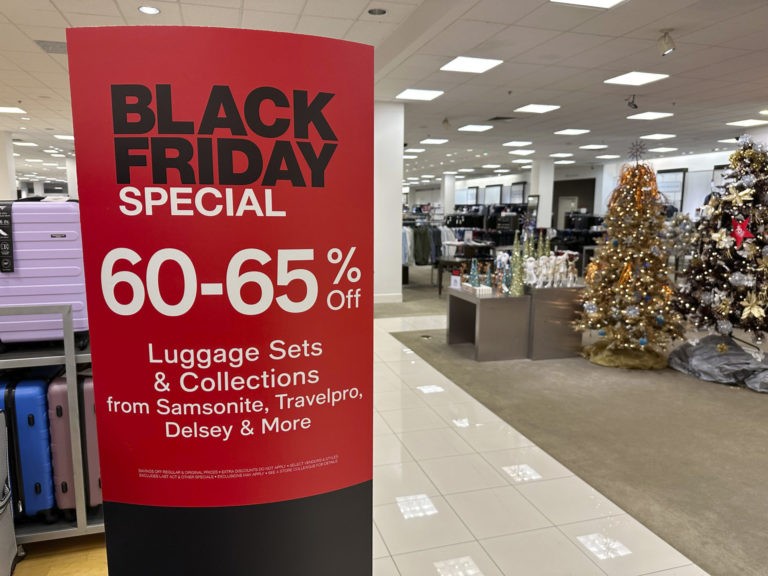
(Headline USA) Stores stepped up discounts and other enticements on Black Friday to entice shoppers holding out for the best deals. But retailers worry those may not be enough.
Consumers are coming under pressure as their savings dwindle and their credit card debt grows. And although they have gotten some relief from easing inflation, many goods and services like meat and rent are still far higher than they were just three years ago.
Barbara Lindquist, 85, from Hawthorne Woods, Illinois, said she and her husband plan to spend about $1,000 for holiday gifts for her three adult children, 13 grandchildren and three great-grandchildren. That’s about the same as last year.
But Lindquist, who continues to work as a pre-school teacher at a local church, said she’ll be more focused on deals given still high prices on meat and other staples. And she plans to buy more gift cards, which she believes will help her stick to her budget.
“I go for value,” said Lindquist, who just picked up discounted sheets and towels at Kohl’s for friends who will be visiting from Panama during the holidays.
Many retailers had already ordered fewer goods for this holiday season and have pushed holiday sales earlier in October than last year to help shoppers spread out their spending.
An early shopping push appears to be a trend that only got more pronounced during the pandemic when clogs in the supply network in 2021 made people buy early for fear of not getting what they wanted.
But retailers said that many shoppers will be focusing more on deals and will likely wait until the last minute. Best Buy said it’s pushing more items at opening price points, while Kohl’s has simplified its deals, promoting items under a certain price point like $25 at its stores.
Target said shoppers are waiting longer to buy items. For example, instead of buying sweatshirts or denim back in August or September, they held out until the weather turned cold.
“It’s clear that consumers have been remarkably resilient,” Target’s CEO Brian Cornell told analysts last week. “Yet in our research, things like uncertainty, caution and managing a budget are top of mind.”
Salesforce said online sales rose 1% to about $7.5 billion year-over-year on Thanksgiving, as retailers offered better deals. Sales of shoes and handbags increased the most at 11% compared to last year, followed by a 6% rise in sales of healthy and beauty products. Global online sales also rose 1% to $31.7 billion, according to Salesforce, which tracks data from more than 1.5 billion consumers.
Salesforce said online discounts rates in the U.S. have risen to 28% this week, compared to 21% last year, with retailers offering the best deals on apparel and health and beauty products.
The National Retail Federation, the nation’s largest retail trade group, expects shoppers will spend more this year than last year, but their pace will slow given all the economic uncertainty.
The group has forecast that U.S. holiday sales will rise 3% to 4% for November through December, compared with a 5.4% growth of a year ago. The pace is consistent with the average annual holiday increase of 3.6% from 2010 to pre-pandemic 2019. Americans ramped up spending during the pandemic, with more money in their pockets from federal relief checks and nowhere to go during lockdowns. For the holiday 2021 season, sales for the two-month period surged 12.7%.
Online discounts should be better than a year ago, particularly for toys, electronics and clothing, according to Adobe Analytics, which tracks online spending. It predicts toys will be discounted on average by 35%, compared with 22% a year ago, while electronics should see 30% cuts, compared with last year’s 27%. In clothing, shoppers will see an average discount of 25%, compared with 19% last year, Adobe said.
Analysts consider the five-day Black Friday weekend — which includes the Monday after the holiday known as Cyber Monday — a key barometer of shoppers’ willingness to spend. And Black Friday is expected to be once again the busiest shopping day of the year, according to Sensormatic Solutions, a firm that tracks store traffic.
On average, the top 10 busiest shopping days in the U.S are expected to once again account for roughly 40% of all holiday retail traffic, Sensormatic said.
Marshal Cohen, chief retail adviser at Circana, a market research firm, said he thinks that shoppers will just stick to a list and not buy on impulse. He also believes they will take their time buying throughout the season.
“There’s no sense of urgency,” Cohen said. “The consumers are saying, ‘I will shop when it’s convenient for me.’”