ActBlue Spends Millions on Travel, Security and Perks as Legal Scrutiny Grows

(Luis CornelioHeadline USA) Roughly $700,000 on a luxury retreat. Nearly $3 million on security and $5 million on travel. And about $800,000 in CEO pay.

Those are some extravagant figures at the center of a new report scrutinizing fundraising giant ActBlue under CEO Regina Wallace-Jones.

The organization now faces investigations from the Justice Department and Congress, while also dealing with internal concerns over its finances, management and safeguards against foreign donations.

The scrutiny intensified after Wallace-Jones took over in 2023.

By 2025, ActBlue’s own attorneys reportedly urged her to seek personal counsel after concerns she appeared to have misrepresented the group’s safeguards to lawmakers regarding foreign donations.

A new Wall Street Journal report on Monday detailed the spending and raised fresh questions about Wallace-Jones’s leadership and potential legal exposure.

Months after President Donald Trump defeated then-Vice President Kamala Harris in 2024, ActBlue spent roughly $700,000 on a retreat at the InterContinental San Francisco.

The event included hundreds of hotel rooms, while Wallace-Jones stayed in a two-story presidential suite under heavy security.

Security costs have surged to at least $2.8 million since 2023, compared to less than $16,000 between 2020 and 2022, according to The Journal.

Travel expenses also spiked, with ActBlue plowing through $4.9 million in travel costs since 2023, including $2.7 million in 2025 alone. That’s up from less than $400,000 in 2022.

New policies allow executives and board members to book first-class flights and receive largely uncapped accommodations.

Operating costs followed the same trajectory. ActBlue spent $87 million during the 2024 presidential cycle, up from the $42 million spent in 2020. ActBlue has already spent $72 million ahead of the 2026 midterms.

In a statement, Wallace-Jones defended the changes.

“We have been able to steer the organization from a single-service startup into a diversified technology platform supporting campaign operations well beyond fundraising,” she said. “Change on this scale isn’t easy, but neither is protecting the integrity of small-dollar democracy.”

As reported by Headline USA, concerns over foreign donations date to 2023, when Wallace-Jones told the Republican-led House Administration Committee in a letter that ActBlue used a “multilayered” system.

She also told lawmakers that the group required a U.S. passport number for certain foreign-address donations. However, a leaked letter from law firm Covington & Burling — previously retained by ActBlue — suggested those safeguards may have been overstated. Knowingly false statements to Congress can carry criminal liability.

The DOJ investigation remains ongoing.

Person Shot by Law Enforcement Near Washington Monument, Secret Service Says

(Headline USA) An individual was shot by law enforcement Monday near the Washington Monument, the Secret Service said.

The person’s condition and the circumstances surrounding the shooting around 15th Street and Independence Avenue were not immediately known.

The Secret Service encouraged people to avoid the area as emergency crews responded to the shooting not far from the White House, where President Donald Trump was holding a small business event.

The White House was briefly locked down as authorities investigated the incident. The Secret Service ushered journalists who were outside into the briefing room, and Trump continued his event without interruption.

The story is developing… 

Adapted from reporting by the Associated Press

Did AOC Just Out Barack Obama?

(Ben Sellers, Headline USA) A cryptic comment from Rep. Alexandria Ocasio–Cortez last week ignited a firestorm of speculation online that she may have outed former President Barack Obama.

A reporter from celebrity gossip site TMZ asked “AOC” in a clip posted to X on Wednesday whether she thought the United States would have a woman president first or a gay one.

“Well, we don’t know if we already had a gay president,” she said with a knowing leer.  “… I think there are chances that maybe we have.”

The viral video generated a range of reactions, with homophobic anti-Trumpers suggesting that the current president’s three marriages and penchant for “p***y-grabbing” might all be a façade.

Some used AI-generated videos to support their thesis.

Others proffered an equally unlikely view that notorious tomcat John F. Kennedy may have been light in the loafers, based off a 1933 photo of him dancing with Lem Billings, a gay friend with whom Kennedy had been roommates at the Connecticut boarding school Choate Rosemary Hall.

In terms of more serious speculation, America’s only bachelor president, James Buchanan, elicited strong support, with users pointing to his rumored relationship with former Vice President William R. King.

Other modern scholarship has pointed to the possibility that Abraham Lincoln may have been swishy in the stovepipe, noting the four years he spent sharing a bed with close friend Joshua Speed and similar arrangements with at least two other men.

However, the bulk of speculation centered around Obama, with users pointing to circumstantial evidence like the 2023 drowning death of his chef and alleged gay lover, Tafari Campbell.

Other rumors about Obama include allegations that he was part of a “Down-Low Club” at his Chicago church, which is where he allegedly first met Michelle Obama (née Michael Robinson).

Proponents of the theory that Michelle Obama was born a man point not only to photographic evidence of a prominent bulge and official voting records that indicate the former first lady was officially registered as a man until 2008.

The most compelling evidence of Barack Obama’s gay tendencies may be the firsthand accounts of his former limousine driver and drug dealer, Larry Sinclair.

Sinclair has spoken repeatedly about his encounter after meeting Obama at a bar in 1999.

“I performed fellatio on [then Illinois state senator] Obama in the limousine during the time Sen. Obama was smoking crack cocaine,” he recalled during a 2008 press conference.

Sinclair also confirmed that it was not simply a drunken indiscretion, revealing that he “came back for seconds” the following day.

Sinclair once more offered a detailed account during a 2023 interview with Tucker Carlson.

Additional evidence of Barack Obama’s lust for men includes the emergence of a 1982 letter to his ex-girlfriend, Alex McNear, in which the future president made reference to his “androgynous” mind and admitted that he liked to “make love to men daily, but in the imagination.”

Some have cautioned, however, that there is an inherent risk in perpetuating the longstanding theories about the Obamas, citing Campbell’s drowning death and the mysterious circumstances surrounding the operating-table death of iconic comedienne Joan Rivers.

Slain conservative activist Charlie Kirk also acknowledged the Obama theories prior to his 2025 assassination.

No harm had yet befallen AOC at press time.

Ben Sellers is a freelance writer and former editor of Headline USA. Follow him at x.com/realbensellers.

U.S. Supreme Court Temporarily Allows Mail-Order Abortion Pills

(Andrew Rice, The Center Square) The U.S. Supreme Court will temporarily allow women to obtain abortion pills through the mail, without visiting an in-person doctor. 

Justices on the court blocked a ruling out of Louisiana that would have restricted a woman’s ability to access a pill through the mail. Louisiana already has a ban on the abortion drug mifepristone, but sought to prevent its access through the mail from other states. 

An order, finalized by the Joe Biden administration in 2023, allowed for women to access mifepristone without an in-person doctor’s visit. A federal judge ruled in favor of Louisiana last week, blocking access to the pill through the mail. 

Danco and GenProBio, two abortion drug makers, filed emergency requests to the U.S. Supreme Court seeking relief from the order. The high court’s temporary order, from Justice Samuel Alito, will give time to weigh the requests for one more week.

“Making it a federal crime to mail drugs for lawful medical purposes contravenes nearly a century of precedent and all indicia of Congressional intent,” Danco Laboratories wrote. “It would also significantly interfere with states’ traditional power to enact their own ‘health and welfare laws.’”

Louisiana Attorney General Liz Murrill said removing the in-person doctor’s visit requirement causes undue harm to women. She said the lack of an in-person doctor’s visit facilitates potential abuse an coercion for women who do not want abortions. 

“We will continue to pursue enforcement of our laws, both civilly and criminally, against anybody who has facilitated the distribution of these drugs for the purposes of causing an abortion,” Murrill said. “It is a violation of our criminal laws, and we will pursue them and hold everyone accountable.”

Louisiana is not the only state challenging either the approval of mifepristone or subsequent actions easing the restrictions for mailing abortion pills. Missouri, Idaho, Kansas, Florida and Texas have also challenged the ease of restrictions. 

Justices on the nation’s highest court will hold the ban in place until May 11, while they further consider the restrictions and weigh whether to take up the emergency petitions. 

Prosecutors Say Arson Suspect in Los Angeles’ Palisades Fire Was Angry ‘At the World’

(Headline USA) The man accused of sparking the deadly Palisades Fire in Los Angeles was upset that he didn’t have plans for New Year’s Eve and ranted about being angry at the world before the initial blaze was sparked, according to court documents filed by prosecutors.

Jonathan Rinderknecht, 29, has pleaded not guilty to starting what became one of the most destructive wildfires in California history. It began Jan. 7, 2025, in hillside neighborhoods of Pacific Palisades and Malibu and killed 12 people. Prosecutors say Rinderknecht started a fire on Jan. 1 that burned undetected deep in root systems before flaring back up a week later.

Rinderknecht’s trial is set to begin June 8. His attorneys say he is being used as a scapegoat for the Los Angeles Fire Department’s failure to fully extinguish the earlier blaze.

An outline of the prosecutors’ strategy — with details about the defendant’s alleged state of mind on the night before the first fire began — appears in an April 29 pre-trial memo filed by the U.S. Attorney’s Office.

Witnesses reported that Rinderknecht had been driving erratically while on Uber routes around the Palisades on New Year’s Eve, said prosecutors. His passengers described him as “angry, intense, driving erratically, and ranting about being ‘pissed off at the world,'” the memo said.

According to court filings, Rinderknecht ranted to passengers about accused UnitedHealthcare CEO shooter Luigi Mangione, capitalism and vigilantism. In an interview with investigators on Jan. 24, when asked why someone might commit arson in the Palisades, Rinderknecht “responded that it would be out of resentment of the rich enjoying their money as ‘we’re basically being enslaved by them,’” and again referenced Mangione’s alleged crime, the documents said.

In addition, prosecutors said Rinderknecht was distraught over a failed relationship and upset about thwarted plans for New Year’s Eve.

“My client maintains his innocence as he has from the beginning and we look forward to clearing his name at trial,” Rinderknecht’s attorney Steve Haney said in an email Sunday. “The offered motive that my client started a fire on NYs Eve because he did not have date speaks for itself.”

Haney held a news conference in March to call for Rinderknecht’s release from jail in light of evidence he said shows he is not responsible for the blaze. Haney pointed to a deposition in which a firefighter testified that he noticed the ground was still smoldering from the fire on Jan. 2 and alerted a supervisors that there were hot spots. That testimony was gathered as part of a lawsuit filed by fire victims against the city.

A battalion chief had testified that he walked the perimeter of the burn area four times throughout the day and ensured all hot spots were out.

Fire Department Chief Jaime Moore, who was appointed in October, has said he is concerned about the differences in the firefighters’ testimonies and commissioned an independent report on how the Jan. 1 fire was handled.

Haney has said this evidence was not available to the defense when Rinderknecht was indicted.

Adapted from reporting by the Associated Press

India Continues to Bring Its Gold Home

(Mike Maharrey, Money Metals News Service) India has accelerated efforts to bring its gold home.

In the spring of 2024, India brought 100 tonnes of gold home, repatriating it from vaults in the UK. Over the last six months, the Reserve Bank of India has repatriated another 104 tonnes.

According to data from the Management of Foreign Exchange Reserves, India now has about 680 tonnes of its 880.52-tonne gold reserves (77 percent) stored within its borders. Approximately 197.67 tonnes remain stored in the Bank of England and the Bank for International Settlements vaults.

As of March 2023, India only held around 37 percent of its gold reserves within the country.

After a 100-tonne move in 2024, an anonymously quoted central bank official told Reuters, “We did have it [gold] held in London… but now we’ve transferred it back to our country to hold as a safe haven asset and to keep it safe.

At the same time, Invesco’s head of official institutions, Rod Ringrow, told Reuters this reflects a widely held view.

“‘If it’s my gold then I want it in my country,’ has been the mantra we have seen in the last year or so.”

According to the Economic Times of IndiaU.S. weaponization of the dollar is one of the key factors driving gold repatriation, specifically aggressive sanctions levied on Russia after it invaded Ukraine, and the freezing of Afghanistan’s reserves by Western powers.

“Those episodes, involving G7 countries restricting access to sovereign assets, have reshaped how central banks think about custody.”

India was also a leading gold buyer in 2024, upping its gold holdings by 73 tonnes. The pace of buying slowed last year, with reserves increasing by around 5 tonnes.

Even with the slower pace of purchases, India’s increasing gold holdings over the last two years reflect a longer trend. The RBI has been buying gold since 2017. Over that period, it has increased its gold reserves by over 270 tons.

The Times of India reported that de-dollarization is one of the primary motives behind India’s gold-buying spree.

“India’s central bank has shown a preference for increasing gold reserves instead of U.S. Treasury bills to strengthen its foreign exchange holdings. This is part of a broader global shift towards diversifying national reserves beyond dollar-based assets.”

An economist told the Times, “It makes a lot of sense (to invest in gold), given the increased volatility in the FX market, elevated interest rates in the U.S., and, of course, also as the central banks in each economy would like to diversify the asset classes in which they are parking their reserves.

India isn’t the only country worried about the weaponization of the dollar, along with U.S. fiscal mismanagement.

According to a World Gold Council survey in 2023, a “substantial share” of central banks expressed concern about potential sanctions after the U.S. and other Western countries froze almost half of Russia’s $650 billion gold and forex reserves in the wake of its invasion of Ukraine. According to the WGC, 68 percent of the banks surveyed said they plan to keep their gold reserve within their country’s borders. This was up from 50 percent in 2020.

There has been a growing chorus of voices calling for Germany and Italy to bring their gold home.

There has also been speculation that other countries have been moving gold and other assets out of the U.S. in the wake of economic sanctions on Russia. However, this has been difficult to confirm because the Federal Reserve will not release information on the amount of gold in its vaults.

The gold repatriation trend started long before the West slapped sanctions on Russia. In 2019, Poland brought home 100 tons of gold. Hungary and Romania also repatriated some of their gold reserves around that same time. In the summer of 2017, Germany completed a project returning roughly half of its gold reserves inside its borders. In 2015, Australia launched efforts to bring half of its reserves home. The Netherlands and Belgium have also initiated repatriation programs.

This gold repatriation trend underscores the importance of holding physical gold free from counterparty risk.

If you store your gold and silver with a third party, you could lose your metal through theft, fraud, or an act of God. Of course, you could lose silver and gold stored in your home the same way (except for fraud), so you have to weigh the risk of using third-party storage and keeping large amounts of silver and gold at home.

If you opt for third-party vaulting, it is important to choose a trusted company.

Money Metals offers secure precious metals storage in its state-of-the-art facility.

Here are just a few advantages of storing with Money Metals:

  • Money Metals Depository contents are fully insured by Lloyd’s of London.
  • Metals stored in your account are segregated and never commingled or rehypothecated — and cannot be used as collateral for a loan by anyone but you.
  • Depository holdings are independent and removed from any bank, Wall Street, or Washington, D.C.

Mike Maharrey is a journalist and market analyst for Money Metals with over a decade of experience in precious metals. He holds a BS in accounting from the University of Kentucky and a BA in journalism from the University of South Florida.

Debt-to-GDP Eclipses 100 Percent (And It’s Actually Worse Than That)

(Mike Maharrey, Money Metals News Service) The U.S. debt has reached yet another ominous milestone.

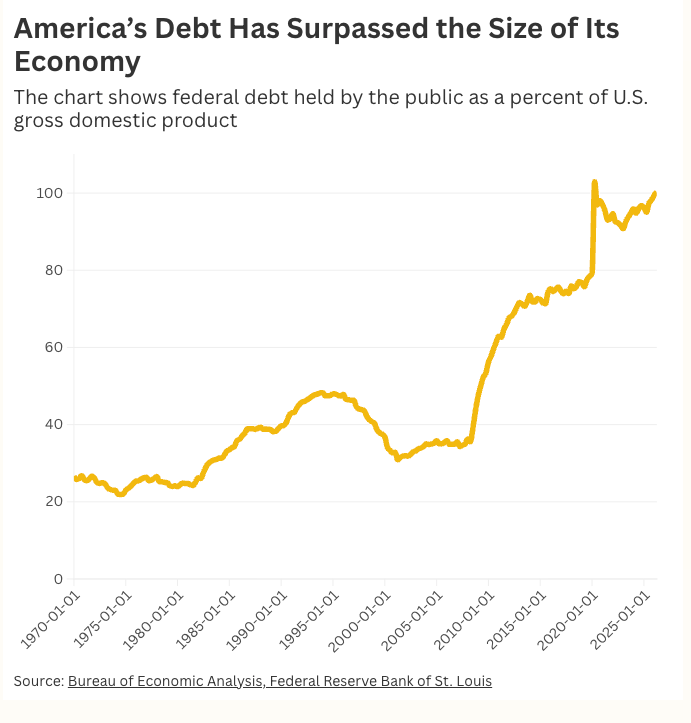
In March, the national debt surged over $39 trillion.  Now, the federal debt held by the public-to-GDP ratio has crossed the 100 percent threshold.

In other words, the U.S. government owes the world more money than the economy’s total annual output.

And it’s actually worse than that. There is additional federal debt not factored into the data that produced this eye-bulging headline.

The last time the debt held by the public exceeded GDP (briefly) was when governments effectively shut down the global economy during COVID. Before that, the debt-to-GDP ratio hadn’t exceeded 100 percent since World War II.

To put this “achievement” into perspective, the average debt-to-GDP ratio has historically hovered around 50 percent.

The news created some stir over the weekend, as such news often does. But as Newsweek noted, “Congress appears uninterested in countering” the trajectory of the debt.

Committee for a Responsible Federal Budget President Maya MacGuineas pointed out that despite the general apathy toward Washington, D.C.’s borrowing and spending problem, it has real negative impacts on the economy.

“The debt slows economic growth, pushes up borrowing costs and prices, and leaves us vulnerable to a fiscal crisis in the future. There are good milestones, and bad ones, and this is the worst kind there is.”

In a well-known paper, published in 2010, economists Carmen Reinhart and Kenneth Rogoff show that when debt to GDP crosses the 90 percent threshold, it retards median economic growth by 1 percent, and average growth falls considerably more (up to 30 percent).

While it generated some headlines out there in the mainstream, the debt-to-GDP ratio rising above 100 is just a symbolic event. As Newsweek noted, it doesn’t create an immediate crisis. But anybody who doesn’t recognize this is a problem is out of their mind.

Unfortunately, it appears that most elected officials are out of their minds – or they have their heads buried in the sand. They read these headlines. A few might express concern. And then they go right back to spending money.

And make no mistake – this is a spending problem. Federal revenues have been at a record level over the last year. Meanwhile, Uncle Sam spent $3.65 trillion through the first half of fiscal 2026. That was up about 2 percent over the same period in fiscal ‘25.

A 2 percent increase in spending might not sound significant. But weren’t we told there would be spending cuts?

Even with all the hype about DOGE and some lip service to cutting spending during the early days of the Trump administration, the U.S. government spent just over $7 trillion last year. That’s an average of $583.3 billion per month or $19.2 billion per day.

And now there’s a war.

Despite some nonspecific talk about “spending cuts,” there seems to be little to no commitment to dealing with the runaway spending.

The Debt-to-GDP Is Even Worse Than the Headlines Suggest

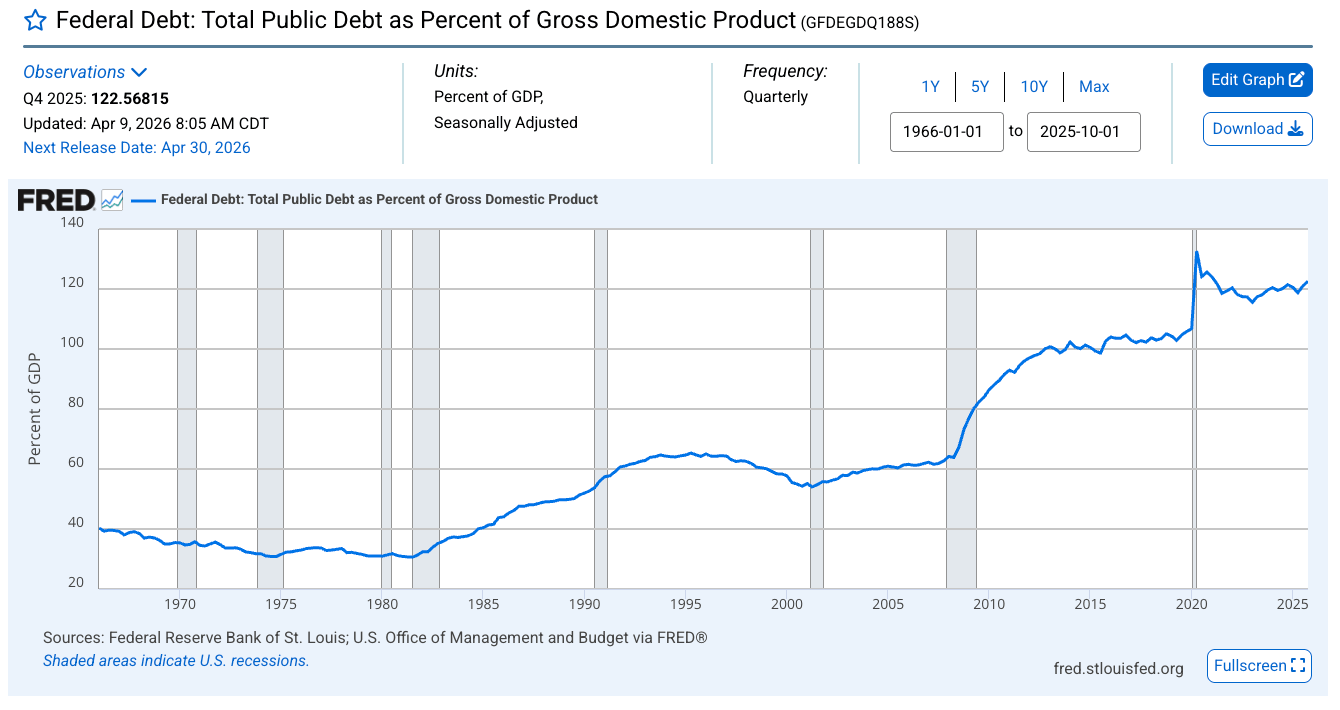
If you go to the national debt clock, it shows the debt-to-GDP ratio at 122 percent. It’s been in that range for well over a year.

So, why are mainstream news outlets just now reporting a debt-to-GDP ratio crossing the 100 percent threshold?

Because they are measuring the debt-to-GDP in different ways.

The National Debt Clock factors in all the debt that has been issued by the federal government (gross debt). This includes the debt held by the public plus “intragovernmental holdings,” essentially money the government owes to itself. For instance, if the Social Security Administration runs a surplus, it invests in U.S. Treasuries.

Of the $39.1 trillion in debt, around $7.8 trillion is made up of intragovernmental holdings.

While one can argue that government debt held by the government is nothing but internal governmental accounting, those Treasuries held by other federal agencies must be paid off with dollars at some point, so they are “real” debts.

And no, the National Debt Clock is not inflating numbers just to make things look worse than they are. The Federal Reserve maintains the same data.

Both these numbers are relevant.

The debt held by the public (the lower number used to generate the recent headlines) is more relevant in determining the economic burden of the debt and the pressure on the bond markets. The gross debt used to determine the National Debt Clock debt-to-GDP ratio is more relevant when determining the fiscal sustainability of this borrow-spend regime.

And keep in mind that none of this takes into consideration the unfunded obligations looming in the future. That pushes the debt to over $100 trillion.

No matter how you slice and dice the numbers, they spell b-a-d n-e-w-s.

And very few people seem to care.

It’s easy to play “kick the can down the road” with the debt. Everything seems OK now. After all, people have been worrying about the debt for decades, and nothing bad has happened. There are virtually no political incentives to deal with the debt problem. That’s because there is no path out other than drastic spending cuts. (No, you can’t solve the problem by taxing billionaires.) Politicians’ number one priority is getting reelected. You don’t get votes by cutting people’s favorite programs.

So, on down the road the can goes.

Of course, the problem with kicking the can down the road is that you eventually run out of road.


Mike Maharrey is a journalist and market analyst for Money Metals with over a decade of experience in precious metals. He holds a BS in accounting from the University of Kentucky and a BA in journalism from the University of South Florida.

Widow from Butler Trump Shooting Believes Others Were Involved

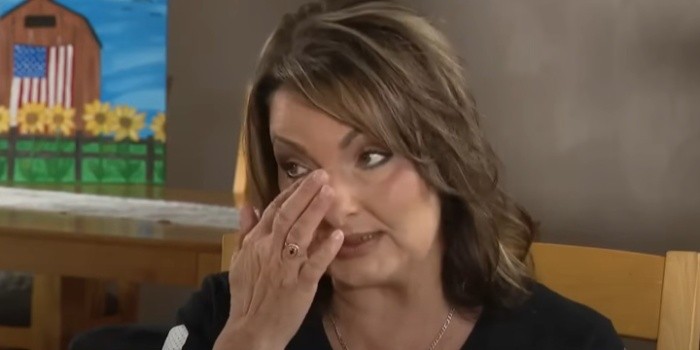
(Ken Silva, Headline USA) In a rare public interview, the widow of the firefighter who was murdered at the July 13, 2024, Trump campaign rally in Butler, Pennsylvania said she believes others were involved in the shooting that day.

Speaking to the New York Times, the widow, Helen Comperatore, specifically mentioned former President Joe Biden as being implicated in the assassination attempt against Donald Trump—and, by extension, the murder of her husband, Corey.

“That’s why I didn’t take Biden’s call: I thought he set something up,” Comperatore said, referencing the fact that she declined to speak to Biden after Butler.

“I do not believe that this kid just got out of bed that day and decided to come over there and kill the president,” she said at another point during the interview. “I believe that he was involved with someone greater than him, that worked with him and probably offered him money to do this, and I would like to know what that entailed.”

The Times interview is Comperatore’s first public comments since around the time of the first anniversary of Butler. At that time, she said that then-FBI Deputy Director Dan Bongino said the bureau was about to release more information on the event. Bongino didn’t keep his promise—the FBI has released a few dozen pages of documents in response to a lawsuit from the transparency group Judicial Watch, but that’s about it.

Around the same time her comments were published, Rep. Anna Paulina Luna also said she believes Butler was an “inside job.”

Headline USA has published more information about the assassination attempt than any other outlet in the world—including Thomas Crooks’s autopsy and toxicology reports, his some of his online metadata, and his college emails, along with police radio communications and much more—and has uncovered no evidence that Biden was directly involved in the assassination attempt.

However, numerous questions from that event linger. Along with the fact that the Secret Service left the rooftop used by alleged gunman, Crooks, wide open, there’s the fact that the Butler rally was the first time Secret Service snipers protected someone who wasn’t in office. Those same snipers waited 15 seconds before responding to the would-be assassin’s gunfire (it was a local cop who shot him in the first six seconds).

There’s also the fact that the Secret Service allowed Trump to take the stage despite knowing that there was a suspicious person with a rangefinder on the loose, as well as the fact that the Secret Service didn’t say anything over the radios about someone being on the rooftop—despite being informed of this by local police.

Then, there’s the would-be assassin himself. The FBI initially said that Crooks did not interact with others online, but conservative media personality Tucker Carlson proved otherwise late last year, when he released correspondence between Crooks and a neo-Nazi. The two were talking in a YouTube comments section about committing violence against the government, which Carlson and others argue should have put Crooks on the government’s radar. It’s also unclear how Crooks learned to make anfo bombs.

FBI Director Kashyap Patel has said there’s not much more to know about what happened at Butler, but the bureau has declined Headline USA’s interview request.

While Comperatore and others still have suspicions that others were involved, she did denounce those who think that Trump “staged” the event.

“Like any of that’s staged. I mean, how? Why would you think that the president would stage taking a bullet? I mean, that’s insane,” she said. “I’m not an actress, I never was. I’m a small town country girl.”

“That scream you hear the entire time,” she added, “that was my daughter.”

To Comperatore’s point, the bullets, blood, bodies and shrapnel were all very much real. As for questions about Trump’s ear, plastic surgeons have explained that yes, it could have healed without a scar if it were just grazed. Meanwhile, Butler truthers have yet to articulate a cogent explanation for how Trump could have staged his own assassination attempt with the complicity of the Biden Justice Department, Secret Service and FBI, as well as with state and local authorities.

Ken Silva is the editor of Headline USA. Follow him at x.com/jd_cashless.

Questions Swirl over Who Will Win Gerrymander War after SCOTUS Ruling

(Ben Sellers, Headline USA) Virginia Democrats’ attempt to gerrymander the state and a landmark Supreme Court decision that ended race-based redistricting have spurred what some consider to be a race to the bottom for control of the U.S. House.

But the jury is still out as to who will wind up with the upper hand.

Red states including Mississippi, Alabama, Tennessee and Louisiana have signaled plans to redraw their districts following the Louisiana v. Callais decision, which said the minority–majority districts used since the passage of the 1965 Voting Rights Act did more to promote racism and inequity than to resolve it.

The now-unconstitutional VRA mandates had essentially guaranteed seats for Democrats, even though doing so required them to go to great lengths to segregate black-heavy constituencies.

Even before the SCOTUS ruling, Florida Gov. Ron DeSantis had called for a special session to redraw Florida’s maps following Virginia’s April 21 ballot referendum.

Virginia Democrats succeeded in passing their effort to create a “temporary” loophole in the state’s constitution — which normally requires a bipartisan redistricting commission to draw reasonably apportioned maps. But despite their dubious victory at the polls, the issue is now being considered by the Virginia Supreme Court after plaintiffs argued that the Democrat General Assembly violated several other laws in the process.

Florida’s new maps would effectively offset Virginia’s gains, but if the courts shut down the Democrat referendum in the Old Dominion, the brazen power grab could backfire exquisitely.

Still, radical leftists are not likely to concede defeat gracefully.

An Axios report said Democrats may seek to retaliate by shoring up their already lopsided maps in 11 other blue-controlled states.

That might include using extreme “spaghetti” maps in states like Illinois, routing districts from the entire red-leaning southern part of the state through deep-blue Chicago in the northeast.

Some speculated that the effort to squeeze more Democrat seats out of states that already are maxxed out could fail by diluting already-blue districts, including those earmarked for black voters.

Moreover, redrawing states like Pennsylvania, Wisconsin and Minnesota — where Republicans currently maintain some legislative power — could prove challenging, if nothing else becoming a focal point of upcoming state elections.

Other states, like New Jersey and Washington, would have to follow Virginia’s model of circumventing the fair-map safeguards already enshrined in their state constitutions.

Still, there are likely to be some avenues for Democrat seat gains in states like Colorado and New York — the latter of which saw an earlier 2022 attempt to gerrymander its seats shut down by the state courts. The shifting circumstances, along with an activist bench that has become increasingly ideologically driven, may compel judges to reconsider their previous objections.

Those two states, if they left no Republican seats, could add up to 11 more into the Democrats’ column. But South Carolina and Georgia, two red states that have signaled they are not likely to redraw their maps before the 2026 midterms, may move before the 2028 race, adding up to six seats in the red column — including those of notorious race baiting representatives James Clyburn and Hank Johnson.

Christian Heiens, a Virginia-based podcaster and political strategist, broke down all of the seats in play for 2028, concluding it would likely be a wash with 19 seats going both ways.

But in order to offset desperate Democrats who are willing to bend the rules to achieve the desired outcome, Republicans must reach even deeper into states like Ohio, Missouri, Indiana, Nebraska, Utah, Kansas and Kentucky.

“If Republicans aren’t prepared to do all of this to counter what’s coming they will lose the redistricting war,” Heiens wrote. “At some point we’ll see both sides begin to run out of targets and it’s a just a matter of which side is willing to go further to win.”

There are good reasons to be alarmed about the chain reaction that hyperpartisan gerrymandering will trigger, which will potentially disfranchise all of the voters in a state who may be in the political minority. Yet, having less-concentrated districts also may give some voters more of a sporting chance by creating a greater number of potential tossup races, with voter turnout becoming even more of a deciding factor.

Public distaste over the tit-for-tat rule-changing also may provide the catalyst needed for a constitutional amendment that would take the power from individual state legislatures and establish a uniform method for drawing fair maps — perhaps with help from emerging artificial-intelligence technology.

Ben Sellers is a freelance writer and former editor of Headline USA. Follow him at x.com/realbensellers.

Comey’s New DOJ Charges Come into Focus as Left Falsely Claims ‘Free Speech’

(Ben Sellers, Headline USA) It may have come as little surprise that the Justice Department was seeking for a third time to hold former FBI Director James Comey accountable for his long history of seditious conduct.

An Judge Cameron McGowan Currie, a Bill Clinton appointee, dropped criminal cases against Comey and New York Attorney General Letitia James last year on technicalities, claiming the lead prosecutor, Lindsey Halligan, had been improperly appointed as a U.S. Attorney. A grand jury subsequently refused to re-indict Comey after the charges were re-filed.

But following last week’s announcement of a new grand-jury indictment on different charges, some were left scratching their heads as to whether the case would hold up in either the court of public opinion or the court of law.

Comey was charged with making a threat against President Donald Trump after he posted on Instagram a picture of a shell formation spelling out the slogan “86 47” while vacationing at his beach house on North Carolina’s Emerald Isle.

“This is not going anywhere. This is clearly not a punishable threat,” Eugene Volokh, a senior fellow at Stanford University’s Hoover Institution who specializes in First Amendment law, told CNN.

Comey’s defenders swiftly rushed to decry the case as an infringement of his free-speech rights.

Many media outlets, such as NBC News, carped on the fact that the term “86” is commonly used in the restaurant business to indicate a menu item that needs to be scratched.

Meanwhile, Comey allies like left-wing blogger Aaron Rupar mocked the two-page indictment as “laughably thin.”

Even libertarian-leaning Trump supporters, like influential podcaster Joe Rogan and constitutional law expert Jonathan Turley weighed in to question its wisdom.

Both warned, in Rogan’s words, that it “sets a crazy precedent” for prosecuting protected speech.

“I would prefer to crawl into one of Comey’s conversant shells than write a column supporting him,” Turley wrote.

“However, here we are,” he added. “The fact is that I believe that this indictment is facially unconstitutional absent some unknown new facts.”

As it turns out, Turley’s final caveat may be an important one.

In addition to a charge stemming from the threat itself, Comey was charged with a second offence under U.S. Code 8, section 875(c), which pertains to interstate commerce.

As some astute legal observers pointed out, the now-deleted shell picture was, in fact, one in a series of three posts that were promoting Comey’s third fiction book, FDR Drive.

The picture that preceded the shells showed him lounging on the beach reading the book, and the one after it provided a screenshot of a promotional blurb from Publishers Weekly.

The book’s protagonist, a U.S. attorney named Carmen Garcia, believes “far-right media personality” Samuel Buchanan “went far beyond the protection of the First Amendment when he singled out his enemies by name and suggested ‘something should be done’ about them,” says the blurb. “His fans have obliged, killing or grievously injuring some of his foes.”

It goes on to describe Comey’s thinly veiled plot as being “ripped-from-the-headlines.”

But according to legal analyst and influencer David Freiheit (aka “Viva Frei”), Comey was indirectly dog-whistling to his own supporters that they should heed Buchanan’s clarion call.

“All of the elements are there to eliminate any ambiguity as to what [Comey] meant — sandwiching his 8647 in shells in between a picture of him reading his book, and a summary of his book — which has to do with calling out enemies by name, suggesting something should be done to them, and his fans obliging,” wrote Freiheit, a former Canadian lawyer.

He criticized the “bare bones” indictment for lacking the full details of the case, and for the delay in getting it to a grand jury.

“If I were drafting it, I would have included these details,” Freiheit wrote. “But, according to some American attorneys, the indictment need not include every single allegation in it, just the essential.”

Nonetheless, he said that those playing coy about the substance of the charges were “either ignorant or dishonest. Either way, their opinions should be disregarded.”

Freiheit also disarmed a counterargument that a similar statement (“8646”) was made in 2022 by Human Events editor Jack Posobiec against Joe Biden, noting that the context was paramount in making the case for a legitimate threat.

Meanwhile, Posobiec himself also picked up on the sequencing of the posts, suggesting that the profits from Comey’s book may bolster the second charge.

Others pointed to Comey’s admission that the post was problematic and subsequent decision to delete it as an acknowledgement of the threat’s severity.

And likewise, his decision to wage a PR campaign over the controversy, even joking about it with late-night host Stephen Colbert, may be used to prove that he was aware that the term “86” had deadly connotations beyond its usage in the food-service industry.

Jay Town, a former U.S. Attorney and curreny legal analyst for Newsmax, laid out the full case in detail with an X thread that explained the legal standard the court will apply.

Ironically, it is likely to boil down to the same thing that Comey used to clear Hillary Clinton of her e-mail scandal: intent.

“If Comey was aware (or should have been) that there was ANY possible interpretation by reasonable people that his post would constitute a threat, but posted anyway, then that is a reckless disregard of that threat,” Town wrote.