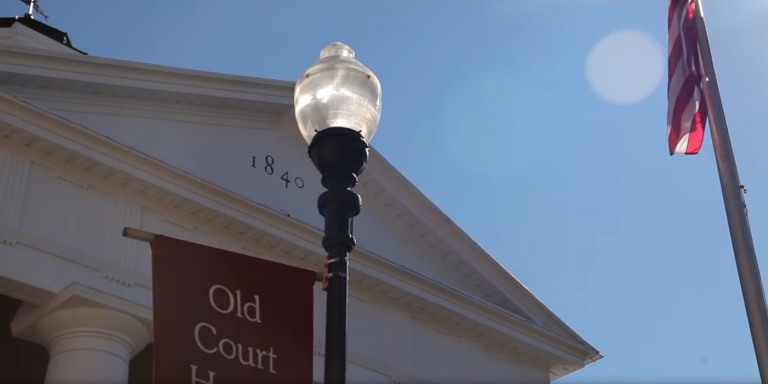
Federal Judge Bans Most ICE Arrests at New York City Courthouses

(Chris Wade, The Center Square) A federal judge has banned most arrests by ICE agents in several New York City immigration courts, siding with civil liberties groups that sued to stop the practice.

The ruling by U.S. District Court Judge P. Kevin Castel prevents U.S. Immigration and Customs Enforcement agents from detaining immigrants who show up for scheduled hearings at three Lower Manhattan federal immigration buildings.

Federal authorities will still be allowed to make arrests in the courthouses under “exceptional” circumstances and when there is a “serious threat” to public safety, under the ruling.

Castel, appointed by former President George W. Bush, had previously given a greenlight to the ICE courthouse arrests in a September ruling in the legal challenge. But he said attorneys for the federal government recently conceded that the 2025 policy the Trump administration relied on to make arrests at the courthouses didn’t apply to federal immigration courts.

“Here, defendants’ concession that the 2025 ICE Courthouse Arrest Policies never applied to immigration courts warrants reexamination of the prior ruling, both to correct a clear error and prevent a manifest injustice,” Castel wrote in the 15-page ruling.

The ruling comes in response to a lawsuit by American Civil Liberties Union and other groups in August that asked the court to strike down the Trump administration’s policy of arresting immigrants at immigration court, citing “inhumane conditions” and a “lack of due process” at holding facilities.

Amy Belsher, director of Immigrants’ Rights Litigation at the New York chapter of the ACLU, called the ruling “an enormous win for noncitizen New Yorkers seeking to safely attend their immigration court proceedings.”

“For nearly a year, we’ve watched masked ICE officers ambush noncitizens in courthouse hallways, throw immigrant New Yorkers to the ground, and tear children from their parents,” she said in a statement. “Now, ICE has admitted that it does not and has never had an explanation or justification for conducting mass arrests at immigration courts. We look forward to a final ruling in the case that sets aside these cruel, pointless policies once and for all.”

The Justice Department is expected to appeal the ruling. It has previously defended the practice, saying arrests in courthouses reduce “flight and safety risks to the public, law enforcement officers, and targets themselves” because individuals are “usually screened for weapons or other contraband before entering a courthouses.”

“It is common sense to take illegal aliens into custody following the completion of their removal proceedings,” the Department of Homeland Security said in a statement in response to Castel’s ruling. “Nothing prohibits arresting a lawbreaker where you find them. We are confident we will ultimately be vindicated in this case.”

Immigration enforcement actions in courthouses have been a flashpoint in pushback to Trump’s administration enforcing the law. Advocates, court officials and even some judges have been accused of resisting attempts by ICE to apprehend suspects who show up for court hearings. Democrats have staged protests outside courthouses to decry ICE tactics and shield immigrants from apprehension.

New York is also facing several federal lawsuits over its sanctuary policies that restrict cooperation with federal immigration crackdowns.

Virginia Revenues Surge Amid Data Center Debate

(Shirleen Guerra, The Center Square) Virginia revenues are running hundreds of millions of dollars ahead of forecast, but lawmakers warned Tuesday that slowing job growth, inflation and uncertainty tied to healthcare and federal funding are still creating pressure on Virginia’s budget talks.

During a Senate Finance and Appropriations Committee meeting, Secretary of Finance Mark Sickles said the commonwealth has lost roughly 41,900 jobs over the last 10 months even as revenues continue outperforming expectations.

“Virginia has a remarkable economy,” Sickles told lawmakers. “We lost 41,900 jobs in the last 10 months and still have revenues coming in like this.”

According to the administration’s presentation, Virginia revenues are growing 7.3% year over year and could still decline 11.2% over the final two months of the fiscal year while still meeting the commonwealth’s 3.7% revenue forecast.

Sickles said much of the revenue growth has come from nonwithholding income tied to stock market gains and retirement withdrawals, while the number of traditional W-2 tax forms remained flat to negative.

Committee Chairwoman Louise Lucas opened the meeting by cautioning lawmakers against relying on temporary revenue growth to fund ongoing expenses. Budget negotiations are ongoing between the House, Senate and Gov. Abigail Spanberger’s administration.

“There is certainly revenue that exceeds the forecast in the bank today, however, I caution anyone who tries to tell us to use one-time money for ongoing budget expenses,” Lucas said.

Lucas also defended efforts to scale back tax incentives for large data center developments, saying residents should not bear infrastructure and utility costs tied to rapid expansion.

“I remain committed that data centers who employ very few permanent jobs for a sizable tax giveaway will pay sales tax on computer equipment,” Lucas said.

Lucas said the commonwealth must “protect our electric grid and natural resources” while ensuring Virginians are not forced “to pick up higher utility costs to fund a higher share of our existing core services.”

Spanberger has also directed state officials to reforecast fiscal years 2027 and 2028 revenues, prompting questions from lawmakers about how the updated projections will be developed and whether legislative stakeholders will be involved in the process.

Sen. Scott Surovell raised questions during the hearing about statutory requirements involving the Governor’s Advisory Committee on Revenue Estimates and legislative input into the forecasting process.

Sickles warned lawmakers that removing data center tax exemptions entirely could push future projects outside Virginia.

“They have said that they’re not going to go forward without this tax abatement,” Sickles said while discussing a proposed Southside Virginia data center project.

Sickles also told lawmakers that Compass Datacenters had sent the administration a written statement saying Virginia’s “current legislative and political environment” no longer reflected “the kind of partnership that makes these investments viable” and that the company had redirected “all further investment outside of Virginia.”

According to Sickles, the company abandoned projects tied to the Prince William Digital Gateway area as well as potential expansion sites in the Greensville County-Emporia region.

“I think we would just be taking ourselves out of the game if we went forward with this total removal,” Sickles said. “I think there’s room to compromise.”

Some lawmakers questioned whether the long-term infrastructure demands tied to additional data centers would outweigh the projected economic benefits.

Sen. Creigh Deeds questioned how many additional data centers would be needed to generate the proposed Southside project’s projected 2,500 jobs.

Lucas later clarified that the projections could require significantly more development and infrastructure.

“I think what needs to be clarified here is that in order to get those 2,500 jobs, you’re talking about 40 additional data centers,” Lucas said.

Lucas added that additional projects would also require expanded power, water and infrastructure capacity.

Lawmakers also raised concerns about rising healthcare pressures tied to federal policy changes and Medicaid funding.

Sen. Barbara Favola warned the Commonwealth may face additional administrative and healthcare costs tied to federal changes under House Resolution 1, including Medicaid eligibility checks and insurance losses.

“We have a lot to worry about,” Sickles responded.

This was Lucas’ first Senate Finance and Appropriations Committee meeting since federal agents earlier this month executed search warrants tied to businesses connected to the longtime Portsmouth lawmaker. Lucas has not been charged with a crime and has denied wrongdoing.

Despite the ongoing budget negotiations, Lucas said lawmakers still expect to finalize a state budget before the fiscal year deadline.

“Virginia will have a budget by June 30,” Lucas said. “I repeat, Virginia will have a budget by June 30.”

Ilhan Omar Under Criminal Investigation

(Luis CornelioHeadline USA) Trouble for Rep. Ilhan Omar, D-Minn., is far from over, as Vice President JD Vance appeared to confirm Tuesday that the Justice Department is investigating allegations of immigration fraud involving the congresswoman.

Omar was separately referred to the House Ethics Committee over her amended financial disclosures, which significantly reduced her reported net worth from $30 million to under $100,000.

Speaking from the White House press briefing room, Vance said the DOJ is also examining longstanding allegations that Omar may have married a relative in an alleged immigration fraud case.

“I don’t want to prejudge an investigation. I mean, you read the things about Ilhan Omar… who she married, and whether she didn’t marry this person or that person… it certainly seems like something fishy is there,” Vance said in response to a question from the Daily Caller. “If we think that there’s a crime. We’re going to prosecute that crime, and that’s something the Department of Justice is looking at right now.”

Omar has vehemently denied the allegations, going as far as calling Trump officials “sick” for scrutinizing her.

White House border czar Tom Homan said last year that the Trump administration had previously scrutinized Omar’s marriage.

“You know, there was immigration fraud involved,” Homan said in an interview on Newsmax, pointing to what appeared to be a lack of action during the Biden administration.

“The statute of limitations became an issue in the last four years when this was first brought up. Who was president? Who ran [the Department of Justice]?” Homan added.

In a separate development, Fox News reported Tuesday that House Oversight Chairman James Comer formally requested an Ethics Committee investigation into the financial disclosure discrepancy he had previously raised concerns about.

Comer also requested information from companies owned or co-owned by Omar’s husband, Timothy Mynett, as part of the inquiry.

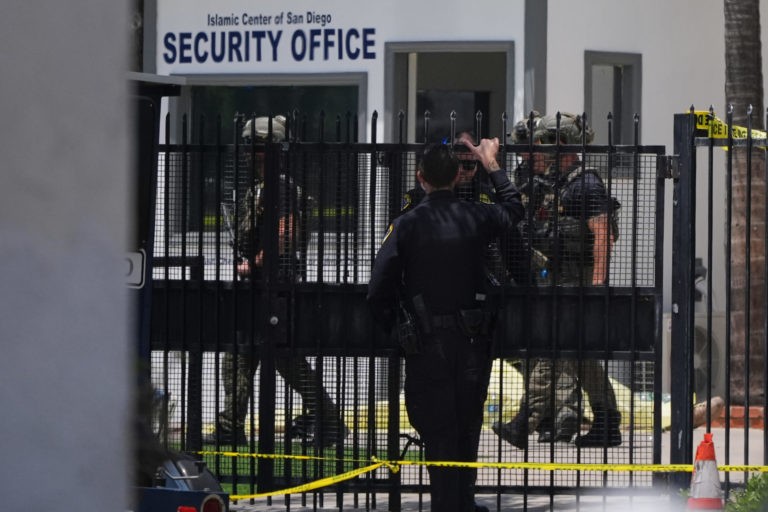
San Diego Mosque Shooters Met Online and Left Writings Expressing Hate, FBI Says

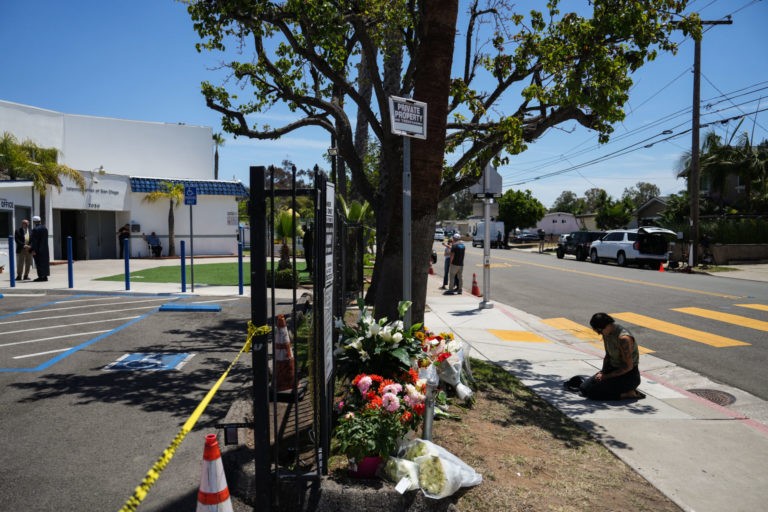
(Headline USA) The teenagers who killed three people at a San Diego mosque met online and shared a “broad hatred” toward different religions and races, authorities said Tuesday.

Mark Remily of the FBI said during a news conference that authorities have uncovered writings by the suspects. Authorities declined to specify what ideologies or views were expressed by the shooters.

Authorities have also recovered 30 firearms and a crossbow from two residences searched in connection to the investigation.

Remily said authorities are still trying to uncover whether the shooters had broader plans.

Hours before Monday’s attack police were racing to find the two teenagers who would ultimately be deemed responsible.

The search began after the mother of one teen reported that her son was suicidal and had run away, according to Police Chief Scott Wahl, who said weapons and her vehicle were missing from the family’s home. Two hours after her call, the shooting started at the Islamic Center of San Diego, which also houses a school.

The suspects, ages 17 and 18, were found nearby in a vehicle after killing themselves.

The shooting was the latest in a string of attacks on houses of worship and comes amid rising threats and hate crimes targeting the Muslim and Jewish communities since the beginning of war in the Middle East, forcing increases in security.

Authorities have not yet publicly identified the teens Tuesday morning, but after the shooting investigators were seen searching the San Diego home of Cain Clark, a high school senior. Clark’s parents, who are listed in public records as living at the home, did not respond to messages seeking comment, nor did other family members.

James Canning, a spokesman for San Diego Unified School District, said school police were cooperating with San Diego authorities investigating the mosque attack. Clark had been attending school online since 2021 and was on track to graduate next month, he said.

While he did not attend school in person, he did participate in 2024 as a member of the wrestling team at Madison High School in San Diego. Canning said Clark had no record of disciplinary issues in high school.

Neighbors Marne and Ted Celaya said they last saw Clark a few hours before the shooting and that he waved as he got into a car alone and drove away. They described the Clark family as good neighbors of more than 20 years and remembered when Cain was born, watching him and his older brother grow up.

“It’s unbelievable,” Marne Celaya said of the shooting. “He’s helped me bring in my groceries.”

Authorities executed search warrants as they piece together how and why the attack happened. There was no specific threat against the Islamic center, which is the largest mosque in San Diego, but authorities found that the suspects engaged in “generalized hate rhetoric,” Wahl said.

Muslim American organizations were quick to point out that anti-Muslim rhetoric has been on the rise across the U.S. “Words have consequences,” said Mohamed Gula, interim CEO of advocacy group Emgage Action.

Among those killed was a security guard who authorities said stopped the attack from moving beyond the mosque’s front section.

Imam Taha Hassane identified the victims as Abdullah, Mansour Kaziha and Nader Awad.

Kaziha, known as Abu Ezz, “was everything” to the Islamic Center, Hassane said.

“He was the handyman. He was the cook. He was the caretaker,” Hassane said.

Wahl spoke about how the three men helped distract the gunman, preventing a larger tragedy.

Abdullah had worked at the mosque for more than a decade.

“He wanted to defend the innocent so he decided to become a security guard,” said Shaykh Uthman Ibn Farooq, who spoke with Abdullah’s son.

In a Facebook post, the mosque said those who died were “men of courage, sacrifice, and faith,” the center wrote. “Their absence leaves a void that can never truly be filled.”

Just before the attack, the search for the missing teen intensified Monday morning as law enforcement gathered more details. Police found he had dressed in camouflage — raising their alarms — and was with a friend. Officers used automated license plate readers to track the car to a mall and went there.

The police chief said that while other officers were talking with the suspect’s mother who had called police, the first reports of the shooting came from blocks away at the mosque, which sits in a neighborhood with Middle Eastern restaurants and markets. The center includes the Al Rashid School, which offers courses in Arabic language, Islamic studies and the Quran for students ages 5 and up, according to its website.

TV footage showed more than a dozen children holding hands and being walked out of the center’s parking lot as it was surrounded by police vehicles.

As officers searched the mosque for the shooters, there were reports of people in a fleeing vehicle shooting at a landscaper who was not seriously hurt, Wahl said. Police then found the suspects dead.

Daniel McDonald said he was inside his house when he heard gunshots. He went outside to find the streets shut down, shattered glass on the pavement and a gardener who was shaken up. He said he saw police trying to revive one of the suspects.

Adapted from reporting by the Associated Press

SCOOP: Lawsuit Unearths 911 Call Made by Alleged Trump Shooter’s Father

(Ken Silva, Headline USA) Thanks to the help of the transparency organization Judicial Watch, Headline USA has won its lawsuit for audio of the 911 call Thomas Crooks’s father made the day his son allegedly tried assassinating then-presidential candidate Donald Trump at his July 13, 2024, campaign rally in Butler, Pennsylvania.

Following a roughly 18-month legal battle, Judge Daniel Regan ordered the Bethel Park Police Department to disclose the phone call recording on April 24. Bethel Park did so on Friday, and Judicial Watch published the recording today.

The call from the father, Matthew Crook, was made just before 11 p.m. on July 13, 2024—nearly five hours after the shooting at the Butler Farm Show.

“I was calling in regards to my son Thomas. He, he belongs to the Claritin Sportsmen Club in Claritin…. The reason I’m calling is he left the house here at about a quarter till 2:00 this afternoon. And we’ve gotten no contact from him, no text messages, nothing’s been returned, and he’s not home yet…. Like I said, he belongs to the Claritin Sportsmen Club or Gun Club, and he took a rifle of his out there, and it’s, it’s routine. He always does it, but he’s usually back within two hours,” Matthew Crooks told the police.

“And we’ve been texting him, leaving him messages on his phone. He’s not been returning any of our texts or messages, which is totally not like him. And, you know, we’re, we’re going on 11:00, and he still hasn’t come back or contacted us, so we’re kind of worried. We don’t know if he’s been in an accident or if something else happened to him.”

Less than an hour later, ATF and Pennsylvania troopers approached the house to conduct a search. Crooks’s father exited the residence, stepped onto the front porch, and asked them: “Is it true? Did Thomas shoot Trump?”

A responding ATF agent was initially caught off guard, according to the transcript of an interview he conducted with Congress.

“What makes you say that?” he asked the father, who responded: “The news called me.”

Legal History

Headline USA initially filed a request for the call in August 2024, only to have Bethel Park Police deny disclosure nine days later—citing Section 708(b)(18) of the RTKL, which exempts 911 recordings from public disclosure. However, the exact same RTKL paragraph cited by Bethel Police also states that law enforcement can release 911 recordings that are in the public interest.

That’s where Judicial Watch came in. The non-profit watchdog agreed to take on this publication’s case, filing a lawsuit in late October 2024 in the Pennsylvania Court of Common Pleas to force Bethel Park Police to disclose the 911 call.

Judicial Watch argued in court filings that it was in the public interest to release the call. The judge finally agreed on April 24.

A similar recording from a call Matthew Crooks made to 911 dispatch was released in December 2024. The call lasts roughly 2 minutes before abruptly ending when the 911 dispatch center transferred Matthew to the Bethel Park Police. It’s the Bethel Park Police portion of the call that was released today.

Ken Silva is the editor of Headline USA. Follow him at x.com/jd_cashless.

Structural Supply Deficits Forecast to Continue Driving Platinum Group Metal Prices Higher

(Mike Maharrey, Money Metals News Service) Platinum group metal prices rose substantially last year, driven by persistent supply deficits and favorable market dynamics, and Metals Focus expects the bull market to continue this year, with significant price upside remaining.

Platinum joined gold and silver for the wild ride up in 2025, gaining 119 percent, and then continuing to surge through the first three weeks of 2026. Platinum hit an all-time high of $2,923 an ounce in late January before selling off along with gold and silver.

Palladium took a similar trajectory, rising 78.7 percent in 2025 from $914.10 before peaking just below $1,100 in January.

According to Metals Focus, several factors drove PGM prices higher, including tightening physical balances, increasing investor interest, and concerns about the possible impact of trade and strategic access policies on trade flows.

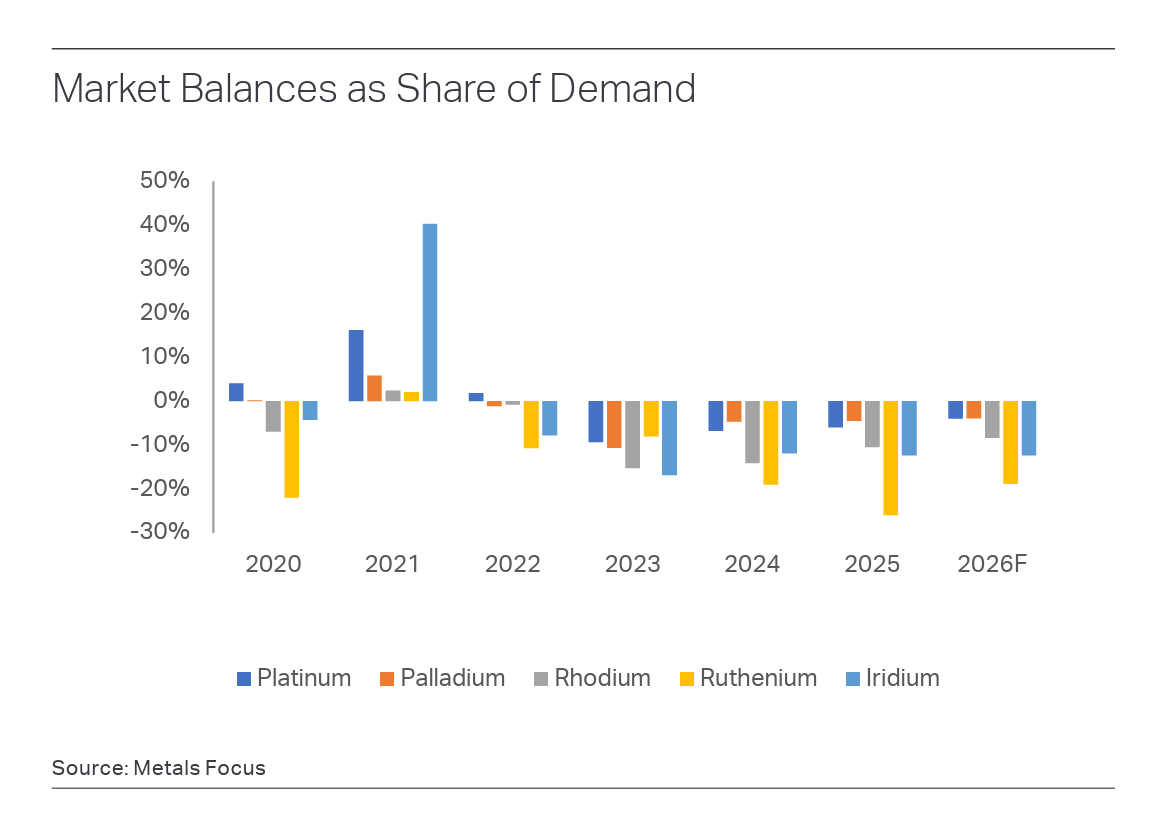
Persistent market deficits have squeezed both the platinum and palladium markets. In 2025, platinum demand outstripped supply by 951,000 ounces. It was the fourth straight market deficit, with the supply shortfall widening significantly from 559,000 ounces in 2024.

The palladium market deficit nearly doubled from 218,000 ounces in 2024 to 416,000 ounces last year.

This is similar to what happened in the silver market, where persistent deficits finally reached a critical mass and drove two squeezes that sent prices sharply higher. When production dips below demand, users must source metal from existing above-ground stocks. This generally requires higher prices to incentivize sellers.

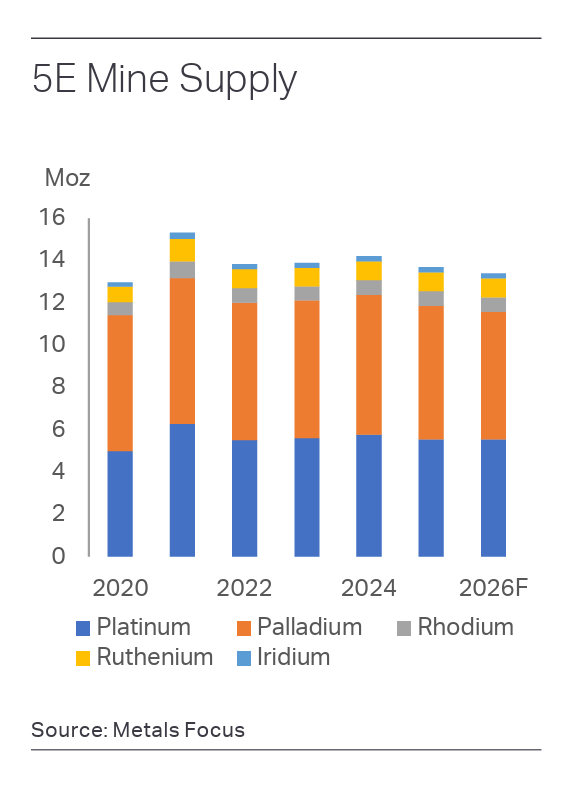
Declining mine output is squeezing the platinum supply.

Total platinum mine supply fell by 4 percent to 5.6 million ounces last year. Palladium mine output mirrored the percentage decline, contracting to 6.3 million ounces.

Secondary supply provided a partial offset, with total PGM scrap rising.

According to Metals Focus, several factors impacted PGM mine output, including a disruption in South African production due to flooding at several operations and a sharp decline in North American supply following the placement of Stillwater West on care and maintenance.

On the demand side, automotive offtake for PGMs (platinum, palladium, and rhodium) fell modestly by 2 percent to 11.9 million ounces in 2025. Notably, it was the first time auto demand dipped below 12 million ounces since a chip shortage impacted the industry in 2022.

According to Metals Focus, light-duty vehicle production grew 3 percent last year, but gains were skewed towards battery electric vehicles (BEV), which achieved a 16 percent market share.

“The pace of electrification will remain the central question for these three key PGMs. In 2025, ICE and hybrid production still accounted for the vast majority of light vehicles, but BEVs penetration is increasing steadily.”

Increasing demand in other sectors, particularly investment offtake, took up the slack.

“What has changed markedly is the investor story. Platinum’s re-rating last year was driven as much by strategic accumulation and correlation with gold as by physical fundamentals and tighter available stock levels, and that dynamic alongside the risk of protracted U.S.-Iran conflict will likely continue to shape pricing in 2026.”

Retail investment demand surged by 96 percent to 404,000 ounces. Record Chinese buying accounted for roughly 60 percent of global purchases.

PGM offtake for other industrial applications also rose last year.

Electronics demand rose by 8 percent to 1.3 million ounces across all PGMs, thanks to the AI boom.

Chemical demand grew 3 percent to 1.9 million ounces. Palladium is an important input in plastic precursor production.

Meanwhile, platinum jewelry demand rose 10 percent to a 9-year high of 2.2 million ounces. Surging platinum jewelry sales continued the upward trend that began in 2024, with manufacturers pivoting to platinum as gold prices surged.

Metals Focus expects the PGM market deficits to continue in 2026. However, “price outcomes will increasingly be shaped by investor flows, stock movements and policy intervention rather than supply-demand balances alone.

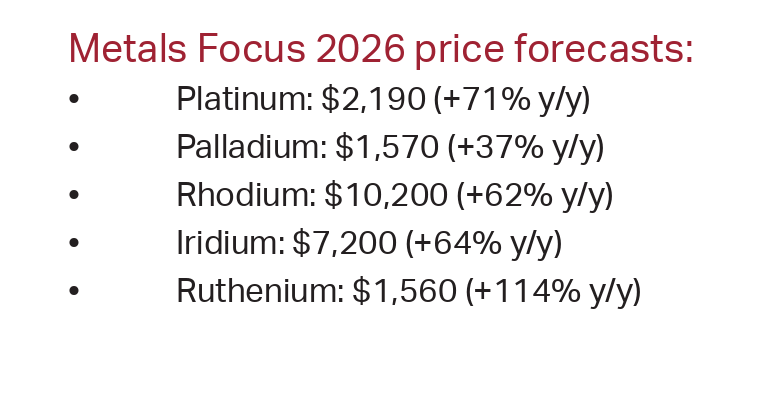
“Platinum is forecast to remain in a fourth consecutive deficit of 312,000 ounces, with above-ground stocks declining to 9.0 million ounces. Following a sharp re-rating in 2025, driven by the launch of platinum futures on China’s Guangzhou Futures Exchange (GFEX) and other investment inflows, the metal is expected to consolidate at elevated levels, averaging $2,190 in 2026 (+71% y/y). Palladium, while still in deficit for a fifth consecutive year at 376,000 ounces, faces limited investor appetite, keeping it at a discount to platinum, with a forecast average of $1,570 (+37% y/y).”

Based on its market analysis, Metals Focus expects the price of all the PGMs to rise further in 2026.


Mike Maharrey is a journalist and market analyst for Money Metals with over a decade of experience in precious metals. He holds a BS in accounting from the University of Kentucky and a BA in journalism from the University of South Florida.

Alleged Charlie Kirk Assassin’s Lawyers Seek to Keep Some Evidence Secret

(Headline USALawyers for the man accused of killing conservative activist Charlie Kirk will make their case Tuesday to close portions of a key hearing and seal some evidence after a judge rejected their request to ban news cameras from court.

Tyler Robinson’s defense has argued that broadcasts of the proceedings create a media frenzy that often misrepresents him and could bias potential jurors. They hope to keep private portions of his preliminary hearing, scheduled for July 6-10, when prosecutors must show they have enough evidence against Robinson to proceed to trial.

The July hearing will mark the most significant presentation of details to date in a case that has focused largely on public access in its first eight months.

Prosecutors intend to seek the death penalty if Robinson, 23, is convicted. He is charged with crimes including aggravated murder in the Sept. 10 assassination of the conservative activist on the Utah Valley University campus. Robinson has not yet entered a plea.

Prior to his death, Kirk and the conservative youth movement he founded, Turning Point USA, emerged as a major force in U.S. politics that was considered instrumental in getting President Donald Trump elected to a second term.

As public attention has swirled, state District Judge Tony Graf has taken steps to protect Robinson’s rights in court, but he declined earlier this month to shut out cameras.

During the preliminary hearing, prosecutors say they plan to introduce forensic analyses, surveillance video, recordings of witness statements, autopsy findings and alleged messages from Robinson admitting to the crime.

Defense attorneys have asked the judge to seal dozens of those exhibits to “prevent infecting the potential jury pool,” according to a court document filed Monday.

Prosecutors argue the preliminary hearing should remain open, but they agree that media should be restricted from viewing or copying some exhibits that could be used in a future trial.

Prosecutors have said Robinson left a note for his romantic partner hidden under a keyboard that said, “I had the opportunity to take out Charlie Kirk and I’m going to take it.” They have also said he wrote in a text message about Kirk: “I had enough of his hatred. Some hate can’t be negotiated out.”

Authorities have said DNA consistent with Robinson’s was found on the trigger of the rifle used to kill Kirk, the fired cartridge casing, two unfired cartridges and a towel used to wrap the rifle.

Deputy Utah County Attorney Chad Grunander said in court documents that some evidence they plan to present in July is “reliable hearsay,” or statements made outside of court that are considered highly trustworthy. Such statements are typically allowed in preliminary hearings but not at trial, where standards are stricter.

Robinson’s attorneys worry the statements will spread widely after the preliminary hearing, harm their client and then not be admissible at a trial.

Prosecutors disagree, saying in a court filing, “There is nothing to suggest that the substance of the evidence is inadmissible.”

Adapted from reporting by the Associated Press

Police Were Searching San Diego Mosque Attackers Before the Bloodshed Began

(Headline USABefore the first shot rang out at a San Diego mosque in a deadly shooting that would leave three men dead, police were already scrambling to find two teenagers who would ultimately be responsible.

The search began after a mother of one of the teenagers reported her son was suicidal and had run away, according to San Diego Police Chief Scott Wahl, who said weapons were missing from the home and her vehicle was gone.

Two hours later, the shooting began at the Islamic Center of San Diego, just blocks away from the home.

The suspects, ages 17 and 18, were found in a vehicle after killing themselves a few blocks from the site of the shooting.

Authorities planned to execute search warrants related to the investigation Tuesday as they piece together how and why the shooting unfolded. There was no specific threat made against the Islamic center, but authorities found evidence that the suspects engaged in “generalized hate rhetoric,” Wahl said, noting that the shooting is being investigated as a hate crime.

The center, which said it was closed until further notice, is the largest mosque in San Diego and typically holds five daily prayers.

“These were men who put themselves on the line for our masjid and our community,” the center wrote in a Facebook post, using the Arabic word for mosque. “Men of courage, sacrifice, and faith. Their absence leaves a void that can never truly be filled.”

On Monday morning, the search for the missing teen intensified as law enforcement began to gather more details. Police learned he had dressed in camouflage and was with an acquaintance. Officers used automated license plate readers to track the car and went to a mall in the area. They also alerted a school where at least one of the teens had been a student and continued interviewing the mother, Wahl said.

When reports of the shooting came in, police responded within four minutes of being called. Three men were dead when they arrived, Wahl said.

Among those killed was a security guard, who police believe “played a pivotal role” in keeping the attack from being “much worse,” Wahl said.

“It’s fair to say his actions were heroic,” the chief said at a news conference. “Undoubtedly he saved lives today.”

A family friend identified the guard as Amin Abdullah, a well-known face at the mosque who had worked there for more than a decade.

“He wanted to defend the innocent so he decided to become a security guard,” said Shaykh Uthman Ibn Farooq, who spoke with Abdullah’s son.

The family could not immediately be reached for comment.

The center called him “a courageous man who put himself on the line of the safety of others, who even in his last moments did not stop protecting our community.”

The mosque is in a neighborhood of homes, apartments and strip malls with Middle Eastern restaurants and markets. The center includes the Al Rashid School, which offers courses in Arabic language, Islamic studies and the Quran for students ages 5 and up, according to its website.

Aerial TV footage showed more than a dozen children holding hands and being walked out of the center’s parking lot as it was surrounded by scores of police vehicles.

Imam Taha Hassane, the mosque’s director, called it “extremely outrageous to target a place of worship,” adding that the center focused on interfaith relations and community building.

President Donald Trump called the shooting a “terrible situation.”

Adapted from reporting by the Associated Press

Trump Makes It Official: Lawfare Victims to Be Compensated

(Luis CornelioHeadline USA) Millions in legal fees. Felony charges. Thousands of combined years in prison sentences. Hours of interrogations. Hundreds of subpoenas. Careers ruined.

That is the scale of what thousands of conservative activists and organizations endured through years of federal investigations under the Biden administration.

Now, they are set to be compensated under a $1.776 billion fund announced Monday by President Donald Trump and the Department of Justice.

The fund is part of a settlement between Trump, the Department of the Treasury and the IRS after former IRS contractor Charles Littlejohn leaked Trump’s tax returns to the media.

The fund will be overseen by a five-member board appointed by the attorney general, with one member selected in consultation with lawmakers, according to the DOJ.

The department said participation in the claims process will be voluntary and open to eligible applicants, with no partisan requirements to file.

Acting Attorney General Todd Blanche praised the settlement and the creation of the fund.

“The machinery of government should never be weaponized against any American, and it is this Department’s intention to make right the wrongs that were previously done while ensuring this never happens again,” Blanche said.

“As part of this settlement, we are setting up a lawful process for victims of lawfare and weaponization to be heard and seek redress,” he added.

The DOJ said the fund was modeled after a $760 million program established during the Obama administration to redress claims of discrimination within the federal government.

Any unclaimed funds will be returned to the federal government, unlike the Obama-era program, which redirected remaining funds to outside organizations.

However, nearly 100 Democrats in the House of Representatives have signed onto a legal brief urging a judge to block what they described as an unprecedented resolution that they said would unjustly enrich people close to the president and open the door to meritless claims of political persecution.

“Let’s call this what it is: a billion-dollar slush fund for Trump to reward felons, insurrectionists, and cronies, paid for by YOUR taxpayer dollars,” Democratic Sen. Chris Coons, a member of the subcommittee from Delaware, wrote on X. “It’s bad enough that this DOJ believes it works for Donald Trump. Now, it’s giving him its budget to use as his piggy bank.”

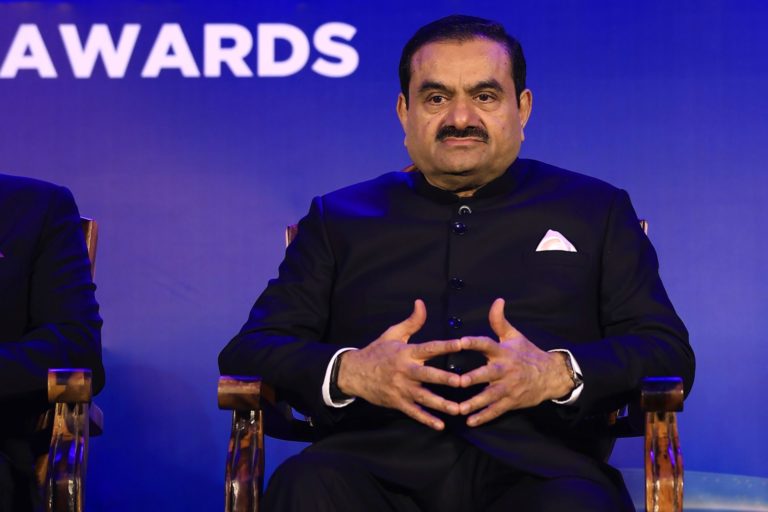
US Prosecutors Drop Fraud Charges Against Billionaire Indian Businessman Gautam Adani

(Headline USA) U.S. prosecutors asked a judge Monday to dismiss criminal fraud and conspiracy charges against Indian billionaire Gautam Adani, who had been accused of duping Wall Street investors who poured billions of dollars into a massive solar project in India.

Adani, one of the world’s richest people, was accused in 2024 of paying massive bribes to ensure the project’s success. He was indicted in federal court in Brooklyn on charges of conspiracy, securities fraud and wire fraud charges in connection with a lucrative arrangement for Adani Green Energy Ltd. and another firm to sell 12 gigawatts of solar power to the Indian government to light millions of homes and businesses.

The Adani Group denied the allegations at the time, calling them baseless.

“The Department of Justice has reviewed this case and has decided, in its prosecutorial discretion, not to devote further resources to these criminal charges against individual defendants,” prosecutors wrote in a court filing.

The filing bore the names of Principal Associate Deputy Attorney General R. Trent McCotter and Brooklyn U.S. Attorney Joseph Nocella Jr.

Judge Nicholas Garaufis must still approve the request.

Lawyers for Adani and his co-defendants consented to the request, prosecutors said.

Adani’s lawyer, Robert Giuffra, declined to comment. Lawyers Timothy Sini and Sean Hecker, who represent Adani’s nephew and co-defendant Sagar Adani, also declined comment.

Adani was never arrested in the case or brought to the U.S. to face trial and some in India long expected the case would be shelved after President Donald Trump last year suspended enforcement of the Foreign Corrupt Practices Act, a U.S. law banning business bribes overseas.

The move to drop the charges comes after the U.S. Securities and Exchange Commission said it was settling a related lawsuit against Adani.

Adani built his fortune in the coal business in the 1990s and, over time, the Adani Group embraced a diverse portfolio, investing in industries like renewable energy, defense and agriculture.

The company amassed a clean energy portfolio that included one of the world’s largest solar power plants, and had set a goal of becoming the country’s biggest player in the space by 2030. Adani had close ties with India’s government and Prime Minister Narendra Modi.

But the company also had its critics.

Short-seller Hindenburg Research, a U.S.-based financial research firm, has accused Adani and his company of “brazen stock manipulation” and “accounting fraud.” The Adani Group labeled the claims “a malicious combination of selective misinformation and stale, baseless and discredited allegations.”

When they charged Adani in 2024, U.S. prosecutors in New York said he and others played two sides of the solar deal, enticing investors with a rosy portrayal that the project was above board while offering $265 million in bribes to Indian government officials to secure lucrative contracts.

After the case was announced, Kenya’s president canceled multimillion-dollar airport expansion and energy deals with Adani. Adani Green Energy withdrew its wind energy projects from Sri Lanka after the country sought to renegotiate prices, while a French oil giant also paused new investments.

Analysts say a key factor in Adani’s meteoric rise over the years has been his knack for aligning his group’s priorities with those of the Modi government. His critics accuse him of crony capitalism and of gaining preferential treatment from the government, including in winning contracts, which the group has denied.

Adapted from reporting by the Associated Press