Hogan Aims to Leverage Outrage over Biden’s Open Border in Deep-Blue Md. Senate Race

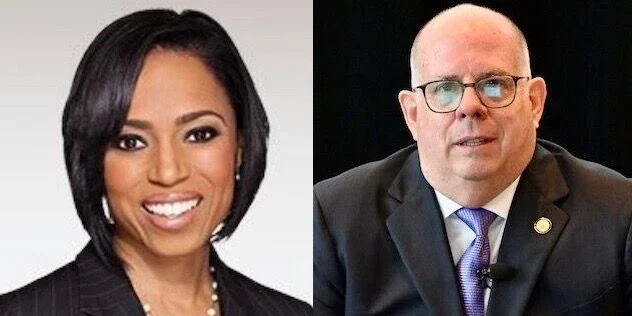
() Former Maryland Gov. Larry Hogan has made illegal immigration a centerpiece of his 2024 Senate campaign in the state.

Meanwhile, if voters listened only to his Democrat opponent, Angela Alsobrooks, they might not hear the word “immigration” at all.

Hogan, a centrist NeverTrumper, hopes to flip the seat being vacated by retiring Democrat Sen. Ben Cardin in the deep blue state where he succeeded in serving two terms as a surprisingly popular governor.

Since winning the GOP primary election on May 14, Hogan has aggressively campaigned on stopping illegal immigration, which has experienced a dramatic increase under the Biden administration.

“Our open southern border is a humanitarian catastrophe that is harming our communities and wreaking havoc across the country,” Hogan’s campaign wrote in a statement to the Center Square.

“For decades, politicians have played campaign politics with this issue instead of actually just solving the problem,” the statement continued. “Enough is enough.”

Hogan has posted multiple times about “the border crisis” on his Twitter account, where he blames both parties for failing to address the issue.

In April, Hogan visited Texas to tour the U.S. southern border with Mexico—a common practice by Republican candidates across the country seeking to attack Democrats on the issue.

Hogan is making a conservative argument on border security in a heavily Democratic state, with a Cook Partisan Voting Index (PVI) score of D+14. It is estimated that 275,000 illegal immigrants live in Maryland, with at least 120,000 of them being family of U.S. citizens, according to the American Immigration Council.

By contrast, Alsobrooks has said close to nothing about border security or immigration during her campaign. In public statements and on social media, she has instead emphasized abortion, gun violence and climate change as top issues.

Where Alsobrooks, currently the top executive for Prince George’s County, has commented on immigration, she has instead highlighted her record of supporting “undocumented” immigrants and efforts to shield them from deportation

The county, like many other “woke” municipalities, has made a point of its refusal to cooperate with Immigration and Customs Enforcement, even when doing so has resulted in an uptick in violent crime for already vulnerable communities.

For Democrats, however, the reduced quality of living is a worthwhile tradeoff for the increase in political power they receive by importing new residents. Not only does it potentially allow the blue areas to gain additional federal funds—and possibly even congressional seats—but the Great Replacement strategy also helps assure that the region will remain Democrat in generations to come, if not veer even farther to the radical left.

“Angela was a vocal advocate and pushed to pass legislation allowing undocumented immigrants to obtain driver’s licenses,” reads Alsobrooks’ campaign website, which also details her efforts to prevent police officers from collaborating with federal officials to deport non-violent offenders.

Alsobrooks has vowed to “fervently support” a pathway to U.S. citizenship for foreign nationals who are illegally present in the country, a policy long supported by Democrats but criticized as “amnesty” for illegal immigrants by Republicans.

Her website cites as a model the American Dream and Promise Act—a bill that would grant legal status to minors brought to the U.S. illegally as children, which passed the Democratic-led House in the 117th Congress.

Hogan’s and Alsobrooks’s vastly different views on the border come as Republicans seek to make illegal immigration a key argument in their campaigns, particularly to attack the Biden administration, which has allowed an estimated 11 million illegals into the country. Democrats, by contrast, have sought to deflect from the problem by claiming that Republicans are seeking to weaponize the issue and are not interested in solving the issue.

These differences came to a head in February, when Senate Republicans voted to kill a bill that Democrats said would have enacted border security reforms to limit illegal crossings.

Democrats accused former President Donald Trump, the GOP nominee for president in 2024, of giving fellow Republicans their marching orders by criticizing the bill. Republicans countered that the bill would have given Homeland Security Secretary Alejandro Mayorkas, whom House Republicans impeached over the border crisis, even more discretionary authority to make decisions on border policy.

“This Bill is a great gift to the Democrats, and a Death Wish for The Republican Party. It takes the HORRIBLE JOB the Democrats have done on Immigration and the Border, absolves them, and puts it all squarely on the shoulders of Republicans,” Trump wrote on Truth Social.

As part of a cynical political ploy, Senate Majority Leader Chuck Schumer brought the bill back to the Senate floor last week. However, it failed in a 43-50 procedural vote.

While the RealClearPolitics polling average shows Hogan currently with a 6.5 point advantage, only one of those polls was conducted in May, just five days before the two secured their nominations in the state primary, and that poll, from Emerson College, gave a 10-point edge to Alsobrooks in a head-to-head matchup between the two.

The poll’s 54% Democrats roughly reflected the accurate percentages within the state, although it slightly underrepresented Republicans in favor of independents.

Gold & Silver May Gain Further Appeal As Chaos Hedge

(Mike Gleason, Money Metals News Service) As the criminal conviction of former President Donald Trump dominates the news cycle, investors have to be asking themselves whether the upcoming election will be anything like normal. 

A potential crisis of legitimacy for America’s electoral system looms. That could bring with it a loss of confidence in U.S. financial markets and the U.S. dollar itself.

The media is aghast that Trump’s legal troubles have failed to dampen his appeal to voters. In fact, Trump holds a polling lead over struggling incumbent Joe Biden in most swing states.   

Were the election to be held today, the final outcome would likely to be too close to and too bitterly contested to convince backers of the defeated candidate to accept the winner’s victory.  

Trump supporters say the Democrat-controlled New York criminal justice system is trying to single-handedly decide the election for the entire country.  It’s possible that Trump could be prevented from holding campaign rallies because he is placed under house arrest or even confined inside a jail cell. 

Meanwhile, Trump made an unusual campaign stop last week, delivering a speech before the Libertarian Party national convention. In seeking the support of this faction of the liberty movement, he declared that being politically persecuted by forces within the government have made him more of a libertarian than ever before. Trump vowed to uproot the deep state, bring down inflation, protect cryptocurrency holders, and prevent the Federal Reserve from issuing a central bank digital currency.

His remarks were interrupted by chants of “end the Fed.” 

It’s not clear whether another Trump administration will result in any fundamental changes in fiscal or monetary policy. In his first term, he rarely used his veto power to push back against deficit spending by Congress. And despite some attempts to point the central bank in a different direction, he appointed establishment insider Jerome Powell to be Fed chairman – a hiring decision among many others that he later came to regret. 

Sound money advocates will certainly aim to gain some influence in a Trump administration. A few Trump allies in Congress are proponents of gold and silver as money. Trump himself is known to be personally fond of gold and may be receptive to concerns such as eliminating the punitive “collectibles” tax on bullion. 

As to how gold and silver prices might respond to the election results, it’s difficult to predict given how close and unpredictable the election itself is shaping up to be. 

Stock market investors may have more to worry about. Wall Street hates uncertainty. 

A Constitutional crisis surrounding the election is quite possible, as is social unrest and possibly even martial law. If the election results are in dispute and the peaceful transfer of power is in doubt, then the stock market could gyrate violently to the downside.    

In such a scenario, precious metals could gain safe-haven appeal. Longer term, gold and silver prices can be expected to rise as a reflection of ongoing currency depreciation. 

Neither Joe Biden nor Donald Trump have submitted any credible plans to balance the budget. But it is possible that in the event of a Trump victory, optimism about a change in course from Bidenomics could cause investment demand for bullion to decrease in the near term. 

Renewed investor interest in gold so far this year has helped propel the monetary metal to record highs. Gold is trading slightly off those highs here in this final trading day of May, coming in at $2,355.

Turning to silver, it has been outperforming gold in recent weeks. As a result, the gold to silver has narrowed to a 3-year low. Silver prices are trading near $31.40 per ounce. 

This week, UBS raised its price target for silver to $36 by the end of the year. The Swiss investment bank cited an expected 9% surge in industrial demand for silver, led by the photovoltaic sector. At the same time, global mining output is expected to suffer a small decline, exacerbating a chronic supply deficit for the metal.

Recent reports out of China suggest silver inventories there are being rapidly depleted as the country ramps up production of solar panels. Silver is a critical component of solar and other electricity generating infrastructure.  

Silver along with gold are also critical components of an inflation protection strategy for investors. 


Mike Gleason is a Director with Money Metals Exchange, a precious metals dealer recently named “Best in the USA” by an independent global ratings group. Gleason is a hard money advocate and a strong proponent of personal liberty, limited government and the Austrian School of Economics. A graduate of the University of Florida, Gleason has extensive experience in management, sales and logistics as well as precious metals investing. He also puts his longtime broadcasting background to good use, hosting a weekly precious metals podcast since 2011, a program listened to by tens of thousands each week.

Louisiana Reaffirms Gold and Silver As Legal Tender

(Money Metals News Service) Louisiana Gov. Jeff Landry has signed a new law reaffirming gold and silver as legal tender, making a symbolic statement in favor of sound money principles.

Senate Bill 232, sponsored by Sen. Mark Abraham, marks the sixth pro-sound money bill passed by a state this year, underscoring a growing national trend.

Louisiana’s sound money bill simply affirms that “any gold or silver coin, specie, or bullion” issued by the United States government is considered legal tender whenever voluntarily agreed upon by both parties to a contract. The measure enjoyed popular support, receiving only one “no” vote on the floor throughout the Louisiana House and Senate.

This concept is consistent with the U.S. Constitution. In fact, Article 1 Section 10 reads: “No state shall…coin Money; emit Bills of Credit; [or] make any Thing but gold and silver Coin a Tender in Payment of Debts…”

America’s 53-year experiment in a purely fiat currency system has gone poorly. Without backing of gold or silver, the Federal Reserve note “dollar” has continuously declined in purchasing power. The nation has faced a series of Fed-created booms caused by interest rate manipulation, followed by busts and explosive growth in government spending.

When savers, wage earners, and investors seek ways to protect their savings from the ravages of inflation, they often choose precious metals over fiat currency because precious metals have preserved purchasing power over time.

This bill provides symbolic support to Louisiana citizens making this choice, and it is a modest step toward establishing sound money policies in the state.

Alabama, Utah, Wisconsin, Nebraska, and Kentucky passed legislation in 2024 ending sales and capital gains taxes on precious metals, declaring that Central Bank Digital Currencies are not valid money in their state, or empowering state treasurers to invest state funds in gold and silver.

Louisiana is the sixth state to enact sound money laws this year, while five other states did so in 2023.

Alleged ISIS Loyalist Arrested for Plotting Terrorism While out on Bail

(Ken Silva, Headline USA) Last August, Detroit man Jibreel Pratt was arrested for allegedly purchasing stolen bank-account info on an illicit online marketplace named Genesis Market—which the FBI had been investigating via online undercover employees and other methods since 2018.

When the FBI searched Pratt’s home last August, they claim to have found an AR-style semiautomatic rifle and handgun, a tactical gas mask and boots, and goodbye letters to his family. It turned out, Pratt had been talking to FBI informants since at least February 2023, pledging his support for ISIS.

But instead of hitting Pratt with terrorism-related charges when they arrested him for fraud last August, authorities released him on bail. Pratt then continued to talk to the FBI informants online for another roughly nine months before he was arrested again this week.

“While on this Court’s bond and federal supervision for his cyber case, Pratt quickly reached out to the ISIS source [an FBI informant] and told the ISIS source (emphasis in the original) to “DELETE EVERYTHING” and plotted to jump bond and flee the country,” a Justice Department lawyer said in a Tuesday motion to revoke Pratt’s bail.

“Pratt vowed that, since his arrest, his ‘drive and determination has not lowered but increased’ and that he wanted to ‘grow’ ISIS to even ‘bigger heights’ than when it had unleashed savage tyranny across the Middle East.”

In December, Pratt contacted another online FBI persona that he believed to be a separate ISIS member, again expressing his desire for jihad, according to the DOJ.

“As recently as March 2024, Pratt asked the Second ISIS source to help him leave America without a passport because Pratt ‘need[s]’ to ‘make hijrah’ and ‘come to my state,’” the DOJ said in its motion for detention.

Unlike the slew of teenagers the FBI has arrested over the last year for talking to informants posing as ISIS members, Pratt appears to be a sophisticated criminal.

The DOJ noted that he had sporadic employment over the last few years, but was still able to accumulate several firearms, ammunition, combat gear, an apartment, and computer equipment. And his cellphone showed that he had somehow accumulated over $102,000 in Bitcoin, according to the DOJ.

Pratt is currently detained, and has a detention hearing on Wednesday.

Ken Silva is a staff writer at Headline USA. Follow him at twitter.com/jd_cashless.

Hunter Biden Used Sandy Hook Memorial as Cover for Shady Business Deal

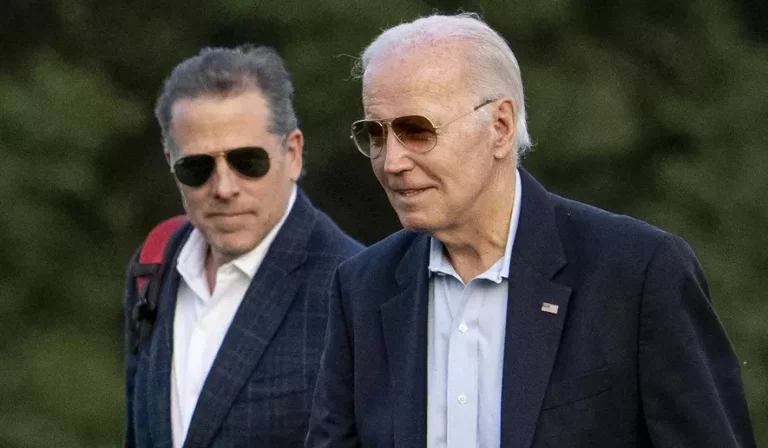
(Ken Silva, Headline USA) New text messages from the House GOP investigation into the Biden family reveal that Hunter used his father’s appearance at Sandy Hook Elementary School—where 26 people, including 19 students, were gunned down in 2012—to arrange a shady business deal.

The text messages were from Dec. 12, 2017, when Hunter Biden asked his business partner, Liu Yadong, a top executive at Chinese oil giant CEFC, to arrange a meeting with his father.

“Can you meet this evening early?” Hunter wrote, as first reported by the Daily Mail. “My father will be in New York also and he wants me to attend the Sandyhook memorial service with him and I would like him to meet you along with my uncle [Jim Biden] and then you and I can talk let me know if that works.”

Yadong agreed to meet.

“No problem,” he told Hunter. “Pls let me know where and when to meet.”

It’s not clear if they ever met at Sandy Hook, but the Bidens eventually struck a deal with CEFC to be involved with the company in exchange for $10 million a year.

That agreement led to the infamous July 2017 text message from Hunter to CEFC executive Henry Zhao, asking about receiving payments from the deal.

“I am sitting here with my father and we would like to understand why the commitment made has not been fulfilled,” Hunter said in that July 2017 message to Henry Zhao. “Tell the director that I would like to resolve this now before it gets out of hand, and now means tonight.”

Days later, Hunter received $5 million from CEFC.

Some of that money wound up in Joe Biden’s bank account. According to the House Oversight Committee, CEFC first sent the $5 million to Northern International Capital, which then forwarded the payment to Hudson West III—a joint venture between a Hunter Biden and a CEFC associate.

Then, Hudson West sent $400,000 to Hunter’s law firm, Owasco PC. From there, $150,000 was sent to the Lion Hall Group, which was owned by James Biden and his wife, Sara Biden.

Sara then withdrew $50,000 from Lion Hall and deposited it in her personal account.

Finally, a few days later, Sara cut a check in September 2017 to Joe for $40,000—calling it a “loan repayment.”

“Even if this $40,000 was a loan repayment from James Biden, it still shows how Joe benefited from his family cashing in on his name—with money from China, no less,” House Oversight Chairman James Comer said of this revelation last year.

Meanwhile, conservative pundits expressed disgust—but not surprise—that the Bidens were willing to use the Sandy Hook memorial to facilitate shady business deals.

“It takes a special kind of degenerate to use a memorial for deceased children as cover for meeting with the Chinese communists,” Red State wrote in an editorial. “Has there been another political family in American history with this level of consistent corruption?”

Ken Silva is a staff writer at Headline USA. Follow him at twitter.com/jd_cashless.

Did FDR Really Confiscate Everybody’s Gold?

(Mike Maharrey, Money Metals News Service) Did the U.S. government really try to confiscate Americans’ gold? The short answer is… well, there isn’t a short answer. It’s a complicated subject with more nuance than most people give it.

Yes, President Franklin D. Roosevelt did try to take most of the gold out of the public’s hands. But the scheme didn’t go quite as well as many people claim.

Still, some gold dealers use the confiscation story to try to scare you into only buying collectible coins because there was an exception in Roosevelt’s order for “gold coins having a recognized special value to collectors of rare and unusual coins.” They’ll say, “The government could come to take your Gold Eagles as they did in 1933, but not these collectible coins we’re selling.” Of course, these collectible coins come with higher premiums and bigger profits for the dealer. 

You might call it a confiscation con because the reality is there wasn’t “confiscation” in the strict sense of the word.

So what actually happened?

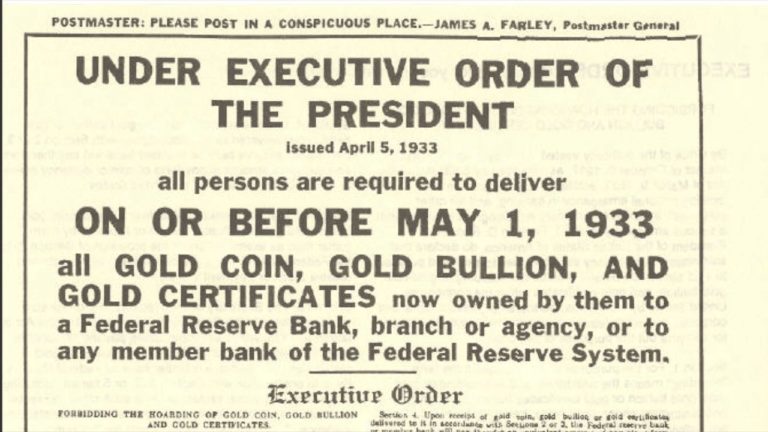
On April 5, 1933, President Franklin D. Roosevelt signed Executive Order 6102. He justified the move based on the Trading with the Enemy Act of 1917, as amended by the Emergency Banking Act in March 1933.

At the time, the United States was in the grip of the Great Depression. A lot of people were redeeming paper dollars for physical gold because they were losing faith in the paper currency.  This caused significant problems for the federal government because the dollar was tethered to gold, and thus, the printing of it was at least somewhat limited. 

During a Fireside Chat a month before issuing the EO, Roosevelt claimed gold “hoarding during the past week has become an exceedingly unfashionable pastime,” and he said that it was undermining the banking system. The use of the word “hoarding” was almost certainly intentional because of its negative connotations. 

This carried forward to EO6102. Stopping hoarding was the public rationale for the order, but it went far beyond merely taking large amounts of gold from “hoarders.” By creating an expansive definition of “hoarding,” the EO was designed to take virtually all gold coins and bars out of private hands and transfer them to the government. 

“The term ‘hoarding’ means the withdrawal and withholding of gold coin, gold bullion, or gold certificates from the recognized and customary channels of trade. The term ‘person’ means any individual, partnership, association or corporation.”

In short, anyone who wanted to hold their gold as a form of savings was considered to be “hoarding.”

Under the order, private citizens, partnerships, associations, and corporations were required to turn in virtually all their gold. 

The order allowed people to keep up to $100 in gold coins, along with gold “as may be required for legitimate and customary use in industry, profession or art within a reasonable time,” and “rare” coins. 

It read, in part: “Deliver on or before May 1, 1933, to a Federal Reserve Bank or a branch or agency thereof or to any member bank of the Federal Reserve System all gold coin, gold bullion, and gold certificates now owned by them or coming into their ownership on or before April 28, 1933.”

In return, the Federal Reserve Bank would give individuals an equivalent amount in “any other form of coin or currency coined or issued under the laws of the United States” at the rate of $20.67 per ounce.

Once the government got the gold at that price, it did what governments do – it changed the price-fixing to its advantage, raising the price to $35 and devaluing the paper money people received in exchange for their gold. 

Violators of the law were subject to up to a $10,000 fine and/or 10 years in prison.

Like so often happens today, Congress passed the Emergency Banking Act before the majority of members had even read the bill. It expanded The Trading With Enemy Act of 1917 (TWEA), a WWI statute still on the books today, prohibiting trade with enemies of the United States. 

One provision in the 1917 law empowered the president to regulate or prohibit “under such rules and regulations as he may prescribe … any transactions in foreign exchange, export or earmarkings of gold or silver coin or bullion or currency … by any person within the United States.” 

On March 6, 1933, President Roosevelt declared a national emergency under § 5(b) of the TWEA, authorizing him to declare a bank holiday to prevent the hoarding of gold. The President invoked this authority even though the section explicitly limited presidential power to wartime. 

Congress then retroactively amended the section to allow the president to take action “during time of war or during any other period of national emergency declared by the president” when it passed the Emergency Banking Act three days later.

Provisions in the Emergency Banking Act gave the secretary of the Treasury the power to require all individuals and corporations to hand over all their gold coin, gold bullion, or gold certificates if in his judgment “such action is necessary to protect the currency system of the United States.” 

This served as the legal justification for EO6102.

What Was the Motive Behind Roosevelt’s Gold Confiscation Scheme?


Despite the window dressing and propaganda, Rosevelt’s order wasn’t a benevolent move to protect America from greedy gold hoarders. In truth, the government needed the gold.

With the dollar tied to gold, the Federal Reserve could not significantly increase the money supply during the Great Depression. It couldn’t simply fire up the printing press as it can today. The Federal Reserve Act required the central bank to hold enough gold to back at least 40 percent of the notes in circulation.

But the central bank was low on gold and up against the limit.

Since monetary stimulus – an increase in the supply of money –  is the Keynesian response to an economic downturn, Roosevelt was between a rock and a hard place. He wanted the Fed to increase the money supply and support government spending but was limited by this partial gold standard.  

By transferring gold from the public to the Federal Reserve, the central bank boosted its reserve holdings, allowing it to print more money than it was previously able to.

Gold confiscation was the second step in Roosevelt’s aggressive plan to weaken the gold standard.

EO6102 followed on the heels of Executive Order 6073, which Roosevelt issued just weeks prior, prohibiting banks from paying out or exporting gold.

A little over a year after the enactment of EO6102, the United States effectively went off the gold standard when Congress passed the Gold Reserve Act of 1934. In effect, this law transformed gold from a currency to a commodity.

One of the most significant provisions in the law erased the right of creditors to demand payment in gold. In practice, this forced debtors to make payments in whatever the government declared was legal tender. Gold couldn’t even be used as the basis for determining how much paper money was owed.

As noted above, when people were ordered to turn in their gold they were given a rate of $20.67 per ounce, but the government wasn’t done.

The war on sound money continued in 1934 when President Roosevelt issued a proclamation raising the fixed price for gold to $35 per ounce. This effectively boosted the value of gold on the Federal Reserve’s balance sheet by 69 percent. 

By increasing its gold stores through the transfer of private gold to the Fed, and declaring a higher exchange rate, the Fed could circulate more paper money. In effect, the hoarding of gold by the government allowed it to inflate the money supply.

Was the Gold Confiscation Order Enforced?

The short answer is “barely.”

EO6102 is often referred to as a gold confiscation order, and in principle, it was. Roosevelt effectively nationalized gold. But the word “confiscation” conjures up images of police breaking down doors to forcibly take people’s gold. 

That’s not what happened.

The Federal Reserve collected plenty of gold, but only because many Americans turned it in voluntarily as an act of obedience. Some likely did so because they trusted the government, others out of a sense of patriotism, and some probably turned their gold in out of fear.

But generally speaking, federal agents did not search for private holdings or seize gold. People took their gold and gold certificates to the bank and received the promised compensation.

As Tom Woods noted in The Great Gold Robbery of 1933, “The paper currency they were receiving in exchange for the gold had always been redeemable in gold in the past, so few saw anything amiss in this coerced transaction, and most trusted the government’s assurances that this was somehow necessary in order to combat the Depression.”

The total amount of gold turned in to the Fed remains unclear because the central bank isn’t required to disclose detailed accounting. However, in their book A Monetary History of the United States, economists Milton Friedman and Anna Jacobson Schwartz estimated the amount was relatively small and that most people simply ignored the order. 

According to their calculations, Americans turned in about 20 to 25 percent of gold held in private hands at the time. In other words, a large percentage of people simply ignored the order.

Friedman and Schwartz came to this conclusion when they found something wonky in the official government data. The amount of gold the government said it held (in dollar terms) before the confiscation order was abnormally low.

“If the estimates of gold lost and gold exported without record are added to the gold coin returned to the Treasury since 1934, we are still far short of accounting for even half of the $287 million. We therefore concluded that in Jan. 1934 the bulk of the $287 million was retained illegally in private hands.”

In effect, the Federal Reserve cooked the books to make it look like more gold was turned in than was. Economist David Henderson explains it this way:

“The government thought that x gold existed in, say, 1930. Then, when people were supposed to turn their gold over by law in 1934, the government calculated that there was only 0.8x. Rather than concluding that people were withholding 0.2x of gold, the government went back and said, ‘Oops, we overestimated the amount of gold in 1930. It must have been falling due to factors y and z.’”

Looking at gold coin mintage versus gold meltdown figures confirms the 20 to 25 percent turn-in rate, along with official gold reserve data.

This goes to show that, like most other federal actions, the gold confiscation actually depended primarily on the voluntary cooperation of the people. 

That’s not to say the government didn’t try to enforce the orders. 

Frederick Barber Campbell was the first person to find himself in federal crosshairs. He had over 5,000 ounces of gold on deposit at Chase National Bank. When the bank refused his request to withdraw the gold after Roosevelt issued EO6102, Campbell sued the bank, bringing himself to the attention of federal prosecutors. 

A judge overturned the prosecution because the president signed EO6102 instead of the Treasury secretary as required under the Banking Act of 1933. But the court upheld the federal government’s authority to confiscate gold and still seized Campbell’s holdings.

Campbell was the only person prosecuted under EO6102

After the judge nullified the federal enforcement authority in EO6102, Roosevelt signed EO6260 to empower the Treasurer to make rules relating to gold confiscation, to allow for licensed individuals to hold gold, and to authorize federal prosecution under the direction of the Treasurer.

“Whoever willfully violates any provision of this Executive Order or of any license, order, rule, or regulation issued or prescribed hereunder, shall, upon conviction, be fined not more than $10,000, or, if a natural person, may be imprisoned for not more than 10 years, or both; and any officer, director, or agent of any corporation who knowingly participates in such violation may be punished by a like fine, imprisonment, or both.”

The Gold Reserve Act of 1934 also included provisions beefing up the power to prosecute individuals illegally holding gold.

“Any gold withheld, acquired, transported, melted or treated, imported, exported, or earmarked or held in custody, in violation of this Act or of any regulations issued hereunder, or licenses issued pursuant thereto, shall be forfeited to the United States, and may be seized and condemned … And in addition, any person failing to comply with the provisions of this Act or of any such regulations or licenses, shall be subject to a penalty equal to twice the value of the gold in respect of which such failure occurred.”

Following the pattern Campbell established, most of the prosecutions happened after people got caught in sting actions trying to illegally sell gold, or otherwise did things that brought attention to their “illegal” gold. 

For instance, the government prosecuted a San Francisco diamond and jewelry merchant after he tried to sell thirteen $20 gold coins without a license. Gus Farber got busted when the buyer tipped off the Secret Service. Faber and his father, along with 12 other people, got caught up in the subsequent sting operation. Federal agents confiscated $24,000 in gold.

Other prosecutions followed a similar pattern. It’s unclear exactly how many people were prosecuted under the various orders and laws, but there weren’t a lot. Most criminal actions involved individuals trying to sell gold. There are no recorded cases of individuals being prosecuted merely because they had gold in their homes.

By and large, Roosevelt’s gold confiscation largely relied on voluntary compliance. The federal government made no effort to hunt down people who quietly ignored the order.

A lack of personnel and resources to enforce federal actions is an ongoing problem for the federal government. As Roger Sherman noted in 1787, “All acts of the Congress not warranted by the constitution would be void. Nor could they be enforced contrary to the sense of a majority of the States.”

The same holds true today. When people and the states refuse to cooperate or submit, the federal government has a hard time doing anything.

This article was adapted from a report published by the Tenth Amendment Center.  


Mike Maharrey is a journalist and market analyst for MoneyMetals.com with over a decade of experience in precious metals. He holds a BS in accounting from the University of Kentucky and a BA in journalism from the University of South Florida.


India Brings 100 Tons of Gold Home for Safe Keeping

(Mike Maharrey, Money Metals News Service) The Reserve Bank of India recently brought a little over 100 tons of gold home. And more gold may be heading back to India in the near future. The Indian central bank repatriated the gold from vaults in the UK.

According to a Times of India report, moving 100 tons of gold over 4,000 miles was “a massive logistical exercise, requiring months of planning and precise execution.” Transporting 100 tons of gold required specialized aircraft and detailed security arrangements. 

According to the latest official data released at the end of March, the RBI held 822 tons of gold with about half of that stored overseas.

An unnamed official told the Times of India the bank decided to move the gold for “logistical and storage diversification” reasons.

“RBI started purchasing gold a few years ago and decided to undertake a review of where it wants to store it, something that is done from time to time. Since stock was building up overseas, it was decided to get some of the gold to India.”

The RBI will also save storage costs paid to the Bank of England. 

The Reserve Bank of India has been adding gold to its reserves in recent months.  According to the latest data released by the RBI, the Indian central bank increased its gold holdings by 24 tons through the first four months of the year. The RBI added 16 tons of gold to its holdings through the entirety of 2023.

India went on a big gold-buying spree in 2022, adding about 200 tons of gold to its reserves before slowing purchases later in mid-2023. 

India is one of several central banks that have repatriated some of their gold holdings for safekeeping in recent years.

According to a World Gold Council survey in 2023, a “substantial share” of central banks expressed concern about potential sanctions after the U.S. and other Western countries froze almost half of Russia’s $650 billion gold and forex reserves in the wake of its invasion of Ukraine. According to the WGC, 68 percent of the banks surveyed said they plan to keep their gold reserve within their country’s borders. This was up from 50 percent in 2020.

One anonymously quoted central bank official told Reuters, “We did have it [gold] held in London… but now we’ve transferred it back to our country to hold as a safe haven asset and to keep it safe.” 

Invesco head of official institutions Rod Ringrow told Reuters this reflects a widely held view.

“‘If it’s my gold then I want it in my country,’ has been the mantra we have seen in the last year or so.”

There has been speculation that countries have been moving gold and other assets out of the U.S. in the wake of economic sanctions on Russia, but it’s been difficult to confirm because the Federal Reserve will not release information on the amount of gold in its vaults. 

Federal Reserve Chairman Jerome Powell recently evaded Rep. Alex Mooney’s (R-W.Va) questions about the central bank’s foreign gold holdings. The U.S. central bank has also declined to comply with a Freedom of Information Act request for records about such holdings.

As investigative reporter Ken Silva wrote, Headline USA filed a FOIA request with the Fed for records reflecting how much gold the Federal Reserve Bank of New York currently holds in its vault, as well as records reflecting the ownership stake that each of FRBNY’s central bank/government clients have in that gold following Powell’s evasive response. The FOIA request also sought records about the Fed’s gold holdings prior to Russia’s February 2022 invasion of Ukraine. 

The Fed denied the request.

The gold repatriation trend started long before the West slapped sanctions on Russia. In 2019, Poland brought home 100 tons of gold. Hungary and Romania also repatriated some of their gold reserves around that same time. In the summer of 2017, Germany completed a project returning roughly half of its gold reserves back inside its borders. In 2015, Australia launched efforts to bring half of its reserves home. The Netherlands and Belgium have also initiated repatriation programs.

This gold repatriation trend underscores the importance of holding physical gold free from counterparty risk.  

If you store your gold and silver with a third party could lose your metal through theft, fraud, or an act of God. Of course, you could lose silver and gold stored in your home the same way (except for fraud), so you have to weigh the risk of using third-party storage and keeping large amounts of silver and gold at home.

If you opt for third-party vaulting, it is important to choose a trusted company.

Money Metals offers secure precious metals storage in its own state-of-the-art facility.


Mike Maharrey is a journalist and market analyst for MoneyMetals.com with over a decade of experience in precious metals. He holds a BS in accounting from the University of Kentucky and a BA in journalism from the University of South Florida.

Dem. Senator ‘Done’ w/ Own Party over Lax Child Predators Sentencing

(Dmytro “Henry” Aleksandrov, Headline USA) A Democratic California state senator who fought to throw pedophiles into prison for longer criticized far-left members of her party for trying to water down the new law and protect child predators.

Sen. Susan Eggman, D-Calif., who represents part of San Joaquin County just outside San Francisco, gave a speech on the Senate floor on May 23, 2024, when lawmakers were weighing legislation that would make it a felony to purchase or solicit a minor for commercial sex in the leftist state, the New York Post reported.

“I’d like to say as a progressive, proud member of this body for the last 12 years, I’m done. I’m done with us protecting people who would buy and abuse our children. I’m done. I don’t want to send more black and brown men to prison. I don’t want more people in prison, but I don’t want people buying girls. I don’t want people buying little girls anymore. I’m tired of saying it’s okay and that we have to protect the men who do it,” she said.

According to the state’s current law, buying or soliciting sex from a child is considered just a misdemeanor that carries a penalty of between two days and a year in jail and a $10,000 fine.

Bill 1414 which was authored by State Sen. Shannon Grove, R-Calif., and supported by Eggman aims to make sure that pedophiles would be forced to spend at least two to four years in prison and be registered as sex offenders.

Some of the pedophile-supporting Democrats watered down the bill last month to only allow the felony classification for the purchase of minors under the age of 16.

“I am not arguing that we open the gates to flood our prisons with people, but I am arguing that we have a moral responsibility to say, ‘Enough, enough.’ We have given away enough on this area and we’ve got to move back into the center or we all look like fools and laughingstocks,” Eggman said.

She then continued defending children, adding that it is not up to the Democratic Party to say that pedophilia is “okay.”

“It’s not okay. And I’m not doing it anymore. And I hope none of you do too. We have to be able to draw a line,” she said.

EU Globalist Pledges to ‘Vaccinate’ Population that Disagrees w/ Establishment

(Dmytro “Henry” Aleksandrov, Headline USA) European Commission President Ursula von der Leyen recently said the European population that disagrees with the ideology pushed by the globalist establishment must be “vaccinated.”

During her speech at the Copenhagen Democracy Summit a few weeks ago, she talked about her “European Democracy Shield” plan that aims to “detect disinformation and malign interference… remove content, including [artificial intelligence] deepfakes [and] to make our societies more resilient.”

However, people who don’t use “doublespeak” would say that the “Democracy Shield” is just a twisted way of saying that the government will use censorship and “societal resilience” to control the population.

“Think of information manipulation as a virus. Instead of treating an infection once it has taken hold, that’s the de-bunking, it is better to vaccinate so that our body is inoculated. Pre-bunking is the same approach,” von der Leyen said.

She continued pushing her narrative by saying that people should be aware enough to not spread the “disinformation.”

“Because disinformation relies on people passing it on to others – it is essential that people know what malign information influence is and what the techniques look like. As that knowledge goes up – our chances of being influenced go down. And that builds up the societal resilience that we will need.”

Considering the far-left political ideology of von der Leyen, it would not be hard to assume that she thinks that “disinformation” is anything that contradicts her views or other globalist political narratives, such as criticism of lockdowns, the experimental COVID-19 vaccines, digital IDs, masks and social distancing, the influx of illegal aliens and climate change.

“And this is why – if I am re-elected as President, the Commission will put forward a European Democracy Shield as one of the key priorities of the next Commission. This should be an ambitious European project that focuses on the biggest threats from foreign interference and manipulation,” she said.

Anti-Israel Activists Want to ‘Surround’ White House Because Hamas Said So

(Dmytro “Henry” Aleksandrov, Headline USA) Some of the Students for Justice in Palestine chapters declared they would travel to Washington D.C. to “surround the White House” just days after Hamas and other Jew-hating organizations issued a call for students to “besiege” Joe Biden’s residence.

North Carolina State University and Duke University chapters posted a graphic for the June 8, 2024, protest, that reads “Biden, we are your red line. Stop the genocide. Surround the White House!”

”Biden can’t draw the line, but we have. On June 8, we’ll come together from across the country and surround the White House. Wearing red, and raising our demands high, we’ll show the world that we are the red line,” the groups wrote.

The ANSWER Coalition and Peoples Forum NYC also wrote that buses are being made available for transportation to the event from all over the country, including Dearborn, Mich., Des Moines, Iowa, Portland, Maine and other places.

The upcoming protest was announced just one day after a group of terrorist organizations, including Hamas and the Popular Front for the Liberation of Palestine, released a message to college students through the “Student Frameworks Secretariat” that called on them to “besiege the White House.”

”We call on you to besiege the White House in Washington, and to surround the palaces, headquarters and ministries of Western colonial governments and Zionist embassies, and the buildings and offices of the corporations that finance the Zionist entity and arm its criminal army with all kinds of bombs and means of death and destruction,” the groups wrote.

The groups continued by saying that the students should blockade the buildings until “the American Zionist aggression against our people in the Gaza Strip stops.”

”We in the Gaza Strip look at you with pride and honor, as you are a revolutionary fighting vanguard and a natural and integral part of our Palestinian liberation movement,” they wrote.