(Headline USA) Protesters attacked federal immigration officers in front of a New Jersey detention center where advocates have demonstrated over poor conditions.
Groups of demonstrators, many wearing gas masks and other face coverings, linked arms in a human chain in front of Delaney Hall in Newark on Wednesday night, videos and photos posted on social media show.
Some used trash cans, old mattresses, umbrellas and other materials as makeshift shields and barricades as they confronted U.S. Immigration Customs Enforcement officers. Others attempted to block people and vehicles from entering and exiting the building or threw orange traffic cones and other objects in the direction of the ICE officers lined at the entry gate.
🚨 BREAKING: Acting AG Todd Blance just CONFIRMED federal law enforcement will be ARRESTING the man I caught on video threatening to KlLL an ICE agent and his family
The group chanted, “You will hang!” and, “Every cop, every fed, shoot yourself in the head,” and other taunts at the officers, many of whom wore helmets and tactical vests.
The ICE officers used pepper spray to try and disperse the protesters, according to videos posted to social media. Some used their batons to beat and push back protesters as the officers attempted to clear the roadway for vehicles.
At least one truck driver got out of his vehicle to vent his frustration when some protesters tried to block vehicles driving on the road in front of the detention center. People detained inside could at times be seen waving to protestors from Delaney Hall’s windows.
The U.S. Department of Homeland Security, which oversees ICE, said about six demonstrators were arrested for assaulting law enforcement officers.
“Assaulting and obstructing ICE law enforcement is a crime and felony,” the agency said in a statement. “Anyone who assaults law enforcement will be prosecuted to the fullest extent of the law.”
On Thursday, demonstrators again returned to Delaney Hall.
New Jersey Gov. Mikie Sherrill also said state health department officials were “denied full access” to the facility for a health inspection. The Democrat said the officials were only allowed to inspect a limited part of the facility as she called on ICE to “de-escalate” the situation.
“As I’ve said repeatedly, refusing to provide full access raises serious questions about what ICE is trying to hide from public view,” Sherrill said in a statement that also repeated her calls to shut down the facility outright.
Earlier Wednesday, Democratic members of Congress from New York City toured the facility as part of an oversight visit. A private prison company runs the detention center, which sits along an industrial stretch of Newark Bay.
Reps. Jerry Nadler, Daniel Goldman and Adriano Espaillat, who all represent Manhattan, described dire conditions where people held in the facility are fed small portions of often spoiled food and their varied medical needs are ignored.
DHS spokespersons have denied any hunger strike, abuse or poor conditions inside the center and dismissed criticism from opponents as political posturing.
(Mike Maharrey, Money Metals News Service) The British Royal Mint reported record gold and silver bullion sales in the first quarter of this year, reflecting strong demand for physical gold in the UK.
In a statement, the Royal Mint said that capital gains tax-exempt gold bullion sales increased 94 percent compared to the same quarter last year. Meanwhile, silver bullion sales soared by 1,000 percent in the same period.
In total, Royal Mint transaction volumes were up 130 percent year-on-year in Q1.
During the 2025/2026 fiscal year (April-March), the Royal Mint reported a 49 percent increase in the number of customers buying and selling bullion via RoyalMint.com. Around 60 percent of those people were first-time customers at the mint.
According to a Royal Mint spokesperson, the number of new customers set an all-time high in the fourth quarter.
Royal Mint officials called silver “the standout metal” in the first quarter. Investors poured into silver, taking advantage of the bull market to diversify their portfolios.
A pair of squeezes pushed the price of silver to a record high of over $100 an ounce in early January.
Some investors saw the skyrocketing silver price as an opportunity to take profits. The Royal Mint said the value of silver buybacks rose 3,300 percent over the same period last year.
Even with a sharp rise in sales, Royal Mint officials described investor sentiment toward silver as “firmly bullish” despite increased volatility in the precious metals sector.
“Customers purchased two ounces of silver for every ounce sold back, signaling strong conviction in the metal’s longer-term trajectory.”
Royal Mint private wealth consultant Stuart O’Reilly said the strong sales over the last financial year signal “a fundamental shift in how investors are thinking about their portfolios.”
“Precious metals are increasingly being seen as an essential hedge against inflation and potential stock market volatility, and that conviction is driving record numbers of new and existing customers to The Royal Mint.”
O’Reilly said that while momentum in the precious metals sector has slowed due to impacts stemming from the U.S.-Iran conflict, recent downward price action hasn’t significantly impacted investor sentiment.
“While the recent retracement in prices appears to be a result of short-term interest rate expectations, our customers are taking a longer-term view. They’re diversifying into precious metals as a hedge against inflation and a potential stock market correction, and many are doing so in a tax-efficient way through CGT-exempt UK bullion coins.”
Mike Maharrey is a journalist and market analyst for Money Metals with over a decade of experience in precious metals. He holds a BS in accounting from the University of Kentucky and a BA in journalism from the University of South Florida.
(Mike Maharrey, Money Metals News Service) Malaysia has joined India in hiking its import duty on gold.
Traders and dealers in the Southeast Asian nation said officials have already started charging a 10 percent levy on certain gold bar shipments into the country. The move has reportedly disrupted bullion trade in the regional market.
According to reporting by Kitco News, the tariff officially goes into effect on June 8.
With both gold and oil prices spiking, India’s import bill exploded, putting significant downward pressure on the rupee. The tax hike is intended to discourage imports to narrow that trade deficit.
It remains unclear what motivated the tax hike in Malaysia, as officials have not provided much information. According to Bloomberg, a Royal Malaysian Customs Department spokesperson said that the Ministry of Finance will be “engaging with the industry” regarding the imports of “minted gold products.”
Many analysts believe Malaysian officials made the move for similar reasons as Indian policymakers, as many countries try to manage their currencies and trade deficits in a period of rapidly rising oil prices.
There is also speculation that government officials want to exert tighter control over the gold market as demand has exploded over the last year. Bloomberg reported, “In Malaysia, some local banks have introduced gold investment products over the past year, and Loomis AB, a bullion logistics company, opened a vault near the country’s capital to cater to the growing demand.”
The tax appears to be limited to gold bars meeting LBMA standards. These are primarily used by banks, institutions, and bullion dealers. This would effectively create a two-tiered gold import policy, with investment-grade bars taxed while lower-quality bars and jewelry remain exempt.
In practice, Banks offering LBMA-standard gold bars will be required to add the entire tax to the cost, widening the spread between local and spot prices in the country.
According to Bloomberg, the tax has already disrupted the Southeast Asian gold market.
“Some shipments were held at customs or have been diverted elsewhere as the extra cost — without a comparable rise in local gold prices — would make the imports unprofitable, some of the people said.”
Analysts say higher import duties could have spillover effects into the broader gold market. Juris Hour senior editor Mariya Paliwala said she’s keeping an eye on ETF premiums, particularly in India’s silver market.
“These premiums represent the additional amount investors pay above the underlying net asset value (NAV) of the assets held by the fund. Restrictions on silver imports have generated concerns that supply channels could tighten if demand rises sharply. Such circumstances may create distortions between physical availability and ETF pricing.”
Taxes on gold and silver are particularly pernicious because they are essentially taxing money. In effect, India and Malaysia appear to be trying to raise the price of good money to protect their rapidly devaluing fiat currency.
Mike Maharrey is a journalist and market analyst for Money Metals with over a decade of experience in precious metals. He holds a BS in accounting from the University of Kentucky and a BA in journalism from the University of South Florida.
(Ken Silva, Headline USA) The New York Times reported Wednesday that the Justice Department has opened a criminal investigation into E. Jean Carroll, who won $88 million in civil judgments against President Donald Trump after accusing him of sexual assault.
Citing two anonymous sources, the Times reported that the DOJ is investigating whether Carroll committed perjury in civil lawsuits against Trump.
Carroll, whose advice column ran in the women’s magazine Elle from 1993 to 2019, has reportedly accused at least six prior men of raping her, including former CBS President Les Moonves. Her bizarre social-media history also included posts making light of sexual trauma and even asking her followers if they found Trump sexually attractive. Trump was prevented from submitting that evidence in his trial.
A civil jury in Manhattan issued the $88.3 million award in 2024 following a trial that centered on Trump’s repeated social media attacks against Carroll over her claims that he sexually assaulted her in a Manhattan department store in 1996.
That award followed a separate trial, in which Trump was found liable for sexually abusing Carroll and ordered to pay $5 million. That award was upheld by an appeals court last December.
In a memoir, and again at a 2023 trial, Carroll described how a chance encounter with Trump at Bergdorf Goodman’s Fifth Avenue in 1996 started with the two flirting as they shopped, then ended with a violent struggle inside a dressing room.
Carroll said Trump slammed her against a dressing room wall, pulled down her tights and forced himself on her.
A jury found Trump liable for sexual assault, but concluded he hadn’t committed rape, as defined under New York law.
Trump repeatedly denied that the encounter took place and accused Carroll of making it up to help sell her book.
He also said that Carroll was “not my type.”
Ken Silva is the editor of Headline USA. Follow him at x.com/jd_cashless.
(Luis Cornelio, Headline USA) An unnamed federal judge in the South was disciplined earlier this year after admitting to disturbing accusations of judicial misconduct, including claims she engaged in a sexual relationship with an officer inside her taxpayer-funded chambers.
The allegations were revealed in a judicial filing released Friday by the U.S. Committee on Judicial Conduct and Disability of the Judicial Conference.
The identities of both the married judge and officer were not revealed in the filing, despite the damning accusations dating to September 2025. Bloomberg Law first reported on the accusations.
According to the filing, the judge engaged in an “extramarital affair” with a “high-ranking law enforcement officer” and reportedly had sexual intercourse inside her chambers during business hours and “within hearing distance of staff.”
The disciplinary body also found that the judge attended a partisan political event hosted by an unidentified district attorney and made false statements to both the chief circuit judge and chief district judge during the investigation.
The judge agreed to apologize to six law clerks affected by her conduct, permanently forgo potential service as chief judge if the opportunity ever arises and “indefinitely” refrain from serving on any judicial conference committee.
Nonprofit organization Marco Polo claimed the filing points to a federal judge in Georgia and a deputy chief in Atlanta, though Headline USA could not independently verify that reporting.
Headline USA’s attempts to reach the judge’s chambers for comment were unsuccessful.
According to the filing, the judge’s misconduct first came to the attention of her superiors after a law clerk submitted a complaint.
The clerk said the judge engaged in “sexual activity” with a uniformed law enforcement officer inside her chambers during work hours and “within earshot of the judge’s staff.”
The judge also reportedly told law clerks she had “too many martinis the night before” at an event for a district attorney.
When confronted by her superiors, the judge dismissed the accusations as “outrageous” and “baseless.” She also claimed the complaint was a form of retaliation tied to concerns about a law clerk’s job performance.
This story may be updated if the identity of the judge becomes public.
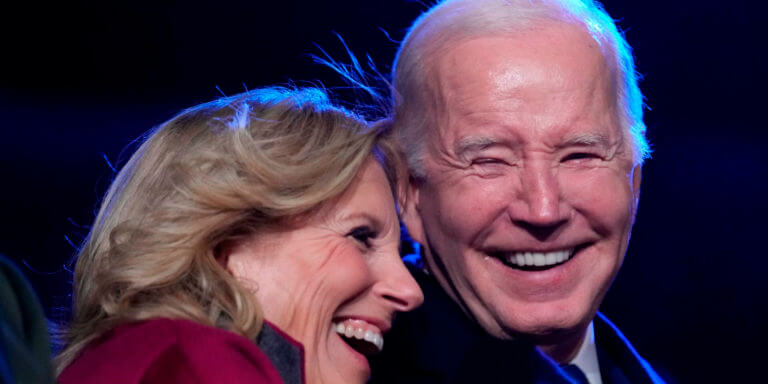
(Headline USA) Jill Biden says she feared her husband was having a stroke as she watched then-President Joe Biden stumble through a disastrous debate performance that led to the end of his 2024 reelection campaign, the former first lady said in a recent interview.
“I was frightened, because I had never ever seen Joe like that before or since. Never,” Jill Biden told CBS News in an interview scheduled to air Sunday.
NEW: Former First Lady Jill Biden says she thought her husband was having a stroke during his 2024 debate against Donald Trump.
Jill famously boasted on stage with Joe Biden after the debate about how he did "such a great job."
Joe Biden’s shaky, mumbling and sometimes confused delivery against Donald Trump in June 2024 gave fuel to questions voters already had about his fitness for a second term. His attempts to explain away his performance and offer reassurance that he could handle four more years of the demanding job did little to assuage voters. Under mounting pressure from within his party, he stepped aside, and Democrats nominated Vice President Kamala Harris.
“I don’t know what happened,” Jill Biden said in the interview. “As I watched it, I thought, ‘Oh, my God, he’s having a stroke.’ And it scared me to death.”
However, observers questioned Jill’s comments after a video resurfaced of her and Joe visiting a Waffle House after the disastrous debate.
ATLANTA — President @JoeBiden said he thinks he did well tonight and is experiencing a sore throat, in a post-debate stop at a Waffle House near Truist Park. pic.twitter.com/rMICE0bLKw
(Money Metals News Service) In this episode of the Money Metals Midweek Memo, host Mike Maharrey challenged what he described as a deeply flawed mainstream narrative surrounding gold, inflation, and interest rates. Drawing parallels to common myths passed down through generations — like cracking knuckles causing arthritis or bread crust containing more vitamins — Maharrey argued that repetition does not make an idea true.
According to Maharrey, mainstream financial media outlets such as CNBC and Fox Business are pushing the idea that gold and silver prices are under pressure because the Federal Reserve may keep interest rates “higher for longer” in response to inflation tied to escalating oil prices and the ongoing U.S.-Iran war. Gold has reportedly fallen more than 11% from its January high above $5,100 an ounce, while silver has also struggled to regain upward momentum.
The prevailing assumption, Maharrey said, is that higher interest rates hurt gold because gold is a “non-yielding asset.” Investors, according to this theory, are supposedly shifting toward bonds and other interest-bearing investments. But Maharrey argued that this explanation overlooks two crucial realities: real interest rates and the growing “debt black hole” threatening the U.S. economy.
Maharrey stressed that markets appear to be reacting to war headlines almost mechanically. Negative developments in the Middle East tend to push gold lower because traders assume inflation will remain elevated and force the Fed to stay hawkish.
Meanwhile, any signs of peace talks send gold and silver prices higher on hopes of future rate cuts. Yet he argued that beneath this short-term volatility, the long-term bullish fundamentals for precious metals remain intact, including de-dollarization trends, heavy central bank gold buying, massive government debt, persistent inflation pressures, and economic instability.
Why Real Interest Rates Matter More Than Nominal Rates
One of Maharrey’s central arguments focused on the distinction between nominal and real interest rates. He noted that mainstream commentators routinely cite Treasury yields without factoring in inflation, which distorts the actual purchasing-power return investors receive.
Using a hypothetical example, Maharrey explained that if a 10-year Treasury bond yields 4.6% while CPI inflation runs at 3.8%, the real interest rate is only 0.8%. In his view, such a modest real return is hardly enough to justify abandoning gold and silver.
He further argued that official CPI data understates true inflation because of formula changes made in the 1990s. Maharrey claimed that using older CPI calculations from the 1970s would place inflation closer to 6% or 7%, meaning real interest rates could already be deeply negative. If inflation were to rise above 5% while Treasury yields remained around 4.6%, investors would actually lose purchasing power by holding bonds.
According to Maharrey, this misunderstanding of real rates is one of the biggest weaknesses in the mainstream bearish case against gold. He emphasized that rising nominal rates alone do not automatically make bonds attractive if inflation continues eroding purchasing power.
The “Debt Black Hole” and the Fed’s Catch-22
The second major theme centered on what Maharrey called the “debt black hole,” a term he credited to analyst Greg Weldon. He argued that the modern U.S. economy is so burdened by debt that it cannot tolerate high interest rates indefinitely.
Maharrey contended that the Federal Reserve faces a fundamental contradiction. On one hand, it is expected to fight inflation by keeping rates elevated. On the other, sustained high rates threaten to burst what he described as a debt-fueled economic bubble. He argued that the economy never fully purged the distortions created during the 2008 financial crisis and that pandemic-era stimulus only worsened those structural imbalances.
He pointed to the Fed’s historical behavior during previous crises — including the dot-com collapse, the 2008 financial crisis, and the COVID-era downturn — as evidence that policymakers ultimately prioritize economic rescue over inflation control. In each case, the Fed responded with rate cuts, quantitative easing, and large-scale money creation.
Although Maharrey acknowledged the possibility that current Fed leadership could behave differently, he remained skeptical. He specifically mentioned new Fed Governor Kevin Walsh but argued that monetary easing remains the only policy “fork” the central bank truly knows how to use.
Because of this, Maharrey warned listeners not to overreact to temporary price weakness in gold and silver caused by geopolitical headlines. Historically, he noted, wars often create initial volatility in precious metals markets, but longer-term monetary trends ultimately dominate pricing.
Inflation Is Not a Bug — It’s a Feature
The podcast then shifted into a broader philosophical discussion about inflation, fiat currency, and government power. Maharrey argued that inflation is not an accidental flaw in the modern monetary system but rather an intentional feature that enables government expansion.
He cited Austrian economist Ludwig von Mises, who described sound money as a safeguard for civil liberties comparable to constitutions and bills of rights. Maharrey argued that sound money restrains governments by limiting their ability to create money and finance endless spending.
He also referenced historian Tom Woods, who has argued that the destruction of sound money has contributed to broader societal problems affecting science, food, architecture, family life, and culture. According to Maharrey, fiat monetary systems allow governments to grow far beyond what taxpayers would otherwise tolerate.
The host repeatedly emphasized that inflation functions as a hidden tax. Quoting Benjamin Franklin and Gouverneur Morris, Maharrey argued that America’s Founding Fathers understood currency depreciation as a stealth form of taxation that reduces purchasing power over time.
How the Federal Reserve Creates Inflation
Maharrey spent a significant portion of the episode explaining how the Federal Reserve allegedly enables government overspending through money creation and debt monetization. He argued that inflation should properly be understood not simply as rising prices, but as an expansion of the money and credit supply.
He described how the U.S. government finances deficits by issuing Treasury bonds while the Federal Reserve suppresses borrowing costs through artificially low interest rates and quantitative easing programs. During QE operations, the Fed purchases Treasury securities and mortgage-backed assets using newly created money, effectively injecting fresh liquidity into the economy.
Maharrey highlighted the COVID-era response as a prime example. He said the Federal Reserve monetized nearly all pandemic-era borrowing through approximately $5 trillion in quantitative easing, enabling trillions in stimulus spending while dramatically expanding the money supply. According to Maharrey, Americans later paid for that monetary expansion through sharply higher prices at grocery stores and gas stations.
He argued that such large-scale monetary intervention would have been impossible under a gold- or silver-backed system because sound money constrains unlimited money creation. Maharrey also referenced Franklin D. Roosevelt’s gold confiscation policies in the 1930s as an example of governments removing monetary restraints in order to expand spending power.
Gold and Silver as Protection Against Monetary Debasement
Recognizing that many Americans feel financially strained, Maharrey promoted Money Metals’ monthly purchase program, which allows customers to accumulate gold and silver starting at $100 per month. He described the current sideways trading action in gold and silver as a potential buying opportunity, particularly during market selloffs tied to war-related news.
The episode closed with Maharrey reiterating his belief that inflation will persist because governments fundamentally depend on fiat money systems to sustain borrowing and spending. While he acknowledged that dismantling the fiat system is politically unlikely, he argued that individuals can still protect themselves by owning physical precious metals and avoiding excessive exposure to depreciating paper currency.
(Luis Cornelio, Headline USA) A group of 35 little-known former federal judges gained national attention Wednesday after filing a petition urging a federal court to reopen President Donald Trump’s case against the IRS — seemingly in a bid to cancel a $1.776 billion settlement fund.
The now-settled lawsuit paved the way for the creation of a $1.776 billion restitution fund intended for victims of federal government weaponization. Democrats quickly attacked the arrangement, claiming without evidence that the fund would primarily benefit Trump allies.
The former federal judges echoed those attacks in their filing, purporting that Trump and his administration deceived the court and that the fund would ultimately be administered by a commission “effectively controlled” by Trump.
Trump originally sued the IRS and the Treasury Department in January after the agencies failed to prevent the leak of his tax returns to hostile legacy media outlets.
The president previously said that any money collected from the federal government would be donated to charity. However, before the case was scheduled to proceed further, Trump voluntarily withdrew the lawsuit and instead announced the $1.776 billion compensation fund.
In their petition, the 35 former judges asked U.S. District Judge Kathleen Williams of the Southern District of Florida to reopen the case and scrutinize the settlement, though it is unclear if she even has jurisdiction over the matter settled outside her court.
“The purported ‘settlement’ that the parties never placed before this Court raises profound questions about the parties’ candor toward the Court and manipulation of the judicial system, which threatens to undermine confidence in the administration of justice,” the former judges claimed.
Despite the legal obstacles, the former judges added that the court should “commence an inquiry into whether the Court was deceived, including with respect to the existence of an underlying case or controversy and any purported arms-length negotiations undertaken to resolve it.”
Critics on X quickly mocked the filing, comparing it to the infamous letter signed by 51 “spies who lied” who falsely claimed the Hunter Biden laptop was part of a Russian disinformation campaign during the 2020 presidential election.
(Ken Silva, Headline USA) A former senior CIA official has been implicated in a scheme to apparently steal some $40 million in gold bars that he has obtained from the government for unspecified “work-related expenses.”
The ex-CIA official, David Rush, was arrested on May 19, a day after the FBI raided his home and found the allegedly misappropriated gold.
According to charging papers, the FBI initially investigated Rush for lying on his resume. For instance, Rush allegedly said in an application to enter the “senior executive service” level ranks that he was the “director of test” for a joint Army/Navy weapons test organization. However, his military records showed that he separated from the Navy in 2015.
As its investigation progressed, the FBI allegedly found that Rush made several requests to the government to obtain a “significant quantity” of foreign currency, as well as tens of millions of dollars in gold bars, for “work-related expenses” from last November to March.
The charging papers don’t explain what those work-related expenses entail, nor do they identify Rush as having worked for the CIA. It was the New York Times that reported Rush’s CIA background. Presumably, the gold was intended to be used for a covert operation.
The charging papers do say that the gold went missing from the government storage space where it was supposed to have been held. Agents allegedly found it at Rush’s home when executing a search warrant on May 18.
“During the search, FBI agents seized approximately 303 gold bars, each of which weighs approximately one kilogram,” court records say. “Based on the current price of gold, the estimated value of the gold exceeds $40 million.”
The charging papers also say that agents seized about $2 million in U.S. currency, as well as 35 luxury watches.
Ken Silva is the editor of Headline USA. Follow him at x.com/jd_cashless.
(José Niño, Headline USA) The federal government has walked away from its prosecution of Ori Solomon, the Israeli citizen arrested in connection with an illegal biological lab operating out of a Las Vegas short-term rental, though a state charge for hazardous waste disposal still hangs over him, according toKTNV Las Vegas.
The station reported that federal prosecutors dismissed Solomon’s case without prejudice, a designation that permits them to bring charges again in the future. He remains subject to a Clark County criminal charge related to improperly discarding hazardous materials.
The matter traces back to an investigation launched after local and federal authoritiesdiscovered what officials described as an unlicensed biological laboratory inside a home Solomon oversaw near Washington Avenue and Hollywood Boulevard, as KTNV reported. The search yielded suspected biological substances and laboratory apparatus.
KTNV reported that authoritiesarrested Solomon during their probe of the illegal facility. Thefederal counts against him originated from a search of his personal residence on January 31, 2026, which uncovered multiple guns. As an Israeli citizen in the country on a non-immigrant visa, federal law prohibits Solomon from having firearms. An affidavit reviewed by KTNV stated that investigators removed several weapons from his home.
The individual who owns the property housing the suspected lab, Jia Bei Zhu, recentlyreceived a guilty verdict for fraudulently selling more than a million COVID tests for close to $4 million via his Fresno company Universal Meditech Inc., per KTNV. His conviction stemmed from a separate illegal lab operation in California.
The decision to drop Solomon’s charges drew a sharp response from journalist Ryan Grim, whoobserved on X, “So the feds are dropping charges against the Israeli citizen caught in Las Vegas with an illegal biolab, after he was caught in LA with an illegal biolab.”
So the feds are dropping charges against the Israeli citizen caught in Las Vegas with an illegal biolab, after he was caught in LA with an illegal biolab https://t.co/4KAU8mbNNB