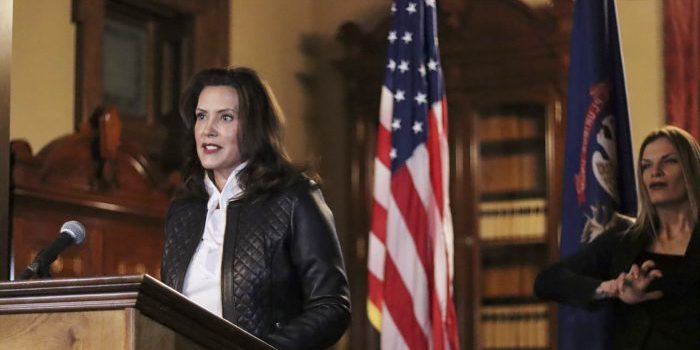
(Ken Silva, Headline USA) The makers of KIDNAP and KILL: An FBI Terror Plot have released the second trailer for their documentary, giving the public a preview of a film that intends to expose how the FBI engineered the 2020 militia plot to kidnap Michigan Gov. Gretchen Whitmer.
The latest trailer comes more than a year after KIDNAP and KILL producer Christina Urso released her first trailer—focusing on the story of Brandon Caserta, who was charged in the plot but acquitted in 2022. Since then, Urso’s interviewed 20 different people across eight states, including multiple trips to Michigan.
The trailer generated a buzz over the weekend, with stars such as comedian Adam Corolla sharing it.
“We aren’t fully funded. We need to meet our fundraising goals so we can edit the documentary, pay our editor, hire him an assistant, pay our colorist, pay a composer, pay for a graphics person, pay for a marketing person,” she said in a message after the trailer.
“There’s so much that goes into making a documentary. It’s such a big story.”
This writer is involved in the project as an unpaid researcher and writer—and has seen unreleased information showing that corruption in the FBI’s Whitmer case ran deeper than what has already been revealed.
(Clint Siegner, Money Metals News Service) One of the primary reasons that investors turn to physical gold and silver is to eliminate counterparty risk. Stock markets can melt down, banks and brokerages can close, the currency can hyperinflate, the federal government can default on Treasury debt, or all of the above.
When a person owns bullion and keeps personal possession of it, it will retain value. Its purchasing power could even surge.
Metals investors aren’t relying upon the smooth functioning of the financial system and the good stewardship of corporate executives and political leaders – thank goodness.
The only steward is the individual investor, and that is a responsibility which should not be taken lightly. They must stay alert and think carefully about safeguarding their investment.
Secure Your Gold & Silver and Keep Your Mouth Shut
Metals investors are naturally aware it is important to keep their coins, rounds, and bars in a safe place – whether it be in a home safe or hidden away. They need also to know that none of these methods are foolproof.
If thieves know a person owns bullion, it can be stolen. So, nothing is more important than an investor keeping his or her mouth shut. There are plenty of guides available with methods for safekeeping online – see here for example.
In this article, though, we’d like to focus investors on a less obvious threat.
The number of scams involving precious metals is proliferating. Criminals have always targeted gold and silver because pretty much nothing is easier to fence at or near full market value. Con artists know the promise of gold can play to a victim’s greed.
Many laugh off the idea of being scammed. They believe the only people falling for one of these schemes are rubes dumb enough to believe an email which says they are the only heir to some Nigerian prince’s fortune.
It’s no laughing matter. Fraud should be thought of as an industry.
There are vast numbers of criminals working in the industry full-time. Nobody is beyond their reach.
Some of these crooks are smart and innovative. If they can get access to an information source such as someone’s email account, they can craft a scheme sophisticated enough to fool anybody.
There are also con artists who will spend months, or even years, cultivating a relationship with the victim and setting up the heist.
Gold Bar Scam Sweeping the Nation
Scams can be complex and, therefore, very convincing. For example, there is a pervasive gold-related scheme currently operating which has recently conned Americans out of hundreds of millions of dollars.
To begin with, it’s important to mention that the targets of the following scheme are usually not owners of gold at the outset.
They are simply folks with cash in the bank.
The recent scheme starts with an email or text message.
Victims are told their identity has been stolen and that they must call for assistance.
If they engage, they will have a phone conversation with someone who explains their stolen identity has been used to create a number of bank accounts, which, in turn, have been used in very nefarious activity. They are warned that a federal investigation is already underway.
Shortly thereafter, they receive a call from someone else posing as the investigator. They are warned the government is getting ready to seize their bank or brokerage accounts.
The “investigator” instructs the victim to withdraw the funds to acquire gold (usually kilo gold bars) until the matter is resolved.
Victims Told to Give Their Gold to Fake Government Officials
Throughout the process, the victim is supplied with official-looking documents and will spend hours on the phone with multiple people who pretend to work at their bank and various government agencies such as the FBI and FTC.
By the end of the scheme, people are so convinced the story is real that they actually turn the newly acquired gold bullion over to someone they believe is a government official for safekeeping. It is, unfortunately, the last they will ever see of it.
Investors should trust people with information about their precious metals holdings very sparingly. If approached, folks should independently verify the people involved are who they say they are.
Fear and greed are powerful levers and will be used to manipulate victims. They should assume things which sound too good to be true are nonsense. The same goes for things that sound too bad or too scary to be true.
When they are told some action is urgent, otherwise they will either miss the big opportunity or risk some terrible consequence, it is time to pump the brakes and start asking questions.
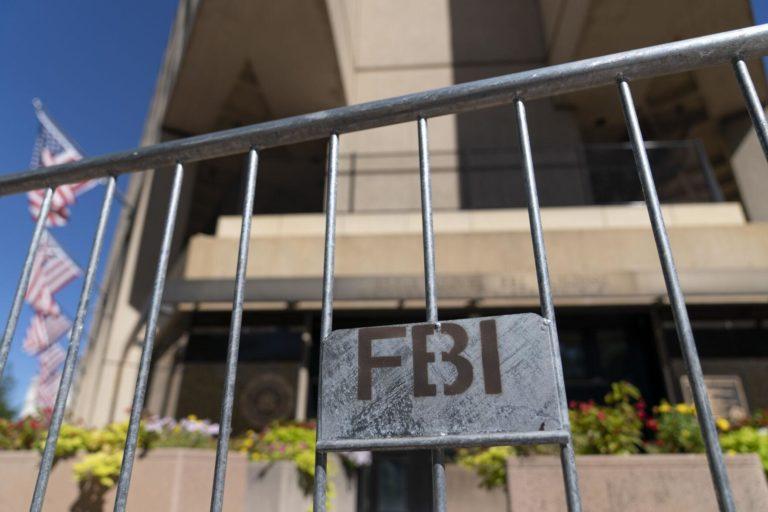
(Ken Silva, Headline USA) On Feb. 6, an FBI contractor stole an agent’s vehicle and drove it to the Terrorist Screening Center in Vienna, Virginia—doing so after purportedly hearing “coded messages.”
Three days later, the contractor, John Conrad Worrell III, was out of jail; and in July, he was given a deferred prosecution agreement—all of this coming after the Justice Department initially deemed him a “danger to the community,” according to records reviewed by Headline USA.
Instead of being punished, Worrell was ordered to undergo mental health treatment with Stepanie Hughes of Dynamic Emotional Wellness. He was also ordered to stay away from FBI HQ and the Terrorist Screening Center in Vienna.
The details of Worrell’s case are bizarre.
According to the FBI’s criminal complaint, Worrell heard “coded messages” before committing his crime.
Let's start off the week w/ an especially weird story: Remember that FBI contractor who stole an agent's car from HQ and drove it to the Terrorist Screening Center in Vienna — doing so after hearing "coded messages"? He was let out of jail three days later and given zero… pic.twitter.com/milJqgCw48
“WORRELL believed he had been receiving coded messages, which appeared in various forms including e-mails, ‘stage whispering,’ and a variety of different context clues over the course of several weeks, indicating that WORRELL was in danger, and thus he was attempting to go to a secure facility where he could be ‘safe,’” the FBI’s criminal complaint said.
Motivated by those coded messages, Worrell allegedly took the vehicle—a dark green four-door Ford sedan—from FBI HQ around 12:26 p.m. on Feb. 6. He then drove to Vienna and arrived at another FBI facility about 90 minutes later, the complaint said.
Once he was at the Vienna facility, Worrell identified himself as the agent he stole the car from, the complaint said.
“WORRELL claimed to have a classified meeting at the Vienna FBI facility. When WORRELL was unable to provide FBI access cards that matched the Victim Agent’s identity, WORRELL was denied access to the facility and was directed to park in a nearby visitor lot,” the complaint said.
Vienna Police Department arrived at the FBI facility at approximately 3:02 p.m. Worrell allegedly admitted his theft soon thereafter.
Later, when interviewed by the FBI, Worrell told agents about hearing the coded messages.
Worrell was arrested on Feb. 6, and the DOJ pushed for Worrell to remain in prison pending trial—writing a 10-page, partially redacted detention memo on Feb. 8 that argued he was a “danger to the community.”
“What is the most disturbing and troubling, is that the defendant stated that he had been receiving coded messages in various forms, including emails, that indicated that he is was in danger, and therefore, was attempting to go to a secure facility where he could be ‘safe,'” the DOJ said in that memo.
But at Worrell’s detention hearing the very next day, prosecutors made an oral motion to have him released—which was granted. No transcript or other records exist on the federal court docket that would explain the decision to release him.
For the next several months, a judge continually loosened Worrell’s conditions of release—allowing him to go to brother-on-law’s wedding in Annapolis in March, and removing the curfew requirement so he could leave his home overnight so that it could be staged and shown by his real estate agent.
It’s unclear whether he’s still a contractor for the FBI or any other federal agency. He did not return an email from this author seeking comment. The FBI didn’t immediately respond to an email about his employment status.
Ken Silva is a staff writer at Headline USA. Follow him at x.com/jd_cashless.
The two groups have set aside more than 100 ounces of physical gold (currently valued at approximately $260,000) to reward deserving students and researchers advancing original sound money analyses.
Building on the overwhelming popularity of the nation’s first gold-backed annual Sound Money Scholarship, the Sound Money Fellowship is open to graduate students, post-graduate students, and independent researchers.
The fellowship seeks to advance scholarship pertaining to sound money by encouraging in-depth exploration of monetary history, policy analysis, and comparative studies.
Each selected Sound Money Fellow will receive a stipend of $3,000 and will write three articles for publication (750-1000 words) as well as a research paper during a six-month period.
The writings and research of Sound Money Fellows will be featured on both the Sound Money Defense League and Money Metals’ websites, as well as in the prestigious Sound Money Review, an annual publication that highlights the contributions of our fellows while serving as a valuable resource for academics, policymakers, and the public.
“After almost a decade of receiving hundreds of thoughtful essays on sound money from students all over the world through our Sound Money Scholarship program, we are excited to expand our overall support and thought leadership through the Sound Money Fellowship,” said Jp Cortez, Executive Director of the Sound Money Defense League.
“Money Metals is excited to augment its efforts to cultivate the next generation of thought leaders as they make meaningful contributions to the discourse surrounding the monetary future of America, and the world,” said Money Metals president Stefan Gleason.
The application period for the 2025 Sound Money Fellowship is now open, with a deadline of December 31, 2024. For more information on the fellowship and how to apply, please visit www.moneymetals.com/fellowship or email [email protected].
China cut interest rates last week and unveiled an extensive stimulus package to boost its struggling economy. These announcements sparked a surge in commodities like gold, silver, and copper, bringing my bullish outlook on silver closer to fruition. I decided it was an opportune time for a quick update.
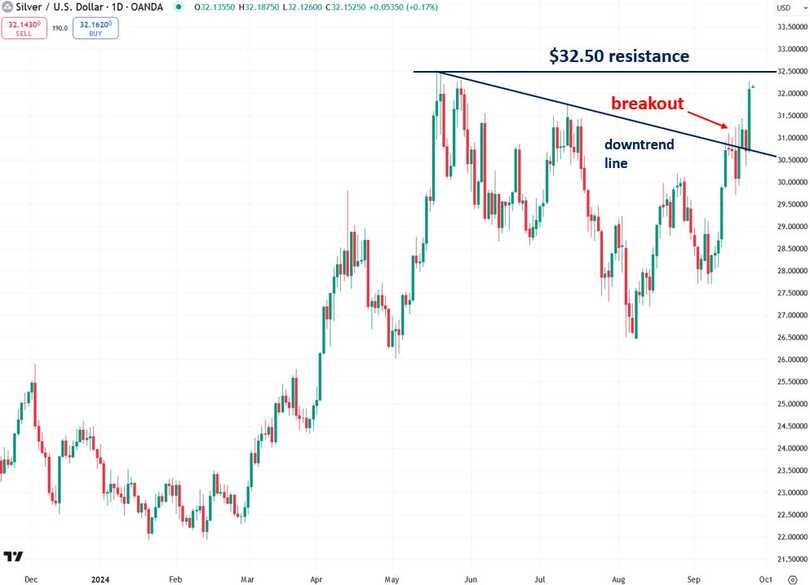
Let’s start with silver’s daily chart.
Since its peak in May, silver had been languishing for several months until it finally broke above a downtrend line that started in May, closing above it last Friday. In my original Substack piece, I highlighted this breakout as a promising sign of strength.
Silver’s recent surch has taken it to its highest level since May. Silver now needs to close above its $32.50 resistance level with strong volume to confirm that the next leg of the bull market is underway.
Once silver clears the $32.50 resistance, it’s likely to surge toward $50 rapidly. I’m focusing on $50 as an intermediate-term target because it’s a significant psychological level and the peak reached during both the 1980 and 2011 rallies.
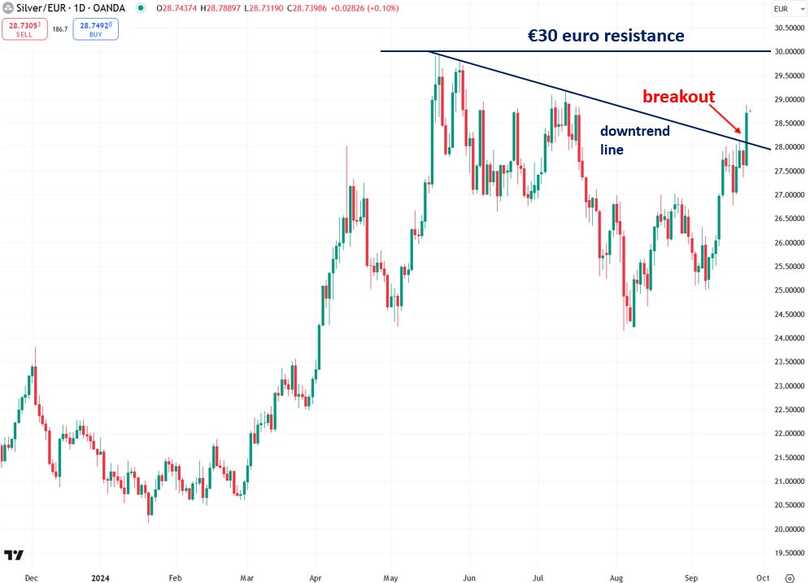
For further confirmation, I find it valuable to analyze silver priced in euros. This method removes the impact of U.S. dollar fluctuations, offering a clearer view of silver’s intrinsic strength or weakness.
Interestingly, silver priced in euros often respects round numbers like €26, €27, and €28, frequently establishing key support and resistance levels at these points. These levels are worth monitoring closely—take a look for yourself.
Silver recently closed above both the €28 level and a downtrend line that started in May, marking a very bullish development. The final hurdle is for silver to decisively close above the €30 level on high volume, which would be the signal that silver is ready to take off.
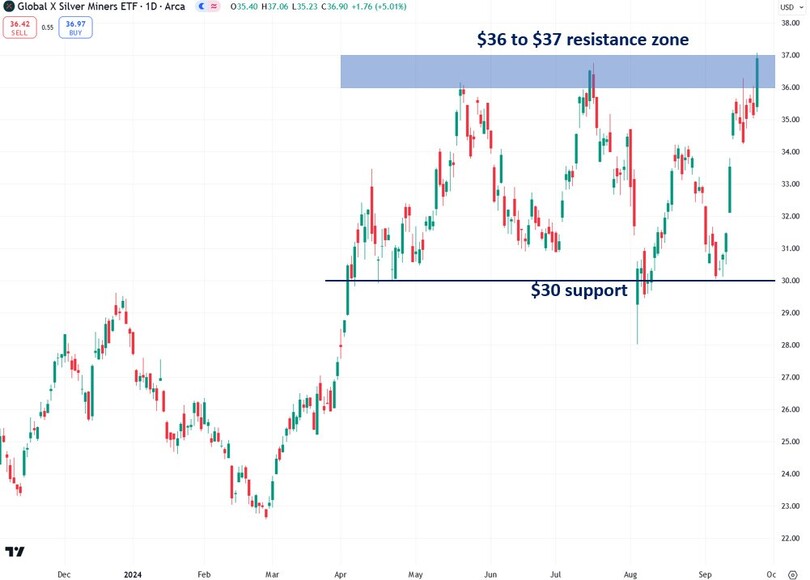
Silver mining stocks are also important to watch for confirming silver’s price movements, as they often mirror investor sentiment toward the metal. The Global X Silver Miners ETF (symbol: SIL), the most heavily traded silver mining stock ETF, has been stuck in a flat range since April.
A strong, high-volume close above the $36 to $37 resistance zone would signal that both silver mining stocks and silver itself are poised for a significant breakout. After surging in recent days, SIL is very close to breaking out.
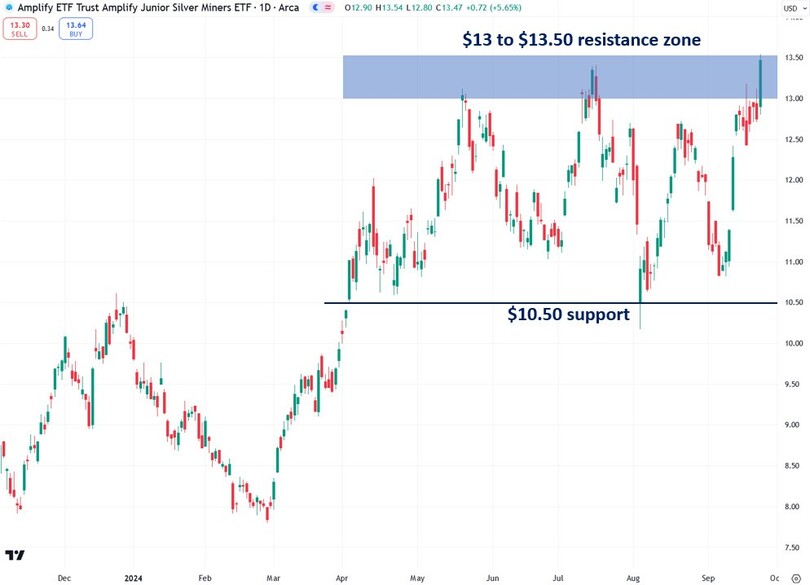
Similarly, the Amplify Junior Silver Miners ETF (symbol: SILJ)—a key proxy for junior silver mining shares—has been range-bound for the past five months.
A decisive, high-volume close above the $13 to $13.50 resistance zone would indicate the start of a rally for both silver mining shares and silver itself. After its sharp rise, SILJ is very close to breaking out.
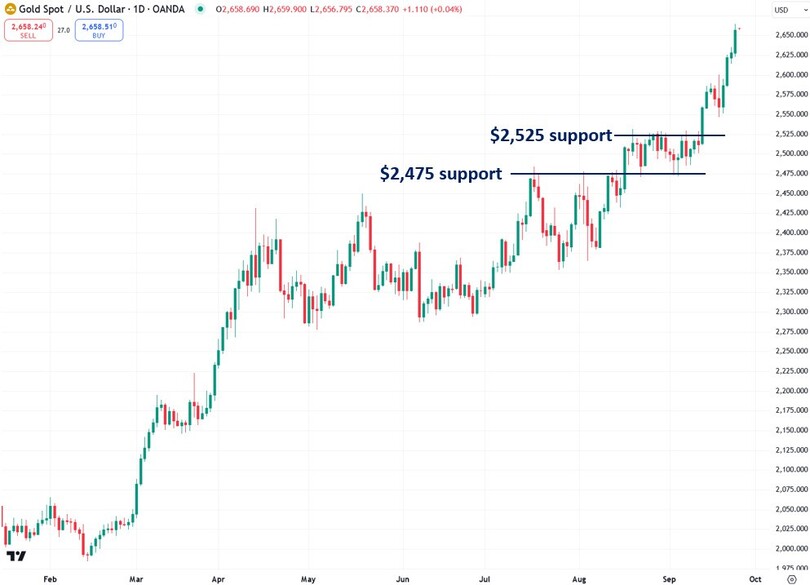
Gold, a major driver of silver prices, is generating a tailwind for silver after breaking through two key resistance levels in the past month and a half. In a recent Substack piece, I explained how gold’s breakout across multiple currencies sets the stage for an imminent surge toward $3,000.
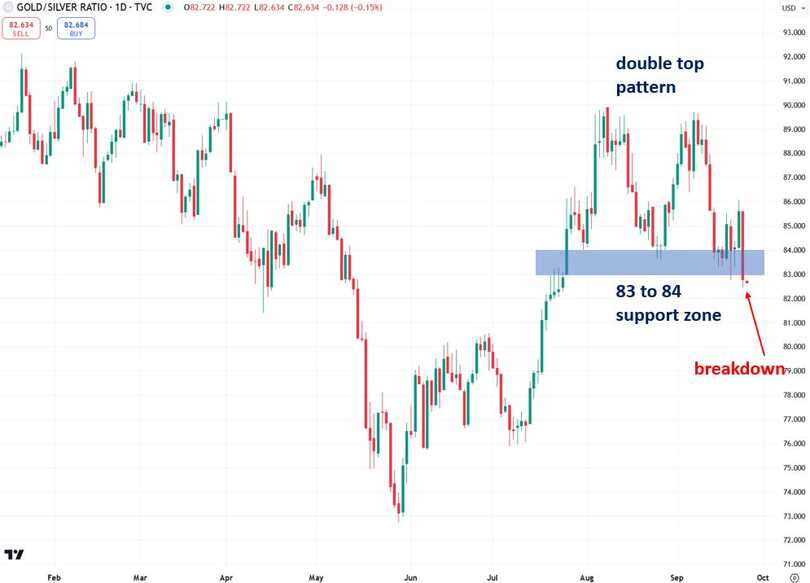
The gold-to-silver ratio is a valuable indicator for gauging silver’s price direction. A double top chart pattern appears to have formed over the past two months, indicating a likely decline in the ratio.
This suggests that silver may soon start outperforming gold. A close below the 83 to 84 support zone is key to confirming the start of a silver rally and its outperformance of gold.
Following silver’s strong performance, the ratio is starting to break below the critical 83 to 84 support zone—an unmistakable sign of strength for silver.
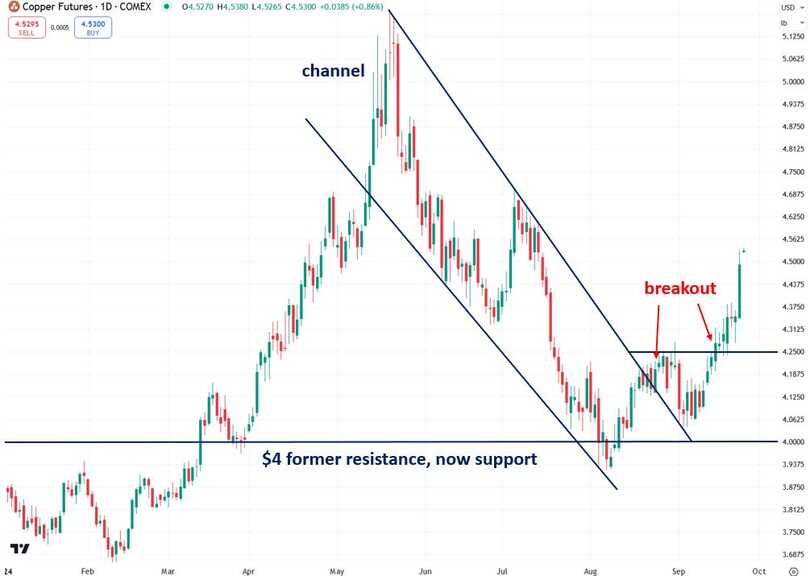
The price of copper is often an underappreciated factor in silver’s performance. Copper’s decline over the past several months has dragged silver down with it, but the copper rebound I’ve been anticipating following a technical breakout should significantly strengthen silver’s rally.
Another potential bullish factor for silver, gold, and copper is the prospect of a weaker U.S. dollar as the Federal Reserve begins its rate-cutting cycle.
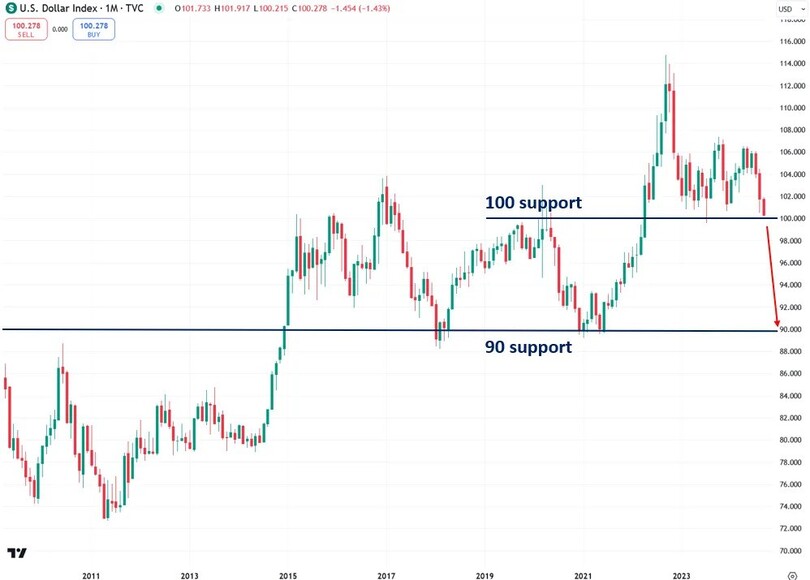
Since commodities typically move inversely to the U.S. dollar, this is a critical development to monitor. The key level to watch is the 100 support on the U.S. Dollar Index.
A close below this level would strongly suggest a continued decline toward the 90 support level. At the time of writing, the U.S. Dollar Index is trading at 99.95.
As silver nears a critical breakout, the convergence of multiple indicators signals a strong bullish outlook. Recent economic developments, such as the U.S. rate cut and China’s stimulus measures, have fueled momentum in commodities like silver, gold, and copper.
Silver’s ability to break through key resistance levels, both in U.S. dollars and euros, alongside potential strength in silver mining stocks and a weakening U.S. dollar, reinforces the bullish outlook.
As the gold-to-silver ratio shows signs of decline and copper rebounds, the stage is set for silver to make significant gains, with $50 as a key intermediate-term target.
In an interview with PBS’s Margaret Hoover on Sunday, Clinton compared herself to the mythical figure of Cassandra, a Trojan princess who had the gift of clairvoyance but was unable to persuade anyone of what she foresaw, the Converseer reported.
However, some may suspect that Clinton’s ominous declaration about Trump was more akin to legendary New York Yankee Babe Ruth pointing to where he planned on hitting his next home run.
Although she was not specific about the threat, Clinton’s prediction follows not long after a second serious assassination attempt on Trump’s life while golfing at his resort in West Palm Beach, Fla.
“I anticipate that, you know, something will happen in October, as it always does,” Clinton told Hoover.
“You know, the Russians, as I said earlier, are very active in this election,” she continued. “We know the Iranians are active as well. Chinese [sic] uses TikTok, or they certainly did against Biden and for Trump. I think they’re a little less pro-Trump right now.”
In characteristic form, Clinton attempted to blur the lines of what side foreign bad actors were actually supporting, projecting Democrat conspiracies and corruption onto the Trump campaign.
Both the first assassination attempt, by Thomas Crooks, and the second, by Ryan Routh, appear to have links to possible influence from Ukraine or from the multi-trillion-dollar BlackRock investment fund, which is overseeing the economic redevelopment of the war-torn country.
Trump, moreover, recently received a national intelligence briefing that outlined serious threats being made against him by Iran for the sake of sowing discord and chaos in the 2024 election—only to discover that President Joe Biden was, nonetheless, planning to meet with Iran’s new president during the United Nations General Assembly.
I’ve been informed that this video was made by Iran and released on Ayatollah’s official website in January 2022.
At a campaign stop last week in North Carolina, Trump condemned the Biden–Harris coddling of the bloodthirsty Islamic fundamentalist regime, which is likely to escalate its attacks on Israel and the U.S. following successful airstrikes from the Netanyahu government that took out top Hezbollah leaders over the weekend.
“If I were president, and a former president and leading candidate to be the next president was under threat, I would inform the threatening country—in this case Iran—that if they do anything to harm this person, we are going to blow your largest cities and the country itself to smithereens,” Trump said at a speech in Mint Hill, just outside of Charlotte, on Wednesday.
Despite the severity of the threats from Clinton- and Biden- linked foreign adversaries, the failed 2016 candidate sought to put the blame on Trump for his own lack of safety.
“The press needs a consistent narrative about the danger that Trump poses,” Clinton claimed.
“Because, you know, people may still look at the danger and say, ‘I don’t care,’ but at least people need to be woken up and given the facts about what he has done, is saying and would do,” she continued.
Clinton accused him of being an “existential” threat while pushing a debunked talking point that attempted to link Trump to the Heritage Foundation’s Project 2025—a series of mundane policy papers that the conservative think-tank drafted for the next GOP leader, whoever it may be, which the Left has attempted to turn into a boogeyman among low-info voters.
Hillary Clinton calls President Trump an "existential threat" less than 2 weeks after second assassinat*on attempt. pic.twitter.com/U7yY0RC5pp
Hoover—a former Fox News contributor who recently made headlines for ambushing her ex-boss, Bill O’Reilly, by drudging up old sexual-harassment allegations—did not appear to challenge Clinton on her promotion of disinformation.
Ironically, as Clinton was actively and knowningly pushing her own fraudulent talking points, she concurrently claimed that the Trump campaign would somehow misrepresent the radicalism of Vice President Kamala Harris.
“There will be concerted efforts to distort and pervert Kamala Harris: who she is, what she stands for, what she’s done,” Clinton claimed, failing to elaborate or clarify how such a distortion would stray from the fundamental facts about the current Democrat nominee.
“I mean, look, I mean, the crazy story about me running a child trafficking operation out of a basement, a pizzeria,” Clinton said in reference to the so-called Pizzagate theory, which was based on the leaked private correspondence of her campaign chief and close associate John Podesta. “Don’t laugh. Don’t laugh. It was a huge story.”
Although a lone-wolf vigilante’s efforts to liberate child sex-slaves he believed were being held captive in a basement dungeon of Washington, D.C.’s Comet Ping Pong pizzeria ultimately proved fruitless, suspicions over Clinton’s unsavory connections with convicted rapists and sex-criminals, including Harvey Weinstein and Jeffrey Epstein, continue to give legs to the yet-unproven allegations.
Epstein is also one of the high-profile individuals whose suspicious deaths has been linked to Clinton after he reportedly hanged himself in 2019 while under close supervision in a New York jail.
John F. Kennedy Jr., who had been considering a primary run against Clinton for his uncle’s former Senate seat in New York, he reportedly perished in a 1999 plane crash.
Seth Rich, a suspected whistleblower who may have leaked sensitive files exposing the Clinton campaign’s 2016 corruption, was murdered under suspicious circumstances outside his D.C. apartment shortly after the files surfaced on Wikileaks.
Ron Brown, the former Commerce secretary who had been subpoenaed to testify against the Clintons in a case led by Judicial Watch, died in an Air Force plane crash.
Vince Foster, former deputy White House counsel, was suspected of having committed suicide in a Virginia park via gunshot to the back of the head.
Christopher Sign, the reporter who broke the story about a secret tarmac meeting between former President Bill Clinton and then-Attorney General Loretta Lynch as the FBI was investigating Hillary Clinton’s mishandling of classified emails, was said to have committed suicide five years later at his Alabama home, leaving a grieving widow and three young children.
Don Henry and Kevin Ives, two Arkansas teenagers who allegedly stumbled on a drug-smuggling operation being run by the Clintons in the town of Mena during Bill Clinton’s tenure as governor, were discovered lying on the railroad tracks after getting run over by a train in 1987.
During her interview with Hoover, Clinton smugly boasted that she was the “most investigated ‘innocent’ person you have ever met.”
Hillary Clinton Claims She’s The "Most Investigated Innocent Person You Have Ever Met." pic.twitter.com/y4c9B1l7rf
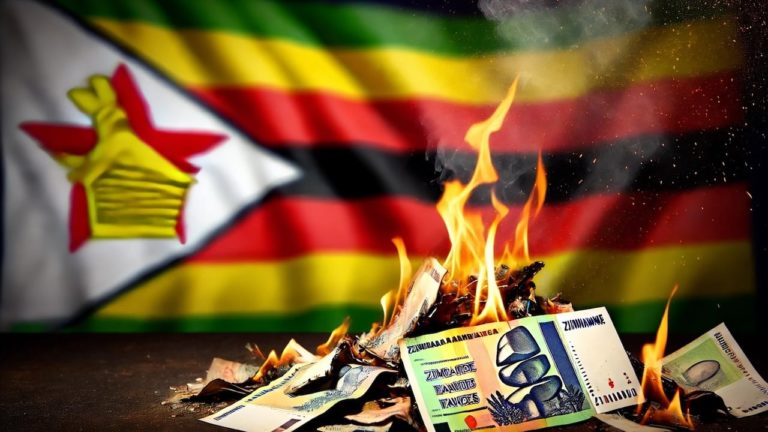
(Mike Maharrey, Money Metals News Service) Well, that didn’t take long. In April, Zimbabwe introduced a gold-backed currency in an effort to stabilize the country’s financial system. Less than six months later, the Reserve Bank of Zimbabwe has already devalued the new money.
I hate to say, “I told you so,” but, well, I told you so.
When Zimbabwe launched the ZiG, I warned that a gold-backed currency would be a great step but would not solve the country’s problems unless the government changed its ways.
It appears that hasn’t happened.
The ZiG, also known as Zimbabwe Gold, is a structured currency backed primarily by 2.5 tons of gold along with other forex reserves including, $100 million USD.
As the Zimbabwe African National Union-Patriotic Front (Zanu PF) explained, “Given that Zig is a structured currency deriving its value from gold (a valuable asset), it is likely to maintain a stable value, ceteris paribus. The value of zig against USD, therefore, appreciates or depreciates as gold price increases or decreases at the international market. Given the stability of gold price, the zig is more likely going to be stable in value currency.”
The Zimbabwe government introduced the ZiG at a rate of 13.56 per dollar. On Sept. 26, the currency was quoted at 14 ZiG per dollar. The next day, the valuation jumped to 24.4 ZiG per dollar, a 43 percent devaluation.
The Reserve Bank of Zimbabwe also raised its benchmark interest rate from 20 percent to 35 percent in an effort to strengthen the local currency.
Price inflation spiked from 1.4 percent in August to 5.8 percent in September.
Governor John Mushayavanhu wouldn’t confirm the Reserve Bank of Zimbabwe had devalued the ZiG, but he did say the central bank took “a number of steps” to combat inflation, including allowing “greater exchange rate flexibility, in line with the increased demand for foreign currency in the country.”
The ZiG was the sixth government attempt to shore up the Zimbabwean currency since 2009.
The country has a long history of rampant inflation. The Zimbabwean dollar (RTGS) lost about 800 percent of its value against the dollar in 2023 alone.
Hyperinflation totally wiped out the value of the Zimbabwe dollar in the early 2000s. In 2009, the government abandoned its currency and adopted foreign currencies – primarily the U.S. dollar (or, more accurately, the Federal Reserve Note).
The African nation reintroduced the Zimbabwe dollar, also known as the bond note, in 2016. It was to be backed by the U.S. dollar loan facility. Then-central bank governor John Mangudya swore the new Zimbabwe dollar would remain on par with the greenback. But the bond note crashed when the government once again began printing excess money. By mid-July 2019, price inflation had increased to 175 percent.
The ZiG was supposed to slam the door on the country’s monetary malfeasance. Backing currency with a hard asset theoretically limits money creation. The government shouldn’t create more notes unless it gets more gold. A gold standard puts a natural brake on monetary expansion.
But merely pegging a currency won’t do the trick if the government can’t resist the temptation to arbitrarily change the peg. A gold standard only works when government officials leave it alone. And as Americans learned in the 1930s, governments can and will quickly unravel a gold standard when it suits their purposes.
With the dollar tied to gold, the Federal Reserve couldn’t significantly increase the money supply during the Great Depression. It wasn’t able to simply fire up the printing press as it can today. The Federal Reserve Act required the central bank to hold enough gold to back at least 40 percent of the notes in circulation.
But, a lot of Americans were redeeming paper dollars for physical gold because they were losing faith in the paper currency. As a result, the central bank was low on gold and up against the limit.
This put President Franklin D. Roosevelt between a rock and a hard place. He wanted the Fed to increase the money supply and support government spending, but this was limited by this partial gold standard.
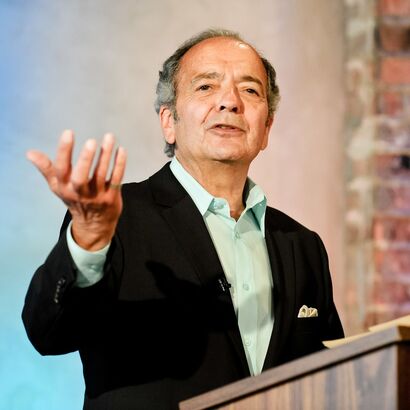
(Money Metals News Service) In a recent interview with Money Metals Podcast host Mike Maharrey, Gerald Celente, Founder of the Trends Research Institute and Publisher of the Trends Journal, discussed the significant global issues that he believes are shaping the future.
With over 43 years of experience in trend forecasting, Celente’s insights on geopolitics, the economy, and gold’s growing importance are compelling.
(Interview Begins Around 6:49 Mark)
Who is Gerald Celente?
Gerald Celente
Gerald Celente is a renowned trend forecaster, author, and founder of the Trends Research Institute. He publishes the weekly Trends Journal magazine and is known for his bold predictions about global financial markets, geopolitics, and societal trends. (Coupon code at end of article)
With over 43 years of experience, Celente has accurately forecasted significant events, such as the 1987 stock market crash, the Dot-com bust, the 2008 financial crisis (“Panic of ’08”), and the rise of gold prices.
Celente developed a forecasting method known as Globalnomic methodology, which he uses to track and predict future trends. He describes himself as a “political atheist,” meaning he operates free from political ideology or conventional wisdom, and his motto is “Think for Yourself.” Celente is also the founder of the Occupy Peace & Freedom movement, advocating for constitutional rights and non-interventionist foreign policy.
He has authored best-selling books such as Trend Tracking and Trends 2000 and is widely seen and heard across major media outlets like The Today Show, CNN, Fox News, and BBC. Celente is recognized for his critical perspective on U.S. government policies, the global economy, and the declining state of the U.S. dollar.
A World on the Brink of Nuclear War
Gerald Celente opened the conversation by highlighting his deep concern for the escalating global conflict, stating, “I’ve never been more concerned about World War III and nuclear annihilation in my life.”
Citing Russian President Vladimir Putin’s recent warnings regarding U.S. involvement in Ukraine, Celente emphasized that if the U.S. provides long-range missiles, nuclear retaliation may be inevitable.
His perspective on the Ukraine conflict dates back to 2014 when the Trends Journal published an article by Dr. Paul Craig Roberts, detailing the U.S.-backed overthrow of Ukraine’s democratically elected government.
Gold’s Meteoric Rise in 2024
Shifting focus to the economy, Celente reflected on his forecast made on January 2nd, predicting that 2024 would be a “golden year for gold.”
He noted how his prediction materialized with the Fed’s 50-basis-point rate cut, which triggered gold’s price increase. He highlighted that lower interest rates weaken the dollar, driving up the price of gold.
According to Celente, gold’s future trajectory remains upward as geopolitical tensions continue to rise and central banks stockpile gold reserves in record amounts.
He emphasized the importance of understanding these dynamics, saying, “The deeper the interest rates go, the deeper the dollar falls, and the higher gold prices go.” This trend, coupled with the ongoing economic and geopolitical crises, has solidified gold as the top safe-haven asset.
Office Building Bust and Looming Banking Crisis
Celente also underscored the looming “office building bust,” a direct consequence of the COVID-19 lockdowns. He cited startling data, such as the 35% office vacancy rate in San Francisco, with properties like a once $320 million building selling for just $8.5 million.
Celente forecasts this crisis will drive hundreds of banks into failure, reminiscent of the 2023 collapse of institutions like Signature Bank and First Republic.
He predicts that gold could surge to $3,000 an ounce when this crisis intensifies, noting, “The sky’s the limit when the banks start going bust.”
The Weaponization of the Dollar
Celente and Maharrey also delved into the U.S. weaponization of the dollar through mechanisms like the SWIFT payment system. Celente pointed to the BRICS nations’ growing resistance to U.S. hegemony and their interest in de-dollarizing global trade.
“The U.S. became the country our Founding Fathers fought against,” Celente remarked, adding that ongoing wars and economic mismanagement are accelerating the dollar’s decline. He warned that the combination of lower interest rates and mounting geopolitical conflicts will eventually lead to the dollar’s demise.
A Call for a Renaissance
Despite the grim outlook, Celente ended the interview with a message of hope, calling for a new cultural renaissance. Drawing parallels to the Renaissance that followed the Black Plague in Europe, Celente expressed his belief that a revival of arts, culture, and intellectualism could steer humanity away from its current destructive path.
He called for unity among those who care about peace, saying, “It does not take a majority to prevail, but rather an irate, tireless minority.”
Final Thoughts
Gerald Celente’s interview offers a sobering view of the global landscape, with insights into the rising dangers of war, economic instability, and the decline of the U.S. dollar. His longstanding expertise in trend forecasting, combined with his candid and unfiltered analysis, underscores the need for individuals to prepare for the future by investing in safe-haven assets like gold and promoting peace.
For those interested in following Celente’s work, the Trends Journal provides in-depth analysis on geopolitics, economics, and social trends. As Celente emphasized, “Think for yourself” is the guiding principle that drives his forecasting, and his publications aim to equip readers with the knowledge to navigate the turbulent times ahead.
Key Questions & Answers
How is Gerald Celente doing?
“I’m doing fine, but my heart’s broken seeing what’s going on around the world. We’re having a Peace and Freedom rally up in Kingston, New York, with Judge Napolitano, Scott Ritter, Max Blumenthal, and others, but the reality of the global situation is heartbreaking.”
What are Gerald Celente’s concerns about World War III?
“I’ve never been more concerned about World War III and nuclear annihilation. Putin recently said if the U.S. sends long-range missiles into Ukraine, they’ll go nuclear. He’s serious, and people don’t realize how close we are to that. People are distracted by irrelevant news, like whether Taylor Swift had sex last night, but the reality is we’re on the brink of a catastrophic war.”
What did Celente forecast for gold in 2024, and how accurate was that prediction?
“On January 2nd, I forecasted that 2024 would be a golden year for gold, and I was spot on. When the Fed cut rates by 50 basis points, gold prices soared just as we predicted in the Trends Journal. This isn’t rocket science—lower interest rates mean a weaker dollar, and that drives gold up. We called it.”
What impact will the ongoing interest rate cuts have on the U.S. dollar?
“The deeper the interest rate cuts, the weaker the dollar gets. As the dollar falls, gold prices rise. It’s the beginning of the death of the dollar. The only reason the dollar’s been strong is because of high interest rates, and now we’re seeing the end of that.”
What is the significance of the “office building bust”?
“We’re on the verge of a massive office building bust. Take Manhattan—office vacancy rates are at 24%, and properties once worth hundreds of millions are selling for peanuts. Look at that building on 15th Street in New York—sold for $320 million in 2006, and it went for $8.5 million recently. Banks are going to start collapsing as a result of this, and when they do, gold could hit $3,000 an ounce.”
What are Celente’s thoughts on the weaponization of the dollar?
“The U.S. is using the dollar as a geopolitical weapon, locking Russia out of the SWIFT system. Countries like Turkey are looking to join BRICS because they’re tired of U.S. hegemony. Just like the British Empire fell after World War I, the U.S. is headed in the same direction—war after war is killing the dollar. It’s only a matter of time.”
How does Celente address those who don’t care about geopolitics?
“Most people don’t care, and it’s a waste of time trying to convince them. My father used to say, ‘People have little minds, don’t waste your time.’ Samuel Adams said it best: ‘It does not take a majority to prevail, but an irate, tireless minority keen on setting brush fires of freedom in the minds of men.’ Focus on the people who care—facts don’t matter to the masses.”
What is something that mainstream analysts are missing?
“The office building bust, without a doubt. The mainstream media is completely ignoring the fact that office vacancy rates are skyrocketing, and this is going to take down banks. Tech companies aren’t bringing their workers back, and these buildings are non-convertible into apartments. We’re looking at an impending economic crisis.”
Is there anything that gives Celente optimism?
“A renaissance. After the Black Plague, Europe had the Renaissance, and I believe we need something similar today. We need to bring back art, culture, and the true meaning of the human spirit. That’s the only thing that gives me optimism—people striving to reach their highest potential.”
Where can listeners find Celente’s work?
“You can follow my work at Trendsjournal.com. It’s $2.56 a week, with no ads, and we cover everything—geopolitics, economics, high-tech, health, and more. We give you the facts from all over the world, and we don’t push any agenda. It’s about thinking for yourself and being prepared for what’s coming.”
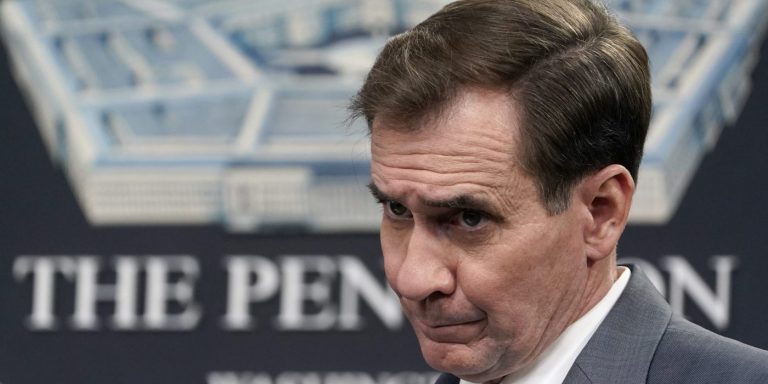
(Luis Cornelio, Headline USA) National Security spokesperson John Kirby sounded uncertain when asked Sunday whether the Biden-Harris administration has a plan to evacuate Americans from Lebanon if the conflict between Hezbollah and Israel escalates.
During an interview on ABC News’s This Week with host Martha Raddatz, Kirby was asked about the escalating conflict between Hezbollah, a foreign terrorist organization, and Israel.
Raddatz asked, “If the situation does escalate, and we certainly hope it does not, are you absolutely certain we are prepared to get Americans out of Lebanon or even Israel?” She then reminded Kirby of the deadly chaos during the Afghanistan withdrawal.
In response, Kirby dodged the question, vaguely referring to “contingency plans for evacuations in just about every corner of the world.”
Kirby added that Defense Secretary Lloyd Austin is working to ensure the U.S. has the capability for a potential evacuation scenario.
“We are working our way through that,” Kirby claimed. “I would add that right now the State Department does not feel the need for that, that there are still commercial operations, commercial air… that is getting out of Beirut and are still available to those Americans that want to leave.”
Kirby then issued a warning to Americans in Lebanon: “If you are in Lebanon, and you want to go, go now while these options are available to you.”
Tensions in the region are at an all-time high after the Israeli military killed Hezbollah’s long-time leader and co-founder, Hassan Nasrallah, in airstrikes on Saturday.
Hezbollah is a designated foreign terrorist organization based in Lebanon, a country north of Israel—and has the backing of the Iranian government and Hamas.
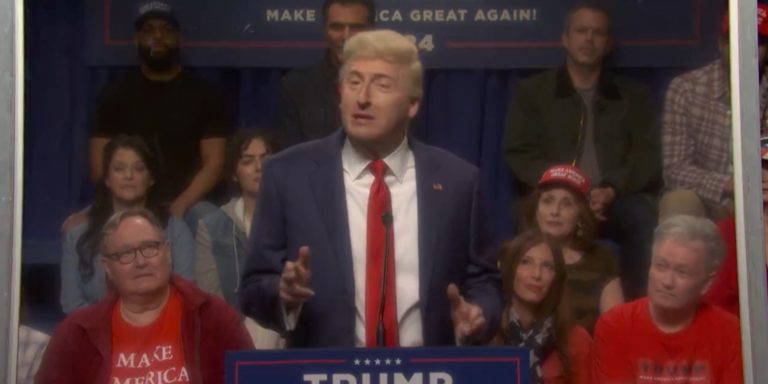
The joke occurred on Saturday when actor James Austin Johnson portrayed Trump during a fictitious rally, seemingly mocking the former president’s complaints about being shot.
“We love my rallies, except when someone does the ‘bing, bong, bing, bing, bing’ right at me,” Johnson said while mimicking a gun with his fingers.
“You know that happened because of the rhetoric of the radical left? They say that me blaming the Democrats for inciting violence is the pot calling the kettle black,” Johnson added.
Trump’s campaign criticized SNL on X, sharing the clip with the following caption: “There were two assassination attempts against President Trump within a span of seven weeks.”
There were two assassination attempts against President Trump within a span of seven weeks.@nbcsnl apparently finds that funny. Disgusting. pic.twitter.com/huSqKsrGhM
The skit followed Trump’s narrow escape from an assassination attempt on July 13 during a campaign rally in Butler, Pennsylvania.
Corey Comperatore, a MAGA supporter and beloved former fire chief, was tragically killed while heroically shielding his two daughters and wife from gunfire.
Trump escaped a second assassination attempt on Sept. 15 when an alleged suspect, Ryan Routh, targeted him at a golf course.
Townhall columnist Dustin Grage rebuked SNL for downplaying the seriousness of the targeted attacks on Trump.
“There are a lot of jokes SNL can make with Trump impersonations. Just turn on TikTok, they are hilarious,” Grage wrote. “One of these scenarios isn’t an assasination [sic] attempt where an innocent man’s life was taken.”
Comedian Tim Young chimed in, saying, “SNL mocked Trump after he survived multiple ass*ss*nation attempts. But recall that when Hillary lost in 2016, they started their show like it was a funeral. They stopped being funny a long time ago.”
SNL mocked Trump after he survived multiple ass*ss*nation attempts.
But recall that when Hillary lost in 2016, they started their show like it was a funeral.
Beyond mocking Trump, SNL poked fun at President Joe Biden, Vice President Kamala Harris, New York City Mayor Eric Adams and Minnesota Gov. Tim Walz. Watch these skits below.