

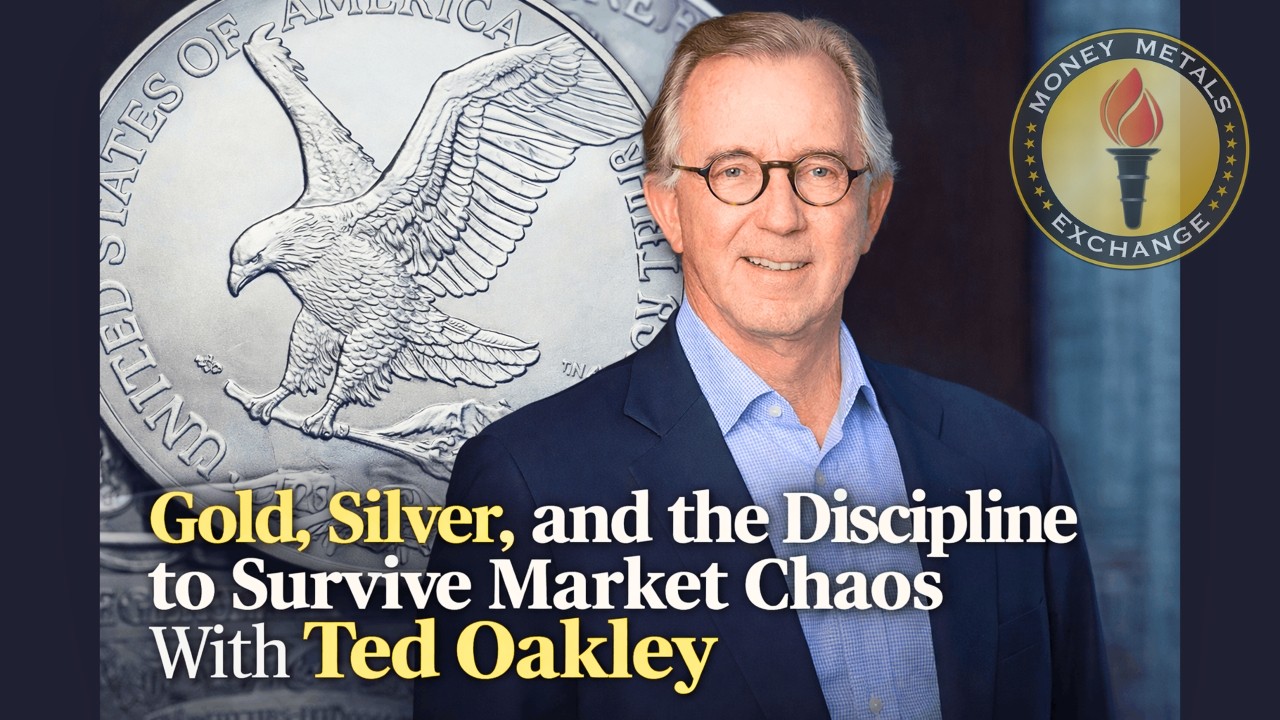
(Money Metals News Service) In a recent episode of the Money Metals podcast, host Mike Maharrey sat down with veteran investment advisor J. Ted Oakley, founder of Oxbow Advisors. Oakley brought more than 40 years of experience advising high-net-worth clients, but the conversation began far from Wall Street.
Oakley shared a deeply personal story of growing up in extreme poverty in the backwoods of North Carolina and Georgia, without running water or basic comforts. Forced to work from a young age and leave home shortly after high school, he learned early that survival required discipline, effort, and vigilance. Those formative years left a permanent imprint on how he views risk, loss, and responsibility.
That background, Oakley explained, created a mindset that never takes capital for granted. Even after achieving success, he admits to “running scared” in the sense that he never forgets how quickly things can be lost. That perspective shapes how he manages money today, with a strong emphasis on avoiding catastrophic losses rather than chasing reckless gains.
(Interview Starts Around 6:20 Mark)
Why Gold Belongs in a Serious Portfolio
Unlike many traditional advisors, Oakley has long viewed gold and silver as essential components of a diversified portfolio. He emphasized that gold, in particular, should be understood not merely as a commodity but as a form of currency that has preserved value for thousands of years.
Oakley noted that while gold can experience long periods of stagnation or decline, its historical role as a universally tradable store of value makes it uniquely suited to hedge against monetary instability. At Oxbow Advisors, gold is held across all strategies as a currency-like asset rather than a speculative trade.
Silver, by contrast, plays a different role. Oakley described it primarily as an industrial metal with higher volatility and a higher beta than gold. Because of that volatility, his firm trades silver more actively and typically allocates less capital to it than to gold, recognizing both its opportunity and its risk.
Rethinking the 60/40 Model
The conversation turned to recent remarks by the chief investment officer of Morgan Stanley, who suggested rethinking the traditional 60/40 stock-bond portfolio in favor of a 60/20/20 allocation that includes precious metals. Oakley said the recommendation made sense given the breakdown of the old model.
For years, massive liquidity injections made passive index investing appear foolproof. But Oakley argued that the environment has changed. Stocks and bonds no longer provide the same diversification benefits they once did, forcing institutional voices to acknowledge alternatives like gold.
He suggested the shift reflects a broader changing of the guard in markets, as strategies that worked effortlessly for more than a decade begin to falter under new macroeconomic pressures.
Navigating Volatility Without Panic
As gold and silver experienced sharp corrections following recent highs, Maharrey raised the emotional toll these moves take on investors. Oakley observed that he received few calls during the early stages of the rally, but interest surged once gold pushed above $5,000 and silver climbed into triple digits.
That pattern, he said, is often a contrarian signal. When enthusiasm peaks among average investors, corrections tend to follow. Oakley cautioned that such pullbacks do not signal the end of a bull market, but they do require patience. Historically, major breaks often take three to four months to stabilize before resuming an upward trend.
He stressed that gold should be allocated deliberately, whether at 5%, 10%, or another level, and then held with discipline. Selling during volatility undermines gold’s role as a long-term stabilizer. Oakley encouraged investors to think in relative terms, such as how much gold it takes to buy a home over time, rather than focusing solely on dollar prices.
Gold Versus Silver in a Changing World
Oakley highlighted key differences between gold and silver that investors often overlook. Gold has been heavily supported by central bank buying, especially since 2022, when geopolitical shifts accelerated demand among sovereign institutions.
Silver lacks that central bank backing and remains more exposed to industrial demand cycles. While structural supply deficits exist, Oakley cautioned that mining constraints take time to resolve, meaning price volatility is inevitable. He acknowledged that supply cannot be ramped up quickly, which supports long-term prices, but short-term swings are unavoidable.
Because of this volatility, Oakley believes silver belongs in smaller allocations relative to gold, particularly for investors seeking stability rather than speculation.
Inflation, Debt, and Financial Repression
On inflation, Oakley argued that official measures understate the real cost pressures faced by households. He described today’s environment as one of “stealth inflation,” where expenses like healthcare, insurance, and groceries rise faster than headline CPI figures suggest.
He believes policymakers are incentivized to allow inflation to run hotter than interest rates as a way to reduce the real burden of debt, echoing the post–World War II period from 1946 through the early 1960s. Yield curve control and financial repression, he suggested, may be used again to manage unsustainable debt-to-GDP levels.
Looking ahead, Oakley expects inflation to remain structurally higher over the next five to ten years, regardless of short-term soft patches or political narratives surrounding tariffs and rate policy, including leadership changes such as the appointment of Kevin Walsh.
The Risk Most Investors Are Missing
Perhaps Oakley’s strongest warning concerned the dominance of passive investing. He estimated that more than 90% of investors are heavily concentrated in S&P 500 index funds and U.S.-focused exchange-traded funds.
That concentration, he warned, leaves portfolios vulnerable if foreign markets outperform and global investors reduce exposure to U.S. assets due to currency weakness. Oakley noted that many advisors entered the industry after 2009 and have never experienced a prolonged bear market, leading to overconfidence in strategies that worked only under extraordinary monetary conditions.
He believes the next decade will challenge those assumptions, as markets require active management, diversification, and risk awareness rather than blind faith in indexes.
A Legacy Beyond Markets
Beyond investing, Oakley spoke passionately about his philanthropic work supporting foster children. Inspired nearly three decades ago by the book A Child Called “It”, he founded charitable organizations that now operate across roughly 68 counties in Texas.
Through two foundations, Oakley helps nearly 10,000 children each year, providing essentials, educational support, and pathways through college. He described the work as deeply personal, rooted in gratitude for those who helped him when he had nothing.
For Oakley, success is ultimately measured not by returns alone, but by the lives improved along the way—a philosophy that mirrors his disciplined, long-term approach to both markets and life.
Stay connected with Ted Oakley at Oxbow Advisors.
 Ted Oakley explains why discipline, gold, and selective silver exposure help investors survive volatility, inflation, debt, and a shifting market regime dominated by fragile index investing.)