

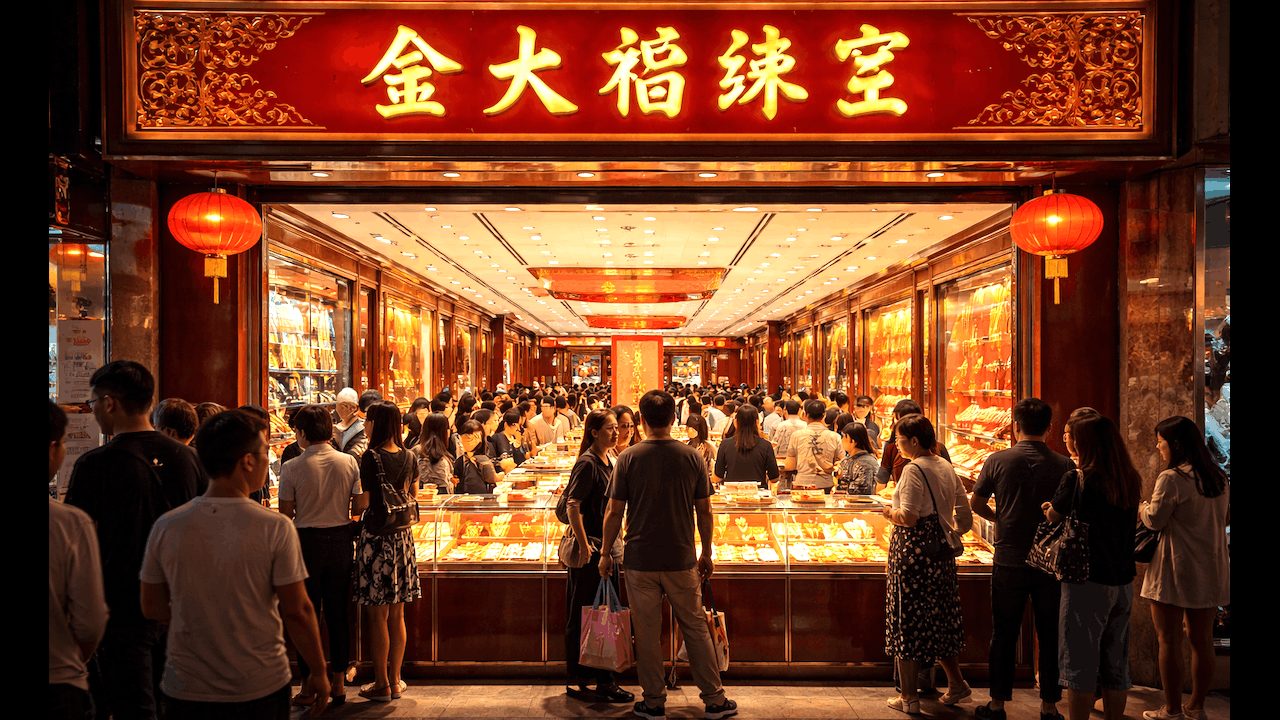
(Mike Maharrey, Money Metals News Service) Chinese consumers seeking a “safety net” are gobbling up gold even with prices at record levels.
The Chinese Lunar New Year holiday (Feb. 17) typically boosts Chinese gold demand. This year, buying is hotter than ever, even with elevated prices. As the South China Morning Post describes it, rich and poor alike have caught gold fever.
“From migrant workers splashing out on gold-coated jewelry, to white-collar workers pouring their savings into gold-linked investment funds, the metal is widely seen not only as a marker of social respectability, but also as a safety net amid an uncertain world.”
The Lunar New Year is a major gift-giving holiday in China. Migrant workers return to their home villages laden with gifts.
Consumers are reportedly snapping up 1-gram gold “beans” as a holiday gift.
“It feels more thoughtful than a red envelope with 1,000 yuan in cash,” Liu Huilan told the SCMP.
Major Chinese retailers report gold jewelry is selling for an average of ¥1,529 (US$221) per gram. That’s up from an ¥890 average during the same period last year.
The higher gold price, coupled with the surging silver price, has boosted the popularity of gold-plated silver jewelry. A jewelry shop owner told the South China Morning Post that it is much more affordable, and it will likely hold its value like pure gold jewelry. He said that he expected gold-plated jewelry to become even more popular as the silver price continues to rise.
Gold investment demand is also surging, particularly among middle-class workers in the cities.
Yang Ling works as a translator in Beijing. She said geopolitical instability is driving her and many of her friends to gold as a safe haven.
“When we heard about the Venezuela and Middle East situations worsening in early January, we invested more in gold that same day.”
She said she plans to invest her year-end bonus in a gold ETF.
Chinese buying helped push gold bar and coin demand to a 12-year high of 1,374.1 tonnes. In value terms, global bar and coin demand was a record-breaking $154 billion.
More than half of the global coin and bar demand came from two countries – China and India.
Chinese have also turned to gold ETFs over the last year, with Chinese funds more than doubling their gold holdings in 2025 (+133 tonnes). Meanwhile, Indian funds charted eight straight months of gold inflows to wrap up the year.
ETF demand is so strong that the Chinese government recently required banks to tighten risk-management policies last month, requiring investors to pass more stringent risk assessments before purchasing gold-related financial products.
A gold ETF is backed by a trust company that holds metal owned and stored by the trust. In most cases, investing in an ETF does not entitle you to any amount of physical gold. You own a share of the ETF, not gold itself. ETFs are a convenient way for investors to play the gold market, but owning ETF shares is not the same as holding physical gold.
One gold investor told the South China Morning Post that he expects gold investment to remain robust, even if the gold price rises more slowly, because it provides a sense of security.
“Gold’s gains this year may not match last year’s, but it remains the safest bet.”
Mike Maharrey is a journalist and market analyst for Money Metals with over a decade of experience in precious metals. He holds a BS in accounting from the University of Kentucky and a BA in journalism from the University of South Florida.
