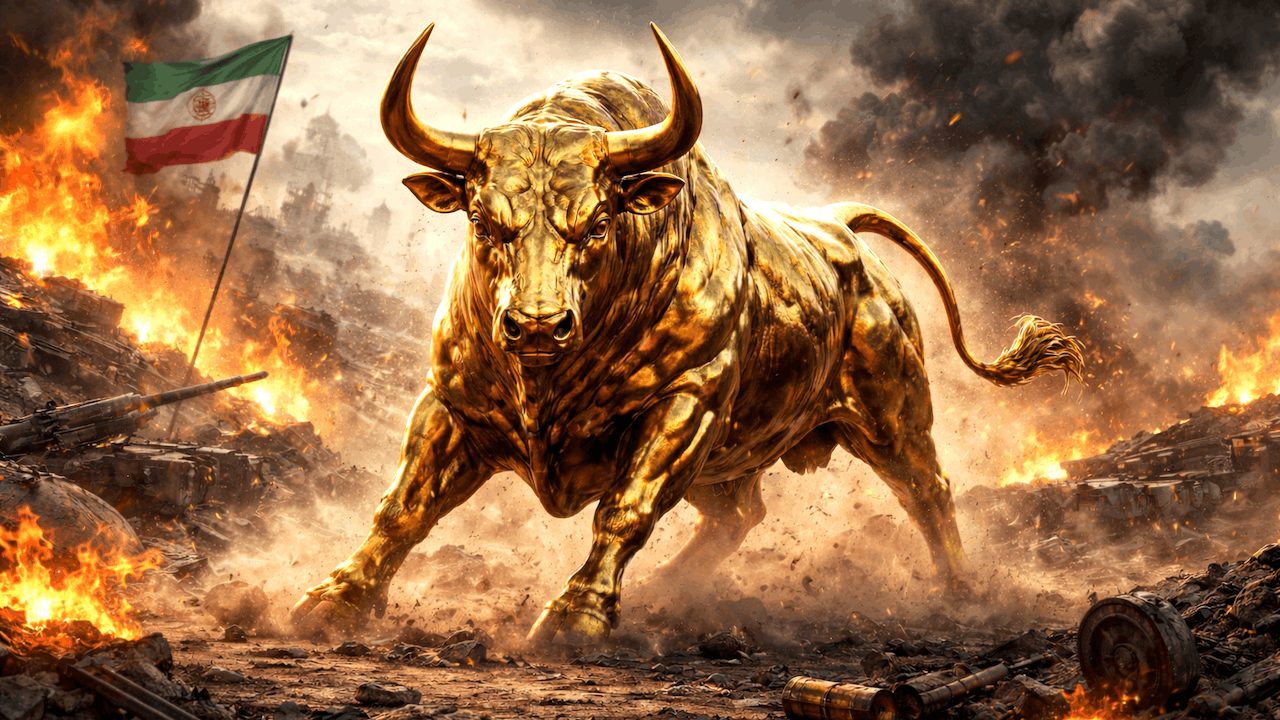
(Mike Maharrey, Money Metals News Service) Could the U.S./Israel war against Iran provide additional long-term support to the gold bull market?
Analysts at Metals Focus think it might.
Historically, wars have had little impact on the gold market beyond initial safe-haven buying. Typically, other factors, such as central bank monetary policy, come to dominate the market as the war drags on.
As Metals Focus notes, there tends to be an initial boost to gold prices at the onset of a war.
“Looking back in history, the boost that gold tends to enjoy because of geopolitical tensions or shocks rarely lasts. Indeed, this is largely the case for most markets, leaving aside, of course, assets favorable supply/demand fundamentals. Even in cases when conflicts have been prolonged, investor fatigue has soon set in, and appetite for safe-haven assets dissipated.”
The safe-haven phase was particularly short after the U.S. and Israel launched their attack on Iran. Gold surged, eclipsing $5,400. However, the safe-haven spike quickly corrected, along with everything else, leaving significant price volatility in its wake as everybody tries to sort through the propaganda and figure out how exactly the war might play out.
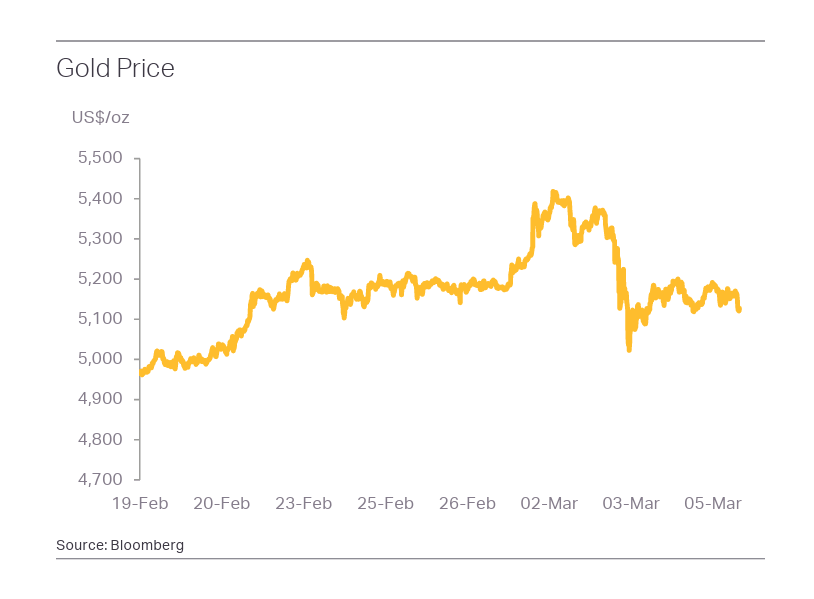
In the near term, Metals Focus analysts expect frequent price rallies driven by war headlines; however, they don’t expect the price to scale all-time highs due to the war itself.
“As the market consensus oscillates between this and the sort of complacency we have seen develop this week towards the war, corrections are also on the cards, resulting in a period of heightened volatility.”
The Metals Focus analysts say gold could get a bigger boost if the situation spirals out of control or if “one or more of the fat-tail risks instead crystallize.”
“Either way, sooner or later, the impact of the war on the gold price will wane. Whether this is due to de-escalation or the investor fatigue that tends to develop, some of the conflict-related safe-haven bid for gold will dissipate.”
Could This War Give Gold Bulls a Long-term Boost?
While wars don’t typically have a longer-term impact on the gold market, Metals Focus argues that this time could be different, identifying “a sizeable tail risk that, due to the specifics of the conflict.”
Analysts specifically note that the location of the war and the potential for Iran to significantly restrict the global flow of oil, plunging the entire world into economic chaos.
But even without the worst-case scenario, Metals Focus analysts say they have “no doubt” that it is going to contribute to “the wider positive sentiment towards gold and its investment case.”
They base their conclusion on three key factors.
Broader U.S. Foreign Policy Implications
U.S. foreign policy has grown increasingly interventionalist, and this raises geopolitical uncertainty.
The U.S. government has effectively overthrown two regimes in the last two months. As Metals Focus notes, whether you agree with this aggressive foreign policy or not, “It comes with lasting implications regarding the country’s foreign policy.”
“It signals an appetite to induce regime or political change, using hard power, if necessary, to meet its strategic objectives.”
Analysts also point out that the U.S. did not do much to coordinate the attack with its traditional European allies, signaling a shift toward “unilateralism.”
“On balance, such shifts in the world’s largest economy and leading military power amplify geopolitical uncertainty.”
The Potential for Long-term Instability in the Middle East
Regime change does not guarantee a better regime.
In fact, Mojtaba Khamenei has taken over the mantle of leadership in Iran. The son of former “supreme leader” Ayatollah Ali Khamenei, Moktaba has been described by some as “his father on steroids.”
Of course, U.S. and Israeli forces may well take the second Khamenei out, but there is still no guarantee that the war will stabilize the region. As Metals Focus analysts point out, the new Iranian administration could “become yet more radicalized and adversarial.”
“The possibility of internal turmoil that spills over into neighboring countries can also not be ruled out, as the various factions in what is an ethnically diverse country compete for power, following a potential regime collapse.”
This kind of geopolitical chaos is bullish for gold.
Treasuries Have Failed as a Safe Haven
Treasuries have historically served as one of the go-to safe havens in times of uncertainty. Not anymore. The yield on the 10-year Treasury has nudged up since the Iran war commenced, indicating sagging demand.
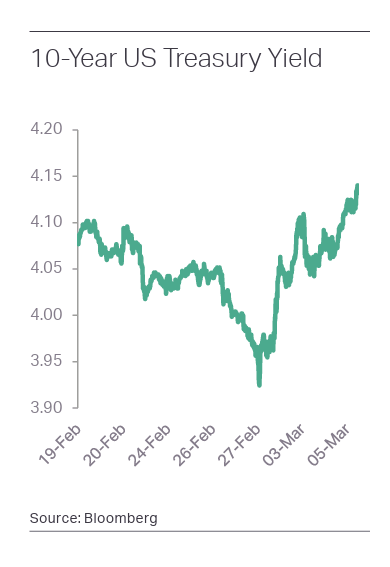
This effectively leaves gold as the last haven standing.
As the Metals Focus analysts call the waning lack of Treasury safe-haven appeal “clearly a positive for gold, both directly, as it competes with treasuries for safe-haven investment flows, and indirectly, due to the impact these concerns are having on the U.S. dollar.”
The only thing certain about war is uncertainty. Regardless of how things play out, we can expect ongoing price volatility as the markets try to make sense out of the daily war moves. Long-term, the war will undoubtedly change the current geopolitical landscape. And of course, this will play out in a broader context of ongoing inflationary pressure, a giant Debt Black Hole, and a central bank caught in a Catch-22 when it comes to the trajectory of monetary policy.
Given all of these factors, I agree that the bullish case for gold is arguably increased by the war, but investors should expect significant price volatility in the weeks ahead.
Mike Maharrey is a journalist and market analyst for Money Metals with over a decade of experience in precious metals. He holds a BS in accounting from the University of Kentucky and a BA in journalism from the University of South Florida.