(Maire Clayton, Headline USA) Legendary Star Wars actor Mark Hamill had another unhinged rant while appearing on a recent episode of the Politickin Podcast.
Hamill started by expressing how he was devastated President-elect Donald Trump beat out Vice President Kamala Harris in the November election and wants to remove the Electoral College.
After running to BlueCry, Mark Hamill has gone completely insane.
“I want to get rid of the Electoral College because Hillary beat [Trump] by 3 million votes, just shy under 3 million and Gore beat W by half a million,” he said.
However, Hamill failed to mention that Trump won both the popular vote as well as the Electoral College when he faced Harris in the election.
As the podcast went on, Hamill appeared to get more and more frustrated as he waved and shook his hands.
X users noticed the strange behavior and took to the platform to give their opinion on it.
“If anyone asks for reasons why we should re-open the asylums, show them Mark Hamill,” Internet personality Nick Sortor wrote.
Hamill then ranted about how he would receive pushback from “the MAGA crowd” on social media.
“And when I was still on Twitter, I had to stop reading the responses,” he began. “I wouldn’t block anyone because then they could display ‘Mark Hamill blocked you’ as a badge of honor, but I knew I muted like a mofo. I would mute.”
His Trump Derangement Syndrome was clearly in full effect as he added he would lose track of time while silencing opposing views.
“You know, I looked up one day and I said, my God, I’ve been muting people for forty minutes!” the actor added.
Hamill admitted his own family expressed that maybe he should stop posting about politics.
“My daughter would say, Daddy, you shouldn’t tweet politically so much because, you know, people get so angry,” he confessed.
The once beloved actor said he refuses to stop expressing his opinions.
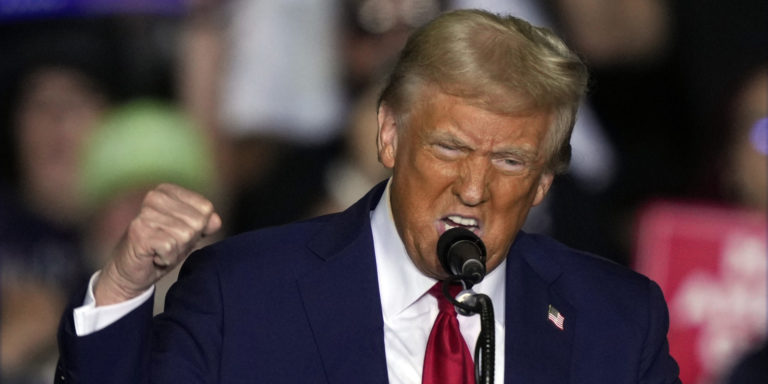
“Who cares if I lose a part in the movie because I hate the orange atrocity? I do,” Hamill said. “And I want people to know that.”
Hamill was previously slammed online when he compared Trump’s win to Pearl Harbor.
(Ken Silva, Headline USA) The Pentagon has admitted that it has more troops deployed in Iraq and Syria than what it previously disclosed to the public—the latest in a long list of Defense Department lies about its activity in that region.
The Pentagon’s admission about Syria was made last week by Maj. Gen. Pat Ryder, who reportedly said the true number of troops there is 2,000—not the 900 that officials have reported for years. Then, on Monday, Ryder also said there were more troops in Iraq than the 2,500 figure that he’s quoted for years. However, Ryder wouldn’t disclose exactly how many more troops are there.
“In addition to the approximately 900 baseline troops, there are also approximately 1,100 US military personnel in Syria that deploy for shorter durations as temporary enablers in support of force protection, transportation, maintenance, or other emerging operational requirements,” Ryder said, as reported by antiwar.com.
🚨 Biden Pentagon spokesman Pat Ryder says he "recently learned" there are actually 2,000+ U.S. troops deployed in Syria — far more than the 900 they had previously announced. pic.twitter.com/MKlqO2ZlqS
“The numbers of these additional temporary forces have fluctuated over the past several years based on mission needs but in general have increased over time as the threat has increased to baseline forces.”
The Pentagon’s revisions come as Donald Trump is set to take office. During his last administration, Pentagon officials lied to Trump about the true number of troops in Syria—defying his orders for a draw-down.
Trump’s orders to withdraw from Syria came in 2018 and again in 2019, and each time officials either resigned in protest or outright deceived the President.
In December 2018, Defense Secretary Jim Mattis resigned over the matter, as did Syria envoy Brett McGurk. And according to DefenseOne.com, military officials lied to Trump about how many troops were there.
“We were always playing shell games to not make clear to our leadership how many troops we had there,” McGurk’s replacement, diplomat Jim Jeffrey, told the publication in November 2020.
Jeffrey added that the actual number of troops in northeast Syria is “a lot more than” the roughly two hundred troops Trump initially agreed to leave there in 2019.
Now, the Biden administration is threatening war with Iran if any of its troops are killed by Iranian-backed militias.
According to the New York Times, Iranian-backed militias had already carried out 140 attacks on American troops in Iraq and Syria as of Thursday, with nearly 70 U.S. personnel wounded, some of them suffering traumatic brain injuries.
“Biden administration officials have regularly debated the proper strategy. They do not want to let such attacks go without a response, but on the other hand do not want to go so far that the conflict would escalate into a full-fledged war, particularly by striking Iran directly,” the Times reported in January.
“They privately say they may have no choice, however, if American troops are killed. That is a red line that has not been crossed, but if the Iranian-backed militias ever have a day of better aim or better luck, it easily could be.”
Ken Silva is a staff writer at Headline USA. Follow him at x.com/jd_cashless.
(Ken Silva, Headline USA) The non-profit Campaign Legal Center filed a complaint with the Federal Election Commission earlier this month, alleging an illegal $1.4 million scheme to finance Democratic politicians through a dark-money operation.
The complaint, filed on Dec. 9 and reported on Thursday by The Intercept, focused on the liberal-leaning clothing company Patagonia, and its ties to a mysterious corporation called “Save Our Home Planet Action, Inc.”
According to the complaint, SOHPA was incorporated in Delaware in August 2024. It appears to have conducted no real business before donating some $1.4 million to five political action committees—Senate Democratic campaign fund, the League of Conservation Voters Victory Fund, the House Democrats, FF PAC, The PAC for America’s Future—and three “hybrid” PACs. The donations were made between Aug. 16 and Sept. 4.
The complaint says that SOHPA’s address is the same as Patagonia’s. The complaint further noted that Patagonia founder Yvon Chouinard said in 2018 that “we’re in business to save our home planet”—the same phrase used in the SOHPA acronym.
The Campaign Legal Center said those connections “strongly suggest” that Patagonia or its executives may be the true source of the contributions made in SOHPA’s name.
“Voters have a right to know who is spending money to influence their votes, elect their preferred candidates, and sway public policy,” says Saurav Ghosh, director of federal campaign finance reform at CLC.
“This is just the latest example of how wealthy corporate special interests are using straw donor schemes to secretly spend enormous amounts of money on our elections. The FEC must investigate who really contributed over $1.4 million through this scheme, and hold any violators accountable for depriving the public of this vital information.”
Along with the CLC’s complaint, The Intercept further revealed Thursday that SOHPA has the same CEO, Greg Curtis, as the Holdfast Collective—a nonprofit organization that owns 98% of Patagonia.
Neither Patagonia nor the entity in question, Save our Home Planet Action, responded to The Intercept’s requests for comment. Curtis also reportedly did not respond to a request for comment.
The Campaign Legal Center told The Intercept that it is still waiting on a response to its complaint.
Ken Silva is a staff writer at Headline USA. Follow him at x.com/jd_cashless.
(Headline USA) The heavily disputed outcome of the 2020 election led to surges in traffic for conservative news sites in the weeks and months afterward, only subsiding when President Joe Biden was fully installed in the position.
For Democrats, however, the resurgence of President-elect Donald Trump, who won the popular vote and all swing states in the November race, has had the opposite effect.
Rather than craving more information, many on the Left have tuned out, retreating even farther into their information silos despite recent criticism that media failures in covering Biden and Vice President Kamala Harris were to blame for the nation’s current state of disarray.
“People are mentally exhausted,” said Ziad Aunallah, 45, a Democrat from San Diego. “Everyone knows what is coming and we are just taking some time off.”
Television ratings—and now a new poll—clearly illustrate the phenomenon. About two-thirds of American adults say they have recently felt the need to limit media consumption about politics and government because of overload, according to the survey from the Associated Press-NORC Center for Public Affairs Research.
Smaller percentages of Americans are limiting their intake of news about overseas conflicts, the economy or climate change, the poll says. Politics stand out.
The poll, conducted in early December, found that about 7 in 10 Democrats say they are stepping back from political news.
“The last thing I want to watch right now is the interregnum,” said Sam Gude, a 47-year-old electrician from Lincoln, Nebraska, who had a steady diet of pro-Kamala propaganda on CNN and MSNBC before the election.
Still, Gude is among those discovering other ways to get news to which he does want to pay attention, including on YouTube.
After election night through Dec. 13, the prime-time viewership of MSNBC was an average of 620,000, down 54% from the pre-election audience this year, the Nielsen company said. For the same time comparison, CNN’s average of 405,000 viewers was down 45%.
The percentage isn’t as high for Republicans, who have reason to celebrate Trump’s victory. Still, about 6 in 10 Republicans say they’ve felt the need to take some time off too, and the share for independents is similar.
At Fox News Channel, a favorite news network for Trump fans, the post-election average of 2.68 million viewers is up 13%, Nielsen said. Since the election, 72% of the people watching one of those three cable networks in the evening were watching Fox News, compared to 53% prior to election day.
A post-election slump for fans of the losing candidate is not a new trend for networks that have become heavily identified for a partisan audience. MSNBC had similar issues after Trump was elected in 2016.
Same for Fox in 2020, although that was complicated by anger: many of its viewers were outraged then by the network’s crucial election night call of Arizona for the Democratic presidential candidate, Joe Biden, and sought alternatives.
MSNBC had its own anger issues after several Morning Joe viewers became upset that hosts Joe Scarborough and Mika Brzezinski visited Trump shortly after his victory last month. Yet while the show’s ratings are down 35% since Election Day, that’s a smaller drop than the network’s prime-time ratings.
CNN points out that while it has been suffering in the television ratings, its streaming and digital ratings have been consistent. However, the network notably was in decline prior to the election, suggesting that consistency may not be an ideal situation financially.
MSNBC can take some solace in history. In previous years, network ratings bounce back when the depression after an election loss lifts. When a new administration takes office, people who oppose it are frequently looking for a gathering place.
“I’ll be tuning back in once the clown show starts,” Aunallah said. “You have no choice. Whether or not you want to hear it, it’s happening.”
But the ride may not be smooth. MSNBC’s slide is steeper than it was in 2016; and there’s some question about whether Trump opponents will want to be as engaged as they were during his first term.
People are also unplugging from cable television in rates that are only getting more rapid, although MSNBC believes it has bucked this trend eating away at audiences before.
The poll indicates that Americans want less talk about politics from public figures in general. After an election season where endorsements from celebrities like Taylor Swift made headlines, the survey found that Americans are more likely to disapprove than approve of celebrities, large companies and professional athletes speaking out about politics.
That suggests another victory for Trump and his supporters, who have long fought off the scourge of woke corporations by successfully boycotting those who virtue-signaled their extreme leftist values.
MSNBC is also in the middle of some corporate upheaval that raises questions about potential changes. Parent company Comcast announced last month that the cable network is among some properties that will spin off into a new company, which will give MSNBC new corporate leadership and cut its ties to NBC News.
Gude said MSNBC will always have a hard-core audience of Trump haters. But if the network wants to expand its audience, “then you have to talk about issues, and you have to stop talking about Trump.”
Steering leftist media away from its Trump Derangement Syndrome and toward a more thoughtful, serious approach to journalism seems to be something that many can agree on across the aisle.
Kathleen Kendrick, a 36-year-old sales rep from Grand Junction, Colorado, who’s a registered independent voter, said she hears plenty of people loudly spouting off about their political opinions on the job. She wants more depth when she watches the news. Much of what she sees is one-sided and shallow, she said.
“You get a story but only part of a story,” Kendrick said. “It would be nice if you could get both sides, and more research.”
Aunallah, similarly, is looking for more depth and variety. He’s not interested “in watching the angry man on the corner yelling at me anymore,” he said.
“It’s kind of their own fault that I’m not watching,” he said. “I felt they spent all this time talking about the election. They made it so much of their focus that when the main event ends, why would people want to keep watching?”
The poll of 1,251 adults was conducted Dec. 5-9, 2024, using a sample drawn from NORC’s probability-based AmeriSpeak Panel, which is designed to be representative of the U.S. population. The margin of sampling error for adults overall is plus or minus 3.7 percentage points.
(Mike Maharrey, Money Metals News Service) Why don’t I push for tax increases to address the massive budget deficits and the ever-growing national debt?
The answer is simple – Uncle Sam doesn’t have a revenue problem. He has a spending problem.
“All you guys talk about is the runaway spending, ignoring the government cash flow problem.”
He goes on to claim that “taxation relief from Bush II and Trump have pillaged Treasury.”
But have tax cuts really “pillaged” the Treasury?
The Bush Tax Cuts
In 2001, Congress passed the “Economic Growth and Tax Relief Reconciliation Act,” cutting the marginal tax rates for all income brackets and lowering the highest bracket from 39.6 percent to 35 percent.
Congress passed a second round of tax cuts in 2003 through the “Jobs and Growth Tax Relief Reconciliation Act.” This bill primarily reduced tax rates on dividends and capital gains to spur investment.
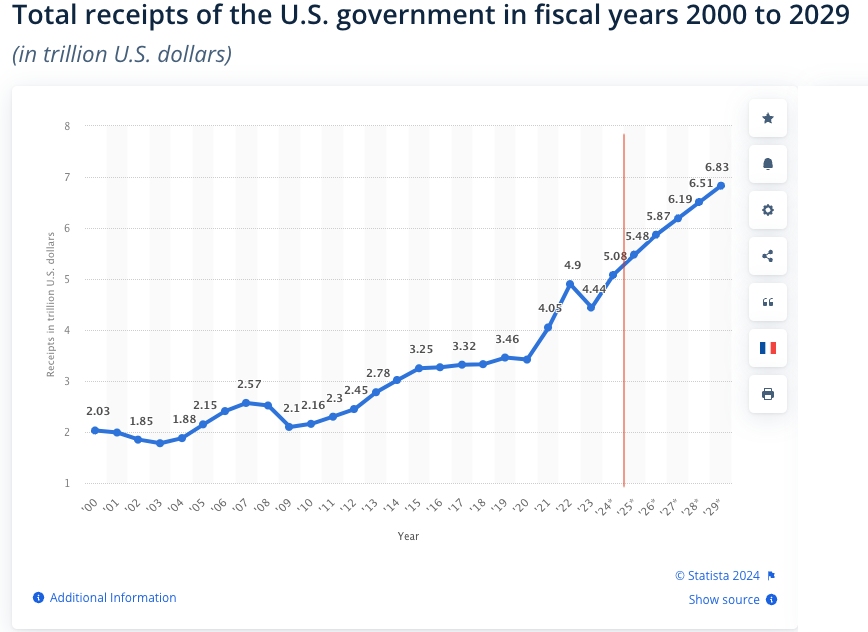
Federal receipts initially declined by about 10 percent after the enactment of these cuts. But it’s important to note that the U.S. went through a recession in 2001, in the wake of the dot com bust. Declining economic growth in that period also contributed to the reduction in federal revenue.
In fiscal 2001, federal revenues came in at $1.99 trillion. In 2002, receipts dipped modestly to $1.85 trillion. In 2003, they dipped again to $1.78 trillion. But in 2004, federal revenues began climbing again, growing to $1.88 trillion. By 2006, federal receipts were higher than pre-cut levels.
This underscores one of the benefits of a lower tax environment – it tends to be more favorable for economic growth. When individuals and businesses keep more of their money, there is more capital available for investment and consumption. We can debate just how much impact tax cuts have on growth, but it’s certainly greater than zero.
Expanding economic growth benefits the Treasury. More economic activity means more money to tax, boosting federal receipts even in a lower tax rate environment.
As economist Arthur Laffer demonstrated, there is always a tradeoff between taxes, economic growth, and federal receipts. Looking at either extreme reveals this fact.
At a zero percent tax rate, the government gets no revenue because it collects no taxes. On the other hand, a 100 percent tax rate would also yield no revenue because individuals and businesses would have no incentive to work or invest if all of their income is confiscated by the tax man.
The point is that while tax increases raise revenues, at least in the short term, they come with a downside. In fact, tax hikes generally fail to raise as much revenue as projected due to their drag on economic activity. We can debate the scope of that downside, but it should always be considered when contemplating higher taxation.
As far as the Bush-era cuts, the CBO estimates federal revenues would have been higher had they not been enacted. But it’s impossible to say by how much or if the CBO calculations are even accurate, given that we can’t calculate how much economic growth the tax cuts spurred. It’s entirely possible that revenues would have been lower without the tax cuts and their positive impact on economic growth.
Regardless, even if we take the CBO’s guesses at face value, it’s clear that the Bush tax cuts didn’t “pillage” the Treasury. At worst, they caused a temporary dip in federal receipts.
The Trump Tax Cuts
When Donald Trump took office, Congress pushed through another round of tax cuts. Not only did they not pillage the Treasury, they didn’t even reduce federal revenues in dollar terms.
The Trump tax cuts went into effect in 2018. Federal receipts were flat during that fiscal year, nudging slightly higher from $3.31 trillion in fiscal 2017 to $3.32 trillion.
Revenues rose again in fiscal 2019, ticking up to $3.46 trillion.
It’s impossible to know how the tax cuts would have affected revenues in 2020 and 2021, given the government lockdown of the economy for COVID-19, but in 2022, tax receipts surged by 21 percent to just under $5 trillion. Tax receipts that year charted a multi-decade high of 19.6 percent as a share of GDP.
However, people today still blame the massive budget deficits on the Trump tax cuts. To be blunt, this is utter nonsense.
After dipping in 2023 off 2022’s record, Federal revenues were at record levels again in fiscal 2024, coming in at $4.92 trillion. Despite this, the Biden administration managed to run the third-largest budget deficit in history.
It’s The Spending!
Any objective look at federal revenues reveals the real problem – the ever-increasing spending.
Federal receipts have generally trended upward since 2001 despite tax cuts.
(Note the big drop in revenue in 2008 with the onset of the Great Recession. This highlights the impact of economic activity on federal receipts.)
While revenue has increased, government spending has gone up much faster. The Biden administration blew through $6.75 trillion in fiscal 2024 alone, a 10 percent increase over 2023 spending. Going back to 2023, factoring out the reversal of student loan forgiveness (expensed in 2022 but struck down by the courts), the Biden administration spent $6.46 trillion, an 8.8 percent year-over-year increase in actual spending.
We saw the same trend in the Bush era. As government receipts fell by about 10 percent between 2001 and 2004, government spending rose from $1.86 trillion to $2.29 trillion, a 23 percent increase.
Between fiscal 2001 and fiscal 2024, spending was up 273.1 percent. During the same period, revenues rose 155.3 percent.
This is why I focus on the spending side of the ledger. Until the government gets its spending problem under control, tax increases, no matter how substantial, aren’t going to put a significant dent in the growing national debt.
Political Considerations
There are also political considerations when trying to figure out how to close the gaping federal budget hole. Sure, you could hand the politicians more money through tax increases, but would that guarantee a decrease in budget deficits?
Of course not.
Because politicians with more money are going to find new ways to spend it.
It’s all about incentives.
A politician’s overarching goal is to stay in office. And most politicians aspire to higher offices. In other words, they want votes. And the easiest way to get people to vote for you is to give them stuff. Conversely, politicians will find themselves looking for real jobs if they cause their constituents pain.
So, the incentives drive politicians to keep spending so they can keep delivering goodies to their constituents. Deep down, they probably realize the borrowing and spending is going to morph into a crisis – someday. But why worry about it now when they can kick the can down the road and get reelected for another term? They certainly aren’t motivated to deliver tough love and slash programs their constituents love. (This is also why they don’t really want to raise taxes either – except on the rich. I’ve already shown that taxing billionaires is a red herring.)
You probably wouldn’t hand an alcoholic standing outside of a bar $100, right? Likewise, it’s not a good idea to shower money on politicians who haven’t addressed their spending addiction.
When the political class demonstrates an ability to legitimately slow down the spending train, we can talk about tax increases. Until then, I’m going to keep harping on the spending.
Trump refused to wish a Merry Christmas to the 37 out of 40 murderers and rapists who Biden saved from the death penalty and instead sentenced to life in prison.
“To the 37 most violent criminals, who killed, raped, and plundered like virtually no one before them, but were just given, incredibly, a pardon by Sleepy Joe Biden,” Trump wrote on Truth Social. “I refuse to wish Merry Christmas to those lucky ‘souls’ but, instead, will say, GO TO HELL!”
Trump’s condemnation of Biden scrapping the death penalty for dozens of ruthless criminals came after the Republican issued personalized season’s greetings to China, Canadian Prime Minister Justin Trudeau and Greenland.
“Merry Christmas to all, including to the wonderful soldiers of China, who are lovingly, but illegally, operating the Panama Canal (where we lost 38,000 people in its building 110 years ago), always making certain that the United States puts in Billions of Dollars in ‘repair’ money, but will have absolutely nothing to say about ‘anything,’” Trump began.
Trump continued by taking aim at Trudeau, who he has trolled for weeks amid threats of U.S. tariffs on Canada if the country persists in violating American interests.
The president-elect wrote, “Also, to Governor Justin Trudeau of Canada, whose Citizens’ Taxes are far too high, but if Canada was to become our 51st State, their Taxes would be cut by more than 60%, their businesses would immediately double in size, and they would be militarily protected like no other Country anywhere in the World.”
To Greenland, Trump added, “Likewise, to the people of Greenland, which is needed by the United States for National Security purposes and, who want the U.S. to be there, and we will!”
Trump wished a Merry Christmas to the “Radical Left Lunatics,” the same language he used in his Thanksgiving Day wish to Democrats.
“We had the Greatest Election in the History of our Country, a bright light is now shining over the U.S.A. and, in 26 days, we will, MAKE AMERICA GREAT AGAIN. MERRY CHRISTMAS!” Trump said at the end of his second post.
Julianna Frieman is a freelance writer published by the Daily Caller, Headline USA, The Federalist, and The American Spectator. Follow her on Twitter at @JuliannaFrieman.
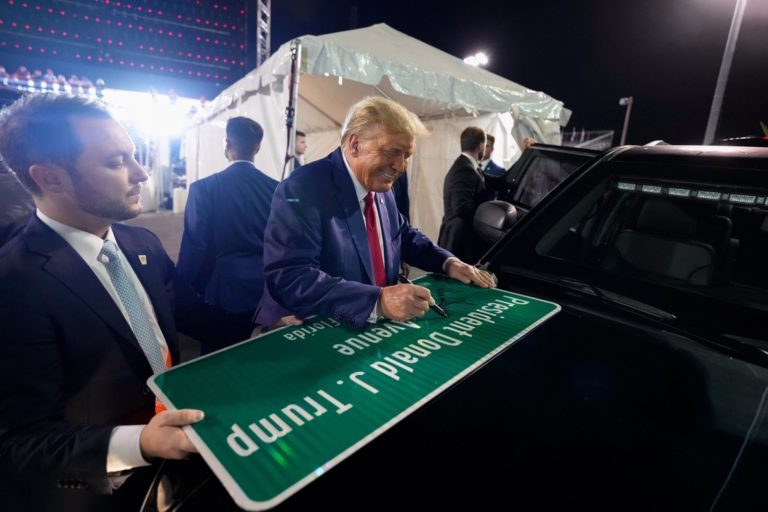
(Julianna Frieman, Headline USA) The commissioner who spearheaded the creation of “Donald J. Trump Avenue” in Miami-Dade County, Florida received the Christmas gift of a lifetime on Wednesday: a position in the incoming Trump administration.
President-elect Donald Trump announced his intent to appoint Commissioner Kevin Marino Cabrera as Ambassador to the Republic of Panama amid his ongoing efforts to disentangle the Panama Canal from China.
“I am pleased to announce that Kevin Marino Cabrera will serve as the United States Ambassador to the Republic of Panama, a Country that is ripping us off on the Panama Canal, far beyond their wildest dreams,” Trump wrote on Truth Social.
On Saturday, Trump slammed Panama for its continuous “rip-off” of the U.S. with expensive charges levied on the use of its canal.
The crucial shipping route belonged to the U.S. until former President Jimmy Carter “foolishly” gave it to Panama in 1977.
Trump noted Saturday that Panama Canal was given “as a token of cooperation” with the U.S., adding that he will demand its return if the country continues to take advantage of Americans.
Cabrera led the charge to rename Palm Avenue as “Donald J. Trump Avenue” in a move described by the Miami Herald to be an attempt to get a position in the second Trump administration. With the support of multiple Democrat commissioners, the City of Hialeah approved the initiative to honor Trump’s legacy.
President Donald J. Trump Avenue is official in Miami-Dade County!
Today, we ratified the City of Hialeah’s initiative to honor President Trump’s legacy of championing freedom and opportunity by co-designating Palm Avenue—a vital artery in our community—as "President Donald J.… pic.twitter.com/27AECJ6qTB
— Commissioner Kevin Marino Cabrera (@KMCabreraFL) December 3, 2024
“Kevin is a fierce fighter for America First principles. As a Miami-Dade County Commissioner, and Vice Chairman of the International Trade Consortium, he has been instrumental in driving Economic growth, and fostering International partnerships,” Trump wrote in his Christmas Day announcement. “In 2020, Kevin did an incredible job as my Florida State Director and, this year, advanced our MAGA Agenda as a Member of the RNC Platform Committee.”
The president-elect added, “Few understand Latin American politics as well as Kevin – He will do a FANTASTIC job representing our Nation’s interests in Panama!”
Cabrera responded to Trump’s nomination with a post on X.
Thank you, President Trump! 🇺🇸
I’m humbled and honored by your nomination to serve as the U.S. Ambassador to Panama.
— Commissioner Kevin Marino Cabrera (@KMCabreraFL) December 25, 2024
“Thank you, President Trump!” Cabrera wrote with an American flag emoji. “I’m humbled and honored by your nomination to serve as the U.S. Ambassador to Panama. Let’s get to work!”
Julianna Frieman is a freelance writer published by the Daily Caller, Headline USA, The Federalist, and The American Spectator. Follow her on Twitter at @JuliannaFrieman.
(Ken Silva, Headline USA) The Wall Street Journal published the inside story of how the intelligence agencies investigated the origins of COVID-19 under the Biden administration, revealing that Joe Biden’s handlers blocked the FBI and other scientists from presenting their lab-leak theory to the President.
The Journal’s article focused on what’s been deemed the “90-day sprint”—when Biden ordered his intelligence agencies to conduct an expedited study into Covid’s origins.
“The intelligence agencies that drilled into the issue brought a range of capabilities, from the National Security Agency, which intercepts foreign communications, to the FBI, which has a cadre of experts, including some who worked in the National Bioforensic Analysis Center, a laboratory for handling biological agents at Fort Detrick, Md,” the Journal wrote.
As has been widely documented, the FBI concluded with “moderate confidence” that COVID likely originated from a lab leak. Three scientists at the National Center for Medical Intelligence, part of the Pentagon’s Defense Intelligence Agency, also reportedly concluded that “Covid-19 was manipulated in a laboratory in a risky research effort.”
But according to the Journal, those findings weren’t presented to Biden.
“The intelligence officials who briefed Biden in August 2021 at the White House all wore masks to protect them against the still-raging pandemic, as did the president. The participants included [Avril] Haines, the president’s top intelligence official, and Murphy, from the National Intelligence Council. They were accompanied by another analyst from Haines’s office and a technical expert from the Central Intelligence Agency,” the Journal reported.
WSJ revealed this morning that the top FBI scientist who ruled COVID as a likely lab leak previously worked on the post-9/11 anthrax case. pic.twitter.com/ZS7Vo5fHI3
“Since the National Intelligence Council was among proponents of the zoonotic theory, and the CIA, like two other agencies, had declined to take a stand either way, the makeup of the briefing meant that no proponents of the lab leak theory were present.”
Responding to the Journal, spokesman for Haines’s office reportedly said that the FBI assessment that pointed to a lab leak was “accurately presented” during that August 2021 meeting.
The Journal also reported that the National Center for Medical Intelligence’s findings weren’t included in the DIA’s final report on the matter.
Meanwhile, U.S. intelligence agencies still haven’t reached a strong consensus as to what started COVID. Sen. Rand Paul, R-Ky., has indicated that he will investigate the matter next Congress when he heads the Senate Judiciary Committee.
“The pace of U.S. intelligence investigation has slackened, as many intelligence analysts who were assigned to the crash effort have shifted to other priorities,” the Journal reported.
Ken Silva is a staff writer at Headline USA. Follow him at x.com/jd_cashless.
(Jan Nieuwenhuijs, Money Metals News Service) While 99% of the media keeps staring at official data by the Chinese central bank (PBoC)—misleadingly stating it added 5 tonnes of gold in November following a supposed six-month pause—the PBoC’s “unreported” purchases in London accounted for a stunning 60 tonnes in September and another 55 tonnes in October.
And while cross-border trade statistics from the U.K. for November have yet to be released, I foresee another purchase of a similar magnitude.
Chinese authorities see a greater role for gold in the future international monetary system, or they wouldn’t continue buying such extraordinary amounts of gold. Via London alone, the PBoC has stockpiled 1,000 tonnes of gold since Russia’s foreign exchange assets were “frozen” by the West early 2022.
London Exports to China Are a Proxy for PBoC Buying
Since July this year, I have been writing that a large share of China’s gold imports into the domestic market is not bought by the private sector. We can conclude that the bars exported from the U.K. to China are secretly destined for the PBoC.
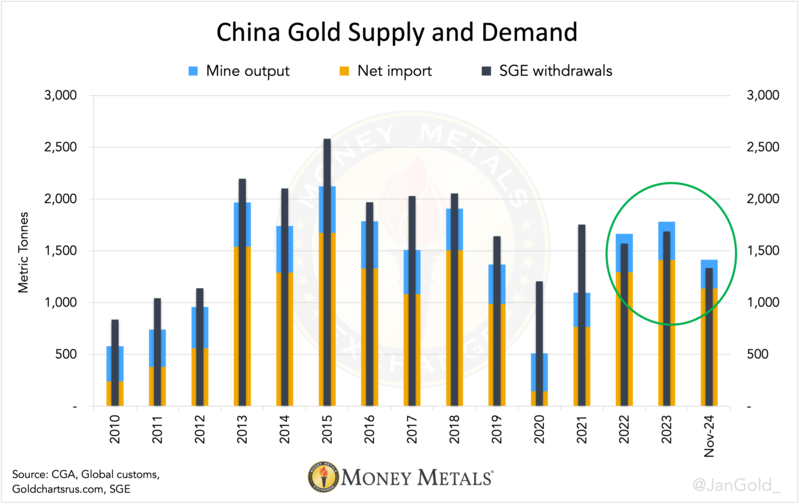
Initially, I based my analysis on a pronounced surplus in the Chinese domestic gold market—resulting from supply (mine, recycled gold, and imports) outstripping demand. The most conceivable explanation for this surplus is that the central bank of China is behind large gold imports.
Chart 1. From 2022 until November 2025 there is a surplus in the Chinese gold market, because import and domestically mined gold was more than SGE withdrawals.
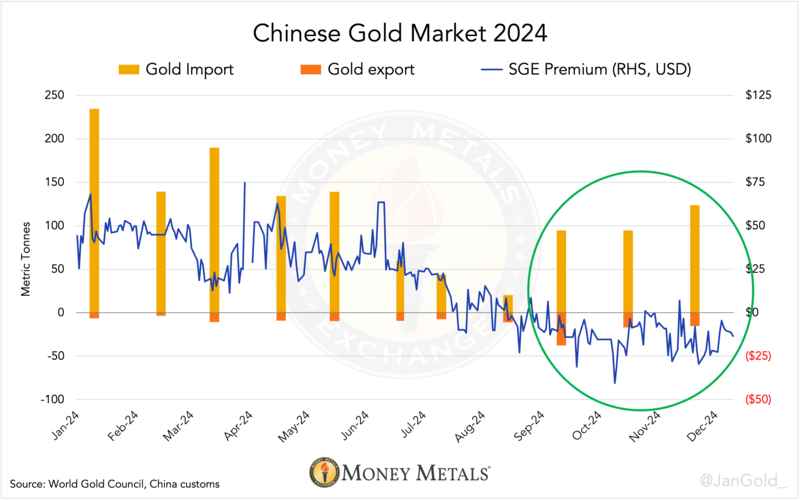
My findings became more evident when in September the premium on the Shanghai Gold Exchange (SGE) turned negative, but Chinese gross imports accounted for a sturdy 95 tonnes for the month.
It makes no economic sense for any bullion bank to buy gold abroad and sell at a loss at the SGE. The 60 tonnes (in 400-ounce bars) exported in September from the London Bullion Market to China went to the vaults of the PBoC in Beijing, I therefore concluded.
The PBoC Keeps Up the Pace, Buying 55 Tonnes in October
…we can see that in October, the SGE was trading at a discount while imports reached 95 tonnes, which was the same as in the prior month. I strongly suspect the PBoC was secretly buying gold in London again.
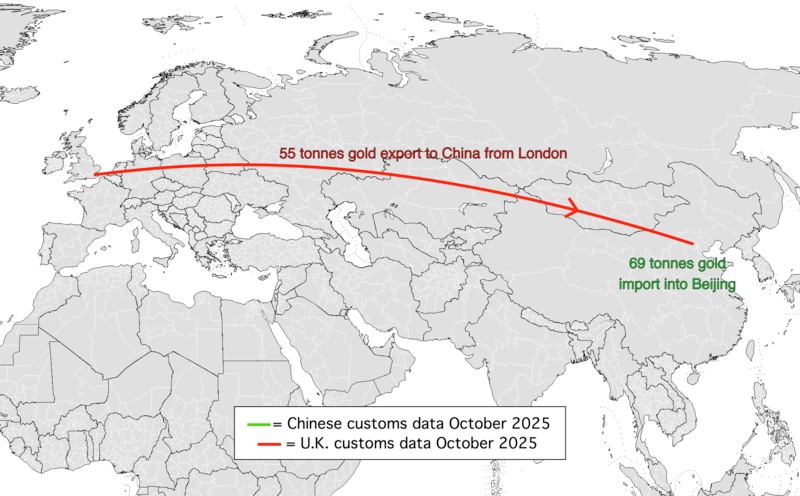
Recent data by Her Majesty’s Revenue & Customs (HMRC)—Britain’s tax, payments and customs authority—reveal 55 tonnes were indeed dispatched from the London region to China in October.
Graph 2. Courtesy of Wikimedia for the map.
Meanwhile, it’s likely the PBoC also bought gold elsewhere. Total imports into the Beijing region accounted for 69 tonnes in October, as per General Administration of Customs People’s Republic of China. That’s 14 tonnes more than what was shipped from London.
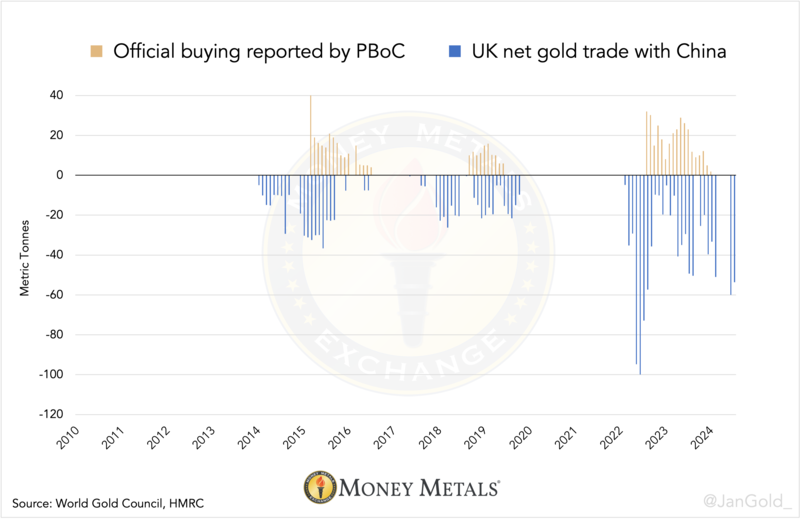
An illustration I shared previously is a chart of the PBoC’s publicly disclosed gold purchases versus U.K. gold exports to China. The chart shows both are loosely correlated “although the PBoC usually takes up to a year to publicly report its acquisitions and keeps about 65% of it hidden” (quote from my article from November 26, 2025).
Chart 3. The PBoC’s publicly disclosed gold purchases versus U.K. gold exports to China that serve as a proxy for covert buying by the Chinese central bank.
Only two months after September (when the PBoC covertly resumed buying in London), it revealed to the world it bought a mere 5 tonnes in November. Even this fraction of the truth boosted sentiment in the gold market. Go figure.
The Chinese central bank is currently buying at least ten times more gold than what you read in the newspaper, and yet markets got excited based on mere breadcrumbs!
Goldman Sachs Writes on PBoC Gold Buying in London
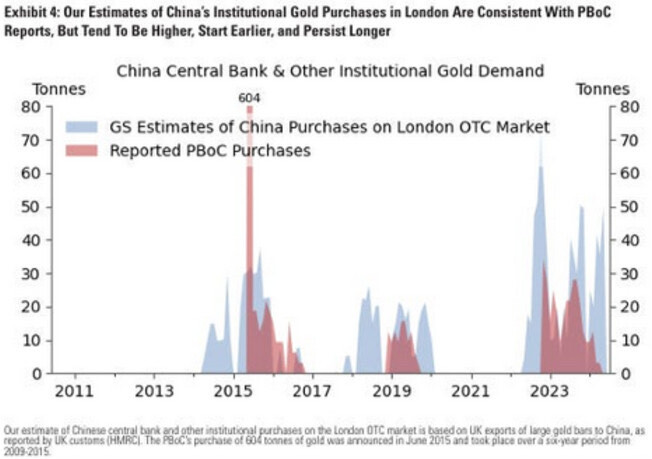
Meanwhile, my research is gaining traction as it was picked up by Goldman Sachs (GS). Below you can see a chart by GS displaying what I first demonstrated in July, but with a different design.
Chart 4. Courtesy of Goldman Sachs.
At the bottom it reads “our estimate of Chinese central bank … purchases on the London OTC market is based on UK exports of large bars to China, as reported by UK customs (HMRC).” (Parroting my own conclusion.) Eventually other media will start writing about these huge purchases as well.
For me, this topic reminds me of my early work analyzing SGE withdrawals. In 2013, I began spotlighting the volumes of gold withdrawn from SGE vaults, documenting why that is a proxy for Chinese wholesale demand. By implication, gold demand in China at the time was twice what consultancy firms stated. A few years later, nobody argued about the meaning of SGE withdrawals anymore.
Gold’s Role in the International Monetary System Will Increase
In November, gold on the SGE was still trading at a discount, yet Chinese gross gold imports swelled to 122 tonnes. No doubt the PBoC struck big in the London Bullion Market once again.
Chart 5. The Chinese central bank orders gold abroad at bullion banks and outsources transport to Beijing to those banks, making them have to register the metal at customs.
My latest estimate of the PBoC’s true gold holdings is roughly 5,000 tonnes, a number that is in stark contrast to what the Chinese divulge to the IMF, i.e. 2,271 tonnes. (I will substantiate my estimate in a follow up article.)
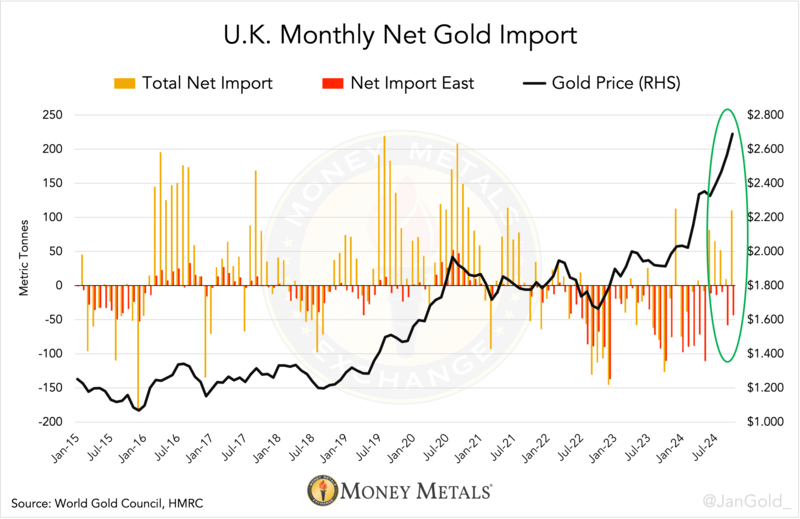
Tellingly, it seems some large investors in the West are sniffing out the momentous developments in the gold market. Although the U.K. was a gross exporter of 55 tonnes to China in October, the U.K. itself net imported 110 tonnes.
Who bought? Most likely institutional money as ETF holdings stored in London increased by only 18 tonnes, according to statistics compiled by friend and data wrangler Nick Laird from GoldChartsRUs.com.
Chart 6. Western institutional money must be buying gold too, because London inflows are substantial. As an aside, HMRC’s numbers show mostly mining countries exported to the U.K. (Australia, Canada, Kazakhstan, South Africa, United States, Uzbekistan), next to Germany, Singapore, and Switzerland.
These are exciting times indeed for gold.
China’s monetary authority doesn’t buy gold for no reason at a pace of approximately 60 tonnes a month from Great Britain alone—now 1,000 tonnes in total since the war in Ukraine. The Chinese obviously see a greater role for gold in the international monetary system going forward.
Over the same 30-month period, the value of China’s holdings of U.S. Treasuries has declined by $250 billion.
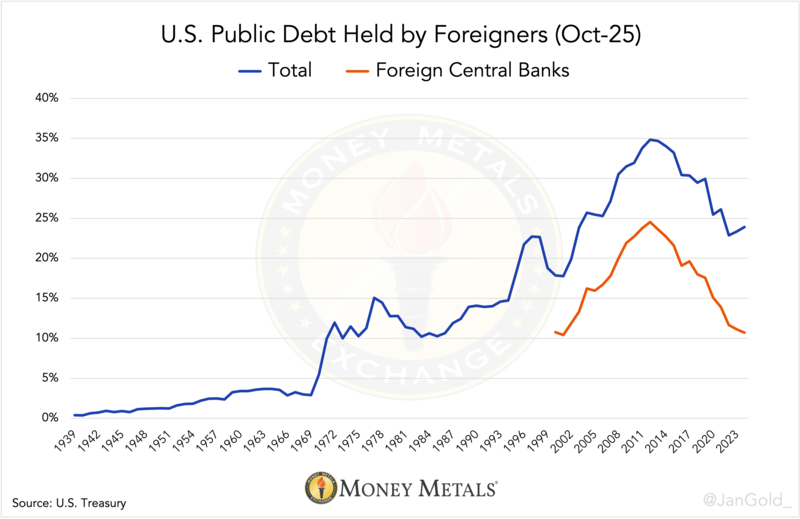
What we’re witnessing a shift from “dollar recycling“—the status quo from 1971 through 2021—to “gold recycling.” Instead of investing trade surpluses in dollars, countries are increasingly choosing for gold.
As a result, less and less of the U.S. its excessive public debt (122% of GDP) is financed by foreigners, let alone foreign central banks. This forces Treasury to either reduce the fiscal deficit (currently 6% of GDP, good luck!), pay higher interest rates and accelerate the debt spiral, or print its way out of this through inflation.
In addition to dollar weaponization, the (global) debt overhang is a motive for central banks to increase their gold reserves, as historically inflation is the most common big way of restructuring debts.
(Brien Lundin, Money Metals News Service) Gold is closing out an extraordinary year, one which marked the start of a new bull market.
More importantly, this bull market seems likely to go on much longer and much higher, thanks to a few fundamental forces and irreversible trends.
It’s been a helluva year for gold.
In the early days of this bull market…way, way back in March…I reported in these pages how fortunate we were to have an unprecedented mix of buyers for gold.
The mix included central banks, with furious buying from the People’s Bank of China in particular, along with strong demand from Chinese citizens as their equity and real estate markets tanked.
It was something we’d never seen before in the history of gold as an investible asset. Not only were these buyers acquiring gold aggressively, they also didn’t seem to care much about the price. If anything, they were buying more as the price rose.
The one thing we didn’t have in the market were the Western investors.
“Be Careful What You Wish For…”
The saying “Be careful what you ask for — you might just get it, good and hard!” is often attributed to legendary journalist and curmudgeon H.L. Mencken, but the underlying sentiment actually predates the pundit by a couple of millennia, having originated with Aesop’s fables circa 250 BC.
No matter where it came from, it rings true — as gold bugs learned this year.
As the gold price rose relentlessly in March and well into April, I was among those predicting that Western buyers would turbocharge the gold rally once they got onboard.
I also warned, however, that we had become spoiled by the price-insensitive central banks and that the trading-oriented Western investors would bring a lot more volatility to the uptrend when they arrived.
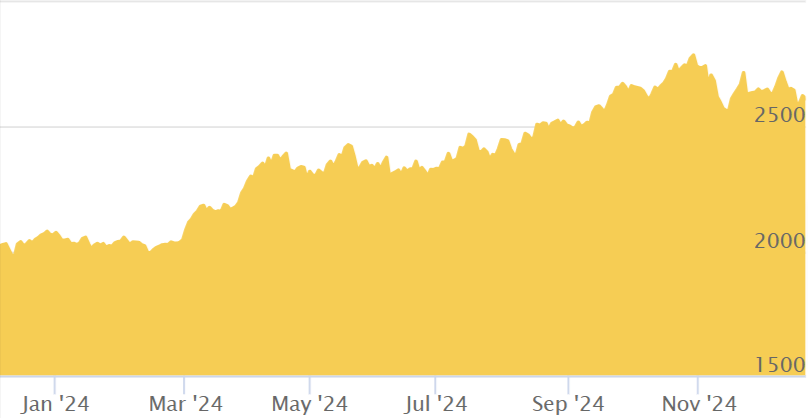
Well, as you can see from the accompanying one-year chart of the gold price, we got the turbocharged gold market we wished for… and then got all the volatility we feared, good and hard.
Much of this year was spent in anticipation of the Fed’s pivot to rate cuts. In fact, last December the market was expecting as many as seven rate cuts in 2024, with the first coming early in the year.
As the year progressed, though, those hopes were repeatedly dashed as Powell & Co. kept postponing the pivot. It wasn’t until mid-summer that they began signaling that the long-awaited rate cuts were near, and not until their September meeting that they actually pulled the trigger.
As part of their pricing of markets in anticipation, those infamous Western traders started buying gold in earnest in July, as evidenced by the year’s first inflows into the GLD gold ETF in that month.
That gold-price surge from July to October that you can see above reflects the impact of the Western traders as they eagerly built long gold positions and started dipping their collective toes into mining equities.
We enjoyed that run higher, but then came the volatility.
It actually started in late October, as traders played with the market as the month-end options expiry approached. It accelerated, however, immediately after Trump’s election victory, with the manipulators using the Bitcoin-bullish result as a perceived threat against gold.
That strange bit of logic was used as a fulcrum for leveraged short positions, forcing the gold price lower and taking out sell-stop after sell-stop.
The result: Instead of bursting through the $2,800 level, gold was shoved down to the $2,600s.
As you can also see from the chart above, the metal has been recovering from that take down in halting fashion.
Even as the price rebounded, the attacks continued, with the paper gold speculators sometimes using signs of peace breaking out in the Middle East as flimsy rationales for selling gold.
I thought we might have finally broken out for good in the last bounce to the $2,750 range, even telling my Alert readers that this had all the earmarks of the typical year-end to new year rally…although also warning that we’d been bitten before over the years by early-December surges that quickly faded away.
It looks like this was one of those false moves, with a couple of bear attacks late last week — including the market-wide sell-off predicted in our year-end issue of Gold Newsletter — providing yet another setback.
So where does this leave us?
Frankly, I still expect an imminent rebound and rally in gold, whether that begins in the few remaining days of this year or in the early days of the next.
My optimism is based partly on seasonality patterns as well as the return of central banks to the gold market…but primarily upon the intractable debt trap that the Fed is now in.
I explained a bit about this in our issue last week, and have been covering it in detail for years. The bottom line is that the Federal Reserve is facing increasing pressure to cut rates because neither Uncle Sam nor corporate America can afford to service their massive debt loads at current interest levels.
Yet this growing financing risk is being sensed by investors, who are driving rates higher in response. And this in turn makes the Fed even more desperate to lower rates.
The end result will be the Fed losing control…or a recession that forces them to impose emergency cuts…or both. And gold will be the big winner.
Obviously, there’s a lot more to this than I can relate here. The good news, as I told you last week, is that my full insights, as well as those of many of the world’s top experts, are available to you now:
The Single Best Value in Investing
Last Tuesday, we delivered the single best value in investment publishing to our readers of Gold Newsletter.
It was our blockbuster year-end issue packed with 87-pages of invaluable investing intelligence. It presented not only my latest market outlook, but also coverage of dozens of today’s top junior resource stocks (including three red-hot new recommendations) and comprehensive highlights from our recent New Orleans Investment Conference.
My comments above were taken from my opening article in that year-end Gold Newsletter. But I went much deeper into the issues, risks and opportunities now facing us.
For example, consider what I wrote in my opening article on Tuesday — notably, the day before the big sell off in the markets on Wednesday:
“…that valuations of equities and other assets are getting stretched to the point where a very significant correction, if not a full-blown crash, seems both inevitable and imminent. When that happens, we need to understand that gold will get hit hard along with everything else…but gold is also positioned as no other asset to benefit from the inevitable flood of liquidity from central banks.”
Bottom line, between my market comments and the insights of dozens of today’s top experts featured in this issue, our year-end edition of Gold Newsletter is the single best guide for the uncertain days ahead.
Once again, you have a special opportunity to purchase this single issue — jam packed with value — at the special low price of just $29.95.
And if you wish to subscribe for a year — or access our special alert service — just click here.
The Best of the Season to You and Yours!
Finally, as we close out this remarkable year, please accept my sincerest wishes for the best of the season.
It’s been a good start for gold, and while we’re hopeful that the mining sector will finally respond in the months ahead, we most importantly wish that the new year brings you and your loved ones happiness and health.
All the best,
Brien Lundin
Publisher, Gold Newsletter
CEO, the New Orleans Investment Conference
To get Brien Lundin’s ongoing commentary on the markets at no charge, click here to subscribe to his free Golden Opportunities newsletter.