Singer Pink Shouts Out ‘Every Other Gender that Absolutely Exists’ While at a Benefit for the Calif. Fires

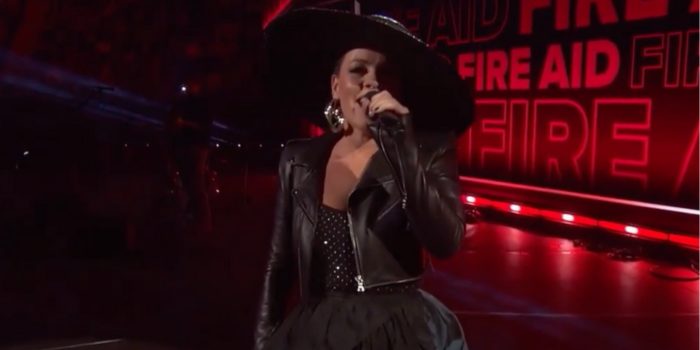
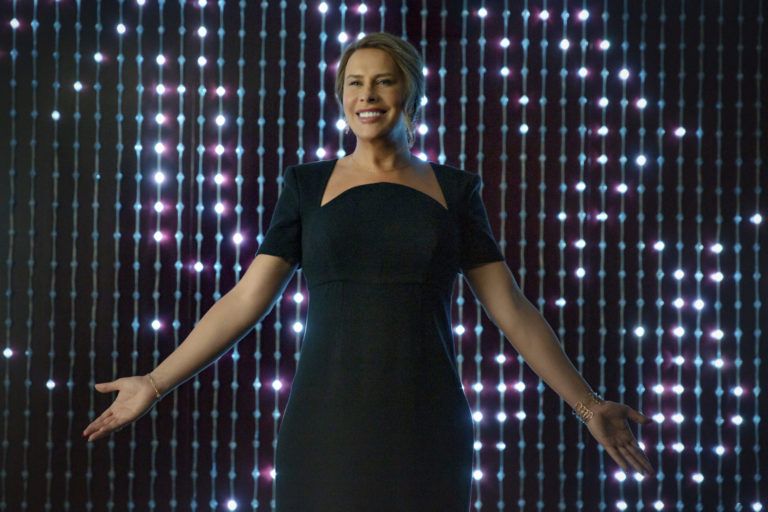
(Maire Clayton, Headline USA) Singer Pink decided to bring woke ideology into a benefit that was put on Thursday to help aid the devastation that occurred with the Los Angeles wildfires.

The singer was introducing John Mayer when she decided to insert politics into the mainly apolitical event.

“Ladies and gentleman and ever other gender that absolutely does exist,” Pink said.

She quickly was blasted on social media regarding the statement.

“She is demonstrating that she is mentall ill,” one user wrote. “Don’t let your children go to one of her concerts.”

Others lampooned the “Just Give Me a Reason” singer for not reading the room.

“Because clearly, what wildfire survivors need is a lecture on gender,” another user noted. “Bravo, Pink, for focusing on what absolutely does NOT exist or matter.”

Some users were more explicative with their reaction to the clip.

“You’re a f**king idiot, ⁦@Pink⁩. There are only two genders. Same as ALWAYS,” one user wrote. “It’s DELUSIONAL and MADNESS to believe otherwise. In five years people are going to shame you with that clip.”

The gender debate ramped up Friday as President Donald Trump announced federal employees would need to remove pronouns from their email signatures by the end of the day, according to ABC News.

The FireAid concerts took place at the Intuit Dome and the Kia Forum. The event lasted roughly five hours and featured over 20 artists.

The list included Billie Eilish, the Red Hot Chili Peppers, Dr. Dre and Katy Perry.

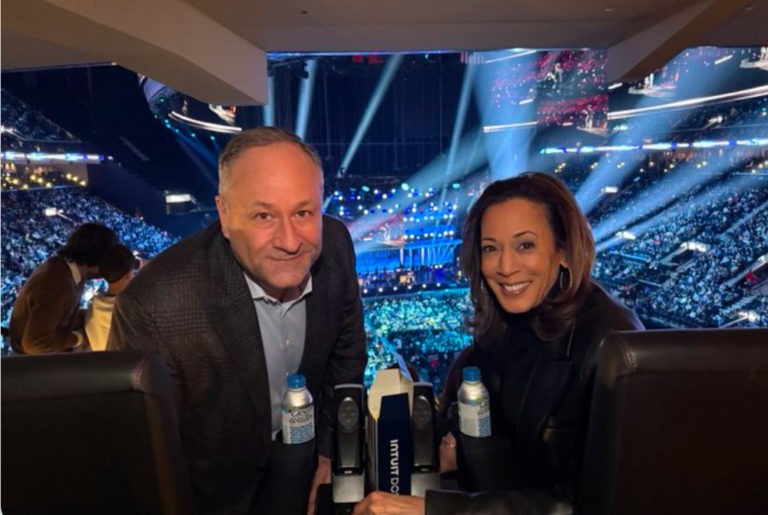
Former Vice President Kamala Harris and her husband Doug Emhoff were also in attendance for the event. She received a round of applause in the Democrat stronghold city.

“Thank you to the artists who gathered tonight in Los Angeles for the FireAid Concert,” she wrote after the event. “Angelenos will continue to stand together to support those impacted by the wildfires and show gratitude for the first responders who help keep our communities safe.”

Ex-Federal Reserve Adviser Charged w/ Stealing Trade Secrets for China

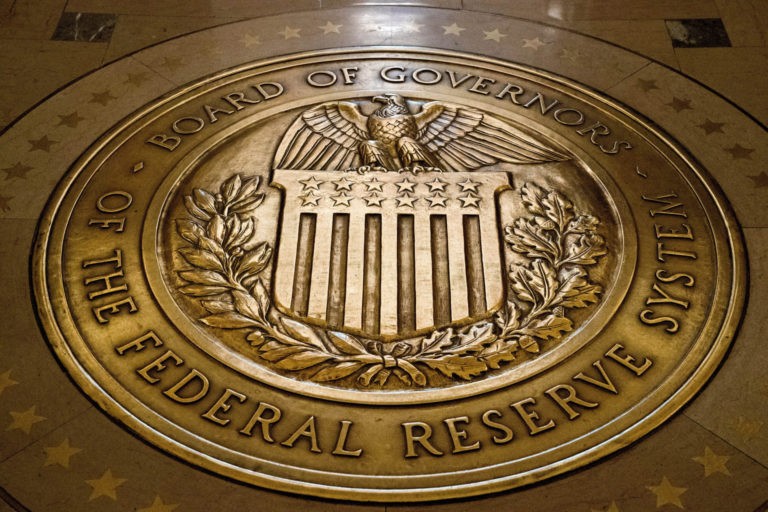
(Ken Silva, Headline USA) The Justice Department announced Friday that a former senior adviser for the Federal Reserve Board of Governors has been indicted for allegedly conspiring to steal trade secrets for the People’s Republic of China.

The ex-Fed official, John Harold Rogers, 63, of Vienna, Virginia, was arrested on Friday, the same day the indictment was unsealed. According to the Justice Department, Rogers a U.S. citizen with a Ph.D. in economics, worked as a senior adviser in the Federal Reserve’s Division of International Finance from 2010 until 2021—giving him access to confidential financial information.

The DOJ alleged that Rogers shared that information with Chinese intelligence agents. Specifically, Rogers gave them info that could allow China to manipulate the U.S. market, in a manner similar to insider trading, according to the DOJ.

“Rogers allegedly exploited his employment with the FRB by soliciting trade-secret information regarding proprietary economic data sets, deliberations about tariffs targeting China, briefing books for designated governors, and sensitive information about Federal Open Market Committee (FOMC) deliberations and forthcoming announcements,” the DOJ said in a press release.

“He passed that information electronically to his personal email account, in violation of FRB policy, or printed it prior to traveling to China, in preparation for meetings with his co-conspirators.”

Rogers was paid about $450,000 as a part-time professor at a Chinese university, the DOJ added.

Rogers was interviewed in 2020 by the Office of the Inspector General for the Federal Reserve Board about his dealings with China. During that interview, he allegedly lied about his accessing and passage of sensitive information and his associations with his co-conspirators.

Rogers was charged with conspiracy to commit economic espionage and with making false statements. He faces a maximum statutory penalty of 15 years in prison, and a maximum fine of $5 million. He also faces five years for making false statements to the Federal Reserve Board Office of Inspector General.

U.S. Attorney Edward R. Martin, Jr., said the case against Rogers should send a stark warning to any government official thinking about doing business with the enemy.

“President Trump tasks us with protecting our fellow Americans from all enemies, foreign and domestic. As alleged in the indictment, this defendant leveraged his position within the Federal Reserve to pass sensitive financial information to the Chinese government, a designated foreign adversary,” Martin said. “Let this indictment serve as a warning to all who seek to betray or exploit the United States: law enforcement will find you and hold you accountable.”

Ken Silva is a staff writer at Headline USA. Follow him at x.com/jd_cashless.

Former ‘Meet the Press’ Moderator Chuck Todd Exits NBC News after Nearly Two Decades

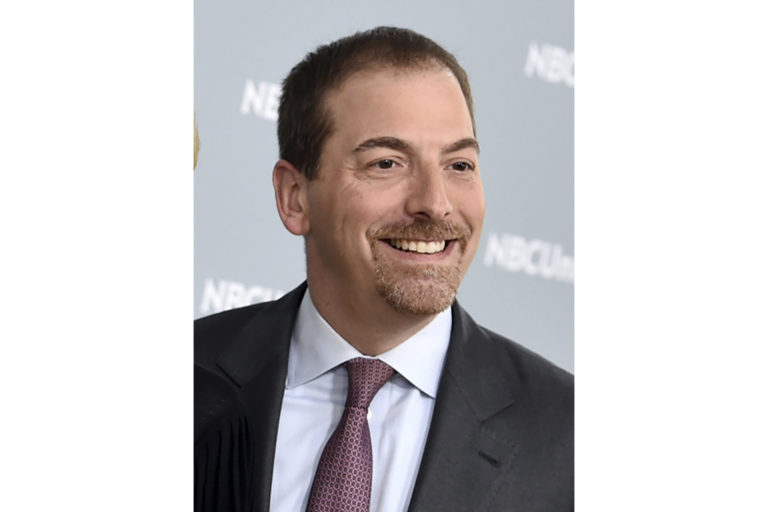
(Headline USA) Former Meet the Press moderator Chuck Todd is leaving NBC News after nearly 18 years at the network.

Todd said in a memo to NBC News colleagues that Friday was his last day. He’ll continue doing his podcast and said he’s considering new projects, but offered no details.

He joined NBC News as political director in 2007 and was “Meet the Press” moderator from 2014 to 2023, before giving way to Kristen Welker. The role made him one of the more visible journalists in Washington and, as such, an occasional target of President Donald Trump and his supporters.

Todd was a leader in the on-air protest last year that scuttled the hiring of former Republican Party chair Ronna McDaniel as an NBC News contributor.

In his memo to colleagues, Todd said the news media has much work to do in winning back the trust of consumers, “and I’m convinced the best place to start is from the bottom up” with entrepreneurship.

“National media can’t win trust back without having a robust partner locally and trying to game algorithms is no way to inform and report,” he wrote. “People are craving community and that’s something national media or the major social media companies can’t do as well as local media.”

Reporting is key to winning back public support, he said. “If you do this job seeking popularity, or to simply be an activist,” he said, “you are doing this job incorrectly.”

Adapted from reporting by the Associated Press

Epstein Pitched Big Bank CEO to Become Next Treasury Sec., New Records Show

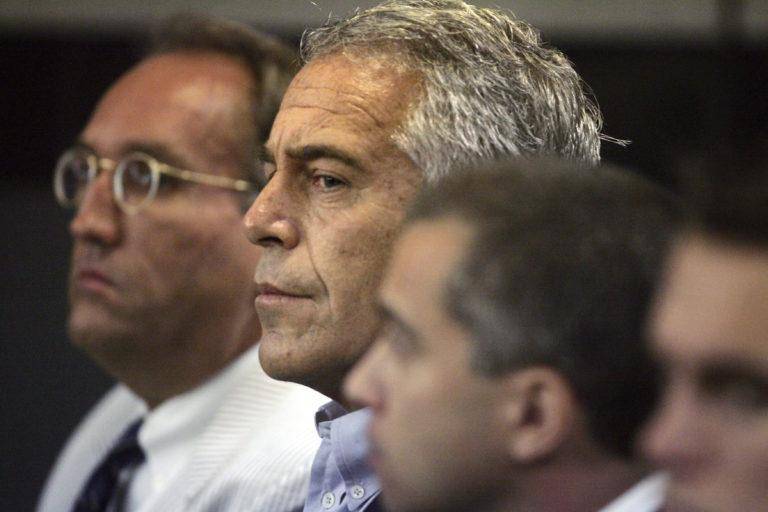
(Ken Silva, Headline USA) The UK Financial Conduct Authority filed explosive new records Friday in a dispute with former Barclays CEO Jes Staley, revealing that Staley’s relationship with deceased sex trafficker Jeffrey Epstein ran deeper than he previously disclosed.

The UK FCA’s filings were made in a long-running dispute with Staley, who was banned in 2023 from holding senior positions in the UK financial services industry. Staley appealed that ruling and will have his hearing in March.

The FCA has argued that Staley misled both Barclays and regulators about the nature of his relationship with Epstein—and the records filed Friday go a long way in telling that story.

According to the Wall Street Journal, the records filed show that Staley considered Epstein a “deep friend,” even after Epstein was convicted of sex crimes against juveniles in 2009. In fact, when Epstein’s brief jail stint was over in July 2009, Staley wrote him the following email: “I toast your courage!!!!”

Later that year, Staley again wrote to Epstein: “I owe you much. And I deeply appreciate our friendship. I have few so profound.”

Over the next 10 years, Staley maintained his relationship with Epstein, visiting his private Caribbean island in 2015.

“Thanks for the flight and thanks for the lunch. Your place is crazy, and special. It has a warmth and silliness that makes it yours. I count u as a deep friend,” Staley wrote in an email to Epstein, according to the Journal.

Furthermore, Staley often used his daughter, Alexa Staley, as an intermediary to conceal their relationship, the Journal reported Friday.

In the fall of 2016, Epstein emailed Alexis to offer his father a potential gig as U.S. Treasury Secretary.

“Spoke with him. He said not yet, but thanks,” Alexa reportedly replied.

It’s unclear whether this was after Donald Trump won the election that year, as the Journal didn’t disclose the exact date. Trump and Epstein were once considered friends, but they had a falling out in 2004 over a bidding war for a mansion near Mar-a-Lago. Trump also kicked Epstein out of Mar-a-Lago in 2007 for harassing the daughter of a member there.

Additionally, disgraced author Michael Wolff reported last November that Epstein was “afraid” of Trump up until his final days, when he died in prison.

According to Wolff, Epstein believed that Trump caused him to be initially investigated by law enforcement in 2005 after the two had a fight over the property near Mar-a-Lago—an allegation that, if true, could arguably be seen as a heroic move by Trump, regardless of his motives.

Ken Silva is a staff writer at Headline USA. Follow him at x.com/jd_cashless.

Whoops: Transgender Oscar Darling Turns Out to Be Outspoken Xenophobe

(Ben Sellers, Headline USA) With its wokest array of nominees yet, this year’s Oscars all but assured that any gradual ratings gains they had clawed back since the disasterous 2021 COVID season would go down the drain like the Hershey’s chocolate syrup used in Alfred Hitchcock’s iconic Psycho shower scene.

Once again, however, the Academy of Motion Picture Arts and Sciences has shot itself in the foot while playing the dangerous game of identity politics.

On Thursday, Karla Sofía Gascón—the transgender star of the top-nominated Emilia Pérez, who made movie history as the first biological male to compete in the “best actress” category—was found to have made old posts on social media that violated the Left’s dogma in the most unforgivable ways possible.

Gascón (whose “dead name” is Juan Carlos) transitioned in 2018.

The 52-year-old native of Alcobendas, Spain, might have had a date with destiny when the Oscars opted to change their standard regarding men portraying women—after potentially robbing “best actress” contenders like Jack Lemmon and Tony Curtis in Some Like It Hot, Dustin Hoffman in Tootsie and Robin Williams in Mrs. Doubtfire of their much-deserved statuettes.

Unfortunately for Gascón, a recent public-relations fiasco may deny the trans community its due, as the New York Post‘s Page Six reported.

The problem isn’t that Hollywood fears the backlash from foisting the LGBT agenda onto an audience that has little appetite for it. Rather, it is that Gascón stepped outside of the intersectionality pecking order with a series of controversial tweets spanning a period of roughly seven years.

Ironically, some might argue that all the trans actor did was speak the truth.

“I’m sorry, Is it just my impression or is there more muslims in Spain?” Gascón wrote in one 2020 Twitter post translated from its original Spanish into English.

“Every time I go to pick up my daughter from school there are more women with their hair covered and their skirts down to their heels,” Gascón continued. “Next year instead of English we’ll have to teach Arabic.”

Several of the newly resurfaced tweets took aim at the Muslim community—whom Gascón referred to as an “infection for humanity that urgently needs to be cured”—and also the black community, sometimes within the same tweet.

“Let me get this straight: if you say that the f**king moors are back killing them, that’s racism, but if a Libyan terrorist starts stabbing white people in a park in England, that’s justice for oppression,” Gascón wrote. “The greatest backwardness in rights is in Islam.”

The Oscar nominee’s controversial posts, unearthed by Canadian journalist Sarah Hagi, were dated from 2016 to 2023, even as others were seeing their careers destroyed for the mildest hint of skepticism directed at the now-discredited Black Lives Matter movement.

Gascón, however, fearlessly weighed in on the death of George Floyd, adding a unique take on the real reasons why the BLM martyr had resonated so intensely with left-wing activists seeking to sow civil disorder.

“I really think that very few people ever cared about George Floyd, a drug addict swindler, but his death has served to once again demonstrate that there are people who still consider black people to be monkeys Without rights and consider policemen to be assassins,” Gascón wrote. “They’re all wrong.”

The scandal launched a desperate damage-control operation from Netflix, the company behind Emilia Pérez, which was poised to lose out bigtime by the backlash if Academy voters took it out on the entire project. Including the best actress nod for Gascón, the film’s 13 nominations came up just short of the record of 14 held by Titanic, La La Land and All About Eve.

“I want to acknowledge the conversation around my past social media posts that have caused hurt,” Gascón said in a follow-up apology.

“As someone in a marginalized community, I know this suffering all too well and I am deeply sorry to those I have caused pain,” added the actor, who was not technically marginalized when the first tweets were posted. “All my life I have fought for a better world. I believe light will always triumph over darkness.”

While the PR Dumpster fire is unlikely to lure conservatives into sitting through the insufferable Oscar ceremony, it could make things more interesting, particularly if outraged Muslims launch their own red-carpet protests mirroring the pro-Hamas disorder that consumed many college campuses last year.

The double victory of having a biological male and raging xenophobe beat out four woke actresses in the ultimate showcase of Hollywood’s out-of-touch irrelevance might make an interesting contest yet out of what otherwise promised to be a clunker of a ceremony.

Ben Sellers is the editor of Headline USA. Follow him at x.com/realbensellers.

Kamala Harris Soaks Up Spotlight at Star-Studded Concert for California Fires

(Julianna Frieman, Headline USA) Former Vice President Kamala Harris soaked up the spotlight Thursday night in the audience at the star-studded FireAid concerts raising money for California after large swathes of the state burned down.

Harris found celebrity status from a box seat at the Intuit Dome, where she received loud cheers from concert-goers in the Democrat stronghold of Los Angeles.

She and her husband, Doug Emhoff, were caught on video at the event where performers including Billie Eilish, the Red Hot Chili Peppers, Dr. Dre and Katy Perry took the stage, according to Deadline.

Leftist social media users celebrated Harris’s appearance at the benefit concert, and some audience members shared on social media that the former vice president was seated close to them.

Emhoff posted a photo of himself and Harris attending the concert.

The Democrat duo smiled in front of a background of the concert’s bright blue lights, and they each had a bottle of expensive Open Water in their cup holders.

“Kamala and I are grateful to be at the FireAid concert tonight in our hometown of Los Angeles. It is a wonderful night that shows the strength and resilience of our city as we begin to recover and rebuild from the devastating wildfires,” Emhoff wrote on X.

Harris made her own post on top of her husband’s message, thanking the musicians who performed at the concert.

“Thank you to the artists who gathered tonight in Los Angeles for the FireAid Concert,” Harris wrote. “Angelenos will continue to stand together to support those impacted by the wildfires and show gratitude for the first responders who help keep our communities safe.”

Other FireAid performers included the following: Earth, Wind & Fire, Gracie Abrams, Jelly Roll, Lady Gaga, Lil Baby, Olivia Rodrigo, Stevie Wonder, Rod Stewart, P!nk and Green Day, Deadline reported.

While pop stars Taylor Swift and Beyonce did not perform at FireAid, they both donated to California wildlife relief efforts. Both women endorsed Harris during her celebrity-reliant campaign, but neither opted to put on a concert to generate support for failed presidential candidate.

Julianna Frieman is a freelance writer published by Headline USA, the Daily Caller, The Federalist, and the American Spectator. Follow her on Twitter at @JuliannaFrieman.

Is the London Gold Shortage Just a Tariff Scare… or Something More?

(Chris Powell, Money Metals News Service) If reports this week are correct — there is a severe shortage of gold — the metallic kind rather than the paper kind — in the London market, caused by the desire of bullion banks to ship a lot of metal to the United States before President Trump imposes tariffs on imports of the monetary metals.

There are several problems with this scenario.

First is that gold is not a commodity or consumer good, the things Trump has been talking about subjecting to tariffs, but money in its highest form. Trump wants money to come to the United States for investment and purchase of U.S. production. Tariffs on imports of money make no sense.

If, as seems likely, the U.S. government has gold loan and swap obligations to meet, it would have another reason not to impede imports of monetary metal.

The second problem with the tariff scare scenario is that U.S. bullion banks and traders lately have had no trouble using New York Commodities Exchange futures contracts to obtain gold in London via the “exchange for physical” and “exchange for risk” mechanisms of fulfilling futures obligations. The bullion banks do gold business in both cities and gold can be sold for cash in London and the cash wired back to the United States.

Third, the reports say the Bank of England has been desperately lending metal from its vaults — presumably its own metal and the metal of other central banks — to help the bullion banks get metal for shipping to New York. But typically gold lending is a paper transaction in which IOUs, not actual metal, change hands. The IOUs are treated as the real thing but ordinarily the underlying metal never leaves the vault.

For several years gold’s big trend in central banking has been the repatriation of metal out of London and New York as nations don’t want to risk having their foreign-exchange assets frozen or confiscated by the United States or its allies. What central banks vaulting gold at the Bank of England these days would be giving permission for their metal to be moved even more distant from their control?

These considerations suggest another explanation for the gold shortage in London.

That is, what if the tariff panic stories are just more disinformation?

After all, both the Financial Times and Reuters reports were based on anonymous sources, precluding any accountability.

What if there really is just an ordinary shortage of gold? Or, to be more precise, what if there is a shortage of gold under U.S. and U.K. control relative to rising international demand for the safe-haven metal?

Meanwhile, news reports and research by Jan Nieuwenhuijs of Money Metals Exchange and others — even the feckless World Gold Council — have long been telling of rising demand for metal, particularly in Asia. Russia, China, and the BRICS countries have been openly contemplating building gold into a new international trade currency system to escape from the seemingly infinite financial derivatives with which the United States has been rigging markets and creating infinite imaginary supplies of gold and silver.

These countries may not be seeking to destroy the U.S. dollar but they are looking for a hedge against it.

If the fraudulent, derivatives-based Western gold market was breaking down at last, would it look much different than the situation reported in London this week?

And if gold were to be revalued by agreement among the major central banks — including the big recent acquirers of the metal — mightn’t revaluation be precipitated by a shortage of the metal in a major market?

Your secretary/treasurer long has thought that a revaluation would have to be accomplished in a flash — that is, on a Sunday night before the Asian markets opened — and that all major central banks would have to be participating in it. Nieuwenhuijs has produced evidence of official preparations for revaluation.

The record of central bank involvement in gold since the United States repudiated the Bretton Woods gold exchange standard in 1971 shows central banks striving to prevent the gold market from getting ahead of them — that is, to prevent a genuinely free market in the monetary metal from developing at all:

But lately gold does seem to have been getting ahead of them, rising about 35% in dollar terms over the past year, and more in other currencies.

Meanwhile, government and private debt has exploded in the United States, China, and other nations. China may already be in a depression.

Devaluing currencies is what governments do to inflate away debt.

The economists Paul Brodsky and Lee Quaintance hypothesized 13 years ago that central banks already were planning redistribution of official gold reserves as the prerequisite for devaluing their currencies, inflating their debts away, and coming out ahead with gold revaluation:

London metals trader Andrew Maguire has presented gold price charts suggesting that a revaluation has been underway in the open for many months now, with steady “stair step” increases in price, not the “disorderly” increases central bankers are said to hate, perhaps because they also hate free markets generally and free markets aren’t free if they aren’t sometimes “disorderly.” The stairsteps charted by Maguire indicate steady price management by central banks.

If the unidentified sources in this week’s FT and Reuters reports are telling the truth, the Bank of England has been trying desperately to keep managing the gold price by leasing large amounts of metal, which would be an indication that the central banks aren’t quite ready for revaluation. Of course, maybe they’re only waiting for this Sunday night, or next.

Maybe they need a little more time for their bullion bank brokers to cover any remaining short positions so there will be no need for another messy bailout mechanism like the Bank of England’s gold sales in 1999, which brought great suspicion to the bank and prompted complaints of gold market manipulation.

In any case, the bank’s reported intervention via gold leasing this week was a proclamation that the bank and probably the Federal Reserve and U.S. Treasury are still engaged in gold price suppression.

How dishonest do those who denied such suppression look now?


Chris Powell is a journalist in Connecticut, where he worked for the Journal Inquirer, a daily newspaper in Manchester, for 56 years, 44 of them as managing editor. He continues to write political columns for that paper and many others in the state. He frequently appears on talk radio programs on four Connecticut stations.

Powell is also secretary/treasurer of the Gold Anti-Trust Action Committee Inc. (GATA), which he co-founded in 1999 to expose and oppose the rigging of the gold market by Western central banks and their investment bank agents. He edits the GATA Dispatch, that organization’s daily electronic newsletter, and speaks on behalf of the organization at financial conferences in the United States and abroad.

He is a member of the Board of Directors of the Connecticut Council on Freedom of Information and was its state legislative chairman from 2004-2010.

Fifth Straight Significant Silver Supply Deficit Forecast for 2025

(Mike Maharrey, Money Metals News Service) The silver market is forecast to record a fifth straight market deficit in 2025, with demand once again outstripping supply.

Analysts at the Silver Institute call the projected market deficit “sizeable.”

The Silver Institute projects record silver offtake this year, with overall demand coming in at around 1.20 billion ounces.

Supply is expected to grow by 3 percent, but it won’t be nearly enough to feed growing demand. This will lead to a 149 million-ounce market deficit. While the gap between supply and demand will shrink by about 19 percent from last year’s level, it will remain “sizeable historically.”

This supply shortfall will have to be filled by existing stocks of above-ground metal, potentially driving prices higher.

Silver Demand in 2025

According to the Silver Institute, growing industrial and investment demand will be somewhat offset by sagging offtake in the jewelry and silverware sectors.

Industrial demand is expected to grow by another 3 percent coming off a record year in 2024. Continuing growth in the green energy sector – specifically solar energy applications – will continue to drive overall demand higher.

Policies implemented by the Trump administration will likely put pressure on renewable energy initiatives in the U.S., however, analysts at the Silver Institute still expect global photovoltaics installations to reach another all-time high in 2025.

The rapid growth of artificial intelligence (AI) will also fuel demand for silver.

Silver is a key component in circuit boards, semiconductors, and connectors and is vital in reducing electrical resistance and enhancing processing speeds in AI applications. AI also requires massive data centers that rely on advanced cooling systems and efficient electrical transmission. Silver is used in heat-dissipation materials and high-speed connectivity components in these big data centers.

Silver is also an important input in the automotive industry. Even assuming slower growth in battery electrical vehicle production, silver demand is expected to remain robust in this sector due to greater vehicle sophistication, electrification of powertrains (albeit at a reduced pace), and ongoing investment in expanding related infrastructure.

On the investment side of the coin, silver demand is expected to grow by around 3 percent due to increasing retail buying in the West. According to the Silver Institute, “As Western investors adjust to new price levels, fresh investment is expected to improve, and profit-taking will also ease.”

Analysts say there are several factors underpinning investment demand.

“Uncertainty over U.S. trade and foreign policy, record-high U.S. equities, and worries about U.S. public debt levels should all reinforce interest in portfolio diversification, which in turn will benefit silver and gold investment. Moreover, even if the pace of U.S. policy rate cuts slows in 2025, the consensus is still that they are coming. Coupled with sticky inflation, this points to potential declines in real rates ahead.”

Silver Institute analysts say that any kind of crisis could drive investment demand even higher.

Given the Federal Reserve is walking a monetary policy tightrope, and the economy has been distorted by decades of easy money policies, the likelihood of some kind of economic upheaval is elevated.

This is exacerbated by the fact that the central bank is caught in a Catch-22.

On the one hand, the Fed needs to keep rates elevated to address price inflation.

On the other hand, the debt-riddled bubble economy can’t function in a higher interest rate environment.

Clearly, the Fed can’t do both, meaning rising price inflation or an economic meltdown are in the cards. In the worst-case scenario, we could see a combination of both – stagflation.

The demand for jewelry and silverware is expected to soften in 2025, with jewelry fabrication declining by about 6 percent.

According to the Silver Institute, India will account for the bulk of the decline due to higher local prices. Chinese demand is also expected to drop due to “cautious spending by consumers on non-essential items.”

Silver Supply in 2025

On the supply side, silver mine production is expected to grow by 2 percent to a seven-year high of 844 million ounces, with increased output anticipated from both existing and new operations in several markets. But even with the surge in mine output, the silver mining sector faces structural challenges.

Silver mine output peaked in 2016 at 900 million ounces. Up until last year, silver production had dropped by an average of 1.4 percent each year. In 2023, mines produced 814 million ounces of silver.

According to Metals Focus, a combination of reserve depletion, mine closures, and a 20 percent drop in ore grades drove sagging mine output.

With prices rising, silver recycling is projected to increase by 5 percent, with volumes breaching 200 million ounces for the first time since 2012. According to the Silver Institute, “Industrial scrap will be the key growth driver, particularly changeouts in ethylene oxide catalysts. Jewelry and silverware recycling will also rise, reflecting India’s price-led gains.”

Silver Isn’t Priced for These Dynamics

While silver gained over 20 percent in 2024, many investors consider it a laggard because it remains far below its all-time high, even as gold continues to set new records. Given the supply and demand dynamics, there is the potential for silver to shine in 2025.

The gold-silver ratio is hovering at around 90-1, indicating that silver is on sale when priced in gold. Historically, when the ratio gets distorted to this degree, it tends to snap back to the mean with a vengeance as the silver price spikes to catch up.

And as already mentioned, there is the potential for economic chaos in the coming months.

Furthermore, as analyst Jesse Colombo explained, bearish investor sentiment on silver due to its perceived underperformance last year is bullish from a contrarian perspective.

When you add it all up, there are plenty of reasons to be bullish on silver and it appears at least some in the mainstream are picking up on these dynamics.


Mike Maharrey is a journalist and market analyst for MoneyMetals.com with over a decade of experience in precious metals. He holds a BS in accounting from the University of Kentucky and a BA in journalism from the University of South Florida.


Rapist Transgender Inmate to Plead Guilty to Sending Bombs to U.S. Gov’t

(Ken Silva, Headline USA) David Cassady, 55, a convicted violent rapist serving life behind bars at Phillips State Prison in Georgia, successfully sued the Georgia Department of Corrections last year to receive a taxpayer-funded sex change—a lawsuit supported by Biden’s Justice Department.

It’s not clear whether the sex change will still move forward now that Donald Trump is President, given Trump’s executive order to cease federally funded sex changes for prisoners. Cassady has yet to receive the operation, and his lawsuit is still an open case.

Either way, Cassady is also set to plead guilty to sending a bomb to the DOJ, the same agency that helped him win his sex-change lawsuit against the Georgia DOC. The DOJ notified a federal judge Wednesday that it has struck a plea deal with Cassady. The terms of the deal haven’t been disclosed.

Ironically, the DOJ filed a brief in support of Cassady’s lawsuit last January, while the inmate was under investigation for alleged bomb-making. Even more ironically, the inmate was under investigation for sending a bomb to 1400 New York Avenue NW in Washington, D.C.—a building that houses a DOJ office.

In other words, the DOJ filed an amicus brief in support of an inmate who apparently tried bombing the DOJ, according to the DOJ. To add a drop of stupidity, the DOJ refers to Cassady as a female in the sex-change litigation, but calls him a man in the bombing case.

Cassady was indicted last April on multiple federal charges for constructing and mailing bombs to federal facilities.

The DOJ declined to comment, while the non-profit groups representing the inmate haven’t responded to emails seeking comment. Georgia’s Department of Corrections also declined to comment, citing the pending litigation.

According to the DOJ’s indictment, Cassady’s bomb-making occurred from September 2019 to January 2020. He faces one count of making an unregistered destructive device, two counts of mailing a destructive device, and one count of attempted malicious use of an explosive.

When the indictment was unsealed in April, WSB-TV in Atlanta revealed that Cassady sent a bomb to the widow of a man he sexually assaulted as a teenager.

“How is somebody who is in prison for life, for horrific acts against the community, how is possible that he can still terrorize members of the community from behind bars?” the widow reportedly said. “And now somehow, he was able to access all of this and mail it out of prison. Somebody needs to look at the bigger picture of who he is.”

Cassady has pleaded not guilty to the charges, according to the court docket. The inmate is already serving a life sentence.

Cassady isn’t the only trans bomber to receive DOJ support in a sex-change lawsuit. As Headline USA exclusively documented in 2023, former neo-Nazi bank robber Pete/Donna Langan, who has ties to the Oklahoma City bombing, reached a settlement with the DOJ to become the first federal inmate in history to receive a sex change.

Ken Silva is a staff writer at Headline USA. Follow him at x.com/jd_cashless.

Gold & Silver Are Staging Powerful Breakouts

(Jesse Colombo, Money Metals News Service) Amid a global scramble for physical gold and silver, both metals are breaking out, signaling the start of the next powerful phase in their bull markets.

Many investors dismissed gold and silver after President Donald Trump’s victory in the November election. However, his first two weeks in office have proven exceptionally strong for both metals.

While sentiment toward precious metals had been at a low point in recent months, I’ve consistently argued that this pessimism was unwarranted—gold and silver were merely consolidating before resuming their bullish trajectory.

Now, with mounting evidence of a global rush for physical gold and silver, both metals are breaking out, signaling that the next phase of their bull markets is underway.

The big story this week centered on speculation over whether President Trump will impose tariffs on imported goods—and whether gold and silver will be affected.

The mere threat of tariffs has been roiling the precious metals market. Now, massive shipments of gold from London to New York in anticipation of potential tariffs threaten a bullion shortage in London, the world’s most important gold trading hub.

As this physical supply squeeze has become more known—contrasting sharply with the abundance of “paper” gold and silver—both metals have surged.

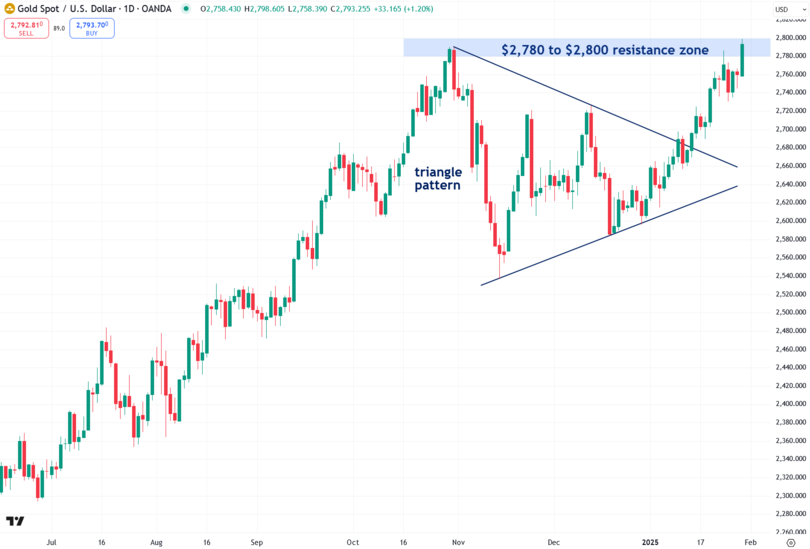
Let’s start with gold, which continues its strong rally. As I’ve emphasized, this breakout strongly suggests that gold’s 2024 bull market didn’t end with the early-November sell-off.

Instead, it is gaining momentum, likely extending well into 2025. In my view, gold is now on track to target $3,000, with the potential to reach the low-$3,000s relatively quickly.

The next key test for spot gold is a decisive close above the $2,780–$2,800 resistance zone that’s just overhead—an achievement that would confirm that the next phase of the bull market is officially underway.

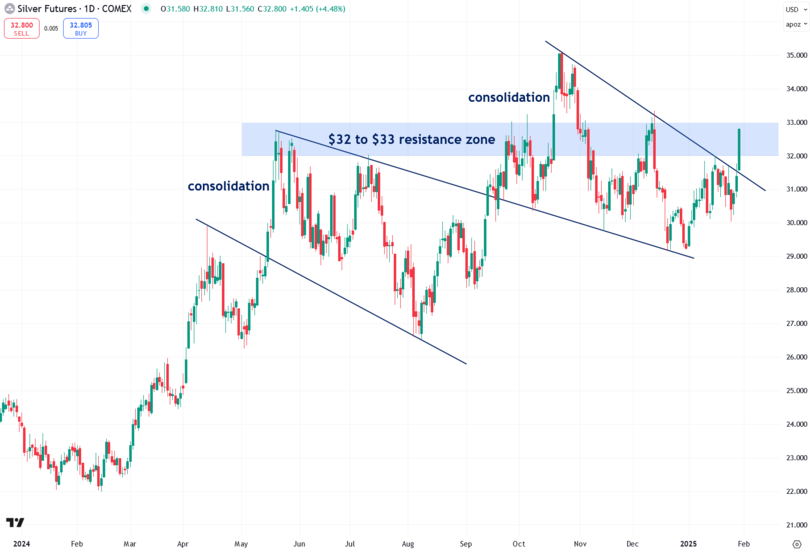
Silver is now rallying alongside gold. Yesterday, it broke out of the consolidation pattern it had been stuck in since October—a strong bullish signal.

For further confirmation of this breakout, I’m watching for COMEX silver futures to close decisively above the key $32–$33 resistance zone, which would reinforce the bullish momentum.

Silver’s bullish move this week isn’t surprising. As I noted last week, silver sentiment had hit its lowest point in years, reflected in the elevated short interest in the popular iShares Silver ETF (SLV).

According to contrarian logic, extreme pessimism often precedes a strong rally—making this breakout a textbook example of sentiment-driven reversals.

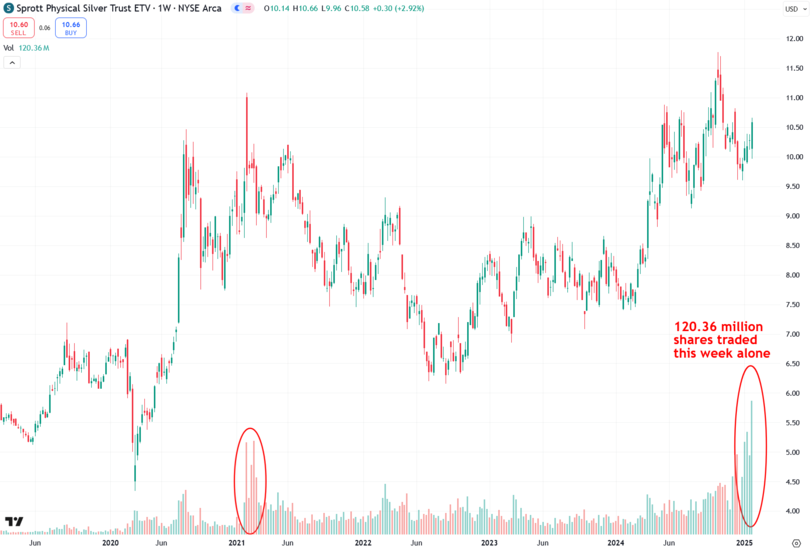
One particularly intriguing development amid the global scramble for physical gold and silver is the surge in trading activity in the Sprott Physical Silver Trust (PSLV).

Unlike most silver-tracking ETFs, PSLV is fully backed by physical silver. Over the past week alone, it has traded an impressive 120.36 million shares—the highest volume since its inception in 2010. Meanwhile, non-physically backed ETFs like SLV have shown no unusual changes in trading activity.

This divergence strongly reinforces the notion that demand is surging specifically for physical silver rather than “paper” silver, signaling that a silver squeeze may be underway.

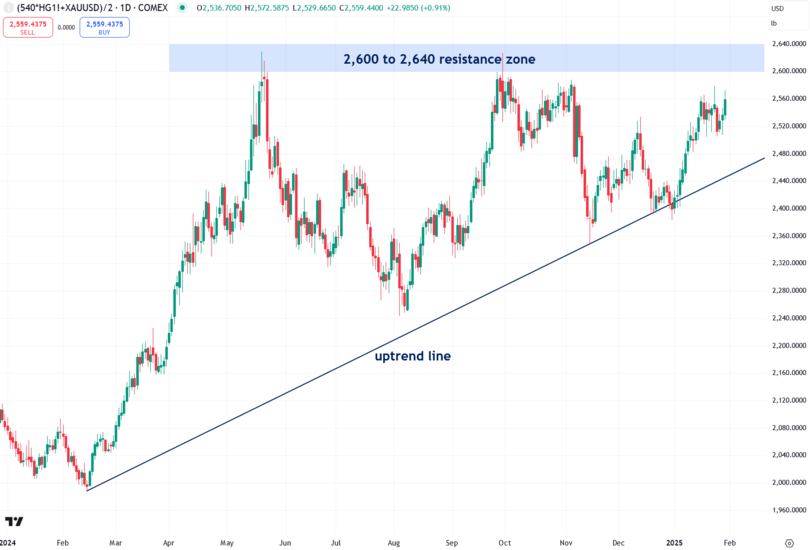
My proprietary Synthetic Silver Price Index (SSPI)—an indicator I developed to validate silver’s price movements—is also trending upward, further reinforcing the positive developments occurring in silver.

The SSPI averages the prices of copper and gold, with copper adjusted by a factor of 540 to prevent gold from disproportionately influencing the index. The SSPI closely mirrors silver’s price movement, even though silver itself is not an input.

The SSPI is rapidly approaching the 2,600–2,640 resistance zone, which has served as a key ceiling for much of the past year. A decisive close above this zone would signal a strong bullish breakout, indicating that another bull run for silver has likely started.

Beyond investing in gold and silver themselves, I also track and invest in gold and silver mining stocks. While these stocks have faced prolonged struggles, I believe they’re on the verge of a significant bull market as the overall precious metals bull market gains momentum.

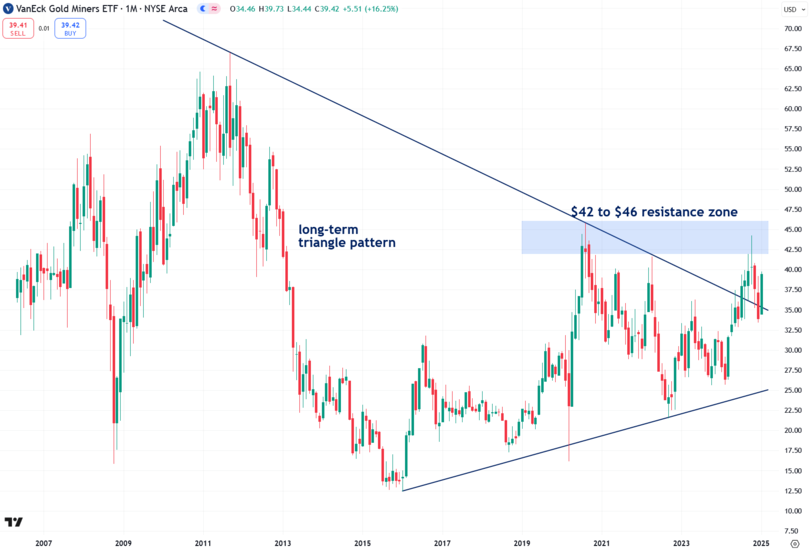
A key indicator of this shift is the large-cap VanEck Gold Miners ETF (GDX), which recently broke out of a long-term triangle pattern that dates back to 2011—a highly bullish development. For confirmation of this breakout, I’m watching for GDX to close decisively above the critical $42–$46 resistance zone.

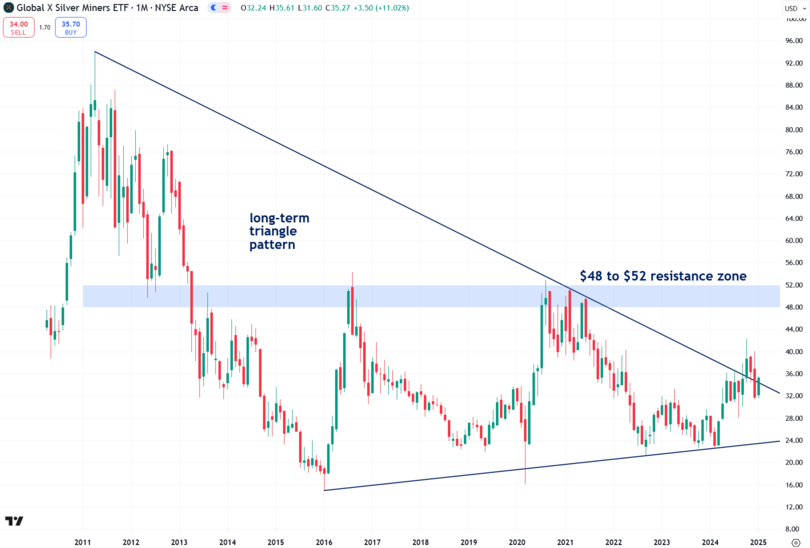
When it comes to silver miners, I’m closely watching the Global X Silver Miners ETF (SIL), which is currently in the process of breaking out of a long-term triangle pattern. For full bullish confirmation, I’m looking for a decisive close above the key $48–$52 resistance zone.

In summary, gold and silver are heating up again after a challenging few months. Gold has been the stronger of the two, as it sets new highs across nearly every major currency—a trend that appears far from over.

While silver has lagged behind, I believe gold’s bullish momentum will help pull silver higher until Western investor sentiment improves significantly.

When that shift occurs, demand for silver will surge, allowing it to outperform even gold. Additionally, as this precious metals bull market continues, gold and silver miners—long dormant—are poised for a powerful bull market. 2025 is shaping up to be a standout year for precious metals investors.


Jesse Colombo is a financial analyst and investor writing on macro-economics and precious metals markets. Recognized by The Times of London, he has built a reputation for warning about economic bubbles and future financial crises. An advocate for free markets and sound money, Colombo was also named one of LinkedIn’s Top Voices in Economy & Finance. His Substack can be accessed here.