(Clint Siegner, Money Metals News Service) Americans got an eyeful of the waste and fraud which has been rampant in federal spending last week. A barrage of announcements by the Trump administration included putting the brakes on a $50 million program to buy and supply condoms to people in Gaza.
While the headlines scroll by and the reform effort enters full swing, there is one quasi-federal institution which has somehow dodged pretty much all accountability for more than a century.
There may be no organization which can compete with the Federal Reserve Bank when it comes to waste, fraud, and abuse. While the nation is focused on making reforms, the Fed cannot be overlooked.
Let’s review…
The Fed principally serves the interests of its formal owners, i.e. Wall Street banks. The central bank also facilitates taxpayer-funded bail-outs for undeserving banks.
The infamous Trouble Asset Relief Program (TARP) provided about $650 billion to the shady banks behind the 2008 Financial Crisis. The bankers responsible wrote and then resold NINJA (No Income No Job) loans and were richly rewarded, even as Americans at large suffered through the worst economic crisis since the Great Depression.
Courtesy of the Fed, Wall Street enjoys a sort of immunity which is greater than that of the vaccine manufacturers. A pharmaceutical company which sells an experimental vaccine often cannot be sued, but they can still fail for other reasons. The largest banks – designated as Globally Systemically Important – aren’t allowed to fail for any reason.
Direct handouts to banks are by no means the only charity that Wall Street receives from the Fed.
There are lots of hidden giveaways. For example, when the Fed monetizes U.S. debt (a travesty in its own right), it doesn’t just print money and send it directly to the Treasury Department in return for Treasury bonds. It lets bankers skim a commission by letting them act as middlemen.
Through that monetization mechanism along with the setting of short-term interest rates below the true market price, the Federal Reserve is also responsible for the catastrophic decline in the purchasing power of the U.S. dollar.
Prior to the creation of the Fed in 1913, Americans enjoyed stable, even falling, prices. Today the dollar buys less every year – and sometimes a lot less. Adding insult to injury, Fed officials try to convince citizens that it is normal and healthy for their currency to perpetually fall in purchasing power.
The Fed is the chief regulator for U.S. banks, and it has failed utterly when it comes to keeping them honest.
No CEO of a major bank was criminally prosecuted for the fraud which came to light after the 2008 financial crisis.
The lack of oversight must have been encouraging to bankers who seem only to have grown more brazen.
Wells Fargo was found guilty of creating phony new accounts for clients and sticking them with extra fees. Traders at JPMorgan Chase and other banks were convicted of rigging the silver markets. The rap sheet is long and terrible, yet the Fed never suspends a major bank’s trading privileges or access.
The “revolving door” form of regulatory capture is as much a problem at the Fed as it is at the SEC and other agencies. Fed staffers responsible for oversight regularly take high-paid positions with one of the banks they used to “watch.”
The economic distortions created by our central bank have been more devastating in terms of cost than anything else.
The American dream itself is almost out of reach for most young people. Housing prices have been massively inflated by nearly two decades of artificially low interest rates. Wages have not kept pace with inflation. And the Fed has been instrumental as the buyer of last resort for federal debt – supporting perpetual deficits.
The awful truth is these offenses are just what we know about. Not once in its 112-year history has the Fed undergone a complete audit of its activities and expenditures.
America’s central bank is even less accountable than the CIA. It does not provide a comprehensive report of activities to the president or Congress, and its officials fight vigorously to avoid oversight whenever it comes up.
Clint Siegner is a Director at Money Metals Exchange, a precious metals dealer recently named “Best in the USA” by an independent global ratings group. A graduate of Linfield College in Oregon, Siegner puts his experience in business management along with his passion for personal liberty, limited government, and honest money into the development of Money Metals’ brand and reach. This includes writing extensively on the bullion markets and their intersection with policy and world affairs.
(Money Metals News Service) In a recent Money Metals podcast, Mike Maharrey interviewed Helen Viljoen, founder and CEO of Nebu Gold, a South African company that has pioneered the concept of “investment jewelry.”
The discussion highlighted how Nebu Gold combines high-purity gold and platinum with elegant design to create jewelry that serves as both an investment and a luxury product. The company’s name, Nebu, is derived from the ancient Egyptian word for gold, symbolizing wealth, eternity, and divine power.
(Interview Begins Around 4:23 Mark)
The Concept of Investment Jewelry
Helen Viljoen explained that investment jewelry differs from traditional fine jewelry in a fundamental way: it retains a significantly higher portion of its value.
Standard jewelry made with 14K gold (common in the United States) is only about 58% pure, with much of its price driven by design, brand, and marketing.
In contrast, Nebu Gold uses 22K (91.7%) and 24K (99.99%) gold (gold jewelry) as well as platinum (platinum jewelry) to ensure that pieces retain about 80% of their value at the time of purchase. This is a dramatic improvement over the 10-20% retained by typical luxury jewelry.
Nebu Gold’s pricing is transparent, based on the weight of the metal and a small premium above the spot price to cover manufacturing fees. This allows investors to enjoy and wear their investment without compromising its long-term value.
Gold, Platinum, and Durability
Helen Viljoen, Founder and CEO of Nebu
One major advantage of Nebu Gold’s pieces is their high purity. The 24K gold used by the company is significantly more valuable than the alloys commonly found in mass-market jewelry.
Viljoen emphasized that although pure gold is softer than lower-karat gold, Nebu’s designs are carefully stress-tested for durability. Additionally, the company offers investment-grade platinum pieces, which share similar benefits of durability and value retention.
“Pure gold molds to the body as you wear it,” Viljoen noted.
She explained that, unlike lower-karat gold, 24K jewelry does not tarnish over time. Platinum is similarly resistant to wear, making both metals ideal for heirloom pieces that retain their beauty and integrity for generations.
Cultural Differences in Gold Perception
During the interview, Viljoen explored the stark contrast between how gold is perceived in Eastern and Western cultures. In many Eastern countries, such as India, gold serves as both a cultural symbol and a store of wealth. Even rural families with limited access to financial institutions understand the importance of owning gold as a safeguard against economic instability.
In the West, however, gold is often seen as a luxury item rather than an investment. Viljoen attributes this to historical trust in fiat currency and centralized banking systems.
“In the West, people have relied on the dollar and industrial growth,” she said. “But in the East, where economic and geopolitical instability has been prevalent, there’s a long-standing tradition of using gold to preserve wealth.”
Gold and Economic Trends
The conversation also touched on global trends influencing the precious metals market, particularly central bank gold purchases and de-dollarization.
Viljoen, as a South African citizen and resident of a BRICS (Brazil, Russia, India, China, South Africa) nation, offered valuable insights into these developments. While she does not believe that de-dollarization will fully take hold, she emphasized the importance of currency competition, particularly in resource-rich regions.
“Inflation isn’t just rising prices,” Viljoen explained. “It’s the increase in the supply of currency. Gold has historically acted as a sentinel, keeping that inflationary pressure in check.”
Empowerment Through Gold Ownership
Viljoen shared an inspiring story from India, where women historically lacked financial independence. In response, many pooled their gold to create collective savings, using it to develop their communities. This practice underscores gold’s versatility as both a personal asset and a tool for social empowerment.
“Gold is universally recognized,” Viljoen noted. “It holds value no matter where you go, unlike many national currencies.”
A New Era of Investment Jewelry
With a growing number of design options, Nebu Gold caters to both serious investors and style-conscious customers. Pieces range from small, elegant pendants weighing 3.6 grams to larger, statement bangles weighing 40 grams. The company also offers platinum jewelry with similar investment-grade quality.
Viljoen emphasized that customer input plays a crucial role in shaping Nebu’s designs, ensuring that each piece is both aesthetically pleasing and financially sound.
As Valentine’s Day approaches, Nebu Gold offers a meaningful alternative to conventional jewelry gifts. With its emphasis on purity, transparency, and value retention, Nebu’s jewelry blends luxury with long-term financial security.
For more information, customers can visitwww.NebuGold.com to explore the collection.
High-purity jewelry: Nebu Gold offers both 22K and 24K gold, as well as platinum investment jewelry, retaining up to 80% of their purchase value.
Cultural insight: Gold plays a crucial role in preserving wealth in many Eastern cultures, unlike its status as a luxury item in the West.
Economic trends: Central bank gold buying and concerns over inflation and de-dollarization are driving global interest in gold investment.
Sustainability: Both pure gold and platinum jewelry maintain their appearance and integrity across generations, making them timeless assets.
Meaning of Nebu: The company’s name, Nebu, is derived from an ancient Egyptian word symbolizing wealth, eternity, and divine protection.
Helen Viljoen’s innovative approach is helping Western investors rethink the role of precious metals in their portfolios. Through Nebu Gold, she offers a compelling solution: wealth you can wear.
Key Questions & Answers
The following are the key questions and answers from the Money Metals podcast with host Mike Maharrey interviewing Nebu’s founder and CEO, Helen Viljoen:
What is investment jewelry?
Investment jewelry is a type of jewelry that retains significant financial value. Unlike traditional jewelry, which often contains lower-karat gold (e.g., 14K at 58% purity) and loses value due to branding and marketing costs, investment jewelry is made from high-purity gold (22K or 24K) and retains about 80% of its purchase value. Nebu Gold prices their pieces by weight, adding only a small manufacturing fee above the spot price.
What makes Nebu Gold’s jewelry different from traditional fine jewelry?
Nebu Gold uses 24K (99.99% pure) gold and 22K (91.7%) gold chains, offering significantly higher intrinsic value than standard jewelry, which often contains less than 60% gold. Their pieces maintain purity and durability, designed to hold value while being worn as beautiful, timeless items.
Isn’t pure gold too soft to wear as jewelry?
While 24K gold is softer than lower-karat alloys, Nebu Gold designs and stress-tests their pieces to ensure durability. Viljoen explained that pure gold molds to the body over time but does not easily scratch or tarnish. Proper care is recommended, but the durability is enhanced by the gold’s natural properties.
How do Eastern and Western cultures perceive gold differently?
In many Eastern cultures, gold is seen as both a symbol of wealth and a reliable store of value. Families often pass down gold as savings, particularly in countries like India, where gold is essential in dowries and economic planning. In contrast, Western cultures typically view gold as a luxury item rather than an investment, due to a historical reliance on fiat currency and trust in banking systems.
What role does gold play in today’s global economy?
Gold remains a hedge against inflation and a safeguard during economic instability. Central banks, particularly in BRICS nations, continue to increase their gold reserves, which reflects growing concerns over the dominance of the U.S. dollar. While full de-dollarization is unlikely, Viljoen emphasized that global currency competition is healthy and necessary to keep monetary policies in check.
How has gold empowered communities in countries like India?
Historically, Indian women who lacked access to bank accounts pooled their gold to create community-based savings systems. These systems allowed villages to develop infrastructure by collateralizing their gold, illustrating how gold can empower individuals and uplift entire communities through creative financial use.
Does Nebu Gold offer a variety of designs?
Yes, Nebu Gold offers a wide range of designs, from small pendants (3.6 grams) to large bangles (40 grams). The company prioritizes customer feedback and research to ensure that designs are both aesthetically appealing and financially valuable. This makes Nebu’s jewelry suitable for both style-conscious buyers and serious investors.
Where can people find Nebu Gold’s products?
Nebu Gold’s full collection is available atwww.NebuGold.com. Customers can browse through a variety of pieces designed to combine investment value with wearable beauty, making them ideal for special occasions or long-term wealth preservation.
With thousands of federal employees potentially on the chopping block, FBI Acting Director Brian Driscoll is reportedly refusing an order from the Justice Department to compile a list of agents who were involved in the prosecution of Jan. 6 protestors.
Driscoll’s insubordination is in response to a Friday order from Acting Deputy Attorney General Emil Bove, who directed the firing of eight senior FBI executives. Bove also ordered the review of thousands of other bureau employees, including all those who investigated the Jan. 6, 2021, Capitol Hill uprising, as well as those involved in the raid of Trump’s Mar-a-Lago property in 2022.
“I do not believe the current leadership of the Justice Department can trust these FBI employees to assist in implementing the President’s agenda faithfully,” Bove reportedly said in the order.
In response to that order, Driscoll wrote an email to FBI employees on Friday evening, confirming that he was directed to compile a list of agents involved in Jan. 6.
Here’s tonight’s email from Acting FBI Director Brian Driscoll (see photos)
When I was a new agent trainee at Quantico, our ethics instructor taught us that “…an FBI Agent’s greatest power isn’t in their ability to arrest or take a life, but in their ability to say ‘No.’”
“We understand that this request encompasses thousands of employees across the country who have supported these investigative efforts. I am one of those employees, as is acting Deputy Director Kissane,” he said.
However, the Washington Times reported Sunday that Driscoll didn’t follow the DOJ’s order.
“According to sources, he refused the DOJ’s demand altogether after its subsequent request, which was to provide by late Monday detailed information on how each employee was involved, and to what extent, in the 1,300 cases,” the Times reported.
Driscoll was still FBI acting director at the time of this article’s publication, but speculation is swirling that he could be out by the end of the day.
Meanwhile, notorious anti-Trump attorney Mark Zaid is complaining that Trump’s plans to fire FBI agents is violating their constitutional rights.
“Any adverse employment action, including removal, must respect all required standard procedural and substantive due process protections,” Zaid said in a Sunday letter to Bove, threatening legal action. “If you proceed with terminations and/or public exposure of terminated employees’ identities, we stand ready to vindicate their rights through all available legal means.”
Ken Silva is a staff writer at Headline USA. Follow him at x.com/jd_cashless.
(Mike Maharrey, Money Metals News Service) Are we heading for a repeat performance of the resurrection of inflation that we saw in the mid-1970s?
It sure appears to be setting up that way.
The Federal Reserve declared victory over price inflation over the summer when it began rolling back its balance sheet reduction. In September, it took another step, initiating a supersized 50 basis point interest rate cut, followed by additional cuts in November and December.
I’ve been arguing for months that the central bank never did enough to slay price inflation. The trajectory of the CPI in recent months seems to bear this out. After dropping as low as 2.4 percent on an annual basis in September, the CPI has crept up for the past three months and stood at 2.9 percent in December. Meanwhile, core CPI has been mired around 3 percent since last summer. It’s clear that inflation isn’t dead.
It’s sticky.
The resurgence of price inflation has created a Catch-22 for the Fed. It needs to keep rates higher for longer to drive price inflation down while simultaneously cutting rates due to the staggering levels of debt incentivized by decades of easy money.
An Inflation Deja Vu
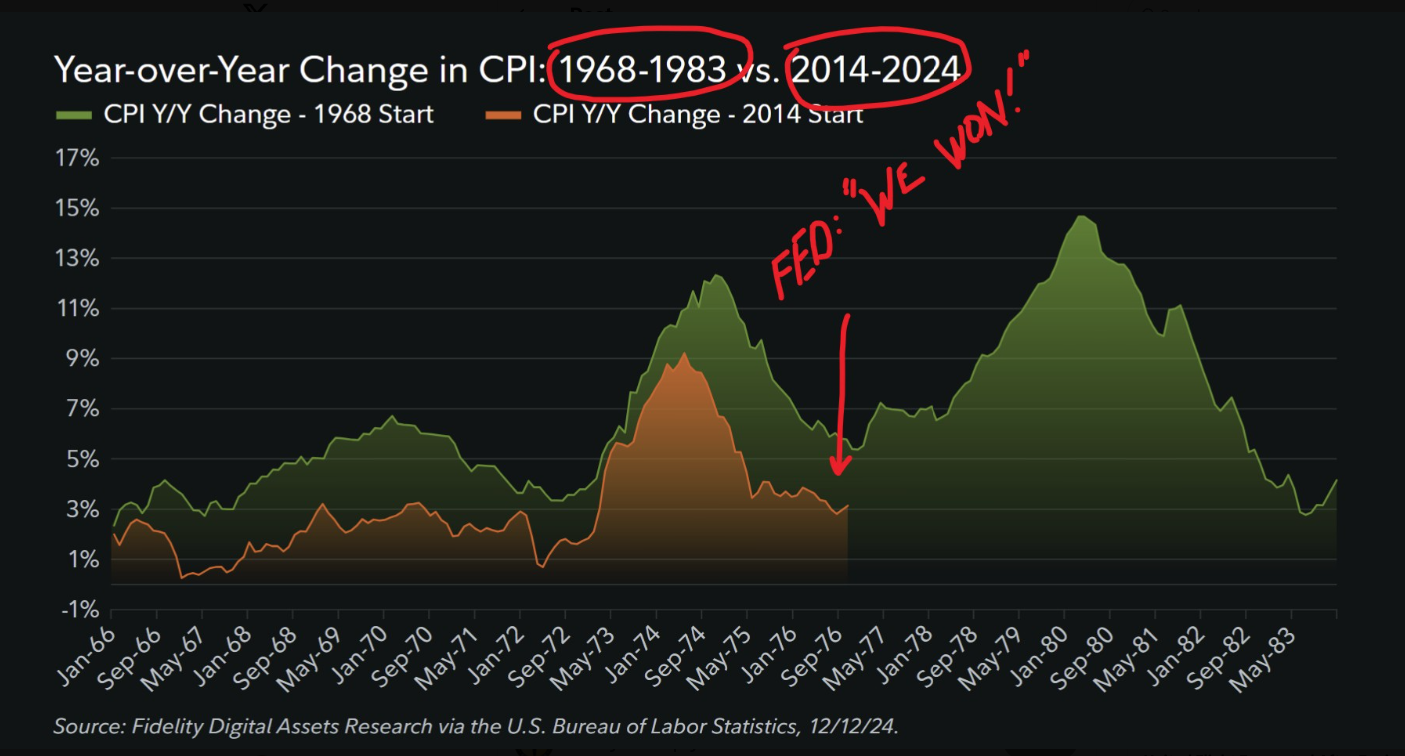
Inflation took a similar path in the 1970s, playing possum and then surging again after the Federal Reserve prematurely declared victory.
As you can see from the chart, CPI spiked in the early 70s, peaking in 1974 at around 12 percent. The Fed responded to the surge in inflation by driving interest rates up in late ’73 and into 74. Rates peaked at 13 percent that summer and price inflation came down.
By early 1976, the CPI had cooled 4.75 percent.
The Fed declared victory and started cutting rates in November 1974. By January 1976, the interest rate was down to 4.75 percent, an extremely loose level at the time.
As it turns out, declaring victory was premature.
In 1977, the CPI was climbing again, and by January 1980, it was nearly 15 percent. That forced Paul Volcker to actually go to war with inflation. He jacked rates up to 20 percent and finally laid the inflation dragon to rest.
Fast forward to today. After injecting some $9 trillion of new money into the economy through quantitative easing, and holding interest rates artificially low for well over the decade after the Great Recession (creating inflation by definition), the Fed tried to pretend price inflation wasn’t a thing for months, calling it “transitory.” When it could no longer deny reality, the Fed went to war against inflation, but just like it did in the 1970s, it waved the white flag of surrender prematurely. Now it appears the inflation dragon is ready to get up off the mat.
If you look at the CPI between 2022 and today, the trajectory tracks almost perfectly with the mid-1970s. CPI peaked and then fell off but never got back to the target. The most recent inflation data has shown it if not heating up, at least showing signs of stickiness.
History doesn’t necessarily repeat, but it often rhymes. It looks like the Fed may be taking us down a similar path as it did in the 70s.
The problem is, we don’t have a Paul Volcker. And even if he did, it’s unlikely he could take a similarly aggressive stand against inflation because of all the debt and malinvestments in the economy.
It remains unclear how the Fed will try to get out of its conundrum. Will Powell & Company surrender to inflation? Or will they keep rates elevated and crash the economy? Or will we get the worst-case scenario – stagflation?
No matter how the central bankers play this, it’s difficult to see an optimistic path forward and investors should be prepared.
Mike Maharrey is a journalist and market analyst for MoneyMetals.com with over a decade of experience in precious metals. He holds a BS in accounting from the University of Kentucky and a BA in journalism from the University of South Florida.
(Mike Maharrey, Money Metals News Service) The flow of physical gold and silver from London to New York continued last week, with JPMorgan announcing plans to move $4 billion in metal to deliver against futures contracts. Meanwhile, big players in the gold market are reportedly begging central banks to borrow gold stored in London vaults to fulfill the surging demand for physical metal.
According to Bloomberg, JPMorgan was among several financial institutions that announced plans to deliver bullion contracts traded on the COMEX. The delivery announcements totaled 30 million ounces of gold, the second-largest level of planned deliveries since 1994.
The prices of gold and silver futures traded on the COMEX have surged above the spot price of gold in the London market. Mainstream analysts blame the dynamic on the threat of tariffs pushing the futures price of gold (and silver) higher in New York, but as Chris Powell reported, there could be a more fundamental issue at play: the fact that there is a lot more paper gold than physical metal.
Powell asked a key question to consider:
“What if there really is just an ordinary shortage of gold? Or, to be more precise, what if there is a shortage of gold under U.S. and U.K. control relative to rising international demand for the safe-haven metal?”
Futures Market Imbalance
Regardless of the reason, physical metal is moving out of London into New York because of the price dynamics in the futures market.
Even though the price of gold surged last week and set new price records above $2,800 per ounce, the premium on the COMEX has created an arbitrage opportunity that big institutions capable of quickly moving metal between trading hubs can take advantage of.
According to Bloomberg, JPMorgan issued delivery notices for 1.485 million ounces of gold to meet physical delivery for the February gold 100-ounce contract. Deutsche Bank AG, Morgan Stanley, and Goldman Sachs Group Inc. made up the bulk of the rest.
Bloomberg reports a similar dynamic in the silver market, with traders flying silver into the U.S. as well. This rarely happens because of the much lower silver price and the fact that it is bulky and expensive to transport. One industry veteran said this is the first time he’s seen the movement of physical silver at this level.
Dynamics in the futures market and the increasing price discrepancies are driving this movement of metal.
A futures contract is a legal agreement to buy or sell a specific amount of metal at a predetermined price on a future date. Speculators can use the difference between the contract price and the actual price at the time of delivery to make a tidy profit (or lose a lot of money).
Generally, these trades are made on paper. There is a legal obligation to deliver metal at the close of the contract, however, metal rarely changes hands. Both parties generally close their positions before the expiration date by selling (if they initially bought) or buying (if they initially sold). Contracts can also be settled in cash. Only about 1 percent of COMEX trades typically go to delivery.
The opportunity to deliver cheaper London gold to fulfill more expensive COMEX futures contracts is creating a nice profit opportunity for the big banks able to move the metal.
The Gold and Silver Shortage
The movement of gold and silver out of London vaults is becoming problematic.
This issue here is obvious. As metal flows out of London into New York, at some point, the gold and silver holdings across the pond will become depleted. As we reported a couple of weeks ago, this dynamic is creating significant uncertainty in both the gold and silver markets.
“This dynamic is having the effect of draining London vaults of gold and silver at an unusually fast rate –and at some point, these lower levels of vaulted metal in London could create price dislocations in that major market too. Those who have short positions in the New York market are in the process of getting squeezed, especially if they are having trouble getting their hands on physical metal to deliver into their short positions. Or get it into the right form.”
This squeeze is likely one of the factors that pushed the spot price of gold to record levels last week.
According to a Reuters report, bullion market players in London are racing to borrow gold from central banks that have metal stored in London vaults to meet the physical demand for metal.
As an analyst explained to Reuters, “The key with the BoE is that they are not a commercial vault so not prepared to handle the onslaught of gold borrowing banks are requesting from the central banks.”
The Bank of England stores a significant amount of gold for foreign central banks. Sources in London say the wait time for gold to be moved out of BoE vaults typically runs a few days to a week. Recently, the minimum time to load out gold has risen to as long as four weeks.
According to the Reuters report, there has been a significant drop in the size of the so-called Loco London free float representing the amount of metal readily available to the London over-the-counter market. Meanwhile, 12.2 million ounces of gold were delivered to COMEX-approved warehouses, raising stocks by 70 percent, the highest level since August 2022.
An analyst told Reuters that there are also liquidity challenges at other large trading hubs globally, although less pronounced than in London.
“The logistical complexities of moving large quantities of gold, particularly from Europe to the U.S., are amplifying these stresses. Asia has also seen some knock-on effects, particularly in markets like Singapore and Hong Kong.”
If this gold and silver squeeze continues, it could put additional upward pressure on gold and silver prices. It’s definitely a dynamic investors need to keep their eyes on.
Mike Maharrey is a journalist and market analyst for MoneyMetals.com with over a decade of experience in precious metals. He holds a BS in accounting from the University of Kentucky and a BA in journalism from the University of South Florida.
(Headline USA) President Donald Trump said Sunday that Americans initially could feel “some pain” from the emerging trade war triggered by his tariffs against Canada, Mexico and China.
However, the end result will be to further bolster his “America First” agenda as domestic production fills the void of cheaply made imported products and the more secure borders ensure that American citizens reap the job benefits of American industry rather than cheaply imported workers.
He also warned outgoing Canadian Prime Minister Justin Trudeau and other members of the Liberal party in the U.S.A.’s northern neighbor that Canada would “cease to exist” without its trade surplus with the United States.
More than 75% of Canada’s exports go to the U.S. Canada is the largest export market for 36 states, and Mexico is the largest trading partner of the U.S.
Trump signed the trade orders, adding additional surgarges to imported goods, on Saturday at his Florida Mar-a-Lago estate. On Sunday night, he returned from Florida and threatened to impose steeper tariffs elsewhere, telling reporters that the import taxes will “definitely happen” with the European Union and possibly with the United Kingdom as well.
He brushed aside retaliatory measures from Canada, saying, “If they want to play the game, I don’t mind. We can play the game all they want.”
Trump said he planned to speak with his Canadian and Mexican counterparts on Monday.
Trump long touted the promise of tariffs on the campaign trail, although critics maintain that they will further compound the pain from the inflation that began during former President Joe Biden’s first year in office and has remained difficult to rein in, despite the highest interest rates in decades.
An analysis by the Budget Lab at Yale showed that if the tariffs were to continue, an average U.S. household would lose roughly $1,245 in income this year, in what would be the overall equivalent of a more than $1.4 trillion tax increase over the next 10 years.
Larry Summers, treasury secretary in the Clinton administration, told CNN on Sunday that the ultimate winner would be Chinese leader Xi Jinping because “we’ve moved to drive some of our closest allies into his arms” and “we’re legitimating everything he’s doing by violating all the international norms that we set up.”
Trump seemed to acknowledge an initial increase in the cost of living for goods on which America typically depends on foreign trade partners. However, unlike inflation, tariffs should also increase the value of the dollar in the long run—assuming there are also reductions to government spending and minting of money.
“WILL THERE BE SOME PAIN? YES, MAYBE (AND MAYBE NOT!),” the Republican president said in a social media post. “BUT WE WILL MAKE AMERICA GREAT AGAIN, AND IT WILL ALL BE WORTH THE PRICE THAT MUST BE PAID.”
His administration has not said what specific improvements would need to be seen in stopping illegal immigration and the smuggling of fentanyl to merit the removal of the tariffs that Trump imposed under the legal justification of an economic emergency. But Trump, speaking to reporters after Air Force One, landed said that the trade imbalances with Canada and Mexico would also need to be erased as a condition for lifting the tariffs.
The president also tried to clarify his post about the possible inflation, saying on Sunday: “We may have in the short term, a little pain, and people understand that. But long term, the United States has been ripped off by virtually every country in the world.”
The tariffs are set to launch Tuesday and triggered confusion as Canada’s U.S. ambassador, Kirsten Hillman, told ABC News that her country was perplexed by the move because “we view ourselves as your neighbor, your closest friend, your ally.”
In his Truth Social post, Trump took particular aim at Canada, which responded with retaliatory measures. Trump is placing a 25% tariff on Canadian goods, with a 10% tax on oil, natural gas and electricity. Canada is imposing 25% tariffs, more than $155 billion Canadian (US$105 billion), on U.S. products, including alcohol and fruit.
One area in particular that Trump hopes to bolster U.S. production is in the energy sector. Under the Biden administration, one-quarter of the oil that America consumed per day came from Canada.
Trump contended that without that surplus, “Canada ceases to exist as a viable Country. Harsh but true! Therefore, Canada should become our Cherished 51st State. Much lower taxes, and far better military protection for the people of Canada — AND NO TARIFFS!”
Trudeau—who will be stepping down in a matter of weeks as his party faced the prospect of a conservative revolution like the one that America saw in November—encouraged Canadians to buy more Canadian goods, saying Trump’s moves would only cause pain across North America.
Canada will first target alcohol, cosmetics and paper products; a second round later will include passenger vehicles, trucks, steel and aluminum products, certain fruits and vegetables, beef, pork, dairy products and more.
Mexico’s president, Claudia Sheinbaum, also announced new tariffs and suggested the U.S. should do more within its own borders to address drug addiction. She and Trudeau spoke after Trump’s announcement and agreed “to enhance the strong bilateral relations” between Canada and Mexico, according to the prime minister’s office.
The Chinese government said it would take steps to defend its economic interests and intends to file a lawsuit with the World Trade Organization.
The U.S. president did not offer details Sunday about when he would impose tariffs elsewhere, but he said they would be coming “pretty soon” for the EU.
Goldman Sachs, in a Sunday analyst note, stressed that the tariffs go into effect on Tuesday, which means they’re likely to proceed “though a last-minute compromise cannot be completely ruled out.”
The investment bank concluded that because of the possible economic damage and possible conditions for removal “we think it is more likely that the tariffs will be temporary but the outlook is unclear.”
(Luis Cornelio, Headline USA) The Democratic Party is in utter disarray after most Americans rebuked former Vice President Kamala Harris in the 2024 election, according to The New York Times’s interviews with several dozen officials.
“More than 50 interviews with Democratic leaders revealed a party struggling to decide what it believes in, what issues to prioritize and how to confront an aggressive right-wing administration,” The Times reported on Sunday.
According to the reporting, Democrats appeared “leaderless, rudderless and divided,” often clashing over how to counter President Donald Trump’s popular policies and no-nonsense governance.
“We have no coherent message,” said Rep. Jasmine Crockett, D-Texas, who is infamous for her dramatic outbursts and divisive rhetoric in Congssional hearings.
Crockett then lashed out at Trump: “This guy is psychotic, and there’s so much, but everything that underlines it is white supremacy and hate. There needs to be a message that is clear on at least the underlying thing that comes with all of this.”
Meanwhile, the Democratic National Committee (DNC) turned to Minnesota operative Ken Martin and social media influencer David Hogg as their respective chair and vice chair.
BREAKING: David Hogg just delivered his speech at the DNC to become vice chair.
Democrats believe he can be the masculine figure they need to regain the young male vote.
"I don't just don't tweet, I don't just talk the talk, I also walk the talk, and I knock the knock."… pic.twitter.com/jlA3W1OIbz
Notably, Martin conceded in remarks to The Times that the DNC is apparently grappling with an identity crisis.
“The policies that we support and the message that we have is not wrong,” he said. “It is a messaging problem and a brand problem. Those voters are not connecting our policies with their lives.”
In response, some Democrats proposed puzzling solutions like pinning the current economy to Trump, who took office less than two weeks ago.
“There are people in the middle — and trust me, there’s a lot of them — that wanted costs to go down,” Klobuchar claimed. “Instead, what they see is chaos going up, corruption going up with the firing of the inspector generals, and guess what else is going up? Egg prices.”
Former President Barack Obama drew comparisons between the current failed state of the DNC and 2004, when George W. Bush won reelection and Democrats lost control of Congress.
However, Obama seemingly pointed to the 2006 midterms—when his party regained both chambers of Congress and later the White House in 2008—as possible turning points.
For now, however, Democrats will have to contend with Trump’s growing influence and policies for which Americans voted for in 2024.
Trump’s landslide victory led Republicans to take the Senate and maintain their Republican majority in the House of Representatives.
The blockade was particularly striking, as unelected bureaucrats were impeding representatives of Donald Trump, the duly elected president.
Critics could suggest this serves as an example of the unchecked power bureaucrats believe they wield. The suspended officials are USAID Director of Security John Voorhees and his deputy, according to liberal CNN.
USAID, the federal government’s humanitarian arm, has come under scrutiny in recent years for exploiting taxpayer dollars to fund radical left-wing initiatives, including climate change and “Diversity, Equity, and Inclusion” programs.
Personnel from the Department of Government Efficiency had sought to access USAID’s security systems and employees’ files. Anonymous sources claimed that some of these documents were classified, though they provided no evidence to support these claims.
DOGE official Katie Miller countered the accusations, saying, “No classified material was accessed without proper security clearances.” Elon Musk, who leads DOGE, issued a blunt rebuke of USAID, calling it a “criminal organization” and adding, “Time for it to die.”
Did you know that USAID, using YOUR tax dollars, funded bioweapon research, including COVID-19, that killed millions of people? https://t.co/YVwyKA7ifs
According to Politico, USAID officials physically blocked DOGE representatives from entering USAID’s offices. DOGE’s officials threatened to involve the U.S. Marshals Service to gain entry. Only then were they allowed access.
A USAID staffer anonymously claimed that DOGE was given access to several “secure spaces,” including the Office of Security and the Executive Secretariat.
“We understand that they sought access to, like out of their way to seek access to the Office of the Inspector General, but it’s not clear that they were able to access that space,” the staffer added.
Politico reported that the Trump administration plans to abolish the agency and fold it into the Department of State, currently led by Secretary Marco Rubio.
Rep. Brian Mast, R-Fla., appeared to confirm this reporting telling CBS News on Sunday that the agency “is likely to be going to be rolled more closely under Secretary Rubio.”
USAID’s website and social media pages were shut down on Saturday. The Department of State then launched a landing page on its website.
HFAC Chair Brian Mast (R-FL) SCHOOLS Margaret Brennan on wasteful spending in the State Department, after she questioned him about the "purging" of personnel and the need to freeze aid. pic.twitter.com/ajT4OQQ4Ym
(Luis Cornelio, Headline USA) The Trump administration has rescinded one of the worst immigration policies enacted under Joe Biden: Temporary Protected Status (TPS) for hundreds of thousands of Venezuelan nationals.
DHS Secretary Kristi Noem vacated Biden’s 18-month extension of TPS for Venezuelans residing in the U.S., according to Sunday reporting by the liberal New York Times. Noem’s predecessor, Alejandro Mayorkas, granted the extension on Jan. 10—just 11 days before leaving office.
The Biden-era extension would have forced the Trump administration to continue granting special protection to more than 300,000 Venezuelan nationals without the ability to reassess the program or even tighten the vetting process.
Under the new directive,The Timesreported that Venezuelans who received TPS in 2023 will lose the special protections 60 days after the federal government issues its termination notice.
Noem addressed the reversal during an interview with NBC News host Kristen Welker on Meet the Press on Sunday: “The [TPS] program has been abused and it doesn’t have integrity right now.”
Biden first granted TPS for Venezuelans in 2021, a puzzling move critics say incentivized illegal immigration under the pretense they would be covered. Since then, Biden blindly renewed and expanded the program.
TPS has long been criticized by the Center for Immigration Studies as a scheme to grant de facto permanent status to its beneficiaries.
Some countries—such as El Salvador and Honduras—have been on the program since 2001 and 1999, respectively.
Approximately 250,000 Salvadorans remain on TPS due to an earthquake that happened over two decades ago.
Trump’s first attempt to get rid of the program was halted by activist judges and by the results of the 2020 presidential election. Biden quickly reinstated the program once he took office.
The Biden regime argued that El Salvador remains unsafe for TPS recipients, but these claims are contradicted by their actions as they deported 7,000 individuals to El Salvador in 2022, according to CIS.
Supporters of TPS also point to the dire situation in Venezuela under the socialist dictatorship of Nicolás Maduro. However, CIS found that most Venezuelan nationals receiving TPS had already found safety in countries like Colombia, Ecuador, Peru and Argentina before coming to the U.S.
DHS’s reversal comes amid a surge in high-profile crimes involving Venezuelan nationals who entered the country under the Biden administration.
Laken Riley, a 22-year-old nursing student in Georgia, was brutally killed by José Antonio Ibarra, a 26-year-old Venezuelan national and member of the Tren de Aragua gang. He was sentenced to life without the possibility of parole.
🚨Laken Riley’s murderer has been convicted on 10 criminal charges
In Texas, 12-year-old Jocelyn Nungaray was gang-raped, tied up and murdered by Franklin Pena and Johan Martínez-Rangel, two Venezuelan nationals, according to investigators. They are currently facing the death penalty for these offenses.
NEW: Prosecutors say 12-year-old Jocelyn Nungaray fought to survive until her last breath, say she left bite and scratch marks on one of the illegal immigrants.
21-year-old Johan Jose Rangel Martinez still had bite marks on his body when he was arrested.
(Headline USA) New Defense Secretary Pete Hegseth and Sen. Katie Britt, R-Ala., slammed passive-aggressive Air Force officials for creating a fake scandal through their overly broad interpretation of a Trump administration order ending discriminatory identity-politics programs in federal agencies.
I have no doubt Secretary Hegseth will correct and get to the bottom of the malicious compliance we’ve seen in recent days. President Trump celebrated and honored the Tuskegee Airmen during his first term, promoting legendary aviator Charles McGee to Brigadier General and pinning…
Speaking Friday on Fox & Friends, Hegseth said the Tuskegee Airmen were an example of “courageous merit” and that cutting their video was “something I like to call malicious implementation.”
“An outfit like the Tuskegee Airmen, we will salute and we will elevate,” Hegseth said. “And we want every service member to understand what they did. That’s very different than the DEI programs.”
White House press secretary Karoline Leavitt agreed that some agencies had gone too far in reacting to the DEI executive order.
“As far as I know, this White House certainly still intends to celebrate, and we will continue to celebrate American history and the contributions that all Americans, regardless of race, religion, or creed, have made to our great country,” she said during a media briefing.
On Friday, Trump issued a proclamation recognizing Black History Month, while on the same day the Defense Department issued a news release proclaiming “Identity Months Dead at DOD.”
The Air Force’s initial action was one of the most publicized when it took down courses that included videos about the Tuskegee Airmen and the WASPs.
The Airmen squadron, based out of Alabama, is credited with shattering racial barriers and racist beliefs about the capabilities of black pilots. Their success in combat paved the way for the desegregation of the U.S. military, a story that is interwoven in state and U.S. history.
The service removed training videos of the Tuskegee Airmen along with ones showing the World War II contributions of the WASPs, at its basic training base in San Antonio, where airmen have passed through for generations.
The decision to remove the videos was met with disbelief from some of the descendants of those who were part of the squadron
“I was angry,” said Alysyn Harvey–Greene. Her 101-year-old father, retired Air Force Lt. Col. James Harvey III, was one of the original Tuskegee Airmen. “It’s been very disturbing. We fought for so long to get this history out.”
Harvey finished his pilot training as the war in Europe was winding down, but flew combat missions in Korea. In 1949, he and other Tuskegee Airmen won the Air Force’s inaugural Fighter Gunnery “Top Gun Meet”—where the best Air Force pilot teams competed—but were not recognized as the winner for 73 years.
“For so long, we were not able to tell the story,” Harvey–Greene said.
Lisa Taylor, executive director of the National WASP WWII Museum in Sweetwater, Texas, said she was incredulous when she heard the content might be removed from the training base.
“The stories are historical and also uplifting and inspiring for all men and women who have found themselves wondering if they were good enough socially, mentally and technologically,” she said. “They are the anecdotes that might provide someone with the final push to take the next step in becoming who she or he longs to be.”
She said she was relieved when the training material was restored.
In later announcing the reversal, Air Force Chief of Staff Gen. David Allvin said in a statement that the initial removal was because the service, like other agencies, had to move swiftly to comply with Trump’s executive order with “no equivocation, no slow-rolling, no foot-dragging.”
In addition to the Air Force’s action, the Army pulled its sexual assault regulations off websites before restoring them.
A notice from the Defense Intelligence Agency said it was pausing “until further notice” special observances that included Black History Month, Women’s History Month, Holocaust Days of Remembrance, Women’s Equality Day and National American Indian Heritage Month.
There were reports that employees at the CIA were notified there would be no Black History Month acknowledgements. A CIA spokesman said in a statement that the the agency was complying with the order and “OPM Implementing Guidance,” referring to the Office of Personnel Management.
“The Office of Diversity and Inclusion has been dissolved, along with component DEI programs,” the CIA statement said.
Democrats insisted that the misinterpretation of the DEI directives by the military and other government agencies was an innocent mistake, not an act of subversive resistance against the Republican president and his Cabinet.
Amy McGrath, who was the Democratic nominee for U.S. Senate in Kentucky in 2020 against Republican incumbent Mitch McConnell, claimed the move by the Air Force was understandable because military leaders were trying to avoid missteps with the new administration.
“They’re afraid that if they do basic leadership—which is embracing everyone no matter what race, no matter what religion, no matter what gender—that’s going to be labeled as ‘woke’ or ‘Marxist’,’” said McGrath, a retired Marine Corps lieutenant colonel who was the first woman to fly an F-18 fighter plane in combat.
Still, some Trump critics who sought to insinuate that the DEI orders were racist may have inadvertently underscored the point that public officials who were incapable of distinguishing between practices that honored American history and those that promoted a divisive racial narrative should not be trusted to use their own discretion and would be wise to step aside.
Adia Harvey Wingfield, a professor of sociology at Washington University in St. Louis, said many places were “unclear about exactly where the legal landscape stands, but very aware about the political landscape and wanting to make sure that they are not doing things that will attract attention, negative press or negative responses.”
She noted that a 2023 Supreme Court decision striking down affirmative action in college admissions was clear on restricting opportunities to specific groups.
But it was “a far cry from that to not including information about groups that are basic parts of history like the Tuskegee Airmen,” she added.