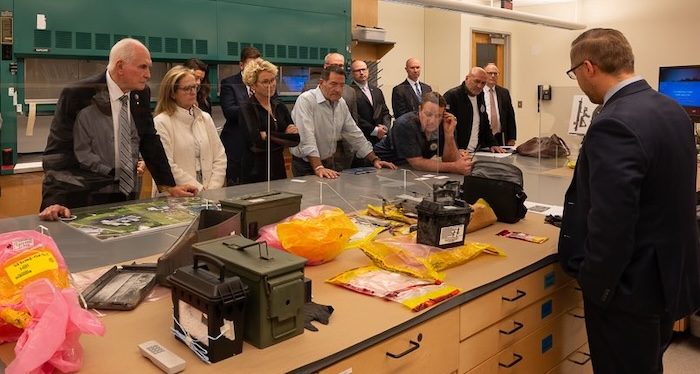
(Ken Silva, Headline USA) One of the nation’s top forensic science organizations was reportedly pressured by the FBI to censor speeches critical of the bureau crime lab, which were to take place at a conference later this month.
According to The Intercept, there were two speeches that were expected to be critical of the FBI at the Feb. 17 American Academy of Forensic Sciences annual conference: a 20-minute talk titled “How the FBI Has Failed to Enforce Its Own Explicit Standards Applicable to Handwriting Comparison and Improperly Restricts the Use of Blind Verification in Handwriting Cases”; and another 45-minute talk titled “Taking on the FBI.”
However, the FBI caught wind of the upcoming talks, and pressured the AAFS to cancel them. Citing unnamed sources, The Intercept reported last Thursday that the FBI threatened to boycott the conference if the AAFS didn’t “take action.”
According to The Intercept, the AAFS caved to the FBI’s pressure.
“On December 17, the AAFS board voted unanimously (with one member absent) to ask the organizers of the two workshops to censor their presentations or face cancellation. Two members of the board also suggested an apology to the FBI might be in order,” the outlet reported.
According to The Intercept, the organizers of the “Taking on the FBI” speech agreed to “several small changes to their workshop language.” However, the speaker set to talk about the FBI’s handwriting evaluation standards refused to buckle. The speaker reportedly pulled his presentation altogether.
The FBI, for its part, denied censoring the conference. The bureau told The Intercept that it merely “brought to the attention” of the AAFS material mentioning the FBI that “seemingly violated AAFS’s own bylaws”—a similar argument the bureau made when insisting it didn’t pressure tech companies to censor stories such as the Hunter Biden laptop scandal.
The FBI’s sordid history of tampering with and destroying evidence dates back decades, as chronicled by authors John Kelly and Phillip Wearne in their book, “Tainting Evidence : Behind the Scandals at the FBI Crime Lab.” This book features interviews and records from former FBI crime-lab scientist Fred Whitehurst, who came out as a whistleblower in the 1990s about the bureau’s mishandling of evidence.
Whitehurst revealed that the FBI mishandled evidence in prominent investigations into the Unabomber, O.J. Simpson, and the Oklahoma City bombing cases. The Department of Justice’s Office of Inspector General found some of Whitehurst’s key allegations to be substantiated in an April 1997 report.
Ken Silva is a staff writer at Headline USA. Follow him at x.com/jd_cashless.
Pennies famously cost more than a penny to produce, putting them in the crosshairs of Trump and DOGE’s government efficiency push.
“For far too long the United States has minted pennies which literally cost us more than 2 cents,” Trump wrote on TruthSocial, his social media site. “This is so wasteful! I have instructed my Secretary of the US Treasury to stop producing new pennies.
Let’s rip the waste out of our great nations budget, even if it’s a penny at a time,” Trump added.
DOGE posted on X last month critical of the penny’s cost, hinting at its fate.
“The penny costs over 3 cents to make and cost US taxpayers over $179 million in FY2023,” DOGE wrote on X. “The Mint produced over 4.5 billion pennies in FY2023, around 40% of the 11.4 billion coins for circulation produced. Penny (or 3 cents!) for your thoughts.”
According to the U.S. Mint’s latest report, the cost of all coins is on the rise. From the Mint’s 2024 report:
“FY 2024 unit costs increased for all circulating denominations compared to last year. The penny’s unit cost increased 20.2 percent, the nickel’s unit cost increased by 19.4 percent, the dime’s unit cost increased by 8.7 percent, and the quarter-dollar’s unit cost increased by 26.2 percent. The unit cost for pennies (3.69 cents) and nickels (13.78 cents) remained above face value for the 19th consecutive fiscal year.”
This scenario has particularly intrigued me because a surge in copper would provide a significant tailwind for silver. I believe copper’s sluggish performance has been a key factor holding silver back, as the two metals are highly correlated, with arbitrage algorithms reinforcing their relationship.
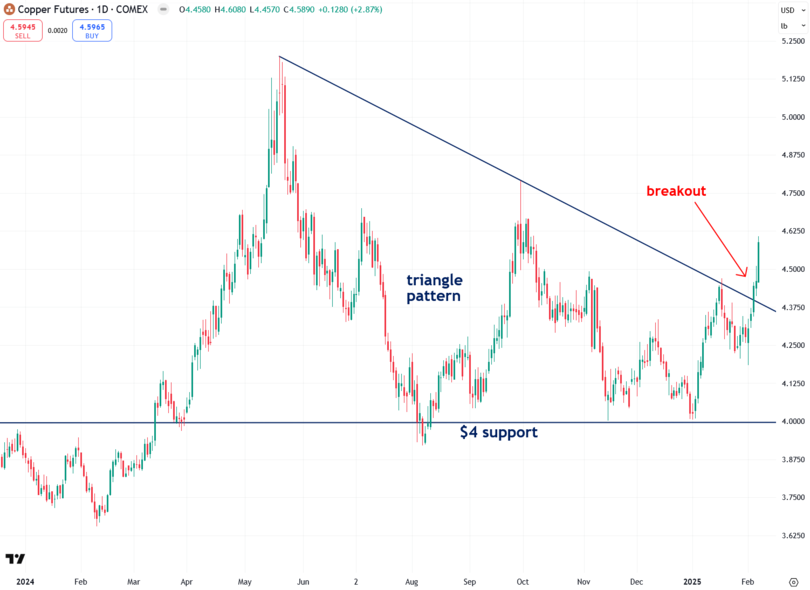
In the past week, my expectations were validated when copper broke out of a major triangle pattern that had been forming since May.
As the chart below illustrates, copper rebounded off the $4 support level at the start of January, quickly surging higher and breaking out of the triangle pattern—a strong signal that further bullish momentum is likely ahead.
Several factors have fueled this rally, including technical buy programs kicking in, stockpiling in anticipation of potential tariffs, and expectations of a major stimulus program as China’s economy continues to suffer.
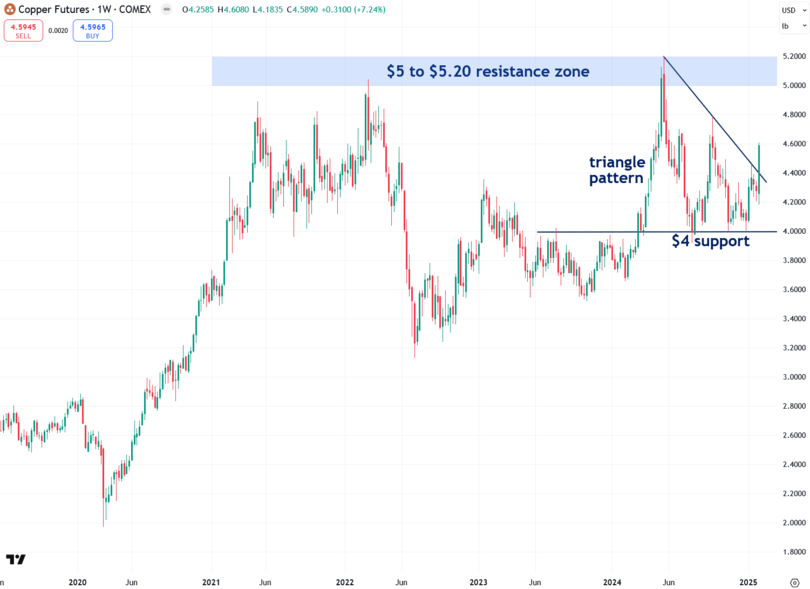
The longer-term weekly chart provides valuable perspective on copper’s recent breakout and highlights the critical $5 to $5.20 resistance zone overhead—my next price target now that copper has broken out.
A decisive break above this zone should herald a full-blown bull market, which would also be highly beneficial for silver. I’ll explore this correlation in more detail later in the article.
I frequently show a proprietary indicator I developed, the Synthetic Silver Price Index (SSPI), which helps validate silver’s price movements and filter out potential fakeouts.
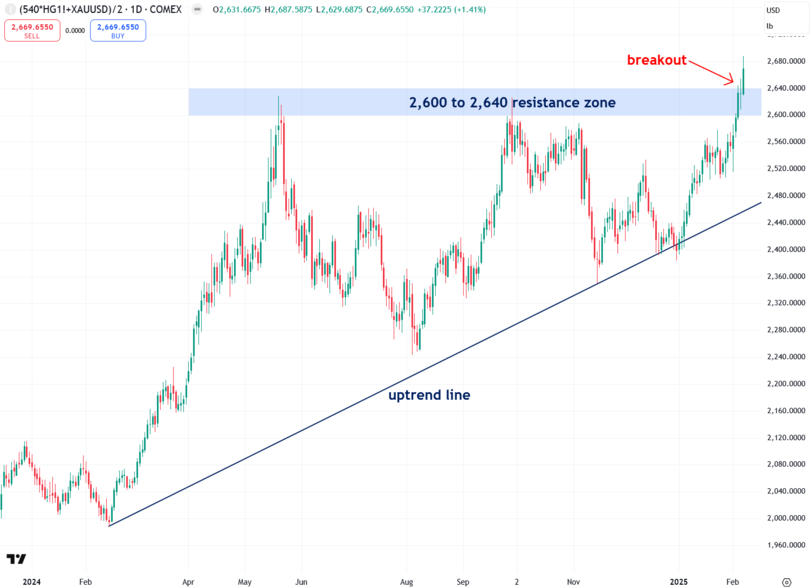
This index is the average price of copper and gold, with copper adjusted by a factor of 540 to prevent gold from disproportionately influencing the index. The SSPI closely mirrors silver’s price movement, even though silver itself is not an input.
I’ve been highlighting how the SSPI has remained below the critical 2,600 to 2,640 resistance zone, emphasizing that a breakout above this level would serve as a strong bullish confirmation for silver.
As of Friday, thanks to the impressive rallies in both copper and gold, that long-awaited breakout has finally happened! This signals that a strong breakout in silver is likely imminent.
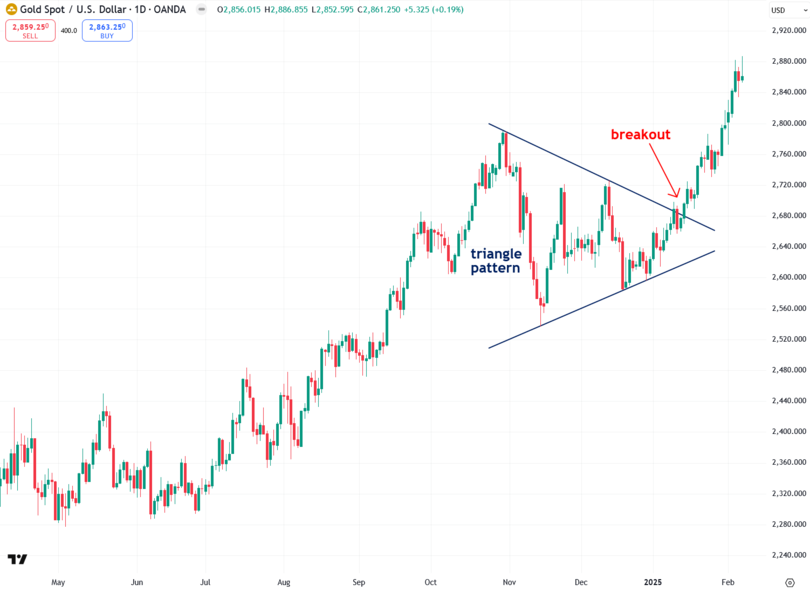
As the chart below illustrates, gold is in a strong bull market and recently broke out:
Another key factor that could drive copper, silver, and gold even higher is a potential decline in the U.S. Dollar Index. Since commodities typically move inversely to the dollar, a decline in the index would provide a strong tailwind for these metals.
Since October, the U.S. Dollar Index has staged an unexpected and powerful rally—largely sparked by the growing realization that Donald Trump would win the U.S. presidential election—which has put significant pressure on copper, silver, and gold.
Now that President Donald Trump is officially in office, there has been a “sell the news” reaction as traders reassess whether the dollar’s sharp surge was overdone.
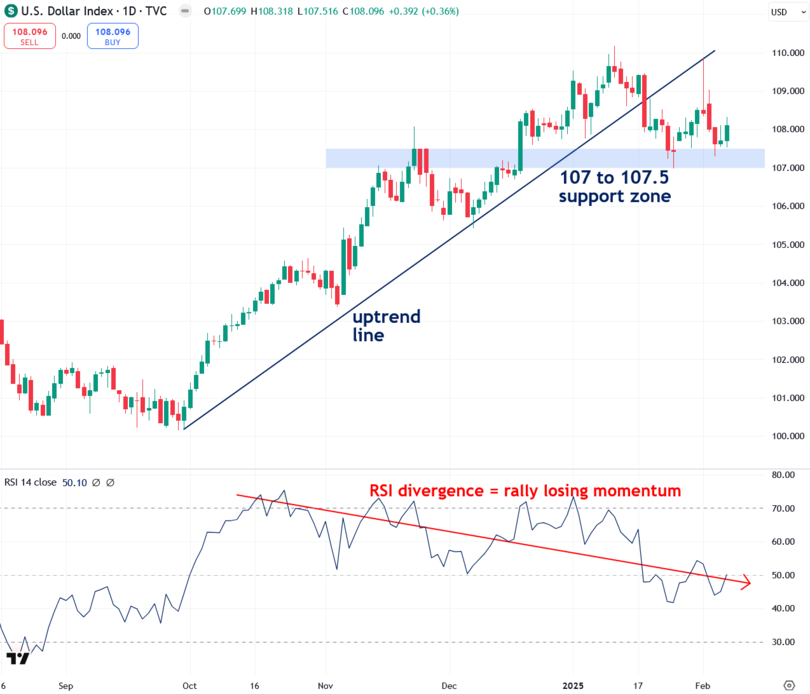
Notably, the Relative Strength Index (RSI)—a widely followed momentum indicator—has shown significant weakening and divergence, a pattern that often precedes pullbacks. The U.S. Dollar Index recently broke below its uptrend line, which had been intact since the rally began in October.
If it decisively closes below the critical 107 to 107.5 support zone, it should signal a deeper decline—an outcome that would send copper, silver, and gold soaring.
With its real estate and stock markets plunging, an estimated $18 trillion in household wealth has been wiped out—an economic crisis akin to China’s version of the 2008 Great Recession.
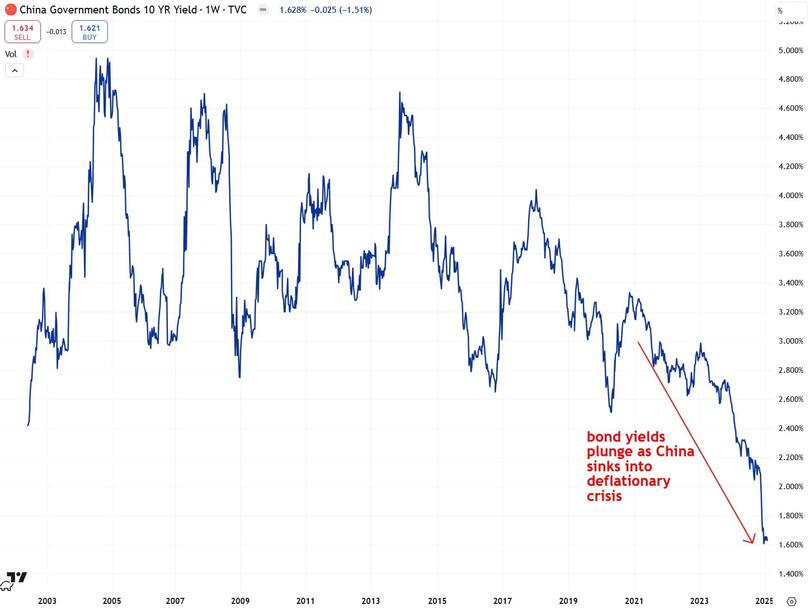
Meanwhile, Chinese government bond yields have collapsed to record lows, signaling a deepening deflationary spiral.
Finally, with all that in mind, let’s turn our focus to silver itself. COMEX silver futures recently broke out of a consolidation pattern that had been forming since early November—a promising bullish signal.
The next key test is securing a strong close above the $32 to $33 resistance zone, which has repeatedly acted as a barrier since May.
In short, copper’s breakout signals further upside for the metal, which bodes well for silver due to their strong correlation.
At the same time, gold remains in a powerful bull market, creating additional support for silver, which tends to take cues from both metals. If the U.S. Dollar Index finally experiences a meaningful pullback, it would provide another major tailwind for all three metals, given their inverse relationship with the dollar.
The final hurdle for silver is a decisive close above the key $33 resistance level—once that happens, a new bull market in silver should be underway.
Jesse Colombo is a financial analyst and investor writing on macro-economics and precious metals markets. Recognized by The Times of London, he has built a reputation for warning about economic bubbles and future financial crises. An advocate for free markets and sound money, Colombo was also named one of LinkedIn’s Top Voices in Economy & Finance. His Substack can be accessed here.
(Clint Siegner, Money Metals News Service) Traders with an obligation to deliver physical bars in the U.S. have found the available inventory is in short supply. They have been rushing to import supplies from London and/or paying hefty premiums to secure the bars they need. Others have been capitalizing on arbitrage opportunities.
A premium first appeared in December in trades called Exchange of Futures for Physical (EFP). The premiums have mostly been driven by the possibility of new tariffs on metals being imported to the U.S.
Since then, at least seventy-five tons of London silver and 5 tons of London gold have exited LBMA vaults.
Most of that was transferred to COMEX vaults here in the U.S.
The silver transfer is particularly significant as it represents about 10% of the total remaining LBMA stocks.
President Donald Trump delayed the implementation of 25% tariffs on Canadian and Mexican imports for at least a month, but the above dynamic persists.
In fact, the crunch for inventory appears to have bled over into gold and silver Exchange Traded Funds (ETFs). Fees for borrowing shares of both the GLD and the SLV exploded higher over the last week.
The unprecedented spike in these borrowing costs is connected with the extraordinary rise in premiums for EFPs (Exchange For Physical). The root cause of both is the high demand for commercial gold and silver bars to deliver to the U.S.
More specifically, the cost to borrow SLV shares, which is normally about 0.5% annualized, reached 12% on Friday. The previous all-time high was 7% for a brief period in 2022. The number of shares available to borrow is now a paltry 10,000, down from about 10 million a week prior.
Oftentimes, rising demand for shares to borrow is a signal that speculators are expecting share prices to fall.
They normally borrow shares to sell them short, intending to repurchase shares at a lower price later to return to the lender.
However, the current interest in borrowing GLD and SLV is something different this time. There are almost no shares available to borrow despite the fact shareholders can collect an all-time high fee for lending – without giving up their long position.
The demand for shares to borrow is likely coming from Authorized Participants (APs) rather than speculative shorts and hedgers. The APs for SLV and GLD are large banks and brokerages, including the bullion banks.
The APs are the only parties involved with an ETF that are allowed to redeem baskets of shares for the physical bars held by the ETF.
These APs can redeem a basket of 50,000 SLV shares for a pro-rata share of physical silver bars. Upon redemption, the shares are canceled, and the total number of shares outstanding is reduced by 50,000.
The current cost to borrow shares relative to the available premium in an EFP trade makes borrowing shares to capture the premium unprofitable unless the borrowing rate falls quickly.
It’s worth noting that borrowing ETF shares for the purpose of redemption does not put downward pressure on the share price, as opposed to borrowing to sell the shares short.
In fact, redemption of borrowed shares could eventually lead to upward pressure on the price. The borrower of the shares is still on the hook with the lender and will need to come up with different shares to return – one way or another.
Ronan Manly with Bullion Brief reports that the shrinking inventories in London are impacting markets.
The spikes in premiums and extraordinary borrowing costs may be temporary. They should go away once the questions over tariffs are answered and prices force a new equilibrium between supply and demand.
If there is a serious shortage of inventory, though, the price of gold and silver may need to go significantly higher.
Clint Siegner is a Director at Money Metals Exchange, a precious metals dealer recently named “Best in the USA” by an independent global ratings group. A graduate of Linfield College in Oregon, Siegner puts his experience in business management along with his passion for personal liberty, limited government, and honest money into the development of Money Metals’ brand and reach. This includes writing extensively on the bullion markets and their intersection with policy and world affairs.
(Mike Maharrey, Money Metals News Service) As gold continues to surge, two big banks have raised their gold price forecasts to $3,000, citing the threat of trade wars and geopolitical uncertainty.
Citigroup analysts now expect gold to top $3,000 in the next three months, up from their previous $2,800 forecast. The bank also raised its average 2025 price forecast to $2,900.
“The gold bull market looks set to continue under Trump 2.0 with trade wars and geopolitical tensions reinforcing the reserve diversification/de-dollarization trend and supporting emerging market (EM) official sector gold demand.”
Citigroup analysts remain bullish on gold despite dollar strength. They said a strong greenback will incentivize central banks to hold more gold to support their own currencies.
Official central bank gold buying topped 1,000 tonnes for the third straight year in 2024, driven primarily by emerging market banks. The World Gold Council said that despite 15 straight years of increasing global gold reserves, “their hunger for gold shows no sign of being quelled.”
“Geopolitical and economic uncertainty remains high in 2025, and it seems as likely as ever that central banks will once again turn to gold as a stable strategic asset.”
As for tariffs, Citi analysts do not expect gold or silver to be included in any blanket tariffs at least through the first half of the year, but they acknowledged the risk of a spike in U.S. premiums if the metals aren’t explicitly exempted in communications about broad-based tariffs.
Citi analysts say a clear resolution to the tariff issue and an easing of geopolitical tensions could create some buying opportunities.
“A Russia/Ukraine peace deal, and confirmation of whether gold would be exempt from broad tariffs (or not), could provide a buying opportunity over the next 2-3 months.”
Swiss Bank UBS also raised its gold price forecast to $3,000. The spot price has already eclipsed its initial forecast of $2,850.
“While we acknowledge the current spot price of $2,870/oz is above our fair-value estimate, gold’s enduring appeal as a store of value and hedge against uncertainty has again proven itself.”
Given the market dynamics, these big bank analysts might actually be understating the strength of the bulls. As analyst Brien Lundin put it, “Gold seemingly ‘wants’ to go higher.”
“A powerful sign of a bull market is when seemingly bearish news or data is instead interpreted bullishly by investors. As I’ve said numerous times over the years, and particularly over the course of this one-year-old gold rally, it’s instances like these when gold seemingly ‘wants’ to go higher. That’s just where we are now — at a time when even a strong dollar or rising Treasury yields can’t deter gold’s upward trajectory.”
There may also be some factors the mainstream analysts are missing. For instance, UBS and Citigroup analysts did not focus on inflation expectations in their analysis, but this could be another phenomenon driving gold higher. In the U.S., CPI has nudged upward for three straight months.
U.S. consumers’ 12-month inflation expectations jumped to 4.3 percent in February, the highest level since November 2023, according to the University of Michigan’s monthly consumer sentiment survey. Analyst Jesse Colombo pointed out that the 1.7 percentage point surge over the past three months is the sharpest increase in inflation expectations since February 2020.
Meanwhile, the Fed has eased its monetary policy.
We’re already seeing inflationary pressure manifest in the increasing money supply.
The M2 money supply bottomed a little over a year ago at $20.60 trillion. Since then, it has crept upward. As of December, it was at 21.5 trillion. That’s the highest level since October 2022.
The money supply rose by 0.4 percent in December alone. This represents an annual monetary inflation rate of nearly 5 percent.
And yet, despite not factoring in these dynamics, there is still growing bullishness for gold in the mainstream.
Mike Maharrey is a journalist and market analyst for MoneyMetals.com with over a decade of experience in precious metals. He holds a BS in accounting from the University of Kentucky and a BA in journalism from the University of South Florida.
(Mike Maharrey, Money Metals News Service) The Super Bowl may be one of the most popular sporting contests in the world. In 2024, over 120 million people tuned into the game.
I have to say, for such a big event, the trophy awarded to the winner is rather pedestrian. I mean, isn’t the goal in sports to “go for the gold?”
Well, not in the NFL.
It’s all about the silver.
The Philadelphia Eagles dominated the Kansas City Chiefs to capture the Lombardi Trophy, giving MVP quarterback Jalen Hurts an opportunity to hoist it for the first time.
The Lombardi Trophy looks impressive. It stands just under 2 feet tall and weighs in at about 7 pounds. It features a regulation-sized football on a pedestal.
The trophy is formed out of sterling silver. Sterling is an alloy containing 92.5 percent by weight of silver and 7.5 percent by weight of other metals, usually copper.
A Lombardi trophy is valued at around $10,000. That’s mostly because — well — it’s the Lombardi Trophy. If you melted the trophy down, you’d get about 93.5 troy ounces of pure silver. At the current price of silver, that’s worth just over $2,990.
The value of last year’s trophy was around $2,111, based on the price of silver at the time of the game. That just goes to show that despite the prevailing sense that silver underperformed last year, it hasn’t exactly been a slouch.
Now, imagine if the trophy was made of gold. At just over 102 troy ounces, it would be worth over $292,900 at the current gold price.
The Lombardi Trophy was designed by Tiffany & Co. According to The Sporting News, company VP Oscar Riedener sketched out the design for the trophy on a napkin for NFL commissioner Pete Rozelle back in 1966.
The first Lombardi was awarded in 1967, and all of the Super Bowl trophies have been produced in Tiffany’s hollowware workshop in Cumberland, Rhode Island.
The trophy is hand-crafted, and it takes about 72 total hours of labor. Sterling silver must be heated to over 1,000 degrees to mold it into the trophy’s distinctive shape.
Interestingly, there is more than one Lombardi produced each year. The official trophy is awarded to the winning team, but Tiffany also produces several authorized replicas. Players on the winning team can even order one to take home.
When I said the trophy is rather pedestrian, I didn’t mean to denigrate it. It’s certainly pretty cool. But compared to other professional sports trophies…
Don’t get me wrong; winning a Lombardi would be amazing, but if you want to win a more valuable trophy and take home a lot more silver, you should take up ice hockey.
The Stanley Cup has an estimated value of $600,000. The cup itself is pure silver, and the base is made of sterling silver (.925 fine). The Stanley Cup weighs in at 34.5 pounds.
And how can you win the most valuable trophy in sports?
Play soccer.
The FIFA World Cup trophy is formed from solid 18-karat gold with a weight of over 11 pounds. The melt value of the gold itself comes in at well over $100,000, but the estimated value of the trophy is over $20 million.
Of course, these trophies all have subjective value because of what they represent. It takes tremendous discipline, dedication, blood, sweat, and tears to win a championship. But even if you don’t play sports, you can still enjoy owning gold and silver.
Mike Maharrey is a journalist and market analyst for MoneyMetals.com with over a decade of experience in precious metals. He holds a BS in accounting from the University of Kentucky and a BA in journalism from the University of South Florida.
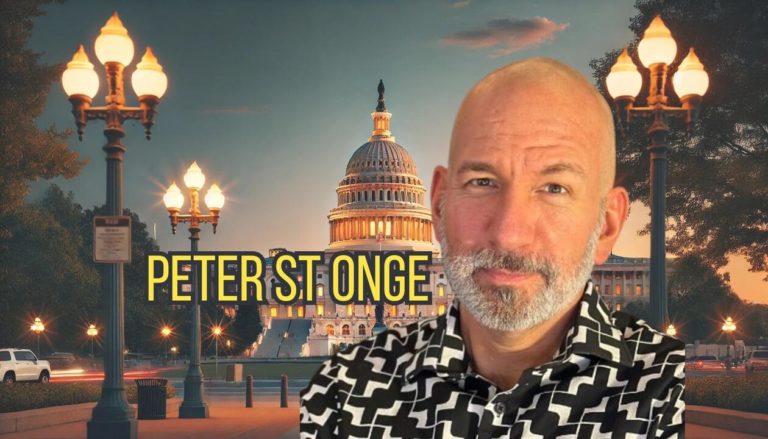
(Money Metals News Service) In a recent interview on the Money Metals podcast, host Mike Maharrey sat down with economist and internet personality Dr. Peter St. Onge to discuss pressing issues surrounding U.S. national debt, government spending, and economic recovery strategies under the current administration. The conversation shed light on the alarming fiscal trajectory of the United States and potential solutions to avoid economic collapse.
(Interview Starts Around 3:19 Mark)
The Burden of National Debt
Peter St. Onge painted a sobering picture of the U.S. fiscal state. The national debt stands at $36 trillion, with $1.2 trillion in annual interest payments—equivalent to the entire federal budget during Bill Clinton’s presidency. Coupled with annual budget deficits nearing $2 trillion, projections suggest that the debt could climb to between $50 and $75 trillion within decades. St. Onge warned that such fiscal mismanagement could push the U.S. economy into a prolonged decline, similar to Argentina’s transformation from a prosperous nation to one plagued by poverty and economic instability.
“Countries don’t default because they can’t pay; they default when political leaders decide to shift the blame to foreign creditors,” St. Onge explained, pointing to Greece’s 2011 crisis as an example. He emphasized that with enough political momentum, the U.S. could theoretically erase $26 trillion of debt through selective default, but this would come at the cost of banking system collapse.
Political Will and the Challenges of Reform
Despite the dire situation, St. Onge expressed cautious optimism about recent political shifts. He noted that ongoing initiatives, such as efforts to audit and cut wasteful federal programs, could provide meaningful fiscal relief.
According to St. Onge, agencies like the Department of Education are under scrutiny, with possible budget reductions in the pipeline. The economist highlighted that the U.S. government spends over half a trillion dollars monthly, much of it going to programs that do little to benefit taxpayers.
He believes that the anti-establishment movement, symbolized by figures like Elon Musk, could finally lead to real government reform. Musk’s forensic approach to uncovering wasteful spending, including fraud and unauthorized payments, has already revealed opportunities for cutting billions without requiring congressional approval. St. Onge speculated that these efforts could result in defunding politically entrenched organizations that have long relied on federal subsidies.
Trump’s Economic Strategy: A Path Forward?
Turning to the potential for economic growth, St. Onge praised former President Donald Trump’s focus on regulatory and tax reform. If successful, a reduction in red tape and corporate taxes could incentivize domestic manufacturing, countering the reliance on foreign imports. St. Onge cited Trump’s previous tariffs as an effective, albeit misunderstood, policy tool. While tariffs raise prices on targeted goods, many of the costs are absorbed by foreign exporters through currency devaluation or direct subsidies from their governments. For example, China and Canada adjusted their currency policies to offset the impact of U.S. tariffs.
St. Onge emphasized that the key to reversing the U.S. debt crisis lies in sustained federal spending cuts. “To step back from the fiscal cliff, we need to reduce spending by at least $1 trillion annually,” he argued. While this won’t eliminate the deficit, it would allow economic growth to outpace debt accumulation, stabilizing the country’s financial future.
Inflation, Tariffs, and the Federal Reserve
The conversation also touched on inflation, a persistent concern for both investors and consumers. Maharrey observed that investment in physical gold and silver has declined since the election, possibly due to growing optimism about the economy. However, St. Onge cautioned that the Federal Reserve’s previous money-printing policies have left an inflationary overhang of 10-15% that has yet to manifest fully.
St. Onge explained that as the economy improves, increased lending and investment could unlock this dormant inflation. He stressed the importance of reducing federal competition for resources—such as steel and labor—through spending cuts. Without these cuts, the private sector’s resurgence could trigger further price increases.
A Tumor on the Economy
Both Maharrey and St. Onge agreed that the government’s outsized role in the economy acts like a “tumor,” crowding out private sector growth. St. Onge underscored that federal spending often supports unproductive initiatives, contrasting with private investment that creates jobs, builds infrastructure, and drives innovation. He concluded that shrinking the federal government is essential to unleashing the full potential of the U.S. economy.
Looking Ahead
St. Onge anticipates that the next few years will be turbulent but potentially transformative. “It’s going to be a crazy four years,” he remarked, noting that ongoing reform efforts could significantly alter the U.S. economic landscape. As watchdog initiatives like Musk’s DOGE program continue to expose inefficiencies, there may be new opportunities to reduce debt, cut wasteful spending, and foster sustainable growth.
Listeners can follow Peter St. Onge’s work on X (@profstonge), where he provides daily economic commentary. He also offers a weekly newsletter and podcast that delve into historical and contemporary economic issues with a focus on freedom and fiscal responsibility.
Key Questions & Answers
The following are the key questions and answers from the Money Metals podcast with host Mike Maharrey interviewing economist and internet personality Dr. Peter St. Onge:
What are “they” trying to do to us according to Peter St. Onge?
Peter St. Onge explained that organized political forces, particularly on the left, aim to increase their power by using taxpayer money to fund activists and agendas. He characterized this as a long-term trend aimed at undermining individual liberties and controlling economic resources.
Why does the national debt matter?
St. Onge emphasized two critical aspects of the debt: day-to-day management and long-term consequences.
The national debt stands at $36 trillion, with $1.2 trillion in annual interest payments, a figure comparable to the entire federal budget during Bill Clinton’s presidency.
The U.S. faces annual deficits of $2 trillion, leading to projections of $50 to $75 trillion in debt.
St. Onge warned that uncontrolled debt will crowd out private sector activity, potentially driving the U.S. economy into a state of prolonged decline, similar to Argentina’s economic collapse.
While the U.S. has the capacity to repay this debt, there is a growing risk that political leaders could pursue default as a politically expedient solution.
Why don’t Americans seem more concerned about the national debt?
St. Onge suggested that many Americans do not take the debt seriously because they do not expect it to be repaid. He pointed to the 2011 Greek debt crisis, where political leaders gained support by blaming foreign creditors and threatening to default. He warned that a similar scenario could unfold in the U.S. if populist politicians frame default as a way to punish Wall Street and foreign creditors.
Can Congress and the administration make meaningful spending cuts?
St. Onge expressed cautious optimism that recent efforts to reduce federal waste might succeed, particularly under pressure from figures like Elon Musk, who has exposed inefficiencies through data analysis. However, St. Onge noted that previous reform efforts often failed because they were led by Washington insiders unwilling to challenge the system.
He pointed to Musk’s DOGE initiative, which has already identified billions in fraudulent or wasteful payments. St. Onge believes such efforts could help defund politically entrenched organizations and reduce spending by hundreds of billions annually.
How do tariffs affect inflation and prices?
St. Onge acknowledged that tariffs can mechanically raise prices on specific goods, such as avocados or Chinese toys. However, he argued that other factors, such as currency devaluation or reduced corporate profits, often offset these price increases.
For example, when Trump imposed tariffs on China, approximately 80% of the costs were absorbed by Chinese exporters or the Chinese government.
St. Onge emphasized that real inflation stems from money creation rather than tariffs. He pointed out that, in many cases, the overall economic impact of tariffs is minimal when compared to monetary policy and other macroeconomic factors.
What is the Federal Reserve’s role in the current inflationary environment?
St. Onge explained that the Federal Reserve has temporarily restrained inflation by raising interest rates. However, there is still a 10-15% inflationary overhang due to excess money printing during the COVID-19 era. He warned that as the economy improves and bank lending increases, this inflation could resurface unless the federal government reduces spending.
What are the key obstacles to economic growth?
St. Onge argued that the federal government is a major barrier to economic growth, likening it to a “tumor” that crowds out productive private sector activity. Government spending competes with private investment for resources, driving up costs for construction, labor, and materials. He stressed the need to shrink the federal government to allow the real economy to flourish.
What are the prospects for U.S. manufacturing growth under Trump’s policies?
St. Onge noted that Trump’s focus on regulatory and tax cuts could attract manufacturing back to the U.S.
Countries like China and Germany face high energy costs and regulatory burdens, making the U.S. a more attractive location for production.
St. Onge cited reports that companies such as Audi are already considering U.S. factories to avoid tariffs and benefit from lower production costs.
He believes that if the U.S. achieves a 15% corporate tax rate and reduces red tape, foreign and domestic manufacturers will move operations to the U.S., boosting economic growth.
What is Peter St. Onge’s outlook for the next few years?
St. Onge predicted that the next four years would be politically and economically volatile. However, he expressed optimism that ongoing reform efforts could stabilize the U.S. economy by cutting wasteful spending and encouraging private sector growth. He emphasized that reducing federal spending by at least $1 trillion annually is necessary to prevent fiscal collapse and control inflation.
Where can people follow Peter St. Onge’s work?
St. Onge is active on X (formerly Twitter) under the handle @profstonge, where he shares daily economic commentary. He also offers a free weekly newsletter and podcast that provide deeper insights into economic history, government policy, and personal freedom.
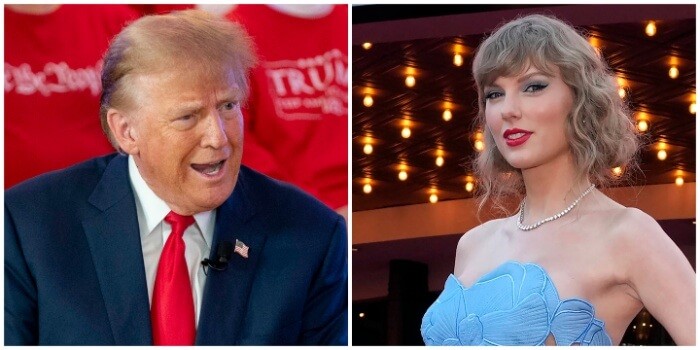
Meanwhile, Trump received praise when he was shown on the Jumbotron during the national anthem.
“The only one that had a tougher night than the Kansas City Chiefs was Taylor Swift,” Trump wrote on Truth Social. “She got BOOED out of the Stadium. MAGA is very unforgiving!”
He also shared two videos, showing how he was cheered while Swift was booed.
The now-viral clip showed the Cruel Summer singer looking perplexed over the crowd’s negative reaction.
Swift appeared to ask singer Ice Spice “What’s going on?” during the incident, according to the New York Post.
Social media users quickly expressed their joy over the singer not receiving a warm welcome.
“That tracks why her endorsement made it worse for Kamala,” one user wrote.
Swift previously decided to throw her support behind former Vice President Kamala Harris when she ran for the presidency. The Blank Space singer posted a lengthy Instagram post, where she referred to herself as a “Childless Cat Lady.”
Others noted the drastic contrast between Trump and Swift.
The crowd erupts for President @realDonaldTrump when he appears on the screen,” a user wrote. “And nothing but loud boos for Taylor Swift. Is… America back?
Wow.
Take a listen to the difference.
I’ve included both in this post for comparison
The crowd erupts for President @realDonaldTrump when he appears on the screen.
Swift was at the game to support her boyfriend Travis Kelce, who is the tight end for the Kansas City Chiefs. The Chiefs suffered a blowout loss to the Philadelphia Eagles.
Prior to the Super Bowl, Kelce said he was looking forward to playing in from of a sitting president.
He called it a “great honor” during the interview.
“I think you know, no matter who the president is, I know I’m excited because it’s the biggest game of my life, you know, and having the president there—it’s the best country in the world—and that’s pretty cool,” he elaborated.
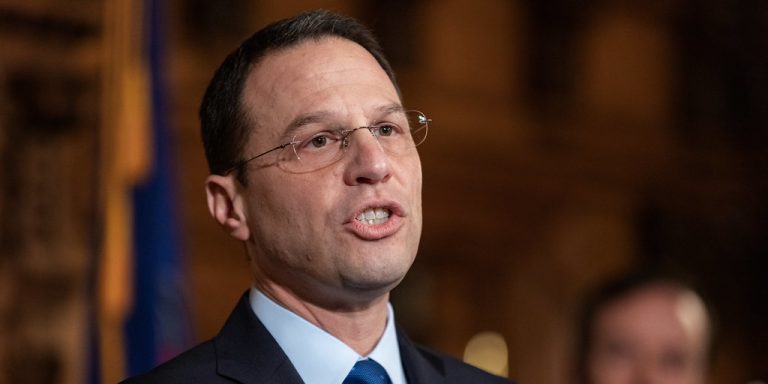
(Ken Silva, Headline USA) As much of the world was watching the Super Bowl on Sunday, a wild rumor was spreading online that Pennsylvania Gov. Josh Shapiro was involved in the July 13 assassination attempt against Donald Trump.
“Trump learned today a Federal Whistleblower and former PA State Police employee has come forward with information … allegedly linking [Shapiro] with the assassination attempt in Butler,” a Facebook post from an account named “Pennsylvania Arrest Warrants” stated.
The Facebook post cited a “private criminal complaint,” which alleged that Shapiro “organized, schemed, and conspired with other officials to carry out the attempted assassination.”
Other documents circulating online Sunday included a Feb. 7 criminal complaint filed by someone named Hadassah Feinberg, as well as a Aug. 22, 2024, letter from Butler District Attorney Richard Goldinger, in which he declined to pursue a similar complaint against Shapiro.
However, there was no actual evidence presented that links Shapiro to the July 13 attempt. Nor was there any evidence that DA Goldinger or any other Pennsylvania officials were taking such allegations seriously.
I reached out to Butler DA Richard Goldinger about this. He told me he did receive a complaint, but that he has absolutely no evidence that Gov. Shapiro was involved. https://t.co/C12IdS9Rcdpic.twitter.com/DCP3lJA3hy
Goldinger confirmed in an email to Headline USA that he did receive a criminal complaint against Shapiro, but that he has no evidence of Shapiro’s involvement.
“While I did not know the history of the person making the complaint, I found the allegations to be unbelievable. That being said, with the multiple investigations that were occurring, including by the Pennsylvania State Police and the FBI, I disapproved the complaint, relying on the fact there were multiple investigations underway,” he said.
“As of this date, there has been nothing uncovered in the investigation that would even remotely support the allegations in this private criminal complaint.”
Goldinger further explained that private citizens file criminal complaints frequently, and that their allegations are mostly retaliatory, false, or unsubstantiated and unprovable.
Usually, he still has a detective conduct an initial investigation to see if the complaint has merit. But in the case of the Butler Trump shooting, he said he declined to do so because the matter was already under investigation by multiple agencies.
“Generally, when I receive one, I have a county detective conduct some initial investigation to determine if there is any merit. I am always of the opinion that if the police do not file charges, or if the individual filing the private criminal complaint has not reached out to the police, that the allegations are questionable, at best,” he said.
Headline USA also contacted Feinberg, the person named on the Feb. 7 criminal complaint against Shapiro. Feinberg identifies herself as someone with PTSD who’s living on Social Security benefits.
Feinberg is representing herself in several lawsuits alleging a wide-ranging conspiracy against her and her four children. One complaint, which was dismissed last October because she didn’t pay her filing fee, accused Shapiro of failing his duties as governor “to protect and intervene with Plaintiff and her four minor children who were being harassed … between October 18, 203, through June 4, 2024.”
In response to an email from this reporter, Feinberg stated the following: “Thank you for reaching out. I can confirm that this is a valid criminal complaint. Due to pending and active litigation at the Pennsylvania Commonwealth Court docket Feinberg et al v Evan’s et al 402 MD 2024, a lot of the information must remain confidential so it does not compromise the lawsuit.”
Ken Silva is a staff writer at Headline USA. Follow him at x.com/jd_cashless.
This story was updated to reflect the response from the person who filed the complaint against Shapiro.
“I’m entitled to know,” Trump told The Post. “I want to find out about the two assassins … Why did the one guy have six cell phones and why did the other guy have [foreign] apps? No more holding back because of Biden … I’m entitled to know. And they held it back long enough.”
The Post added that Trump has been briefed on the matter by National Security Adviser Mike Waltz, who sat on the House Task Force that investigated the assassination attempts last year. Waltz has been pushing the dubious claim that Iran might be behind one or more assassination plots against Trump.
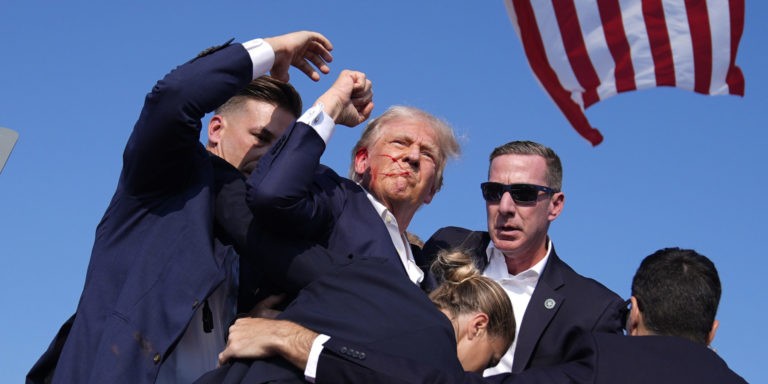
Crooks allegedly grazed Trump’s ear with a bullet at his campaign rally last July, while Routh was caught hiding in the bushes within several feet of Trump on his golf course last September. Crooks was killed by law enforcement, and Routh is awaiting trial for attempted assassination.
Trump’s remarks about the cell phones was in reference to Routh, who in fact was found with 18 cell phones, according to court documents. Crooks had the encrypted accounts Trump spoke of—one apiece in Germany, New Zealand and Belgium.
The information Trump seeks may not be held by the Secret Service, which is now headed by the former leader of his security detail, Sean Curran. The FBI headed the investigations into both Crooks and Routh—withholding information about both from the House Task Force formed last year to investigated the assassination attempts.
Task Force leaders Reps. Mike Kelly, R-Pa., and Jason Crow, D-Co., complained about the FBI stonewalling them when they released their final report last December.
According to the Task Force’s report, the FBI declined to provide any documents about the second, Sept. 15 assassination attempt that occurred at Trump’s Florida golf course—despite the fact that the Task Force’s legal authority was expanded to investigate that case, too.
Nor did the FBI provide the Task Force with much information about Crooks himself. The Task Force’s report said the FBI provided the Task Force with access to only 81, out of over 1,000, witness interview reports—known as 302s—comprising roughly 180 pages.
In a December interview with Meet the Press, Crow blasted the DOJ’s lack of transparency. He said Congress should have the right to review evidence from a criminal investigation in a private setting where the information can’t be leaked. He said he regularly receives briefs on military and intelligence operations under the same conditions.
Ken Silva is a staff writer at Headline USA. Follow him at x.com/jd_cashless.